
Ask are prop firms legit and you deserve a straight answer rather than a sales pitch. The funded-account industry is real, and traders do collect real payouts from it.
Still, that question deserves its other half. This guide stays firm-neutral and walks through the sound mechanics and the genuine conflicts, so you can judge any single program yourself.
Are Prop Firms Legit, the Short Answer
The model itself holds up. A firm risks its own capital, sets rules to protect it, and shares profit with traders who perform.
Payouts happen every month across the sector. Traders post withdrawal proof, firms publish payout totals, and the money moves.
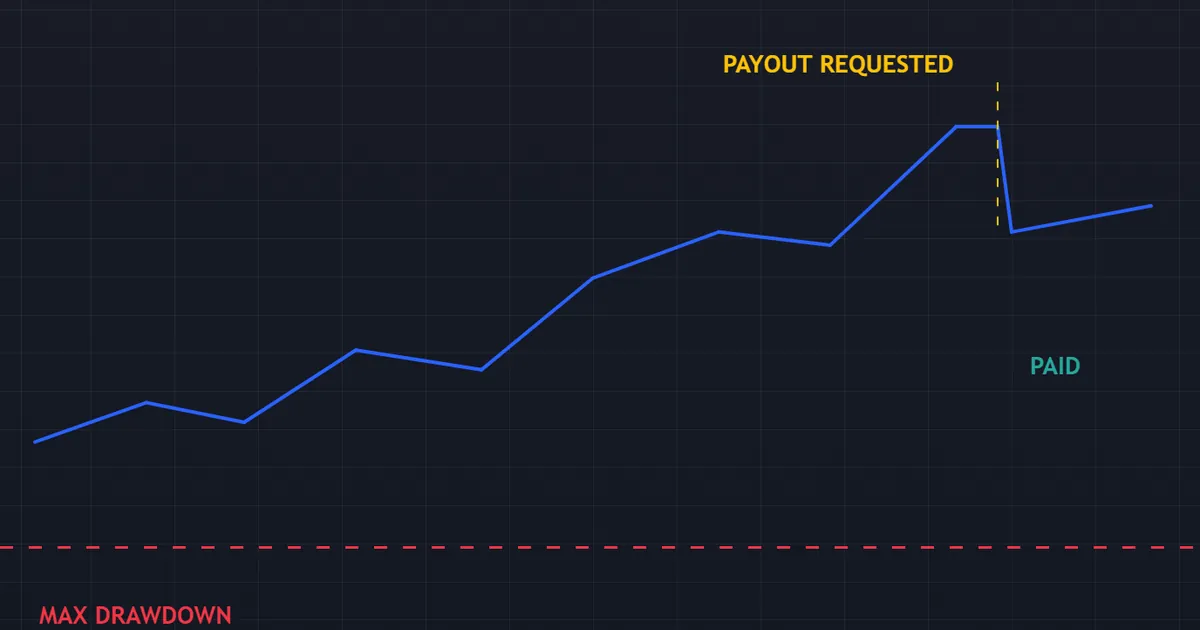
So the honest verdict runs two ways. A workable business model sits underneath, yet the sector also holds weak operators, one-sided terms and very heavy marketing.
Treat this as a per-firm question rather than an industry one. Because quality varies enormously, the useful skill lies in vetting a single program well.
Why the Question Keeps Coming Up
Three things fuel the doubt. Fees arrive before any service, most buyers fail, and many accounts run on simulated feeds.
Add aggressive affiliate marketing and the suspicion grows. So plenty of traders assume a scam where a harsh business model actually sits.
Harsh differs from fraudulent, though. A program that publishes tough rules and then honours them behaves lawfully, even when most buyers lose a fee.
What Legitimate Does Not Mean
Legitimate does not mean easy, and it does not mean safe. You can lose your entry fee at a perfectly honest firm.
Nor does it mean regulated the way a broker gets regulated. Most funded-account programs sell an evaluation service, so the usual client-money protections rarely apply.
So read the word narrowly. A legitimate firm states its rules, applies them evenly, and pays what it owes. Nothing else comes bundled with the label.
The Fee Is Not an Investment
Frame the entry fee correctly and much of the anxiety fades. You buy an attempt, not a stake in anything.
So the fee behaves like a tournament entry or an exam booking. Nothing comes back if you fail, and no clause promises otherwise.
That framing also sets your budget. Because the money leaves for good, spend only what a failed attempt would cost you painlessly. So a trader who cannot afford two attempts should keep practising instead.
How to Use This Article
Skip the urge to rank the sector. Instead, build a checklist you can run against whichever program tempts you next.
Everything below feeds that checklist. So read the mechanics first, then the conflicts, then the red flags, and finish with the quick-reference list.
What Makes the Model Sound
Strip away the marketing and a clear commercial logic remains. Both sides bring something real to the table.
You supply skill and accept a rule set. The firm supplies capital, technology and a payout obligation.
Real Capital Behind Real Payouts
Serious programs hold cash to cover withdrawals. Some hedge trader flow with a broker, while others pay from fee income and reserves.
Either route can work, provided the balance sheet supports it. So ask how a firm funds payouts, since that answer separates a business from a gamble.
Rules That Protect the Capital
Drawdown limits, daily caps and consistency clauses all serve one purpose. They stop a single trader from doing serious damage.
Those limits mirror what any sensible risk desk would impose. Because the same rules protect a private account, a trader who resents them usually needs them most.
A Contract You Can Read
Everything in this arrangement sits in writing. Targets, floors, payout cycles and prohibited behaviour all appear in the terms.
So the contract becomes your protection. A firm that writes clear numbers and then sticks to them hands you something you can hold it to.
Two Sides, One Interest
Both parties want the same outcome on a funded account. Profit pays the trader and the firm at the same moment.
That shared interest starts only after you pass, though. Before then, the firm earns from your fee whatever happens. So the alignment arrives late, which explains much of the friction around the model.
Two Kinds of Program, Two Risk Profiles
The sector splits roughly in two, and the split matters more than any ranking. Age and scale tell you most of what you need.
One group has traded through several market cycles. The other launched last quarter on rented infrastructure.
Established Operators
A long-running program carries a public track record. Thousands of traders have tested its payout desk, and the results sit in forum threads anyone can read.
Scale also brings caution. Because a large operator has a brand to protect, it tends to write clearer rules and settle withdrawals on schedule. So longevity works as a rough proxy for reliability.
New Entrants and White Labels
Launching a program now costs very little. Off-the-shelf dashboards, a broker link and a marketing budget cover most of it.
Low barriers cut both ways. Some newcomers genuinely improve on the incumbents, while others fold within a year and leave payouts unpaid. So treat a young program as unproven rather than dishonest, and keep your first account small.
How to Check a Firm, Step by Step
Vetting a program takes about an hour, and it saves far more than that. Work the list in order.
Nothing here needs insider access. Every item sits in public view, on the firm’s own pages or in trader communities.
- Find the numbers. Profit target, daily cap, maximum drawdown, drawdown type, payout cycle, minimum withdrawal.
- Identify the drawdown type. Static from the starting balance, trailing on equity, or trailing on daily close.
- Read the consistency clause. Look for a stated percentage rather than a vague promise of steady trading.
- Search payout reports. Hunt trader forums for recent withdrawals and for complaints about delays.
- Check the trading model. Ask whether funded accounts route to a live venue or stay on a simulated feed.
- Test support. Send one specific question and judge the speed and clarity of the reply.
Notice that none of those checks involves a ranking site. So gather your own evidence first, then decide.
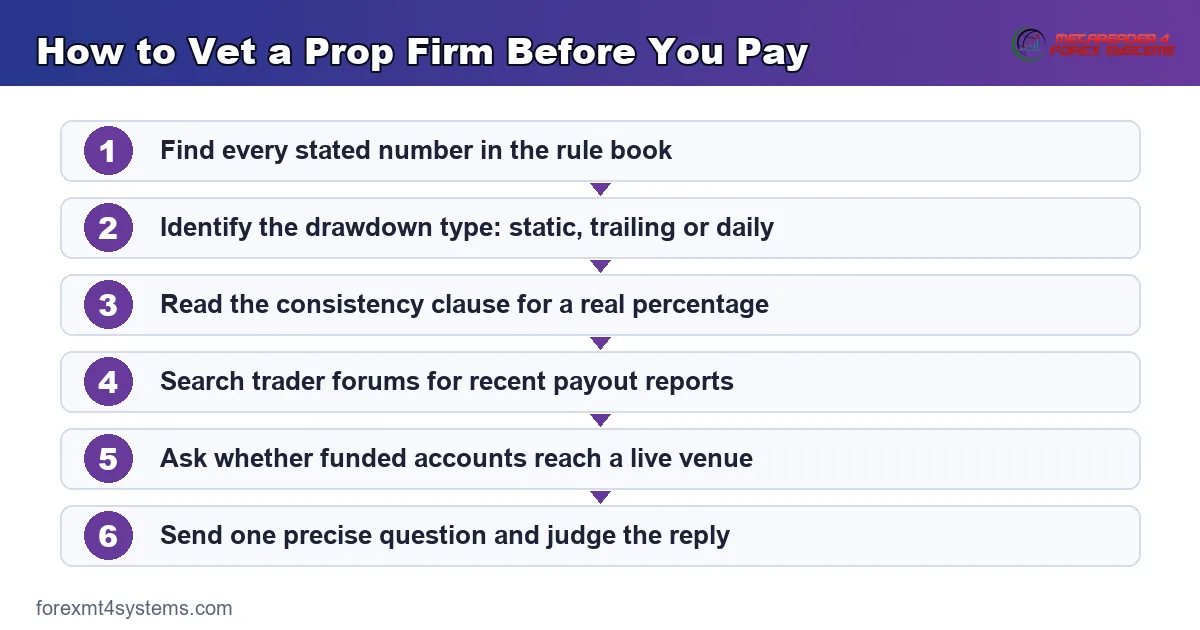
Score each item rather than hunting for perfection. Because almost no program aces every test, a pattern of solid answers matters more than a flawless sheet.
Rules Clarity Comes First
Open the rule book and look for figures. A serious firm states the target, the daily cap, the drawdown type and the payout cycle in plain numbers.
Vague prose signals trouble. Where a clause says only that trading must stay consistent, the firm keeps room to refuse a payout later. So demand percentages.
Payout History Beats Promises
Search trader communities for withdrawal reports on the exact program. Look for volume, recency and any pattern of delay.
A long thread of routine payouts carries real weight. Because a payout problem spreads fast among traders, quiet on that front counts as good news.
Demo Capital Versus Live Capital
Ask whether funded accounts reach a live venue. Many programs run everything on a simulated feed, which stays lawful once the firm discloses it.
The answer shifts your expectations rather than the legality. So look for a clear statement either way, and treat evasion as a warning.
Reading the Trading Restrictions
Rule books also limit how you may trade. Many programs restrict certain automation, copy trading, latency tricks or very short holding times.
Read that section even if you trade by hand. Because a clause on holding time or on news windows can catch an ordinary scalper, it belongs in your plan from day one.
Ask directly where the wording stays fuzzy. So you learn the boundary before a payout request rather than after one, and you keep your method inside it.
Where the Conflicts Really Sit
Sound and conflicted can coexist, and here they do. Name the tensions rather than wishing them away.
Fee income rises when traders fail. Payout obligations rise when traders succeed.
The Fee Incentive
Every breach can produce another sale. So a program gains, in the short run, from limits that bite hard.
Watch for rules that seem built to trip a competent trader. A floor that trails unrealised equity, a very tight daily cap or a short deadline all deserve scrutiny.
The Reputation Counterweight
Word travels quickly among traders. A firm that stops paying loses its funnel within weeks, so reputation pushes hard the other way.
That counterweight explains why established programs settle promptly. Because their fee flow depends on visible winners, they guard the payout record carefully.
Regulation and Its Limits
Most funded-account programs sit outside broker regulation. They do not hold client money in the usual sense, so the familiar safeguards rarely attach.
Authorities in several countries have started asking questions about how these programs market themselves. So treat any claim of full regulation with care, and check what a licence actually covers.
Who Carries the Loss
Follow the loss and the structure gets clearer. On a challenge account, your fee covers the downside, since the trading itself costs the firm nothing real.
On a funded account the picture changes. Now a losing run either hits the firm’s hedge or its internal book, so it wants your risk small.
That shift explains why rules tighten rather than relax after you pass. Because real money now sits behind the account, the firm guards it harder. So expect the same limits to feel stricter once the payouts become genuine.
A Worked Example of Due Diligence
Walk one hypothetical check to see the process in motion. Picture a program offering a two-phase challenge on a fifty thousand unit account.
The page states an eight percent target, a five percent daily cap and a ten percent maximum drawdown. Those figures read clearly, which already counts in its favour.
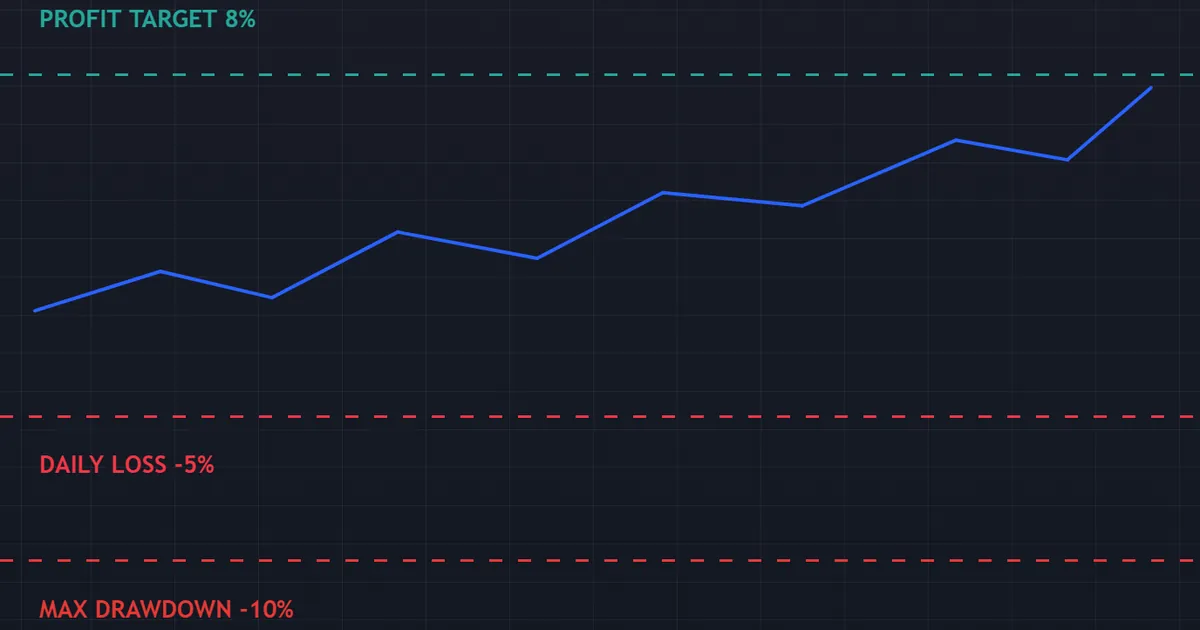
Next you find the drawdown type tucked into a footnote. It trails your highest equity, so the floor climbs whenever you profit.
Turning the Terms Into a Plan
Now the rules become arithmetic. A five percent daily cap and a one percent risk per trade leave room for several losses in one session.
Feed those figures into a tool and the lot size falls out. Try our free prop firm position size calculator to size against the floor rather than the target.
The Questions Left Over
Two items still need answers. You want the payout cycle in days and the minimum withdrawal, both stated on the page.
Send a short support message if either detail hides. Because reply quality predicts payout quality, that message tells you plenty on its own.
Scoring the Program
Add it up. Clear numbers, a disclosed trailing floor, an unclear payout cycle and an untested support desk.
That mix reads as workable but unproven. So a cautious trader would start on the smallest account, request an early withdrawal, and only then scale up.
Write the score down somewhere you can revisit. Because memory blurs after a losing session, a dated note keeps your judgement honest.
Download the complete indicator database
Put these concepts on your charts. One email unlocks the full library of 1,380+ indicators with compiled MT4 and MT5 files, plus my TradingView scripts. No paywall, no spam, unsubscribe any time.
Get free access to my indicator database
One email unlocks 1,380+ free MT4, MT5 and TradingView indicators — the complete library. No single-tool download; you get the whole database.
Common Mistakes When Judging a Firm
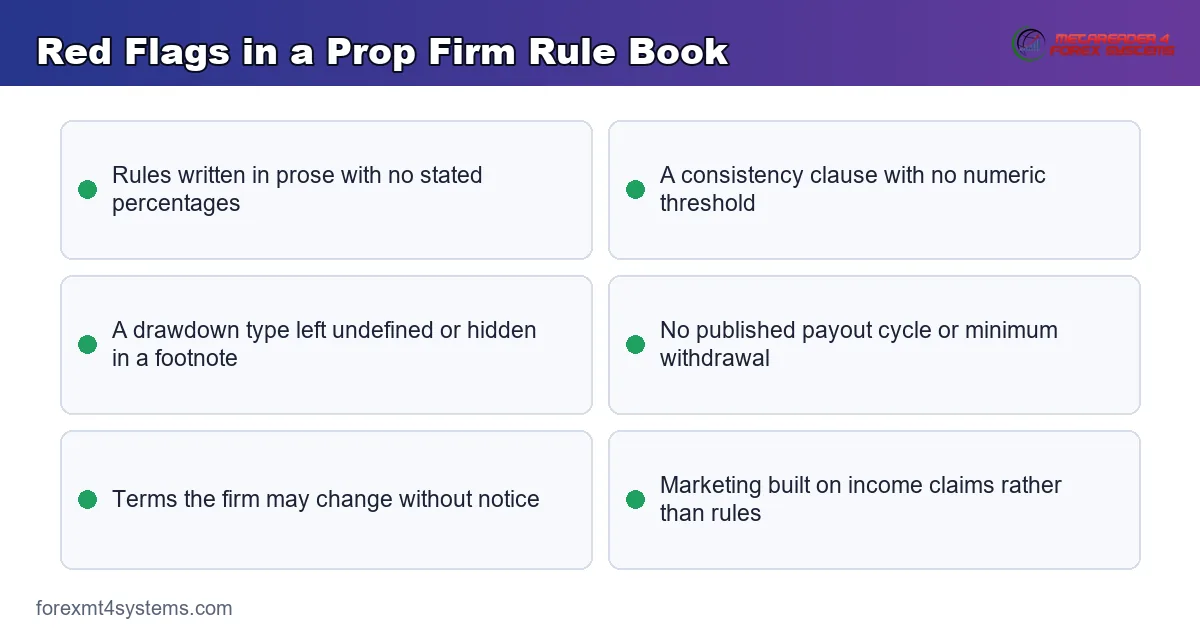
Most bad decisions here come from a shortcut rather than a lack of information. Five errors repeat constantly. The graphic below lists the red flags worth memorising.
Treating Every Program as a Scam
Blanket cynicism costs opportunity. Plenty of firms pay reliably and have done so for years. So judge each program on its rules and its payout record instead of on the label.
Trusting Ranking Sites
Most review pages earn a commission on every referral. Rankings therefore follow payouts to the reviewer, not fairness to traders. So read forums, payout threads and the terms themselves.
Reading the Split Before the Rules
A generous split draws the eye, yet it applies only after you pass. The drawdown terms decide whether you ever reach that stage. So compare rules first and treat the split as a tiebreaker.
Assuming Regulation Applies
Some traders expect broker-style safeguards on a funded account. Those protections usually do not extend to an evaluation service. So read what any stated licence covers before you rely on it.
Blaming the Firm for Your Own Breach
Plenty of complaints trace back to a rule the trader never read. A trailing floor or a minimum-days clause catches people who skimmed. So learn every number by heart, then hold the firm to the same standard.
Ignoring the Trading Restrictions
Automation limits, holding-time clauses and news windows sit in nearly every rule book. Traders who skip that section can void a payout with a perfectly profitable method. So map your style against the restrictions before you pay a fee.
Red Flag Quick Reference
Keep this list beside you while you read any rule book. One clear hit deserves caution, and two deserve a pass.
- Rules written in prose with no stated percentages.
- A consistency clause with no numeric threshold.
- A drawdown type left undefined or buried in a footnote.
- No published payout cycle or minimum withdrawal.
- Forum threads reporting repeated payout delays.
- Terms that the firm may change without notice.
- Support that dodges a direct question about order routing.
- Marketing that leans on income claims rather than rules.
- Trading restrictions written so loosely that any style could breach them.
- A refund or reimbursement promise buried under vague conditions.
Pitfalls and Edge Cases
A few wrinkles catch even careful buyers, so keep them in view. The chart below shows a trailing floor climbing until a partial giveback ends the account.
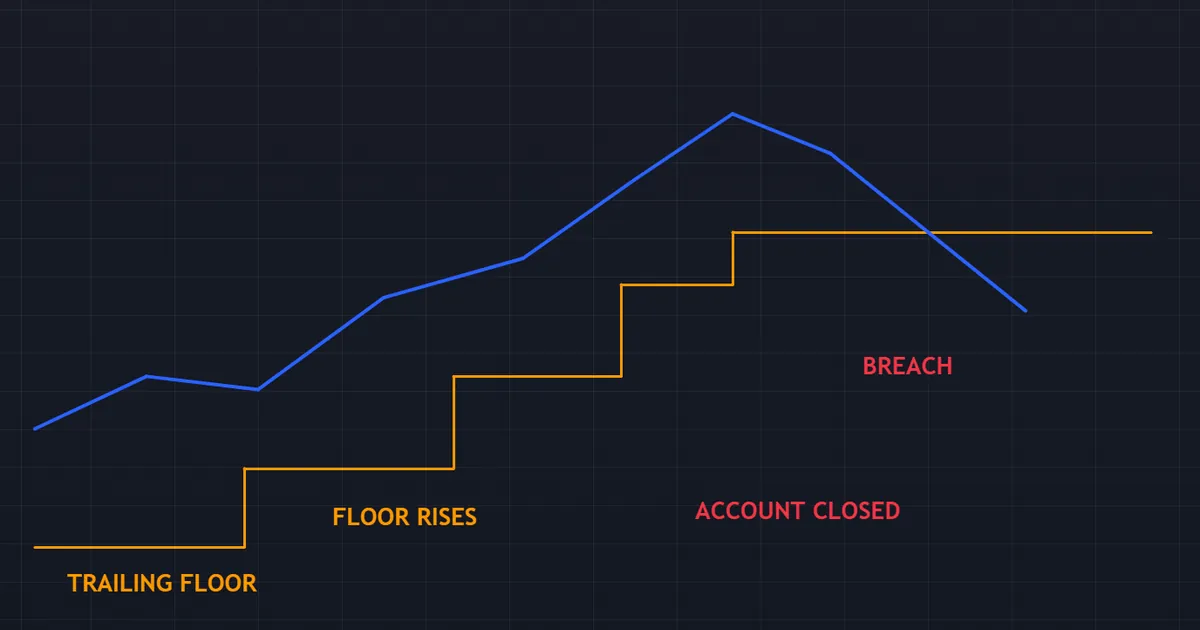
Trailing Floors That Move on Unrealised Profit
Some floors track your highest equity, including profit on open trades. A position that peaks and then retraces can lift the floor and trap you. So confirm whether the floor follows equity or closed balance.
Consistency Clauses Without Numbers
A clause that simply asks for steady trading gives the firm wide discretion. Payout requests then hinge on a judgement call. So insist on a stated percentage before you commit.
Payout Windows That Shift
A cycle advertised as fortnightly can stretch during busy periods. Ask about the worst case rather than the headline. Because cash flow shapes your plans, that detail matters more than most buyers expect.
Sudden Account Reviews
Large or unusual profits can trigger a manual review. Honest firms complete these quickly and explain them. So read the terms on reviews, and keep your trading well inside every stated limit.
Programs That Disappear
New operators sometimes fold and take pending payouts with them. Age and volume offer the best defence you have. So favour a program with a long, dull history over a flashy newcomer.
Copy Trading and Linked Accounts
Many programs forbid mirrored trades across several accounts. Traders who run the same signals on two challenges can lose both at once. So read the clause on account linking before you buy a second attempt.
Refunds With Conditions Attached
Some offers return the entry fee after a first withdrawal. Fine print then narrows that promise to a specific timeframe or account size. So confirm the exact condition rather than trusting the headline.
What This Means for Your Plan
The verdict shapes how you act rather than whether you act. Two habits follow from everything above.
Start Small and Withdraw Early
A first payout tests the whole machine cheaply. Buy the smallest account, trade it carefully, then request a withdrawal as soon as the rules allow.
That single cycle answers most questions. Because a firm either pays or does not, one completed withdrawal beats a hundred reviews. So earn the proof yourself before you scale.
Let the Rules Set Your Size
Every red flag above matters less once you trade small. A modest risk per trade keeps you clear of the floor and away from disputes.
So size from the drawdown, respect the daily cap, and treat the target as a by-product. Because discipline protects you at any firm, it also protects you from the weak ones.
Keep Your Own Records
Save the rule book, the dashboard screenshots and every support reply. A dated archive settles most disputes in a sentence.
Log your trades separately too. Because a firm’s platform can go dark without warning, your own journal becomes the only version you control. So back it up weekly and note the balance at each day’s close.
Related Concepts to Study Next
The verdict lands better once you know the surrounding vocabulary. A short reading list closes the gaps.
Begin with our primer on what is a prop firm, then follow the money in how prop firms make money. Because the terms decide everything, read our guide to prop firm rules and our overview of a funded trading account. For the cash-flow side, study prop firm payouts, respect the floor with our note on drawdown in trading, and measure recovery with our drawdown calculator. More guides sit in our prop trading library.
FAQ
Are prop firms legit or a scam?
The model itself works, and many firms pay traders reliably every month. Quality varies widely across the sector, though, so the label belongs to a single program rather than the industry. Judge each one on rules clarity, payout history and support quality.
Are prop firms regulated?
Most funded-account programs sit outside broker regulation, since they sell an evaluation service rather than hold client money. Some hold licences that cover only part of what they do. So check exactly what any stated licence covers before you rely on it.
Do prop firms actually pay out?
Established programs pay routinely, and trader communities document those withdrawals in detail. Weak or very new operators cause most of the horror stories. So search recent payout threads for the exact program before you buy.
Is the funded account real money?
Both models exist. Plenty of programs keep even funded accounts on a simulated feed and pay withdrawals from company funds, which stays lawful once disclosed. Others route successful traders to live capital, so ask which model applies.
What separates a serious firm from a bad one?
Four things: rules stated as numbers, a defined drawdown type, a published payout cycle, and a long record of paying on time. Add responsive support and you have a workable program. Vague clauses and shifting terms point the other way.
Should a beginner buy a prop firm challenge?
Learn to trade a rule set profitably on a demo first, since a challenge only tests skills you already hold. Start on the smallest account, size from the drawdown floor, and request an early withdrawal to test the firm. Results are not guaranteed; past performance is not indicative of future results.
External references
- For background on this concept, see Financial Regulation on Wikipedia.
- For broader market context, see Due Diligence at Investopedia.

About the author
Written by Dominic Walsh, a Forex trader and MT4/MT5 indicator, Expert Advisor and script developer. Every tool on forexmt4systems.com is tested on live charts before release and ships with ready-to-use compiled MT4 (.ex4) and MT5 (.ex5) files. Learn more about the trader and developer behind this site.
How we build, test and correct every tool: Editorial & Testing Policy. Trading carries risk; see the disclaimer.