
Many new traders ask what is a prop firm after seeing funded-account offers online. A prop firm, short for proprietary trading firm, backs skilled traders with its own capital and shares the profits they earn.
This guide explains what is a prop firm in plain, beginner terms, and it stays firm-neutral throughout. You will follow the modern funded-account model, from the evaluation challenge to the profit split, and see the risk rules that end most accounts.
What Is a Prop Firm, Defined
A proprietary trading firm trades with its own money rather than client funds. It seeks traders who can grow that capital, then splits the resulting profit with them.
So the arrangement is a partnership of sorts. The firm supplies the capital and the rules, while the trader supplies the skill and the discipline.
The trader never deposits large sums to trade. Instead, a modest one-time fee opens an evaluation, and passing it unlocks access to the firm’s capital. So the model lowers the cash barrier that stops many skilled traders from trading a meaningful size on their own.
In return, the firm keeps a share of every profit. It also sets strict limits on losses, since it is the firm’s money at risk. So the rules protect the capital while the split rewards the skill. Both sides only win when the trader trades well and stays inside the limits.
The Modern Funded-Account Model
Traditional prop firms hired traders onto a physical desk. The modern version works online and reaches anyone with an internet connection. This shift is what made prop trading a household topic among retail traders.
Under the modern model, you prove yourself on a simulated account first. Once you pass, the firm grants a funded account under a defined rule set. So the path is open to a far wider pool of traders than the old desk model ever was.
How the Funded-Account Model Works
The model follows a clear sequence, and every firm dresses it up a little differently. At heart, though, the stages rarely change.
You start with an evaluation, then move to a funded stage, then collect a share of the profits. So the journey rewards consistency at each step rather than a single lucky run.
The Steps From Challenge to Payout
Walk the typical path in order. Learn these stages, and any firm’s offer becomes easy to read.
- Challenge. Pay a one-time fee, then hit a profit target while obeying the risk rules.
- Verification. Repeat the discipline on a second phase that confirms the first was not luck.
- Funded stage. Trade the firm’s capital under the same rules, now for real payouts.
- Profit split. Withdraw your agreed share of the profit on a regular schedule.
- Scaling. Earn a larger account over time as you keep trading within the rules.
So the process is a filter as much as a reward. Because the firm only profits when you do, it uses these stages to find traders who last.
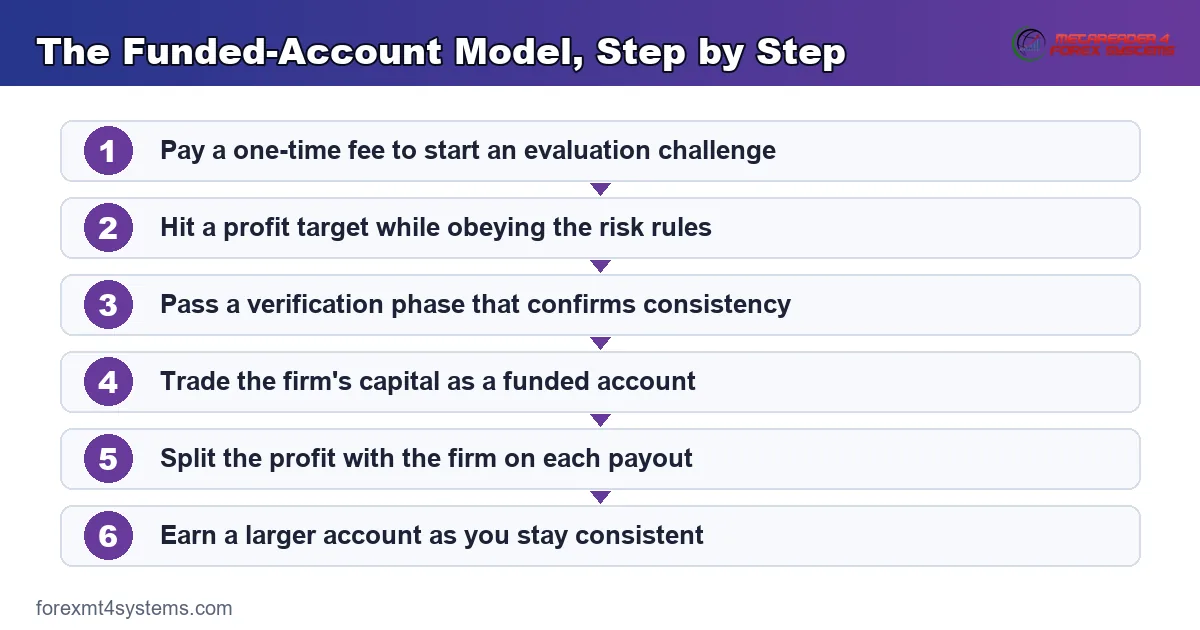
Notice that the early stages use simulated money. The account behaves like a live one, yet the firm is testing your habits before it risks real capital. So the challenge is a rehearsal, not the main act.
How the Profit Split Works
Once funded, you keep an agreed slice of the profit you generate. The firm keeps the rest as its return for supplying the capital and the platform. Splits vary widely, and the trader’s share is often the larger portion.
The split only matters once you pass and stay within the rules. So a generous share means little if the risk limits end the account first. Because survival comes before payout, most experienced traders weigh the rules more heavily than the split. So compare the drawdown and daily limits first, then let the split be a tiebreaker between two firms whose rules you can actually trade.
A Worked Example of the Rules
Numbers make the model concrete, so walk a simple case. Picture a funded account with a three percent daily loss limit and a larger maximum drawdown.
You plan a trade on a major pair near current levels, risking one percent of the account. Your stop sits at a level that caps the loss well inside the daily limit. So even a full stop-out leaves plenty of room before the rule triggers.
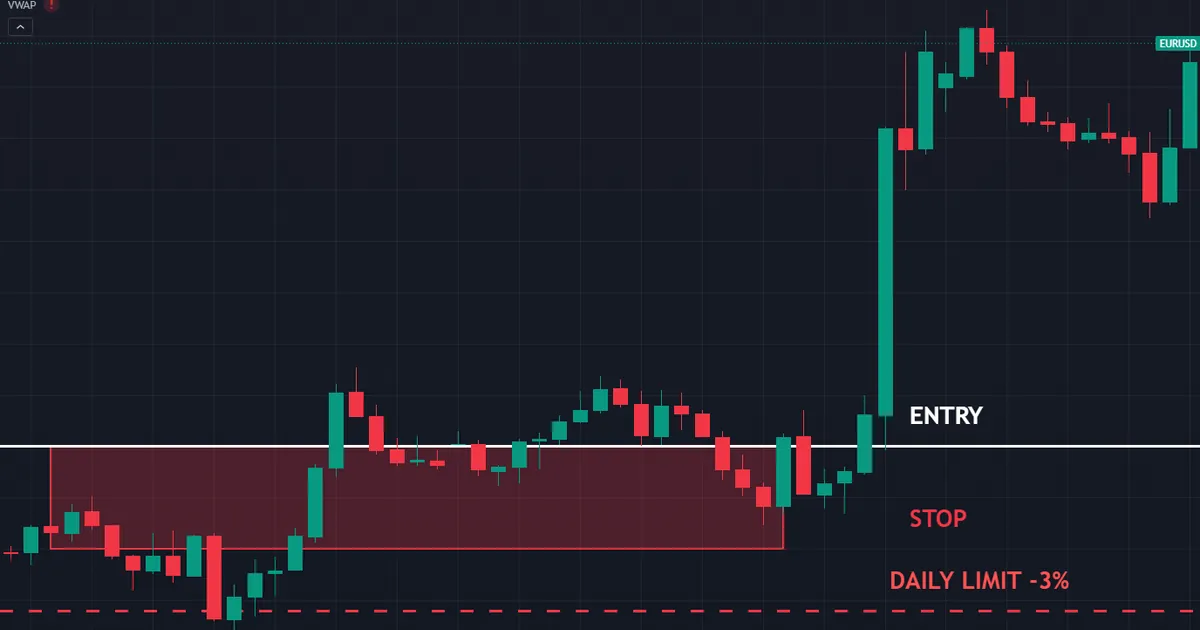
Now suppose the trade loses. You are down one percent on the day, comfortably under the three percent cap. So you can take another measured setup, or simply stop, without any risk of breaching the rule.
Reading the Risk Rules
Feel how the limits shape your sizing. Because the daily cap is three percent, a one percent risk lets you absorb two or three losses before you must stop. So the rule quietly enforces the discipline you should keep anyway.
Contrast that with a reckless five percent risk on the same account. A single loss would leave almost no room, and two would breach the daily limit outright. So the firm’s rules reward the small, steady risk that protects any account.
Download the complete indicator database
Put these concepts on your charts. One email unlocks the full library of 1,380+ indicators with compiled MT4 and MT5 files, plus my TradingView scripts. No paywall, no spam, unsubscribe any time.
Get free access to my indicator database
One email unlocks 1,380+ free MT4, MT5 and TradingView indicators — the complete library. No single-tool download; you get the whole database.
This is why the funded model suits disciplined traders. The rules are not arbitrary hurdles. Instead, they mirror the sound risk habits that keep a private account alive too.
The Risk Rules That End Most Accounts
Most funded accounts do not end from a single bad trade. They end from a broken rule, often one the trader half-understood. So learning the rules matters as much as learning to trade.
Three limits appear at nearly every firm. Master them, and you avoid the traps that catch the majority of new funded traders.
Maximum Drawdown
The maximum drawdown is the deepest loss the account may reach before it closes. Breach it, and the funded account ends regardless of your longer plan. So this figure is the hard floor beneath everything you do.
Some firms measure this drawdown from your starting balance. Others trail it upward as your equity grows, which tightens the floor once you profit. So read carefully whether the limit is fixed or trailing, since the difference is large.
Daily Loss Limit
The daily loss limit caps how much you may lose in a single trading day. Cross it, and the account is suspended for that day or closed outright. So this rule forces you to walk away after a rough session.
The limit is a gift as much as a rule. Because it stops a bad day from becoming a disaster, it protects you from the revenge trading that sinks many accounts. So treat the daily cap as a discipline you would want anyway.
The Consistency Rule
Many firms add a consistency rule to discourage one lucky trade. It asks that no single day account for too large a share of your total profit. So the rule rewards steady work over a single wild swing.
Consistency rules push you toward repeatable trading. Because a jackpot day can fail the rule, you learn to spread profit across many sound trades. So the firm gets a durable trader, and you build a habit that lasts. A tool can check a payout against this rule before you request it, which saves an avoidable rejection.
Two Kinds of Prop Firm
The label prop firm covers two rather different models. Knowing which one you are dealing with sets your expectations correctly.
One is the traditional trading desk, and the other is the online evaluation firm. Both back traders with capital, yet they differ in access, structure, and feel.
Traditional Desk Firms
A traditional prop firm hires traders to sit on a desk, often in a real office. It provides training, capital, and a salary or draw against future profits. So the barrier to entry is skill and an interview, not a fee.
These firms are selective and usually recruit locally. Because seats are limited, they suit traders who can commit to a career path. So the desk model offers depth and mentorship, but reaches far fewer people.
Online Evaluation Firms
The online model opens the door to anyone who can pass an evaluation. You pay a fee, prove yourself on a simulated account, and earn a funded one. So access is broad, and the process runs entirely online.
These firms make the modern funded-account model familiar. Because the fee is modest and the reach is global, they attract a huge retail audience. So most traders asking about prop firms today mean this online kind.
Why Prop Trading Has Grown So Popular
Prop trading was once a closed world of city desks. The online funded-account model tore that door open, and interest exploded among retail traders.
So the appeal is easy to understand. A skilled trader with little capital can suddenly access a large account, provided they can prove their discipline first.
Access Without a Large Deposit
The biggest draw is capital access. Many able traders simply lack the savings to trade a meaningful size. So a modest evaluation fee, rather than a large deposit, becomes the ticket to a funded account.
Because the fee is small next to the account it unlocks, the model attracts a wide audience. So a trader can aim for a larger position than personal savings would ever allow. That leverage of skill over capital is the core attraction.
Capped Personal Downside
The funded model also limits what a trader can personally lose. Your worst case is the evaluation fee, since the firm’s capital carries the trading risk. So the arithmetic feels friendlier than risking your own savings.
Still, the capped downside can breed carelessness. Because the money is not theirs, some traders oversize and breach the rules fast. So the smart approach treats the firm’s capital with the same care you would give your own.
What to Check Before Joining a Firm
Firms vary widely, so a little homework saves money and frustration. A few questions separate a workable program from a costly one.
So read the rule book before you pay, not after your first breach. Because the details decide whether you can trade your natural style, they matter more than any headline number.
The Rule Set and the Drawdown Type
Start with the drawdown, since it is the hard floor. Confirm whether the firm fixes it from your balance or trails it as equity grows. So you know exactly how much room you have after a winning streak.
Then read the daily loss limit and any consistency rule. Because these shape how you size and when you stop, they define your day-to-day trading. So map your usual style against the rules before you commit a single fee.
Costs, Payouts, and Support
Check the evaluation fee and whether a failed attempt requires a fresh one. So you can budget for the real cost of qualifying, not just the sticker price. Because rushing tends to fail, patience often saves several fees.
Look next at the payout schedule and the minimum before you can withdraw. So you understand your cash flow once funded. A responsive support team and clear terms round out a firm worth trusting with your effort.
Common Prop Firm Mistakes and Fixes
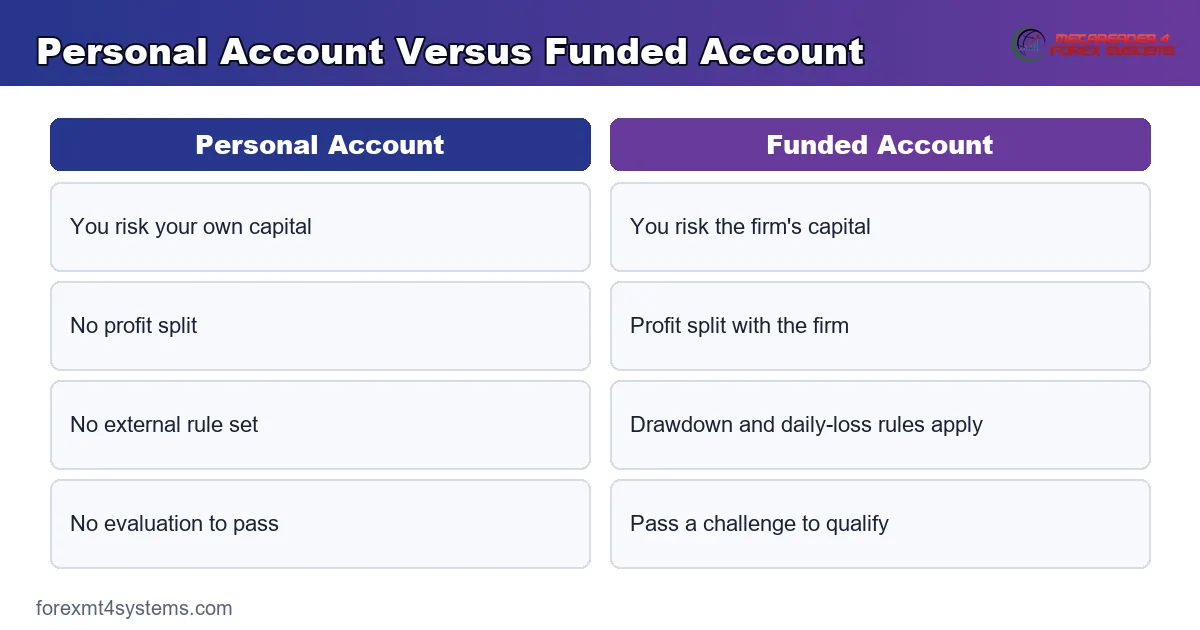
The funded model is straightforward, yet the same errors end account after account. Most trace back to ignoring the rules rather than poor trading. The compare graphic below sets a personal account against a funded one.
Ignoring the Trailing Drawdown
The classic slip is treating a trailing drawdown like a fixed one. As your equity climbs, the floor rises with it, so a giveback can breach the rule. So track the trailing floor after every winning trade, not just the starting balance.
Oversizing to Pass Faster
Some crank the risk to hit the profit target quickly. A single losing streak then breaches the daily or maximum loss rule. So size small, aim for steady gains, and let the target arrive over several sessions.
Trading Right Through News
Fast news moves can jump past a stop and blow through the daily limit in seconds. Many firms even restrict trading around major releases. So check the firm’s news policy, and trade lighter when the calendar is busy.
Chasing a Bad Day
A losing morning tempts some traders into revenge trades. That habit is exactly what the daily loss limit exists to stop. So honor the cap, close the platform, and return the next day with a clear head.
Skipping the Rule Book
Every firm writes its rules a little differently. Traders who skim the fine print often breach a limit they never noticed. So read the full rule set before you pay, and know each figure by heart.
Confusing a Funded Account With a Salary
A funded account is an opportunity, not a salary. The rules can end it, and payouts depend on your results. So treat the account as a serious job with real risk, and never assume the income is certain.
Prop Firm Quick Reference
Keep this short list handy before you join any program. Run through it whenever you compare firms.
- A prop firm backs traders with its own capital for a profit split.
- The modern model runs online: challenge, verification, then funded.
- Maximum drawdown is the hard floor that closes the account.
- The daily loss limit caps how much you may lose in one day.
- A consistency rule rewards steady profit over one big day.
- Read whether the drawdown is fixed or trailing before you pay.
- Size small, since the rules reward disciplined risk.
Pitfalls and Edge Cases
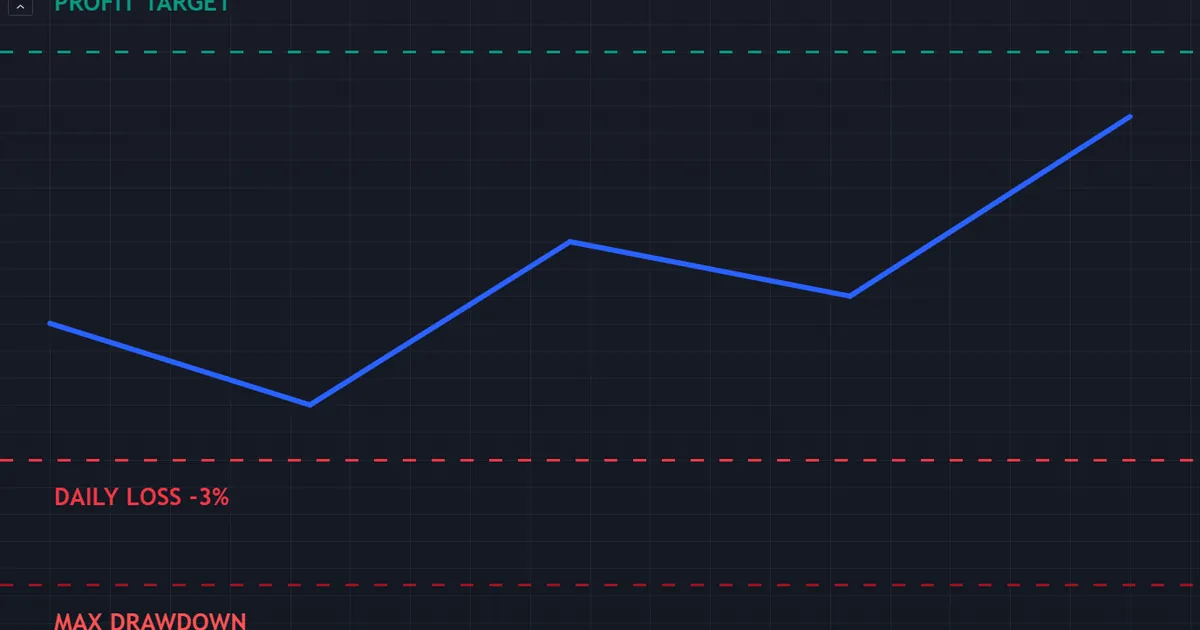
A few wrinkles bend the clean picture, so keep them in view. The chart below contrasts an equity path that stays within the rules against one that pierces the drawdown floor.
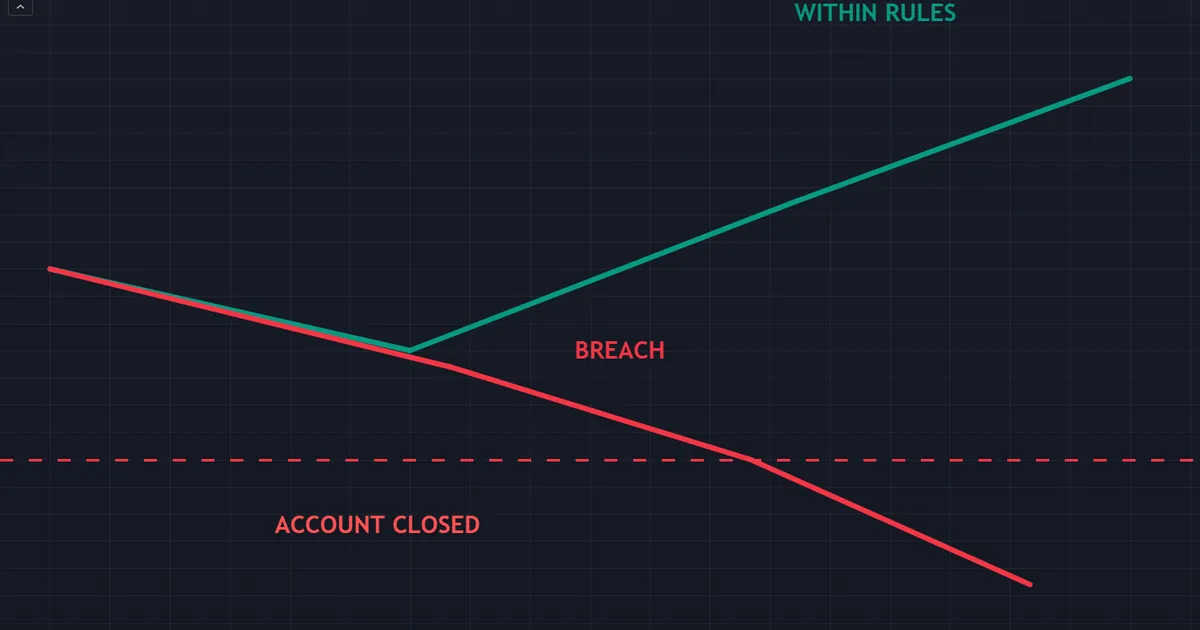
Picture the two paths from the same start. One climbs in careful steps and stays clear of the floor, while the other lunges and then breaches the limit. That single contrast captures the whole challenge of a funded account.
Rules Differ From Firm to Firm
No two firms share an identical rule set. One may trail the drawdown daily, while another fixes it from the start. So never assume a rule from one firm applies to the next, and read each book fresh.
Payout Schedules Vary
Firms pay out on different cycles, and some require a minimum before you can withdraw. So a headline split tells only part of the story. Because the schedule affects your cash flow, check it before you commit.
Simulated and Live Capital Differ
Many online firms route trades on simulated accounts, even at the funded stage. Others move successful traders to live capital. So understand which model a firm uses, since it changes how your orders reach the market.
Fees Add Up Across Attempts
Each evaluation carries a fee, and repeated failed attempts stack those costs. So a trader who rushes and breaches the rules pays again and again. Because patience saves both the account and the fee, it pays twice over.
Time Limits Pressure the Trade
Some firms once gave traders a strict deadline to hit the target. That clock pushed many into oversized, hurried trades. So check whether a program has a time limit, and favor one that lets you trade at a natural pace. Because rushing breaks discipline, a relaxed timeline suits a steady style far better.
Scaling Plans Reward Patience
Most firms grow your account as you keep trading within the rules. So a patient trader can reach a large size over several months. Because the scaling ladder rewards consistency, it favors the same steady habits the rules already demand.
Related Concepts to Study Next
A prop firm rewards the same discipline that protects any account, so a few risk ideas deserve your next reading hour. The rules simply put a hard edge on the habits every sound trader already keeps.
Start by pairing this with our guide to a funded trading account, then browse more in our prop trading library. Because the rules hinge on risk, read our note on risk per trade to fix your sizing, our overview of drawdown in trading to respect the floor, and our guide to a daily loss limit to survive a rough session. To size trades for a firm’s rules, use our free prop firm position size calculator and check a payout against a consistency rule calculator.
FAQ
What is a prop firm in simple terms?
A prop firm, or proprietary trading firm, backs traders with its own capital and shares the profit they earn. You pass an evaluation to prove your skill, then trade a funded account under strict risk rules. The firm keeps part of the profit, and you keep the rest.
How does the funded-account model work?
You pay a one-time fee to start a challenge, hit a profit target while obeying the rules, then pass a verification phase. After that, the firm grants a funded account under the same limits. So consistency, not a single lucky run, unlocks the payouts.
What rules do prop firms enforce?
Most firms set a maximum drawdown, a daily loss limit, and often a consistency rule. The drawdown is a hard floor that closes the account, while the daily cap limits a single session. The consistency rule rewards steady profit over one big day.
What is a trailing drawdown?
A trailing drawdown is a loss floor that rises as your equity grows. So once you profit, the floor tightens, and a giveback can breach it. Many traders miss this, so always check whether a firm fixes or trails the drawdown.
Is passing a prop firm challenge easy?
No, most traders breach a rule before they reach a payout. The challenge tests discipline as much as skill, since one oversized day can end it. So small, steady risk and a careful reading of the rules give you the best chance.
Is a funded account a steady salary?
No, a funded account is an opportunity, not a salary, and the rules can end it at any time. Payouts depend entirely on your results and your discipline. Results are not guaranteed; past performance is not indicative of future results.
External references
- For background on this concept, see Proprietary Trading at Corporate Finance Institute.
- For broader market context, see Trading Desk at Investopedia.

About the author
Written by Dominic Walsh, a Forex trader and MT4/MT5 indicator, Expert Advisor and script developer. Every tool on forexmt4systems.com is tested on live charts before release and ships with ready-to-use compiled MT4 (.ex4) and MT5 (.ex5) files. Learn more about the trader and developer behind this site.
How we build, test and correct every tool: Editorial & Testing Policy. Trading carries risk; see the disclaimer.