
What is instant funding? In prop trading it describes a funded account you buy outright. You pay a fee, skip the evaluation, and start trading firm capital within hours.
This guide keeps the view firm-neutral. No program gets named or ranked here. Instead you get the mechanics, the trade-offs, and the questions worth asking before any money leaves your card.
What Is Instant Funding in Prop Trading
Most funded-account programs ask you to pass a test first. You buy an evaluation, hit a profit target, respect the loss limits, and only then reach a funded account.
Instant funding removes that gate. The fee buys the account itself, so your first order already runs on the firm’s rules and the firm’s capital.
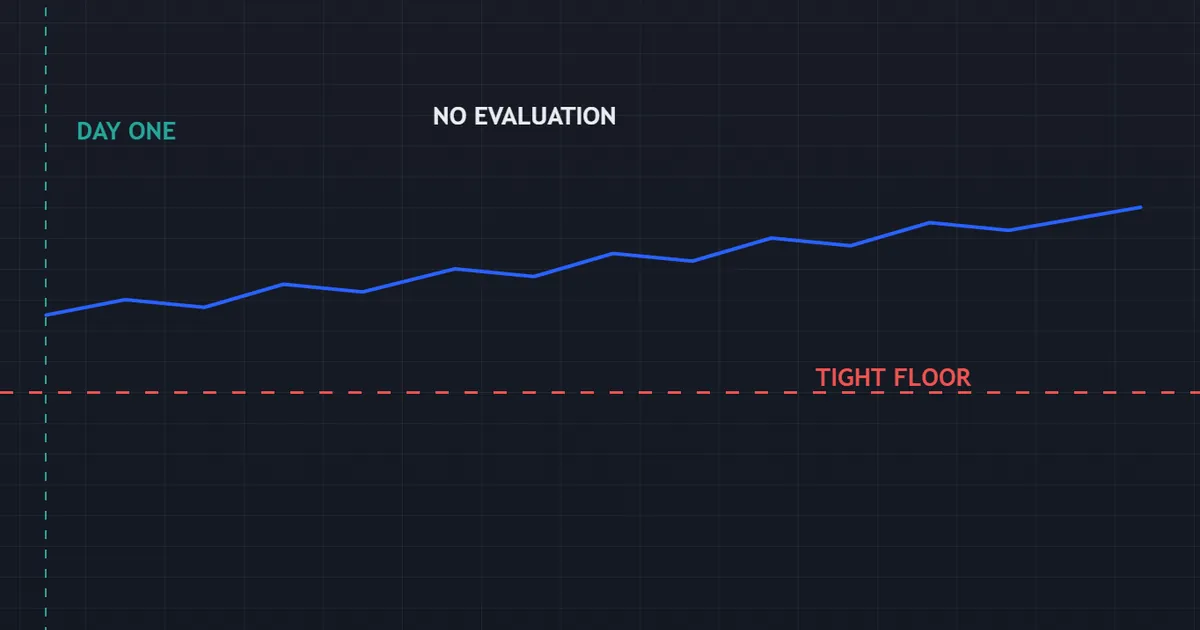
The panel above shows the shape of it. Equity starts at the opening balance on day one, with no evaluation stage sitting in front of it.
Notice the floor line underneath. That floor arrives on day one too, and it usually sits closer to the balance than an evaluation account would allow.
A Fee in Exchange for Access
Every version of this model rests on one swap. You hand over a larger fee, and the firm hands over immediate access.
So the risk shifts forward in time. Because no test screens you first, the program prices that uncertainty into the fee and into a tighter rule set. Both halves of that bargain deserve a slow read.
Why Programs Offer Instant Accounts
Fees fund the whole model. A program earns from every account it sells, whether the buyer lasts a week or a year.
Instant funding widens that pool. It appeals to traders who dislike test conditions, and to traders who already failed an evaluation elsewhere. So the product sells well, which explains why so many programs now list one.
How Instant Funding Works, Step by Step
The mechanics stay simple, and they rarely vary much across programs. Learn the sequence once, then read any sales page quickly.
Each step carries a decision. Skip one, and you inherit a rule you never chose consciously.
The Typical Sequence
Walk the path in order, because the order matters more than the marketing does.
- Choose a size. Programs list several account sizes, each with its own fee.
- Read the rule set. Check the daily loss limit, the overall drawdown, and the consistency clause before you pay.
- Pay the fee. Most charge once, though a few run a monthly subscription instead.
- Receive credentials. Login details usually arrive the same day.
- Trade the account. Loss limits apply from your very first position.
- Clear the first hurdle. Many programs set a profit target before the first withdrawal.
- Request a payout. Identity checks and a compliance review follow.
Nothing in that list resembles a job offer. So treat the purchase as a business expense with an uncertain return, never as a hiring decision.
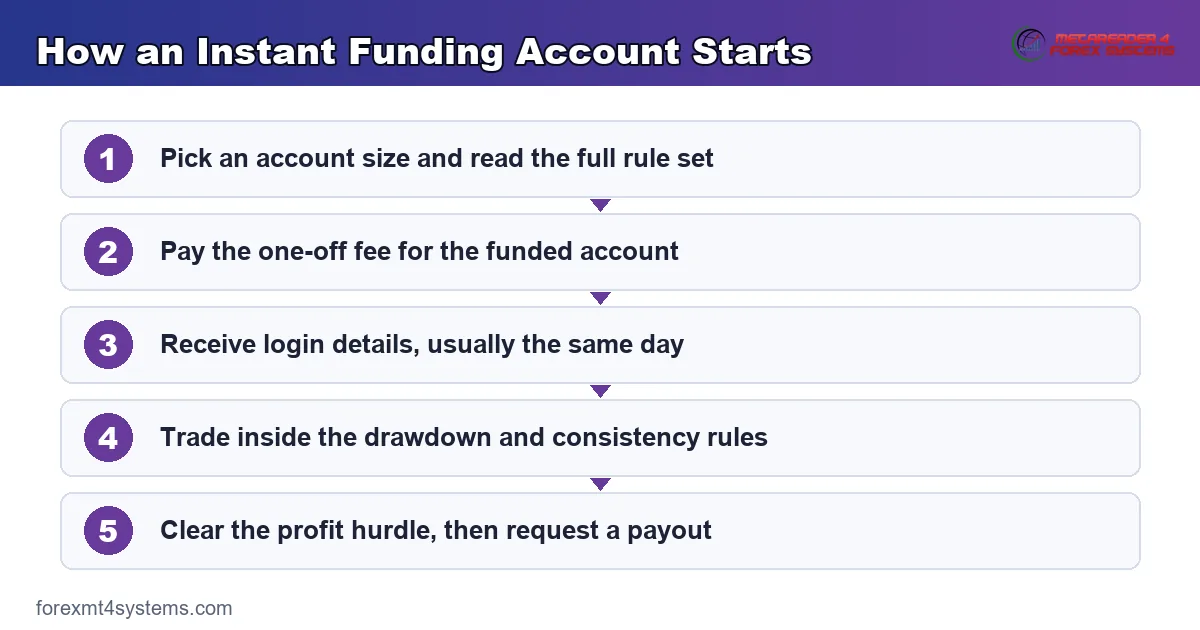
The flow graphic gathers those steps into one view. Pin it beside your notes, and the sales page loses most of its power to surprise you.
What Arrives on Day One
You receive platform credentials and a rule document. Read the rule document first, then read it again.
Account size lands lower than an evaluation account at a similar price. So a fee that would buy a large evaluation account might buy a much smaller instant one. That gap forms the real cost of skipping the test.
Simulated Capital and What It Means
Plenty of funded accounts run on simulated capital, instant ones included. The firm mirrors selected trades on a live desk, or simply pays your share from revenue.
So your profit still depends on the firm’s health. Because the payment comes from a business rather than from a market fill, a program’s track record matters as much as its rule set.
What Tightens When You Skip the Evaluation
Something always tightens. A firm that drops the screening step protects itself elsewhere, and the rule document shows exactly where.
Three areas shift most. Compare all three across programs before you commit.
Smaller Starting Capital
The clearest cost shows up in size. A given fee buys a fraction of the buying power the evaluation route would hand you.
So your percentage returns must work harder. Because the account starts small, many traders scale up too fast and meet a loss limit early. Patience costs nothing here, and it protects the fee you paid.
Tighter Drawdown Floors
Loss limits usually sit closer to the opening balance. A daily cap of two or three percent leaves little room for a rough session.
Trailing floors add more pressure. Because a trailing floor follows your equity peak upward, a good week can leave you with less breathing space than you started with. Check whether the floor tracks equity or balance, and whether it locks at the starting figure.
A Profit Hurdle Before the First Payout
Many instant programs place a target between you and your first withdrawal. Clear it, and the normal payout cycle begins.
That hurdle acts like a hidden evaluation. So the model rarely removes the test entirely, and it moves the test behind the purchase instead. Weigh that hurdle against the evaluation target you would have faced anyway.
Consistency and Lot-Size Clauses
Some programs cap how much of your profit may come from one day. Others limit lot size, ban certain instruments, or restrict news windows.
Read those clauses beside the drawdown rule. Because the clauses interact, a method that fits one can break another. To size positions against a firm’s loss limits, our prop firm position size calculator handles the arithmetic for you.
Trading an Instant Account in Practice
Theory ends at the first order. A tight floor rewards a boring routine, so build one before the platform opens.
Three habits carry most of the weight. None of them demand a new strategy.
Plan the First Week Deliberately
Trade a fraction of your normal size for five sessions. The point lies in learning the platform, the spread and the swap charges, rather than in chasing the hurdle.
Then review what you found. Because execution quality varies between brokers, a method that filled cleanly elsewhere can slip here. So a slow start protects the fee far better than an ambitious one.
Size Every Trade Against the Floor
Work backwards from the loss limit, not forwards from the target. Divide the distance to the floor by the number of losses you want to survive.
That figure sets your maximum risk per position. Because a tight floor shrinks the denominator, instant accounts usually demand smaller risk than a personal account would. Half a percent per position suits many traders here.
Log the Rule, Not Only the Trade
Record the daily loss used, the distance to the floor, and the profit still needed. Those three figures matter more than your entry reason on this kind of account.
So keep the log in one place and update it daily. Our trade journal stores each entry and shows the running drawdown beside it.
A Worked Example of an Instant Funding Account
Numbers turn the model concrete, so walk one plain case. Picture a twenty-five thousand dollar instant account with a four percent overall drawdown.
That floor sits one thousand dollars below your starting balance. So a run of three heavy sessions can end the account before any profit exists.
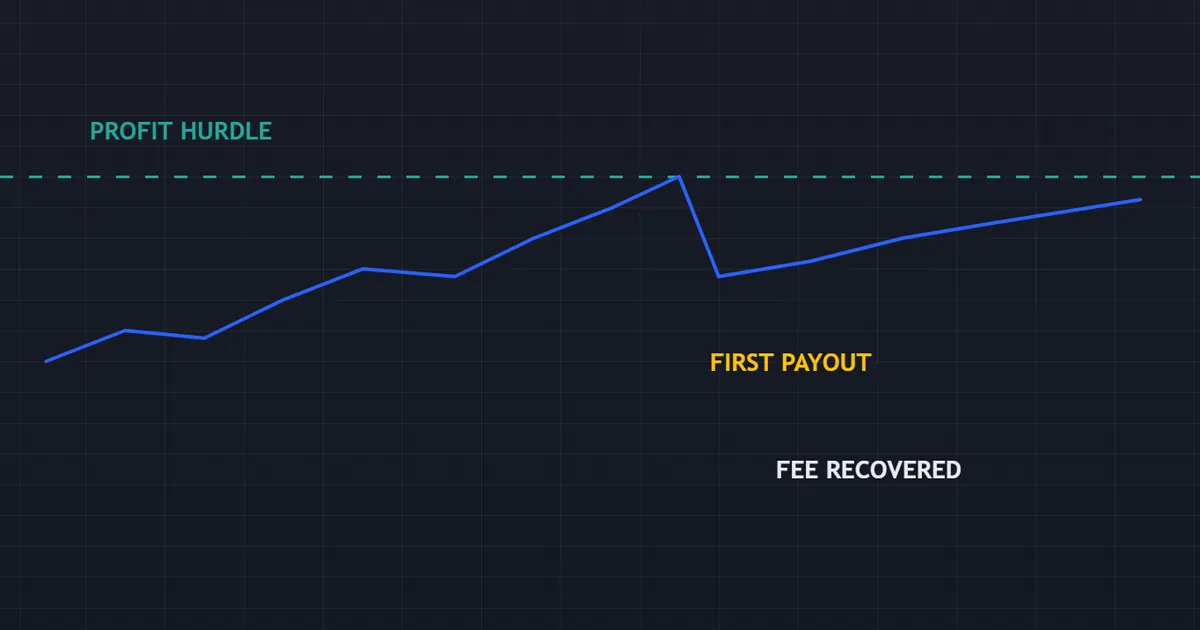
Now add the profit hurdle. Suppose the program asks for six percent, or fifteen hundred dollars, before your first withdrawal.
Your working room therefore spans one thousand dollars down and fifteen hundred dollars up. Risk half a percent per trade, and each loss costs one hundred and twenty five dollars. So the account absorbs eight full losses, and no more.
Spreading the Fee Across Cycles
Spread the fee across your first months, not across your first week. A one-off charge feels heavy on day one and light by month three.
Then ask the harder question. If the account closes in week two, the fee bought a lesson rather than an income stream. Plenty of buyers meet that outcome, so plan for it honestly.
Adding the Fee to the Arithmetic
The fee belongs in the same sum. Add it to the profit you must produce, then judge the target again.
Suppose the account cost four hundred dollars. Your first fifteen hundred dollars of profit therefore pays the fee, the firm’s share, and only then you. So the real hurdle sits higher than the rule document alone suggests.
What the Example Does Not Promise
Nothing above says the account survives. The arithmetic only maps the room you get.
Most people who buy any funded account, instant or otherwise, never reach a payout. So treat the fee as money you can lose without pain, and size the purchase accordingly. To see how a losing run eats a tight floor, our drawdown calculator plots the damage.
Download the complete indicator database
Put these concepts on your charts. One email unlocks the full library of 1,380+ indicators with compiled MT4 and MT5 files, plus my TradingView scripts. No paywall, no spam, unsubscribe any time.
Get free access to my indicator database
One email unlocks 1,380+ free MT4, MT5 and TradingView indicators — the complete library. No single-tool download; you get the whole database.
Instant Funding Versus a Standard Evaluation
Both routes end at the same place: a funded account with rules. They differ in when you pay, and in what you carry along the way.
The table below lines the two up. Read it before you pick a lane.
| Feature | Instant funding | Standard evaluation |
|---|---|---|
| Upfront fee | Higher for the same account size | Lower, though you must pass first |
| Time to first trade | Usually the same day | Days or weeks of testing |
| Capital per unit of fee | Smaller | Larger |
| Drawdown room | Tighter from day one | Wider during the test |
| Cost of an early error | The funded account itself | One evaluation attempt |
| Profit hurdle | Usually sits before the first payout | Sits inside the test stages |
Which Route Suits Which Trader
Speed suits nobody by itself. A trader with a tested routine gains little from starting today rather than next month.
So the honest filter looks at temperament. Traders who freeze under test conditions sometimes perform better without one, while traders who overtrade rarely benefit from a tighter floor. Match the product to your own record, never to the marketing.
Questions to Ask Before You Buy
A rule document answers most doubts in ten minutes. Work through this list with that document open beside you.
- Does the drawdown trail your equity peak, or does it stay static at the opening balance?
- Where does the daily loss limit reset, and in which time zone?
- What profit hurdle stands between you and the first withdrawal?
- How many trading days must you record before requesting money?
- Does a consistency clause cap the share of profit from one session?
- Which instruments, holding periods and news windows carry restrictions?
- What profit split applies, and does it improve through a scaling plan?
- Does the fee return with the first payout, and under which conditions?
- Which countries and payment methods fall outside the program?
An answer that needs a support ticket tells you something too. So save the reply, because a written answer beats a forum rumour later.
Reading Between the Marketing Lines
Sales pages lead with size and speed. Rule documents lead with limits, and the two rarely match in tone.
So trust the document. Because the document governs the money, it settles every dispute that follows a breach or a held payout. Marketing copy settles nothing at all.
Checking the Program Itself
Look for a public payout history, a visible support channel, and a company address you can find. None of those prove much alone.
Together they build a picture. So spend an evening on independent trader forums before the fee leaves your account. Treat glowing reviews with the same care as angry ones, since both carry an agenda.
Common Instant Funding Mistakes and Fixes
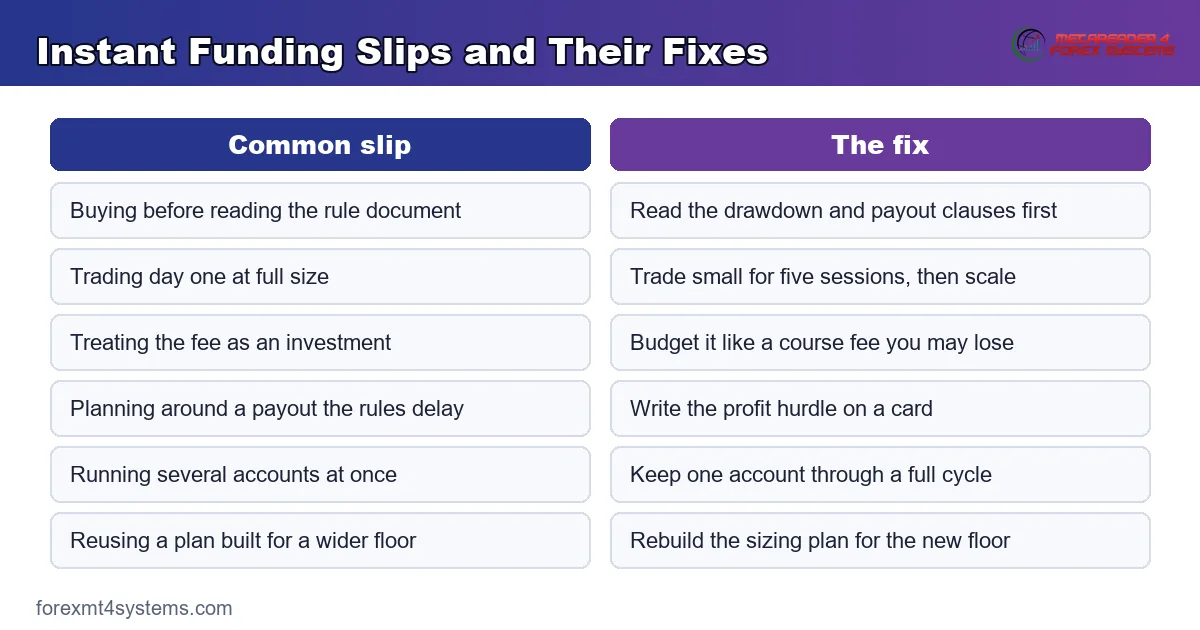
The model looks simple, so the same errors repeat across thousands of accounts. The graphic below sets each slip beside its fix.
Buying Before Reading the Rules
Many buyers read the price and skip the rule document. The daily cap then surprises them in week one. So read the drawdown clause, the consistency clause and the payout terms first, then decide.
Trading the First Day Too Hard
Fresh capital tempts fast action. A tight floor punishes it immediately. So place small trades for the first week and learn how the platform behaves under pressure.
Treating the Fee as an Investment
The fee buys access, not equity. You own nothing at the end of a failed account. So budget it like a course fee, and never with money you need elsewhere.
Ignoring the Profit Hurdle
Some traders plan around a payout that the rules delay. The hurdle then arrives as an unpleasant shock. So write the target and the minimum trading days on a card before your first order.
Stacking Several Accounts at Once
Two accounts feel like two chances. In practice they double your fee and split your attention. So run one account until your routine survives a full payout cycle.
Copying a Plan From a Larger Account
A method built for a wide floor breaks on a narrow one. Position sizes carry across badly. So rebuild the sizing plan for the new floor before you trade a single lot.
Instant Funding Quick Reference
Keep this short list beside you while you compare programs. Run through it again before every purchase.
- Instant funding replaces the evaluation with a larger upfront fee.
- Account sizes usually land smaller than the evaluation route offers.
- Daily and overall loss limits tend to sit tighter from day one.
- A profit hurdle frequently stands between you and the first payout.
- Many accounts run on simulated capital, so the firm’s health matters.
- Consistency and lot-size clauses can hold a payout back.
- The fee buys access only, never ownership of the capital.
- Save the rule document on the day you pay, because terms change.
- Add the fee to the profit you must produce before you judge the target.
- Check whether the program restricts your country or your payment method.
Pitfalls and Edge Cases
A few wrinkles bend the clean picture. The chart below shows an account that breaches a tight floor inside its first week.
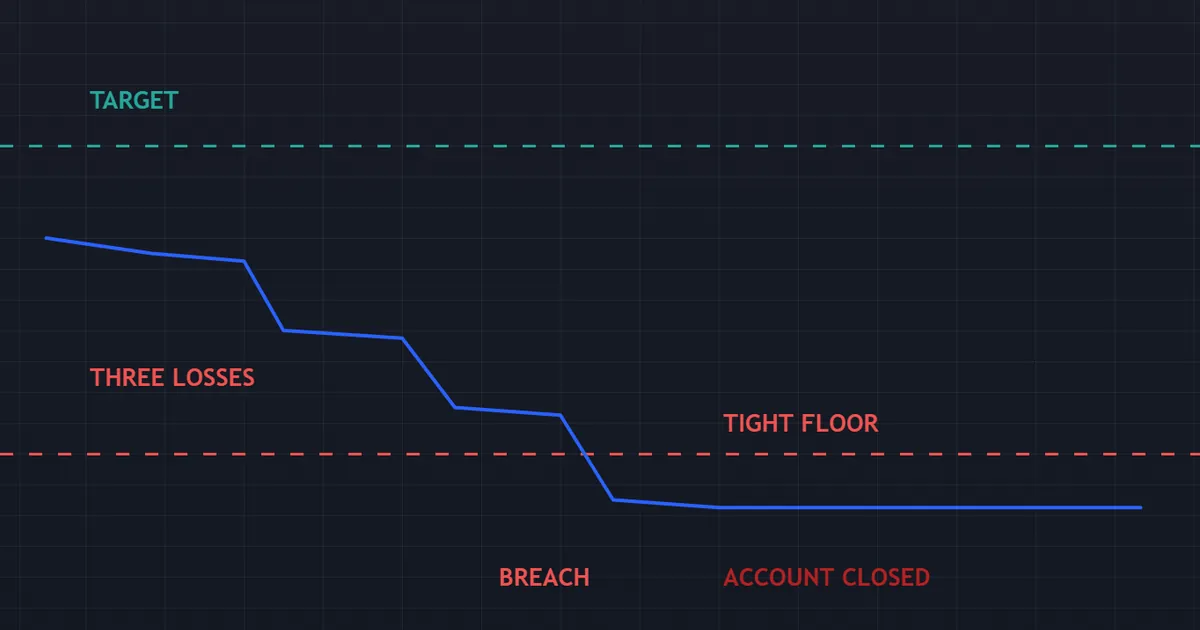
Picture the sequence from the buyer’s side. The fee clears, the platform opens, and three quick losses pierce the floor. The account closes with the profit hurdle still untouched.
Trailing Floors That Follow Your Peak
A trailing floor rises with your equity high. So a profitable morning can shrink your cushion by the afternoon. Check whether the floor freezes once it reaches the starting balance, because that single clause changes the risk profile completely.
Subscription Pricing
A few programs charge monthly rather than once. The cost then grows quietly while the account survives. So multiply the monthly figure by six, then compare it against a one-off fee.
Rule Rewrites After You Buy
Terms change, and rarely with much notice. Save a copy of the rule document on the day you pay. Because your own snapshot settles a dispute faster than memory, that habit costs a minute and saves an argument.
Refunds and Fee Credits
Some programs refund the fee with your first payout, while others never do. Read that clause literally, since a conditional refund usually hides a minimum profit and a waiting period.
Aggregate Limits Across Several Accounts
Traders who hold more than one account often miss a combined cap. Many programs limit total capital per person, and they merge correlated positions across accounts for risk purposes.
So two accounts running the same method may count as one. Because the compliance desk reads the trade record rather than the login, duplicated orders can trigger a review on both.
Regional Restrictions
Programs restrict some countries, and payment rails restrict more. So check the eligibility list before you pay, rather than after the charge clears.
Where Instant Funding Fits in a Trading Plan
The product solves one problem: access. It solves nothing about method, sizing or temperament.
So place it late in your plan, never early. A trader without a tested routine simply buys a faster route to the same result.
Before You Consider It at All
Log at least a few dozen trades on a small personal account first. Record the outcome, the risk taken, and the reason behind each exit.
That record answers the only question that matters. Because a method with no evidence behind it cannot survive a tight floor, the log can save you the fee entirely.
After a Failed Evaluation
Failing a test tempts traders toward the instant route. The reasoning usually skips a step, since the failure rarely came from the test conditions themselves.
So diagnose the failure first. Because a sizing fault follows you into any account, the same fault meets the same floor at a higher price.
Alongside a Personal Account
Some traders run both, and the split works well. A personal account handles longer holds, while the funded account handles whichever method fits its rules.
So keep the two records separate. Because the rule sets differ, mixing the plans creates exactly the confusion a tight floor punishes.
Related Concepts to Study Next
Instant funding sits inside a wider model, so a few neighbouring ideas repay an hour of reading. The rules that govern the account shape your outcome far more than the entry route does.
Start with our explainer on what a prop firm is, then read the guide to the prop firm challenge you skipped. For the rule set itself, see our notes on prop firm drawdown rules and on how prop firm payouts work. Anyone weighing the industry as a whole should read whether prop firms count as legitimate, and our risk per trade guide sets the sizing habit this model demands.
FAQ
What is instant funding in prop trading?
Instant funding means you buy a funded account outright instead of passing an evaluation. The fee covers immediate access to firm capital under a fixed rule set. Trading starts within hours, usually on the same day you pay.
Does instant funding cost less than an evaluation?
No. For the same account size the upfront fee runs higher, since the firm skips its screening step. You also tend to receive a smaller account and a tighter loss limit for that money.
Can I lose more than the fee I paid?
No. You trade the firm’s capital, so a breach closes the account rather than creating a debt. Read the agreement anyway, because a few programs mention clawbacks for prohibited methods.
Do instant funding accounts really pay out?
Yes, and the payout process mirrors the evaluation route. You clear the profit hurdle, meet any minimum trading days, flatten open positions, then request the money. A compliance review and identity checks follow before payment.
Who does instant funding actually suit?
It suits a trader with a tested routine who performs badly under test conditions. It suits nobody without a written plan. Because the floor sits tight from the first order, discipline matters more here than on an evaluation account.
Should I buy the largest account I can afford?
Rarely. A larger account raises the fee without changing your percentage returns. So most traders learn more from a small account and a long run of clean sessions. Results are not guaranteed; past performance is not indicative of future results.
External references
- For background on this concept, see Performance Fee at Investopedia.
- For broader market context, see Adverse Selection on Wikipedia.

About the author
Written by Dominic Walsh, a Forex trader and MT4/MT5 indicator, Expert Advisor and script developer. Every tool on forexmt4systems.com is tested on live charts before release and ships with ready-to-use compiled MT4 (.ex4) and MT5 (.ex5) files. Learn more about the trader and developer behind this site.
How we build, test and correct every tool: Editorial & Testing Policy. Trading carries risk; see the disclaimer.