
Prop firm payouts are the moment the funded-account model finally pays you. You trade the firm’s capital, you build profit inside the rules, and then you withdraw your agreed share of that profit.
This guide explains prop firm payouts in plain terms, and it stays firm-neutral throughout. You will walk the profit split, the payout cycle, the minimum thresholds, the withdrawal methods, and the rule breaches that can void a payment.
What a Payout Actually Is
A payout is a withdrawal of profit from a funded account. The firm holds the capital, so your profit sits with the firm until you request your share.
Your share arrives as a payment rather than a salary. No fixed wage sits behind a funded account, and the firm owes you nothing until you produce profit.
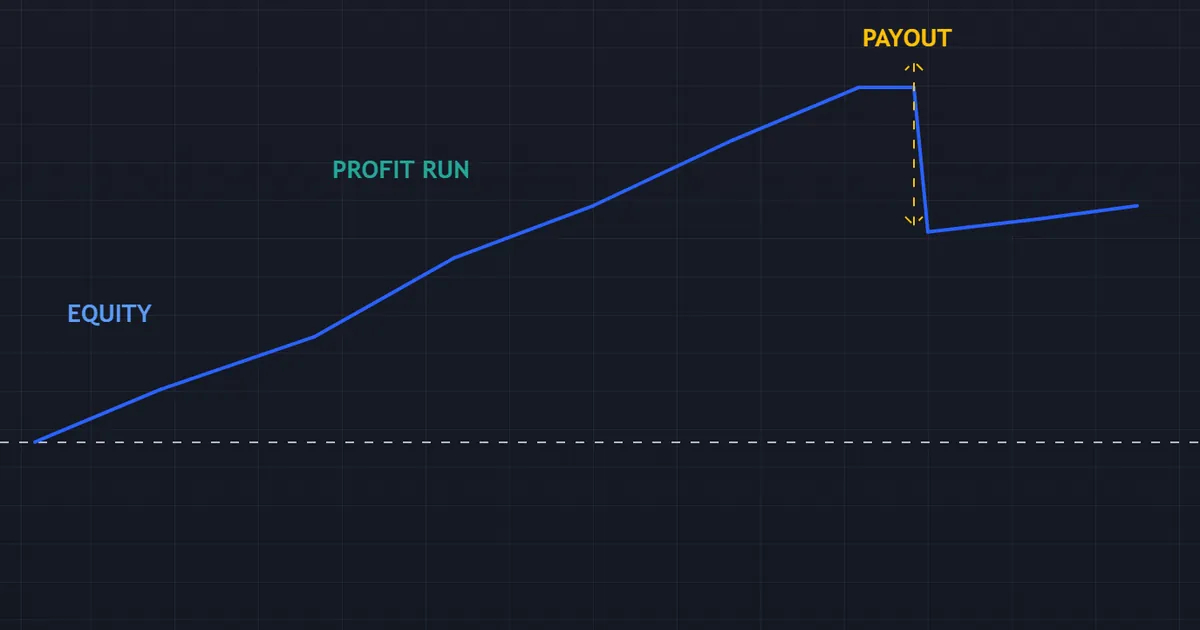
The chart above shows the shape of the whole idea. Equity climbs through a profit run, a payout point arrives, and the account resets to a lower equity figure afterward.
Notice what the picture leaves out. It makes no promise about how often that climb happens, or how far it goes. Payouts reward results, and results vary from month to month.
A Payment, Not a Salary
The difference matters more than it sounds. A salary arrives whether the month went well or badly, while a payout arrives only after profit exists.
So the model shifts the outcome risk onto you. Because the firm loses nothing when you produce nothing, it can offer large capital to many people at once. That asymmetry explains most of what follows in this guide.
The Profit Split in Plain Terms
The profit split sets how much of the profit you keep. Splits of eighty percent to the trader appear widely across the industry, and some programs advertise ninety percent for traders who reach later stages.
So an eighty-twenty split leaves you four fifths of the profit. Because the firm supplies the capital and absorbs the losses, it keeps the remaining fifth. Read the exact figure in the terms rather than on the marketing page.
Why the Firm Keeps a Share
The firm’s cut pays for the capital, the platform, and the risk it carries. It also funds the risk desk that reviews every request.
That split shapes your planning. A higher trader share sounds better, yet a strict schedule can matter more to your cash flow. So weigh the split and the schedule together, never the headline alone.
How Prop Firm Payouts Work, Step by Step
Most firms run a similar sequence, though the wording differs. Learn the sequence once, and any program’s payout page becomes easy to read.
Each step exists to protect the firm from paying on a fluke. So the process checks your eligibility, your rule record, and your identity before money moves.
The Payout Sequence
Walk the typical path in order, because every stage can hold a request back.
- Eligibility. Meet the minimum profit, the minimum trading days, and any waiting period since your last request.
- Flat account. Close open positions, since most firms count realised profit only.
- Request. Submit the payout request through the firm’s dashboard.
- Identity check. Complete identity verification if you have not already done so.
- Compliance review. Let the risk desk compare your trade record against the rule set.
- Payment. Receive the funds by your chosen method.
- Reset. Begin a fresh cycle, often from a reset profit baseline.
Nothing in that list rewards a single lucky trade. Because the review reads your whole record, a clean rule history counts as much as the profit figure.
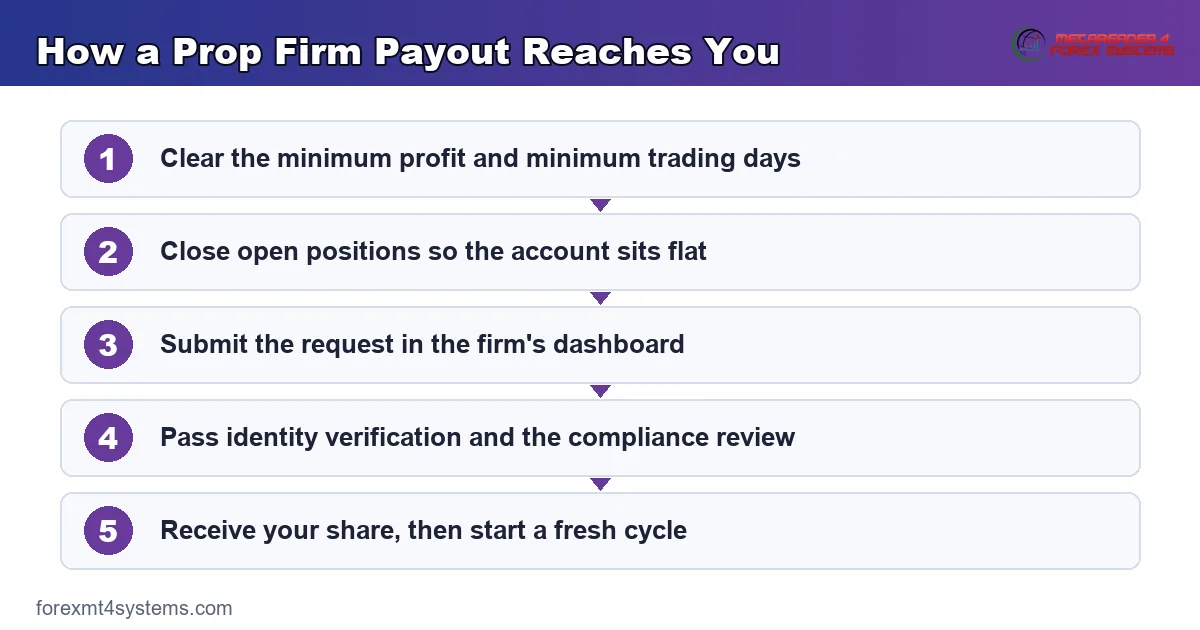
The flow graphic gathers those steps into one view. Pin it up before your first request, and you sidestep the delays that catch most new funded traders.
Payout Cycles and Frequency
A payout cycle sets how often you may withdraw. Some programs run a fortnightly cycle, others monthly, and a few take requests on demand once you clear the minimums.
Faster cycles help your cash flow, yet they rarely change your total. Because the profit must exist before you withdraw it, frequency only shifts the timing. So treat cycle length as a convenience feature rather than an edge.
Minimum Thresholds Before You Withdraw
Almost every program sets a floor under the first request. That floor blocks tiny withdrawals that cost more to process than they pay out.
Two floors appear most often: a minimum profit amount and a minimum number of trading days. Miss either one, and the dashboard refuses the request.
Minimum Profit and Minimum Days
The minimum profit figure varies widely between programs. Some set it low enough to clear in a good week, while others ask for a meaningful sum first.
Minimum trading days work differently. They ask you to trade across a set number of separate sessions, so one windfall day cannot fund a payout. Both floors therefore push you toward steady work.
Buffers and Partial Withdrawals
Some firms hold part of your profit back as a buffer. The buffer keeps a cushion above the drawdown floor after money leaves the account.
Read that clause with care. Because a withdrawal lowers your equity, it can move you closer to a loss limit. So a partial withdrawal often protects the account better than a full sweep.
Waiting Periods Between Requests
Many programs add a cooling-off window after each payment. The clock starts on the day the funds leave, not on the day you filed.
So two requests in one week rarely work, even with plenty of profit. Because the window sets your real frequency, read it alongside the cycle length. A monthly cycle with a two-week window behaves very differently from a fortnightly one.
A Worked Example of a Payout Request
Numbers make the model concrete, so walk one simple case. Picture a fifty thousand dollar funded account on an eighty-twenty split.
You finish the month up two percent, which comes to one thousand dollars of profit. Your eighty percent share works out at eight hundred dollars, and the firm keeps two hundred.
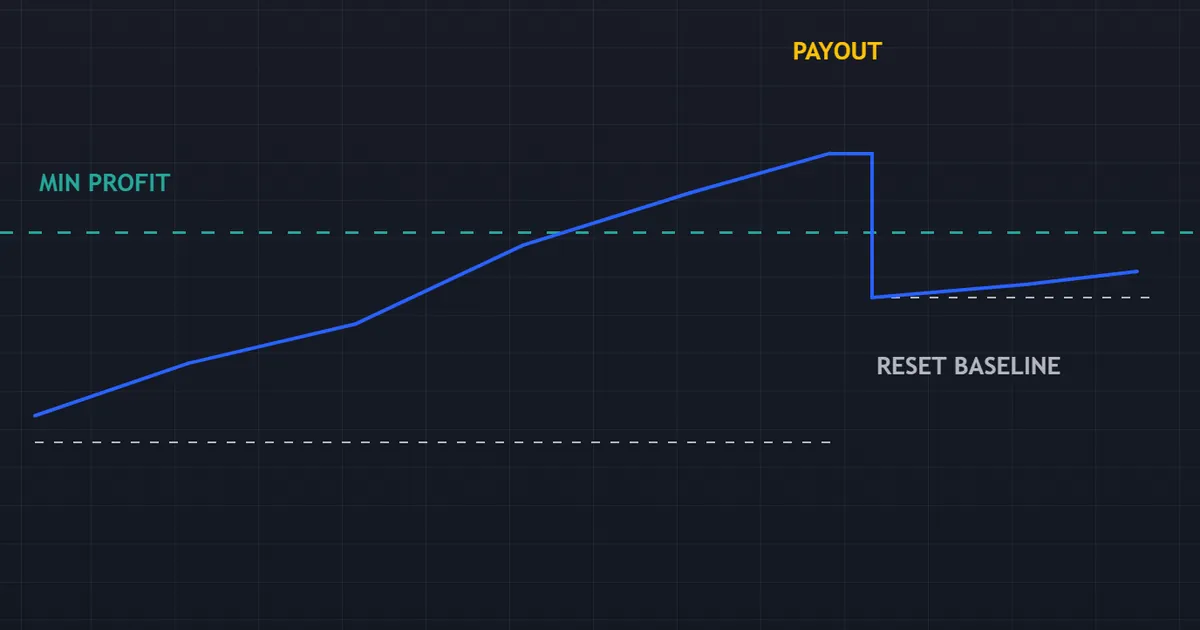
Now add the thresholds. Suppose the program asks for a minimum of one hundred dollars and five trading days, so this month clears both easily. The request goes in, the review passes, and the money lands.
Then look at what changed. Your equity drops by eight hundred dollars after the transfer, so your cushion above the loss floor shrinks by exactly that amount. That single detail explains why experienced funded traders withdraw in measured slices.
The Same Month on a Different Split
Change one variable, and the payment changes with it. On a seventy-thirty split, that same one thousand dollars of profit pays you seven hundred rather than eight hundred.
Change the account size instead, and the effect grows. A one hundred thousand dollar account earning the same two percent produces two thousand dollars of profit, so an eighty percent share comes to sixteen hundred. So size and split multiply together, while your percentage return does the actual work.
Reading the Split After Costs
Spreads, commissions and swaps come out before the split. So the profit figure in your dashboard already carries those costs.
Frequent trading trims that figure quietly. Because every round trip pays a spread, a high-volume month can leave less profit than your strike count suggests. So fewer, cleaner trades often clear a threshold sooner. To size each trade against a firm’s loss limits, our free prop firm position size calculator handles the arithmetic for you.
Where the Money for a Payout Comes From
Understanding the funding source keeps your expectations grounded. Firms pay from revenue, and that revenue has a small number of sources.
So a program’s payout terms track its business health. Because generous terms cost money, they usually arrive with a tighter rule set somewhere else.
Fees, Failed Attempts and the Split
Evaluation fees form the most visible stream. Traders who breach a rule pay again to retry, and those repeat fees add up across a large customer base.
Then comes the firm’s slice of every funded trader’s profit, plus spread or commission arrangements on the flow. So a firm earns whether traders succeed or fail, which is exactly the conflict of interest worth naming out loud.
Why Payout Terms Keep Changing
Programs revise their terms often, and rarely with much notice. A split, a threshold or a cycle can shift between the month you join and the month you withdraw.
So save a copy of the rules on the day you buy. Because the current page may differ later, your own snapshot settles a dispute far faster than memory.
Withdrawal Methods and Timing
Money reaches you through a payment rail, and firms differ on which rails they offer. The choice affects both the fee and the wait.
So read the payment page before your first request. Because a rail can add days to a transfer, the detail matters more than most traders expect.
How Firms Send Money
Most programs offer a bank transfer, and many add digital wallets or card rails. A few settle in crypto, which suits traders in countries with slow banking.
Each rail carries its own fee and its own delay. So compare the options before you pick one, and check who pays the transfer cost. Because a small fee repeats every cycle, the cheapest rail quietly compounds in your favour.
Identity Checks Before the First Payout
Firms verify identity before releasing money, since payment providers require it. Expect a document upload and a short wait.
Start that step early. Traders who leave it until the first request often wait days longer than they planned. So upload the documents the week you get funded, and your first payout moves faster.
Fees, Currency and Cross-Border Costs
A transfer can shrink between the firm’s ledger and your bank. Conversion spreads, correspondent charges and wallet fees all take a slice.
So ask which currency the firm pays in. Because a poor conversion rate costs more than most transfer fees, matching currencies where you can saves real money. Traders outside the firm’s home region feel this most.
How Long Payments Take
Processing times range from same-day to roughly a week across the industry. Larger requests and first-time requests draw a closer look.
Plan around the slower end. Because a review can pause a payment without warning, no funded trader should build a bill schedule on a quick transfer. So keep a personal cash reserve outside the account.
Download the complete indicator database
Put these concepts on your charts. One email unlocks the full library of 1,380+ indicators with compiled MT4 and MT5 files, plus my TradingView scripts. No paywall, no spam, unsubscribe any time.
Get free access to my indicator database
One email unlocks 1,380+ free MT4, MT5 and TradingView indicators — the complete library. No single-tool download; you get the whole database.
What Can Void a Payout
A payout can stall or vanish for reasons that have nothing to do with your profit. Most trace back to a rule you accepted at signup.
Three categories cover almost every case. Learn them, and you protect the money you worked for.
A Hard Rule Breach
Break a drawdown rule or a daily loss limit, and the account closes. A pending payout can disappear with it, since the breach ends the agreement.
So the safest habit stays simple. Request your payout as soon as you qualify, then keep risk small while the review runs. Because a breach inside that window can cost the whole request, patience protects the payment.
A Consistency Check
Many firms cap how much of your total profit may come from one day or one trade. A single outsized day can therefore hold a payout back.
Consistency failures usually delay rather than destroy. Keep trading, let your other days dilute the big one, and the request clears later. To test a month against a cap before you file, our consistency rule calculator shows where your profit concentrates.
Prohibited Trading Styles
Programs commonly ban latency arbitrage, tick scalping, and copy trading across many accounts. Some also restrict trading through major news releases.
Those clauses exist to stop exploits rather than to trap you. So read the prohibited-methods list before you build a routine around a tool. Because a review can flag a style after the fact, a compliant method saves an argument later.
Paperwork and Account Mismatches
Payment providers reject transfers when the names do not line up. A wallet registered to a relative fails that test instantly.
So keep every detail in your own legal name. Because a mismatch triggers a manual review, one wrong digit can add a week. Check the bank details twice before you file, then leave them alone.
Common Payout Mistakes and Fixes
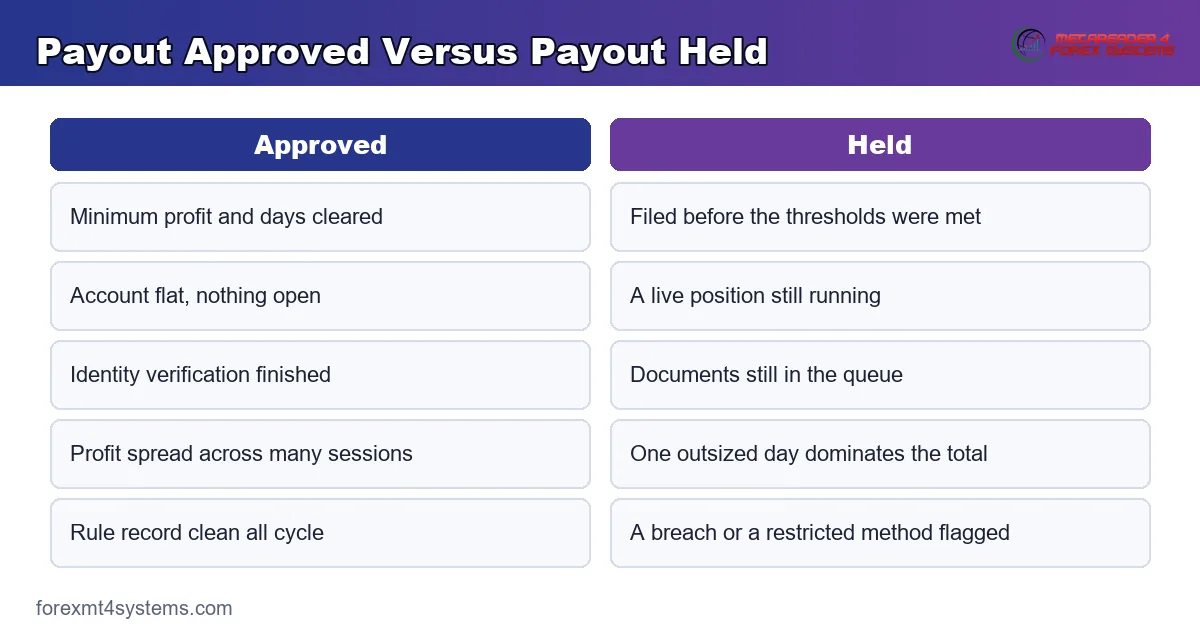
The payout model is simple, yet the same errors delay payment after payment. The comparison graphic below sets an approved request beside a held one.
Requesting Before You Qualify
Many traders file the moment they see green. The dashboard then rejects the request, and some firms restart the waiting period. So check the minimum profit and the minimum days first, then file once.
Leaving Positions Open
Most firms measure realised profit, so an open trade can block a request. Worse, that trade can turn red during the review. So close everything, take the flat screenshot, and only then submit.
Skipping Identity Verification
Unverified traders wait while documents crawl through a queue. Meanwhile the payout window can close. So finish verification during your first funded week, well before any profit exists.
Withdrawing Everything at Once
A full sweep drops your equity to the reset baseline. Your cushion above the loss floor then sits at its thinnest. So leave a slice behind, and the account survives the next rough patch.
Ignoring the Consistency Cap
One huge day feels like a triumph until the cap holds the payment. Traders who never read the clause meet it at the worst moment. So track your best day against your total profit as the month runs.
Trading Hard While a Review Runs
A pending request tempts some traders into extra risk. A breach during the review can end both the account and the payment. So trade small, or step aside entirely, until the funds land.
Payout Quick Reference
Keep this short list beside you before any request. Run through it whenever you compare programs.
- The profit split sets your share, commonly eighty percent and sometimes ninety.
- The payout cycle sets how often you may file a request.
- A minimum profit figure blocks very small withdrawals.
- Minimum trading days stop one windfall session funding a payout.
- Most firms need a flat account with no open positions.
- Identity verification comes before any money moves.
- A rule breach or a consistency failure can hold or void the payment.
Pitfalls and Edge Cases
A few wrinkles bend the clean picture, so keep them in view. The chart below shows an account that breaches its floor while a payout request still sits under review.
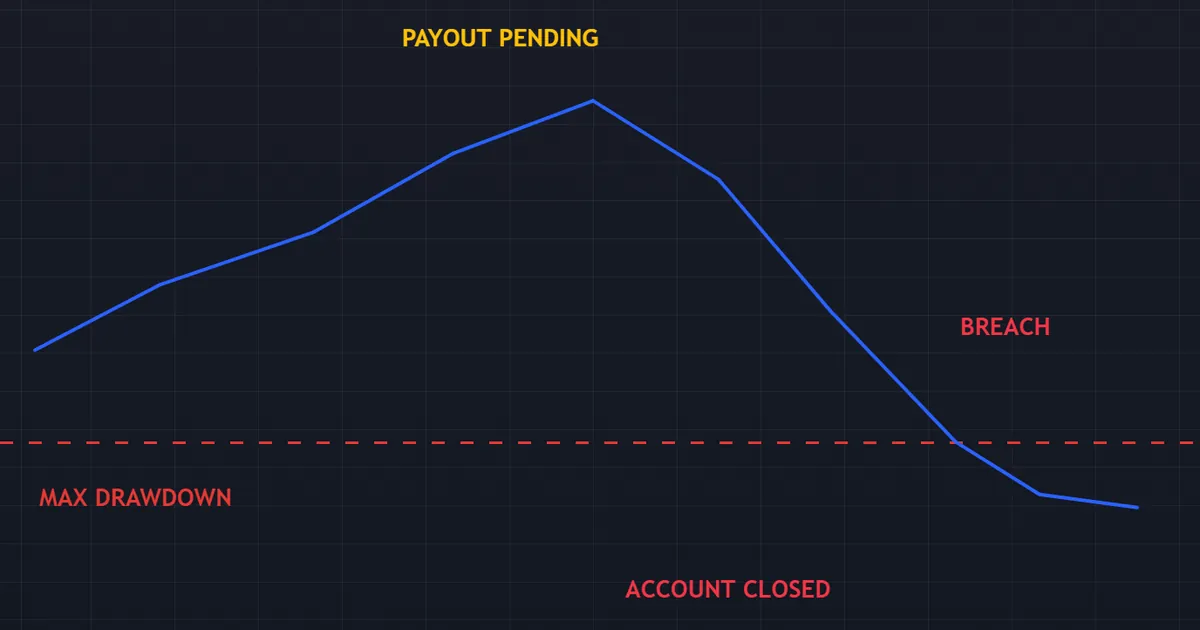
Picture the sequence from the trader’s side. Profit builds, the request goes in, and then one oversized session pierces the drawdown floor. The account closes, and the pending payment closes with it.
Reset Baselines After a Payout
Many programs reset your profit baseline once you withdraw. So the next cycle starts from zero profit, not from your old peak. Read how the reset interacts with your drawdown floor, because the two rules together decide your real cushion.
Simulated Accounts and Payment Sources
Plenty of funded accounts run on simulated capital even after you pass. The firm then pays your share from its own revenue. So the payment depends on the firm’s health, which makes its track record worth checking.
Tax Sits With You
A payout usually arrives as income from a contract, not as a wage with tax withheld. So you carry the reporting duty in your own country. Set money aside as each payment lands, and speak to a local accountant early.
Scaling Can Change the Split
Some programs raise your share as you climb a scaling ladder. Others keep the split fixed and grow the account instead. So compare the whole ladder, not just the entry terms, when two programs look alike.
Program Closures and Rule Rewrites
The industry has seen programs shut down or pause payments during stressed periods. A trader holding a pending request then joins a queue.
So spread the risk where you can. Because no single program deserves your whole plan, withdrawing promptly and keeping capital outside the account both reduce your exposure.
Related Concepts to Study Next
Payouts sit at the end of a chain that starts with risk control, so a few neighbouring ideas repay an hour of reading. The rules that govern a payment are the same rules that keep the account alive.
Start with our look at how much prop firm traders make, then read our guide to the prop firm consistency rule that most often holds a request. For the wider model, see what a funded trading account is and what a prop firm is, or browse the full prop trading library. Because every payout shrinks your cushion, our overview of drawdown in trading belongs on the same list.
FAQ
How do prop firm payouts work?
You trade the firm’s capital, build realised profit inside the rules, then request a withdrawal through the dashboard. The firm checks your eligibility, your rule record and your identity. After the review clears, it sends your agreed share of the profit.
What profit split should I expect?
An eighty-twenty split in the trader’s favour appears widely, and some programs advertise ninety percent at later stages. Splits vary by program and by stage, so read the terms. The schedule and the minimums matter just as much as the headline percentage.
How often can I withdraw?
Cycles range from on-demand requests to fortnightly or monthly windows. Many firms also set a waiting period after your previous payment. So check both the cycle and the cooling-off clause before you plan around the money.
Why would a payout be denied or held?
The usual causes are a missed minimum, an open position, incomplete identity checks, a consistency-cap failure, or a prohibited trading method. A hard drawdown breach can end the account and the request together. Most other holds resolve once you fix the underlying condition.
Should I withdraw all my profit?
Rarely, because a full sweep pulls your equity down to the reset baseline. Your cushion above the loss floor then sits at its thinnest point. So many funded traders take a slice and leave the rest working.
Are payouts a reliable income?
No, and treating them that way ends badly. A payout depends on profit you produce inside strict rules, and the account can close on a single breach. Most people who buy an evaluation never reach a payment at all, so plan on a variable, uncertain stream rather than a wage. Results are not guaranteed; past performance is not indicative of future results.
External references
- For background on this concept, see Know Your Customer on Wikipedia.
- For broader market context, see Wire Transfer at Investopedia.

About the author
Written by Dominic Walsh, a Forex trader and MT4/MT5 indicator, Expert Advisor and script developer. Every tool on forexmt4systems.com is tested on live charts before release and ships with ready-to-use compiled MT4 (.ex4) and MT5 (.ex5) files. Learn more about the trader and developer behind this site.
How we build, test and correct every tool: Editorial & Testing Policy. Trading carries risk; see the disclaimer.