
The prop firm vs personal account question comes down to whose money you trade and who writes the rules. One route hands you large capital with strict limits attached, while the other hands you full freedom over a smaller pot.
This guide weighs prop firm vs personal account on capital, rules, profit, cost, and mindset. It stays firm-neutral throughout, and it treats both routes as sensible choices for different traders.
Prop Firm vs Personal Account at a Glance
A prop firm lends you its capital after you pass an evaluation, then takes a share of the profit. A personal account uses your own deposit, so every dollar of profit stays with you.
So one route trades autonomy for size. The other trades size for autonomy, and neither answer suits everybody.
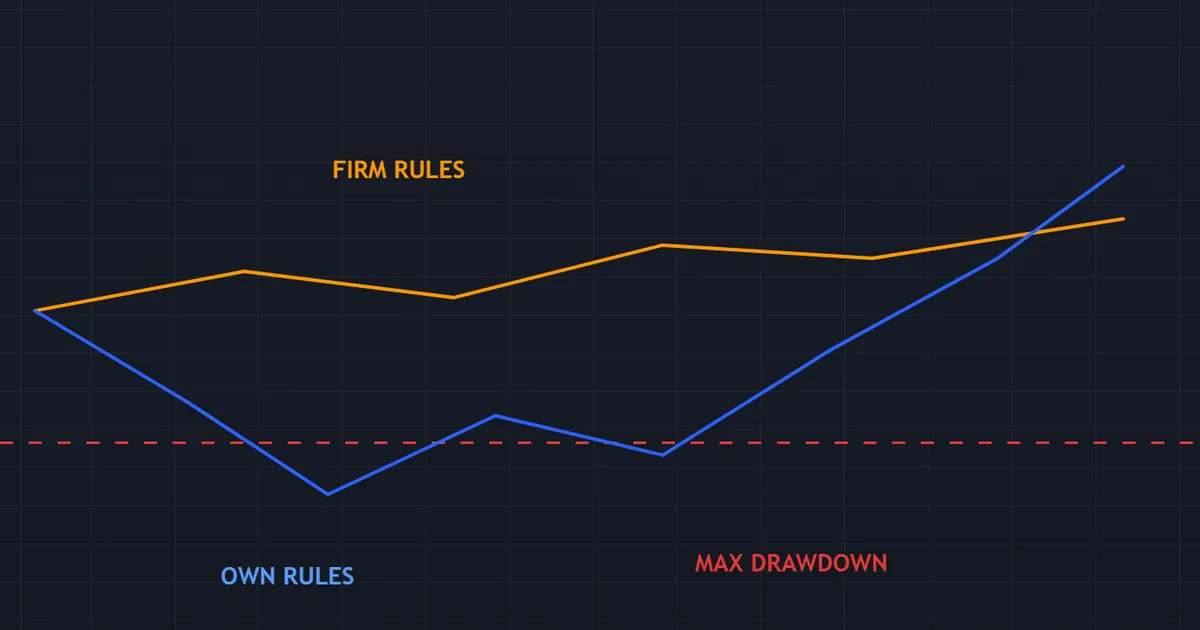
Both routes trade the same markets on the same platforms. The charts look identical, and your method needs no rewrite.
What changes sits around the trading: the money, the rule book, and the consequence of a bad week. So compare those three things, and the choice usually makes itself.
The One-Line Difference
A personal account risks your capital under your rules. A prop account risks the firm’s capital under its rules.
Everything else follows from that single swap. Because the owner of the money writes the rule book, ownership decides how much freedom you keep.
How Each Route Actually Works
Walk both paths in order, and the practical gap becomes obvious. Neither one holds any mystery once you see the steps.
- Personal account, step one. Open an account with a broker and deposit your own money.
- Personal account, step two. Set your own risk limits, then trade with nobody checking them.
- Personal account, step three. Keep all the profit, and absorb every loss yourself.
- Prop route, step one. Pay a fee and pass an evaluation under the firm’s limits.
- Prop route, step two. Trade the funded account while the firm monitors every rule.
- Prop route, step three. Withdraw your agreed share on the firm’s payout cycle.
So the prop route adds a gate at the front and a partner at the back. Because both additions cost you something, the extra capital has to earn its keep.
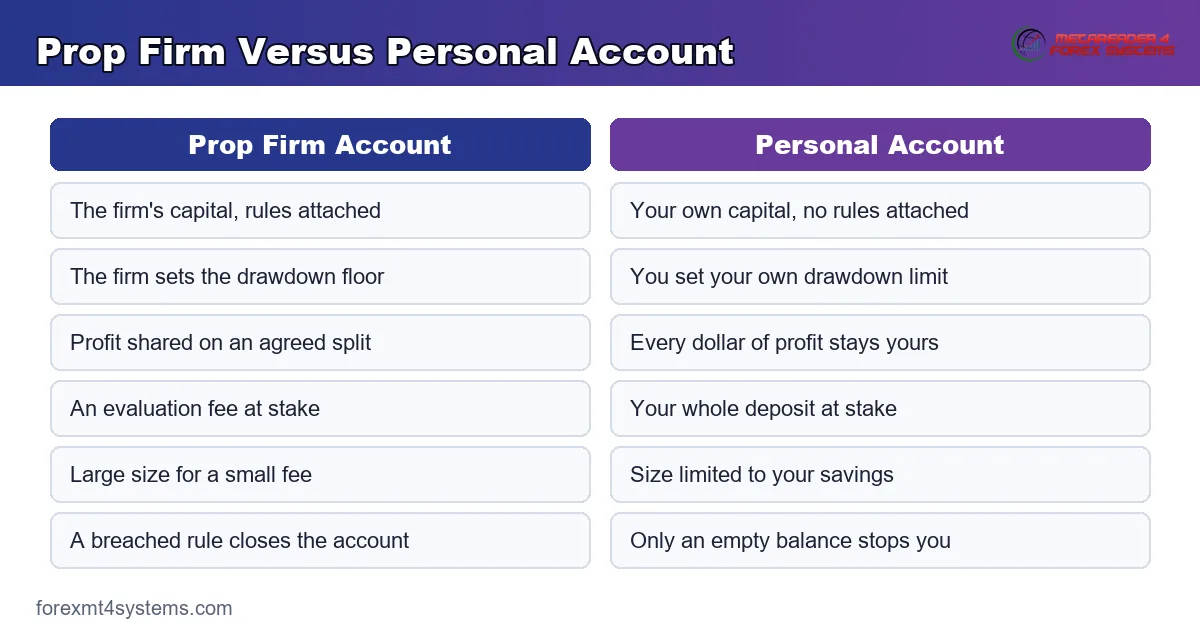
Reading the Comparison Honestly
Neither column wins outright. A disciplined trader with savings often does better alone, while a skilled trader without capital gains far more from a firm.
So judge the routes against your own position. Because the right answer depends on your bank balance and your temperament, borrowed opinions rarely help.
Where the Two Paths Diverge Most
Steps one and three carry the real difference. One decides who funds the account, the other decides who keeps the profit.
Step two looks identical on both sides, yet it feels nothing alike. Because somebody watches every trade on the prop route, the same decision carries an extra layer of consequence.
The Side-by-Side Table
The table below sets the two routes against each other on the points that decide most choices.
| What differs | Prop firm account | Personal account |
|---|---|---|
| Capital source | The firm’s money | Your own deposit |
| Who writes the risk rules | The firm, in advance | You, and only you |
| Profit you keep | An agreed share | All of it |
| Money at stake up front | An evaluation fee | The whole deposit |
| Size you can trade | Large, for a small fee | Limited to your savings |
| What ends the account | A breached limit | Only an empty balance |
| Path to more capital | A scaling plan | Deposits and compounding |
| Time before you trade | An evaluation to pass | The same day you deposit |
Read the last two rows twice. They explain why many traders run both routes side by side.
Two Rows That Decide Most Choices
Row four and row six carry the most weight. One names what you can lose, the other names what ends the account.
On the prop route, a fee caps your loss while a rule ends the account. On your own account, no rule ends anything, yet the loss has no cap. So each route protects one thing and exposes another.
Where the Capital Comes From
Capital drives the whole comparison. Everything else exists because somebody has to protect that capital.
So start here, then work outward. Because the money owner sets the terms, the source of funds explains every rule you meet later.
Firm Capital and Its Conditions
A firm hands you an account many times the size of its fee. That leverage on your skill is the real product.
The firm also carries the loss if you fail, so it guards against that outcome with hard limits. So the conditions exist for a reason rather than out of spite.
Your Own Capital and Its Freedom
Your own deposit answers to nobody. You can hold through a drawdown, average down, or sit out a month.
That freedom cuts both ways. Because nothing stops a bad decision, your own account offers the most rope and the least protection.
How Much Size Each Route Buys
A modest fee can unlock an account worth twenty or fifty times that fee. A personal deposit buys exactly what you paid in.
So the prop route converts skill into size quickly. Because the same skill on a small deposit takes years to compound, that shortcut explains much of the industry’s appeal.
Imposed Rules Versus Self-Imposed Rules
Both routes need risk rules. Only one route enforces them for you.
So the honest question is whether you keep your own rules under pressure. Most traders answer yes and behave otherwise.
Why Imposed Rules Help
A daily loss cap you cannot override stops a spiral early. The platform simply refuses to let you continue.
Many traders credit that hard stop for their first profitable year. Because willpower fades on a red afternoon, an external limit does the work when you cannot.
Why Self-Imposed Rules Slip
On a personal account, your daily limit lives in your head. Nothing prevents one more trade.
So the rule holds until the day it matters most. Because that is exactly the day it breaks, personal accounts demand written rules and a genuine habit of obeying them.
Borrowing the Discipline
Some traders use a prop evaluation purely as a discipline exercise. The fee buys an enforced rule set for a few months.
Then they carry those habits back to their own account. So the two routes can feed each other rather than compete.
Which Rules Actually Overlap
Most firm rules restate ordinary risk practice. A daily loss cap, a total drawdown floor, and modest position sizes all belong on any account.
So the overlap runs larger than traders expect. Because only the enforcement differs, a personal trader can copy a firm’s rule sheet and still keep every dollar.
Profit Split Versus Keeping Everything
Money splits differently on each route, and the arithmetic surprises people. A share of a large account often beats all of a small one.
So compare the take-home figures, not the percentages. Because size and share pull in opposite directions, only the final number tells the truth.
A Worked Example of the Split
Picture a five thousand dollar personal account and a hundred thousand dollar funded account. Both traders earn two percent in a month.
The personal trader keeps a hundred dollars. The funded trader earns two thousand dollars and keeps, say, eighty percent of it.
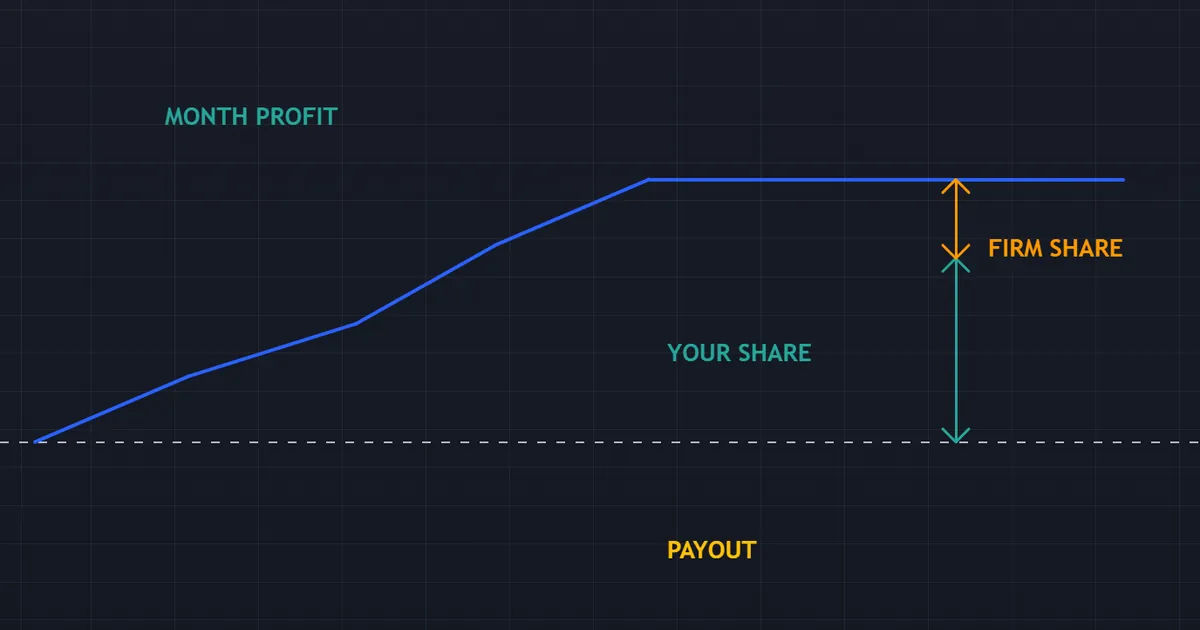
Reading That Example Fairly
Sixteen hundred dollars beats a hundred dollars by a wide margin. The comparison hides two costs, though.
The funded trader paid a fee and passed an evaluation first. She also trades under limits that can close the account overnight, while the personal trader answers to nobody.
When Keeping Everything Wins
Once your own account grows past a certain size, the split starts to hurt. A trader with real savings gains little by giving away a fifth of the upside.
So the personal route strengthens as your capital grows. Because compounding your own money keeps every gain, patience eventually favors ownership.
The Payout Timing Difference
Your own account pays whenever you press withdraw. A funded account pays on the firm’s cycle, sometimes with a minimum attached.
So cash flow differs even when the totals match. Because bills arrive monthly, that timing matters more to a full-time trader than the headline split does.
What Each Route Costs Over a Year
Costs look small in one month and mount across twelve. Both routes carry them, in different shapes.
So total the year before you choose. Because fees and spreads come out of the same pocket, the annual figure tells a cleaner story.
The Prop Route’s Running Costs
Evaluation fees repeat with every failed attempt. Some firms also add monthly platform charges or wider spreads.
So count the attempts you expect, not the one you hope for. Because two or three tries are common, an honest budget doubles the sticker price.
The Personal Route’s Running Costs
Your own account carries spreads, commissions, and swaps, with no fee on top. The cost sits inside every trade instead.
So an active style pays more here than a patient one. Because those charges scale with turnover, frequency matters as much as size.
The Cost of a Failed Attempt
A failed evaluation costs the fee plus the weeks you spent. A losing month on your own account costs real capital instead.
So the two setbacks bite in different places. Because a fee feels smaller than a drawdown, traders often repeat evaluations without noticing the running total.
How Each Route Handles a Losing Month
Every trader meets a bad month. The two routes respond in completely different ways.
So picture your own worst month on each. Because that scenario decides more than a good month ever will, it belongs in the comparison.
A Losing Month on Firm Capital
A firm account may simply close mid-month. The rules act long before your method gets a chance to recover.
So a rough patch can end the whole arrangement. Because recovery needs a fresh fee and a fresh evaluation, the setback costs money as well as time.
A Losing Month on Your Own Capital
Your own account survives as long as the balance holds. You can cut size, pause, and rebuild at your own pace.
That patience carries its own danger, though. Because nothing forces a stop, a losing month can stretch into a losing quarter.
Download the complete indicator database
Put these concepts on your charts. One email unlocks the full library of 1,380+ indicators with compiled MT4 and MT5 files, plus my TradingView scripts. No paywall, no spam, unsubscribe any time.
Get free access to my indicator database
One email unlocks 1,380+ free MT4, MT5 and TradingView indicators — the complete library. No single-tool download; you get the whole database.
Fee at Risk Versus Capital at Risk
The downside differs sharply, and this point decides many choices. One route risks a modest fee, the other risks your savings.
So weigh the worst case on both sides. Because losses feel much heavier than gains, the downside shapes behavior more than the upside does.
What You Can Actually Lose
On the prop route, a breach costs you the fee and the account. Your personal savings never move.
On your own account, a bad month costs real money you already owned. So the prop route caps your loss, while the personal route caps nothing.
The Repeat-Fee Trap
Capped losses tempt traders into repeating attempts. Five failed evaluations can cost more than a small trading deposit.
So count the fees you have paid, not just the current one. Because each attempt feels cheap in isolation, the running total deserves a spreadsheet.
Sizing Under Each Model
Sizing logic flips between the routes. A personal account sizes from your balance, while a funded account sizes from the firm’s floor.
A free prop firm position size calculator handles the floor version, and our general position size calculator covers your own account. So you can price the same trade under both models in a minute.
The Psychology Runs in Opposite Directions
The mental load differs more than most traders expect. Same charts, very different pressure.
So think about which pressure you handle better. Because your behavior under stress decides your results, temperament matters as much as method.
Borrowed Capital Feels Different
Trading a firm’s money removes the fear of losing your savings. It replaces that fear with the fear of breaking a rule.
Some traders relax and trade well. Others freeze, cut winners early, and stall short of the target.
Your Own Money Feels Different
Your own account carries no rule anxiety at all. Every loss, though, comes straight out of your pocket.
So the pain lands harder and lingers longer. Because nobody closes the account for you, a stubborn trader can lose far more than any firm would have allowed.
Which Pressure Suits You
Try a short answer test. If arbitrary limits irritate you, the personal route fits better.
If you trade well only when someone else enforces the stop, a funded account may suit you. So pick the pressure you handle, rather than the one that sounds braver.
Common Mistakes When Choosing
Most regrets trace back to a handful of errors. The panel below collects the ones worth avoiding.
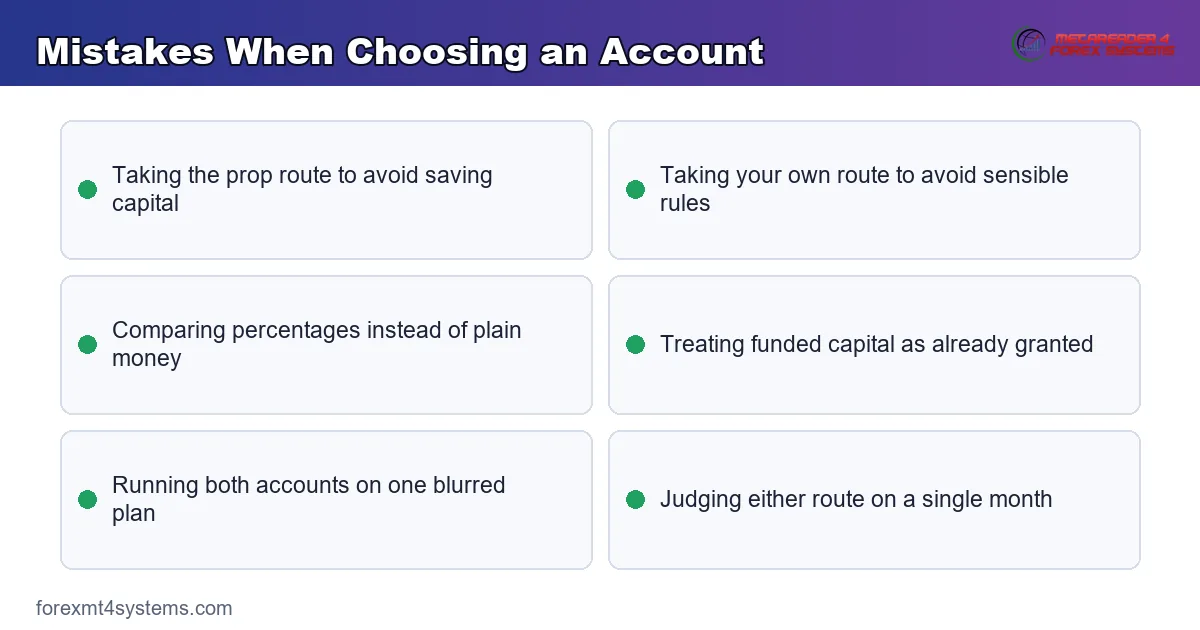
Choosing a Prop Firm to Avoid Saving
An evaluation fee is cheaper than a deposit, so it looks like a shortcut. The rules then punish a method that never worked.
So prove the method on a small personal account first. Because a firm’s limits amplify every flaw, an unproven edge fails faster with borrowed money.
Choosing a Personal Account to Avoid Rules
Some traders reject the prop route because they dislike the limits. Those limits usually mirror sound risk practice.
So write your own version and follow it. Because the rules exist to protect capital, dodging them protects nothing.
Comparing Percentages Instead of Money
A two percent month sounds identical on both routes. The take-home figure can differ by a factor of ten.
So run the arithmetic in plain money every time. Then the comparison stops flattering the smaller account.
Forgetting the Evaluation Hurdle
Funded capital arrives only after you pass a test. Most applicants never reach the funded stage at all.
So treat the prop route as a possibility rather than a plan. Because the gate is real, keep a personal account running while you try.
Running Both Routes Carelessly
Trading both accounts at once splits your attention. A trader watching two rule sets often breaks the stricter one.
So keep the plans separate and written down. Because the prop account has the harder limits, give it your quieter hours.
Judging a Route on One Month
A single month proves very little on either route. Traders quit the prop path after one breach and abandon their own account after one drawdown.
So review the choice over a quarter at least. Because both routes ride the same market, one bad stretch says more about the market than about the route.
Which Route Fits You: Quick Reference
Run down this list, and the honest answer usually appears within a minute.
- Little capital but a proven method: the prop route suits you.
- Solid savings and firm discipline: your own account suits you.
- Discipline that fades under pressure: enforced limits help you.
- A method needing wide stops and long holds: check the rules first.
- A need for withdrawals on demand: your own account wins.
- A wish to trade large soon: only the prop route offers it.
- Repeated failed evaluations: rebuild on a small personal account.
Pitfalls on Both Sides
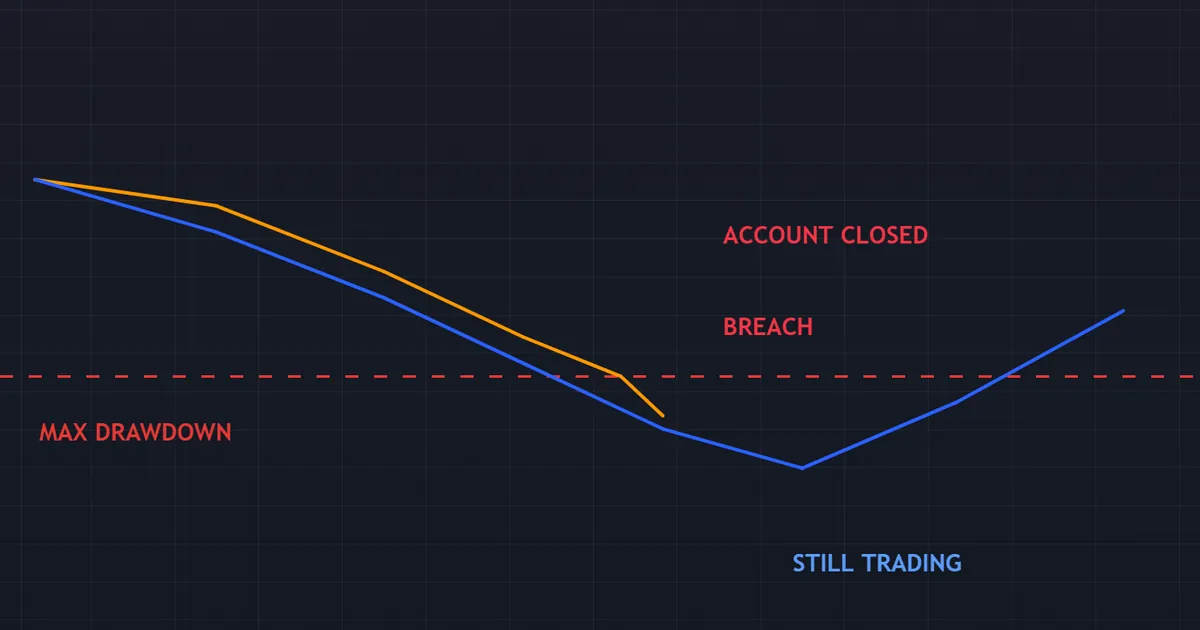
Each route hides a trap worth naming. The chart below shows a firm’s floor ending one equity path while a personal path survives the same drawdown.
The Prop Trap: One Breach Ends Everything
A funded account can end on a single bad session. Months of progress vanish with it.
So size for the nearest limit, never the target. Because the floor decides your survival, it deserves the first line of your plan.
The Personal Trap: Nothing Stops You
A personal account lets a bad day become a disaster. No system closes the platform for you.
So build a hard rule and automate it where possible. Because nobody else will intervene, the rule has to survive your worst mood.
Both Traps Share One Cause
Oversizing ends accounts on either route. The mechanism differs, yet the cause repeats.
So fix the sizing, and both routes become workable. Because position size drives every outcome here, it deserves more attention than the choice of route.
Related Concepts to Study Next
This comparison sits inside a wider picture, so a few short reads round it out. Each one sharpens a different part of the decision.
Start with the basics of what a prop firm is, then separate the two business models in our guide to prop firm vs broker. Because the funded stage carries its own habits, read what a funded trading account demands and the full set of prop firm rules. Then settle your risk per trade on either route, and browse more in our prop trading library.
FAQ
Is a prop firm better than a personal account?
Neither route wins for everybody. A prop firm suits a skilled trader with little capital, since it converts skill into size. A personal account suits a trader with savings and steady discipline, because it keeps every dollar of profit and every decision in your hands.
Do I keep more money with a prop firm or my own account?
It depends on the sizes involved. A share of a large funded account often beats all of a small personal one, so the prop route can pay more in absolute terms. Once your own capital grows, though, giving away part of the upside starts to cost you.
What do I risk with a prop firm compared with my own account?
On the prop route you risk the evaluation fee and the account itself, never your savings. On a personal account you risk the deposit directly. So the prop route caps your downside, while repeated fees can quietly add up to more than a small deposit.
Are prop firm rules harsher than my own rules?
They are usually stricter on paper and similar in spirit. A daily loss cap and a drawdown floor mirror what any careful trader should apply anyway. The real difference lies in enforcement, since the firm closes the account while your own rules rely on willpower.
Can I trade a prop account and a personal account together?
Yes, and many traders do exactly that. Keep separate written plans, and give the funded account your calmest sessions, since it carries the harder limits. Watch your total exposure too, because correlated trades across both accounts multiply the risk you actually hold.
Which route should a beginner choose?
Most beginners learn faster on a small personal account, where no rule can end the experiment early. Once the method holds up for several months, an evaluation becomes a reasonable next step. Either way, expect a long apprenticeship and size every trade so a bad week cannot stop you. Results are not guaranteed; past performance is not indicative of future results.
External references
- For background on this concept, see Margin Account at Investopedia.
- For broader market context, see Retail Trader at BabyPips.

About the author
Written by Dominic Walsh, a Forex trader and MT4/MT5 indicator, Expert Advisor and script developer. Every tool on forexmt4systems.com is tested on live charts before release and ships with ready-to-use compiled MT4 (.ex4) and MT5 (.ex5) files. Learn more about the trader and developer behind this site.
How we build, test and correct every tool: Editorial & Testing Policy. Trading carries risk; see the disclaimer.