
Traders who want to copy trade prop firms usually meet a rule long before they meet a market. Most programs restrict copying in some form, and a few ban it outright.
This guide stays firm-neutral. No program gets named or ranked here. Instead you get the categories of rule that recur across the industry, plus the questions that settle the matter for any account you hold.
What It Means to Copy Trade Prop Firms
Copy trading sends one account’s orders into another account automatically. A source account opens a position, and software repeats that order elsewhere.
The idea long predates funded accounts. Retail brokers built social and mirror features years ago, so the tools arrived well before prop programs had to police them.
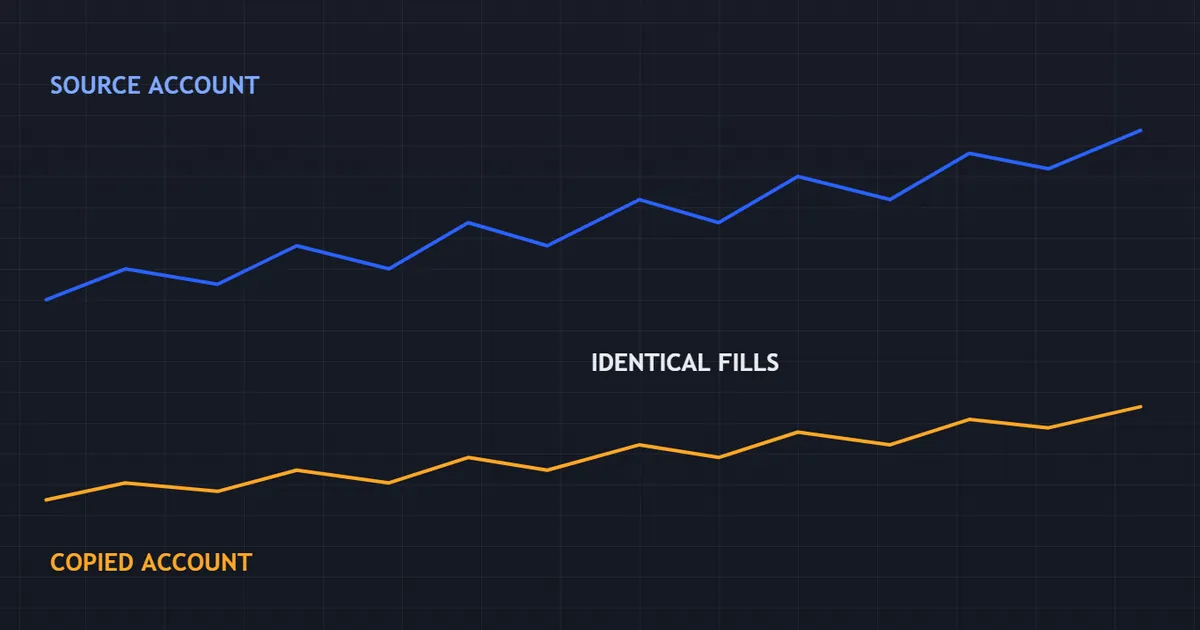
The panel above shows the effect in its purest form. Two equity paths share the same shape, because both accounts hold the same trades at the same moments.
That similarity creates the whole problem. A risk desk can spot it instantly, and identical fills across accounts raise questions no trader wants to answer.
Three Different Things People Mean
The phrase covers several practices, and firms treat them differently. Separate them before you read any rule document.
Some traders copy their own personal account into a funded one. Others follow a paid signal provider. A third group runs the same orders across several funded accounts at once. So one word hides three very different risk profiles.
Why the Distinction Matters
Rule documents rarely spell out every case. They tend to name the practice that worries them most, then add a catch-all clause about duplication.
So your job involves matching your plan to the closest named case. Because a support answer in writing beats a guess, ask before you connect anything.
How Copy Trading Actually Works
The plumbing stays simple. A bridge watches one account and pushes matching orders into another.
Every link in that chain adds delay and rounding. Both effects matter more on a funded account than on a personal one.
The Typical Sequence
Walk the path in order, because each stage introduces its own failure mode.
- Signal. A source account or provider opens a position.
- Detection. Copier software notices the new order, usually within a second.
- Translation. The tool converts the symbol name, since brokers use different suffixes.
- Scaling. It resizes the lot to match the receiving account.
- Execution. The order lands at whatever price the funded broker offers.
- Management. Stops, targets and closes follow the same route.
- Review. The firm’s risk desk reads the pattern days or weeks later.
Notice the last step. A copied trade can sit quietly for a month before anyone examines it, and the review usually arrives with your first payout request.
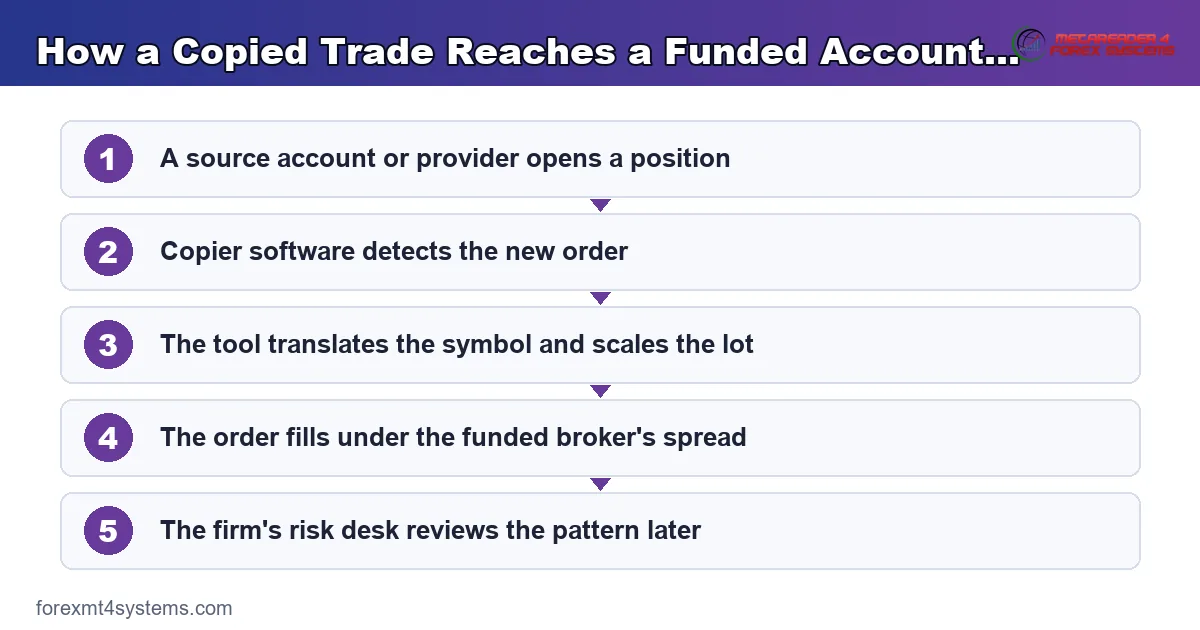
The flow graphic gathers those stages into one view. Keep it in mind whenever a tool promises effortless duplication.
Where the Slippage Creeps In
Delay costs money on fast entries. A quarter-second gap changes the fill, and scalping methods suffer most.
Spread differences add a second layer. Because the funded broker rarely quotes the same spread as the source broker, a method with a small edge can lose that edge in translation. So results diverge even when the copying works perfectly.
What the Tools Cost
Copier software sells by month or by licence. Prices sit low, so cost blocks almost nobody.
The real cost lands elsewhere. Because a breach can close a funded account, a cheap tool can carry a very steep risk.
Scaling Between Accounts of Different Size
Copier tools resize orders by balance, by risk percentage, or by a fixed multiplier. Each method breaks in a different way.
Balance scaling ignores your loss limit entirely. Because a funded account carries a floor rather than a balance-based risk model, a faithful copy can breach the daily cap while the source account sits comfortable. To set the lot size from the floor instead, our position size calculator works backwards from the risk you can afford.
The Rule Categories Firms Apply
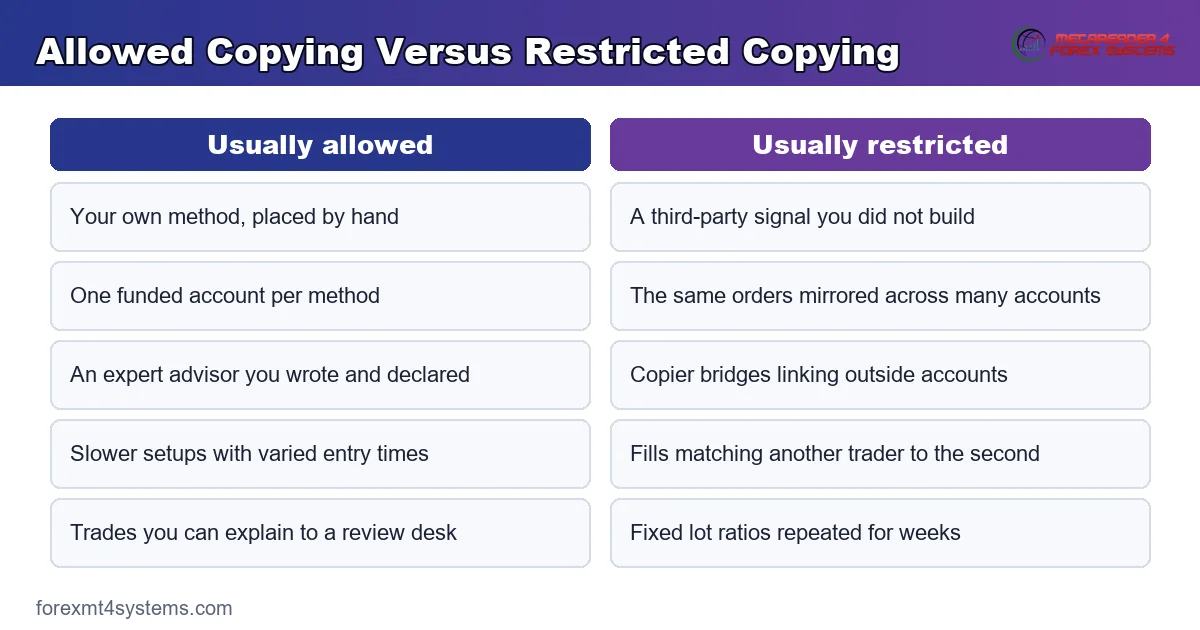
Programs write these clauses in their own words, yet the categories repeat. Learn the categories, then map any document onto them.
Five patterns cover almost every rule set. Read your agreement against all five.
Copying Between Your Own Funded Accounts
Many firms forbid running identical orders across several accounts they fund. The reason sits in their risk book rather than in fairness.
So a trader with three funded accounts cannot simply triple one method. Because the firm hedges its exposure as a whole, duplicated orders concentrate that exposure in one direction.
Third-Party Signal Providers
Following a paid signal service sits in a grey zone at many programs. Some allow it with disclosure, while others treat it as trading you did not perform.
The worry here turns on trust. Because the firm funds a person, it wants a trader who can explain each position. So expect questions about any method you cannot describe.
Copier Software and Trade Bridges
Bridges that link an outside account into a funded one draw the tightest restrictions. Firms watch for them, and platform logs make them visible.
Some programs permit a personal-to-funded link, provided the source belongs to you. Others refuse every external connection. Read the exact wording, since the difference decides whether your setup survives a review.
Group Copying and Identical Fills
Groups that trade one signal across many funded accounts create the pattern firms police hardest. Timestamps make the arrangement obvious.
So a chat room that posts entries to the second carries real risk for everyone in it. Because the firm reviews accounts against each other, a whole group can face closure together.
Automated Tools and Disclosure
Copiers count as automation, so the expert-advisor clause usually applies too. Programs differ on which tools they welcome.
Declare what you run. Our guide to prop firm EA rules covers the automation side in detail, and the same logic governs a copier.
A Worked Example of a Copied Position
One case makes the arithmetic obvious. Picture a personal account of ten thousand dollars and a funded account of fifty thousand dollars.
The source account risks one percent, so one hundred dollars sits at stake. A balance-scaled copier multiplies that by five, which puts five hundred dollars at risk on the funded side.
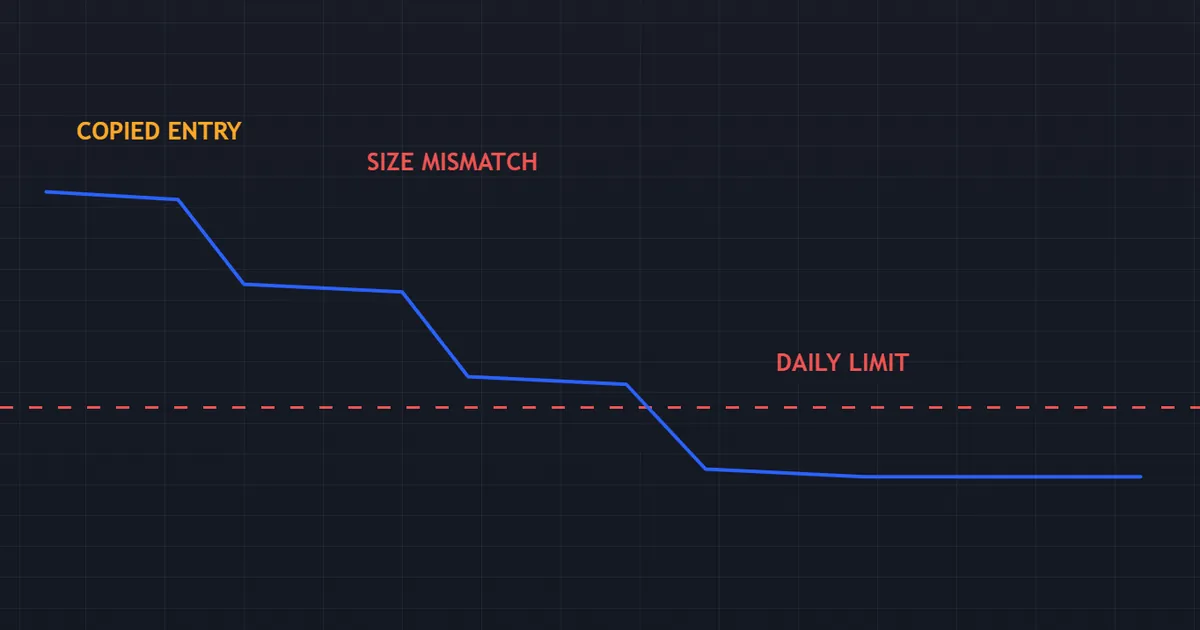
Now apply a typical daily loss limit of three percent. That cap allows fifteen hundred dollars in a session, so three copied losses consume the entire allowance.
Two more copies would end the day early. So the copy behaves faithfully while the account behaves badly, and nothing in the tool warned you.
The Same Method at Two Account Sizes
Change the source account, and the mismatch flips. A fifty thousand dollar personal account copying into a ten thousand dollar funded account under-risks every trade.
Neither outcome helps. Because the funded account carries its own floor and its own targets, the sizing must come from that floor rather than from a ratio between balances.
What the Review Desk Sees
A reviewer opens two trade histories and compares timestamps. Matching entries within a second look mechanical, and matching exits confirm it.
So the pattern speaks for itself. Because the desk needs no confession, an explanation after the fact rarely changes the outcome.
Download the complete indicator database
Put these concepts on your charts. One email unlocks the full library of 1,380+ indicators with compiled MT4 and MT5 files, plus my TradingView scripts. No paywall, no spam, unsubscribe any time.
Get free access to my indicator database
One email unlocks 1,380+ free MT4, MT5 and TradingView indicators — the complete library. No single-tool download; you get the whole database.
Why Firms Restrict Copying
The rules look arbitrary until you see the firm’s side. Three motives explain nearly all of them.
None of the three involve punishing skill. They protect a business model that depends on spread-out, uncorrelated risk.
Correlated Risk Across the Book
A firm hedges the aggregate of its funded traders. Duplicated positions defeat that hedge, since many accounts push the same direction at once.
So a single news spike can hit every copied account together. Because the firm absorbs those losses, it prices the risk by banning the practice outright.
Payout Farming
Running one method across many accounts turns a coin flip into a lottery ticket. Some accounts survive, others fail, and the survivors request payouts.
Firms treat that pattern as gaming the model rather than trading. So consistency clauses and duplication clauses usually appear side by side. Our note on the prop firm consistency rule explains how the two interact.
Latency and Feed Exploits
A copier can carry an exploit as easily as a strategy. Latency arbitrage between two feeds sits on almost every prohibited list.
So firms watch for sub-second entries that precede a price move. Because the pattern looks identical whether the intent existed or not, an innocent fast copier can trip the same alarm.
Signs a Risk Desk Looks For
Reviews rest on data, not on hunches. Three signals do most of the work.
None of them need a confession. Each one shows up in plain trade history.
Matched Entry Times
Two accounts that open at the same second look linked. Human clicks vary by several seconds at least.
So tight timing gives the game away. Because the desk sorts trades by time stamp, the match jumps off the page.
Matched Lot Ratios
A steady ratio between two accounts points to a tool. One account trades one lot, the other trades five, every single time.
Human sizing wanders. So a fixed ratio across dozens of trades reads as software, and the desk treats it that way.
Matched Stops and Targets
Copiers repeat stop and target levels to the pip. Two accounts then show the same exit prices all month.
Hand-placed stops drift a little. So identical levels across many trades point at software just as clearly as the entry times do.
Shared Logins and Devices
Firms record the address and the device behind each login. Two accounts on one machine raise a flag at once.
So use your own device and your own payment details. Because a shared laptop looks like a shared trader, this fix costs nothing.
Copying Your Own Personal Account
This case causes the least trouble, yet it still needs a check. Some programs allow it, and some do not.
The wording usually turns on who owns the source. So read that line closely.
When Programs Allow It
Firms worry about outside signals far more than about your own trades. If you own both accounts, the trust problem shrinks.
So a plain personal-to-funded link often passes. Because the rule still varies, ask support and save the reply.
How to Set It Up Safely
Cap the lot size inside the tool. Then set that cap from the funded floor, never from the source balance.
Turn the bridge off around news. So a spike cannot fire a copied order into a thin spread. Check both accounts each evening, and log any trade the tool missed.
How to Stay Inside the Rules
Most trouble comes from assumption rather than from intent. A short routine removes almost all of it.
Three habits cover the ground. None of them cost anything.
Read the Prohibited Methods List First
Every rule document carries one, usually near the end. Copy trading, group trading and third-party management sit in that list at many programs.
So read it before you buy, not after. Our overview of prop firm rules walks the standard clauses in plain terms.
Keep One Method per Account
Run different setups on different accounts, or trade only one account. The separation removes the duplication question entirely.
So your histories stop matching. Because varied entries and exits look like human decisions, a review passes without a conversation.
Log Your Own Reasoning
Write the reason for each entry as you place it. A journal turns an awkward question into a two-minute answer.
That habit helps beyond compliance. Because portfolio risk grows when positions correlate, tracking your exposure protects the account too, as our guide to portfolio heat explains.
Common Copy Trading Mistakes and Fixes
The same errors repeat across thousands of funded accounts. The graphic below sets each slip beside its fix.
Assuming Silence Means Permission
A rule document that never mentions copiers still carries a catch-all clause. Traders read the gap as approval. So ask support directly, and keep the written reply.
Scaling by Balance Instead of Risk
Balance ratios ignore the loss limit that governs a funded account. One faithful copy can then breach a daily cap. So set the lot size from the floor, and cap it there.
Copying a Scalping Method
Fast entries suffer most from copier delay. The edge disappears into slippage while the risk stays intact. So reserve copying for slower methods, if you copy at all.
Running the Same Orders on Two Funded Accounts
Two accounts feel like two chances until a review reads both histories. Firms treat matched fills as one position. So trade one account, or trade genuinely different methods.
Joining a Signal Group Without Checking
Group members often share a rule breach without knowing. Everyone in the room posts the same entry. So verify the clause yourself, since a group leader carries none of your risk.
Forgetting the Source Account
Traders watch the funded account and ignore the account driving it. A change at the source then arrives unannounced. So review both sides weekly, and switch the bridge off during news.
Alternatives Worth Considering
Traders reach for a copier to save time or skill. Three other routes solve the same problem without a rule fight.
All three ask more of you at the start. All three cost less at the end.
Learn the Method, Then Trade It
Watch the signal source for a month and write down the logic. Then place the trades yourself.
Your fills will differ, and that helps. Because your history now looks human, a review passes quietly. You also learn why each trade exists.
Automate Your Own Rules
An expert advisor you built yourself sits on firmer ground. You can explain every line of it to a review desk.
So declare the tool, then keep the code. Because the firm funds a trader rather than a service, ownership matters more than speed.
Trade One Account Properly
One funded account with a tested plan beats five copied ones. Focus removes the whole duplication question.
So drop the extra logins. Because attention splits badly across accounts, the single account usually earns more anyway.
Copy Trading Quick Reference
Keep this list beside the rule document while you compare programs. Run through it before you connect any tool.
- Copy trading means one account’s orders repeat automatically in another.
- Firms police duplication because correlated risk breaks their hedging.
- Rules usually name three cases: own accounts, third-party signals, and groups.
- Copier software counts as automation, so the expert-advisor clause applies.
- Balance scaling ignores the loss floor that governs a funded account.
- Latency and slippage erode fast methods more than slow ones.
- Reviews arrive with your first payout request, not on the day you trade.
- A written answer from support settles far more than a forum post.
- Matched entry times and fixed lot ratios flag a copier instantly.
- Shared devices and shared payment details raise the same alarm.
- Copying your own personal account carries the lowest rule risk.
Pitfalls and Edge Cases
A few wrinkles bend the clean picture. The chart below shows two accounts diverging after a duplicate-order flag closes one of them.
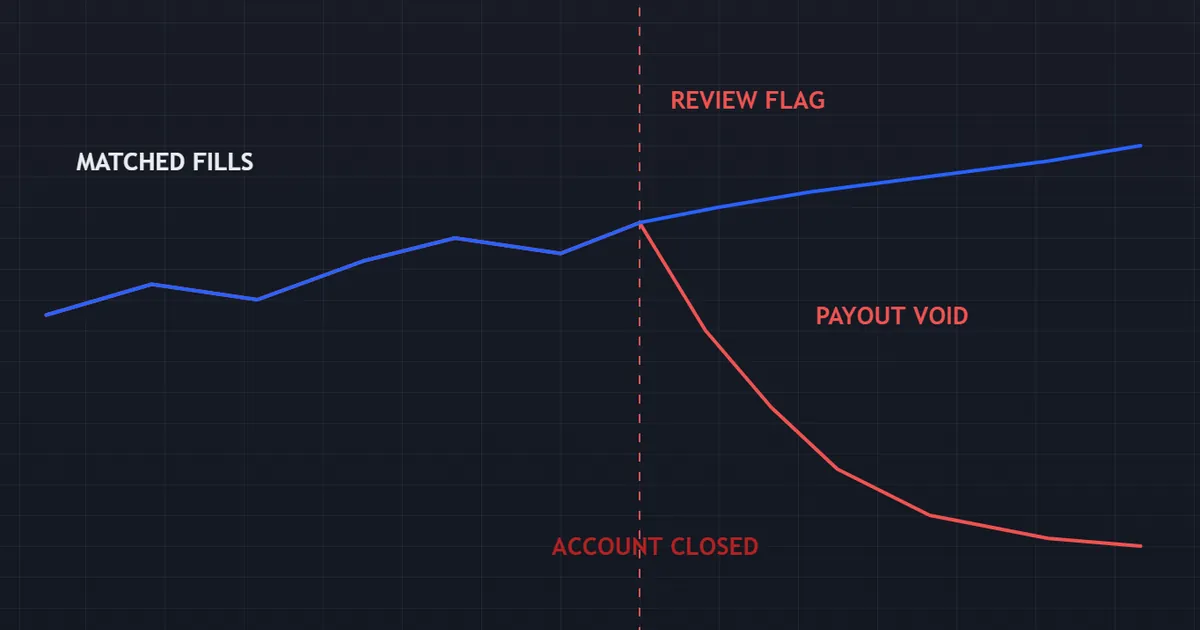
Picture the sequence from the trader’s side. Both accounts run the same method, both stay profitable, and then a payout request triggers a comparison. One account survives, and the other closes with its profit unpaid.
Family and Shared Devices
Two traders in one household can trip a duplication check by accident. Firms match device fingerprints and payment details as well as fills.
So declare the relationship early. Because an unexplained match looks deliberate, a note on file removes the suspicion before it forms.
Managing Another Person’s Account
Trading someone else’s funded account breaks the agreement at almost every program. The clause names the account holder personally.
So account sharing carries more risk than copying. Because the firm can void every payout on both sides, the arrangement rarely ends well for either trader.
Copying and the Consistency Cap
A copied method can bunch profit into one day. The consistency clause then holds the payout back.
So spread your trading across sessions. Because the cap reads your profit mix rather than your intent, one busy Monday can delay a clean month.
Marketplace Signals and Platform Features
Platform marketplaces make subscription copying trivial. A single click connects a stranger’s orders to your funded account.
Convenience hides the rule problem. So treat a marketplace subscription exactly as you would treat a private bridge, and check the clause first.
Rule Rewrites After You Start
Terms change, and copying clauses tighten more often than they loosen. A permitted setup can turn prohibited between two payout cycles.
So save the document on the day you join. Because your own snapshot dates the version you accepted, it settles a dispute far faster than memory.
Related Concepts to Study Next
Copying sits inside a wider rule set, so a few neighbouring topics repay an hour of reading. The clauses interlock, and one breach rarely arrives alone.
Start with our look at why traders fail prop challenges, since rule breaches feature heavily in that list. For the wider commercial picture, compare a prop firm against a broker and note who carries the risk in each case. Traders juggling several accounts should also test a month against a cap with our consistency rule calculator before filing anything.
FAQ
Can you copy trade on a prop firm account?
Sometimes, and the answer depends on the program and on what you copy. Many firms allow you to mirror your own personal account, yet ban third-party signals and duplication across several funded accounts. Read the prohibited methods list, then confirm with support in writing.
Why do firms ban copying between funded accounts?
Duplicated orders concentrate the firm’s risk in one direction. A single adverse move then hits every copied account at once, which breaks the hedging the business relies on. Firms also treat the practice as gaming the payout model.
Does a copier count as an expert advisor?
Usually yes, because it places orders without a human click. The automation clause therefore applies, along with any restriction on news trading or high-frequency entries. Check both clauses before you connect the bridge.
What happens if a firm detects copying?
Outcomes range from a warning to closure with the pending payout cancelled. The severity depends on the clause you broke and on whether several accounts shared the pattern. Appeals rarely succeed once timestamps match to the second.
Can I copy signals from a public marketplace?
Only where the rules permit third-party signals, and many programs do not. A marketplace subscription looks identical to a private bridge in the trade log. So the convenience of one click changes nothing about the clause.
Is copying a shortcut to a funded payout?
No. Copying imports someone else’s risk profile into an account with your loss limits attached. Most people who buy an evaluation never reach a payout, and borrowed trades do not change that arithmetic. Results are not guaranteed; past performance is not indicative of future results.
External references
- For background on this concept, see Automated Trading Systems at Corporate Finance Institute.
- For broader market context, see Social Trading on Wikipedia.

About the author
Written by Dominic Walsh, a Forex trader and MT4/MT5 indicator, Expert Advisor and script developer. Every tool on forexmt4systems.com is tested on live charts before release and ships with ready-to-use compiled MT4 (.ex4) and MT5 (.ex5) files. Learn more about the trader and developer behind this site.
How we build, test and correct every tool: Editorial & Testing Policy. Trading carries risk; see the disclaimer.