
Every few months a new wave of products promises a machine that learns the market for you. So the question arrives again: do ai trading bots work, and how would anybody know?
The honest answer starts with a distinction. Nobody outside a vendor can say what a specific product does, and that limitation is itself the most useful thing to understand.
Do AI Trading Bots Work? Start With the Claim
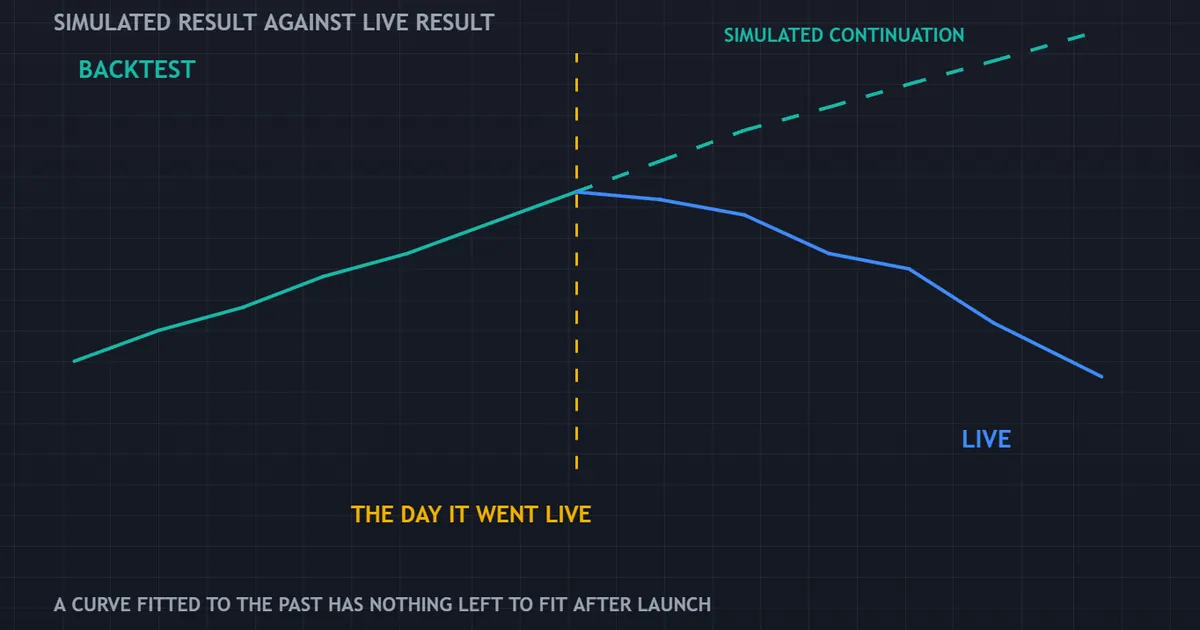
The panel above shows the shape behind most complaints. A smooth simulated path climbs, then the live path flattens and falls from the day the account went live.
That split has ordinary causes. Costs arrive, conditions change, and a model tuned on history meets data it never saw.
What the Word Covers
The label stretches across very different things. A simple decision tree, a neural network, a language model reading headlines and a plain moving average crossover have all been sold under the same word.
So ask what the system computes before you ask whether it works. Vague labels resist every test you could apply.
What Working Has to Mean
Define the claim first. Working might mean a positive expectancy after real costs, or it might mean a losing stretch you can sit through.
Those two definitions pull apart quickly. Write yours down, because a vague claim survives any evidence at all.
What Machine Learning Does to Price Data
Models do something specific and limited. Knowing that removes most of the mystique.
It Finds Patterns Rather Than Reasons
A model searches for relationships between inputs and a labelled outcome. It has no concept of a central bank, a payroll release or a liquidity gap.
So a pattern that held for two years can dissolve without anything inside the model noticing. Correlation carries no obligation to persist.
Labels Leak the Future
Training needs a target, and targets get built from data that came later. Careless construction lets information from the future reach the model.
The result looks brilliant in testing and collapses live. Our note on curve fitting in trading covers the same trap in simpler systems.
Price Data Is Mostly Noise
Financial series carry a small signal inside a very large amount of randomness. Flexible models fit the noise happily, since noise fits better than signal does.
More parameters make that worse. A larger model needs more evidence, and markets supply less new evidence than people assume.
The Black Box Problem
Here sits the honest core of the whole topic. Complex models buy flexibility, and they cost you the ability to read the rule.
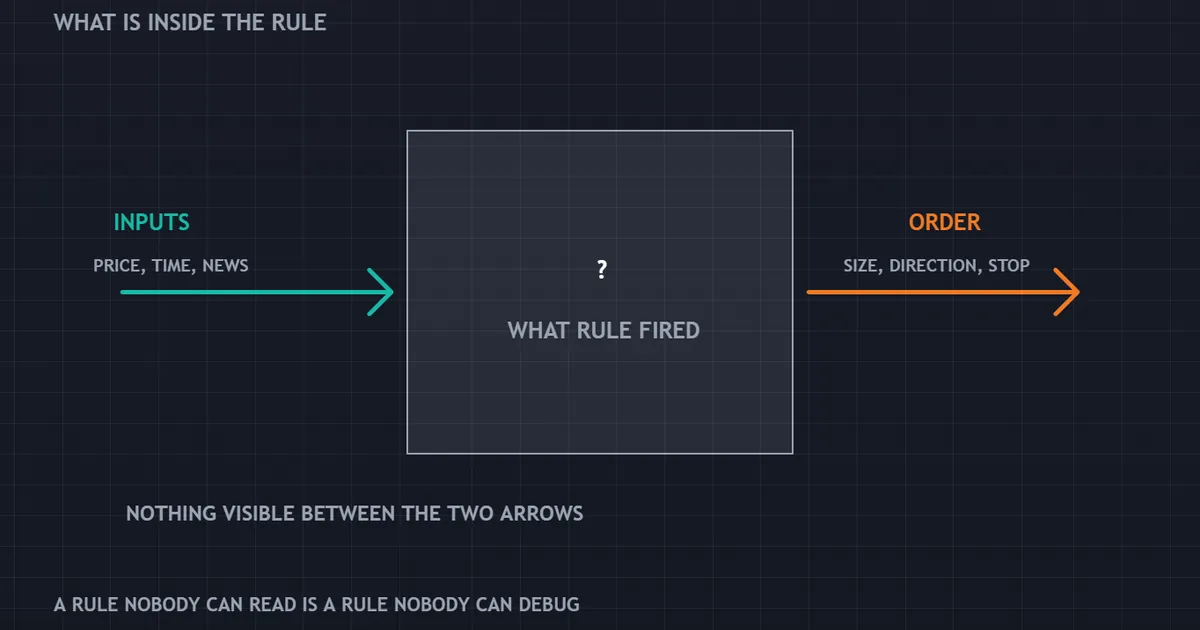
The panel above says it plainly. Inputs go in, an order comes out, and the question in the middle stays unanswered.
A Rule Nobody Can State
Ask why the system bought and a simple rule answers immediately. A large model cannot, since its decision lives across thousands of weights.
You cannot check a rule you cannot read. So you take it whole, or you leave it.
A System Nobody Can Debug
Every automated strategy eventually stops working. When a stated rule fails, you can inspect which condition changed and decide what to do.
When an opaque system fails, that path closes. Nobody can tell whether the market moved, the data pipeline broke, or the model simply found nothing real to begin with.
Why This Matters More Than Accuracy
Traders focus on how often a system wins. Maintenance decides the outcome far more often than that figure does.
A rule you can read survives a change of broker, a change of symbol and a change of regime. A rule nobody can read survives none of them gracefully.
Download the complete indicator database
Put these concepts on your charts. One email unlocks the full library of 1,380+ indicators with compiled MT4 and MT5 files, plus my TradingView scripts. No paywall, no spam, unsubscribe any time.
Get free access to my indicator database
One email unlocks 1,380+ free MT4, MT5 and TradingView indicators — the complete library. No single-tool download; you get the whole database.
How to Test a Claim About an AI Bot
Six steps convert marketing into evidence. Each one removes a way of fooling yourself.
- Ask what the model reads. Inputs, timeframe and the exact target it predicts.
- Ask how the data was split. Training, validation and a test period nobody touched.
- Check for lookahead. Any input built from later bars invalidates everything after it.
- Insist on unseen data. Identical settings, a period the model never met, no tuning afterwards.
- Add real costs. Variable spread, commission, swap and a realistic allowance for slippage.
- Forward test before funding. Live prices expose errors that history hides completely.
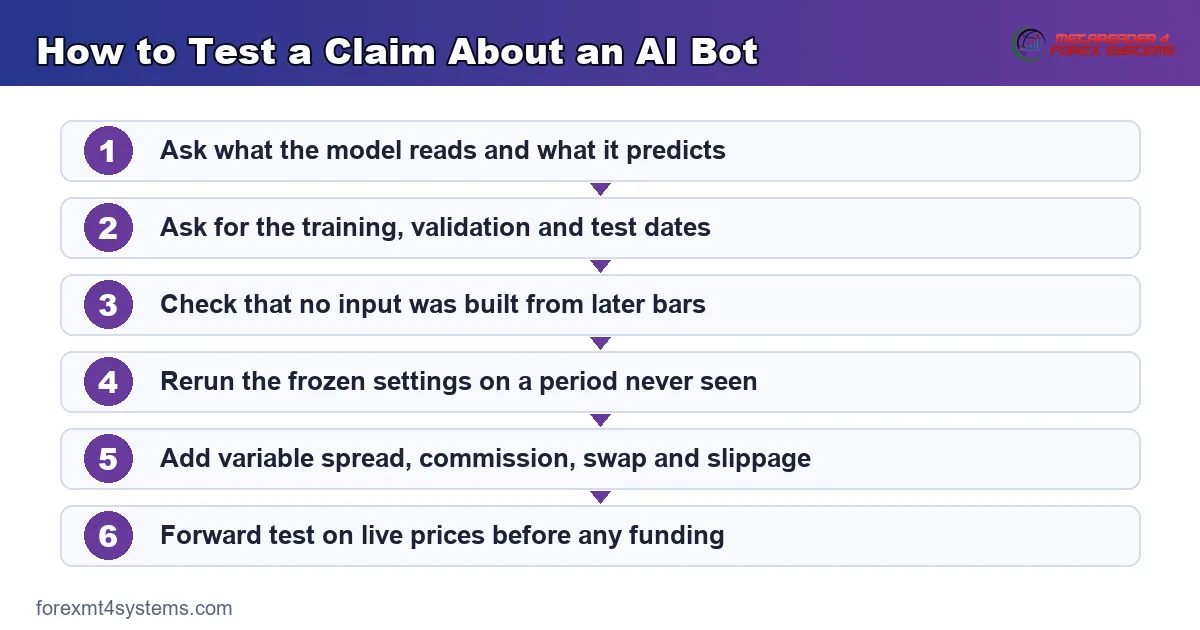
Step two stops most conversations. Vendors who cannot describe the split usually never made one.
Step four decides the rest. A frozen set of settings on data the model never met is the only test that can fail honestly.
Our guide on how to evaluate a forex EA applies the same discipline to conventional programs.
Why the Live Curve Splits From the Backtest
The gap has four ordinary sources. None of them requires anybody to lie.
The Model Saw the Answers
Repeated tuning on one data set leaks knowledge of that set into the settings. A final report then measures memory rather than skill.
The Cost Model Was Kind
Most tests apply one fixed spread. Real spread widens on news and at the daily rollover, and frequent trading multiplies that error.
Execution Differs
Requotes, slippage and rejected orders never show up in a test. Fast markets deliver all three at once.
The Sample Was Kind
A test window without a violent trend never met the failure case. Extending the same test by two years often changes the verdict.
Work out what your own edge needs to survive with our expectancy calculator. Small cost changes move that number further than most people expect.
The Market a Model Never Met
Regime change ends more automated systems than bugs do. One chart makes the point better than a page of argument.
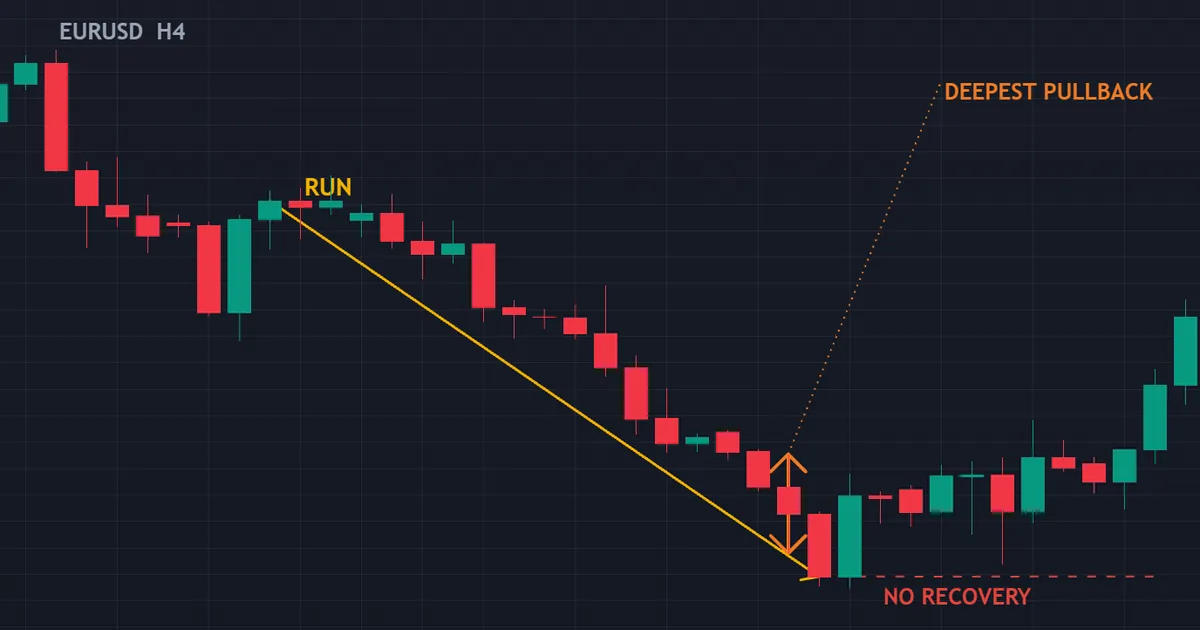
Price ran down 6.2 ATR over 18 bars and the deepest pullback against that run was only 26 percent of the distance travelled, so a model buying every dip stayed underwater the whole way down.
What a Trained Model Does There
A system trained mostly on ranging data learns that dips get bought. It then keeps buying, because that behaviour paid inside the training period.
Nothing in the model measures the regime. It repeats the lesson it learned until somebody switches it off.
Why You Cannot Diagnose It Live
During a run like that, you cannot tell whether the model has broken or simply hit a bad stretch. Both look identical from the outside.
An explicit rule at least tells you which condition fired. That difference decides whether you can act on the drawdown or only watch it.
Price did climb back over the weeks that followed, which is exactly the trap. The bounce arrived long after a dip-buying model had already booked the damage.
What the Page Shows Against What You Need
Sales pages and evidence rarely overlap. The gap between them follows a pattern.
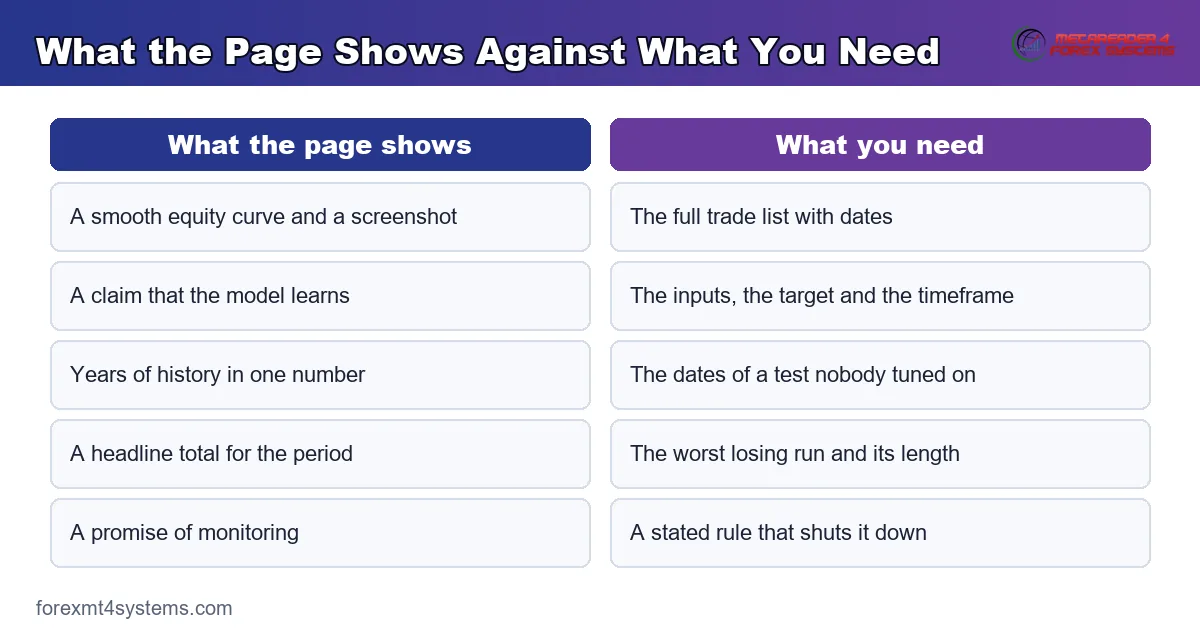
Read the right column as your shopping list. Anything missing from it leaves the claim untested.
Screenshots Are Anecdotes
An image of a strong week says nothing about the weeks around it. It also hides the balance and the risk taken.
Ask for the Trade List
Trade count, holding time and the worst losing run describe behaviour. An equity curve only summarises it.
Three Claims That Should Stop You
Some lines show up on nearly every sales page. Each one hides a gap.
It Learns and Adapts
Ask what it learns from, and how often. A model that updates each week is a new system each week, so no live record ever builds up.
It Works on Any Pair
Markets differ in spread, in hours and in habit. A rule that fits all of them equally well usually fits none of them closely.
It Was Trained on Ten Years of Data
Old data describes a market with wider spreads and slower fills. Depth of history helps a little, and it counts for far less than a clean test on recent bars nobody touched.
A Note on Language Models
Chat models read text, and text about markets is cheap and plentiful. That mix attracts a lot of product ideas.
What They Do Well
Summing up a release, sorting headlines by topic and drafting notes all work fine. Each task has a clear answer you can check.
What They Cannot Do
A model that writes fluent text about a pair still holds no view worth trading. Smooth prose reads like insight and carries none.
Where the Risk Sits
Confident wording invites trust that the output has not earned. Check every number against the source before you act on it.
Where Machine Learning Genuinely Helps
The sceptical case runs long, so balance deserves its own section. Models do several things well, and none of them involves forecasting price.
Sorting and Filtering
Sorting market states into buckets works well enough. A model that flags a wild day can gate a rule you wrote and can read.
Execution and Sizing
Guessing likely slippage, or shaping order size against depth, suits these methods. Both tasks have plenty of data and a stable shape.
Research Assistance
Testing thousands of variants quickly helps, provided you treat the output as hypotheses. Our indicator library gives you inputs to study rather than finished answers.
Where It Struggles
Direct price forecasting remains the hardest case. The signal stays small, the noise stays enormous, and the relationship shifts while you work.
Costs, Latency and the Retail Gap
Large firms do use these methods at scale. Their setup differs from yours in ways that decide the result.
Data
Serious work uses clean tick data, book depth and years of stored history. Retail platforms hand you broker bars with gaps in them.
Speed
Fast strategies live or die on delay. A home connection sits in a different world from a rack beside the exchange.
Cost per Trade
Frequent trading multiplies spread and commission. A thin edge that lives at bank cost dies at retail cost.
So a bank desk that does well tells you little about a file you can buy. The two work under different limits.
What a Small Live Test Tells You
Live money at the smallest lot teaches things no test can. Run one before you scale anything.
The Real Spread
Your bill shows up trade by trade. Compare it with the figure the test used, then judge the edge again.
The Real Fill
Note the price you asked for and the price you got. Do that thirty times and you hold a slippage figure of your own.
Your Own Nerve
Watch how you feel on the third losing day. That answer shapes the result as much as the code does.
Signs a Model Has Stopped Working
Decay rarely arrives as a crash. Four signs show up first.
Trade Count Drifts
A sharp change in how often it trades means the inputs now look different to the model. Log the count each week.
Holding Time Changes
Trades that used to close in hours now run for days. The rule has met a market it was not shaped for.
Losses Cluster on One Side
Long runs of losses on the buy side or the sell side point at a bias, not at bad luck.
The Log Fills With Errors
Broker changes break data feeds quietly. Read the journal tab weekly, since errors show there long before they show in the balance.
Questions to Ask a Vendor
Send these before money moves, then keep the answers. Slow replies carry information too.
- What does the model predict, exactly? Direction, volatility, or a signal on some threshold.
- How were the data split? Ask for dates rather than adjectives.
- What happens when it stops working? A stated shutdown rule beats a promise of monitoring.
- How does it size positions? Fixed lots and percent-of-equity behave very differently in a drawdown.
- How long is the live record? Months from the first live order, not a simulated stretch.
- Who retrains it, and how often? Frequent retraining introduces its own instability.
Answers in writing beat answers in a chat window. Save them, since they define what you agreed to.
Retraining Sounds Like a Fix
Adaptive systems get sold on the idea of continuous learning. That idea deserves a closer look.
Adaptation Cuts Both Ways
A model fed on recent data follows the recent market. So it adapts fastest to whatever has just stopped happening.
Every Retrain Is a New System
Change the weights and you change the strategy. The live record you read describes a version that no longer exists.
Testing Never Catches Up
A system that changes weekly cannot accumulate a meaningful live record. Each version gets judged on a handful of trades, which settles nothing.
What Nobody Can Tell You From Outside
Some questions have no answer from where you sit. Saying so plainly avoids a lot of waste.
Whether a Given Product Makes Money
You cannot see the code, the data or the full live record. Any verdict from outside rests on the seller’s own numbers.
Whether the Record Is Complete
Failed versions rarely reach a web page. A shelf of survivors looks strong even when most attempts died quietly.
Whether It Will Keep Working
That question asks about a market nobody has seen yet. No test answers it, however long the history runs.
So state the limit out loud when somebody asks your view. An honest gap in the evidence beats a confident guess, and it keeps your own money in the right place.
Start With a Rule You Can Read
The plainest advice here costs nothing. Write a rule in one sentence, then test that.
Why Short Rules Age Better
A short rule has few places to hide a fitted number. It also tells you what to check when the market shifts.
Complexity Has to Earn Its Place
Add a term only when it beats the simple version on data it has never met. Most extra terms fail that test.
Keep the Log Either Way
Every version needs its own record. Dates, settings and results in one file settle arguments a year later.
A Sensible Position on the Whole Category
Two statements cover the ground without overclaiming in either direction.
Nobody Can Rank These Products
A ranking needs like-for-like records, costs and dates. Those rarely line up, so most league tables just rank the ad spend.
The Test Is the Same as Ever
Fix the rules, test on unseen data, model real costs, then run small live for months. That process works whatever sits inside the program.
Review the log afterwards with the same discipline you use elsewhere. Our note on how to review your trades covers a format that survives a busy month.
Automation Is Delivery, Not Edge
A program runs a process the same way each time, and nothing more. Our wider look at whether forex robots work makes the same case for conventional systems, and the modelling technique does not change it.
Learning the plumbing helps too. Our overview of algorithmic trading in forex describes the pipeline every automated system runs through.
A Checklist You Can Work Through
Answer each row honestly before money moves. It takes an evening and saves a great deal more.
| Question | What good looks like | Warning sign |
|---|---|---|
| What does the model predict? | A stated target on a stated timeframe | A vague claim about learning the market |
| How were the data split? | Dates for training, validation and a clean test | One long run across all available history |
| What costs were modelled? | Variable spread, commission, swap and slippage | Zero commission and one fixed spread |
| How long is the live record? | Months from the first live order | A simulated curve presented as a result |
| How often does it retrain? | Rarely, with every version logged | Weekly updates and no version history |
| What stops it? | A hard loss cap the program obeys itself | Reliance on you to step in by hand |
Six rows remove most products from the shortlist. That outcome is the point of the exercise.
FAQ
Can an AI bot predict the forex market?
No method available to a retail trader predicts price reliably, and machine learning does not change that. Models estimate relationships inside past data, and those relationships shift. Treat any product claiming prediction as marketing, since the claim exceeds what the evidence could ever support. A model can still be useful for sorting, filtering and sizing, and none of those tasks require a forecast.
Why do these systems test so well and trade so badly?
Four causes stack up. Repeated tuning leaks knowledge of the test data into the settings, cost assumptions run optimistic, execution adds slippage and rejections that no simulation contains, and the test window often lacked the conditions that break the model. Each cause looks minor, and together they explain most of the gap.
Is a neural network better than a simple rule?
Not automatically, and often worse for a retail account. Flexible models need far more evidence than price data supplies, and they fit noise readily. A simple rule you can state, test and inspect gives you something to maintain when performance changes. Complexity should earn its place on data the model has never met.
What does explainability actually buy me?
The ability to act. When a stated rule fails you can check which condition changed, then decide whether to adjust or stop. When an opaque system fails, nobody can separate a broken model from an ordinary losing run, so every decision becomes a guess.
How long should I forward test one of these?
Long enough to meet a losing run, which usually means months rather than weeks. Run a demo first to catch mechanical errors, then trade the smallest size your broker allows so that fills and costs become real. A short record cannot separate an edge from a streak. Decide the stopping point before you start, then let the log settle the question rather than your mood.
Should I avoid the category completely?
That decision depends on what you want from it. Studying the methods teaches you a great deal about testing, sampling and the limits of evidence, and that knowledge transfers to everything else you do. Buying an opaque product on a published curve is a different proposition, because you cannot review the rule, cannot debug it when it changes, and cannot verify the record that persuaded you. Results are not guaranteed; past performance is not indicative of future results.
External references
- For background on this concept, see ONNX Machine Learning Models in the MQL5 Documentation.
- For broader market context, see Concept Drift on Wikipedia.
- The limits of what an AI trading bot actually understands about a market are spelled out in AI Won’t Turn Trading Bots into Money Machines at the CFTC.

About the author
Written by Dominic Walsh, a Forex trader and MT4/MT5 indicator, Expert Advisor and script developer. Every tool on forexmt4systems.com is tested on live charts before release and ships with ready-to-use compiled MT4 (.ex4) and MT5 (.ex5) files. Learn more about the trader and developer behind this site.
How we build, test and correct every tool: Editorial & Testing Policy. Trading carries risk; see the disclaimer.