
A chart shows the same thing to everyone. What separates two accounts is how reliably a decision turns into an order, and that is the gap algorithmic trading in forex tries to close.
The term sounds larger than the reality. Underneath it sits a written rule, a data feed and a piece of code that sends orders when the conditions line up.
What Algorithmic Trading in Forex Actually Means
An algorithm is a sequence of instructions with no ambiguity in it. Applied to currencies, that means a rule precise enough for a machine to follow without asking you anything.
Everything else follows from that precision. If a step cannot be written exactly, it cannot be automated at all.
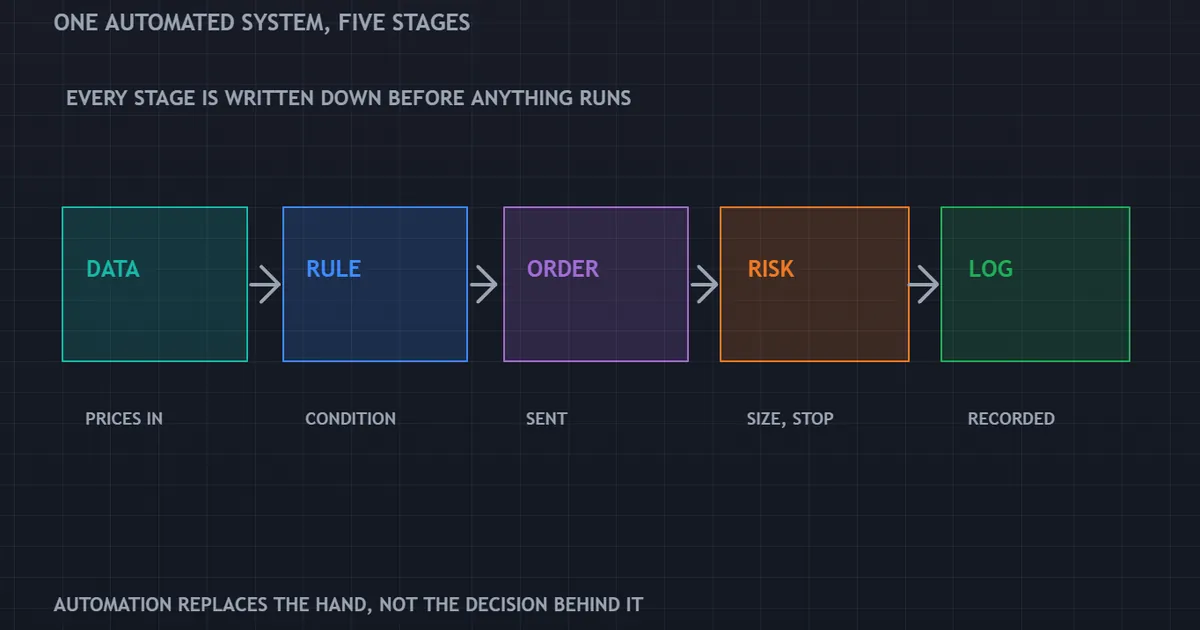
The panel above lays out the five stages every automated system runs through. Data arrives, a rule evaluates it, an order goes out, a risk check sizes and protects it, and a log records the result.
The Five Stages in Order
Data comes first, and it decides everything downstream. A missing tick or a bad quote produces a decision the trader would never have made.
The rule stage does the reasoning. It compares numbers, and nothing more mysterious happens there.
Then the order, the risk check and the log complete the loop. Skip the last one and you lose the only record of what actually happened.
What It Is Not
An algorithm does not predict anything. It applies a rule you wrote, so any forecasting inside it came from you rather than from the code.
Nor does it mean high-speed trading. Millisecond strategies form a tiny corner of the field, and our note on high frequency trading explains why retail accounts rarely compete there.
Why the Distinction Matters
People buy programs expecting intelligence and receive obedience instead. Obedience has real value, though only when the instructions are worth obeying.
So the quality of an automated system sits entirely in the rule. Code quality decides whether the rule survives contact with a broker.
How a Rule Becomes an Order
Six steps carry an idea from a notebook to a filled position. Each one can break independently.
- A price update arrives. The terminal receives a new quote and hands it to the program.
- The rule evaluates on a closed bar. Acting mid-bar means acting on a value that can still change.
- Risk sets the size. Stop distance and account balance decide the volume, never a fixed habit.
- The order goes out. Market or pending, with a stop attached before anything else happens.
- The broker responds. A fill, a partial fill, a requote or a rejection, each needing different handling.
- The result reaches the log. Requested price, filled price, time and the reason for the trade.
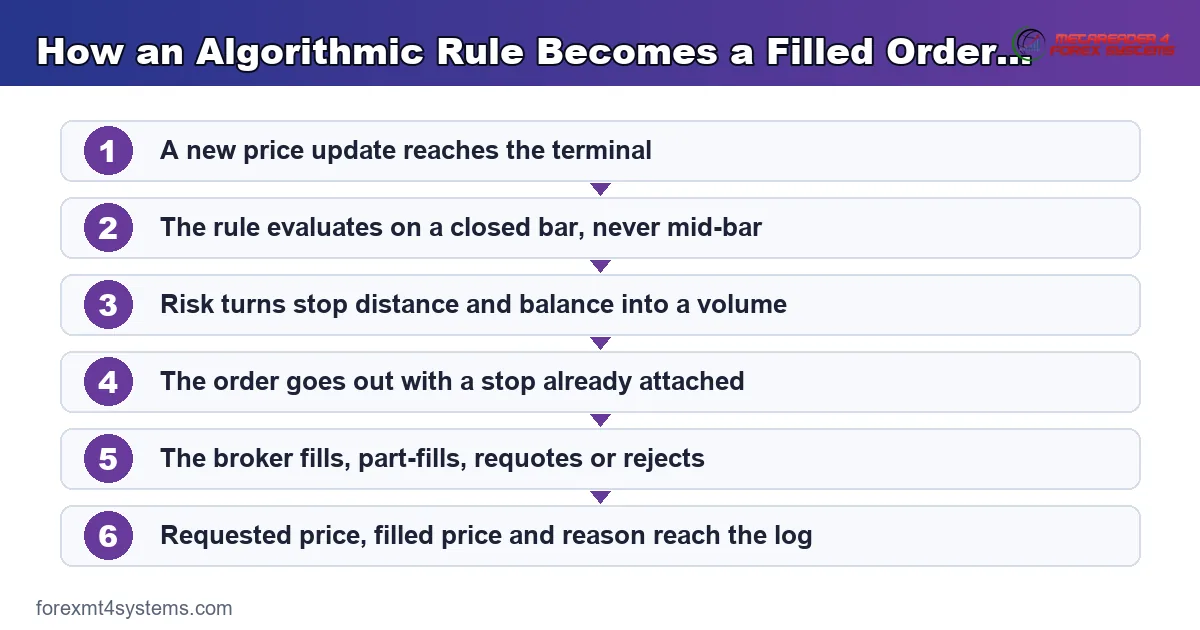
Step two catches most beginners. A rule that reads a value while the bar still forms will behave differently in testing and in live trading.
The Kinds of Algorithm Retail Traders Actually Run
Four families cover almost everything sold and shared publicly. Their logic differs, and so does the market that hurts each one.
Trend Following
These rules buy strength and sell weakness, usually through moving averages or channel breaks. They lose steadily in ranges and earn their keep in a handful of long moves.
Patience is the entire cost. Most of the year looks like small losses, so many traders switch the thing off just before it matters.
Mean Reversion
Here the rule fades stretched prices and expects a return toward an average. It works well while a market oscillates, then fails badly when the market picks a direction.
The failure looks orderly rather than dramatic. Each trade is defensible, and the series still drains the account.
Breakout Rules
A breakout rule watches a range and acts when price leaves it. That sounds clean, and the honest problem shows up in how often nothing follows.
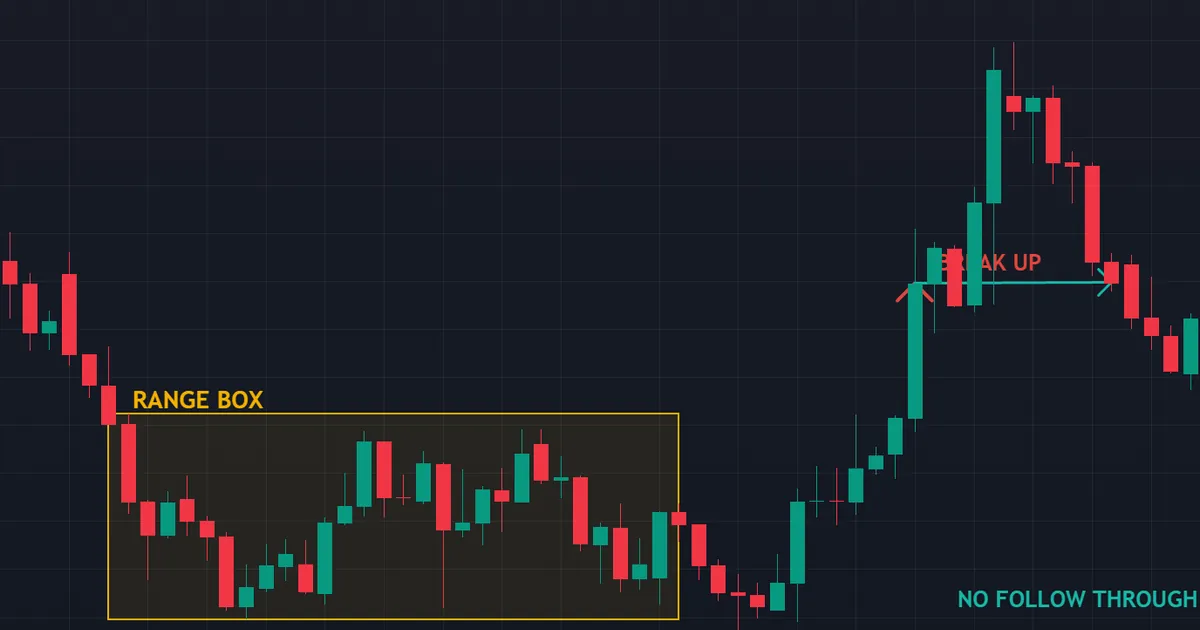
The box held for 28 bars, then price closed up out of it on 2026-07-29 and travelled 0.0 ATR further in that direction over the next 10 bars. On the EURAUD four-hour chart above, an automated breakout order went in and the market simply stopped moving.
Nothing went wrong mechanically. The condition triggered, the order filled, and the follow-through never arrived, which is the ordinary outcome a marketing screenshot never shows.
Execution Algorithms
The fourth family does not choose trades at all. It splits a decision you already made into smaller pieces to reduce the market impact of one large order.
Retail sizes rarely need this. Institutions use it constantly, which is why the term dominates academic writing on the subject.
What the Code Controls and What It Cannot
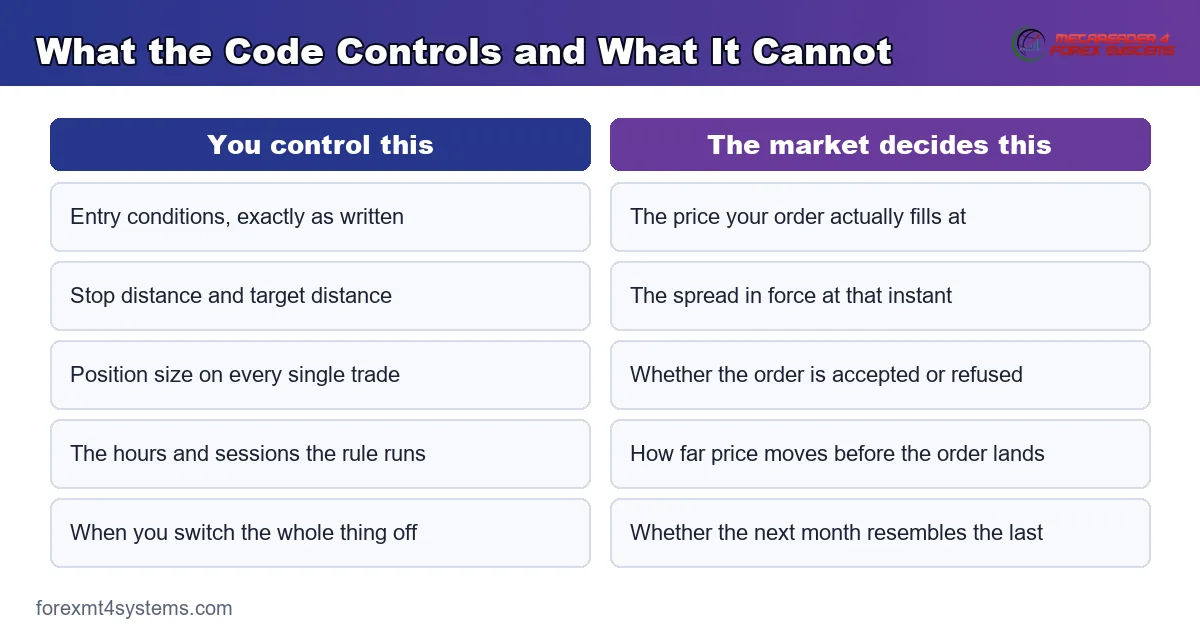
Automation gives you exact control over some things and none at all over others. Mixing the two categories causes most disappointment.
Inside Your Control
You decide the entry logic, the stop, the target, the position size and the hours the program runs. Those choices belong entirely to you, and the code applies them without variation.
Sizing deserves the most attention. Our expectancy calculator shows how a rule’s average outcome interacts with the size you choose.
Outside Your Control
The broker decides your fill price, the spread at that instant and whether the order gets accepted. Liquidity decides how far the market moves before your order lands.
None of that appears in your code. So a rule that only clears its costs by a hair will disappoint you in live trading.
Costs the Model Leaves Out
Three costs bite every automated system, and only one of them looks obvious. Together they explain most of the gap between a test and an account.
Spread
Spread applies twice on every round trip. A rule trading forty times a day pays that toll forty times, and our guide to the spread in forex covers how much it widens at the daily rollover.
Testing usually assumes one fixed figure. Reality supplies a moving one that peaks exactly when breakout rules fire.
Slippage
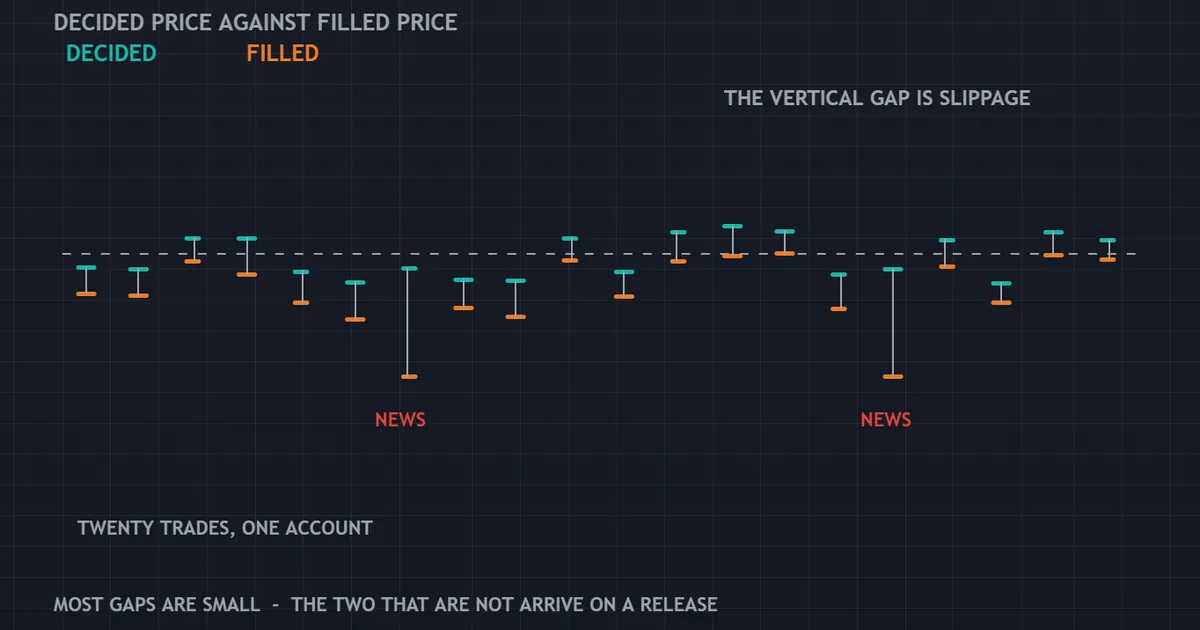
The panel above pairs the decided price against the filled price across twenty trades. Most gaps look tiny, and two of them land during news releases and dwarf the rest.
Those two matter more than the eighteen. A rule with a thin edge can lose a month of progress in a pair of bad fills, as our note on slippage in trading describes.
Swap and Financing
Positions held past the daily rollover pay or receive a financing rate. A rule that holds for days must clear that charge as well as the spread.
Rates change without notice too. A carry that looked comfortable last quarter can turn against you quietly.
Download the complete indicator database
Put these concepts on your charts. One email unlocks the full library of 1,380+ indicators with compiled MT4 and MT5 files, plus my TradingView scripts. No paywall, no spam, unsubscribe any time.
Get free access to my indicator database
One email unlocks 1,380+ free MT4, MT5 and TradingView indicators — the complete library. No single-tool download; you get the whole database.
Testing an Algorithm Honestly
A test can disprove a rule. It can never prove one, and holding that distinction saves an enormous amount of money.
Separate the Data You Tune On
Fit the rule on one stretch of history, then apply the frozen settings to a period it has never met. Most ideas die at that second step.
Tuning until the curve looks good feels productive. It mostly describes the noise inside the sample you tuned on.
Model the Costs You Will Actually Pay
Add realistic spread, commission and slippage before you read a single number. A rule that only survives at zero cost was never viable.
Then check the trade list rather than the curve. Trade count, holding time and the worst losing run describe behaviour honestly.
Forward Test Before Real Size
Run the program on demo with live prices for several weeks. Errors around session times, symbol names and weekend gaps surface here and nowhere else.
Then go live at minimum size. Two logs that disagree teach you more than any equity chart.
A Worked Example From Idea to Order
Abstractions hide the detail that actually matters. So take one simple rule and walk it through the whole chain.
The Idea
Buy when a twenty-period average crosses above a fifty-period average on the four-hour chart. Exit on the opposite cross, with a stop placed two average ranges below entry.
That description already contains four decisions. Each of them can be tuned, and each tuning pass costs credibility.
The Awkward Questions
Which bar counts as the cross, the one forming or the one that closed? What happens if the cross appears while a position is already open?
Does the rule trade through a central bank release, or stand aside? Nothing in the original sentence answers any of that.
Why the Questions Matter
Each answer changes the trade list, sometimes dramatically. Two programmers given the same one-line idea will produce different results, and neither one made a mistake.
So the specification is the strategy. Code merely obeys whatever the specification failed to rule out.
What the Log Should Show
After a month you want the entry time, the requested price, the filled price and the reason for each trade. Add the account balance at the moment of entry.
Those five fields answer nearly every later question. Without them, a disappointing month stays a mystery.
Where Algorithms Break in Live Markets
Failure is usually quiet. Four ordinary doors let it in.
The Market Changes Character
A rule built for calm conditions keeps firing when volatility doubles. Nothing in the code measures the regime, so nothing objects.
Range rules meet trends, and trend rules meet chop. Both then produce a series of correct decisions and poor outcomes.
The Rule Was Fitted, Not Found
Test enough settings and one combination always looks excellent. Check its neighbours: a robust rule leaves a broad patch of decent results, while a fitted one leaves a lonely spike.
That spike rarely survives fresh data. It described an accident in the sample rather than anything durable.
Something Changed at the Broker
Symbol names change. Minimum volumes change, and margin requirements move with very little warning.
Each one can stop a program dead while the chart keeps updating. Read the journal tab weekly, because errors surface there long before they reach your balance.
The Trader Interferes
Most automated records end by hand. Somebody disables the program during a drawdown or edits an input mid-week, and the record then describes neither process.
Decide the stopping rule in advance. Our comparison of bot and manual trading covers why that half-managed state does the most damage.
Infrastructure You Actually Need
The requirements are modest for most retail rules. Three items cover nearly everything.
A Platform and a Language
MetaTrader remains the common route, with MQL4 and MQL5 as the languages. Both handle indicators, expert advisors and scripts, and our indicator library shows what the drawing side looks like in practice.
The tooling matters less than the rule. Any environment that sends orders reliably will do.
Somewhere to Run It
A rule that trades one session may run happily on a home machine. Anything covering several sessions needs a host that stays online through updates and power cuts.
Latency matters far less than uptime for most rules. Missing a whole day beats being fifty milliseconds late.
A Record You Can Read
Keep the requested price, the filled price and the reason for every trade. That single habit turns a vague suspicion into a measurable problem.
Reviews then take minutes. Guesswork takes months and usually reaches the wrong answer.
A Way to Restart Safely
Terminals restart, and a program has to cope with finding positions it did not open in this session. Decide in advance whether it adopts them, ignores them or refuses to trade until somebody checks.
Test that behaviour deliberately on a demo account. Closing the platform mid-trade once, on purpose, tells you more than any amount of reading about it.
Restrictions Worth Checking First
Not every account allows every approach. Two categories catch people out.
Broker Terms
Some brokers limit very short holding times or restrict certain order behaviour on particular account types. Read the terms before you build around an assumption.
Nothing about this is hidden. It simply sits in a document nobody opens until an order gets refused.
Funded Account Rules
Programmes that fund traders often restrict automation, and the categories repeat: news windows, copy bans, limits on very fast trading and consistency requirements. Rules vary by firm and change, so read your own firm’s rulebook rather than a forum post.
A breach usually ends the account immediately. Our guide to expert advisors covers the settings that keep a program inside those limits.
Myths That Follow the Term Around
Four claims attach themselves to this subject constantly. All four mislead in expensive ways.
Algorithms Beat Human Traders
An algorithm applies a rule, so it inherits whatever edge the rule holds. A poor rule automated simply produces poor results with excellent punctuality.
The comparison people want does not exist. Automation and judgement are delivery methods, not strategies.
More Data Means Better Rules
Adding inputs raises the chance of finding a pattern that is not there. Every extra parameter gives the fitting process another way to flatter itself.
Simple rules survive longer for that reason. Fewer moving parts means fewer accidents dressed up as insight.
Machine Learning Removes the Guesswork
It moves the guesswork into the choice of features and the training window. An opaque model cannot be reviewed, and a system nobody can explain cannot be repaired when it stops working.
Nobody outside a vendor can verify what a commercial model does. Treat any confident description of one as marketing until you see the rule.
A Good Backtest Settles It
A test tells you how a rule would have behaved under assumptions you chose. That statement has value, and it carries none of the authority people grant it.
Money moving under conditions nobody arranged in advance produces the only real result. Everything before that counts as preparation.
A Sensible Starting Point
Beginners tend to start at the hardest end. A gentler path exists.
Automate Something Boring First
Move a stop to breakeven, close everything before a release, or cap the number of trades per day. Each task is small, testable and useful immediately.
Confidence grows from working code. Ambition grows from confidence rather than the other way round.
Keep the First Version Ugly
Resist adding filters while you build. Every condition you bolt on before the first live month makes the result harder to interpret later.
Ship the plain version, watch it for four weeks, then change one thing. Slow changes produce readable evidence, while fast ones produce noise.
Then Automate a Rule You Have Traded
Pick something you have already executed by hand dozens of times. You will know what its log should look like, so a mismatch will jump out.
Unfamiliar rules hide their own bugs. Familiar rules expose them within a week.
Measure Before You Judge
Give the first live version a fixed window, such as fifty trades or three months. Whichever arrives first ends the trial, and only then do you read the numbers.
Judging early invites interference. A short stretch cannot separate an ordinary losing run from a rule that never worked, so patience here buys information you cannot get any other way.
A Checklist Before Anything Goes Live
Work through this list before the first real order. It takes an afternoon and prevents the most common losses.
| Check | What good looks like | Warning sign |
|---|---|---|
| Is the rule written down? | Entry, exit, stop and size fixed in advance | The logic only exists inside the code |
| Did unseen data confirm it? | Frozen settings applied to a fresh period | One long run with tuning throughout |
| Were costs modelled? | Realistic spread, commission and slippage | Zero commission and one fixed spread |
| Does every trade carry a stop? | Stop attached at the moment of entry | A stop added manually afterwards |
| Is there a daily loss cap? | A hard limit the program enforces itself | Reliance on you to intervene in time |
| Has it run on demo? | Several weeks on live prices, errors fixed | Straight from a report to a funded account |
| Do you know the stopping rule? | A drawdown and a losing run agreed upfront | A vague plan to watch how it goes |
Notice how little of that list concerns the entry logic. Most live damage comes from missing limits rather than from a weak signal.
Review It Once a Quarter
Conditions drift, brokers change terms, and a rule that fitted last year may not fit now. So put a recurring date in the calendar rather than reacting to a bad week.
Quarterly reviews also stop constant tinkering. Between those dates, the log simply accumulates evidence and nobody touches the settings at all.
FAQ
Is algorithmic trading in forex legal for retail traders?
Yes, in the ordinary case. Retail traders run automated systems on standard platforms every day, and brokers supply the tools deliberately. What varies is the account terms, so check whether your broker restricts very short holding times or specific order behaviour before you build around either.
Do I need to know how to program?
You need to know what the rule does, and someone needs to write it. Buying or borrowing code is common, though it leaves you unable to check the logic or repair it when conditions change. Learning enough to read the code is a reasonable middle path.
How much history should a test cover?
Enough to include several different market conditions, which usually means years rather than months. Depth alone does not settle it though, since very old data describes wider spreads and slower execution. Weight recent, unseen data more heavily than sheer length of history.
Why does my live account differ from the test?
Four causes stack up. Real spread widens when the test assumed a fixed value, fills land away from the requested price, the simulation had to guess what happened inside each bar, and settings tuned on history rarely suit new data. Each one is small, and together they explain most of the difference.
Can an algorithm run without any supervision?
Not safely. Someone has to read the journal, watch for a stalled terminal and notice when a broker changes something. Fifteen minutes each week covers it, and skipping that slot is how people discover a dead program long after it stopped trading.
Is an algorithm suitable for a small account?
Sometimes, though fixed costs make it harder. Hosting and data charges take a much larger share of a small balance, and the smallest lot your broker allows may already risk more than your limit. Grow the balance or pick a rule with tighter stops before automating anything. Results are not guaranteed; past performance is not indicative of future results.
External references
- For background on this concept, see The OnTick Event Handler in the MQL5 Documentation.
- For broader market context, see The Basics of Algorithmic Trading at Investopedia.

About the author
Written by Dominic Walsh, a Forex trader and MT4/MT5 indicator, Expert Advisor and script developer. Every tool on forexmt4systems.com is tested on live charts before release and ships with ready-to-use compiled MT4 (.ex4) and MT5 (.ex5) files. Learn more about the trader and developer behind this site.
How we build, test and correct every tool: Editorial & Testing Policy. Trading carries risk; see the disclaimer.