
Two traders can follow the same rule and finish the year in different places. One clicks each entry by hand while the other lets code do it, so bot trading vs manual trading really asks a narrow question: who presses the button?
That sounds like a small difference. In practice it changes coverage, consistency, cost, and the way the whole thing falls apart when the rule stops working.
Bot Trading vs Manual Trading at the Order Level
Strip the marketing away and one distinction remains. A program reads the same chart data you do, then acts on a written condition without asking anyone.
You read that same data and decide. Sometimes you follow the rule, and sometimes you talk yourself out of it.
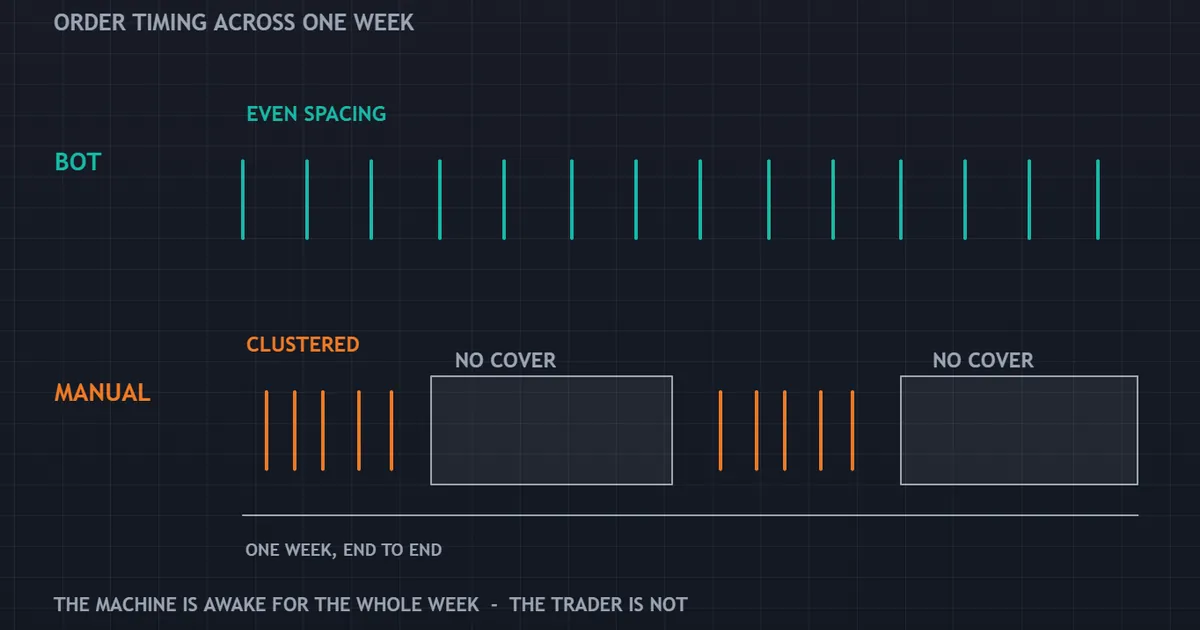
The panel above shows order timing on two rows. Marks on the automated row sit at even intervals, while the manual row clusters into the hours a person sits at the screen and then goes quiet.
What a Program Actually Replaces
Code takes over three jobs. It watches, it checks fixed conditions, and it sends the order.
None of those three jobs needs judgement. Each one simply repeats, which is why software handles them so well.
What Stays With You Either Way
Someone still writes the rule. Someone still picks the risk per trade, the pairs, the hours, and the moment the whole thing goes off.
So automation moves the thinking earlier in the process. It never removes the thinking. Our guide to expert advisors walks through that handover step by step.
The Question Under the Question
People ask which method performs better. A more useful question asks where your own damage comes from.
If you lose money because you skip valid signals, code helps a lot. If you lose money because the rule itself has no edge, code just loses faster.
How a Manual Rule Becomes an Automated One
Six steps sit between an idea and a live program. Skipping any of them tends to produce a file nobody trusts.
- Write the rule in plain words. Entry, exit, stop, size and filters, all fixed before code exists.
- Trade it by hand for a while. Thirty or forty occurrences expose the gaps your notes never mention.
- Code it exactly as written. No extra conditions, no clever additions during the build.
- Compare the log against your manual record. Two logs that disagree point straight at a misunderstanding.
- Forward test on demo with live prices. Session errors and symbol errors surface here, not in history.
- Go live at the smallest size your broker allows. Then leave the settings alone for a full month.

Step one carries most of the weight. A rule you cannot write down in a paragraph cannot be coded either, and that single test kills plenty of ideas early.
Where the Two Approaches Differ in Practice
Four differences do most of the work. Read them as trade-offs rather than as a scoreboard.
Coverage of the Clock
Forex runs around the clock from Sunday evening to Friday close. No person covers that, so a manual trader picks two or three hours and accepts the rest as missed.
A program covers everything, though only if the machine stays awake. That constraint sends most people toward a hosted server, which our note on a forex VPS explains in full.
Consistency Under Pressure
Here sits the largest practical gap. Code takes every signal that qualifies, including the ugly ones after three losses in a row.

People behave differently. The signal after a bad morning looks worse than the identical signal after a good one, even though the chart shows the same thing.
Reaction Speed
A program acts in milliseconds. A person needs a second or two at best, and rather longer when the setup arrives during a phone call.
Speed matters less than most beginners assume. It matters enormously for very short holding times, and barely at all for a rule that holds trades for days.
Handling the Unexpected
Now the ledger flips. A central bank surprises the market, spreads triple, and a person recognises the situation instantly.
Code sees numbers that satisfy a condition. It cannot read the room, because nothing in it models a room.
Errors and Outages
A person notices a frozen platform within seconds. A program keeps running against stale data until something forces it to stop.
Power cuts, updates and broker maintenance all interrupt an automated account silently. So the automated route trades one set of risks for another rather than removing them.
A Week in Each Life
Abstract comparisons hide the practical texture. Two ordinary weeks make the difference easier to picture.
The Automated Week
Sunday evening starts with a check that the terminal reconnected. Nothing else happens by hand until Friday, unless an error appears in the journal.
The program takes eleven trades across five sessions. Four of them arrive while the trader sleeps, and two arrive during a meeting.
Friday brings a fifteen minute review. Trade count, average holding time and the worst run all sit in the log already.
The Manual Week
Each morning starts with an hour at the chart. Two setups appear on Tuesday, and the trader takes one because the other looked untidy.
Wednesday goes badly, so Thursday’s valid signal never gets taken. Friday brings a good trade that closes early out of nervousness.
Four trades land in the record instead of eleven. Two of them followed the plan exactly.
What the Two Weeks Reveal
Neither week proves anything about profit. They do reveal how much of the rule actually reached the market.
Sample size explains why that matters. Eleven honest occurrences teach you more than four filtered ones, since the filter came from mood rather than from evidence.
What Each Approach Does Best
Both methods have genuine strengths, and mixing them badly wastes both. The comparison below sets one against the other.

The Automated Side
Automation delivers three things reliably. It never skips a qualifying signal, it sizes every position by the same formula, and it writes a complete log without being asked.
That third benefit gets overlooked. A clean record turns review into arithmetic instead of recollection, and a trade journal built from real timestamps beats a memory every time.
The Human Side
Judgement earns its keep in three places. You can stand aside before a release, you can notice that conditions changed, and you can adapt a rule that clearly no longer fits.
Adaptation cuts both ways. The same flexibility lets a trader abandon a sound rule after two losses, which is the most expensive habit in retail trading.
How Each Approach Fails
Failure looks different on each side, and the difference matters more than the strengths. Neither method fails loudly.
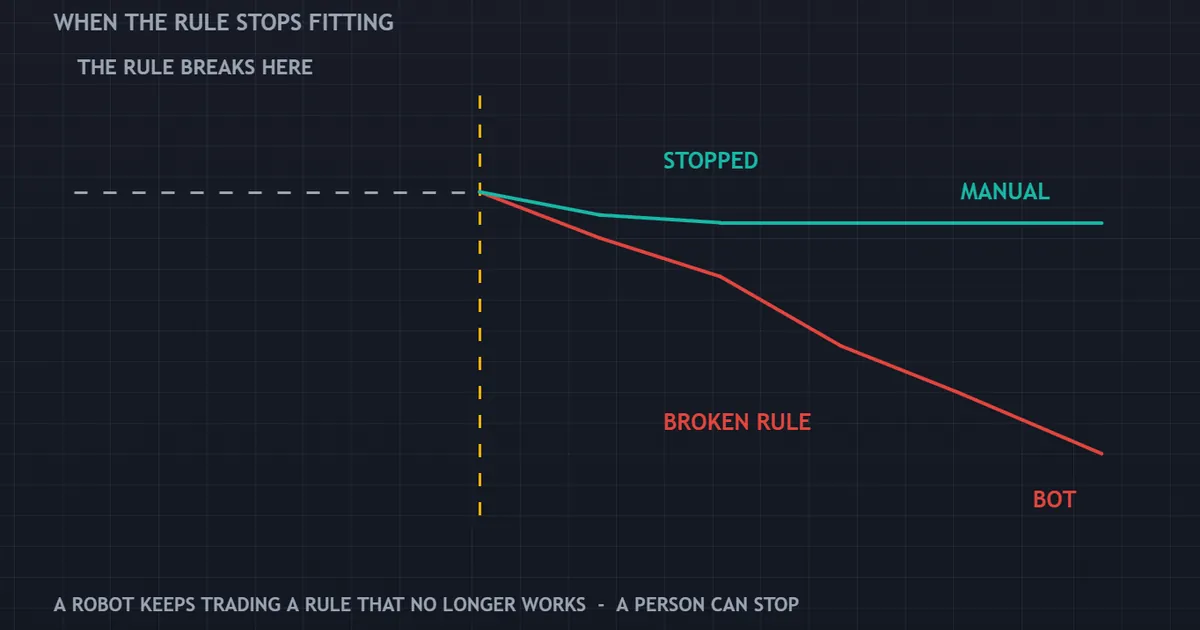
A Program Keeps Trading a Broken Rule
Markets change character without an announcement. A range rule keeps firing into a trend, and the code notices nothing at all.
Losses then arrive in an orderly series. Nothing crashes, nothing errors, and the account drains at a steady rate until somebody intervenes.
A Person Stops at the Worst Moment
Manual traders quit during drawdowns. That instinct sometimes saves an account, and it just as often removes the trader right before a normal recovery.
Neither outcome can be predicted from inside the drawdown. So the honest description sounds unsatisfying: stopping helps sometimes and hurts sometimes.
The Hybrid Failure
Most real damage happens here. Someone runs a program, then disables it during a losing week, then re-enables it after a winning day elsewhere.
The resulting record describes neither process. You cannot review it, because no consistent rule produced it.
The Costs Nobody Counts
Both routes cost money, time and attention. Only the first one shows up on a statement.
Money
A program usually trades more than a person does, so it pays more spread and more commission. Frequency raises the cost hurdle rather than lowering it.
Hosting adds a monthly line as well. Small accounts feel that charge much more than large ones.
Time
Manual trading costs hours every session, week after week. Automation costs a large block up front and then a small slice each week.
Most people underestimate the up-front block badly. Coding, testing and forward testing a simple rule takes weeks, not an evening.
Attention
A running program still needs a keeper. Someone reads the journal tab, watches for a stalled terminal, and notices when the broker renames a symbol.
Fifteen minutes each weekend covers it. Skipping that slot is how people discover a dead program three weeks late.
The Cost of Switching Between Them
Moving from one method to the other carries its own bill. You lose the continuity of your record, and the next few months compare badly against the last few.
So switch deliberately rather than in reaction to a bad week. Give the new arrangement a fixed trial length, then judge it on behaviour instead of on the balance at the end.
Download the complete indicator database
Put these concepts on your charts. One email unlocks the full library of 1,380+ indicators with compiled MT4 and MT5 files, plus my TradingView scripts. No paywall, no spam, unsubscribe any time.
Get free access to my indicator database
One email unlocks 1,380+ free MT4, MT5 and TradingView indicators — the complete library. No single-tool download; you get the whole database.
Which One Suits Your Situation
Three questions settle this faster than any comparison table. Answer them honestly and the choice usually makes itself.
Can You State the Rule?
Write your entry, exit and stop as instructions a stranger could follow. If that paragraph resists writing, your process still relies on feel.
Feel cannot be coded. Trade by hand until the pattern in your decisions becomes clear enough to write down.
Do You Have the Hours?
Manual trading needs you present when your setups appear. A person in a full-time job cannot cover the London open reliably, so the rule must fit the life around it.
Automation solves that by running elsewhere. It does not solve the problem of a rule that never worked.
Where Does Your Damage Come From?
Pull your last fifty trades and mark each one as planned or unplanned. The split tells you which side of this argument you belong on.
Mostly unplanned trades point toward automation. Mostly planned trades that still lose money point toward the rule instead. Our review of whether forex robots work covers how to test that rule properly.
A Direct Comparison
The table below sets the two side by side on the points that decide outcomes. Neither column wins outright.
| Factor | Automated | Manual |
|---|---|---|
| Hours covered | Every session, if the machine stays online | The hours you can actually sit down |
| Rule discipline | Every qualifying signal, without exception | Strong on good days, weaker after losses |
| Reaction to news | Blind to context unless a filter exists | Immediate recognition of unusual conditions |
| Adaptation | None until somebody edits the code | Fast, and sometimes far too fast |
| Record keeping | Complete and timestamped by default | Only as good as your logging habit |
| Main failure mode | Trades a broken rule until stopped | Abandons a sound rule during drawdown |
| Up-front effort | Weeks of building and testing | Hours, then more hours forever |
Notice what the table does not contain. No column claims better results, because the rule decides that and the delivery method does not.
Read each row against your own habits instead. The column that describes your weaker side usually names the route worth testing next.
Myths That Distort the Choice
Four claims circulate constantly, and each one pushes people toward a poor decision. None of them survives much scrutiny.
Automation Removes Emotion
It removes emotion from the click. Emotion returns the moment a person decides whether to leave the program running through a bad month.
The decision simply moves. Instead of hesitating before an entry, the trader hesitates over an off switch.
Manual Trading Is More Skilful
Both routes need the same skill, which is defining an edge and sizing it sensibly. Clicking the order adds nothing to that.
Writing a rule tight enough to code often demands more thought, not less. Vague plans hide comfortably behind a mouse.
Bots Only Suit Fast Trading
Speed helps very short holding times. Yet the clearest gains usually appear on slow rules, where a person’s main enemy is boredom.
A swing rule fires a handful of times a month. Missing two of those through inattention costs far more than a few milliseconds ever would.
You Must Choose One Forever
Nothing forces a permanent choice. Plenty of traders automate one rule, trade another by hand, and move a rule across once it proves stable.
Treat the split as a working arrangement. Review it once a quarter rather than treating it as identity.
What Changes as the Account Grows
Size alters the maths on both sides. Three effects show up reliably.
Fixed Costs Shrink in Relative Terms
Hosting and data feeds cost the same on any balance. On a very small account those charges eat a meaningful share of the return, while on a larger one they barely register.
So automation gets cheaper as the account grows. That fact alone explains why small accounts often start manual.
Execution Quality Starts to Matter
Small orders fill quietly. Larger orders meet the depth of the book, so slippage becomes a real line item rather than a rounding error.
A program can split an order and wait. A person rarely does either consistently.
The Emotional Load Rises
A one percent day feels different on a large balance. Many traders execute a rule perfectly for a year, then start interfering once the numbers get uncomfortable.
Automation helps here, though only if you leave it alone. That is a promise about your own behaviour, not about the code.
Running Both Without Confusing Yourself
Plenty of traders use both, and that works when the boundary stays clean. Two arrangements survive contact with reality.
Separate Accounts
Give the program its own account and leave it alone. Trade discretionary ideas somewhere else, so neither record contaminates the other.
Reviews then become simple. Each account answers one question about one process.
Separate Jobs on One Idea
Let code handle the mechanical parts of a discretionary trade. Trailing a stop, scaling out at fixed levels and closing before a release all suit automation.
You keep the entry decision. The program keeps the parts where hesitation costs you, and your trading plan should state which jobs sit on which side.
The Arrangement to Avoid
Never override a live program by hand on impulse. Either the rule stands or you switch it off entirely and record the reason.
Half measures produce a log nobody can learn from. That is the real cost, well beyond the money involved.
Testing Before You Commit Either Way
Both routes deserve evidence before real size. The evidence looks similar in each case.
Fix the Risk First
Decide the risk per trade before anything else, and keep it constant across both methods. Our note on risk per trade explains why that single number outranks the entry logic.
Changing size mid-test destroys the comparison. Keep it boring and the numbers stay readable.
Run Them on the Same Period
Compare a program and a person over identical weeks. Different months tell you about the market rather than about the method.
Then count the trades each one took. A large gap in trade count usually reveals a rule you have been applying loosely.
Judge Behaviour, Not Profit
Over a short window, profit tells you very little. Trade count, average holding time and the worst losing run describe behaviour far better.
Charting tools help you check that behaviour against the market itself. Our MT4 indicator library holds the raw material for both routes.
Reading a Program Before You Trust It
Buying or borrowing a program shifts the problem rather than solving it. Three checks tell you whether it belongs on your account.
Ask for the Rule in One Paragraph
A seller who cannot describe the logic plainly has either hidden it or never understood it. Both answers point the same way.
Vague descriptions also block repair. When the thing stops working, nobody can say which assumption broke.
Check the Trade Log, Not the Curve
Open the list of individual trades first. Holding times, trade count and the worst losing run describe behaviour, while an equity curve only summarises it.
Then look for one enormous winner carrying the total. That shape describes luck far more often than method.
Confirm It Obeys a Hard Limit
Every program should carry a stop on each trade and a daily loss cap it enforces itself. Relying on you to intervene defeats the point of automation entirely.
Test that cap on a demo account deliberately. A limit nobody has verified is just a claim in a settings panel.
FAQ
Is bot trading better than manual trading?
Neither one is better in the abstract, because both simply deliver a rule to the market. A program applies the rule consistently and covers every hour, while a person adapts to conditions the code cannot see. Pick based on where your own losses come from, not on which method sounds more advanced.
Can a beginner start with automation?
It rarely goes well. Automating a process you have never executed by hand produces mistakes at speed, and you lack the context to judge what the log is telling you. Trade the rules yourself for a few dozen occurrences first, then hand the repetitive parts to code.
Does a bot need to run all the time?
Only if the rule needs the hours. A program built around the London open can sit idle for most of the day, so a home machine may cover it. Rules that watch several sessions need something that stays online, which usually means a hosted server rather than a laptop.
Why do automated results differ from manual results on the same rule?
Three causes explain most of the gap. The program takes signals you would have skipped, it enters at the moment the condition triggers rather than a few seconds later, and it never widens a stop because the trade looks promising. Each difference is small, and together they change the record noticeably.
Can I trust a program someone else wrote?
Only as far as you can describe what it does. Ask for the rule in plain words, then check that the trade log matches that description on data the seller never showed you. An opaque program cannot be reviewed, and a system nobody can explain cannot be repaired when it stops working.
Should I stop a program during a drawdown?
Decide that in advance rather than in the moment. Set a maximum drawdown and a maximum losing run before you go live, then honour whichever arrives first and review the log calmly afterwards. Stopping on instinct produces a record that describes neither the rule nor your judgement. Results are not guaranteed; past performance is not indicative of future results.
External references
- For background on this concept, see Automated Trading Systems at Investopedia.
- For broader market context, see program running rules in the MQL5 documentation.

About the author
Written by Dominic Walsh, a Forex trader and MT4/MT5 indicator, Expert Advisor and script developer. Every tool on forexmt4systems.com is tested on live charts before release and ships with ready-to-use compiled MT4 (.ex4) and MT5 (.ex5) files. Learn more about the trader and developer behind this site.
How we build, test and correct every tool: Editorial & Testing Policy. Trading carries risk; see the disclaimer.