
High frequency trading in forex means holding a position for a fraction of a second, then repeating that thousands of times a day. It runs on speed, scale and hardware rather than on chart reading.
Retail marketing borrows the label constantly. So this guide explains the real mechanism first, then shows where the arithmetic stops working for an ordinary account.
What Is High Frequency Trading in Forex?
Start with a definition a professional desk would accept. A high frequency strategy submits, amends and cancels orders in microseconds, holds very small positions, and ends most days close to flat.
The holding period does the defining work. A trade measured in milliseconds belongs to a different business from a trade measured in hours, even though both count as short-term trading.
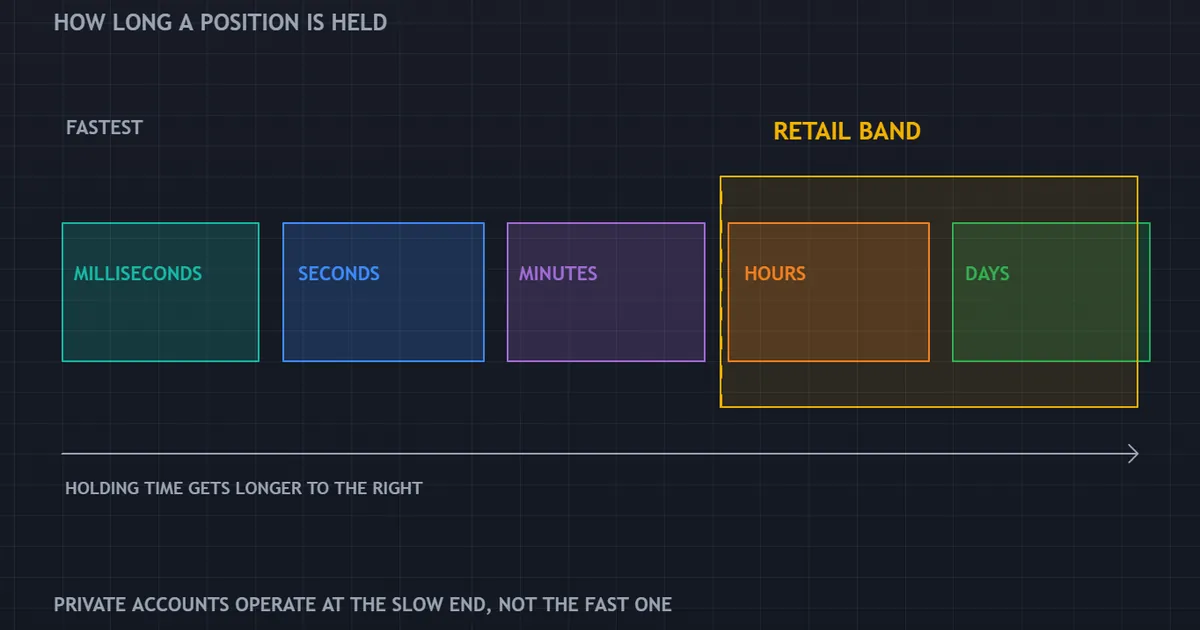
The ladder above places holding periods next to each other. Nearly all retail activity sits at the far right of that ladder, among minutes, hours and days.
Speed Is the Product
An HFT desk does not sell a forecast. It sells the ability to act on a price change before slower participants react to the same change.
That advantage decays quickly. Once two firms see a quote at the same instant, the edge vanishes, so the race never really ends.
Volume Replaces Conviction
Each trade targets a tiny margin, often a small fraction of one pip. No single fill matters, and nobody defends a losing one.
Any profit comes from repetition across an enormous number of fills. So cost per trade drives the model far more than direction does.
Flat by the Close
Most desks finish the session with little or no exposure. Holding overnight would expose them to news, and news rewards a different skill entirely.
That habit separates the business from swing trading at a basic level. One approach earns from turnover, the other from reading a move correctly.
Where the Money Actually Comes From
Three families cover most of the field. Each one earns in a different way, and none of them predicts tomorrow’s direction.
Electronic Market Making
A market maker quotes both sides at once. It buys at the bid, sells at the offer, and tries to end flat with the spread as its pay.
The risk sits in adverse selection. When informed flow hits one side repeatedly, the maker ends up holding exactly the position it did not want.
Latency Arbitrage
The same currency trades on many venues. Prices move on one venue first, so a firm that sees the move earlier can trade against a stale quote elsewhere.
This edge comes from plumbing alone. Nothing in it involves analysis, and it disappears the moment the slower venue updates.
Statistical Arbitrage
Some models trade relationships rather than single prices. Two correlated instruments drift apart, the model sells the rich one and buys the cheap one, then waits for the gap to close.
Holding times here run longer, from seconds to minutes. Still, the same cost pressure applies, because the expected gain per trade stays small.
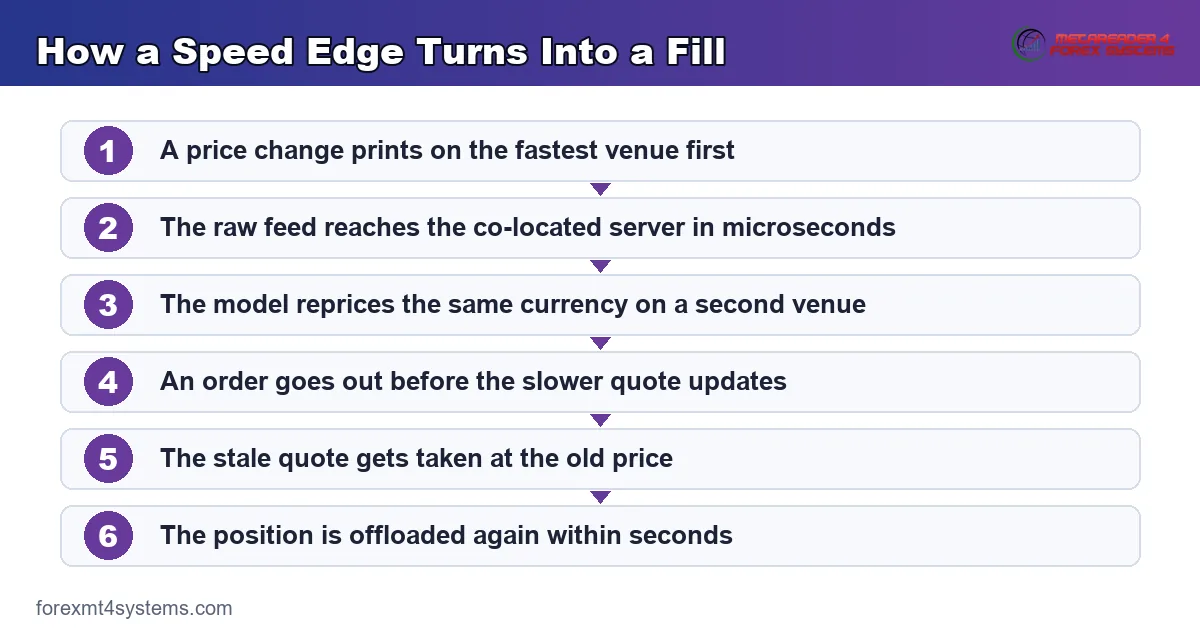
The flow above traces how a speed edge turns into a fill. Every step there solves a plumbing problem rather than a market question.
The Machinery Behind the Speed
Speed costs money in four places. Serious firms spend in all four, because weakness in one cancels the strength of the others.
Co-location
Servers sit inside the same data centre as the matching engine. Distance turns into time, and light through fibre needs roughly five microseconds per kilometre.
Major currency matching happens in a handful of facilities near London, New York and Tokyo. A rack in one of them carries a monthly fee that no retail budget covers.
Direct Market Data
Consumer platforms show an aggregated, throttled price. Firms buy raw feeds straight from the venue, including every update to the order book.
Detail matters as much as speed here. A raw feed reveals depth changes that never reach a retail chart at all.
Specialised Hardware
Ordinary software runs too slowly at this scale. Serious desks push their logic into field programmable gate arrays, so a decision happens inside the network card rather than inside a program.
Kernel bypass, tuned switches and custom clocks fill out the list. Each item shaves a fraction of a microsecond off the round trip.
People
Teams mix network engineers, hardware specialists and quantitative researchers. Payroll usually dwarfs the technology bill.
Those four costs set the entry price for the whole business. They also explain why the field concentrates among a small number of firms.
How Currency Markets Got This Fast
The speed did not appear overnight. Four shifts moved the market from telephones to microseconds, and each one changed who could compete.
From Voice to Screens
Interbank dealing once ran on telephones and telex. A quote lived for as long as the conversation lasted, so seconds counted as fast.
Electronic broking systems arrived in the early nineties. Prices then updated on a screen, and the first automated quoting followed soon after.
Aggregation Splits the Pool
Liquidity spread across many venues over the following decade. Banks, electronic makers and platforms all quoted the same pair, so one price no longer existed anywhere.
That fragmentation created the gap speed exploits. When two venues disagree for a millisecond, somebody with a fast feed can act on the difference.
Automation Reaches the Client Side
Retail platforms then made automation ordinary. Anyone could run a rule overnight, which changed volumes without changing the underlying infrastructure.
Client-side automation and venue-side speed grew apart, though. One trades on a chart, the other trades on a queue.
Venues Push Back
Several venues now slow the race deliberately. Speed bumps delay orders by a set interval, and minimum quote life rules stop a maker cancelling instantly.
Last look adds another wrinkle. A liquidity provider may hold an order briefly before accepting it, which cuts both ways for anyone racing.
Does the Speed Help or Hurt Everyone Else?
Honest answer: it does both, at different moments. The research points in two directions, and both directions matter to a retail trader.
Quiet Markets Get Cheaper
Electronic makers quote tighter than voice desks ever did. Spreads on major pairs during liquid hours have narrowed enormously over two decades.
That benefit reaches your account directly. A tighter interbank spread feeds through to the price your broker shows.
Stressed Markets Get Thinner
Automated quoting withdraws quickly. When volatility spikes, makers widen or step away, and the book thins out within moments.
Flash events in currency markets have shown this repeatedly. Depth vanished, price gapped, and the book refilled minutes later at ordinary levels.
What That Means for You
Plan for both states rather than one. The cheap spread you see at midday will not survive a surprise release or a thin session open.
So size for the stressed state, not the calm one. That single habit protects more accounts than any speed upgrade.
Why the Arithmetic Fails on a Retail Account
Now bring the two worlds together. A retail trader meets the same cost per trade as an institution, without the institutional pricing.
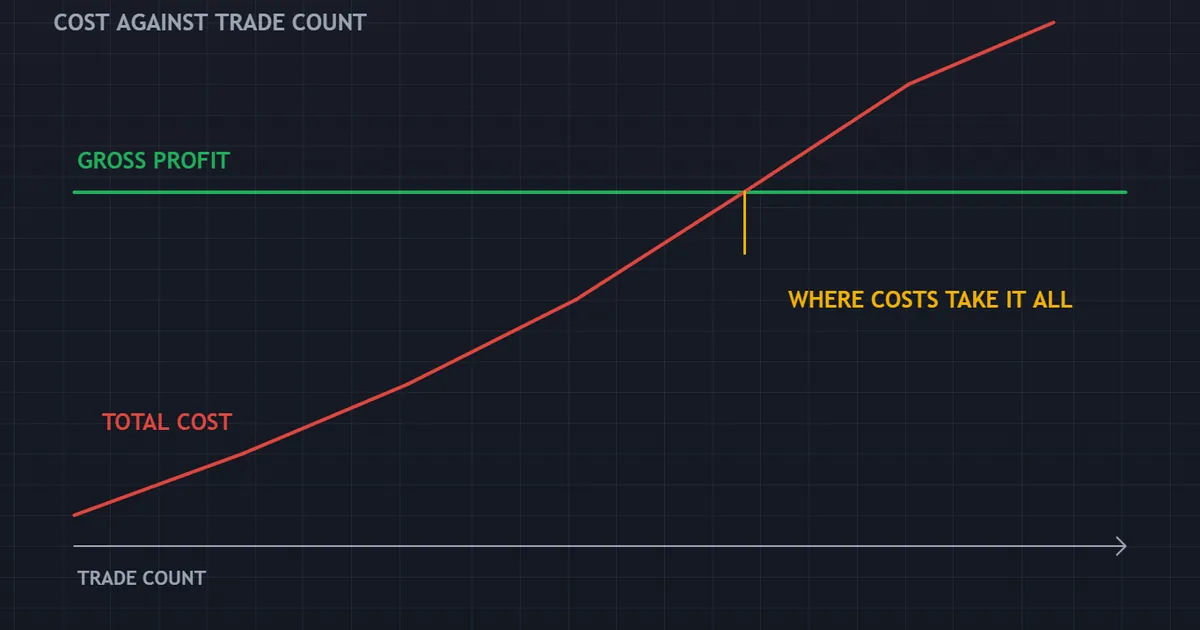
The panel above sets total cost against trade count. Gross profit runs flat while cost climbs with every extra trade, and the crossing point arrives sooner than most people expect.
The Spread Is the Wall
Retail pricing already carries a markup. Trading a thousand times a day means paying that markup a thousand times a day.
An institutional maker earns the spread, while a retail account pays it. Our note on the spread in forex covers how that charge works.
Commission Adds a Second Layer
Raw-spread accounts charge per lot on both sides. That fee looks trivial on one trade, then becomes the dominant term at high turnover.
Compare cost stacks with our spread comparison tool before assuming anything. Small differences compound fast once trade count rises.
Execution You Cannot Buy
Retail orders travel through a bridge, then an aggregator, then a venue. Each hop adds milliseconds, and milliseconds decide these trades.
Slippage finishes the job. A rule that needs a fill at the quoted price rarely gets one, as our guide to slippage in trading explains.
Download the complete indicator database
Put these concepts on your charts. One email unlocks the full library of 1,380+ indicators with compiled MT4 and MT5 files, plus my TradingView scripts. No paywall, no spam, unsubscribe any time.
Get free access to my indicator database
One email unlocks 1,380+ free MT4, MT5 and TradingView indicators — the complete library. No single-tool download; you get the whole database.
An Institutional Setup Against a Retail Setup
Specifics beat adjectives here. The comparison below covers the four things that decide the outcome.
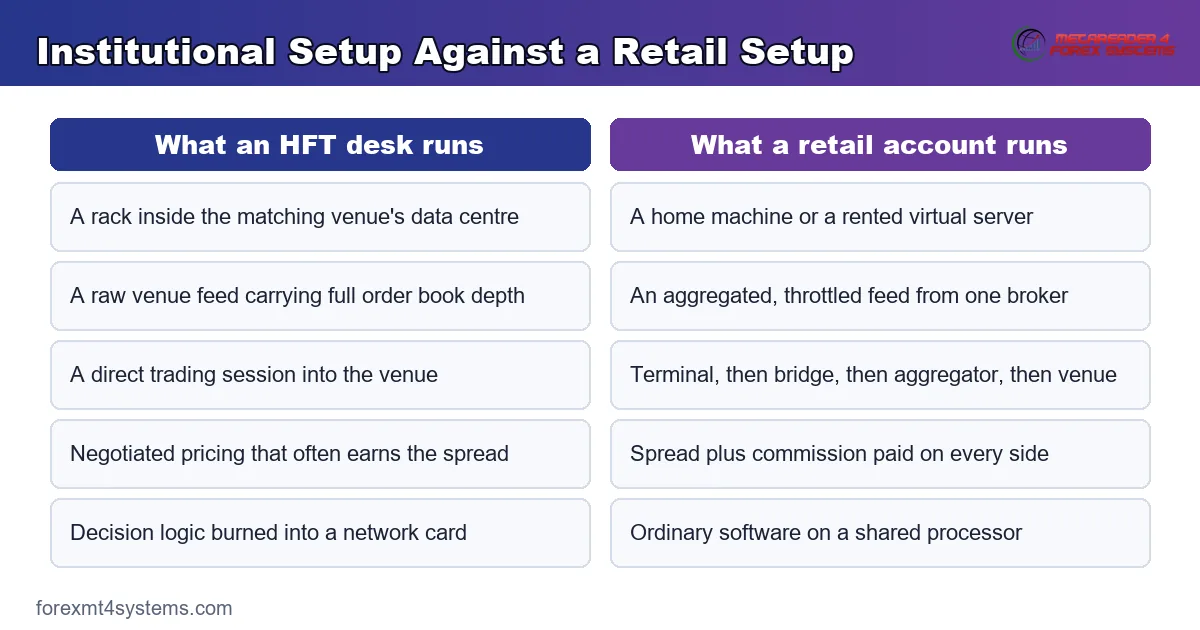
Read the right column as a description, not a complaint. None of it makes retail trading unworkable, but it does rule out this particular business.
| Component | Institutional desk | Retail account |
|---|---|---|
| Server location | Rack in the matching venue’s data centre | Home machine or a rented virtual server |
| Price feed | Raw venue feed with full depth | Aggregated, throttled feed from one broker |
| Order path | Direct session into the venue | Terminal, bridge, aggregator, then venue |
| Cost per fill | Negotiated, often earning the spread | Spread plus commission on every side |
| Decision hardware | Logic burned into a network card | Ordinary software on a shared processor |
| Team | Engineers, researchers and risk staff | One person, usually part time |
Scalping and High Frequency Trading Differ
People use the two words together, yet they describe separate activities. The gap shows up in trade count, holding time and where the profit comes from.
A Scalper Still Reads the Market
A scalper holds for seconds or minutes and takes a handful of pips. Judgement, session timing and a chart all play a part.
Our guide to scalping in forex covers the practical version. It is demanding, though it remains a normal trading style.
An HFT System Reads the Queue
A high frequency system barely looks at price direction. It watches the order book, the queue position and the age of every quote.
So the two disciplines need different inputs. One needs a chart, the other needs a feed nobody sells to retail clients.
Turnover Changes Everything
Raise trade count and cost becomes the whole story. Our overview of forex trading costs shows how the components stack up.
Twenty trades a day and two thousand trades a day are not the same activity. They face different obstacles, so they need different tools.
What Low Latency Genuinely Buys a Retail Trader
Latency still matters, just not the way the marketing suggests. Cutting delay improves reliability, and reliability is not the same thing as an edge.
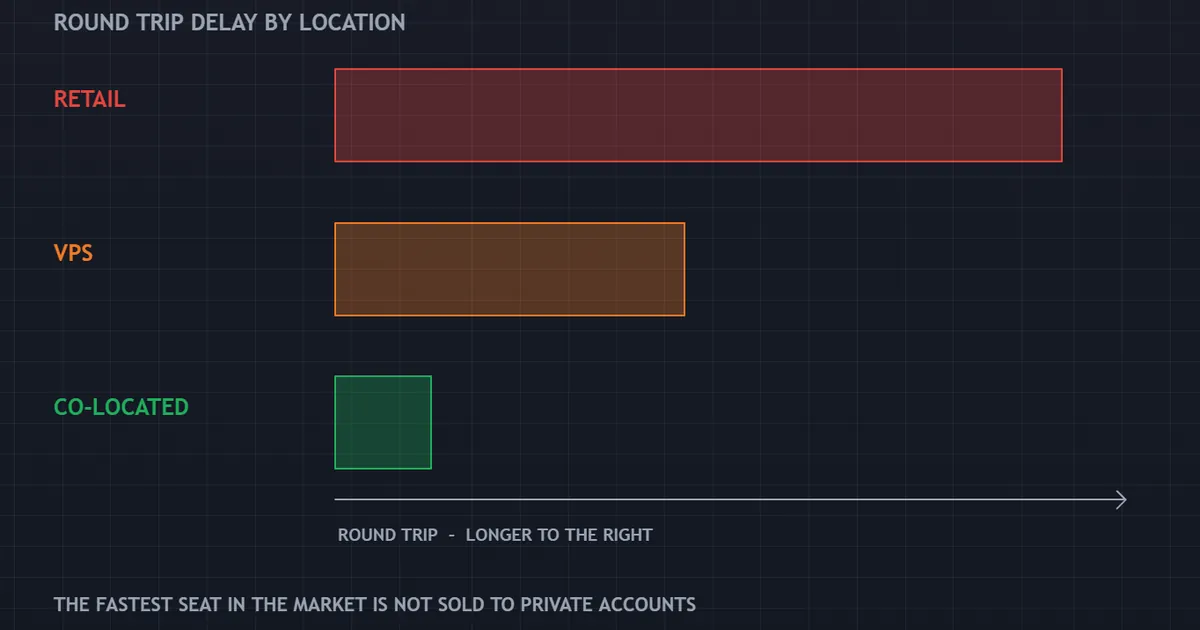
The ladder above compares three ordinary setups. Notice how much of the gain comes from location rather than from a faster machine.
A Home Connection
Household broadband varies through the day. A video call, a firmware update or a brief outage can each interfere with an order.
For a rule that trades a few times a day, that variation hardly registers. For anything faster, it becomes a real hazard.
A Distant Server
A cheap virtual server in the wrong region can run slower than a home connection. Location beats specification for this job.
A Server Near the Broker
A machine in the same city as the broker’s servers cuts the round trip sharply. Our guide to a forex VPS covers how to choose one sensibly.
Even then, the gain measures in milliseconds. That helps a rule act promptly, and it will never make you competitive with a co-located desk.
A Worked Look at Turnover and Cost
Numbers make this concrete without any promise attached. Work through a simple case in pips, since pips travel across account sizes.
Set the Cost Per Round Trip
Suppose the spread runs one pip and commission adds roughly half a pip across both sides. Add another half pip for typical slippage on entry and exit.
Your round trip therefore costs about two pips. Nothing unusual sits in that figure for a major pair on a retail account.
Set the Target
Now suppose the rule aims for three pips per trade and reaches that target more often than not. On paper it looks workable.
After costs, though, the surviving margin shrinks to roughly one pip on a good fill. The rule keeps almost nothing of what it captures.
Scale It Up
Trade twice a day and the friction stays manageable. Trade two hundred times a day and you pay four hundred pips of cost in the same session.
Gross capture would need to clear that hurdle every single day. So higher frequency raises the bar rather than lowering it.
Then Add the Bad Days
Costs behave predictably, and outcomes do not. A quiet week can hand back weeks of accumulated margin when one session gaps.
Model the depth of that stretch before you commit. Keeping a trade journal makes the pattern visible after a month rather than after a year.
Myths Worth Dropping
Five claims circulate constantly. Each one falls apart once you look at the mechanism behind it.
- A fast robot makes you an HFT firm. Speed on the platform side means little when the feed, the bridge and the venue path stay unchanged.
- Latency arbitrage works at a retail broker. Brokers monitor for it, and most account agreements allow them to cancel trades placed against stale quotes.
- More trades mean more profit. More trades mean more cost, so the edge per trade has to grow just to stand still.
- Tick data on a chart shows what a desk sees. A retail feed is aggregated and throttled, so it omits most of the order book activity.
- Anyone can buy institutional speed. The rack, the feed and the engineering team come as a package, and the package prices out an individual.
None of that makes short-term trading pointless. It simply moves the target away from speed and towards something you can actually control.
The Vocabulary, Translated
Speed discussions hide behind jargon. Six terms carry most of the weight, so here they are in plain language.
| Term | What it actually means |
|---|---|
| Latency | The delay between a decision and the venue receiving the order, measured end to end rather than on your machine alone. |
| Co-location | Renting rack space in the building that houses the matching engine, so cable length stops being a disadvantage. |
| Tick-to-trade | The time between a price update arriving and an order leaving, which is the number desks actually compete on. |
| Last look | A brief window in which a liquidity provider may accept or reject an order after seeing it, common in currency markets. |
| Speed bump | A deliberate delay applied by a venue to every incoming order, designed to blunt a pure latency advantage. |
| Adverse selection | The cost a quoting firm pays when the trades it fills tend to move against it immediately afterwards. |
Notice how little of that vocabulary touches analysis. Every entry describes infrastructure, order handling or the cost of being on the wrong side of a fill.
That absence tells you something useful. When a product borrows this vocabulary to sell chart-based automation, the words and the thing being sold do not match.
Better Questions Than How Fast Can I Go
Speed sits at the bottom of the list for a retail account. Three other questions repay attention far more.
What Is My Cost Per Trade?
Add spread, commission and typical slippage together. Then compare that total against the average gain your rule targets.
If the two numbers sit close, the rule has no room. Lower turnover fixes more accounts than faster hardware ever will.
Does My Rule Survive Realistic Costs?
Test with a wider spread than the broker advertises. Add commission on both sides, then add a pip of slippage on entry and exit.
Plenty of rules die at that step. Better to learn it in testing than in an account, and our MT4 indicator library gives you raw material to test properly.
Am I Automating the Right Thing?
Automation removes hesitation and enforces sizing. It does not create an edge that the rule lacked, as our overview of algorithmic trading in forex explains.
So write the rule first, then decide whether a machine should run it. That order saves months.
Where Does My Result Actually Come From?
Break the record into pieces after twenty or thirty trades. Look at gross capture, then at cost, then at the gap between them.
Most disappointing records look fine at the gross level. The damage sits in the second column, and no amount of speed repairs it.
Cutting trade count in half is the blunt fix. Fewer, better trades leave more of the capture in the account, and they demand less from execution.
Would a Slower Version of This Rule Still Work?
Run the same logic on a higher timeframe as a test. If the idea only survives at extreme frequency, it probably depends on conditions you cannot control.
An idea that holds up at lower turnover gives you options. You can then automate it, trade it by hand, or leave it running while you sleep.
FAQ
Can a retail trader do high frequency trading in forex?
Not in the institutional sense. The business needs co-located servers, raw venue feeds and direct order paths, and none of those come with a retail account. A fast robot on an ordinary platform still sits several milliseconds behind, and it pays retail spread on every fill.
How fast is a typical HFT trade?
Decision and order submission happen in microseconds, and many positions close within a second. Some statistical strategies hold for minutes instead. The common thread is turnover, not any single number on a clock.
Do brokers allow very fast automated trading?
Policies vary, and many retail agreements restrict strategies that rely on latency or on arbitraging stale quotes. Some brokers also apply a minimum holding time or cancel trades they judge abusive. Read the client agreement before building anything that depends on speed.
Is high frequency trading the same as algorithmic trading?
No. Algorithmic trading simply means a computer follows a written rule, which covers a daily trend rule as easily as a microsecond one. High frequency trading is a small, extreme corner of that field, defined by holding time and turnover.
Does a VPS make my strategy faster enough to compete?
A well placed server cuts round trip time and keeps a program running through local outages. That helps reliability. It does not close the gap to a co-located desk, because the remaining distance and the retail order path stay in the way.
Where should a short-term trader focus instead?
Focus on cost per trade, on realistic testing and on sizing you can hold through a losing stretch. Those three levers sit under your control, while venue latency does not. Results are not guaranteed; past performance is not indicative of future results.
External references
- For background on this concept, see Latency-Driven Trading in the BabyPips Forexpedia.
- For broader market context, see Statistical Arbitrage at Investopedia.

About the author
Written by Dominic Walsh, a Forex trader and MT4/MT5 indicator, Expert Advisor and script developer. Every tool on forexmt4systems.com is tested on live charts before release and ships with ready-to-use compiled MT4 (.ex4) and MT5 (.ex5) files. Learn more about the trader and developer behind this site.
How we build, test and correct every tool: Editorial & Testing Policy. Trading carries risk; see the disclaimer.