
Risk management for small accounts is the skill that keeps a modest balance alive long enough to grow. When the account is tiny, one careless trade can undo weeks of patient work, so the margin for error is thin.
This how-to guide covers risk management for small accounts in plain, practical steps. You will learn to size with micro lots, hold a true one percent risk, dodge over-leverage, and set growth targets you can actually reach.
Risk Management for Small Accounts, Explained
A small account is any balance where a normal loss feels heavy, often a few hundred dollars. The core rules match those of a larger account, yet the stakes of a slip are sharper.
So the guiding idea is simple. Risk a small, fixed slice of equity on each trade, and never let a single position threaten the whole account.
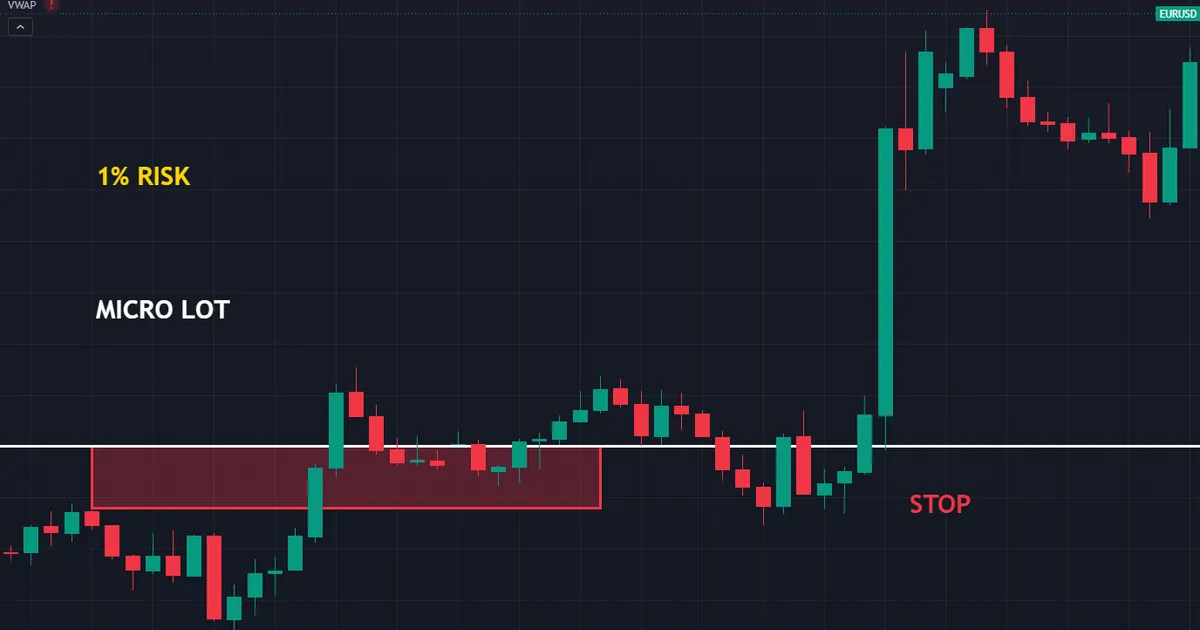
Because the balance is small, the cash you can risk is small too. That feels limiting, yet it is exactly what protects you. A tight risk cap turns each loss into a scratch rather than a wound.
The goal at this stage is survival, not speed. You want the account to still be standing after a rough patch, since a live account can always recover while a blown one cannot.
Why Small Accounts Need Extra Care
Small accounts carry a hidden pressure that larger ones escape. The gains look tiny in cash terms, so the temptation to oversize grows by the week. Many new traders give in and wipe the account chasing a faster curve.
There is also a structural trap. The smallest position a broker allows can force more risk than you intend on a very small balance. So the tools you choose, especially micro lots, matter as much as the discipline you keep.
How to Set Your Risk on a Small Balance
Sizing a trade is a short calculation, and it never changes with account size. You decide a risk percent, turn it into cash, then convert that cash into a lot using your stop distance.
So the process is the same whether you trade two hundred dollars or two hundred thousand. Only the numbers shrink, while the method stays identical.
The Sizing Steps
Run this short loop before every trade. It keeps the risk fixed no matter how the setup looks.
- Pick a risk percent. Choose a small slice of equity, often one percent, to stake on the trade.
- Convert to cash. Multiply the balance by that percent to find the dollars you can lose.
- Measure the stop. Count the distance in pips from your entry to your stop-loss.
- Solve for the lot. Divide the cash risk by the pip value across that stop to get the position size.
So a two hundred dollar account at one percent risks just two dollars per trade. That sounds small, yet it is the discipline that keeps you in the game through a losing streak.
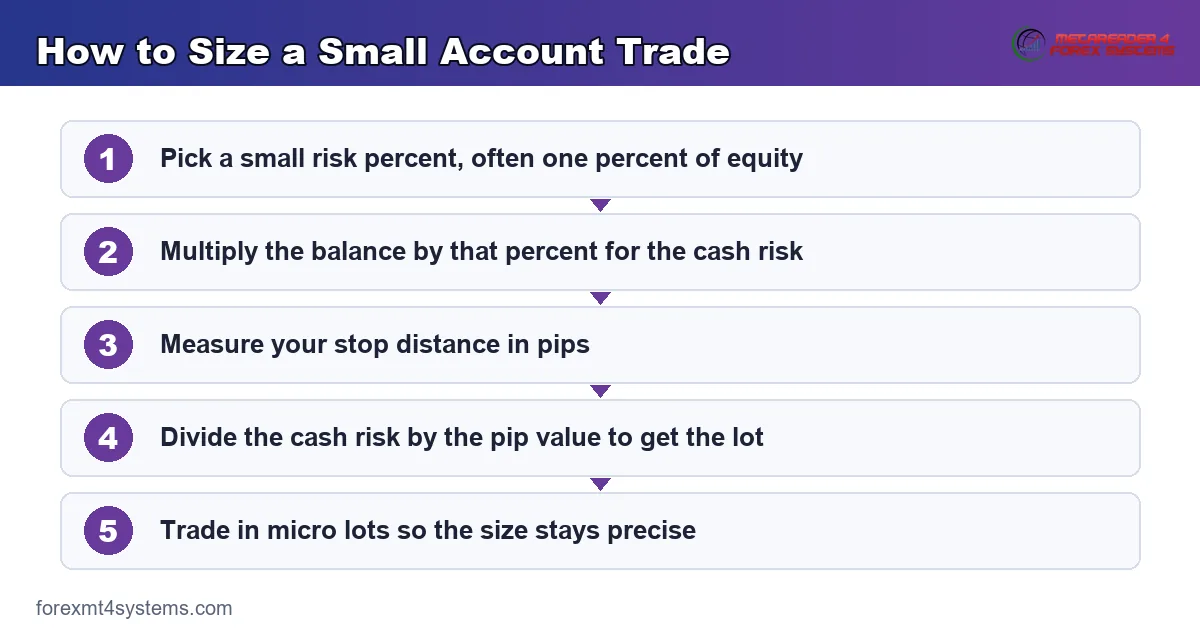
Notice that the stop distance drives the lot as much as the percent does. A wide stop shrinks the position, while a tight stop enlarges it. So plan the stop first, then let the math hand you the size.
Turning Percent Into Micro Lots
Micro lots are the small trader’s best friend. A micro lot is one tenth of a mini lot, so it lets you hold a precise one percent risk even on a tiny balance.
Without micro lots, the smallest tradeable size might force far more than one percent onto a small account. So micro lots are what make disciplined sizing possible when the balance is modest. Many brokers also offer nano lots for even finer control.
Because the increments are small, your position can track the risk rule closely. So a trader with a few hundred dollars can still respect a true percentage, rather than rounding up into danger.
A Worked Small-Account Example
Numbers make the idea stick, so walk a real trade. You hold a five hundred dollar account and want to risk one percent, which is five dollars.
Suppose you spot a setup on a major pair near current levels, with a stop forty pips away. The pip value on a micro lot is roughly ten cents per pip, so forty pips risks about four dollars on a single micro lot.
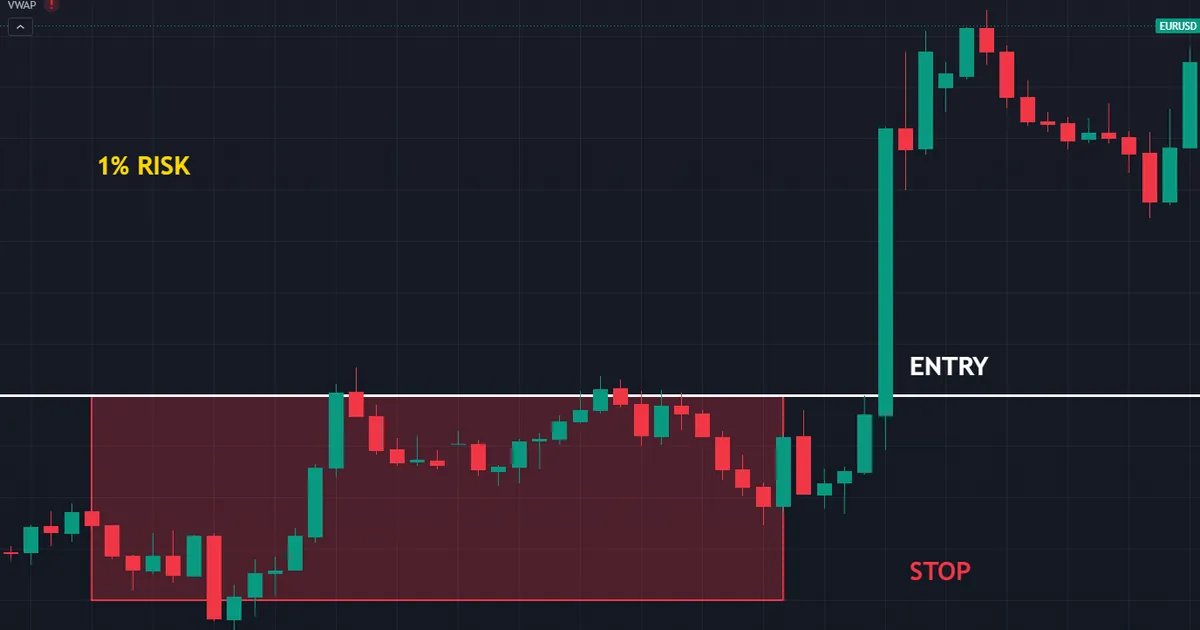
That fits neatly inside your five dollar cap. So one micro lot is the right size here, and the trade respects your one percent rule with room to spare.
Reading the Numbers
Feel how tight the math is on a small account. A five dollar risk leaves no room for a fifty micro-lot swing, since that would blow far past the cap. So the sizing keeps you honest by refusing an oversized bet.
Now imagine the pair moves against you and hits the stop. You lose about four dollars, which is under one percent of the balance. So even a full loss barely dents the account, and the next setup arrives with your capital nearly intact.
This is the quiet power of a small, fixed risk. Because no single trade can hurt much, a run of losses stays a shallow dip rather than a crater. So the account survives to trade another day.
Download the complete indicator database
Put these concepts on your charts. One email unlocks the full library of 1,380+ indicators with compiled MT4 and MT5 files, plus my TradingView scripts. No paywall, no spam, unsubscribe any time.
Get free access to my indicator database
One email unlocks 1,380+ free MT4, MT5 and TradingView indicators — the complete library. No single-tool download; you get the whole database.
Contrast that with a reckless five micro-lot bet on the same setup. A stop-out would cost around twenty dollars, or four percent of the account, in one trade. So a handful of such losses could halve the balance, which is why the disciplined size wins over time.
Avoiding Over-Leverage
Leverage is the feature that lures small accounts into trouble. High leverage lets a tiny balance control a large position, which feels like a shortcut to faster gains.
But leverage cuts both ways. The same tool that magnifies a win magnifies a loss just as hard. So the real danger is not leverage itself, but the oversized positions it tempts you to open.
What Leverage Really Does
Leverage does not change your risk percent on its own. It simply lets you open a bigger position than your cash alone could fund. So a trader can hold one percent risk even on high leverage, as long as the lot size stays disciplined.
The trouble starts when leverage invites a larger bet. Because the broker allows a huge position, the trader takes one, and the risk percent quietly balloons. So treat leverage as a ceiling, not a target, and keep sizing by the risk rule.
The Margin Trap
A small account can run low on free margin fast. Open too many positions, or size them too large, and a small move can trigger a margin call. So watch your used margin, not just your risk per trade.
Because a margin call closes trades at the worst moment, it can lock in losses you meant to ride out. So leave plenty of free margin as a buffer. A lightly loaded account weathers a sharp swing that a heavily loaded one cannot.
Realistic Growth on a Small Account
Growth on a small account is slow at first, and that is normal. The cash gains look trivial, since a good month on a few hundred dollars adds only a few dollars.
So the trap is impatience. A trader who wants a fast dollar figure lifts the risk, and the account soon pays for it. Because compounding rewards survival, the steady path almost always beats the rushed one.
Percent Beats Dollars Early
Judge your progress in percentage terms during the early stretch. A five percent month is strong work, whether it lands on two hundred dollars or twenty thousand. So the percent, not the dollar figure, tells you how well you traded.
Because the account is small, the percentages compound quietly in the background. So a run of modest monthly gains lays the groundwork for a steeper curve later. Patience here pays off far down the line, even when it feels invisible now.
When to Raise the Stake
Hold the risk percent steady while the account is small, and let the balance grow the position for you. So you never need to raise the percent to grow faster. The rising equity does that work on its own.
Only consider a larger absolute stake once the account has matured and proven your method. Even then, keep the percent modest, since a bigger balance still deserves the same care. So discipline scales with you rather than fading as the numbers grow.
Choosing Conditions That Fit a Small Account
The account setup shapes your risk before you place a single trade. Some conditions suit a small balance, while others quietly work against it.
So it pays to check the fine print early. Because a small account has no cushion, the wrong setup can drain it through costs alone, even with careful trading.
Lot Sizes and Spreads Matter Most
Look first for micro or nano lot support, since those let you hold a true one percent risk. A minimum lot that overshoots your cap forces more risk than you want. So confirm the smallest tradeable size before you commit.
Spreads matter just as much on a small balance. A wide spread eats a bigger share of a tiny position, so it drags on every trade. Because those costs stack over time, tighter spreads protect a small account more than they help a large one.
Keeping Costs in Proportion
Every trade pays a spread, and some pay a swap for holding overnight. On a small account, those charges loom large against modest gains. So count them as part of your real return before you judge a strategy.
Frequent trading multiplies these costs, which is why patience pays twice. Fewer, cleaner trades not only cut risk but also trim the running bill. So treat trading costs as a silent position you always hold.
Building a Simple Plan for a Small Balance
A written plan turns scattered trades into a repeatable process. On a small account, that structure is what keeps emotion from steering the size.
So write the rules down before you trade, not during the heat of a move. Because the plan already decided your risk, you only have to follow it when the market tempts you to bend.
What the Plan Should Fix
Pin down the risk percent, the maximum open risk, and the setups you will trade. Then add a rule for major news and a cap on how many trades you take in a day. So every decision has an answer before the session starts.
A clear plan also names your growth target in percent, not dollars. Because the figure is realistic, you resist the urge to oversize for a fast cash gain. So the plan quietly protects the account from its owner.
Reviewing the Plan Each Week
Set aside a few minutes each week to review the trades against the plan. Note where you followed the rules and where you strayed. So the log becomes honest feedback rather than a scoreboard.
Over time, that review reveals which habits help and which hurt. Because the account is small, fixing a leak early saves real ground later. So a short weekly check does more for growth than any single winning trade.
Common Small-Account Mistakes and Fixes
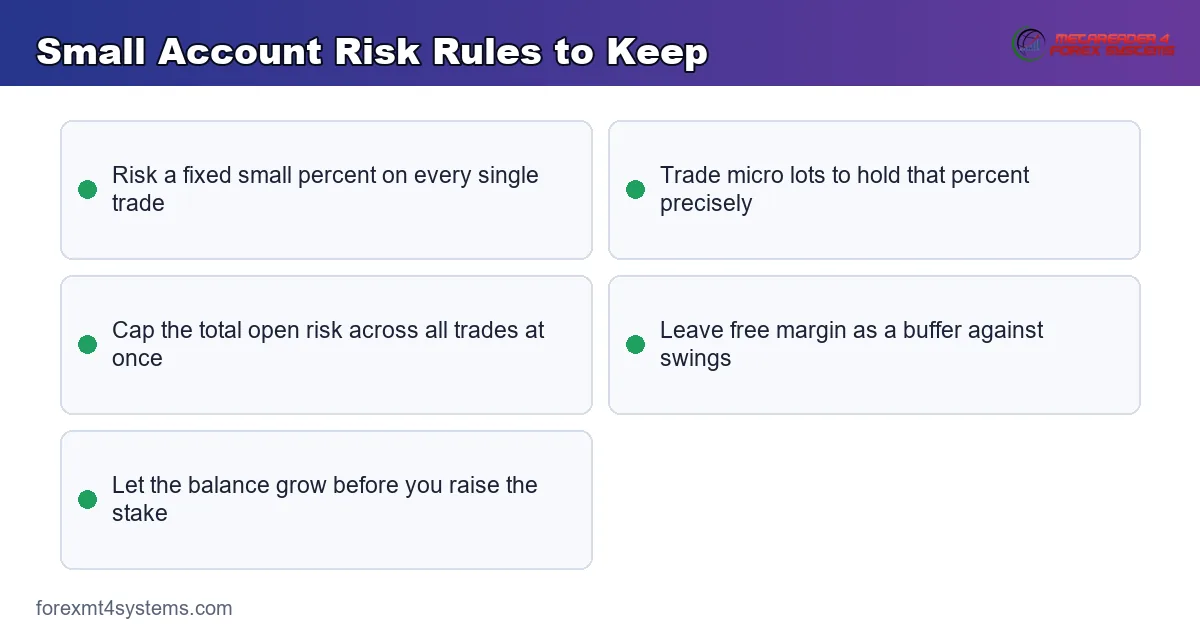
Small-account trading is simple in theory, yet the same errors sink beginners again and again. Most spring from impatience with the slow early pace. The keypoints graphic below gathers the core rules worth pinning up.
Risking Too Much to Grow Faster
The classic slip is lifting the risk to speed up the curve. A single losing streak then carves a deep hole in a tiny account. So keep the percent small, and let the balance, not a bigger bet, do the growing.
Chasing Big Leverage
Some reach for the highest leverage a broker offers, thinking it means faster gains. In truth, it just tempts an oversized position. So size by your risk rule and treat leverage as a limit, never a goal.
Skipping the Stop-Loss
Trading without a stop is doubly dangerous on a small account. One runaway move can wipe the balance before you react. So set a stop on every trade, and use it to calculate the exact position size.
Overtrading to Feel Busy
Small gains tempt some traders into taking many low-quality setups. Each trade pays a spread, and those costs eat a small account quickly. So trade fewer, better setups, and let patience protect the balance.
Judging Progress in Dollars
Watching the cash figure crawl upward frustrates many new traders. That frustration pushes them into rash, oversized bets. So track your growth as a percentage, and the slow early months feel far less discouraging.
Adding Correlated Trades
Two positions on linked pairs can drop together in one move. On a small account, that stacked risk hits hard. So count correlated trades as a single bet, and trim the combined size before it stacks.
Moving the Stop to Avoid a Loss
Some traders slide a stop further away when a trade turns red. That habit quietly enlarges the risk beyond the plan. So set the stop once, size the trade from it, and let the level stand. Because the stop anchors the whole calculation, moving it breaks the discipline that keeps a small account safe.
Small-Account Risk Checklist
Keep this short list beside your trading platform. Run through it before every position on a small balance.
- Risk a fixed small percent, often one percent, on each trade.
- Trade micro lots so the size can match that percent precisely.
- Set a stop-loss and size the position from its distance.
- Cap the total open risk across all your trades at once.
- Leave plenty of free margin as a buffer against swings.
- Judge progress in percent, not in the small dollar figure.
- Let the balance grow the position rather than raising the percent.
Pitfalls and Edge Cases
A few wrinkles bend the clean picture, so keep them in mind. The chart below sets a tiny controlled trade beside an oversized, over-leveraged one on the same small account.
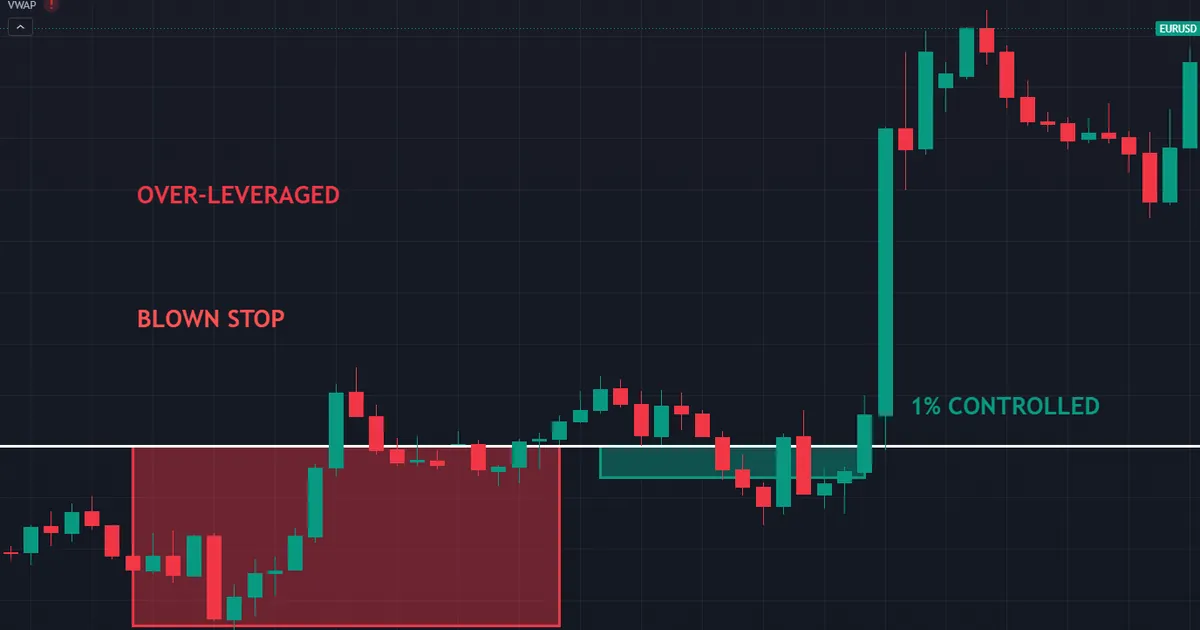
Picture the two positions side by side. One risks a careful one percent and shrugs off a loss, while the other risks a reckless slice and cannot survive a stop-out. That single contrast captures the whole discipline.
Minimum Lot Sizes Force Rounding
Some brokers set a minimum lot that overshoots one percent on a very small balance. So on a tiny account, you may have to accept a slightly larger risk or wait for a wider stop. Either way, know the floor before you fund the account.
Spreads Weigh More on Small Trades
A fixed spread eats a bigger share of a small position. So frequent trading on a modest account can quietly bleed the balance. Because the costs stack, fewer and cleaner trades protect a small account best.
News Spikes Skip Your Stop
Fast news moves can jump straight past a stop-loss, a problem called slippage. On a small account, one bad fill can cost more than the planned risk. So trade lighter around major news, and leave a buffer for the unexpected.
Emotional Swings Run Hot
A loss feels larger on a small account, even when the percent is tiny. That sting pushes some traders into revenge bets. So lean on the fixed rule, and let the plan, not the emotion, decide your next size.
Related Concepts to Study Next
Risk management for small accounts sits inside a wider web of ideas, and a few deserve your next reading hour. The percent you risk on each trade sets how safely a modest balance can grow.
Start with our guide on risk per trade to fix the percentage that anchors every position. Then read our overview of risk management in forex to see how the pieces fit, and learn how compounding in forex turns those small percentages into a rising curve. For the mechanics of a tiny position, our note on lot size on a small account is a useful companion. To size any trade in seconds, use our free position size calculator, project growth with the compounding calculator, and fit it into a plan on our forex trading strategies hub.
FAQ
What is risk management for small accounts?
Risk management for small accounts means staking a small, fixed percent of equity on each trade so no single loss can threaten the balance. You size with micro lots, set a stop on every trade, and avoid oversized, over-leveraged bets. The aim is to survive long enough to grow.
How much should I risk per trade on a small account?
Many traders risk one percent of equity per trade, and some go lower on a very small balance. On a two hundred dollar account, one percent is just two dollars. That feels tiny, yet it keeps a losing streak shallow enough to recover.
Do I need micro lots for a small account?
Micro lots make disciplined sizing possible on a modest balance. A micro lot is one tenth of a mini lot, so it lets you hold a true one percent risk without rounding up into danger. Many brokers also offer even smaller nano lots.
Is high leverage bad for a small account?
Leverage itself does not raise your risk if you size by a fixed percent. The danger is the oversized position it tempts you to open. So treat leverage as a ceiling, size from your risk rule, and keep plenty of free margin as a buffer.
How fast can a small account grow?
Growth is slow at first, since a good month adds only a few dollars in cash terms. Judge progress as a percentage instead, and let compounding stack those gains over many months. Patience protects the account far better than a rushed, oversized bet.
Can I really trade with only a few hundred dollars?
Yes, a small account can trade well with micro lots and a strict risk rule. The key is to treat survival as the first goal and growth as the second. Results are not guaranteed; past performance is not indicative of future results.
External references
- For background on this concept, see Risk Averse at Investopedia.
- For broader market context, see Risk Averse at Corporate Finance Institute.

About the author
Written by Dominic Walsh, a Forex trader and MT4/MT5 indicator, Expert Advisor and script developer. Every tool on forexmt4systems.com is tested on live charts before release and ships with ready-to-use compiled MT4 (.ex4) and MT5 (.ex5) files. Learn more about the trader and developer behind this site.
How we build, test and correct every tool: Editorial & Testing Policy. Trading carries risk; see the disclaimer.