
Two accounts at the same broker can answer the same click in completely different ways. One returns a box asking you to confirm a new price; the other just fills you.
That single behaviour is the whole of instant execution vs market execution. One model promises a price and needs a way to withdraw it, while the other promises a fill and lets the price float.
Instant Execution vs Market Execution in One Line
Instant execution can requote you. Market execution cannot, and gives you slippage in its place.
Everything else follows from that. The order tickets differ, the failure modes differ, and the trading styles they suit differ too.
Neither model removes the underlying problem. Price keeps moving while your request travels, and somebody has to absorb the difference.
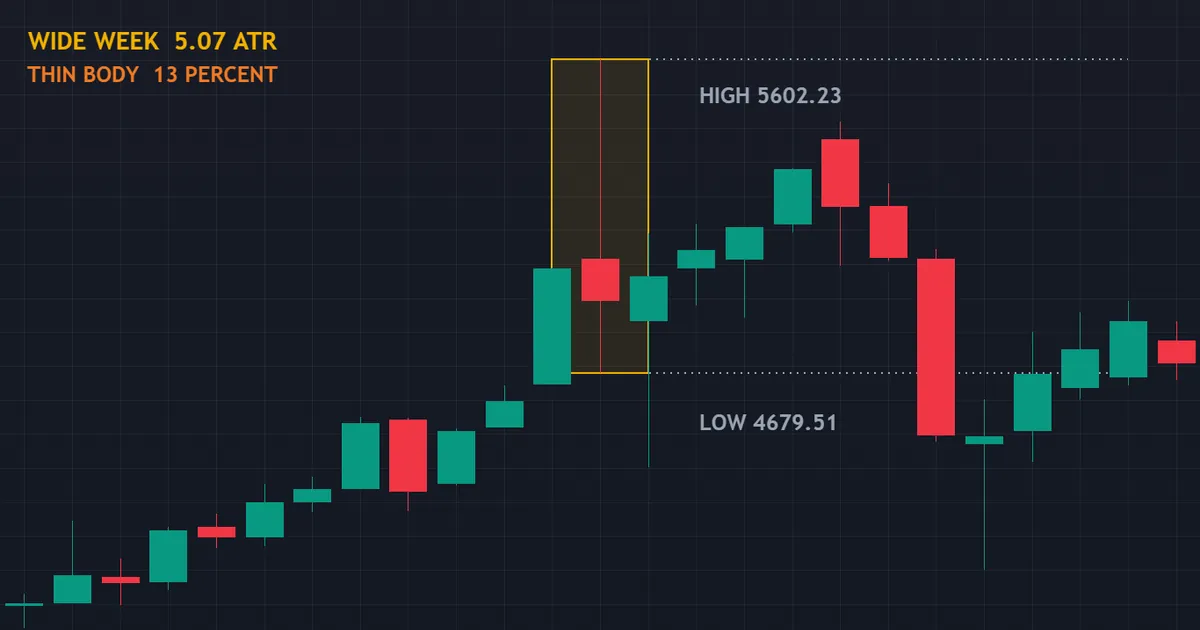
A Week Where Neither Model Felt Comfortable
Above sit gold weekly bars for the week beginning 25 January 2026. The bar opened at 5015.63, ran to 5602.23, fell to 4679.51 and closed at 4895.44.
That range spans 5.07 times the average weekly range, with only about 13 percent of it inside the body. Price travelled enormous distances in both directions before settling.
Afterwards the market recovered. Over the next five weeks price closed about 1.52 average ranges above that level. Weeks like that punish instant accounts with requotes and market accounts with slippage, which is exactly the point.
The Promise Each Model Makes
Instant execution promises the price you clicked. Keeping that promise on a moving market requires the right to say no.
Market execution promises the fill instead. Your order meets whatever the book currently offers, so nothing needs withdrawing.
Read those two sentences again before reading anything else. Almost every argument about execution comes down to which promise a trader values more.
Why Your Account Type Decides This
Traders often assume the behaviour depends on the broker. It depends on the account, and many brokers offer both.
The choice is usually made at signup, in a dropdown nobody reads. Months later a requote appears and the trader assumes something broke.
Nothing broke. The account simply did what that model always does.
What Happens When Price Moves Mid-Order
Both models share the same first four steps. Only the fifth differs.
- You click a price. The terminal packages the instrument, direction, volume and the quote you saw.
- The request crosses the network. Distance and connection quality add milliseconds to the journey.
- The server reads the live market. Liquidity providers have updated their quotes several times by now.
- The two prices no longer agree. Your requested price sits outside the current best available.
- The models part company. One returns a new price for you to approve; the other fills you at the market.
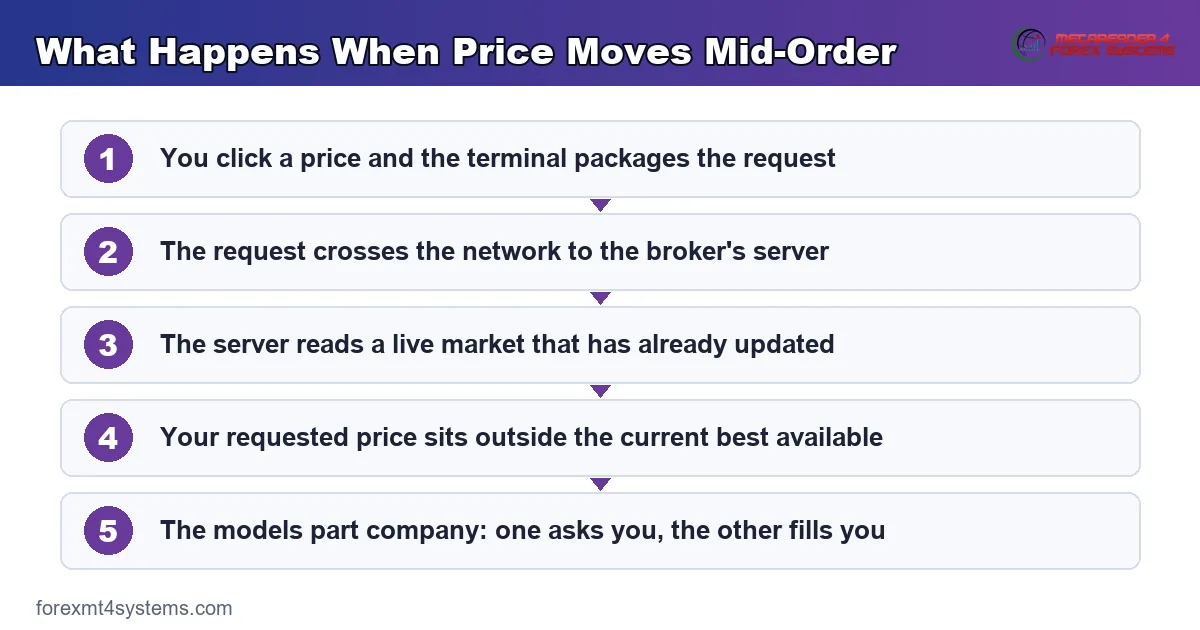
The Fork in the Road
Step five is the entire subject of this article. Everything before it is identical across both models.
Notice what neither model does. Neither of them fills you at a price nobody is currently offering.
That would require the broker to trade against itself at a loss. No execution model works that way, whatever the marketing implies.
A Plain English Version
Strip out the jargon and the choice gets simple. Two shops sell you the same thing on different terms.
The First Shop
The first shop shows a price tag. You bring the item to the till and pay that price.
If the price moved while you walked over, the till stops. A new tag comes up. Pay it, or walk out.
That shop is instant execution. Its tag is the promise, and the pause is how the shop keeps it.
The Second Shop
Shop two has no tags at all. You take the item to the till and pay what it costs right then.
Nothing pauses. You always leave with the item, and the price is whatever it was at that moment.
That shop is market execution. The goods are the promise, and the price floats.
Which Shop You Want
It depends on what you came for. If you must have the item today, take shop two.
If you will only pay a set price, take shop one. Both are honest, and both charge you for the same thing.
How Instant Execution Works
Price certainty sits at the centre of this model. Understanding the mechanism removes most of the frustration around it.
The Fixed Price Promise
Your ticket shows a price, and you click it. The broker undertakes to fill you at that number if it can.
Within a small tolerance, it usually can. Calm markets stay still long enough for the round trip to complete.
The promise only strains when price moves faster than your order travels. Fast markets do that constantly.
The Requote as an Escape Route
When the promise cannot hold, a box appears with a new price. Accept, decline, or let it expire.
Nothing executes until you answer, which preserves your control completely. The cost is time, and time in a fast market is expensive.
Our guide to the requote in forex covers the sequence and what to do with those two seconds.
The Deviation Setting
MetaTrader lets you pre-approve a band around the requested price. Set two pips and anything inside that band fills automatically.
Most requotes disappear at that setting. You keep a ceiling on the damage and lose the frantic clicking.
Set the number deliberately, though. A very wide band quietly turns your instant account into a market account.
Setting Your Deviation Number
One number does most of the work on an instant account. Pick it with care.
Start From Your Stop
Look at your normal stop distance in pips. A band of roughly a twentieth of that rarely changes the trade.
Wide stops can carry a wider band. Tight stops need a tight one.
Then Check the Pair
Major pairs move in small steps most hours. Crosses and exotics move in bigger ones.
A band that suits one can be far too tight for another. Set it per instrument if your platform allows.
Review It Monthly
Count the boxes you still see. Count the fills that land at the edge of the band.
Too many boxes means the band is tight. Too many edge fills mean it is loose.
How Market Execution Works
This model makes the opposite trade. Participation comes first, and the price follows the market.
No Promise, No Withdrawal
Your ticket may not even show a price to click. It shows volume, and the fill arrives at whatever the book offers.
Since nothing was promised, nothing needs taking back. Requotes are structurally impossible here rather than merely rare.
People who move from one model to the other often describe market execution as faster. It is not faster; it simply never pauses to ask.
Slippage in Both Directions
The difference between the quote you saw and the price you got is slippage. It appears on the confirmation rather than in a dialogue box.
Traders expect it to run against them. In practice it runs both ways, and a healthy record shows price improvement regularly.
Our guide to slippage in trading works through how to measure your own stream and read it honestly.
Why Stops Behave the Same Either Way
Here is a detail that catches traders on both models. A stop order becomes a market order the moment price touches it.
So your protective stop takes the next available price regardless of account type. Instant execution offers no shelter at all on the exit.
Our guide on how to use a stop loss explains why that still beats leaving a loss open.
The Two Models Side by Side
Seeing both tickets together settles most confusion. The panel below sets them next to each other.
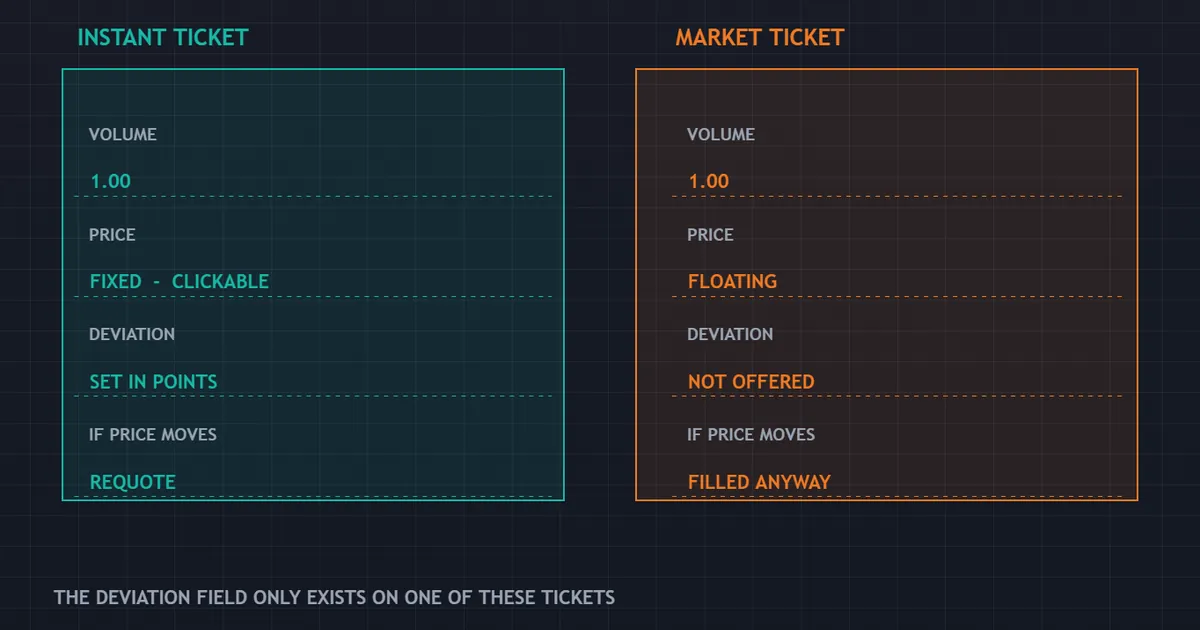
What the Order Ticket Looks Like
An instant execution ticket shows a live price with a buy and sell button attached. A deviation field usually sits nearby.
A market execution ticket often shows volume and little else. Some platforms grey out the price entirely, which tells you everything.
Check yours now rather than during a fast market. Two seconds of reading saves a great deal of confusion later.
What Changes During News
Under instant execution, releases produce requotes. The box appears repeatedly, and each attempt costs another round trip.
Under market execution, the same conditions produce wider fills. Your order goes through, and the difference shows on the confirmation.
Spreads widen in both cases. Our note on the spread in forex covers why the quoted difference moves at all.
Where the Cost Actually Lands
Both models charge you for the same market movement. They simply put the charge in different places.
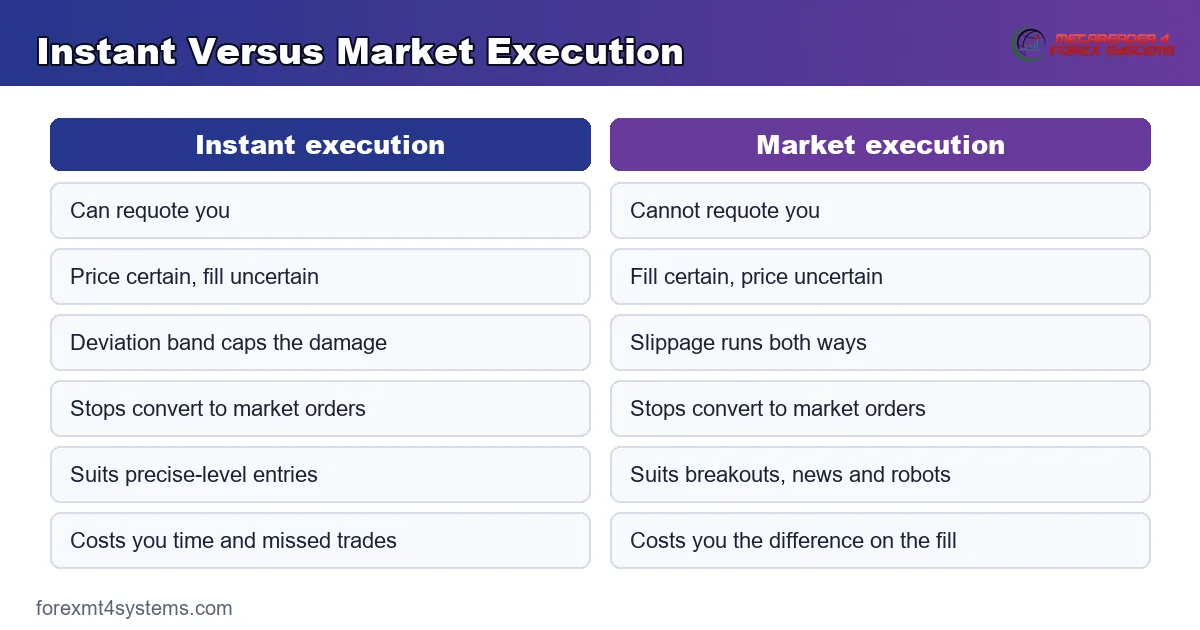
The Cost of a Requote
A requote costs you time and sometimes the trade. Two seconds during a breakout can mean entering ten pips higher or not at all.
It never costs you an unexpected price, though. Whatever you end up paying, you approved it first.
The Cost of Slippage
Slippage costs you the difference on entry or exit. The trade happens, so nothing is missed.
What you lose is control over the number. On a violent bar like the one at the top of this page, that number can surprise you.
Neither Model Is Cheaper
Add up a year of trading and the totals land in the same region. What differs is where the pain shows up.
Choose the pain that damages your method least. That decision is genuinely personal rather than universal.
Which Model Suits Which Trader
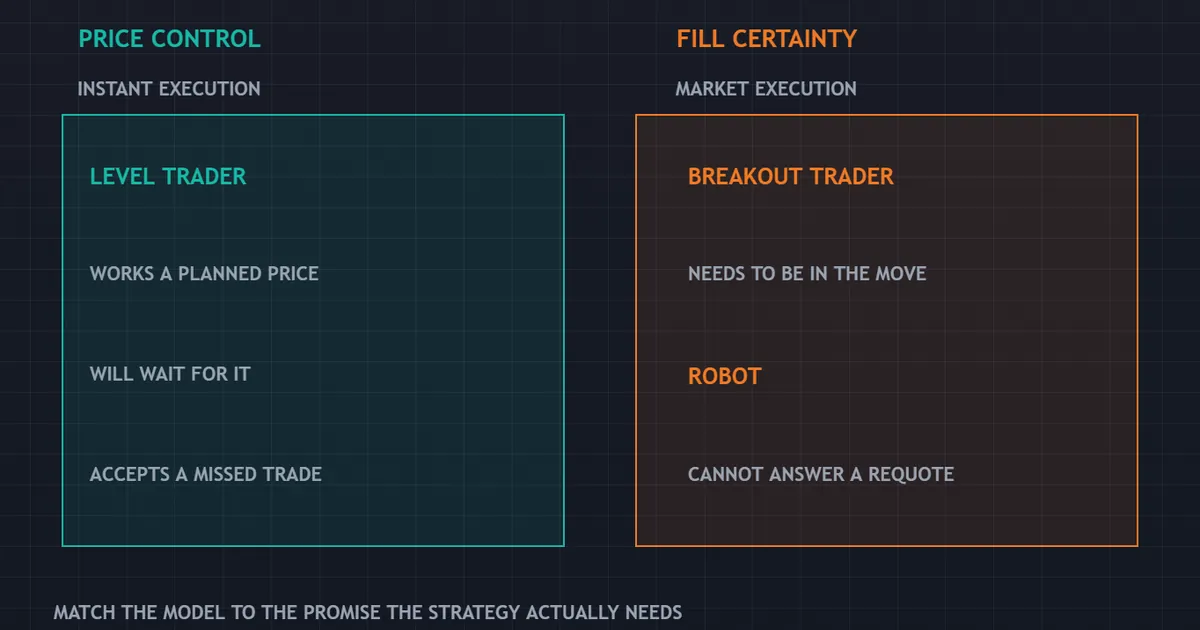
Style decides this far more than opinion does. The panel below maps the common cases.
Breakout and News Traders
Missing the move costs these traders more than a few pips ever will. Market execution fits them naturally.
A requote during a breakout is close to the worst possible outcome. The move leaves, and the trader is still reading a dialogue box.
Precise-Level Traders
Some plans depend on entering within a pip or two of a chosen level. Instant execution protects that.
Declining a worse price costs almost nothing when the setup repeats. Patience is cheap for anyone working from levels marked in advance.
Scalpers
Frequent traders meet execution problems most often, simply by clicking more. Costs scale with trade count in a way that hurts thin targets.
Most scalpers therefore prefer market execution with a tight deviation. Speed of participation matters more than the last fraction of a pip.
Worth noting: many brokers and prop firms restrict very short-term trading. Read the account terms before building a method around it.
Automated Systems
A robot handles a requote badly unless somebody programmed the response. Many default to retrying, which compounds the problem in a fast market.
Market execution removes that failure mode entirely. Set the deviation parameter explicitly and the system behaves predictably.
Backtests show neither requotes nor realistic slippage. That gap explains part of the difference traders find between tested and live results.
How to Tell Which Model You Have
Most traders genuinely do not know. Three checks answer it in a minute.
Check the Order Ticket
Open a new order window and look for a deviation field. Its presence points strongly at instant execution.
Check the Contract Specification
Your broker publishes an execution type per account. The specification page states it plainly, usually alongside spread and swap details.
Watch What Happens Under Pressure
Place a small order in a fast minute and see what the platform does. A box means instant execution, and a fill means market execution.
Download the complete indicator database
Put these concepts on your charts. One email unlocks the full library of 1,380+ indicators with compiled MT4 and MT5 files, plus my TradingView scripts. No paywall, no spam, unsubscribe any time.
Get free access to my indicator database
One email unlocks 1,380+ free MT4, MT5 and TradingView indicators — the complete library. No single-tool download; you get the whole database.
Three Myths Worth Dropping
Three claims circulate constantly. None of them survives contact with an account specification.
Myth One: One Model Is a Scam
Both models run at large, well-regarded brokers. Both have honest reasons to exist.
A firm can behave badly on either. The model itself is not the tell.
Myth Two: Market Execution Means No Dealing Desk
These are two separate questions. A broker can offer market execution and still take the other side of your trade.
Ask about routing on its own. The answer sits in the account terms rather than in the model name.
Myth Three: Instant Execution Locks Your Price
It offers your price and asks again when it cannot hold. That is not the same as locking anything.
Your stop still fills at the market. So does any order sent into a gap.
Reading Your Fill Records
Records settle arguments that opinions cannot. Two weeks of notes will do.
Write Down Three Numbers
Note the price on screen when you clicked. Note the price on the ticket. Note the time of day.
Add one word for the market state: calm, busy or news. That is the whole task.
Count What You Find
Count the fills that matched the click. Count the ones that came in better, then the ones that came in worse.
On an instant account, count the boxes as well. Those are the trades you did not get.
What the Counts Tell You
Calm hours with clean fills mean the model works for you. Calm hours full of boxes or wide fills mean something else.
News hours look rough on both models. Judge them apart, or the calm data gets buried.
Give It a Month
Twenty trades hint at a pattern. Fifty tell you something real.
Then change one thing at a time. Change the band, or the hours, or the account, but never all three at once.
Common Mistakes and the Fixes
Five habits cause most of the trouble. Each fix takes a moment.
Assuming the Broker Chose for You
Account type drives the behaviour, and you picked the account. Check the specification before blaming anyone.
Leaving Deviation at Zero
Zero tolerance maximises requotes on an instant account. A small allowance removes most of them at a known cost.
Expecting Instant Execution to Protect Your Stop
Stops convert to market orders on both models. Neither one shelters an exit from a gap.
Judging a Model From One Fast Session
Violent markets punish everyone. Compare across fifty ordinary trades before drawing conclusions.
Ignoring the Pricing Underneath
Execution model and pricing are separate questions. Compare typical spreads with our forex spread comparison tool alongside the model itself.
Quick Reference Table
Keep this beside the account specification when you compare brokers. It covers the differences that show up in practice.
| Question | Instant execution | Market execution |
|---|---|---|
| Can you be requoted? | Yes, that is the model’s escape route | No, structurally impossible |
| Can you be slipped? | Only within your deviation band | Yes, in both directions |
| Is the fill certain? | No, you may decline or expire | Yes, at the available price |
| Is the price certain? | Yes, or you approve a new one | No, the market decides |
| How do stops behave? | Convert to market orders | Convert to market orders |
| Best suited to | Precise-level entries | Breakouts, news and automation |
What Neither Model Can Do
Marketing sometimes implies more than physics allows. Two limits apply everywhere.
Trade Through a Gap
Nothing trades between Friday close and Sunday open. A level inside that hole cannot fill on either model.
Our guide on how to avoid slippage in forex covers the Friday decision that follows from this.
Create Depth That Is Not There
A quote covers a certain volume, never any volume. Beyond that, the order walks down the book or gets repriced.
Both models meet the same empty book. Only their reaction to it differs.
A Note on Funded Accounts
Prop firm accounts add a layer worth knowing about. Their rules sit on top of whatever model the broker runs.
The Model Is Usually Fixed
You rarely get a choice on a funded account. The firm picks the broker and the account type for everyone.
Read that detail before a challenge starts. It shapes how your entries behave under pressure.
Wide Fills Still Count Against You
A poor fill on a stop can push a day past a loss limit. The rule looks at the closed result, not at your intent.
Size for the fill you might get rather than the level you chose. That habit protects the account better than any setting does.
Check the News Rules
Many firms restrict trading around high-impact releases. Those are the same minutes where both models behave worst.
So the restriction and the execution problem point the same way. Standing aside satisfies both at once.
Related Guides in This Cluster
Execution topics link together tightly. Two more articles complete the set.
For the accounting view, our guide to forex trading costs puts execution differences alongside spread, commission and swap so the full bill is visible.
Traders who want fast conditions flagged before they click can browse our MetaTrader indicators library, where volatility measures mark the windows worth avoiding.
FAQ
Which execution model is better?
Neither, in general. Instant execution protects the price and risks the trade, while market execution protects the trade and risks the price. Pick the one whose failure mode damages your method least, then set the deviation accordingly. A breakout trader and a level trader will honestly reach opposite answers.
Can market execution accounts requote me?
No. The model makes no promise about price, so there is nothing to withdraw. If a box appears offering a new price, you are on an instant execution account whatever the paperwork says.
Does instant execution protect me from slippage?
Only within your deviation setting, and only on orders you click. Protective stops convert to market orders on both models, so an exit takes the next available price either way. That is why sizing carries more weight than account type.
Why does my platform show a deviation box?
Because your account model allows the broker to refuse a stale price. The deviation field lets you pre-approve small changes so the requote never reaches your screen. Set it to a number you would accept without hesitating.
Is one model faster than the other?
Market execution feels faster because it never pauses to ask. The underlying round trip is the same on both, so the difference is behavioural rather than technical. What genuinely changes speed is server distance, connection quality and how loaded your platform is.
Can I have both models at one broker?
Usually yes, on separate accounts. Many traders run one of each and route different strategies accordingly. Keep records for both, since the comparison only means something with real trades behind it.
Does the model change my spread?
Not directly. Fixed-spread accounts often use instant execution, and raw-spread accounts often use market execution, so the two travel together in practice. That link is a packaging choice by the broker rather than a rule. Compare the spread, the commission and the model as three separate lines.
What should I set my deviation to?
Start from your normal stop distance and allow roughly a twentieth of it. On a fifty pip stop that means two or three pips. Check the number monthly: plenty of requote boxes means the band is too tight, while fills landing repeatedly at the edge mean it is too loose.
Which model do most retail accounts use today?
Market execution has become the common default, particularly on raw-spread and commission-based accounts. Instant execution still appears on fixed-spread accounts and on some beginner-facing products. Check the contract specification rather than assuming, then measure your own fills over a full month before deciding whether the model suits you. Results are not guaranteed; past performance is not indicative of future results.
External references
- For background on this concept, see Straight-Through Processing at Investopedia.
- For broader market context, see Quote at BabyPips Forexpedia.

About the author
Written by Dominic Walsh, a Forex trader and MT4/MT5 indicator, Expert Advisor and script developer. Every tool on forexmt4systems.com is tested on live charts before release and ships with ready-to-use compiled MT4 (.ex4) and MT5 (.ex5) files. Learn more about the trader and developer behind this site.
How we build, test and correct every tool: Editorial & Testing Policy. Trading carries risk; see the disclaimer.