
Every trader meets a fill that arrived worse than the screen promised. The reaction is usually to hunt for a way to stop it happening again.
Here is the honest starting point for how to avoid slippage in forex: you cannot remove it. What you can do is choose when you expose yourself to it, and by how much.
How to Avoid Slippage in Forex: The Honest Answer
Slippage means the difference between the price you requested and the price you received. It appears because price keeps moving while your order travels.
No setting, broker or order type stops price from moving. So the goal shifts from prevention to exposure management, which is a very different job.
Better news follows. Exposure runs to a schedule, and most of the damage arrives in a handful of predictable windows.
A Week That Shows the Problem
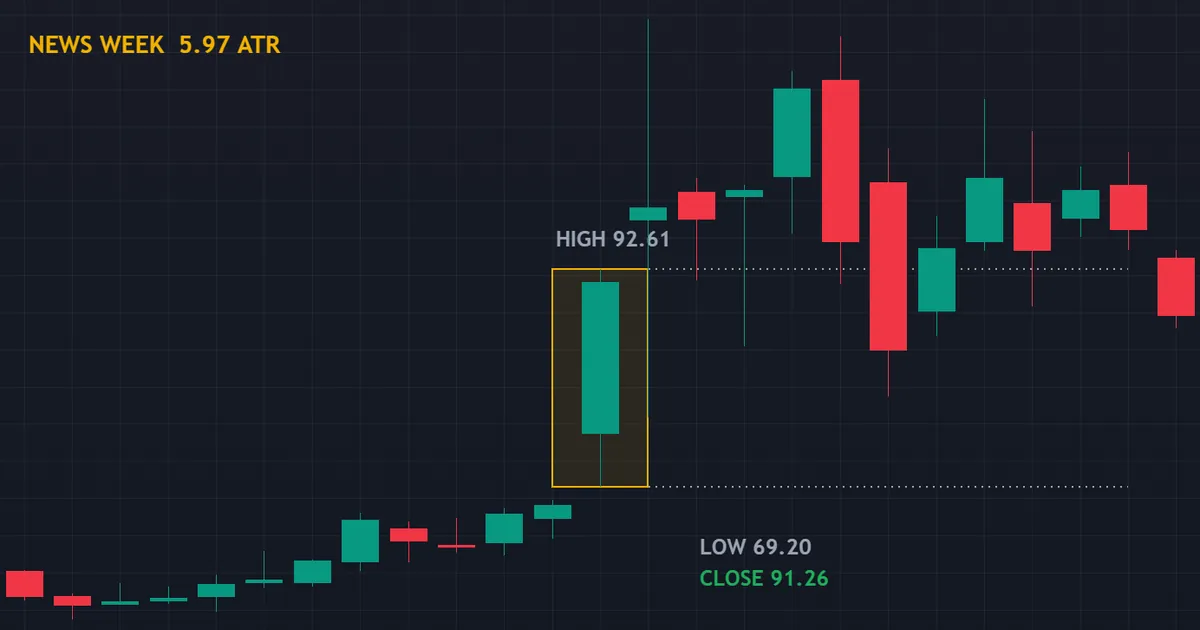
Above sit USOIL weekly bars for the week beginning 1 March 2026. That bar opened near 75.00, dipped to 69.20, ran to 92.61 and closed at 91.26.
The range covers 5.97 times the average weekly range, with roughly 69 percent of it inside the body. News drove the move, and the following weeks added another 1.11 average ranges in the same direction.
Oil is no currency pair, yet the mechanics match exactly. When a market travels that far that fast, every order placed inside the move meets a book that keeps changing.
Reduce the Exposure, Not the Phenomenon
Ask a better question than how to stop slippage. Ask which of your trades genuinely need to sit inside a fast window.
Most do not. A swing entry can wait an hour; a stop on an open position cannot, and that distinction drives everything below.
Our guide to slippage in trading covers the mechanism in full, so this article stays on the controls.
The Seven Controls at a Glance
Seven habits carry nearly all of the benefit. None of them needs special software.
- Read the calendar before placing anything. High-impact releases appear on the schedule days ahead.
- Treat the weekend reopen as a hole. Nothing trades between Friday close and Sunday open.
- Pick the order type on purpose. Limit orders control price; market orders favour participation.
- Size for the fill you might get. Build a buffer rather than assuming the stop level is exact.
- Trade the liquid hours. Depth runs thickest when two major centres overlap.
- Match the instrument to your tolerance. Exotics and commodities travel further per second.
- Measure your own fills. Only a record tells you whether the problem is the market or the routing.
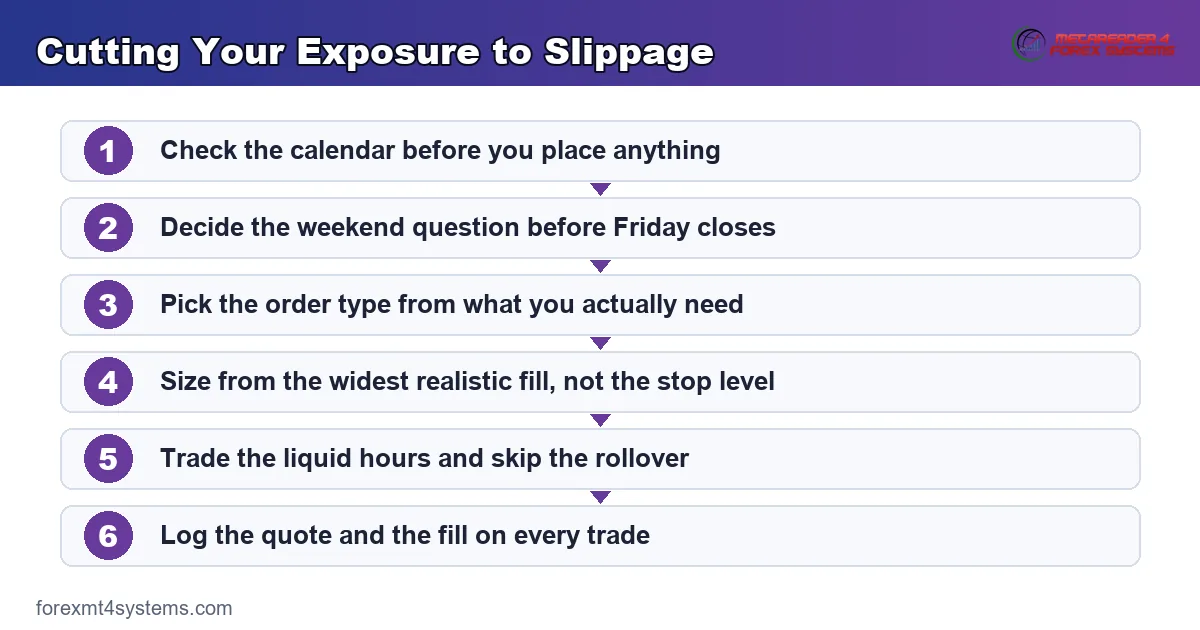
Work down that list in order. The first two remove more exposure than the other five combined.
Control One: Read the Calendar First
Scheduled releases give you their timing in advance. Ignoring that gift is the most common avoidable error in retail execution.
Which Releases Matter
Employment reports, inflation prints and central bank decisions move currencies hardest. Second-tier data rarely troubles a major pair.
Check which currencies you hold before each session. A euro release matters to every pair with a euro in it, including the crosses you forgot about.
Our free economic calendar flags the high-impact entries so you can plan the day in a minute.
How Long to Wait
The worst conditions cluster in the first minute or two. Spreads widen sharply, then narrow again as market makers regain confidence.
Waiting five minutes removes most of the risk for a swing entry. Waiting fifteen removes nearly all of it, at the cost of some of the move.
Direction, by the way, is the wrong thing to focus on here. Reactions frequently run opposite to the headline number, because what mattered was already priced in.
Why Waiting Beats Predicting
Traders often try to solve slippage by being faster. A better answer is being later.
What Priced In Actually Means
Markets move on the difference between the number and the expectation. A strong figure that everyone already expected can leave price flat, or send it the other way entirely.
So the direction of a release is genuinely hard to call. Even a correct forecast of the number tells you little about the reaction.
There sits the real argument for waiting. You are not missing an edge by standing aside; you are declining a coin flip taken at the worst prices of the day.
The Second Move
Initial spikes often reverse within minutes. The move that holds tends to appear once the first wave of orders clears.
Entering there costs you the opening burst. It also hands you a normal spread, a working book and a fill near the quote.
Neither approach wins in every case. One of them, though, removes the execution problem this article exists to solve.
Control Two: Treat the Weekend Reopen as a Hole
Friday close to Sunday open is the longest gap in the trading week. Two days of news arrive with no chance to trade them.

What the Gap Did
The chart above shows AUDUSD hourly bars at the reopen of 19 July 2026. Friday’s last hour never traded below 0.69796, and the new week opened at 0.69664.
That is a downward gap of 0.00124, roughly 1.52 times the average true range of an hourly bar. A long position holding a stop at 0.69777 found that level inside the hole.
No trading occurred at 0.69777, so nothing could fill there. The stop became a market order and met 0.69664 instead, about 11.3 pips below the level chosen.
The Friday Decision
You have three honest options before the close. Close the position, cut the size, or accept the gap as part of the risk you already agreed to take.
Pretending the stop will hold is not among them. Our guide to the weekend gap in forex shows how wide these holes get across different instruments.
Control Three: Pick the Order Type on Purpose
Order type is the one lever that directly changes your exposure. Most traders use whichever button sits closest to the mouse.
When Price Control Wins
A limit order fills at your price or better, never worse. Choose it whenever the exact entry price matters more than taking part.
Mean-reversion entries fit that description well. So does any plan where a few pips of difference would change the risk-to-reward maths.
The trade-off is real, though. Our guide to the limit order explains how often price reaches a level and leaves without filling the queue behind it.
When Participation Wins
Sometimes being in the trade beats being in at a chosen price. Breakout plans usually fall here, since missing the move costs more than a pip or two.
Market orders and stop orders serve that goal. Both take the next available price, so both accept slippage as the price of admission.
Stops Are Market Orders
Here is the point traders most often miss. A stop order converts to a market order the moment price touches it.
So every protective stop you place carries slippage risk by design. Our guide on how to use a stop loss explains why that still beats trading without one.
Control Four: Size for the Fill You Might Get
Position sizing usually assumes the stop level is the exit price. That assumption quietly breaks on the days that matter.
The Buffer Method
Add a small allowance to your stop distance before you calculate lots. Two pips on a major pair covers most ordinary conditions.
The position comes out slightly smaller. In exchange, a normal bad fill no longer overshoots the loss you planned.
The Weekend Adjustment
Weekend gaps deserve a bigger allowance than ordinary sessions. A gap of one and a half average ranges is unremarkable, as the chart above shows.
Compare that with a stop sitting half an average range away. The arithmetic makes the case for a smaller Friday position on its own.
Do Broker Features Actually Help?
Platforms advertise several execution settings. Two of them earn their keep, and the rest do less than the marketing suggests.
Maximum Deviation Settings
MetaTrader lets you cap how far a fill may stray from the requested price. Set the limit to three pips and anything worse gets rejected.
That protects the price at the cost of the trade. On a fast market the order simply fails, which suits an entry and suits an exit far less.
Use it on entries where price matters most. Leave it wide or switched off on protective exits, because a rejected stop leaves you exposed.
Fixed-Exit Stop Products
Some brokers sell a stop that fills at your level whatever the gap does. The broker carries the gap risk and charges for it, usually through a wider spread.
The maths is simple enough to check. Compare the extra cost across a hundred trades against the size of the gaps you actually meet.
Raw-Spread and ECN Accounts
These accounts show tighter quotes and add a commission. Whether they improve your fills depends on the depth behind the quote rather than on the label.
Test with real orders in your normal conditions. Marketing copy tells you nothing about what your size meets at your hours.
Hosting Near the Server
A virtual server close to the broker’s data centre shaves latency. That helps automated systems far more than it helps a discretionary trader.
Milliseconds matter when a robot fires hundreds of orders. They matter much less when you click twice a day.
Control Five: Trade the Liquid Hours
Depth changes through the day in a repeatable pattern. Trading with it costs nothing and helps every fill.
The Overlap
London and New York trade together for several hours each afternoon. That window carries the deepest books of the day on major pairs.
Fills there sit closest to the quote. Spreads narrow too, which improves the same trade twice over.
The Rollover Hour
Liquidity providers step back briefly around the daily rollover. Spreads widen, depth thins, and market orders meet worse prices.
Nothing dramatic usually happens. Still, placing a large market order in that hour is a choice with no upside.
Control Six: Match the Instrument to Your Tolerance
Instruments differ enormously in how far they travel per second. Choosing well removes a problem you would otherwise manage forever.
Majors, Crosses and Exotics
Major pairs carry the most participants at every price level. Crosses carry fewer, and exotics fewer still.
An exotic pair can show a tight headline spread with almost nothing behind it. Depth, not the quote, decides what your order actually meets.
Commodities and Indices
Oil, metals and stock indices move in larger steps than currencies. The chart at the top of this article makes that vivid.
None of that rules them out. It simply means your buffer and your size need to reflect the instrument rather than a habit formed elsewhere.
Download the complete indicator database
Put these concepts on your charts. One email unlocks the full library of 1,380+ indicators with compiled MT4 and MT5 files, plus my TradingView scripts. No paywall, no spam, unsubscribe any time.
Get free access to my indicator database
One email unlocks 1,380+ free MT4, MT5 and TradingView indicators — the complete library. No single-tool download; you get the whole database.
Control Seven: Measure, Then Judge Your Broker
Opinions about execution outnumber measurements by a wide margin. Two weeks of records settles the argument.
What to Record
Note the quote on screen when you clicked and the price on the confirmation. Add the session and whether a release sat nearby.
Twenty trades give you a first impression. Fifty give you something you can act on.
What Good Looks Like
A healthy record shows fills on both sides of the quote. Positive slippage should appear regularly, not once in a blue moon.
A one-sided average across calm hours points at routing. The same pattern around releases points at the market instead.
When Slippage Is Telling You Something Else
Sometimes the fills are a symptom rather than the disease. Two patterns are worth recognising early.
A Strategy That Only Works on Paper
Some methods depend on capturing very small moves. Costs and fill differences then swallow the whole objective.
Check the ratio between your typical target and your typical round-trip cost. Anything under ten to one deserves hard questions.
The fix is rarely a better broker. Usually it is a bigger target, a slower timeframe, or a different method altogether.
Size That Has Outgrown the Book
Accounts grow, and position sizes grow with them. At some point an order stops taking the top of the book and starts walking down it.
Split the order into parts once that begins. Two smaller fills at sensible prices beat one large fill at an average you never chose.
Watching fill quality change as size grows is genuinely useful information. It shows you where your method stops scaling.
A Routine for the Trading Week
Controls only work once they become habits. Here is a week-shaped version.
Sunday and Monday
Open the calendar and mark the high-impact entries for the week ahead. Note which of your pairs each one touches.
Avoid market orders in the first hour after the reopen. Spreads stay wide while the book refills.
Midweek
Place routine entries during the London and New York overlap. Keep the calendar open in a second tab.
If a release lands within thirty minutes, wait it out. The setup usually still exists afterwards, and often at a better price.
Friday
Review every open position before the close. Decide deliberately whether each one earns its weekend exposure.
Then log the week’s fills. Ten minutes on a Friday builds the record that answers every execution question you will ask later.
Common Mistakes and the Fixes
Five habits undo the seven controls above. Each fix takes seconds.
Placing Market Orders Seconds Before a Release
The clock is public, so surprise is optional. Set an alarm five minutes ahead and simply stand aside.
Assuming a Stop Guards the Price
A stop fixes the trigger level, never the fill. Plan the loss with a buffer and the surprise disappears.
Using Limit Orders for Breakouts
Price control is the wrong priority when the move leaves without you. Match the order type to what you actually need.
Sizing Friday Positions Like Monday Positions
Two days of unpriced news sit between them. Treat the weekend as a separate risk decision rather than an afterthought.
Blaming Routing Without a Record
Anecdotes prove nothing about execution quality. Measure, split the sample by conditions, then draw a conclusion.
What You Cannot Control
Honesty about the limits keeps the rest of the plan sensible. Four things sit beyond any trader’s reach.

Gaps, headline surprises, the withdrawal of depth and the speed of other participants all arrive uninvited. Accepting them frees you to work on the parts you do own, which are timing, order type and size.
Quick Reference Checklist
Run through this before each session. It takes under a minute once the habit forms.
| Check | Why it matters | Action if the answer is yes |
|---|---|---|
| Is a high-impact release due within thirty minutes? | Depth withdraws and quotes update constantly | Delay the entry or use a limit order |
| Am I holding into the Friday close? | Two days of news land in one print | Trim size or close the position |
| Does the exact entry price change my risk maths? | A few pips can move the whole ratio | Use a limit order and accept the miss |
| Is this an exotic pair or a commodity? | Fewer participants at every level | Widen the buffer and cut the size |
| Have I logged my last twenty fills? | Only a record separates market from routing | Start the log today |
Your Execution Timing Map
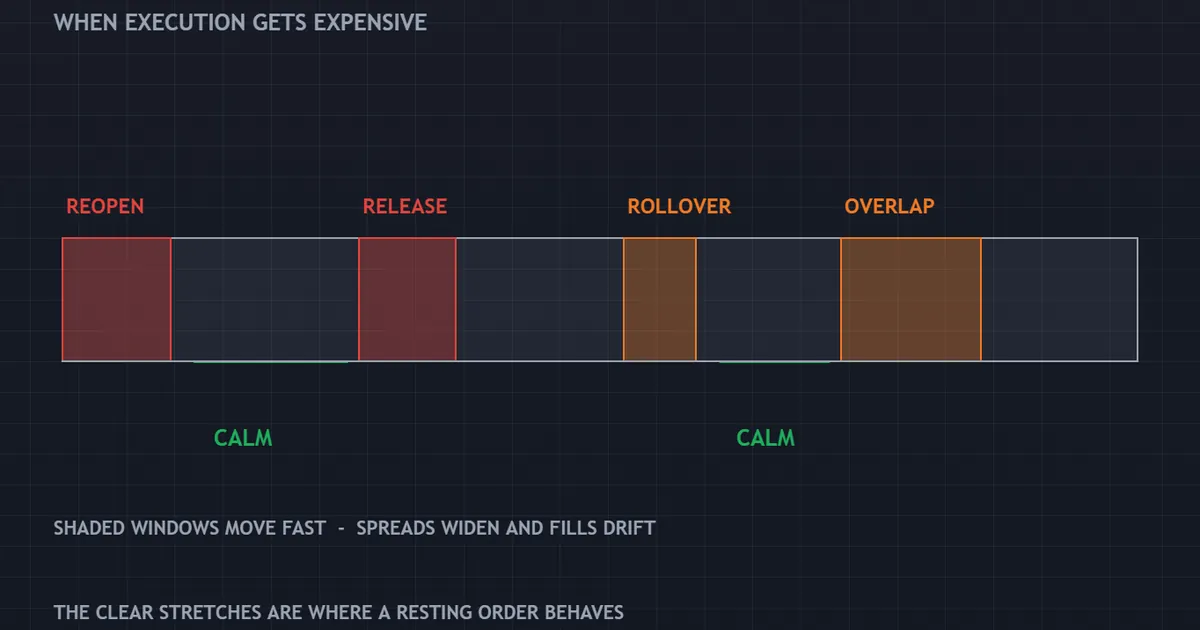
All seven controls collapse into one picture. The panel below marks the windows worth avoiding.
How to Use It
Treat the shaded windows as no-entry zones for market orders. Everything else stays open for normal business.
Exits are different, because they answer to price rather than to you. That asymmetry is why sizing carries so much of the load.
Where the Map Fails
Unscheduled news respects no map. A political headline can hit a quiet Tuesday afternoon and empty the book in seconds.
Nothing prepares for that except size. A position small enough to survive a surprise never needs perfect timing.
Related Guides in This Cluster
Execution is a small cluster of connected ideas. Two more articles complete the picture.
Whether your platform can refuse a fill at all depends on your account model. Our comparison of instant execution vs market execution explains which model produces requotes and which produces slippage instead.
For the accounting side, our guide to forex trading costs puts slippage next to spread, commission and swap so you can see the whole bill.
Traders who want volatility flagged automatically can browse our MetaTrader indicators library, where range measures make thin conditions visible on the chart.
FAQ
Can slippage be avoided completely?
No. Price moves while your order travels, and no platform setting changes that. What you can change is how often you place orders inside fast windows, which order type you use, and how much size sits behind each decision. Those three choices carry almost all of the improvement available to a retail trader.
Do limit orders stop slippage?
On price, yes. A limit fills at your level or better and never worse. The cost lands elsewhere: the order may not fill at all, because price can touch your level, clear the queue ahead of you and leave. You swap price risk for participation risk rather than removing risk.
Is slippage always negative?
Not at all. If price ticks in your favour during the round trip, you receive a better fill than the quote you clicked. Brokers describe that as price improvement. A record showing only negative fills across calm hours is worth investigating, because a normal stream shows both.
Should I turn off my stop loss to avoid slippage?
Definitely not. Removing the stop removes the trigger, not the risk, and an open-ended loss is far worse than a few pips of slippage. Set the level where your idea fails, add a buffer when you size the position, and let the stop do its job.
Does a bigger account get better fills?
Not directly, though account type can matter. Some brokers route larger accounts to different liquidity tiers or offer raw-spread pricing with commission. The instrument, the session and the order size relative to available depth still do most of the work.
Does a demo account show realistic slippage?
Rarely. Demo servers usually fill at the quoted price with no queue and no depth behind it, so execution looks better than it will be. Treat demo work as a test of the logic rather than of the fills. Expect the live version to give some of the difference back, particularly around releases.
How much slippage should I budget for?
Use your own numbers rather than a rule of thumb. Log the difference between quote and fill for fifty trades, split the sample into calm hours and event windows, and take the average of each. Apply the calm figure to routine trades and the event figure to anything held through a release or a weekend. Review the numbers monthly and judge the process across a long run of trades. Results are not guaranteed; past performance is not indicative of future results.
External references
- For background on this concept, see Best Execution on Wikipedia.
- For broader market context, see Fast Market at Investopedia.

About the author
Written by Dominic Walsh, a Forex trader and MT4/MT5 indicator, Expert Advisor and script developer. Every tool on forexmt4systems.com is tested on live charts before release and ships with ready-to-use compiled MT4 (.ex4) and MT5 (.ex5) files. Learn more about the trader and developer behind this site.
How we build, test and correct every tool: Editorial & Testing Policy. Trading carries risk; see the disclaimer.