
Patience has a name on your trading platform. Ask what is a limit order and the short version runs like this: it buys below the market or sells above it, and it waits.
The longer version carries the real lesson. You choose the price, so the market keeps the right to ignore you completely.
What Is a Limit Order in Plain Terms
A limit order names a price you find acceptable and refuses anything worse. Buy limits sit below the current market, and sell limits sit above it.
So the order describes a condition rather than an instruction to act now. Nothing happens until price travels to your level.
Two outcomes follow from that. Either price reaches you and the fill lands at your number or better, or price never arrives and you own nothing at all.
A Real Fill on the Pullback
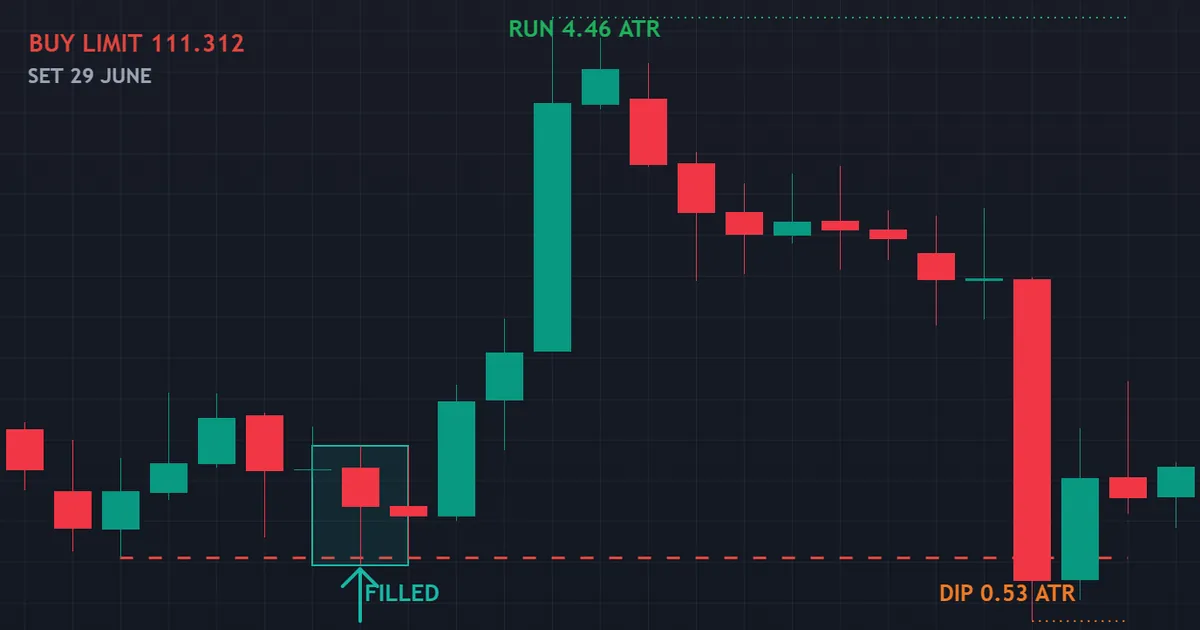
Above sits AUDJPY on four-hour bars during 29 June 2026. A buy limit rested at 111.312 from early that morning, and price dropped into it later the same day.
The fill landed at the level, not beyond it. Price then ran roughly 4.46 ATR in the trade’s favour within a day. Only on 2 July did it slide back about 0.53 ATR below the entry.
ATR simply measures the average range of a bar. Quoting moves in ATR keeps the comparison honest across pairs that move at very different speeds.
Or Better, Never Worse
The phrase “or better” does real work here. A buy limit at 111.312 accepts 111.312, and it also accepts 111.280 if the market opens or gaps below your level.
It never accepts 111.350. That refusal defines the whole order type.
Sell limits mirror the rule exactly. Your price or higher, and nothing beneath it.
How a Limit Order Works, Step by Step
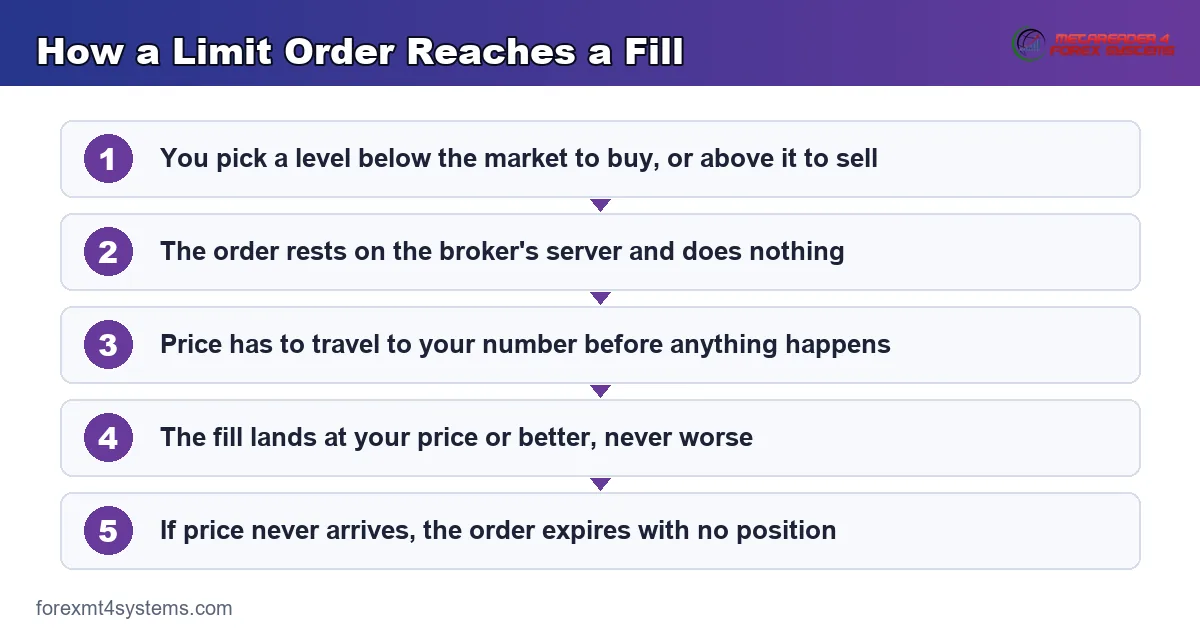
Four stages cover the entire life cycle. Each one explains a behaviour that surprises new traders.
- You pick a level. For a buy, that level sits below the current price; for a sell, above it.
- The order rests. It sits on the broker’s server, consuming nothing and doing nothing.
- Price has to come to you. No fill occurs until the market trades at or through your number.
- The fill lands at your price or better. Slippage against you cannot happen on the entry itself.
The Fifth Outcome Nobody Draws
Every diagram stops at the fill. Reality adds one more branch, and it happens constantly.
Price approaches, misses your level by a pip, and leaves. Your analysis proved correct, your order stayed empty, and you watched the move from the sidelines.
That outcome carries no commission and no visible loss. It still costs you, because the trade you wanted never existed.
Where the Order Actually Lives
Most retail limit orders rest on the broker’s server rather than in a central book. Your platform can close, your machine can sleep, and the order survives both.
Expiry rules differ between brokers, though. Some default to good until cancelled, others to end of day, so check the setting before you rely on an order surviving the week.
Attaching the Exits in Advance
Most platforms let you attach a stop loss and a take profit to the pending order itself. Both levels activate the moment the entry fills.
That habit removes a genuine risk. A fill arriving overnight leaves an unprotected position for hours if you meant to add the stop manually.
Attaching in advance also forces the arithmetic early. You cannot set a stop without deciding where the idea fails, which is exactly the thinking most traders postpone.
Your Price or Better: The Part People Miss
Limit orders solve exactly one problem. They remove entry slippage, and they solve nothing else.
What the Order Type Protects
Nobody can fill you worse than your number. That certainty matters most when spreads widen and immediate execution turns expensive.
Traders working from marked levels get real value from this. Our explainer on support and resistance covers how those levels get chosen in the first place.
What It Does Not Protect
Once filled, your position behaves like any other. The limit order has finished its job and left the building.
It offers no protection against the move afterwards. Only a stop loss does that, and our guide to stop loss and take profit works through how the two exits differ.
The Cost of Missing Out
Traders count losing trades and ignore missed ones. Both belong in the same ledger.
A pullback strategy that misses one entry in three has a much lower trade count than the backtest suggested. Comparing the two order types honestly means counting the empty orders as well as the filled ones, which our note on limit order versus market order works through with examples.
Gaps Can Fill You Better Than You Asked
Occasionally the “or better” clause pays you. A market reopening below your buy limit fills the order at that opening price rather than at your number.
Traders sometimes read that as a system error. It follows the rule exactly, since a lower price satisfies a buy limit perfectly well.
Treat the windfall with caution, though. A market that gapped through your level usually did so for a reason, and the position starts inside whatever caused the move.
The Order That Waits: A Second Real Fill
Waiting looks easy in a diagram. Three days of watching an untouched order feels rather different.
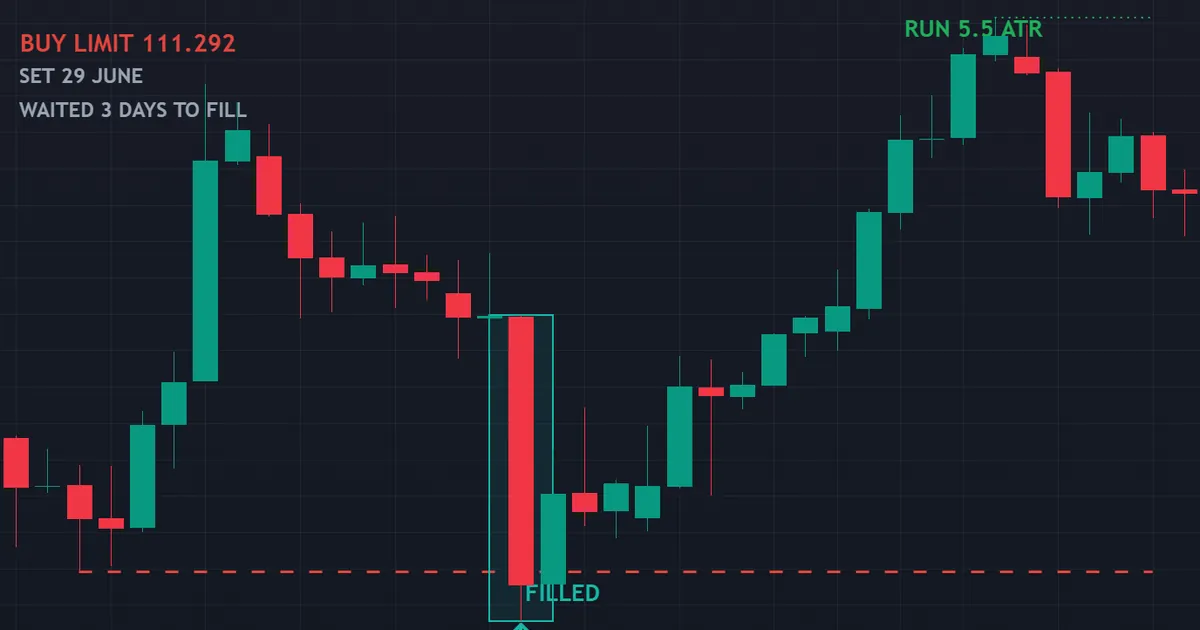
The chart above shows AUDJPY four-hour bars from 29 June to 2 July 2026. A buy limit went in at 111.292 on the Monday evening and sat there, untouched, until Thursday morning.
Three Days of Nothing
Nothing about those days rewarded attention. Price drifted, approached and pulled away, and the order simply waited.
Then the market came back. The fill landed at 111.292, the position dipped roughly 0.49 ATR, and price ran about 5.5 ATR in its favour afterwards.
Notice how little skill the waiting required. The work happened when the level went on the chart, and everything after that was administration.
Why Patience Beats Prediction Here
A resting order removes the moment of decision entirely. You cannot talk yourself into a worse price, because the order refuses one.
That mechanical quality suits traders who struggle with impulse. Our overview of the pending order family in forex shows how the four resting types divide the work between them.
Download the complete indicator database
Put these concepts on your charts. One email unlocks the full library of 1,380+ indicators with compiled MT4 and MT5 files, plus my TradingView scripts. No paywall, no spam, unsubscribe any time.
Get free access to my indicator database
One email unlocks 1,380+ free MT4, MT5 and TradingView indicators — the complete library. No single-tool download; you get the whole database.
Common Mistakes and How to Fix Them
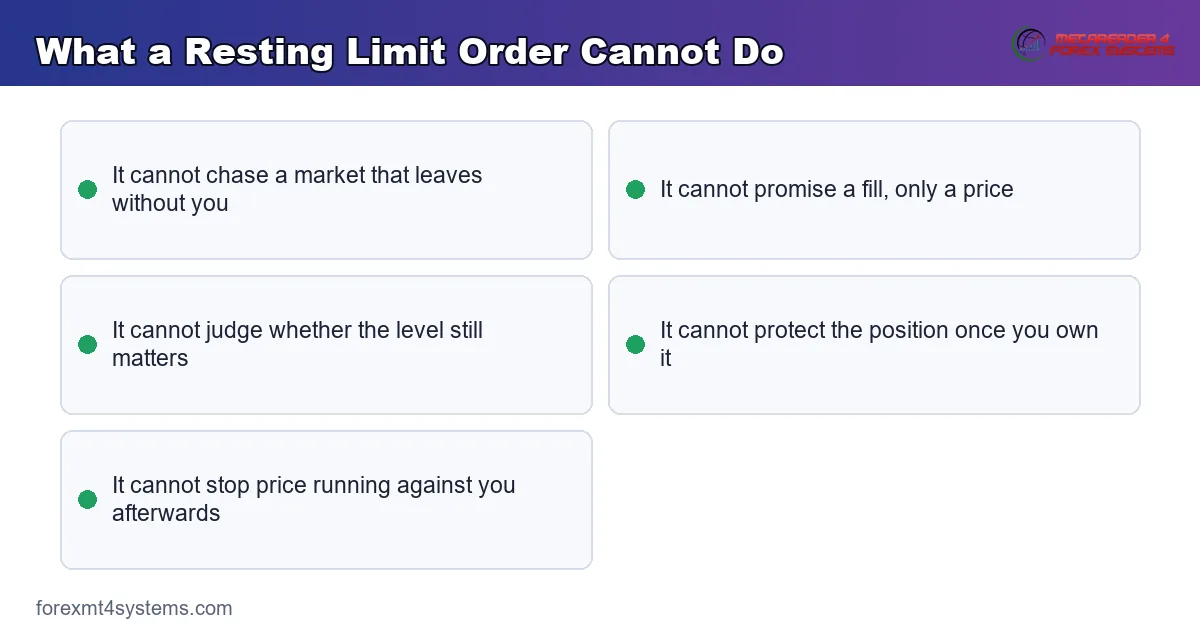
Five habits account for most limit-order disappointment. The panel below lists the jobs this order type simply cannot do.
Placing the Level Where You Want a Fill
Wishful levels get skipped. Put the order where the chart already turned, not where the arithmetic of your target happens to look tidy.
Moving the Order Closer Out of Boredom
Dragging a limit towards price to force a fill destroys the entire point. If waiting feels unbearable, the level was never a real level.
Forgetting the Spread on a Sell Limit
Buy fills happen at the ask and sell fills at the bid. A sell limit therefore needs the bid to reach your number, which sits a spread away from the price most charts display.
Leaving Stale Orders on the Server
An order placed last Tuesday reflects last Tuesday’s chart. Clear anything you would not place fresh today.
Ignoring What the Fill Costs
Removing entry slippage does not remove commission, spread or swap. Our breakdown of forex trading costs covers the full list, and our pip value calculator turns those pips into account terms.
Stacking Several Orders at the Same Level
Traders who fear missing a fill sometimes place three orders a few pips apart. All three trigger during one ordinary dip, and the position ends up triple the intended size.
Decide the total risk first, then split it deliberately if you want scaled entries. Accidental stacking turns a modest idea into an oversized one without any decision behind it.
Quick Reference: The Two Limit Orders
Two variants exist, and traders mix them up constantly. Keep this table nearby until the direction feels automatic.
| Order | Sits where | Fills when | Typical use |
|---|---|---|---|
| Buy limit | Below the current price | Price falls to your level or lower | Buying a pullback into support |
| Sell limit | Above the current price | Price rises to your level or higher | Selling a rally into resistance |
| Buy stop | Above the current price | Price rises through your level | Buying a break higher |
| Sell stop | Below the current price | Price falls through your level | Selling a break lower |
The bottom two rows belong to the stop family rather than the limit family. They appear here because the direction rule confuses almost everyone at first.
What Actually Went Wrong: A Fill That Went Underwater
The limit filled and price then ran about 1.01 ATR against the order before anything went its way — the fill was deeply underwater first, whatever happened later.
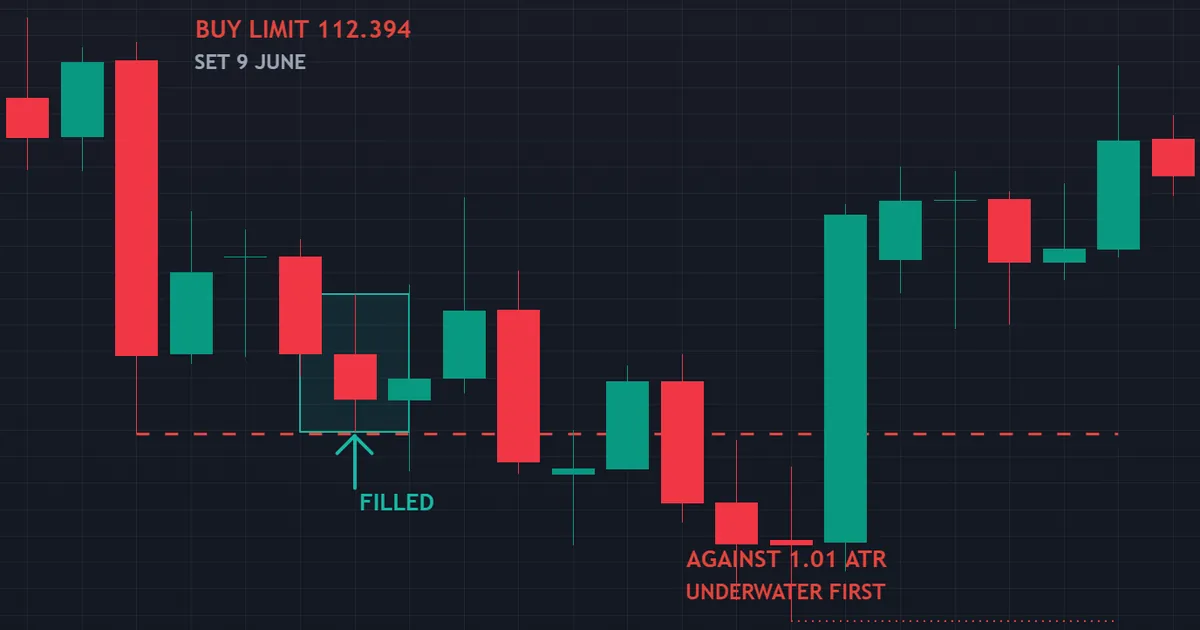
That describes AUDJPY four-hour bars from 9 to 10 June 2026. The order went in at 112.394 on the Tuesday afternoon, and the fill arrived early the following morning.
The Failure Was Not Direction
Read the numbers carefully. Price eventually travelled about 3.18 ATR in the trade’s favour, so the idea itself held up.
The problem sat in the sequence. A full ATR of adverse movement arrived first, which is enough to remove a tight stop before any of the good part happens.
Why This Matters More Than a Losing Trade
A limit fills exactly where you asked, which creates a false sense of precision. Precision on the entry says nothing about what price does next.
One ATR represents a full average bar range moving the wrong way. Traders who size for a quarter-ATR stop meet that move constantly, then blame the setup rather than the stop distance.
The Fix Sits in the Stop, Not the Entry
Set the stop from what the market normally does, not from what you hope it will do. A stop inside typical noise gets removed by noise.
Then size the position from that wider distance. A wider stop with smaller volume risks the same amount and survives the ordinary wobble that removed the tighter version.
Limit Orders Next to Market and Stop Orders
Three order types answer three different questions. Naming the question first makes the choice easy.
Against a Market Order
A market order takes the current price immediately, so the fill is near certain and the price is not. A limit order reverses both halves of that sentence.
Choose by asking what you would regret more. Missing the trade, or paying a few extra pips to be in it.
Against a Buy Stop
A buy stop sits above the market and triggers on strength. A buy limit sits below and triggers on weakness.
Same direction, opposite philosophy. One says the move proves itself by continuing, the other says the level proves itself by holding.
Against a Stop-Limit Order
A stop-limit combines both ideas. The stop price wakes the order up, and a limit price then caps what you will accept.
So it can trigger and still leave you flat. Price crosses your stop, races past your limit, and the order sits unfilled while the move continues without you.
Traders reach for it to avoid dreadful fills during fast trade. The price of that protection is the occasional missed entry, which is the same bargain a plain limit order offers.
Where the Level Comes From
Neither order type finds a level for you. That work stays with your analysis, and our support and resistance indicators archive collects tools that mark candidate levels automatically.
Where Limit Orders Fit in a Strategy
Order choice follows strategy rather than preference. Three broad approaches use resting orders very differently.
Mean Reversion Lives on Limits
A trader buying stretched moves back towards an average wants a worse price, not a better one. That intent maps onto a buy limit perfectly.
The deeper the pullback, the more attractive the entry becomes on this logic. Resting orders let that view express itself without any screen time.
Breakout Trading Rarely Does
Someone trading breaks wants confirmation that price left the range. Waiting for a pullback contradicts the entire idea.
Those traders belong in the stop family instead. Placing a buy limit under a breakout level means buying exactly the failure you were trying to avoid.
Trend Following Sits in Between
Trend traders often want a pullback inside an established move. A shallow buy limit into a rising trend captures that neatly.
Depth becomes the judgement call. Too shallow and the order fills on noise, too deep and the trend leaves without you.
Many trend traders solve this by splitting the entry. Half the size rests shallow and half rests deeper, so a modest pullback still produces a position.
News Traders Rarely Bother
Anyone trading scheduled releases faces a market that moves faster than any resting order can help with. Price frequently sweeps straight through a level and out the other side.
Limit orders in that environment fill at the worst possible instant. The market reaches your number on its way somewhere considerably further away.
Traders who insist on resting orders around releases usually place them far from price. That distance means the order only fills on a genuinely outsized move, which is a different bet entirely.
Building Limit Orders Into a Routine
The order type rewards preparation more than reaction. A short weekly habit covers most of it.
Mark Levels Before the Week Opens
Spend twenty minutes on Sunday marking the levels that already mattered. Prior swings, session extremes and obvious round numbers all qualify.
Then place orders only at those marks. Deciding in advance removes the temptation to invent a level during the week.
Record the Ones That Never Filled
Keep a note of every order that expired untouched. Count them monthly alongside the fills.
A high miss rate tells you the levels sit too far away. A very low one usually means they sit too close, so almost everything triggers and nothing gets selected.
Review the Distance, Not the Outcome
Measure how far price came to your unfilled orders. Three pips short repeatedly suggests a placement habit rather than bad luck.
Small adjustments to placement often change the fill rate more than any change to the strategy behind it. That is a cheap improvement, and most traders never look for it.
Decide What Happens Around Scheduled Events
Resting orders do not care what day it is. A release can drag price through your level and straight out the other side within a minute.
Some traders cancel everything beforehand. Others leave the orders in place and widen the stops to reflect the conditions.
Either policy works. Having no policy means the decision gets made by whichever news you happened to notice.
A Short Checklist Before You Place One
Run through these six questions before the order goes on the server. The whole list takes under a minute once it becomes habit.
- Did the chart turn here before? A level with history attracts other participants; an arbitrary number attracts nobody.
- Which side of the spread does the fill need? Buys need the ask and sells need the bid, so adjust the number accordingly.
- Where does the idea fail? Write the stop price before the entry, never after.
- Does the volume match that stop distance? Wider stops need smaller size to keep the risk constant.
- How long should this order live? Pick an expiry rather than accepting whatever the platform defaults to.
- What is scheduled between now and then? Check the calendar so a release does not decide your entry for you.
Anything that fails one of those questions belongs off the chart. Placing fewer orders with better reasoning beats blanketing a chart with hopeful levels.
FAQ
Can a limit order fill at a worse price than I set?
No. The order refuses anything worse by definition, which is the single feature it offers. A buy limit accepts your price or lower, and a sell limit accepts your price or higher. If the market never trades at your level, nothing happens at all.
Why did price touch my level without filling me?
Usually the spread explains it. Charts commonly display bid prices, while a buy fills at the ask, so price needs to travel a spread further than the chart suggests. Very fast moves through a level can also leave a resting order behind when liquidity at that price disappears within the same instant.
Should I use a limit order for my entries?
It suits traders who work from marked levels and can accept missing some moves. Momentum traders often prefer immediate execution, because the moves they want rarely offer a pullback. Neither choice is better in the abstract; they simply fail in different ways.
How long does a limit order stay active?
That depends on your broker and your platform setting. Good until cancelled keeps the order alive indefinitely, while a day order expires at the session close. Check the default before you assume an order survived the weekend, because the two settings behave very differently.
Do limit orders work the same way on every instrument?
The mechanic stays identical, but the behaviour around it changes. Deep, liquid markets fill resting orders reliably at the stated level, while thin instruments skip them more often during fast moves. Check how your chosen market behaves before you build a strategy that depends on precise fills.
Does a limit order protect me after the fill?
Not at all. Its job ends the moment you own the position. Protection afterwards comes from a stop loss, and profit-taking comes from a separate take-profit order or a manual exit. Many platforms let you attach both to the pending order in advance, which saves a step.
What happens if the market gaps past my limit level?
A gap through a buy limit fills you at the opening price, which sits better than the level you set. That follows the rule rather than breaking it. Be careful with the apparent bargain, though, since a gap usually reflects news that arrived while the market stood still.
Can I place a limit order and a stop order on the same level?
Not sensibly, because they point in opposite directions. A buy limit sits below the current price and a buy stop sits above it, so the same number cannot serve both. Traders who want to trade a level in either direction usually place a buy stop above it and a sell stop below.
Is a limit order cheaper than a market order?
On the entry itself, usually yes, since you avoid crossing the spread and you cannot slip. Over a full sample the picture gets murkier, because unfilled orders remove trades you wanted. Judge the two across many trades rather than one, and count the misses as part of the cost. Results are not guaranteed; past performance is not indicative of future results.
External references
- For background on this concept, see Limit Order on Wikipedia.
- For broader market context, see Buy Limit Order at Investopedia.

About the author
Written by Dominic Walsh, a Forex trader and MT4/MT5 indicator, Expert Advisor and script developer. Every tool on forexmt4systems.com is tested on live charts before release and ships with ready-to-use compiled MT4 (.ex4) and MT5 (.ex5) files. Learn more about the trader and developer behind this site.
How we build, test and correct every tool: Editorial & Testing Policy. Trading carries risk; see the disclaimer.