
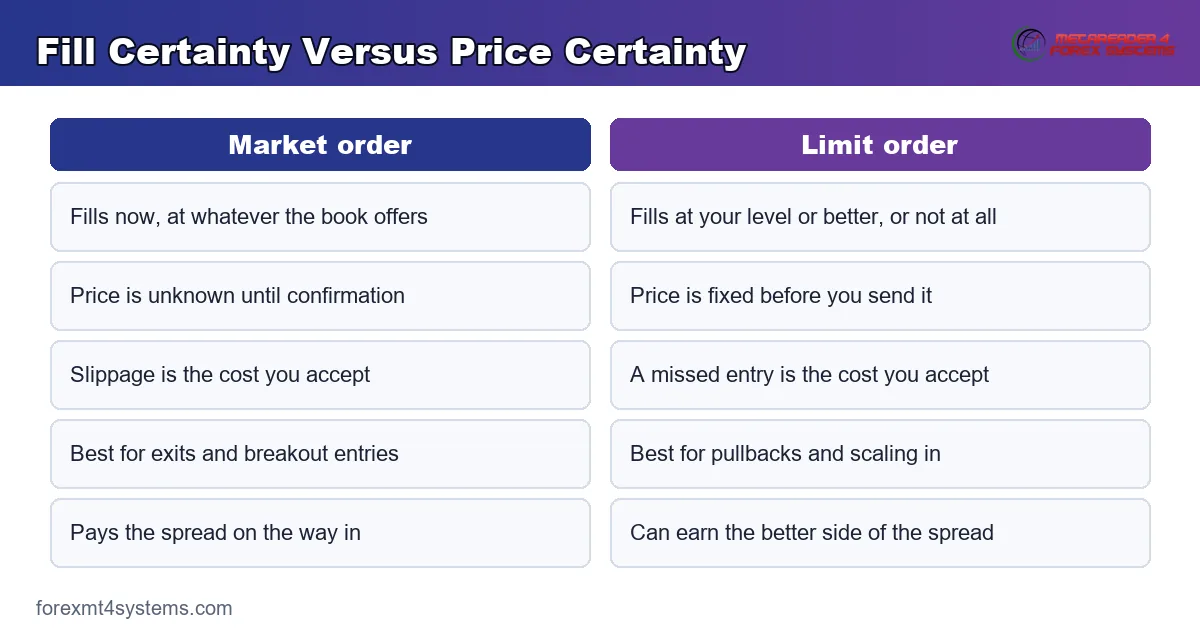
Every order you send forces one choice. Limit order vs market order is that choice at its simplest: you can insist on a price, or you can insist on a fill, but not on both at once.
Market orders take whatever the book offers right now. Limit orders name a level and wait, which sometimes means waiting for a fill that never arrives.
Limit Order vs Market Order: The Whole Trade-Off
One line covers it. A market order buys certainty of execution, while a limit order buys certainty of price.
So neither type performs better than the other. Instead, each one hands you a different uncertainty, and your job means picking which uncertainty suits the trade in front of you.

Above sits a buy limit on AUDJPY four-hour bars, resting at 112.212 from 17:00 on 7 July 2026. The bar that filled it on 8 July dipped to 112.203, barely a pip through the level, then closed back at 112.482.
Adverse movement after that fill came to 0.11 ATR. Favourable movement reached 2.88 ATR, so the entry price did its job almost perfectly.
What Each Order Promises
A market order says one thing: fill me now. Your broker matches it against the best available price, and that number can differ from the one on your screen.
A limit order says something narrower: fill me here or better. If price never reaches your level, nothing happens, so your money stays where it started.
Neither promise covers the other side of the deal. That gap explains almost every argument traders have about execution.
The Fill You Did Not Get
Traders rarely count the limit orders that never filled. Those orders cost nothing in commission, so they leave no trace in the account statement.
They still cost something, though. A missed entry on a move you called correctly hurts as much as a losing trade, and it hides from your records.
Keep a note of every level you set and never reached. Over a month that list tells you whether your limits sit too far from price.
How Each Order Reaches the Market
Both order types travel the same plumbing. Only the instruction riding with them differs.
- You submit the order. The platform sends your instruction to the broker’s execution server.
- The server checks the book. It looks for the best price it can source for your size.
- A market order matches immediately. Whatever price sits at the front of the queue becomes your fill.
- A limit order joins the queue. It rests at your level until the market trades there, or until you cancel it.
- Confirmation returns to your platform. Only at that moment do you learn the real fill price.
Step three holds all the slippage. Missed fills live at step four, and no order type escapes both problems at once.
Where the Price Comes From
Retail forex brokers quote from a pool of liquidity providers. Your platform shows the best bid and ask that pool currently offers.
That quote moves several times a second on a liquid pair. By the time your click reaches the server, the market may sit a tick away.
Market orders accept that drift. Limit orders refuse it, which covers the entire difference in one sentence.
What Your Broker Actually Holds
Your limit does not sit on your chart. It sits on the broker’s server, where it waits for the quote stream to reach your number.
Some brokers pass that instruction to a liquidity provider, while others hold it internally. Either way the trigger logic runs on their side, not on your machine.
Turn your computer off and the limit still works. Draw a line on the chart instead and nothing happens at all, which surprises more beginners than it should.
Why Your Screen Price Is Already Old
Latency runs in both directions. The quote took time to reach you, and your order takes time to reach the server.
On a calm hour that round trip means almost nothing. Around a data release it can mean several pips, because the book empties and refills faster than any human clicks.
Slippage therefore is not misconduct by default. It describes what happens when price moves between your request and your execution.
Where Each Instruction Sits on the Chart
Placement causes more confusion than mechanics. Four resting instructions exist, and each one belongs on a fixed side of the current price.
The Two Buy Instructions
A buy limit rests below the market. You expect a pullback, and you want the cheaper price that pullback offers.
A buy stop rests above the market. You expect a breakout, and you accept a worse price in exchange for proof that price can reach it.
Both instructions buy. Only the expectation about the path differs, so the placement flips from one side to the other.
The Two Sell Instructions
A sell limit rests above the market, since selling higher costs you nothing. A sell stop rests below it, since a lower break gives you the confirmation you wanted.
Mirror the buy logic and you have the whole grid. Limits sit on the favourable side of price, while stops sit on the unfavourable side.
Why the Grid Matters Here
A market order ignores the grid entirely. It has no side, no distance and no wait, since it takes the price in front of it.
So this comparison really runs between waiting and not waiting. Every resting order accepts a delay, and every market order refuses one.
Our note on buy limit vs buy stop takes the most confused pair of the four and makes the placement unambiguous.
How the Two Orders Behave in a Fast Market
Calm conditions flatter both instructions. Speed exposes the difference immediately.
The Market Order Under Pressure
A fast move empties the front of the book. Your order walks down the queue until it finds enough size, so the average price drifts away from the quote you saw.
That drift can run either way. Prices sometimes improve between click and match, though traders remember the bad half far more clearly.
Widen your expectations rather than your complaints. Around a scheduled release, several pips of movement inside one second counts as ordinary.
The Limit Order Under Pressure
A limit refuses to walk. It holds its level, so a violent move can jump straight over it and leave you flat.
Weekend gaps show this most clearly. Price opens away from Friday’s close, and every limit inside that gap sits untouched while the market trades on the other side.
Our weekend gap guide covers that mechanic in full.
Choosing Between Them in Practice
The right answer changes with the trade. Three questions settle it quickly.
When a Market Order Fits
Use one when getting in matters more than the entry tick. Breakout entries, stop-outs and any exit you need immediately all qualify.
Emergencies qualify too. If a position has gone wrong and you want out, arguing over half a pip serves nobody.
Market orders suit wider stops as well. A trade risking forty pips barely notices a one-pip difference at entry.
When a Limit Order Fits
Use one when the exact price matters most. Pullback entries, mean-reversion setups and scaling into a position all depend on getting a specific level.
Limits suit patient traders too. Setting a level and walking away removes the temptation to chase, and it costs nothing while it waits.
Thin markets favour limits as well. In a quiet session on a minor cross, taking whatever the book offers can prove expensive.
How Much Room the Stop Has
Stop distance settles most arguments. A trade with a five-pip stop lives or dies on execution quality, while a trade with a hundred-pip stop barely notices.
So ask that question third, after direction and level. If the answer says the stop sits tight, the entry method suddenly matters a great deal.
A Worked Example: The Order That Became a Market Order
Stop entries show the market-order side clearly. A buy stop sits above price and turns into a market order the instant price touches it.

The chart above shows a buy stop on AUDJPY hourly bars at 113.534, set at 16:00 on 17 July 2026 and triggered in the 02:00 hour on 20 July.
What the Fill Looked Like
That hour opened at 113.459 and reached 113.568, so price ran through the level on its way up. The same hour then closed at 113.533, a single tick below the trigger, which left the new position marginally offside from the start.
Adverse movement came to 0.8 ATR before the turn. Favourable movement then reached 4.11 ATR, which counts as a healthy ratio by any measure.
Notice what the trader accepted here. Certainty of fill mattered more than the exact tick, because a breakout you miss pays nothing at all.
Why the Trigger Price Is Not the Fill Price
Traders often record the order level as the entry. That habit quietly flatters the record, since the actual fill can sit a tick or two away from the number you typed.
Log both figures instead. Over a hundred trades the gap between them becomes the clearest measure of what your execution really costs.
The Same Level With a Limit
A buy limit at 113.534 would have behaved differently. Price rising through the level from below never triggers a buy limit, since a buy limit only fills at that price or lower.
So two instructions at the identical number produce opposite outcomes. Direction of approach decides everything, and that point trips up more new traders than any other.
Our guide to the pending order in forex covers the four resting types side by side.
Download the complete indicator database
Put these concepts on your charts. One email unlocks the full library of 1,380+ indicators with compiled MT4 and MT5 files, plus my TradingView scripts. No paywall, no spam, unsubscribe any time.
Get free access to my indicator database
One email unlocks 1,380+ free MT4, MT5 and TradingView indicators — the complete library. No single-tool download; you get the whole database.
The Execution Cost Nobody Adds Up
Traders track results in pips and ignore the pips that never reach the statement. Execution cost hides in that gap.
What a Market Order Really Pays
Two components stack up. You cross the spread on entry, and you accept whatever slippage the moment supplies.
On a major pair in a quiet hour both numbers stay small. During a release the spread can multiply several times over, so the same click costs far more.
Check your own fills rather than the advertised figure. Our forex spread comparison tool gives you a baseline, though your fills remain the real evidence.
What a Limit Order Really Pays
A resting limit avoids crossing the spread, which sounds like a straight saving. It is not, because the saving arrives only when the order fills.
Count the missed entries against it. A limit that saves one pip forty times but misses two large moves has cost you more than it ever saved.
Log both columns for a quarter. The answer differs by strategy, by pair and by session, so nobody else’s number applies to you.
Where Frequency Changes the Answer
Execution cost scales with trade count, not with account size. A scalper pays it hundreds of times a month, while a swing trader pays it twice.
That single fact explains why short-term traders obsess over fills. Their edge per trade sits close to the cost of getting in.
Common Mistakes and the Fixes
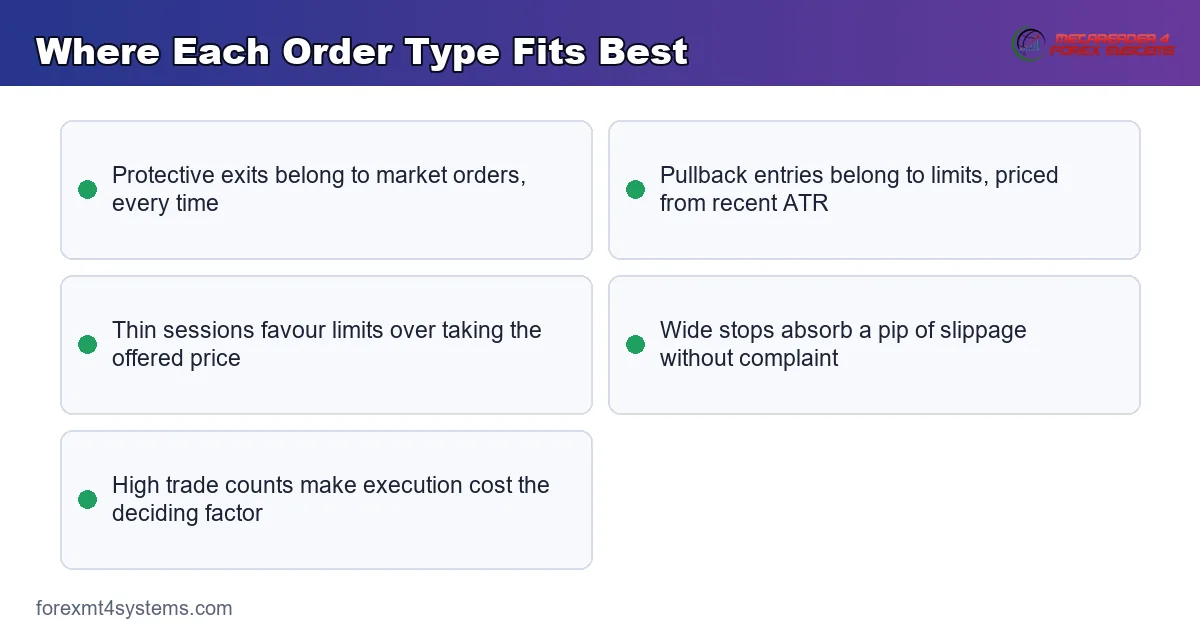
Six habits cause most execution complaints. The panel below collects the corrections.
Blaming the Broker for Every Slipped Fill
Slippage around a release counts as ordinary market behaviour. Check whether your fills slip in both directions, because consistent one-way slippage deserves a much harder look.
Using Limits for Exits That Must Happen
A protective exit needs to happen. Leaving it as a limit means price can gap past your level and leave the position running.
Setting Limits Too Far From Price
An ambitious level fills rarely. Measure your recent pullbacks in ATR, then place the limit inside that typical range rather than at a round number you happen to like.
Ignoring the Spread on Entry
A buy fills at the ask, not at the bid line most platforms draw. Set the limit at the price you want to pay, then check which side your chart shows.
Leaving Orders Resting Over the Weekend
A level that made sense on Friday can sit inside Monday’s gap. Review every resting order before the close, then cancel the ones whose reason has expired.
Chasing After a Missed Limit
Missing a fill stings, so traders often send a market order at a worse price. That reflex turns a disciplined plan into an impulsive one within seconds.
Quick Reference: Which Order, When
Keep this table beside your platform for a week. The pattern becomes automatic quickly.
| Situation | Order type | What you accept |
|---|---|---|
| Breakout entry above resistance | Market or buy stop | A fill price you cannot pin down |
| Pullback entry into support | Limit | The chance of no fill at all |
| Emergency exit | Market | Whatever the book offers right now |
| Scaling into a position | Limit | A partial position if price runs |
| Trading through a data release | Neither, usually | Sitting out the widest spreads |
| Quiet session on a minor cross | Limit | Patience instead of a wide spread |
| Tight stop on a fast pair | Limit, or skip it | Fewer trades, cleaner entries |
Notice that no row calls one type superior. Each row names a situation and the cost that comes with the choice.
What Goes Wrong: A Fill That Went Underwater
The limit filled and price then ran about 16.7 ATR against the order before anything went its way. The fill was deeply underwater first, whatever happened later.

That instance sat on AUDJPY four-hour bars. The buy limit rested at 113.43 from 01:00 on 29 July 2026, and the bar that filled it on 30 July traded down to 113.32 before closing at 113.66.
Why the Entry Price Did Not Save It
Getting your level does not settle anything. A limit controls where you enter, and it says nothing about where price travels next.
Here the order got exactly what it asked for. Price then kept falling for days, which pullback entries invite roughly as often as they catch a turn.
So the stop distance, not the entry, decided whether that trader survived. The 2.1 ATR of upside in that window sat on the entry bar itself. After the fill printed, price barely traded a full ATR above the level again.
Sizing for the Excursion
Measure the adverse move you can tolerate before you place the order. One ATR of heat on a four-hour chart looks completely ordinary.
Then size the position so that heat costs you a planned amount rather than an accidental one. A stop distance in pips plus a fixed percentage of the account gives you the lot size in one step.
What the Failure Does Not Prove
One underwater fill says nothing about limit orders in general. It shows the ordinary variance around any entry method, and variance cuts both ways.
Compare it with the first chart in this article. Same order type, same pair, same timeframe, and a completely different path after the fill.
Building the Choice Into Your Routine
Knowing the difference changes nothing until it reaches your platform. A short routine fixes that.
Decide the Order Type With the Setup
Write the entry instruction into the plan before you look at price. Breakout ideas get a stop or a market fill, while pullback ideas get a limit.
Deciding in advance removes the worst moment for judgement. Nobody chooses well while watching a candle race away from them.
Record the Fill, Not Just the Result
Note the price you wanted beside the price you got. Two columns in a spreadsheet reveal more about your execution than any review site.
Our free trade journal keeps those fields next to the trade itself.
Review the Unfilled Orders Monthly
Pull up every limit that expired untouched. Ask whether the level sat too deep, or whether the idea simply failed to arrive.
Adjust one thing after that review, then leave it alone for a month. Changing two rules at once tells you nothing about either.
Related Concepts Worth Reading Next
Execution sits inside a wider set of ideas. Three of them repay attention immediately.
Start with our breakdowns of the market order and the limit order, which go deeper on each side of this comparison.
After that, read why the spread in forex widens at certain hours, since the spread decides what a market order really costs. Traders hunting entry levels can also browse our support and resistance indicators archive.
FAQ
Which order type should a beginner use?
Start with market orders for exits and limit orders for entries. That split keeps you protected when you need out, and it stops you chasing price when you want in. Once you have logged fifty trades, review how often your limits went unfilled and adjust the distances from there.
Does a limit order always fill at my exact price?
At that price or better, yes, and it occasionally fills at a better level during a fast move. The real caveat sits elsewhere: price must actually trade at your level, and a partial fill can leave you holding less size than you asked for on a thin instrument.
Why did my market order fill at a different price?
Because the quote moved between your click and the server’s match. That distance grows around data releases, at the weekend open and in quiet sessions. Slippage in both directions looks normal, while slippage that only ever runs one way deserves a conversation with your broker.
What happens to my limit order if price gaps past it?
Nothing, in most cases. The order stays where you left it, waiting for price to return, and a gap that jumps the level leaves it untouched. Weekend opens produce this often, so review your resting orders before Friday’s close rather than on Monday morning.
Can I use a limit order for a stop loss?
Not safely on its own. A protective exit has to execute, and a limit can sit unfilled while price runs straight past it. Most platforms attach a stop order for that job precisely because a stop converts to a market order and takes what the book holds.
Do market orders cost more than limit orders?
Usually a little, yes. You pay the spread and any slippage on entry, while a resting limit can hand you the better side of the spread. Weigh that saving against the trades you never entered, since one missed winner outweighs a pip on a single fill.
Which one works better around news?
Neither behaves normally. Spreads widen, books thin out and limits can sit inside a gap without filling, while market orders slip further than usual. Most traders sit out the first minutes and let the range settle before acting, then judge the method over a long run rather than one release. Results are not guaranteed; past performance is not indicative of future results.
External references
- For background on this concept, see Order at BabyPips Forexpedia.
- For broader market context, see Open Order at Investopedia.

About the author
Written by Dominic Walsh, a Forex trader and MT4/MT5 indicator, Expert Advisor and script developer. Every tool on forexmt4systems.com is tested on live charts before release and ships with ready-to-use compiled MT4 (.ex4) and MT5 (.ex5) files. Learn more about the trader and developer behind this site.
How we build, test and correct every tool: Editorial & Testing Policy. Trading carries risk; see the disclaimer.