
Passing the evaluation feels like a finish line. The more useful question is what happens after passing a prop firm challenge, because the fortnight that follows decides whether the account lasts.
Here is the honest summary. Paperwork arrives first, then a funded account, then a slow first cycle that ends with a payout request rather than a party.
What Happens After Passing a Prop Firm Challenge
Treat the pass as a status change, not a prize. Your account number changes, and your habits should not.
Most programs run the same broad stages, though the wording differs everywhere. So learn the sequence once, then map your own firm’s terms onto it.

Nothing about this transition rewards a bolder style. Because the rule set usually tightens rather than loosens, the patient trader keeps the seat.
The First Message You Receive
A pass notice usually lands by email within a day or two. Some firms confirm instantly, while others audit your trade history first.
That audit hunts for rule breaches the dashboard missed. So expect a short wait rather than an instant handover, especially across a weekend.
Why the Audit Exists
Dashboards track equity well, yet they miss softer clauses. A consistency rule, a holding-time limit or a copied trade needs a human eye.
Firms therefore check before they issue capital. Because a mistaken pass costs them money, that step protects both sides of the arrangement.
What Should Not Change
Keep your risk per trade exactly where it sat during the evaluation. The floor beneath a funded account behaves like the floor beneath an attempt.
Many traders lift their size the week funding lands. That single choice undoes the discipline which earned the seat, and few accounts survive it.
Most Participants Never Reach a Payout
Stay clear-eyed about the odds. Plenty of traders clear an evaluation, and far fewer complete a full funded cycle with cash in hand.
Firms rarely publish that split, so treat any confident figure with suspicion. Plan for a long, dull first cycle instead of a quick withdrawal.
The Week One Emotional Trap
Relief and pressure arrive together. You feel proud of the pass, then anxious about protecting a seat that cost real money.
That mix pushes traders toward two opposite errors. Some freeze and skip valid setups, while others force trades to justify the fee.
Name the feeling, then carry on with the plan. Because your plan already survived an evaluation, it needs no upgrade in week one.
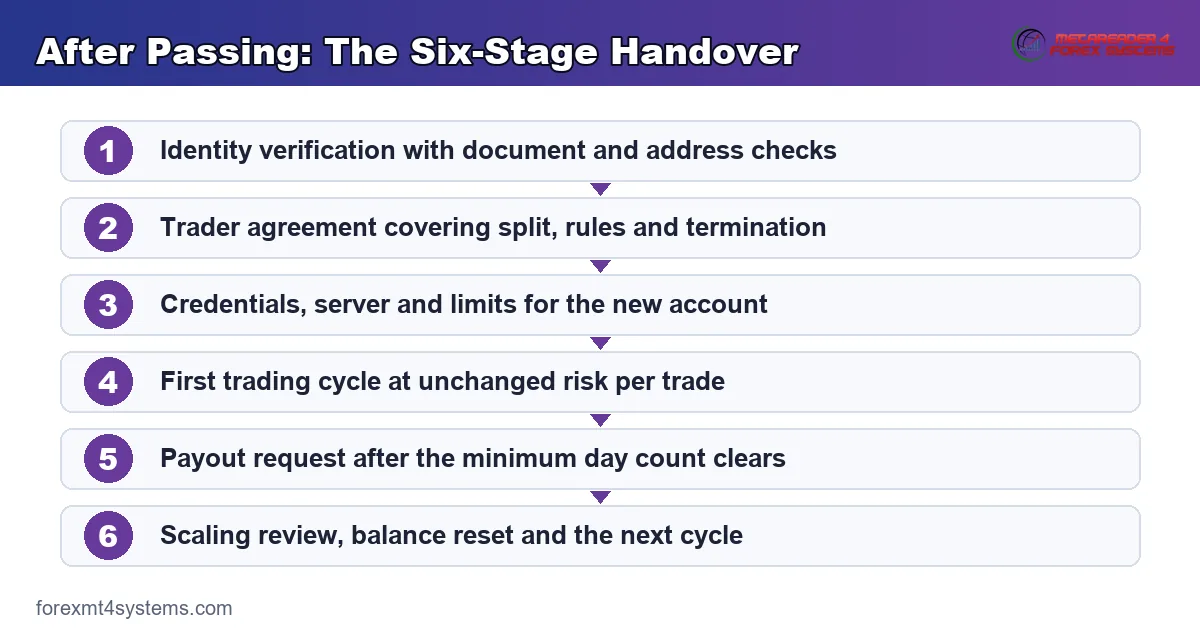
The Post-Pass Sequence in Six Stages
Six stages cover nearly every program. Read them in order, then hold your own terms against each one.
Print the list before you sign anything. Because excitement erodes memory, a visible sequence beats a remembered one.
- Identity verification. A photo document, a proof of address and sometimes a short liveness check.
- The funded-account agreement. A trader contract setting out the split, the rules and the grounds for termination.
- Credentials for the new account. Fresh login details, a new server and a fresh set of limits to confirm.
- Your first trading cycle. The same plan, the same sizing, and enough sessions to clear any minimum day count.
- The payout request. A dashboard form, a consistency check and a short approval window.
- Scaling and the next cycle. A possible size increase, a reset balance and a repeat of the whole loop.
Notice how little of that list involves charts. So the first weeks of funding reward admin and patience more than analysis.
Work through the stages slowly. Because each one carries its own small trap, a rushed handover creates problems that surface later.
Identity Verification in Practice
Nearly every firm runs an identity check before releasing an account. Regulated finance uses the same standard, so the requests should look familiar.
Match the name on your payout method to the name on the trading account. So a mismatch cannot stall your first withdrawal.
The Funded-Account Agreement
You sign a trader agreement rather than an employment contract. The document sets the profit split, the rule set and the grounds for closure.
Read the termination clauses closely. Because they list the behaviour that voids an account, they matter more than the headline split.
Credentials for the New Account
New login details usually arrive within a few working days. Check the platform, the server, the leverage and the instrument list before your first order.
Confirm the drawdown type on the new account too. A firm can run a static floor during evaluation and a trailing floor once funded.
Minimum Days Before a Payout
Most programs ask for a minimum number of active trading days per cycle. Some also set a first-payout window measured in weeks.
Count those days before you plan anything. So the cycle finishes on schedule without a scramble of filler trades at the end.
Reading the Funded Rule Set Line by Line
Funded terms rarely copy the evaluation terms exactly. So treat the new rule book as a fresh document rather than a familiar one.
Spend an hour with it before your first order. That hour costs nothing and removes most week-one surprises.
Turn Every Limit Into Cash
Percentages hide danger on a larger balance. Convert the daily cap and the drawdown floor into currency amounts, then write them somewhere visible.
Cash figures change behaviour. Because a limit expressed in money feels concrete, most traders stop trading far sooner than a percentage would push them.
Check the Instrument List
Funded accounts sometimes carry a shorter symbol list than the evaluation. Exotic pairs, indices and metals appear and disappear between tiers.
Confirm your usual instruments before you plan a session. So a favourite pair cannot vanish on the morning you need it most.
Note Any Leverage Change
Leverage often drops once an account carries a payout obligation. A smaller multiple means a smaller maximum position for the same margin.
Recalculate your lot sizes on the new figure. Because margin limits bite quietly, a rejected order at the wrong moment costs a whole setup.
Log the Payout Calendar
Programs run cycles on fixed dates or on rolling windows. Missing a cut-off pushes your cash into the following period.
Put those dates in a calendar with a reminder. So the request goes in on time rather than a day late.
How the First Funded Cycle Works
The cycle itself looks familiar. You trade the same plan under a similar rule set, then ask for your share.
Two details differ though. The split now applies, and a payout request adds a small approval process at the end.
Simulated Execution or Live Orders
Many firms state plainly that a funded account mirrors live prices in a simulated environment. Others route some or all orders to a live venue.
Neither model changes your job. So read the disclosure, understand what you hold, then trade the rules in front of you.
How the Profit Split Works
Splits commonly start near eighty percent to the trader. Programs often lift that toward ninety percent through a scaling plan or a loyalty tier.
The split applies to net profit across the cycle. Because losses inside the same window reduce the base, a strong week can still fund a modest payout.
Payment Rails and Timing
Firms pay through bank transfer, an e-wallet or a crypto rail. Processing usually takes a few working days after approval.
Fees and conversion spreads sit on that path. So check which rail costs least before you pick one.
The Consistency Clause, Again
Many programs cap how much of a cycle’s profit one session may supply. A single outsized day can therefore delay an otherwise valid request.
Spread your gains across the cycle deliberately. Because the clause measures your best day against the total, steady beats spectacular.
Trading Days That Actually Count
Firms differ on what marks a day as active. Some accept any filled order, while others ask for a minimum volume or a closed position.
Read that definition before you rely on a light session. So a quiet Tuesday still counts toward your total.
Questions to Ask Support Before Your First Order
Support tickets cost nothing and settle arguments early. Send one message with a short numbered list, then keep the reply.
A written answer also protects you later. Because staff and terms change, a saved email beats a half-remembered chat.
- Does the funded floor sit static, or does it trail my equity?
- Which instruments can this account trade, and at what leverage?
- What counts as an active trading day for the minimum count?
- How is the consistency figure calculated across a cycle?
- When does the payout window open, and when does it close?
- Does the balance reset after a withdrawal, or carry forward?
- Which payment rails apply, and who pays the transfer fee?
- What happens to the account during an extended holiday?
Keep the replies in one folder with your agreement. So every rule question has a single source you trust.
A Worked Example of a First Funded Cycle
Walk one cycle end to end. Picture a hundred thousand unit account, an eighty-twenty split and a ten day minimum.
Your risk stays at half a percent, so each loss costs five hundred units. The daily cap allows five thousand units, and your personal stop halves that.

Trade sixteen sessions across three weeks. Take eleven setups, book six winners at twice risk, and accept five losers at one.
Adding Up the Cycle
Six winners return six thousand units. Five losers cost two thousand five hundred, which leaves three thousand five hundred units of net profit.
Your eighty percent share equals two thousand eight hundred units. So the cycle pays a modest amount, and the account keeps its cushion intact.
Requesting the Payout
Open the dashboard and submit the request once the day count clears. Approval usually follows within a few working days.
Check the consistency figure before you click. Because one large session can breach the cap, a quick look saves a rejected request.
What Happens to the Balance
Most firms reset the account balance to its starting figure after a payout. Some instead retain the profit and lift the floor along with it.
Read which model applies to you. So your next cycle starts from a number you actually recognise.
The Session That Goes Wrong
Picture four losses in one morning. You sit two thousand units down, inside your personal stop and far from the firm’s cap.
Close the platform and log the session. Because the floor still sits thousands of units away, tomorrow starts with the cycle intact.
Compare that with a two percent risk on the same balance. Four losses would cost eight thousand units, which lands you on the daily cap in a single morning.
Download the complete indicator database
Put these concepts on your charts. One email unlocks the full library of 1,380+ indicators with compiled MT4 and MT5 files, plus my TradingView scripts. No paywall, no spam, unsubscribe any time.
Get free access to my indicator database
One email unlocks 1,380+ free MT4, MT5 and TradingView indicators — the complete library. No single-tool download; you get the whole database.
Common Mistakes Right After Passing
Six errors account for most accounts lost in the first month. The compare graphic below sets the habits that passed against the drift that follows funding.

Raising Your Risk Per Trade
Funding tempts traders to size up because the balance looks larger. One bad session then erases a month of work. So keep the same percentage and let a scaling plan do the growing.
Skipping the Agreement
The trader agreement holds the clauses that void accounts. Traders who skim it meet those rules during a dispute instead. So read every paragraph before you sign.
Rushing the First Payout
A request filed before the day count clears simply bounces. Worse, a hurried final week invites filler trades with no edge. So schedule the cycle and let the count fill naturally.
Ignoring the Consistency Cap
One outsized session can stall a withdrawal despite a healthy balance. Many traders meet this rule at the request screen. So track your best day against the cycle total from the start.
Mismatched Payout Details
Payment names that differ from account names trigger a manual review. A simple typo can add a fortnight to your first cycle. So verify those details the day your credentials arrive.
Treating Funding as Salary
A funded seat offers an opportunity, nothing more. Traders who budget around it force trades during slow months. So keep other income in place until several cycles complete.
Post-Pass Quick Reference
Run this list during your first funded fortnight. It takes a minute and keeps the handover tidy.
- Complete identity verification the day the request arrives.
- Match your payout account name to your trading account name.
- Read the trader agreement in full, especially the termination clauses.
- Write the new rule set as cash figures on the funded balance.
- Confirm whether the funded floor is static or trailing.
- Keep risk per trade identical to your evaluation sizing.
- Set a personal daily stop at roughly half the firm’s cap.
- Count the minimum trading days and schedule enough sessions.
- Track your best session against the cycle total for consistency.
- Compare payout rails on fees and processing time.
- File the payout request as soon as the rules allow.
- Note whether the balance resets or carries after a payout.
- Confirm the instrument list and the leverage on the funded server.
- Diary the payout cut-off dates for the whole quarter.
- Check how your firm defines an active trading day.
- Store screenshots of any platform issue on the day it happens.
Pitfalls and Edge Cases
A few wrinkles catch traders who did everything else well. The chart below shows a funded equity path that drifts through a trailing floor.

A Trailing Floor That Follows You
A trailing floor climbs behind your equity as the account grows. Your cushion shrinks in cash terms exactly when confidence rises. So recalculate the real distance after every strong day.
Gross Payouts and Tax Paperwork
Firms usually pay gross, with nothing withheld at source. Treatment varies by country and by how the payout gets classified. So keep records from day one and speak to a qualified local tax professional.
Resets That Wipe Your Buffer
A balance reset after a payout removes the cushion you built. Traders who forget this size against a number that no longer exists. So recheck the floor the morning after cash lands.
Inactivity Clauses
Several programs close accounts after a stretch with no trades. A holiday or an illness can therefore end a seat quietly. So note the inactivity window and place a small trade before it expires.
Rules That Differ From the Evaluation
News windows, holding limits and instrument lists can tighten once funded. Traders who assume continuity breach a clause they never read. So compare both rule sets side by side on day one.
Multiple Accounts and Copied Trades
Copying identical trades across several funded accounts breaks most rule books. Firms watch for matching timestamps and sizes. So run one account properly rather than three carelessly.
Refunds of the Evaluation Fee
Some programs return the challenge fee with the first payout. Others fold it into a later milestone or drop it entirely. So confirm the wording rather than assuming a refund arrives.
What Changes Over the Next Few Cycles
A first payout proves the machine works. Everything after that becomes a question of consistency rather than excitement.
Three things usually shift. Account size, split percentage and your own confidence all move once a cycle completes cleanly.
Scaling Plans and Bigger Balances
Many programs raise the balance after a set number of profitable cycles. The percentage rules stay the same, so your cash risk grows with the account.
Recalculate every limit after each step up. Because a larger balance quietly permits a larger loss, an unchanged percentage feels very different in money.
Better Splits and Loyalty Tiers
Splits often improve with tenure or with total profit withdrawn. A move from eighty to ninety percent lifts your share meaningfully.
Treat that as a bonus, never as a reason to trade harder. So the improvement compounds instead of tempting a change of style.
The Quiet Risk of Comfort
Several clean cycles breed complacency. Traders skip journals, widen stops and drift back toward the habits that ended earlier attempts.
Review your rules every cycle, even a profitable one. Because drift happens slowly, a written check catches it long before the floor does.
Related Concepts to Study Next
The post-pass stage rests on ordinary risk habits, so a few nearby topics repay the reading. Start with the payout mechanics, then the sizing arithmetic.
Read our guide to prop firm payouts for the withdrawal cycle in detail, then study prop firm scaling plans to see how account size grows. Because the terms vary widely, keep our explainer on a funded trading account and our notes on the prop firm consistency rule nearby. For expectations, read our piece on prop firm trader income and our guide to risk per trade, then size every funded position with our prop firm position size calculator. More material sits in our prop trading library.
FAQ
What happens after passing a prop firm challenge in the first week?
You verify your identity, sign a trader agreement and receive fresh login details. Most firms audit the passing trade history first, so a short wait is normal. Nothing else changes, and your risk per trade should stay exactly where it was.
How long until the first payout arrives?
Most programs set a minimum number of active trading days plus a first-payout window. Two to six weeks covers the common range, though terms vary widely. Processing then adds a few working days once the request clears approval.
Is a funded account real money?
Many firms run funded accounts in a simulated environment that mirrors live prices, while others route orders to a live venue. The disclosure sits in the trader agreement. Either way, the payout obligation and the rule set behave the same.
Should I increase my position size once funded?
No, keep the same percentage risk you used during the evaluation. Size increases belong to a scaling plan, which raises the account rather than the risk. Traders who size up in week one lose accounts faster than any other group.
What is a typical profit split?
Splits commonly start around eighty percent to the trader and can reach ninety percent through scaling or loyalty tiers. The exact figure sits in your agreement. Remember that the split applies to net profit across a cycle, not to a single good day.
Can I still lose the account after passing?
Yes, and most lost accounts break a limit rather than run out of edge. The daily cap and the drawdown floor apply exactly as before, sometimes more tightly. Treat every funded session with the caution you showed during the evaluation.
Does passing mean a steady second income?
No, a funded seat offers an opportunity rather than a salary, and the same rules can still end it. Most participants never reach a payout, so treat the first cycle as an experiment. Results are not guaranteed; past performance is not indicative of future results.
External references
- For background on this concept, see Know Your Client (KYC) at Corporate Finance Institute.
- For broader market context, see Revenue Sharing on Wikipedia.

About the author
Written by Dominic Walsh, a Forex trader and MT4/MT5 indicator, Expert Advisor and script developer. Every tool on forexmt4systems.com is tested on live charts before release and ships with ready-to-use compiled MT4 (.ex4) and MT5 (.ex5) files. Learn more about the trader and developer behind this site.
How we build, test and correct every tool: Editorial & Testing Policy. Trading carries risk; see the disclaimer.