
Prop firm scaling plans decide how a funded account grows after you prove you can trade the rules. They matter because your first funded account is rarely the size you hope to end up with.
This guide explains prop firm scaling plans in plain terms, and it stays firm-neutral throughout. You will see the usual conditions, the arithmetic of a step up, and why a bigger account carries a bigger absolute drawdown with it.
What Prop Firm Scaling Plans Actually Are
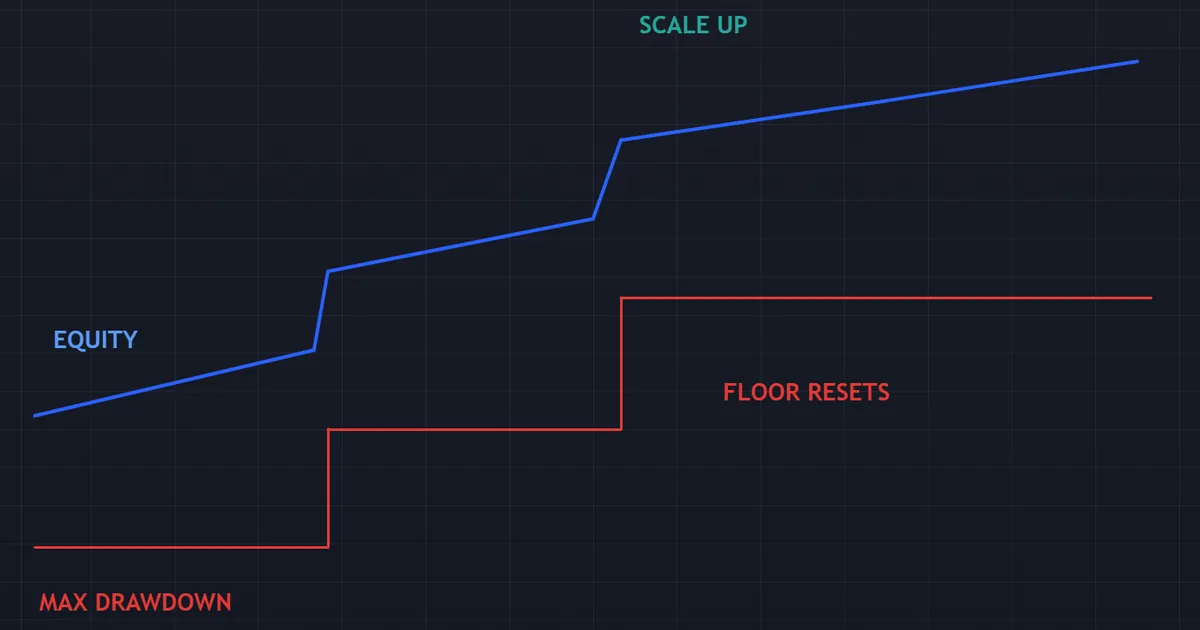
A scaling plan works like a written ladder. Meet the firm’s conditions over a review period, and the firm raises your account size a rung.
So the plan turns steady trading into more capital. Because the firm fixes the rungs in advance, you know exactly what each step asks of you.
Not every firm offers one. Some sell larger accounts outright instead, so a trader who wants size simply pays for it. Others reward performance with growth and keep the entry cheap.
Read the ladder before you pay any fee. A generous headline ceiling means little if the conditions to climb sit out of reach.
A Bigger Account, Not a Bigger Challenge
Scaling differs from buying a second evaluation. You keep the same funded account and the same track record, while the firm simply adds capital to it.
So your history follows you up the ladder. Because you never repeat a challenge, you also avoid paying another fee for the right to trade more.
Why Firms Offer a Ladder
A ladder helps the firm as much as the trader. Traders who reach a payout tend to stay, and staying traders cost less than new ones to find.
The plan also filters quietly. Because each rung asks for months of clean trading, the firm ends up funding the traders who last. So the ladder acts as a slow second evaluation.
How a Scaling Plan Works Step by Step
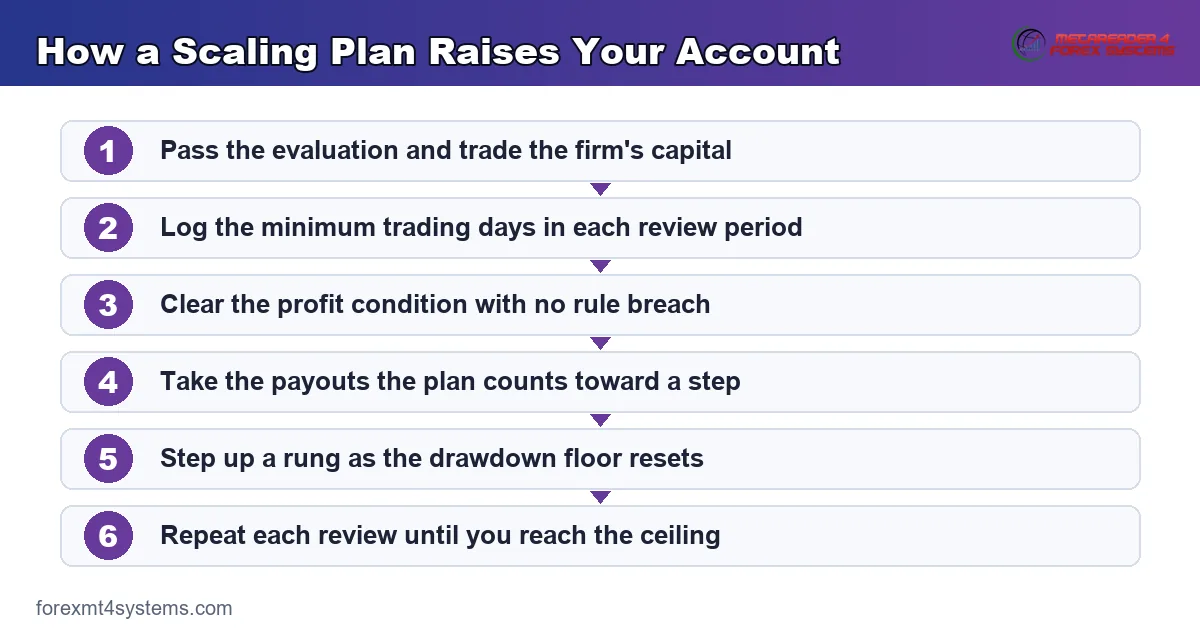
Most ladders follow the same shape, whatever the firm calls it. Walk the sequence once, and any plan becomes easy to read.
- Get funded. Pass the evaluation and start trading the firm’s capital under its rules.
- Trade a review period. Log the minimum trading days the plan asks for, month after month.
- Clear the profit condition. Finish the period a set percentage ahead, with no rule breach along the way.
- Take the payouts. Many plans count completed payouts rather than paper profit.
- Pass the review. The firm checks your trading days, your profit, and your risk behavior.
- Step up. Your account size rises a rung, and the drawdown limits reset around the new balance.
- Repeat to the ceiling. Keep clearing reviews until you reach the plan’s maximum account size.
So the ladder rewards repetition rather than a single strong month. Because each rung repeats the same test, the plan suits a trader with a routine.
Typical Scaling Conditions
Conditions vary, yet three of them appear again and again. Firms want a profit figure, a time span, and a clean record.
Many plans ask for a single-digit percentage gain across one to four months, plus a minimum number of trading days. Some also count a completed payout inside that window. Others add a consistency check so one huge day cannot carry the whole result.
What the Review Window Measures
The review looks backward, not forward. It weighs how you earned the profit as much as the profit itself.
So a month built on one reckless trade rarely passes, even where the headline number looks fine. Because the firm wants a repeatable trader, the review favors small risk and steady gains. Dull months therefore climb the ladder faster than dramatic ones.
How Scaling Plays Out in Practice
The ladder looks simple on paper. In practice, it stretches across many months and tests patience harder than skill.
Most traders meet the profit condition long before they meet the discipline condition. So the slow part of scaling lies in the not-losing, not the earning.
The Ladder Rewards Boring Months
A quiet month with a small gain clears most reviews. A wild month with the same gain often raises questions instead.
So aim for the least interesting equity curve you can produce. Because the firm reads your risk behavior, a flat, tidy path signals exactly what it wants to fund.
Minimum Days Set the Real Pace
Profit targets grab the attention, yet trading-day minimums often set the timetable. A plan asking for ten trading days each month forces you to stay active.
So a trader who takes two setups a week can miss a review despite a fine return. Because the count matters as much as the gain, plan your week around it. Then the ladder moves at the speed the rule book intends.
Breaches Reset More Than Progress
A rule breach does not merely pause the ladder. At most firms it closes the account, so the ladder vanishes with it.
Then you start again from a fresh evaluation and a fresh fee. So protecting the account matters more than climbing quickly. Because one breach erases four clean months, survival is the whole ladder.
A Worked Example of One Scaling Step
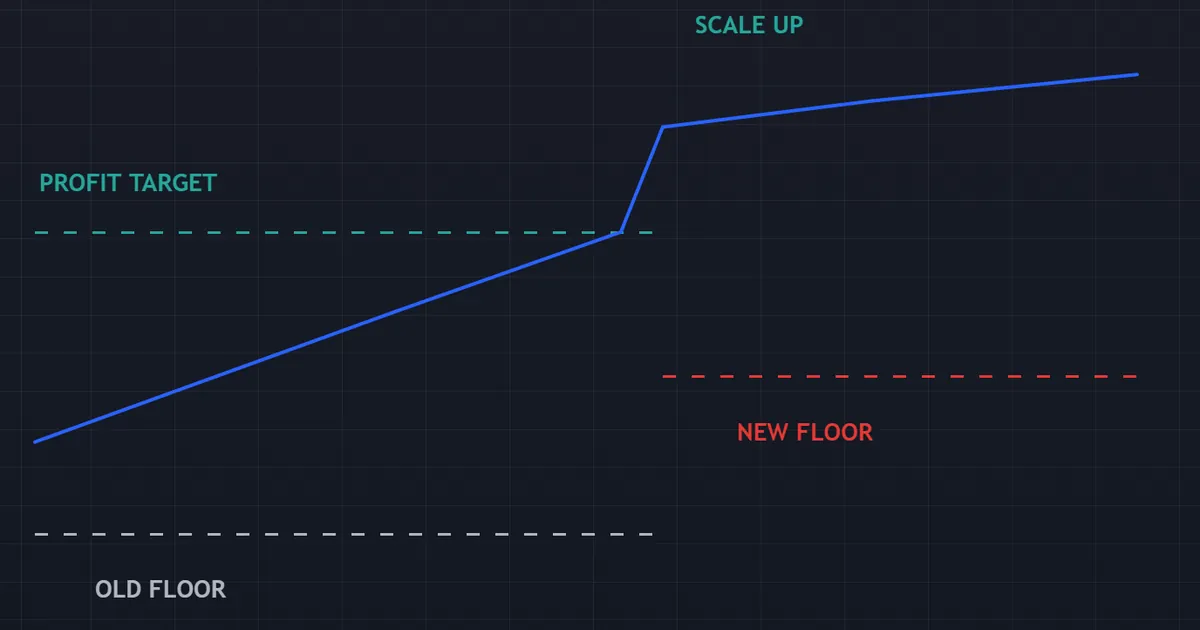
Numbers make the ladder concrete, so walk one rung slowly. Picture a hundred thousand dollar funded account with a ten percent maximum drawdown.
Your floor sits ten thousand dollars below the start. Clear the review, and the firm lifts the account to a hundred and twenty five thousand dollars.
The Same Percent, a Bigger Number
The percentage never moved. Ten percent of the new balance, though, equals twelve and a half thousand dollars.
So your cushion grew in money while staying flat in percent. Because your risk per trade tracks the balance, your typical loss grew by the same quarter. The felt pressure per trade therefore stays roughly where it was.
Where the Feeling Changes
The arithmetic stays calm, but the screen does not. A one percent loss now costs twelve hundred and fifty dollars rather than a thousand.
So the same discipline suddenly carries a larger price tag. Many traders shrink their size at this point without meaning to, and the ladder stalls right there.
Two Rungs Later
Now run the same step twice more. The account climbs from a hundred and twenty five thousand to roughly a hundred and ninety five thousand dollars.
Your ten percent floor then sits about nineteen and a half thousand dollars below the peak. So the cushion looks generous, while one careless week can still spend it. Because the numbers grew, the cost of every mistake grew with them.
What Scaling Does to Drawdown in Absolute Terms
Percentages hide the real change. A ladder that quadruples your account also quadruples the money you can lose before the firm closes it.
So read every limit twice: once in percent, once in money. Because your nerves respond to money, the second reading is the one that counts.
The Floor Grows With the Account
Most firms reset the drawdown floor around the new balance. So a step up hands you a wider absolute cushion on day one.
Some plans instead hold the old floor until you profit again. Read which model your plan uses, since it changes how much room the first week gives you. Our free drawdown calculator turns either version into plain numbers.
Daily Limits Scale Too
The daily loss limit usually tracks the account as well. A five percent daily cap on a bigger balance allows a much larger single-day loss.
That wider cap tempts traders into heavier positions. So set your own daily stop below the firm’s, and hold it in money rather than percent. Because a personal cap never drifts with the balance, it steadies your habits while the account grows.
Your Lot Size Must Grow Too
A bigger account with unchanged lots earns a smaller percentage. So the next review target quietly drifts further away.
Recalculate your position size after every step. A free prop firm position size calculator maps your risk onto the new balance and the new floor in one pass. So the ladder keeps its pace instead of stalling.
How the Firm Checks a Scaling Review
A review acts as an audit, not a formality. The firm reads your trade history to judge whether the profit came from process or from luck.
So learn what the auditor looks for. Because the checks repeat at every rung, one clean routine carries you through all of them.
What the Firm Looks At
Reviewers typically scan your largest single trade, your worst day, and the spread of your gains. They also count your trading days and check every hard limit.
A tidy record answers those questions quickly. So keep your risk per trade steady, and let the history speak for itself when the review lands.
Where Reviews Go Wrong
Most failed reviews trace back to one outsized trade rather than a poor month. That single position skews the consistency check and flags the account.
So cap your largest trade at a size you would happily repeat fifty times. Because the review measures repeatability, an outlier hurts you more than a modest loss ever will.
Keep a Simple Review Log
A short log turns the audit into a formality. Note the date, your risk, and your running distance from each limit.
Then a review becomes a reading exercise rather than a scramble. Because you already track the numbers the firm checks, nothing in the audit can surprise you.
Why Bigger Is Not Automatically Better
A larger account flatters the ego and rarely flatters the equity curve. The rules tighten in absolute terms while the percentages stay put.
So ask what the extra capital actually buys you. Because most traders cap out on emotional tolerance rather than opportunity, the honest answer is sometimes very little.
Size Outruns Composure
A trader calm about a two hundred dollar loss can freeze at a two thousand dollar one. Same percentage, different heartbeat.
So climb only as fast as your nerve allows. Because hesitation costs more than a smaller account ever would, a rung you cannot handle becomes a step backward.
Payout Rhythm Beats Headline Capital
A steady payout on a modest account often pays more than a stalled ladder on a large one. Cash reaches your bank only through payouts.
So weigh the payout schedule alongside the ceiling. Because a smooth cycle compounds your own savings, the rhythm matters more than the number in the account title.
A Ceiling You May Never Reach
Plans advertise impressive maximum account sizes. Reaching one usually demands a year or more of unbroken reviews.
Treat the ceiling as marketing rather than a plan. So judge a firm on its first two rungs, since those are the only ones most traders ever see.
Download the complete indicator database
Put these concepts on your charts. One email unlocks the full library of 1,380+ indicators with compiled MT4 and MT5 files, plus my TradingView scripts. No paywall, no spam, unsubscribe any time.
Get free access to my indicator database
One email unlocks 1,380+ free MT4, MT5 and TradingView indicators — the complete library. No single-tool download; you get the whole database.
What a Scaling Plan Does Not Change
A step up alters the numbers, not the rule book. Every limit you traded under yesterday still applies today.
So treat a new rung as more capital under identical conditions. Because the conditions never soften, the habits that earned the step remain the habits that keep it.
The Rules Stay the Same
Daily loss caps, consistency checks, and news restrictions all carry over untouched. A larger account buys no extra freedom.
Some traders expect a lighter rule set near the top of the ladder. That expectation costs accounts. So reread the rules at each rung, and confirm nothing shifted in your favor or against it.
Your Edge Stays the Same
Extra capital multiplies whatever your method already produces. A method that grinds out small gains will grind out slightly larger ones.
So the ladder magnifies results in both directions. Because a weak edge scales into a weak edge, the honest move is to fix the method before chasing the size.
Comparing Scaling Plans Before You Join
Ladders differ more than the marketing suggests. Three details separate a workable plan from a decorative one.
How Big Each Rung Is
A step that adds a quarter to the account moves the needle. A step that adds a tenth barely registers after costs.
So compare the rung size rather than the ceiling. Because early rungs arrive soonest, their size decides what the plan actually delivers to you.
How Often Reviews Happen
A quarterly review and a monthly review produce very different ladders. Frequent reviews compound faster, though they demand steady activity.
So match the rhythm to your style. A swing trader with few setups may prefer a longer window, while an active trader gains from short ones.
What Happens After a Losing Period
Some plans pause the ladder after a losing month and resume once you recover. Others push you back a rung.
So find the wording on losing periods before you join. Because most traders meet one, this clause shapes the real journey more than any ceiling does.
Common Scaling Mistakes and Fixes
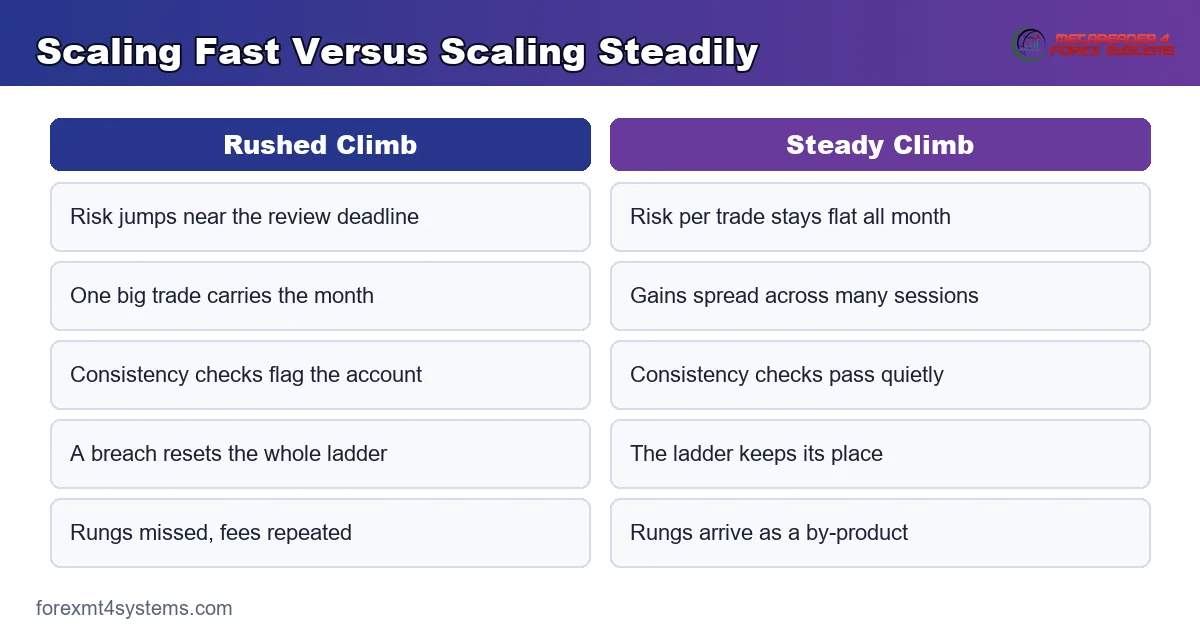
The ladder is simple, yet the same errors stall the same traders. The panel below sets a rushed climb beside a steady one.
Chasing the Review Deadline
Some traders notice the period ending and crank up risk to hit the target. One losing streak then breaches a limit and ends the account.
The fix is patience. Treat the review as a by-product of good months rather than a deadline. So a missed rung simply becomes next quarter’s rung.
Treating the New Floor as the Old One
After a step up, the drawdown figure changes. Traders who keep the old number in their head misjudge the cushion badly.
Write the new floor down on the day it changes. So every session starts from the correct limit rather than a stale memory.
Keeping the Same Lots After a Step
Unchanged lots on a bigger account deliver a smaller percentage return. The next review then slips out of reach quietly.
Resize on the day the capital lands. So your percentage output stays constant, and the ladder keeps moving.
Ignoring a Change in the Split
Some plans adjust the profit share as the account grows. A bigger account on a worse split can pay you less per unit of risk.
So read the split at every rung, not only at the start. Because the split decides your take-home, it deserves the same attention as the size.
Skipping Payouts to Climb Faster
Leaving profit in the account can look like a shortcut to a bigger balance. Many plans count payouts, so skipping them may actually delay a step.
Withdraw on schedule and let the plan do its job. So you bank real money while the ladder still advances.
Reading the Ladder as a Promise
A published plan describes an opportunity, not an outcome. Most funded traders never reach the second rung.
So plan your finances around the account you hold today. Because the ladder rewards survival, treating it as certain income invites the very risk that ends accounts.
Scaling Plan Quick Reference
Run through this list before you join a program, then again after every step up.
- Find the profit condition and the review period in writing.
- Check the minimum trading days each period demands.
- Confirm whether completed payouts count toward a step.
- Note whether the drawdown floor resets around the new balance.
- Translate every limit from percent into plain money.
- Recalculate position size the day the capital arrives.
- Check the profit split at each rung, not just the first.
- Judge the plan on rungs one and two, never the ceiling.
Pitfalls That Reset the Ladder
A few wrinkles undo months of work, so keep them in view. The chart below traces an equity path that breaches its floor soon after a step up.

One Bad Day Undoes Four Good Months
A daily loss limit does not care how well you traded in April. Cross it once, and both the account and the ladder end.
So size for the daily cap first and the review target second. Because the cap sits closer than the target, it decides your survival.
Scaling Terms Can Change
Firms update their rule books, and ladders sometimes shrink. Traders halfway up a plan can find the conditions rewritten.
So keep a dated copy of the terms you joined under. Because disputes turn on wording, a saved rule book protects you.
Costs Rise With Size
Spreads and commissions scale with your lots. A bigger account therefore pays more in costs to clear the same percentage.
So factor costs into every review target. Because they stack across a quarter, they can decide whether you clear a rung at all.
Related Concepts to Study Next
Scaling sits on top of the rules that keep an account alive, so read those next. A ladder only rewards a trader who survives long enough to climb it.
Start with our guide to a funded trading account, then read how prop firm payouts work, since a completed payout often gates a step. Because every rung tests the same limits, review the full prop firm rules and the mechanics of a trailing drawdown. Then tighten your sizing with our note on risk per trade, and browse more in our prop trading library.
FAQ
What are prop firm scaling plans?
Prop firm scaling plans set out a ladder that raises your funded account size once you meet fixed conditions. A plan usually asks for a profit figure across a review period, a minimum number of trading days, and no rule breach. Clear the review, and the firm adds capital.
How long does it take to scale a funded account?
Most plans review every one to four months, so a single rung takes at least that long. Reaching a large account therefore spans a year or more of clean trading. Because any breach resets the whole process, the realistic timeline stretches further than the schedule suggests.
Does scaling reset my drawdown limit?
Usually yes, though the detail varies. Many firms recalculate the drawdown floor around the new, larger balance, which widens your cushion in money terms. Some plans hold the old floor until you build fresh profit, so read the exact wording before your first trade on the new size.
Do I have to take payouts to scale?
Some plans count completed payouts as a condition, while others only measure profit. Where payouts count, leaving money in the account can delay your next step. So check that clause early, then match your withdrawal habit to the plan.
Is a bigger funded account always better?
No, and this catches many traders. A bigger account multiplies your absolute drawdown and your absolute losses, even though the percentages stay the same. If a two thousand dollar loss unsettles you more than a two hundred dollar one, the extra size will cost you discipline.
Can a scaling plan take my account away?
The plan itself does not, but the rules attached to it can. A daily loss breach or a drawdown breach closes the account at most firms, and the ladder ends with it. So treat every rung as a fresh test of risk control rather than a reward you now own. Results are not guaranteed; past performance is not indicative of future results.
External references
- For background on this concept, see High-Water Mark on Wikipedia.
- For broader market context, see Profit-Sharing Plan at Investopedia.

About the author
Written by Dominic Walsh, a Forex trader and MT4/MT5 indicator, Expert Advisor and script developer. Every tool on forexmt4systems.com is tested on live charts before release and ships with ready-to-use compiled MT4 (.ex4) and MT5 (.ex5) files. Learn more about the trader and developer behind this site.
How we build, test and correct every tool: Editorial & Testing Policy. Trading carries risk; see the disclaimer.