
Traders who reach a funded stage soon ask what is trailing drawdown, usually right after a winning week feels less comfortable than it should. A trailing drawdown sets a loss floor that follows your account highs upward and never slides back down.
This guide answers what is trailing drawdown in plain terms, and it stays firm-neutral throughout. You will see how the floor climbs, why profit tightens the rule instead of loosening it, and how a giveback can close an account that still sits above its starting balance.
What Is Trailing Drawdown in Plain Terms
Think of a ratchet on a strap. It slides one way freely, then locks the moment you pull the other way.
A trailing floor works the same way. Every time your account prints a new high, the floor moves up with it, and it stays there for good.
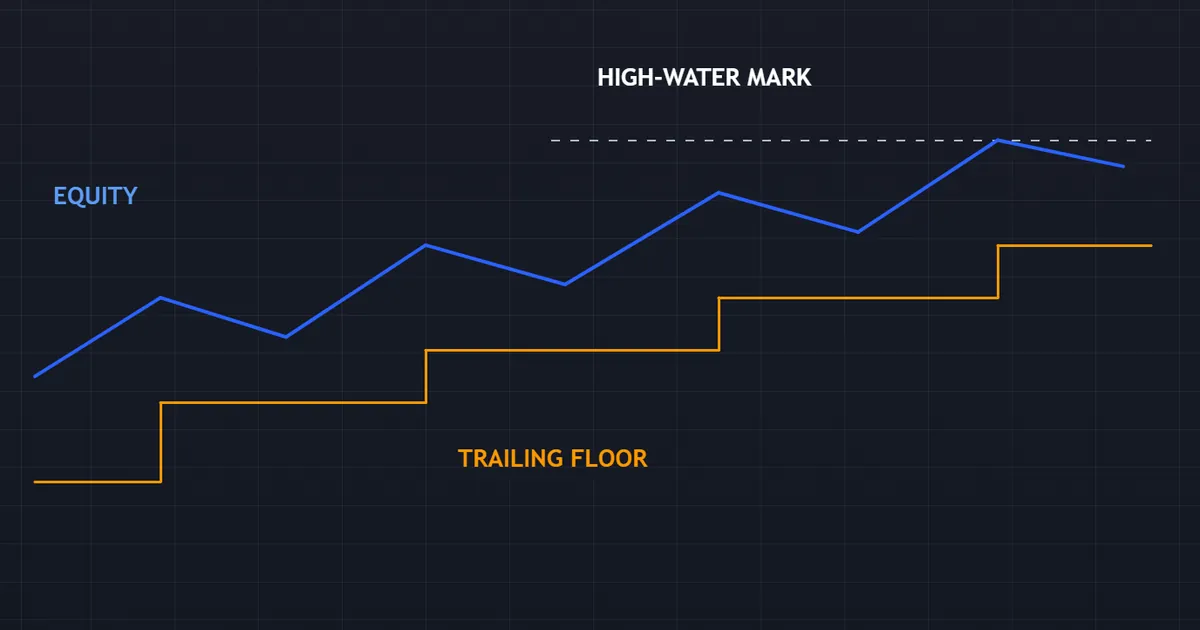
The allowance itself never changes. A firm might grant six percent of the starting balance as your total room, and that six percent simply travels upward behind your best result.
So the number you must stay above keeps rising. Your first winning week feels great, yet it quietly shortens the leash you have left for the rest of the program.
The High-Water Mark Behind the Rule
Fund managers call your best-ever account value the high-water mark. A trailing rule borrows that idea and hangs a floor a fixed distance beneath it.
The mark only ratchets in one direction. Because a new peak lifts it and a loss leaves it alone, the mark records your best moment rather than your current one.
Why the Floor Never Falls Back
Firms design the rule this way on purpose. A floor that dropped again would let a trader gamble, lose, recover and gamble once more without consequence.
A one-way floor removes that loop. So each new high locks in part of your progress, and the account can only breach the rule by giving profit back.
Trailing Drawdown Versus a Simple Loss Cap
A plain loss cap counts downward from where you started. It ignores your peaks entirely, so a winning run genuinely widens your safety margin.
A trailing rule refuses that gift. Because the reference point travels with your best result, your margin resets to the same allowance after every new high. So the two rules feel similar on paper and behave nothing alike in practice.
Why Firms Use a Trailing Floor
The rule looks harsh from the trader’s side. From the firm’s side it solves two problems at once.
It Protects Profit the Firm Has Already Shared
A funded account often pays out on a cycle. Once a firm sends money, it cannot claw that payout back from a later losing run.
A trailing floor limits that exposure. Because the floor rises alongside the profit, the firm caps how much of an already-shared gain a trader can hand back.
It Rewards Smooth Equity Curves
Firms prefer a trader who grinds upward over one who lurches. A trailing rule builds that preference straight into the account.
Lumpy results print tall peaks, and tall peaks drag the floor up fast. So the rule quietly selects for patient traders and screens out the rest.
How the Trailing Floor Is Calculated
The arithmetic takes one line. Getting the inputs right takes a careful read of the rule book.
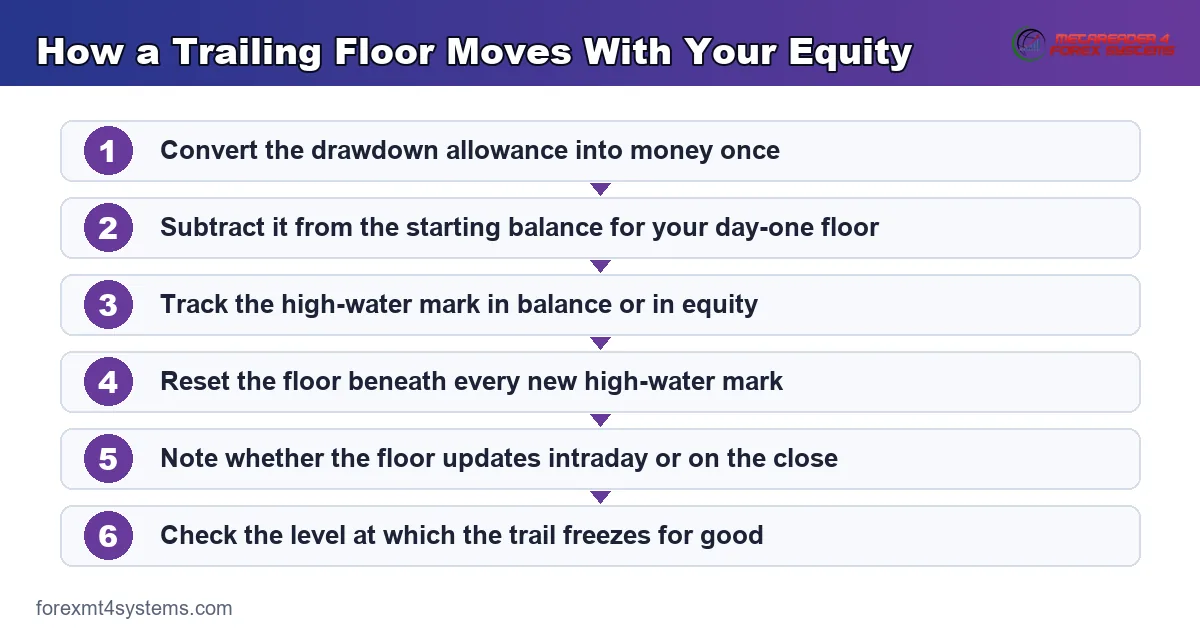
Follow the steps below in order on any new funded account. They turn a paragraph of legal wording into two numbers you can actually watch.
- Find the total allowance. Convert the drawdown percentage into money using the starting balance.
- Set the opening floor. Subtract that allowance from the starting balance to get your day-one floor.
- Identify the high-water mark. Note whether the firm tracks your highest balance or your highest equity.
- Recalculate after each new high. Subtract the same allowance from the fresh peak to get the new floor.
- Check the update timing. Some floors move tick by tick, while others move only on the daily close.
- Look for a freeze condition. Many programs stop the climb once the floor reaches the starting balance.
Notice that step three carries most of the risk. Because an equity high can appear during a trade you never closed, the floor can ratchet on profit you never actually kept.
Write both figures on a sticky note each morning. One line shows today’s floor, and the other shows the distance from your current equity down to it.
Balance Highs Versus Equity Highs
A balance-tracked rule only ratchets when you close a winner. So an open trade can run deep into profit without moving the floor at all.
An equity-tracked rule ratchets on the unrealised peak. Because a trade that spikes and retraces still lifts the floor, this version punishes anyone who lets winners round-trip.
Intraday Trailing Versus End-of-Day Trailing
Intraday trailing updates continuously through the session. Every fresh peak drags the floor along with it, even a peak that lasts one minute.
End-of-day trailing waits for the close. So a spike at lunchtime leaves the floor alone, and only your settled daily result moves it. Many traders find this version far easier to work with.
When the Trail Freezes
Plenty of programs stop the ratchet at a defined point. The usual trigger arrives once the floor reaches the starting balance, sometimes plus a small buffer.
After that moment the floor behaves like a static one. So the rule tightens hard early, then relaxes permanently once you build a real cushion. Read this clause first, because it decides how much long-term room a good run leaves you.
The freeze level varies widely between programs. Some lock the floor at the opening balance, others wait until the floor clears that balance by a percent or two, and a few never freeze at all. So one sentence separates a workable program from a punishing one.
A first payout often acts as the trigger. Several programs lock the floor at the starting balance, or just above it, as soon as your first withdrawal clears, which quietly converts the rule into a static one.
Watch your room around that payout, though. Because the floor stays anchored at your recent peak while the withdrawal lowers your balance, the gap between the two narrows exactly when you cash out.
How Trailing Drawdown Behaves After a Winning Run
The rule stays invisible while you lose. It only shows its teeth after you make money, which surprises almost everyone.
Walk through a short sequence and the pattern becomes obvious. Nothing unusual happens, yet the room underneath you shrinks steadily.
The First Week
You take four small winners and one loss. Your account finishes the week comfortably ahead, and the floor has followed you up four times.
Your distance to the floor now measures exactly the original allowance again. So all that profit bought you no extra safety margin whatsoever.
The Giveback
The second week starts badly with three losses in a row. Because the floor stopped climbing but never descended, those losses eat straight into the allowance.
A fourth loss of the same size touches the floor. So the account closes while the balance still sits above where you started, which feels deeply unfair until you understand the ratchet.
Why Round Trips Hurt
A round trip means going up and coming back to the same place. Under a static floor that journey costs you nothing at all.
Under a trailing floor it costs you the whole climb. So the rule effectively charges you for every peak you fail to hold, and repeated round trips grind the allowance to nothing.
The Effect on Different Trading Styles
Scalpers usually cope well with the ratchet. Their equity curve climbs in tiny steps, so each new high moves the floor by very little.
Swing traders face a harder version of the same rule. Because a single position can print a large unrealised peak, an equity-tracked floor can jump a long way on a move that later fades.
News traders sit at the far end of that spectrum. A spike lifts the floor in seconds and the retrace leaves the new level in place, which turns one volatile release into a lasting constraint.
A Worked Example of a Rising Floor
Numbers make the ratchet obvious, so follow one account from start to breach. Picture a hundred thousand dollar funded account with a six percent trailing drawdown.
Six percent of the starting balance equals six thousand dollars. That figure never changes, though the point it hangs from certainly does.
Step One: The Floor on Day One
Your account opens at a hundred thousand dollars. Subtract the six thousand dollar allowance and the floor sits at ninety-four thousand dollars.
So you begin with six thousand dollars of room. Nothing about that number looks tight, and most traders never think about it again.
Step Two: The Floor After Profit
A good month lifts the account to a hundred and eight thousand dollars. The high-water mark moves to that figure, so the floor climbs to a hundred and two thousand dollars.
Read that new floor carefully. It now sits two thousand dollars above your original starting balance, which means the account can breach the rule while still showing a profit.
Your room, meanwhile, measures six thousand dollars once more. Eight thousand dollars of profit bought you exactly no extra breathing space, because the allowance travelled up with you.
Compare that with the static version of the same program. There the floor would still sit at ninety-four thousand dollars, so your room would now measure fourteen thousand dollars rather than six.
Step Three: The Giveback That Breaches
A rough week hands back seven thousand dollars. Your account drops to a hundred and one thousand dollars, one thousand above where you began.
The floor sits at a hundred and two thousand dollars, so the rule breaks and the account closes. Because you are still up on the program overall, this outcome catches traders completely off guard.
The Same Path Under a Frozen Trail
Now rerun the story with a freeze at breakeven. The floor climbs only until it reaches a hundred thousand dollars, then it locks there permanently.
Your giveback to a hundred and one thousand dollars now survives easily. So one clause in the rule book turns a closed account into a live one, which shows why that clause deserves your attention.
Sizing Against a Moving Floor
Treat the distance to the floor as your true account size. Risk a small fraction of that gap rather than a fraction of the balance.
Our prop firm position size calculator works a position straight against a firm’s drawdown limits, and our drawdown calculator shows how a losing run eats a fixed allowance.
Reading Your Room After Every Trade
Close a winner and the floor may have moved. So the habit worth building takes ten seconds: check the peak, subtract the allowance, note the result.
Then compare that floor with your current equity. The gap between them tells you how many normal losses the account can still absorb, which is the only number that matters when you size the next trade.
Download the complete indicator database
Put these concepts on your charts. One email unlocks the full library of 1,380+ indicators with compiled MT4 and MT5 files, plus my TradingView scripts. No paywall, no spam, unsubscribe any time.
Get free access to my indicator database
One email unlocks 1,380+ free MT4, MT5 and TradingView indicators — the complete library. No single-tool download; you get the whole database.
Common Trailing Drawdown Mistakes and Fixes
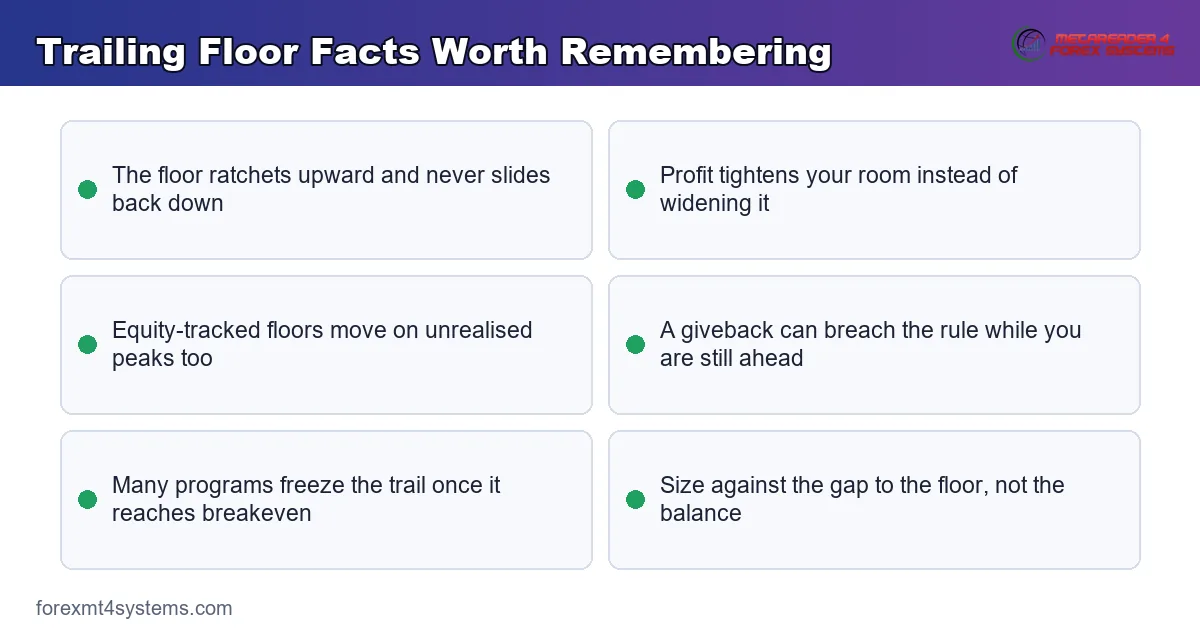
Most breaches trace back to one of a few habits rather than to poor analysis. The graphic below gathers the trailing-floor facts worth committing to memory.
Watching the Balance Instead of the Floor
A profitable balance feels safe, which makes the floor easy to ignore. Then a giveback arrives and the rule bites from a level you never noted. So write the current floor down every single morning.
Letting Winners Round-Trip
Under an equity-tracked rule, an unrealised peak lifts the floor for good. Watching a winner give everything back therefore costs you room as well as profit. So bank partials at sensible levels rather than holding for perfection.
Sizing Off the Balance
Risking one percent of a growing balance feels consistent. Yet your real room stays fixed at the allowance, so the same percentage grows heavier over time. So size against the gap to the floor instead.
Chasing a Fast Start
A quick surge lifts the floor quickly and leaves you trading on a short leash. Traders who sprint early often spend the rest of the program pinned against the rule. So climb in small steps and let the floor lag behind you.
Missing the Freeze Clause
Some traders assume the floor trails forever, while others assume it always freezes. Both assumptions end accounts. So find the exact sentence in the rule book and note the trigger level.
Adding Lots to Rebuild the Cushion
Traders who feel the floor closing in often size up to escape it. That move shortens the distance in either direction, so a loss now arrives twice as fast. So cut size when room runs low, never the other way round.
Holding Through Illiquid Hours
Thin books widen spreads, and a widened spread pushes equity lower on paper. Because an equity-tracked floor sits waiting underneath, that paper move can breach a rule you never traded into. So trim exposure when liquidity dries up.
Trailing Drawdown Quick Reference
Keep this list beside your platform on any trailing program. Run through it before your first order of the day.
- Convert the allowance into money once, then leave it fixed.
- Note today’s floor and your current distance to it.
- Confirm whether the rule tracks balance highs or equity highs.
- Confirm whether the floor updates intraday or on the daily close.
- Find the freeze level, or confirm that none exists.
- Size every trade against the gap to the floor.
- Bank partial profits rather than letting peaks round-trip.
- Recheck the floor after any winning session.
- Cut position size whenever the gap narrows, never widen it.
- Avoid holding large positions through thin liquidity.
Why Trailing Drawdown Ends So Many Funded Accounts
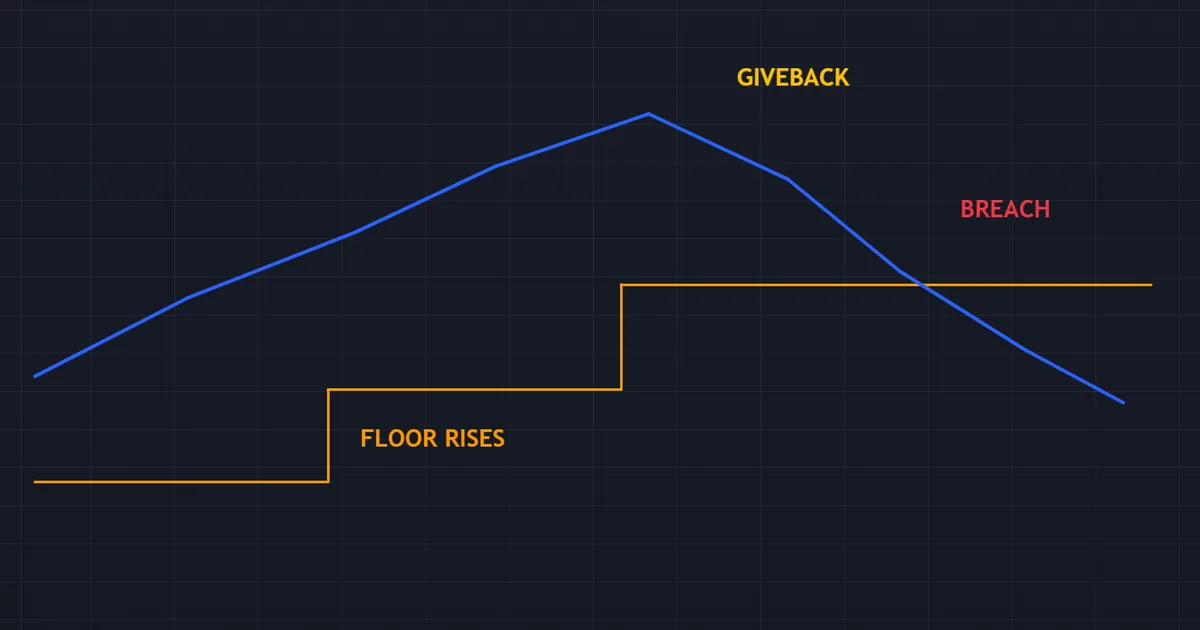
Ask experienced funded traders which rule ended their accounts and the trailing floor comes up again and again. The chart below shows an equity path that climbs, gives profit back and breaches a floor it lifted itself.
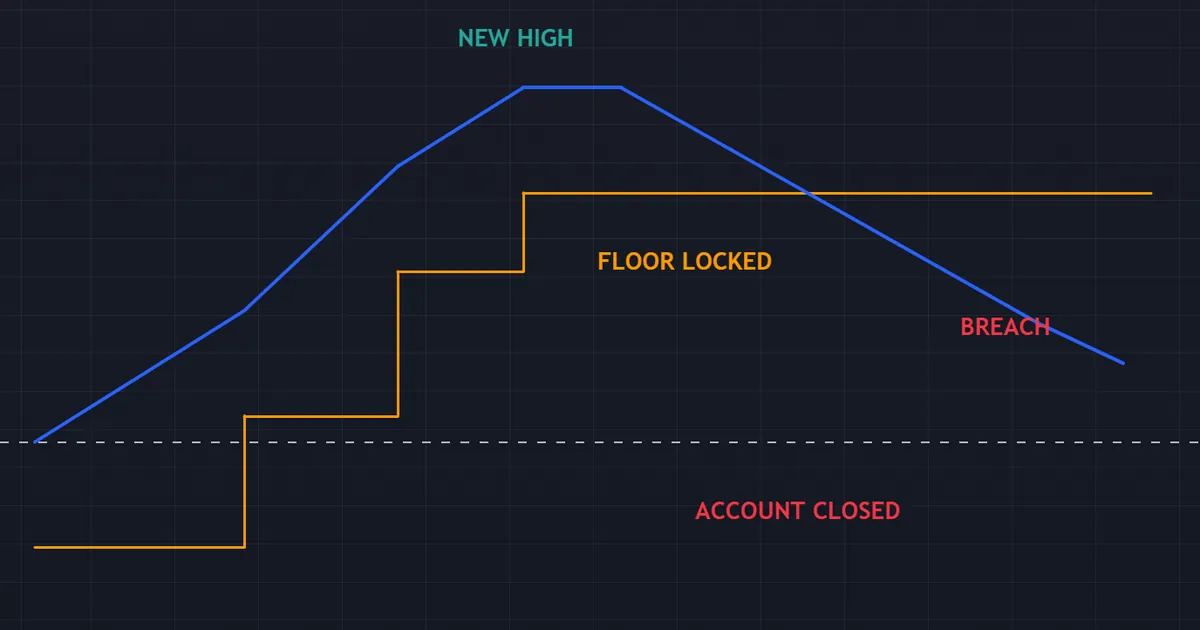
Follow the shape from left to right. The path rises in a burst, stalls, then drifts lower into a line that used to sit far below it. That single picture explains the whole problem.
Profit Feels Like Safety
Human instinct treats a bigger number as more cushion. A trailing rule inverts that instinct, since each new high converts cushion into obligation.
The Rule Punishes Volatility
Strategies with lumpy results print high peaks and deep troughs. Because only the peaks count, a lumpy equity curve burns allowance far faster than a smooth one.
Scaling Up Too Early
Bigger lots produce bigger peaks and bigger givebacks. So the trader who scales after one good week usually meets the floor within the next two.
One Bad Session Costs More Than Usual
On a static program a heavy day simply eats into the original allowance. Under a trailing rule that same day eats into an allowance already shortened by your best week. So the arithmetic turns against you exactly when you least expect it.
Confusing It With a Trailing Stop
A trailing stop protects one trade and costs you nothing when it triggers. A trailing floor governs the whole account and ends it. So the shared word hides two completely different consequences.
Reading a Rule Book for the Trailing Clause
Firms bury this rule in different places and rarely use the same wording. A few phrases give the game away once you know them.
Phrases That Signal a Trailing Rule
Look for wording such as highest equity, peak balance, high-water mark or maximum account value. Any of those phrases means the floor moves with your results.
Static rules read very differently. They refer to the initial balance, the starting equity or a fixed threshold, none of which respond to a winning run.
Watch out for mixed wording too. A firm may trail the maximum floor while measuring the daily cap from a fixed balance, so one document can contain both styles at once.
Questions Worth Asking Support
Ask whether the floor updates on closed trades or on live equity. Then ask at what level the trail stops, if it stops at all.
Ask finally whether the firm publishes the current floor inside the dashboard. Because a visible number beats your own arithmetic under pressure, that single feature saves accounts.
Checking the Dashboard Against Your Own Maths
Dashboards sometimes lag the market by a few seconds. So verify the figure once yourself on day one, using the peak and the allowance you wrote down.
Any mismatch tells you something useful. Either the firm tracks equity while you tracked balance, or the trail already froze, and either answer changes how you trade for the rest of the program.
Related Concepts to Study Next
A trailing floor makes sense once you see the alternative beside it. Two neighbouring guides fill in the rest of the picture.
Set the rule types side by side in our comparison of static versus trailing drawdown, then map the whole rule set in our overview of prop firm drawdown rules. The one-session cap sits in our guide to daily drawdown in prop firms, while the wider model appears in our explainer on a funded trading account. For the underlying maths, read our note on drawdown in trading.
FAQ
What is trailing drawdown in simple terms?
A trailing drawdown sets a loss floor a fixed distance below your best account value. Each new high lifts the floor, and losses never lower it again. So the rule locks in part of your progress and ends the account if you hand too much of it back.
Does a trailing floor ever move down?
No, that one-way behaviour defines the rule. The floor rises with every new peak and then stays put through any losing run. Many programs do stop the climb once the floor reaches the starting balance.
Can I breach a trailing drawdown while still profitable?
Yes, and that outcome surprises most traders. Once the floor climbs above your starting balance, a large enough giveback breaks the rule even though the account remains ahead overall. So track the floor rather than the profit.
Does the floor follow my balance or my equity?
Firms split on this point, so check the wording. Balance-tracked floors only move when you close a winner, while equity-tracked floors move on unrealised peaks too. The equity version tightens far faster.
How should I size trades under a trailing rule?
Treat the gap between your equity and the floor as your working account. Risk a small slice of that gap on each trade rather than a slice of the balance. So your size falls automatically whenever the floor closes in.
Is a trailing drawdown the same as a trailing stop?
No, the two share a word and nothing else. A trailing stop closes one position at a chosen level, while a trailing drawdown closes the entire account. Results are not guaranteed; past performance is not indicative of future results.
External references
- For background on this concept, see Performance Fee on Wikipedia.
- For broader market context, see Hurdle Rate at Investopedia.

About the author
Written by Dominic Walsh, a Forex trader and MT4/MT5 indicator, Expert Advisor and script developer. Every tool on forexmt4systems.com is tested on live charts before release and ships with ready-to-use compiled MT4 (.ex4) and MT5 (.ex5) files. Learn more about the trader and developer behind this site.
How we build, test and correct every tool: Editorial & Testing Policy. Trading carries risk; see the disclaimer.