
The fear of taking a trade arrives at the worst possible moment. Your setup prints, your plan says go, and your hand stops moving.
This guide names the mechanism behind that freeze, then hands you the repair. Three forces drive it: anticipated regret, an old loss you never processed, and a position size your nerves cannot carry.
What the Fear of Taking a Trade Actually Is
Hesitation looks like a discipline problem from the outside. Look closer, though, and it behaves like a pricing problem inside your own head.
Your brain runs a quick cost check before every click. When the imagined pain of a loss outweighs the imagined reward, your hand stalls.
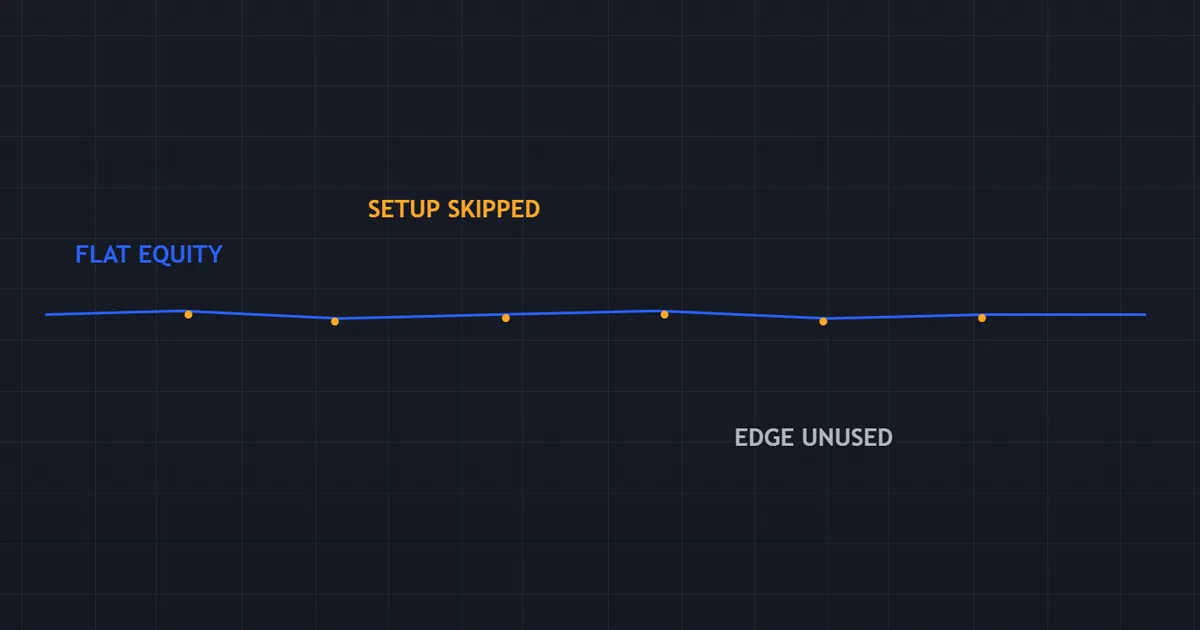
So the freeze protects you. It simply protects you from the wrong thing, because one planned loss costs far less than a missed edge repeated for a year.
The Feeling Versus the Mechanism
Traders describe the feeling in physical terms. Tight chest, hovering cursor, a sudden urge to check one more chart before committing.
Naming the feeling changes very little. Naming the mechanism changes a lot, because each mechanism has a specific and rather boring fix.
Treat hesitation as data rather than weakness. It tells you that something in your plan, your size or your history needs work.
Why Clean Setups Freeze You Too
Most people assume the freeze only strikes on marginal charts. In practice the cleanest signals trigger it hardest.
A clean setup raises the stakes. Because you expect it to work, missing it would sting, while taking it exposes you to a loss that feels avoidable.
Chart quality therefore matters less than the size of the consequence. Shrink the consequence and the freeze loosens quickly.
How the Freeze Differs From Discipline
Discipline means following a rule you wrote when calm. The freeze breaks that rule while wearing the costume of caution.
Both look identical from the outside, since neither one produces a trade. The difference sits in the reason, and only your written plan can settle it.
So keep the plan short enough to read in ten seconds. A long document invites interpretation, and interpretation gives the freeze somewhere to hide.
Three Mechanisms Behind the Freeze
Hesitation rarely has a single cause. Work through the three below in order, since the first one explains most cases.
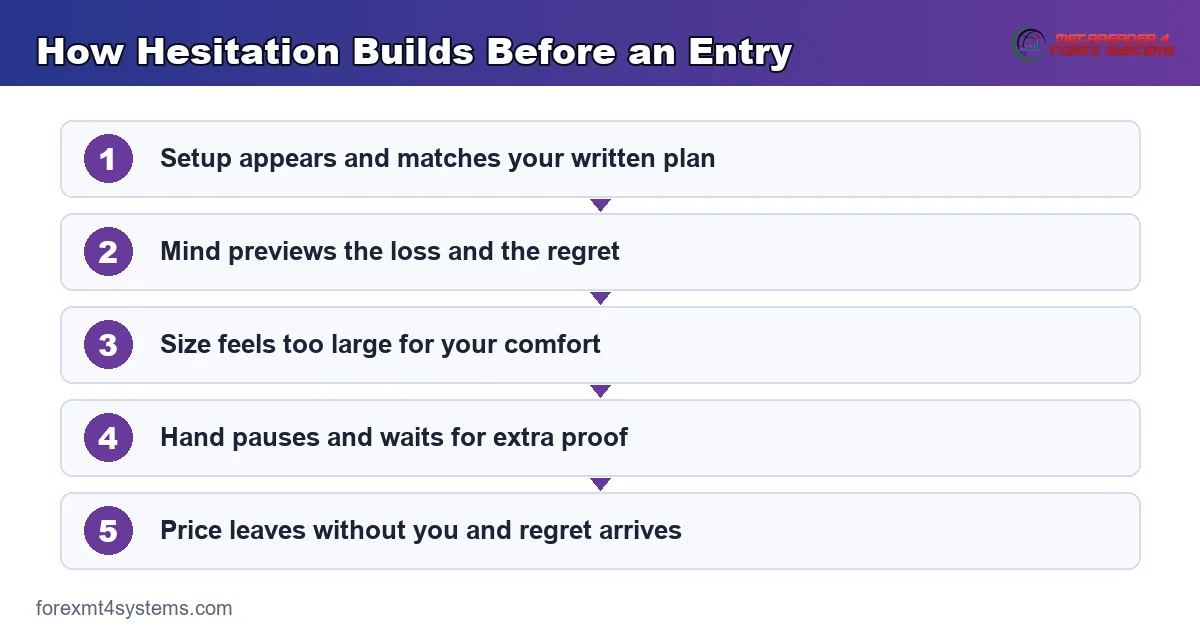
- Anticipated regret. You picture how bad the loss will feel and decide in advance to avoid that feeling.
- Conditioning from a prior loss. One painful trade taught your nervous system that this pattern hurts.
- Size beyond your tolerance. The position risks more than you can watch calmly, so the body refuses.
Each one carries a different repair. Match the fix to the cause and the button gets easier within a week or two.
Anticipated Regret
Regret aversion is a documented effect in decision theory. People weigh the future pain of a bad choice heavily, so they choose the option that looks easiest to defend later.
Skipping the trade feels defensible. Nobody ever posted a screenshot of a loss they avoided by doing nothing.
But omission carries regret too, and yours arrives twenty minutes later. Track both kinds in your journal and the asymmetry disappears.
Conditioning From a Prior Loss
One vivid loss can reshape your behaviour for months. Your memory tags the pattern as dangerous, even when the sample size was one.
Recency bias makes it worse. The last outcome feels more informative than the previous forty, though the arithmetic says otherwise.
So pull the record instead of trusting the memory. Twenty logged results tell you what the setup actually does.
Size Beyond Your Tolerance
This mechanism explains more freezes than the other two combined. A position that risks four percent of the account will scare almost anyone.
Fear at that size is not a flaw. It reads as a correct signal from a system doing its job.
Cut the risk to a level you barely notice and watch what happens. Our free position size calculator turns a chosen risk percentage into a lot size in seconds.
A Fourth Contributor: A Plan You Cannot Read
Sometimes the freeze reports a genuine gap. Your plan says buy at support, yet it never defines support, so the entry becomes a judgement call.
Judgement calls under pressure feel awful. Your mind knows the criteria will not survive review, and it stalls rather than commit.
Rewrite the vague clause as a measurable one. A level tested twice within thirty bars beats an area that simply looks important on the chart.
How to Fix the Fear of Taking a Trade
Three repairs cover almost every case. Apply them together rather than one at a time, since they reinforce each other.
Repair One: Cut the Size Until It Stops Mattering
Drop your risk per trade to a quarter of its current level. At that size a loss annoys you rather than frightening you.
Take twenty trades there. The goal now involves execution rather than profit, so a small account produces exactly the practice you need.
Raise the size in small steps afterwards. If hesitation returns at a given level, step back down and stay there for another twenty trades.
Repair Two: Pre-Commit the Entry Criteria
Write the trigger as a sentence you could hand to a stranger. Vague criteria leave room for negotiation, and negotiation is where the freeze lives.
A usable trigger names the pattern, the level, the confirmation and the invalidation point. Anything softer than that invites another look at a lower timeframe.
Then set a resting order when the criteria allow it. A pending order removes the click entirely, which sidesteps the moment of doubt.
Repair Three: Score the Process, Not the Profit
Give yourself one point for every valid setup you took as written. Deduct a point for a skipped signal and none for a loss.
Because a loss no longer costs you anything on the scorecard, the incentive flips. You start hunting for setups instead of reasons to wait.
Keep the score in your journal beside the results. Our free trade journal gives you a place to log both columns without building a spreadsheet.
Repair Four: Rehearse the Loss Before You Click
Say the loss out loud in account terms. Roughly half a percent, gone, with the plan intact and the next setup already forming.
Rehearsal drains the surprise from the outcome. Because you already pictured the worst case, the actual event lands as a familiar cost rather than a shock.
Add one line to your pre-trade note: the exact figure you accept. Traders who write that number report far less hovering at the moment of entry.
Putting the Four Repairs Together
None of these works well alone. Small size without a written trigger leaves you drifting, while a sharp trigger at frightening size still stalls the hand.
Run all four for one month and judge the month, not the trades. The point involves building a habit that survives a bad week.
A Worked Example of the Repair
Numbers make the argument faster than any pep talk. Picture a trader who takes half the signals a system generates.
The system produces twenty setups a month. Ten get taken, ten get skipped, and the skipped ones are not random.
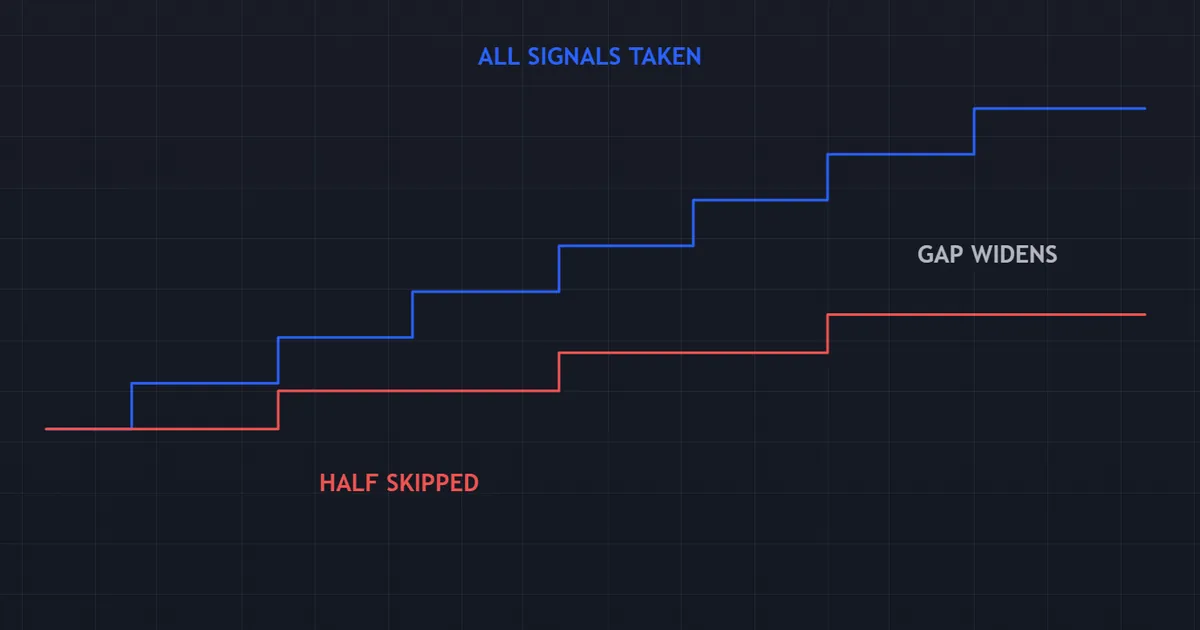
Hesitation clusters after losses, so the trader misses precisely the trades that follow a drawdown. Those trades often carry the recovery.
| Behaviour | Signals taken | What the record shows |
|---|---|---|
| Every valid signal, small size | 20 of 20 | The system’s real distribution appears |
| Half the signals, size unchanged | 10 of 20 | Results reflect mood, not method |
| Half the signals, doubled size | 10 of 20 | Fewer trades, larger swings, worse sleep |
Reading the Table Honestly
Row one produces a record you can study. Rows two and three produce noise, because the sample no longer reflects the rules you wrote.
That distinction matters more than any single result. Without a clean sample you cannot tell whether the plan works at all.
So the first job involves execution rather than optimisation. Fix the taking, then judge the system.
The Cost of Selective Skipping
Skipping at random would merely halve your activity. Skipping after losses removes a specific slice of the distribution instead.
Any edge relies on the whole sequence turning up. Take part of it and you own something quite different from the plan you tested.
Read our guide to risk per trade for the sizing side of the same problem. Size and hesitation move together far more than most traders expect.
What Twenty Small Trades Teach You
Twenty executions at a quarter of your usual risk cost very little. In exchange they hand you three things you cannot buy any other way.
First, evidence about the setup drawn from your own screen. Second, a felt sense of what a normal losing run looks like. Third, proof that you can click when the plan says click.
Traders often expect the third item to feel dramatic. It feels routine instead, and routine is exactly the point.
Download the complete indicator database
Put these concepts on your charts. One email unlocks the full library of 1,380+ indicators with compiled MT4 and MT5 files, plus my TradingView scripts. No paywall, no spam, unsubscribe any time.
Get free access to my indicator database
One email unlocks 1,380+ free MT4, MT5 and TradingView indicators — the complete library. No single-tool download; you get the whole database.
Common Mistakes When Fixing Hesitation
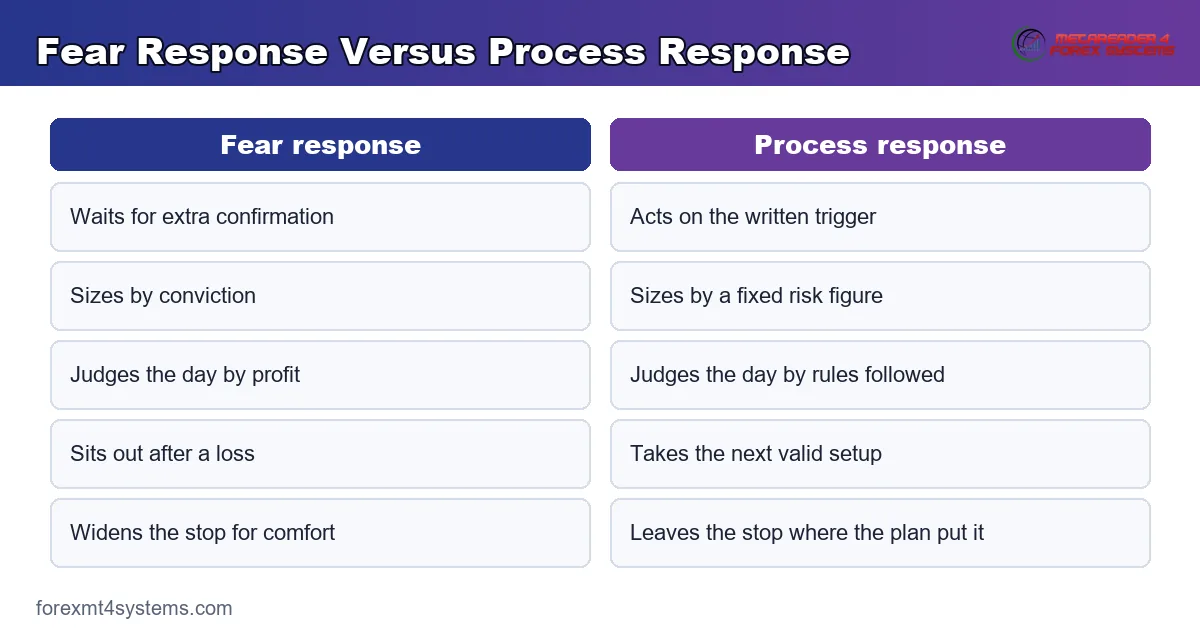
Traders usually attack the freeze with willpower first. The comparison panel below sets that instinct beside the process-led alternative.
Forcing Yourself to Click at Full Size
Pushing through fear at your normal risk teaches nothing useful. One bad outcome then confirms the original lesson and the freeze deepens.
Cut the size first, always. Courage at a quarter of the risk builds the same habit at a fraction of the cost.
Waiting for One More Confirmation
Extra confirmation feels prudent. It usually arrives after the entry level, so you pay a worse price for the same idea.
Decide in advance how much proof the trigger requires. Then honour that number, because a rule you rewrite mid-trade never held any authority.
Trading Only After a Winner
Many hesitant traders participate freely on good days and vanish on bad ones. That habit filters your results by mood.
Set a fixed number of setups to take each week regardless of the last outcome. Consistency of participation beats intensity of effort here.
Treating Every Loss as Evidence
A single loss tells you almost nothing about a strategy. Twenty results tell you something, and fifty tell you rather more.
So review at the sample level rather than the trade level. Monthly reviews cool the emotion that daily reviews amplify.
Hiding the Fear From Your Journal
Skipped trades rarely get logged. Because they leave no ticket, the biggest leak in the account stays invisible.
Add a row for every setup you saw and declined. Our note on analysis paralysis in trading covers the over-checking habit that produces those rows.
Confusing Caution With Judgement
Skipping a setup because it breaks a written filter counts as judgement. Skipping it because the last one lost counts as fear wearing a costume.
Write the filter down and the difference becomes obvious. Anything not on the list belongs to the second category.
Building a Routine That Removes the Decision
A repair you apply on hard days only will fail on the hardest day of all. Bake the four fixes into a routine and the freeze runs out of room.
Prepare the Night Before
Mark your levels while nothing moves. Pre-marked charts turn the session into a waiting game rather than a search, so the entry feels planned.
Write the two or three setups you will accept tomorrow. Anything outside that short list gets no attention, which removes most of the second-guessing.
Fix the Numbers Before the Session
Decide your risk percentage and your maximum number of trades before the first candle. Both figures then govern the day without further debate.
Because the numbers came from a calm mind, they carry more authority than anything you decide mid-move. Write them where you can see them.
Review Weekly, Never Hourly
Set one appointment each week to read the journal. Daily reviews magnify noise, while a weekly pass shows the shape of your behaviour clearly.
Count two figures in that review: signals seen and signals taken. A gap between them tells you the freeze remains active, whatever your profit column says.
Protect the Basics
Sleep, food and a break away from the screen sound unrelated to entries. They govern how much pressure you can absorb before the hand stalls.
Tired traders hesitate, then overcorrect. Guarding the basics costs nothing and removes a surprising share of the problem.
Quick-Reference Checklist Before You Click
Run these seven questions in under a minute. They convert a vague worry into a specific, answerable check.
- Does this setup meet every written criterion, with nothing added?
- What is my risk in account percentage, not in lots?
- Could I watch this position lose without checking the screen?
- Where does the stop sit, and did the chart choose it rather than my comfort?
- Am I skipping a filter, or skipping because of the previous result?
- Have I logged the last five setups I declined?
- Would I take this trade if nobody ever saw the outcome?
Answer question three honestly above all. A no there points straight at size rather than courage.
Pitfalls That Bring the Freeze Back
The fear tends to return in predictable places. The equity panel below shows the pattern most traders recognise at once.
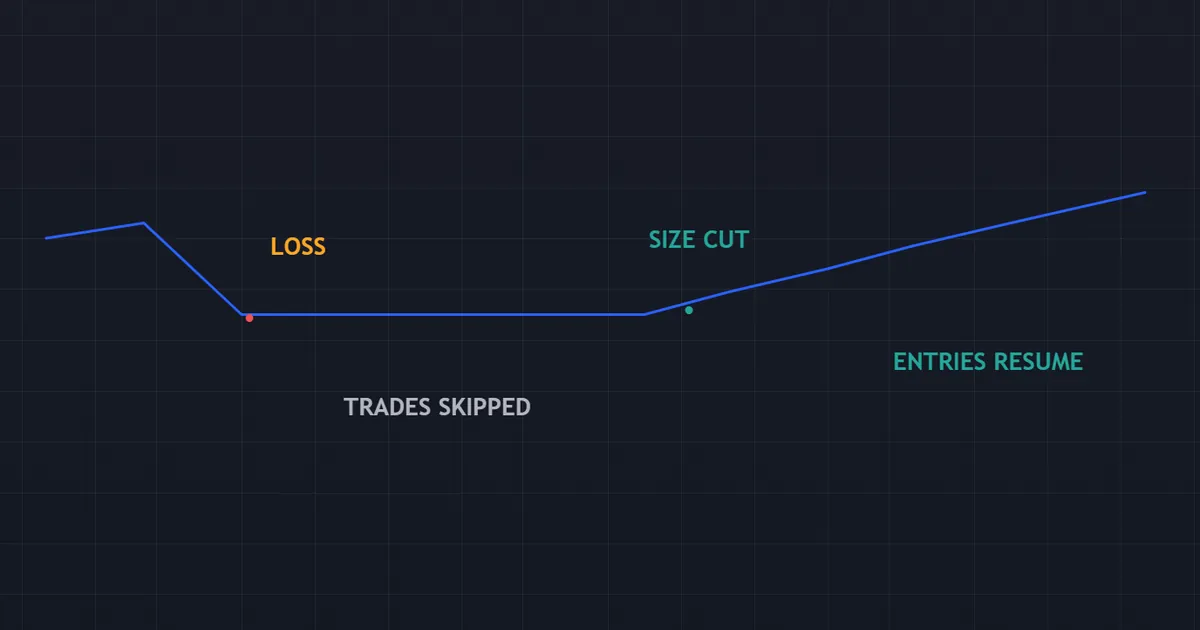
Raising Size Too Quickly
A confident month tempts you to double the risk. Your tolerance has not moved that fast, so the hesitation reappears with the larger number.
A Loss Larger Than Your Plan Allowed
Slippage or a gap can produce a loss well beyond the intended figure. That single event resets your conditioning, even though the rules held.
Trading a Setup You Never Backtested
Confidence comes from evidence. Without a record of how the pattern behaves, every entry feels like a guess, and guessing invites delay.
Watching the Position Tick by Tick
Screen time turns a normal drawdown into an ordeal. Set the stop, set the target, then close the platform for an hour.
Money You Cannot Afford to Risk
No technique fixes this one. If the capital covers rent, the fear tells the truth and the answer involves the account rather than your mindset.
A Long Break From the Market
Two quiet weeks away can undo months of practice. Your hand loses the habit, so the first setup after a holiday feels heavier than it should.
Ease back with the smallest size you trade. Three routine executions restore the rhythm faster than a week of chart study.
Comparing Your Results With Someone Else
Social feeds show winners and hide the rest. Measuring your month against that stream makes an ordinary drawdown look like failure, which feeds straight back into the freeze.
Compare your record with your own plan instead. Rules followed and setups taken tell you everything a screenshot never will.
Skipping Sleep and Skipping Meals
Tired traders hesitate more. Our overview of fomo in trading shows how the same fatigue flips into the opposite failure later in the session.
When the Fear Is Telling You Something True
Not every freeze needs fixing. Sometimes the hesitation reports a genuine problem, and overriding it would cost you more than skipping the trade.
Three Signals Worth Listening To
Listen when the capital matters to your household. Listen when the plan has no tested record. Listen when the size sits above anything you have traded before.
In each case the answer changes the setup rather than your mindset. Reduce the stake, gather evidence, or step back to a size you have already handled.
Traders who force themselves past these three signals usually pay twice. They take the trade, then abandon the plan the moment it moves against them.
When to Step Away Entirely
Occasionally the pressure runs deeper than any checklist can reach. Trading may be affecting your sleep, your finances or the people around you.
Take that seriously and treat it as a stop sign rather than a hurdle. Stepping away from the screen and seeking qualified professional support remains the right move, and no sizing trick substitutes for it.
Markets keep running. An account can wait for months without losing anything that matters.
Rebuilding After a Break
Return in the smallest size your broker allows. Ten quiet executions rebuild more confidence than any amount of chart study.
Then step the risk up slowly, one notch a month. Because the ladder moves slowly, your tolerance has time to catch up with the numbers.
Related Concepts to Study Next
Hesitation sits inside a wider set of behaviours, so a couple of neighbouring guides finish the picture. Each one explains a force that pushes on the same button.
Start with our guide to loss aversion in trading, which explains why a loss feels heavier than an equivalent gain. Then read our note on how to use a stop loss, because a stop you trust removes most of the dread before it starts.
Pair both with a fixed risk figure held for a full month. Traders who stop renegotiating size mid-week report the largest drop in hesitation.
FAQ
Why am I afraid to enter a trade even with a good setup?
A clean setup raises the stakes rather than lowering them. Because you expect it to work, both the loss and the miss feel costly, so the mind stalls between them. Cutting position size usually resolves it faster than any motivational technique.
How do I stop hesitating on entries?
Reduce risk until a loss barely registers, write the trigger as a single testable sentence, and score yourself on rules followed rather than money made. Take twenty trades under those three conditions before you change anything else.
Is hesitation always a psychological problem?
No. Sometimes the plan itself remains too vague to act on, and sometimes the size sits far above your tolerance. Check both before you conclude that your mindset needs work.
Should I use pending orders to avoid the freeze?
They help a great deal when your trigger allows a resting price. A pending order commits you while you feel calm, so the decision no longer happens under pressure.
How long does it take to fix the fear of taking a trade?
Most traders notice a change within twenty to fifty executions at a comfortable size. Progress depends on repetition rather than time, so a slow week simply stretches the calendar.
Why do I freeze on live accounts but not on demo?
Demo removes the financial consequence, so the mechanisms that cause hesitation never fire at all. Bridge the gap by trading live at a size small enough that the emotional signal stays real while the loss stays trivial, then raise it gradually.
Does journalling really help with hesitation?
It helps most when you log the setups you declined as well as the ones you took. Those declined rows expose the pattern behind the freeze, and a pattern you can see becomes a pattern you can change.
Does the fear ever disappear completely?
It fades rather than vanishing, and a small amount of caution serves you well. Aim for a level of nerves that lets you act on your plan without argument. Results are not guaranteed; past performance is not indicative of future results.
External references
- For background on this concept, see Fear on Wikipedia.
- For broader market context, see Risk Tolerance at Investopedia.

About the author
Written by Dominic Walsh, a Forex trader and MT4/MT5 indicator, Expert Advisor and script developer. Every tool on forexmt4systems.com is tested on live charts before release and ships with ready-to-use compiled MT4 (.ex4) and MT5 (.ex5) files. Learn more about the trader and developer behind this site.
How we build, test and correct every tool: Editorial & Testing Policy. Trading carries risk; see the disclaimer.