
Ask what is FOMO in trading and the short answer sounds simple: the fear of missing out on a move. The longer answer explains why that fear overrides a plan you spent months building.
Psychologists have measured this drive for over a decade. Traders feel it as a sudden urge to enter late, larger, and without a stop.
What Is FOMO in Trading, and Where It Comes From
Researchers describe FOMO as a lasting worry that other people enjoy rewarding experiences you are absent from. The 2013 study by Przybylski and colleagues put that definition into the literature.
Markets turn that worry into money. A chart that runs without you looks like a reward other traders collect while you watch.
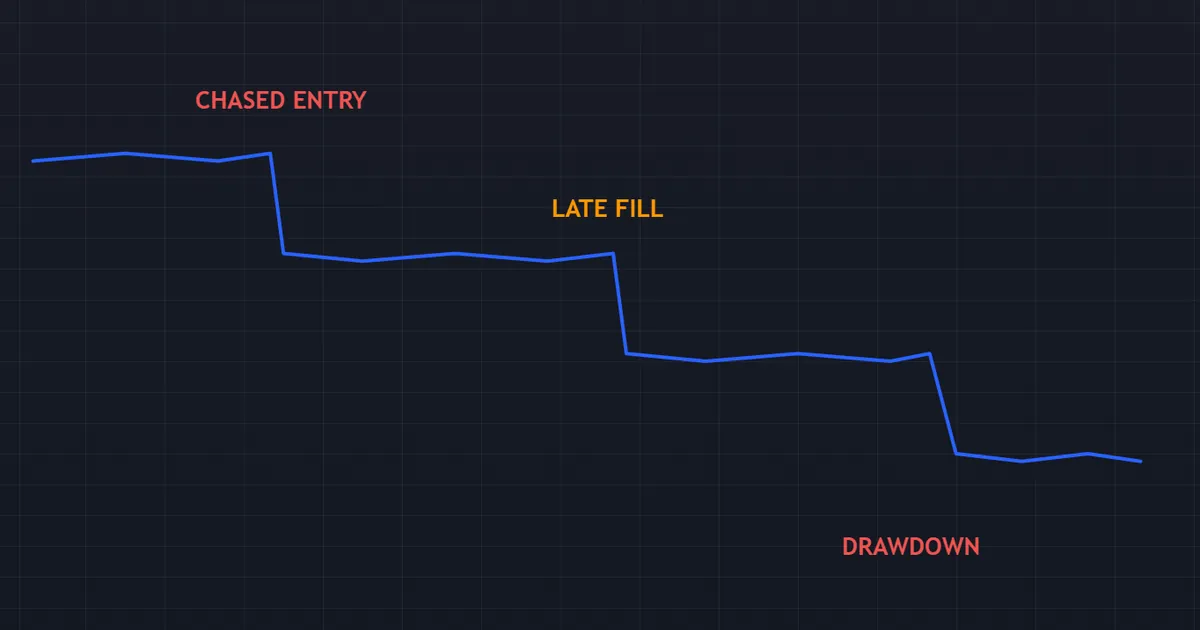
So the trigger sits outside your plan entirely. Nothing about the setup changed, yet the urge to act climbs by the minute.
The Original Definition
The academic work links FOMO to unmet psychological needs. People low on relatedness and competence report the strongest pull toward whatever others seem to enjoy.
That framing helps traders more than it first appears. The urge tracks your sense of being left behind, not the quality of the opportunity.
Test it against your own history. Chased entries cluster after quiet weeks and after losing runs, when your sense of competence sits lowest.
How Traders Describe the Feeling
Ask a trading room and the wording repeats. The move looks obvious, everyone else caught it, and one more minute of waiting seems wasteful.
None of those statements describe the market. All three describe your position relative to other people.
That tell helps you in real time. Any reason that mentions other traders belongs in a journal note, never in an order ticket.
Why Markets Amplify the Effect
Price updates every second and rewards look public. A move you skipped keeps printing on your screen, and each new candle repeats the message.
Leverage sharpens the sting. Missing a modest move on a leveraged account feels like missing a large sum, because you mentally scale the loss by your usual size.
Add a scrolling feed of other people’s screenshots and the pressure compounds. Nobody posts the trades they skipped.
The Behavioural Mechanics of Trading FOMO
Four documented effects turn a missed move into a bad order. Naming them lets you build a rule for each.
- Herd behaviour. Crowded action feels safer than acting alone, so late entries feel justified.
- Information cascades. You treat other people’s moves as evidence and stop checking your own criteria.
- Anticipated regret. The imagined pain of missing out outweighs the real risk of a late entry.
- Recency bias. The last move on your screen crowds out the hundred trades in your record.
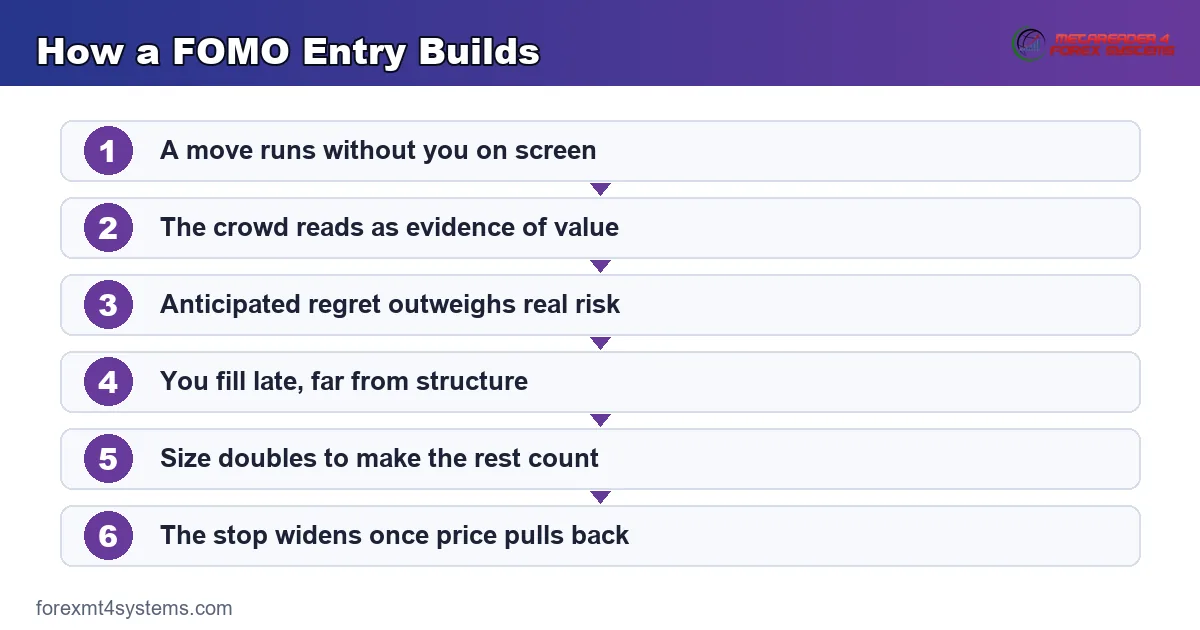
Each effect shows up as a specific order. Learn the order and you can catch the effect before you click.
Herd Behaviour and Information Cascades
Herd behaviour describes people acting together without any central direction. Economists model it through information cascades, where each participant infers value from the crowd rather than from their own analysis.
The logic works fine at the start of a move. It fails late, because by then the crowd carries no fresh information at all.
So ask what you actually know. If your only reason involves other people trading it, you hold no reason at all.
Anticipated Regret
Regret aversion sits close to loss aversion in behavioral finance. Both weight pain more heavily than pleasure, though regret focuses on the road you did not take.
Traders often fear the missed winner more than the taken loser. That ranking flips the arithmetic, because a missed trade costs nothing while a chased one costs real capital.
Write that sentence on a sticky note. A skipped setup has a maximum cost of zero.
Recency Bias and the Hot Screen
Recency bias inflates the importance of the newest data. One fast move erases your memory of the twenty quiet sessions before it.
Watchlists fix part of this. A list written before the session anchors you to your own criteria rather than to whatever moves fastest.
Review the list afterwards too. Traders who log skipped setups discover that most chased moves never appeared on any plan.
Loss Aversion Behind the Urge
Loss aversion usually explains exits, though it drives entries too. A missed move registers as a loss, even though your balance never moved.
Prospect theory calls that a reference point problem. Once you treat the untraded profit as yours, skipping the move feels like giving something up.
Reset the reference point deliberately. Your starting balance, not the profit you imagined, marks the honest baseline for the session.
Social Media as an Accelerant
Feeds select for extremes. Winners get posted, losers stay private, and the sample you see carries a heavy bias.
Muting during market hours costs you nothing. Nobody posts an entry early enough for you to copy it profitably anyway.
Our guide to trading psychology covers the wider set of biases behind that pull.
How a FOMO Trade Actually Unfolds
The damage rarely comes from one decision. It builds through three, and each looks reasonable on its own.
The Setup You Never Planned
First comes the entry. Price has already run, so you take a level that matched none of your criteria an hour ago.
Notice what vanished. Without a planned invalidation point, you have nowhere sensible to put a stop.
Traders then improvise a stop from round numbers. That distance reflects convenience rather than structure, and price treats it accordingly.
The Size That Grows
Next comes the size. Missing the first half of a move creates pressure to make the remaining half count.
So the position doubles. Risk per trade quietly moves from one percent to two, then to four when the first attempt fails.
Fix the percentage before the session starts. Our note on risk per trade explains how to pick a ceiling and hold it.
The Stop That Moves
Last comes the exit. A late entry sits close to the top of the move, so the first pullback threatens the stop almost immediately.
Then the negotiation starts. Widening the stop feels like patience, though it simply converts a planned loss into an open-ended one.
That sequence explains why chased trades hurt twice. They arrive with poor reward and leave with oversized risk.
A Worked Example of a Chased Entry
Picture a move worth one hundred pips. Your plan called for entry at the base, with a thirty pip stop and a ninety pip target.
You miss the base and enter sixty pips higher. The target has not moved, so your reward falls to thirty pips.
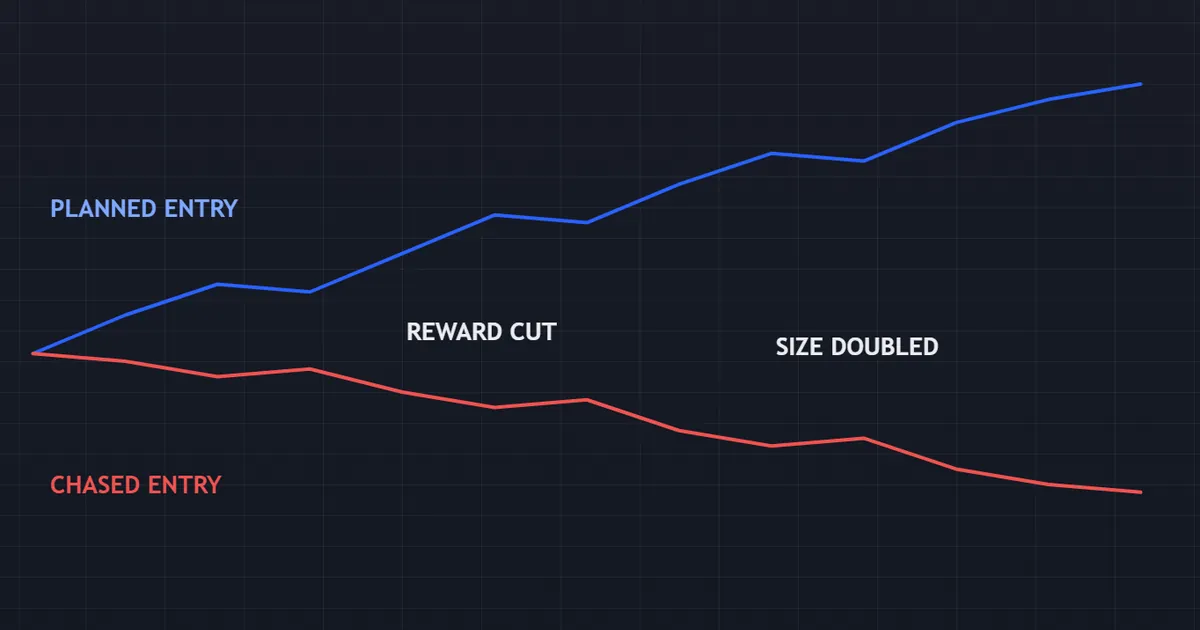
The stop stays thirty pips wide, because structure sits where it sits. Reward and risk now match at one to one.
| Measure | Planned entry | Chased entry |
|---|---|---|
| Distance to target | 90 pips | 30 pips |
| Stop distance | 30 pips | 30 pips |
| Reward for each unit of risk | 3.0 | 1.0 |
| Strike rate needed to break even | 25 percent | 50 percent |
| Position size taken | 1 percent risk | 2 percent risk |
Reading the Two Entries
Look at the last two rows together. The chased version needs twice the strike rate and carries twice the risk.
No indicator repairs that combination. The entry price alone changed the whole profile of the trade.
Size the position from the stop instead of from the urge. Our free position size calculator works the lot size back from your risk figure.
What the Journal Shows
Add one field to your log: was this instrument on my watchlist before the move began? A simple yes or no.
After forty trades, sort by that field. Most traders find their no column carries a much worse average result.
Our free trade journal keeps that field beside your planned levels, so the comparison takes minutes.
What the Chase Costs Over a Month
Behaviour turns into arithmetic quickly. Two costs stack up, and neither depends on your market view.
The Reward You Give Away
Late entries shrink reward while leaving risk alone. A method built on three units of reward drops toward one, purely through timing.
Work out what that demands. At three to one you can lose three trades in four and still finish level, whereas at one to one you need half of them to work.
So a chase raises the bar you must clear. The market did not get harder, though your entry made it feel that way.
The Costs You Pay Twice
Every trade pays the spread and any commission. Chased entries arrive as extras, so they add cost without adding planned opportunity.
Run the sum for a month. Ten extra trades on a twenty thousand dollar account, at a typical major-pair spread, quietly removes a slice of the month before any market move.
Count your own extras from the journal. Traders usually find that the unplanned trades outnumber the planned ones during quiet weeks.
Where FOMO Shows Up Beyond Entries
The same drive appears well away from the order ticket. Three versions cost more than a single chased trade.
Chasing a New Strategy
A quiet month makes someone else’s method look superior. Traders abandon a tested plan after twenty trades and start again from zero.
Set a review threshold instead. Fifty trades, or one full month, decides whether the method stays.
Chasing a New Market
A hot instrument pulls attention from the ones you know. Fresh markets carry fresh session times, spreads and behaviour, so your edge does not travel with you.
Trade the new market on a demo first. Thirty logged trades reveal whether the setup works there or merely looked exciting.
Chasing Signals From Other People
Copying a posted trade skips every step that makes a plan work. You inherit the entry without the reasoning, the stop or the exit rule.
Treat outside ideas as watchlist candidates only. They enter your plan through your own criteria, or they do not enter at all.
Rules That Stop the Chase
Willpower fails in the moment, so the rules have to work in advance. Four of them cover almost every chased entry.
The Watchlist Rule
Trade only what you listed before the session. Anything moving that never made the list waits until tomorrow.
Keep the list short. Five instruments give you enough opportunity without turning the screen into a lottery.
Review skipped names weekly rather than daily. Weekly review removes the pressure to justify today’s restraint.
The Distance Rule
Measure how far price has travelled from your planned entry. Once it exceeds a set multiple of average range, the trade expires.
One average daily range works well as a ceiling. Beyond that, your reward has usually shrunk below the level your method needs.
Write the multiple into your plan. A number decides faster than a feeling, and it decides the same way every time.
The Second-Chance Rule
Missed moves often return. Retests, pullbacks and continuation setups give a planned entry later in the session.
So define the second chance in advance. A pullback to a named level, with your usual confirmation, counts as a valid trade.
Everything else waits. That single rule converts most chased entries into patient ones.
Give the second chance a deadline as well. If the pullback has not arrived by the end of the session, the idea expires with the day.
A Daily Trade Cap
Cap the number of trades per session. Three works for most discretionary traders, and the cap stops a chase from becoming a spree.
Frequency drives cost as much as behaviour. Our guide to overtrading covers what activity does to a small account.
The Alert Rule
Alerts replace watching. Set them at your planned levels, then leave the chart alone until one fires.
Watching a chart invites you to invent reasons. An alert removes the invitation, because nothing happens until your level trades.
Pair alerts with a short pre-fill pause. Sixty seconds between the alert and the order gives the plan time to speak before the urge does.
Download the complete indicator database
Put these concepts on your charts. One email unlocks the full library of 1,380+ indicators with compiled MT4 and MT5 files, plus my TradingView scripts. No paywall, no spam, unsubscribe any time.
Get free access to my indicator database
One email unlocks 1,380+ free MT4, MT5 and TradingView indicators — the complete library. No single-tool download; you get the whole database.
Common FOMO Mistakes and Fixes
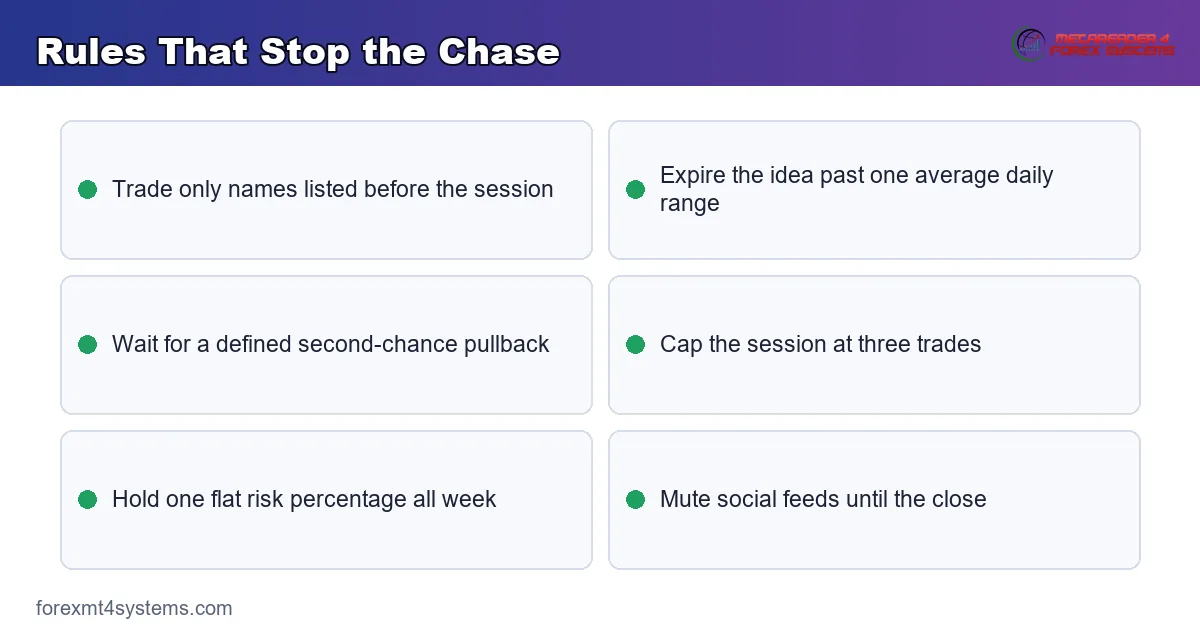
Six habits turn a missed move into a losing week. The panel below collects the rules that answer them.
Treating Speed as Evidence
A fast move proves that other people acted, nothing more. Rate the setup against your written criteria before you look at the candle.
Entering Without an Invalidation Point
Late entries usually lack structure behind them. If you cannot name the level that proves you wrong, skip the trade entirely.
Raising Size to Catch Up
Doubling size compresses a slow week into one bad afternoon. Hold a flat risk percentage, whatever the chart appears to offer.
Watching Instruments You Never Trade
Every extra chart adds another chance to feel left behind. Trim the workspace to the names on your list.
Confusing Boredom With Opportunity
Quiet sessions create the strongest pull. Schedule a task away from the screen, so waiting has something to fill it.
Skipping the Log After a Chase
The chased trade you never record repeats next month. Log it the same day, with the trigger and the outcome side by side.
Widening the Watchlist After a Quiet Week
Adding instruments to create action defeats the point of a list. Keep the names fixed for a month, then review the whole set at once.
Counting a Break-Even Chase as Harmless
A flat result still paid the spread and still rehearsed the habit. Grade the trade on process, and mark it broken whatever the number says.
Judging Restraint by One Session
The move you skipped will sometimes run for days, and that stings. Judge restraint across a month of skipped setups instead, where the average tells a calmer story.
FOMO Quick Reference
Run these seven checks before any unplanned entry. One no ends the discussion.
- Did this instrument appear on my watchlist before the move?
- Can I name the level that invalidates the idea?
- How far has price travelled from my planned entry, in average ranges?
- What reward remains between here and my original target?
- Does my risk match the flat percentage I set this morning?
- How many trades have I taken today, against my cap?
- Would I take this trade if nobody else had mentioned it?
Then pair each trigger with the response you chose while calm.
| Trigger | Written response |
|---|---|
| Price runs off your list | Note it, trade nothing, review on Friday |
| Reward drops under two to one | Cancel the idea for the session |
| Someone posts a large gain | Mute the feed until the close |
| Third trade of the day fills | Stop for the session, cap reached |
| A pullback misses your level | Let the idea expire with the day |
| An unlisted market runs hard | Add it to next week’s demo test only |
Print the pair of tables and keep them beside the screen. Rules you can see beat rules you remember, especially during the hour a market moves without you.
Pitfalls and What Goes Wrong
A few problems survive good rules. Each one hides behind sensible language.
Calling a Chase a Momentum Trade
Momentum methods have entry criteria, stops and defined holding periods. A chase borrows the label without any of the structure.
Check the plan document. If the trade appears nowhere in it, the name you give it changes nothing.
Rules With Exceptions
An exception clause dissolves a rule within a week. Keep the wording absolute, and review the rule monthly rather than mid-session.
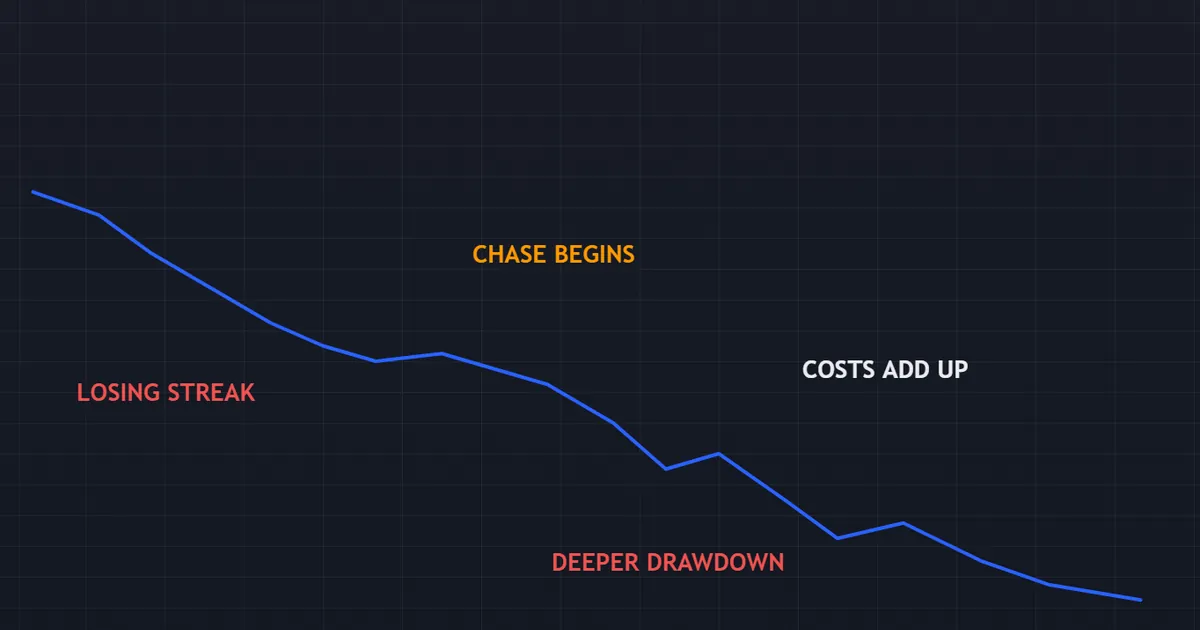
Chasing After a Losing Streak
Drawdowns raise the urge to make something happen. Cut size after three losses instead, then rebuild slowly once the process settles.
Ignoring the Cost of Frequency
Each extra trade pays the spread again. A chase that finishes flat still leaves the account slightly lighter than before.
Letting One Good Chase Rewrite the Rules
Occasionally a chased entry works, and that outcome teaches the wrong lesson. One result carries almost no information, yet it can undo months of restraint.
Grade the process rather than the profit. A trade taken outside the plan counts as broken, whatever landed in the account afterwards.
When the Urge Stops Being About Trading
Chasing can shade into compulsion. If trading disturbs your sleep, your finances or your relationships, step away and seek qualified professional support.
Nothing here counts as clinical advice. These pages address trading behaviour, and genuine distress deserves proper help.
Related Concepts to Study Next
FOMO overlaps with several neighbouring habits, so a few guides finish the picture. Each one turns an urge into a written rule you can audit later.
Take them in order rather than at random. The entry problem comes first, the reaction to a loss comes second, and the framework binds both.
Read fear and greed in trading for the wider emotional pair, then revenge trading for what happens after a chased loss.
Add trading discipline rules for the framework that holds them together. Pair all of it with steady position sizing, because a flat size removes the lever FOMO reaches for first.
FAQ
What is FOMO in trading, in one sentence?
It describes the urge to enter a move you already missed, driven by the fear that others will profit while you watch. Researchers define the underlying feeling as a worry about rewarding experiences you are absent from. In trading it shows up as late entries with oversized risk.
Why does a chased entry perform so badly?
Entering late shrinks the distance to your target while the stop distance stays the same. Reward falls, the strike rate you need rises, and traders often double size to compensate. Those three changes together explain most of the damage.
How do I stop chasing moves?
Write a watchlist before the session and trade nothing outside it. Add a distance rule that expires the idea once price travels too far, a second-chance rule for pullbacks, and a daily cap on trade count.
Does social media make trading FOMO worse?
It amplifies the effect, because feeds show winners and hide losers. The sample you see carries heavy selection bias. Muting during market hours removes a trigger without costing you any real information.
Is FOMO the same as greed?
They overlap, though the drivers differ. Greed pushes you to hold for more than you planned, while FOMO pushes you into positions you never planned. One distorts the exit, the other distorts the entry.
What should I do when I miss a big move?
Write it down and leave it alone. Note the instrument, the level you wanted, and why you missed it, then move to the next planned setup. Reviewing those notes on Friday turns a frustrating moment into a useful pattern rather than a fresh trade.
Can a rule really stop an emotional reaction?
A rule cannot remove the feeling, though it can remove the decision. Traders who decide in advance, and log the moments they broke a rule, tend to chase far less over time. Results are not guaranteed; past performance is not indicative of future results.
External references
- For background on this concept, see Fear of Missing Out on Wikipedia.
- For broader market context, see Herd Instinct at Investopedia.

About the author
Written by Dominic Walsh, a Forex trader and MT4/MT5 indicator, Expert Advisor and script developer. Every tool on forexmt4systems.com is tested on live charts before release and ships with ready-to-use compiled MT4 (.ex4) and MT5 (.ex5) files. Learn more about the trader and developer behind this site.
How we build, test and correct every tool: Editorial & Testing Policy. Trading carries risk; see the disclaimer.