
Most traders learn how to control fear and greed in trading the expensive way. This guide takes the cheaper route, through named mechanisms and rules you write before the session.
Fear and greed are not character flaws. Behavioral finance treats them as predictable responses to gains and losses, which makes them something you can design around.
Why Fear and Greed Beat Good Analysis
Analysis happens when nothing is at stake. Fear and greed arrive once real money moves, and they arrive with better timing than any indicator.
The pattern repeats across thousands of traders. Losses feel roughly twice as heavy as matching gains, so the two emotions pull in opposite directions at exactly the wrong moments.
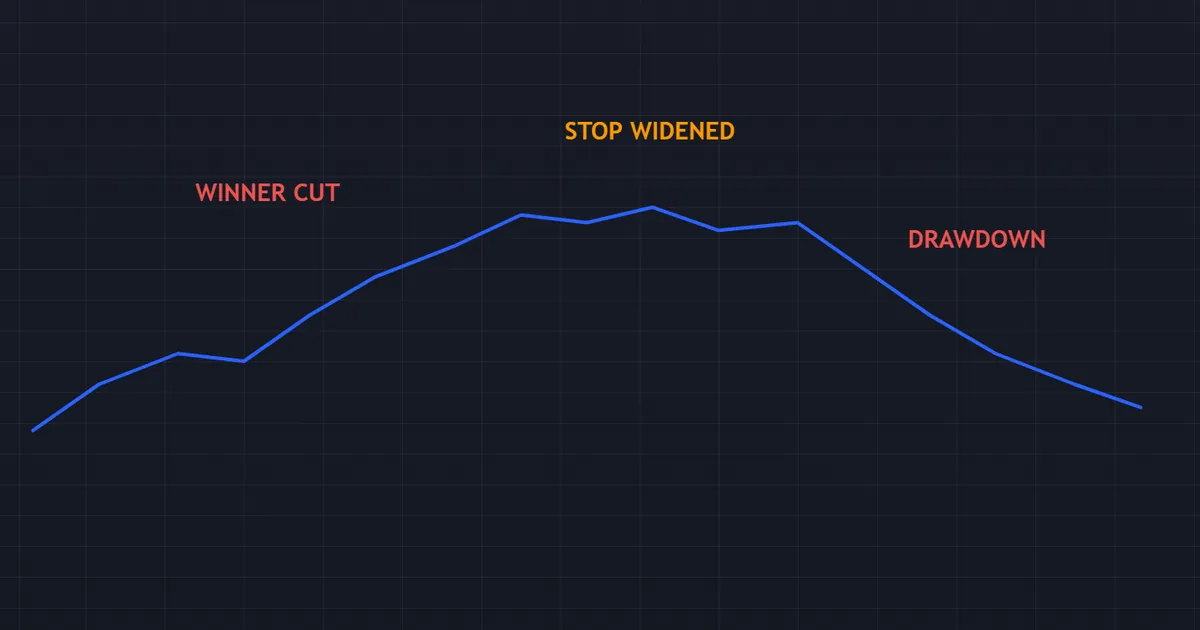
So the plan you wrote on Sunday meets a different decision-maker on Tuesday. Rules bridge that gap, because a rule works the same whichever version of you shows up.
The Two Faces of One Bias
Prospect theory describes a striking asymmetry. People act cautiously when sitting on a gain, then take extra risk when sitting on a loss.
Read that as fear and greed in one sentence. Fear closes a winner at half target, while greed holds a loser and hopes for a return to the entry.
Both come from the same reference point, your fill price. Neither reflects anything the market has told you.
What the Research Actually Says
Kahneman and Tversky put numbers on the effect in 1979. Their value function bends sharply at the reference point, with losses weighted about twice as heavily as gains.
The disposition effect turns that into a habit you can measure. Traders sell winners early and hold losers long, across markets and across decades of data.
Our note on loss aversion in trading covers the mechanism in detail.
How to Control Fear and Greed in Trading, Step by Step
Six steps remove the decisions these emotions attack. Each one happens before the position opens, while nothing is at stake.
- Fix the risk figure. Choose one percentage of the account and hold it for the month.
- Mark the invalidation level. Find where the idea fails before you look at any reward.
- Place the stop with the entry. Send both orders together, never one and then the other.
- Pre-commit the exit. Write the target and any scale-out level into the ticket.
- Set the session limits. Decide the daily loss limit and trade cap in advance.
- Log the reason. Record why you took the trade before the fill, in one sentence.
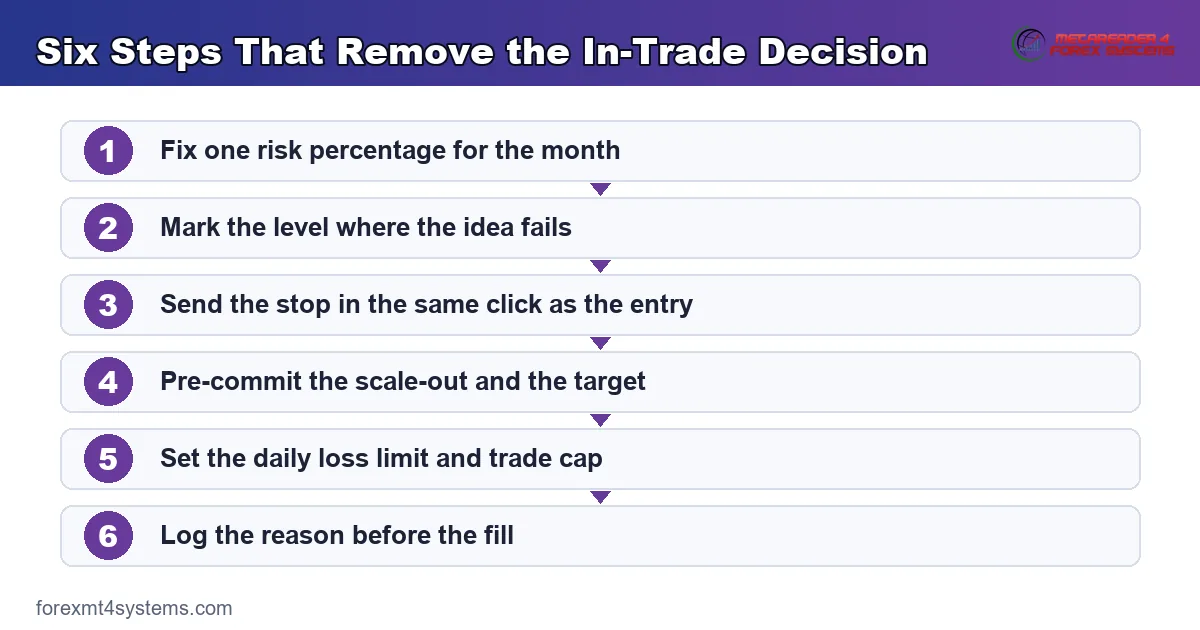
Notice what each step has in common. All six move a choice from the heated moment to a calm one.
Step One: Fix Risk Before You Look
Risk per trade decides how loud the emotions get. A position sized at half a percent barely registers, while four percent turns every tick into a shout.
Pick the figure by feel, once. If a normal loss keeps you awake, the number sits too high.
Then hold it flat for a full month. Changing size mid-month hands the decision straight back to fear and greed.
Step Two: Place the Stop With the Entry
A stop added later never gets added. Send the protective order in the same click as the entry, so the position never exists without it.
Set the level from structure, not from comfort. Our guide on how to use a stop loss covers placement in detail.
Then leave it alone. Moving a stop wider converts a known loss into an unknown one, which is the single most costly habit in this whole subject.
Step Three: Pre-Commit the Exit
Greed and fear fight hardest over the exit. Deciding in advance ends the fight before it starts.
Write two levels: a first scale-out and a final target. Send both as working orders so no in-trade judgement remains.
Traders who scale out report calmer sessions. Taking part of the position at a planned level removes the urge to bank everything at the first wobble.
Step Four: Set the Session Limits
Limits work because they arrive before the pressure does. Decide the daily loss ceiling and the trade cap while the platform still shows yesterday’s result.
Two numbers cover most traders. A loss ceiling near three percent, and a cap of three trades, keep a rough morning from becoming a rough month.
Then treat both as hard stops. A limit you can talk yourself past provides no protection at all.
Step Five: Log the Reason Before the Fill
One sentence, written before the order, does surprising work. It forces you to state a reason that survives being read back on Friday.
Weak reasons expose themselves immediately. Phrases about how a move feels, or what other traders appear to hold, rarely look convincing in daylight.
Keep the sentence in the same row as your levels. Reason and outcome sitting together turn a log into a diagnostic.
Reading Fear in Your Own Trades
Fear leaves fingerprints in your account history. Three of them show up within a month of logging.
Hesitation at the Entry
A valid setup appears, and you wait for one more candle. Price leaves without you, then you chase it forty pips higher.
Count the setups you skipped that met every criterion. A high count points at fear rather than at selectivity.
Alerts and limit orders help here. An order resting at your level fills without asking your permission twice.
Cutting Winners Early
Unrealised profit feels fragile, so traders bank it fast. The habit looks like discipline and costs like a losing streak.
Measure it directly. Compare your average reward on winners against the reward you planned, then divide one by the other.
A figure well under one names the problem. Fix it with working orders rather than willpower.
Shrinking Size After a Loss
Some traders halve their size after a bad day and keep it small for weeks. The next winner then arrives too small to matter.
A planned reduction after a drawdown makes sense. An unplanned one, driven by nerves, quietly ensures the account never climbs back.
Write the rule down either way. A stated size ladder beats a mood-driven one every time.
Reading Greed in Your Own Trades
Greed hides better, because its early results look good. Three signs give it away.
Holding Past the Target
Price reaches your level and you decide to let it run. Sometimes it works, which is exactly what makes the habit stick.
Judge the choice on process, not outcome. A target you moved without a rule counts as a broken trade, whatever the result.
If you want a runner, define it in advance. A trailing rule on a third of the position keeps the upside without the improvisation.
Adding to a Winner Without a Rule
Pyramiding works when planned. It fails when a good afternoon inspires a second and third entry at worse prices.
Check your total exposure before any add. Our note on risk and reward ratios shows how an unplanned add ruins the arithmetic.
Cap the combined risk at your normal single-trade figure. That ceiling keeps a good idea from turning into an oversized one.
Pressing Size After a Good Week
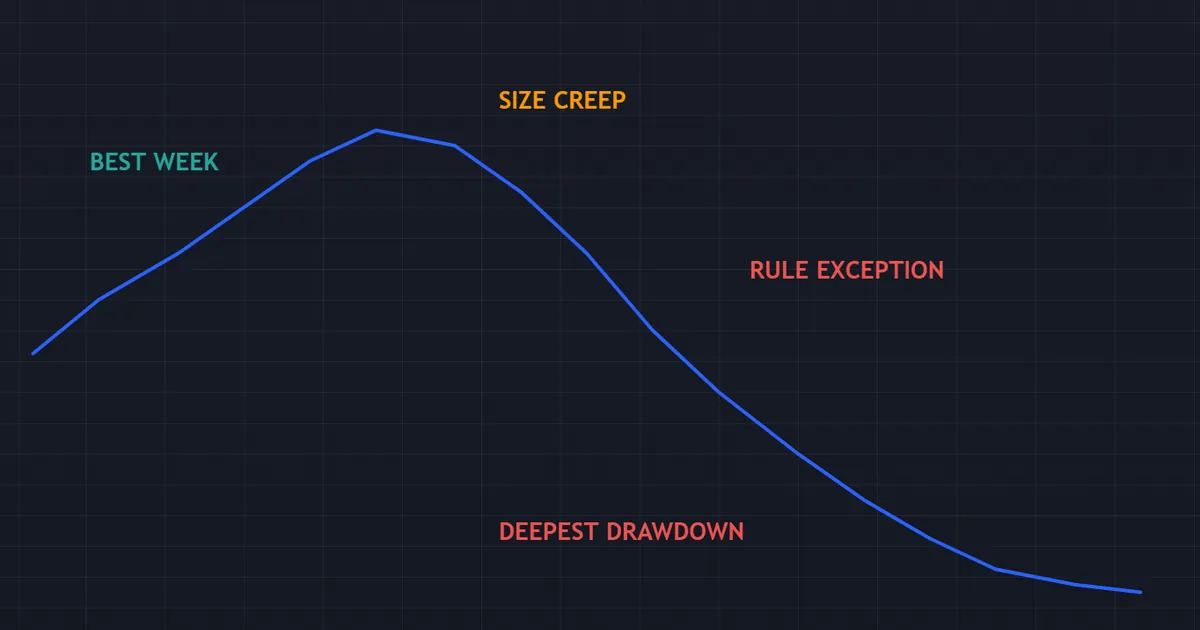
Confidence climbs after a run of winners, and size follows quietly. Accounts often post their worst drawdown right after their best week.
Audit your average risk per trade by week. A rising line marks the drift long before the drawdown arrives.
Refusing to Close a Loser
Greed also wears the mask of hope. A position sitting below your stop level feels survivable, so you leave it open and wait.
Prospect theory predicts exactly that. Sitting in a loss pushes people toward extra risk, because the certain pain of closing outweighs the uncertain pain of holding.
Resting orders solve it mechanically. A stop already in the market closes the trade while you argue with yourself.
How Market Conditions Amplify Both
The same trader behaves differently in different weeks. Three conditions raise the volume on fear and greed alike.
Crowded Moves and Herd Behaviour
Herd behaviour describes people acting together with no central direction. Strong trends and loud headlines make joining the crowd feel like analysis.
Greed enters as a late chase, while fear enters as an early exit from a position everyone now doubts. Both come from the crowd rather than the chart.
Ask what you would do without the commentary. If the answer differs from your plan, the crowd is trading your account.
Volatility and Position Size
Wider ranges move your position value faster. A size that felt calm last month can feel alarming once daily range doubles.
Scale the position to current range rather than to habit. Keeping risk constant in money terms means the lot size falls as volatility rises.
That single adjustment removes much of the panic. Your loss stays the same size whatever the market does with its range.
Drawdowns and the Urge to Fix Things
A drawdown pushes traders toward action. Fear cuts size below anything useful, while greed doubles it to recover faster.
Plan the response in advance instead. A written ladder, halving risk after a set drawdown and restoring it after a set recovery, answers both impulses.
A Worked Example of Fear and Greed in One Week
Picture five trades on a ten thousand dollar account. Risk stays at one percent, and each plan calls for two units of reward.
Fear closes two winners at half target. Greed holds one loser past the stop and pushes size on the final trade.

The entries were all valid. The table below tracks what the decisions did to the week.
| Trade | Plan | What happened | Result in R |
|---|---|---|---|
| 1 | Target at 2R | Closed at 1R, profit felt fragile | Plus 1.0 |
| 2 | Stop at 1R | Stop honoured | Minus 1.0 |
| 3 | Target at 2R | Closed at 0.8R after a wobble | Plus 0.8 |
| 4 | Stop at 1R | Stop widened, closed at 2.2R down | Minus 2.2 |
| 5 | Risk 1 percent | Risked 2 percent to recover | Minus 2.0 |
Reading the Week
Follow the plan exactly and the same five trades return plus two units. Managed by feel, they return minus three and a half.
Nothing in the market caused that swing. Two early exits, one widened stop and one doubled position did all of it.
Run your own numbers with our free expectancy calculator to see how exit habits move the average.
What the Journal Records
Log four fields on every trade: planned stop, planned target, actual exit and the reason for any change. Those four expose fear and greed faster than any amount of reflection.
Our free trade journal keeps them in one place. After thirty trades the pattern reads itself.
Then grade each trade as followed or broken. Money moves around, though adherence tells you what to fix next.
Download the complete indicator database
Put these concepts on your charts. One email unlocks the full library of 1,380+ indicators with compiled MT4 and MT5 files, plus my TradingView scripts. No paywall, no spam, unsubscribe any time.
Get free access to my indicator database
One email unlocks 1,380+ free MT4, MT5 and TradingView indicators — the complete library. No single-tool download; you get the whole database.
The Mechanics That Hold Under Pressure
Good intentions fade the moment a position moves. Four mechanics keep working when they do.
If-Then Rules
Psychologists call these implementation intentions. You pair a specific trigger with a specific action, in advance, and the pairing does the deciding.
Write them in plain language. If price hits my first target, then I close half and move nothing else.
Keep the list under ten lines. A short list you actually follow beats a long one you skim.
A Daily Loss Limit and a Cooling-Off Period
Set a hard stop for the session, in percent or in trades. Two losses, or three percent, suits most discretionary traders.
Our guide to a daily loss limit covers how to pick a level you can hold. Choose the number while calm, never during a drawdown.
Then add a pause after every stop-out. Twenty minutes away from the screen breaks the link between a loss and the next order.
A Flat Risk Figure
One percentage, held all month, removes the lever both emotions reach for. Fear cannot shrink it, and greed cannot press it.
Review the figure at month end only. Changes then arrive from your record rather than from yesterday’s result.
A Weekly Review Slot
Book thirty minutes on Friday. Read the journal, count broken rules, and pick one behaviour for next week.
One change at a time keeps the signal clean. Fix the early exits first, since they usually cost the most.
Common Fear and Greed Mistakes and Fixes
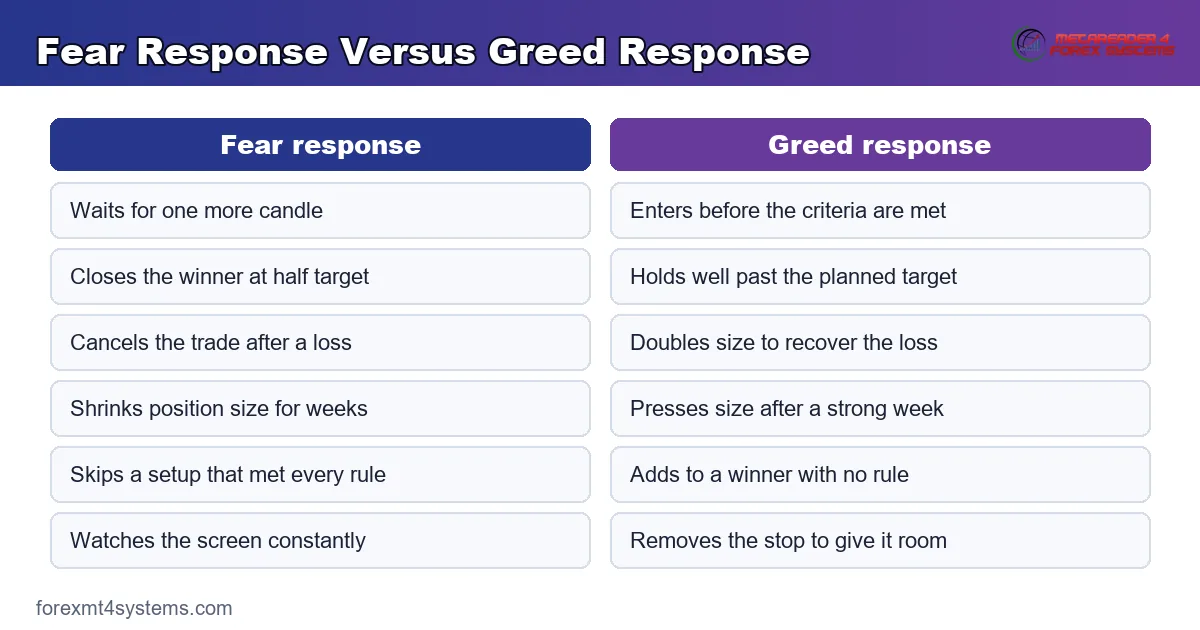
Six habits do most of the damage. The panel below sets each fear response beside its greed twin.
Trading a Size You Cannot Sleep On
Oversized positions turn normal noise into panic. Halve the risk figure until a losing trade feels dull rather than dramatic.
Removing the Stop to Avoid a Loss
Cancelling protection replaces a known cost with an open one. Keep the stop resting at the level, and let it do its job without discussion.
Banking Profit at the First Wobble
Early exits feel prudent and quietly destroy the reward side. Send working orders at your planned levels, so the exit needs no judgement.
Doubling Down to Recover
Extra size after a loss compresses a bad week into an afternoon. Hold the flat figure and let the sample repair itself.
Changing the Plan Mid-Trade
Any edit made while a position runs comes from the emotion, not the analysis. Note the idea, apply it next week, and leave the current trade alone.
Judging Yourself on Money
Daily profit tells you almost nothing about behaviour. Grade each trade as followed or broken first, then look at the account.
Watching Every Tick of an Open Position
Constant screen time converts normal noise into a reason to act. Set alerts at your levels, then leave the chart until one of them fires.
Setting Limits After a Bad Morning
A limit chosen mid-drawdown reflects the drawdown, not your plan. Fix the numbers at the weekend, and change them only at month end.
Fear and Greed Quick Reference
Run these seven checks before the session opens. Two minutes covers the whole list.
- What percentage of the account does this trade risk?
- Where does the idea fail, and does my stop rest there already?
- Which levels take profit, and are those orders working?
- What is today’s loss limit, and how much of it remains?
- How long is my cooling-off period after a stop-out?
- Did I change anything mid-trade yesterday, and why?
- What single behaviour am I working on this week?
Then pair each pressure point with a response you chose while calm.
| Pressure point | Written response |
|---|---|
| Position moves against you | Leave the stop, let it resolve |
| Profit reaches half of target | Scale out only at the planned level |
| Price approaches the target | Let the working order fill, change nothing |
| Two losses in the session | Close the platform, limit reached |
| Best week in months | Hold size flat, log the urge to press |
| Daily range doubles | Cut lot size, keep risk in money constant |
Keep both lists visible beside the platform. A rule you can read beats a rule you recall, especially in the minute a position turns against you.
Pitfalls and What Goes Wrong
Some traps survive a good rule set. Each one arrives wearing sensible clothes.
Calling Discipline a Personality Trait
Discipline lives in your process, not in your character. Traders who blame willpower keep relying on the thing that already failed.
Move the decision earlier instead. Every rule you write before the open reduces what willpower must carry later.
Rules With Exceptions
An exception clause dissolves a rule within a week. Keep the wording absolute, and review it monthly rather than mid-position.
Confusing a Losing Run With Bad Behaviour
Sound process still produces drawdowns. Check adherence first, and change the method only when the broken-rule count sits near zero.
Reading Broker Loss Statistics Wrongly
European regulators require brokers to publish the share of retail accounts losing money on contracts for difference. Those disclosures usually land between roughly seventy and eighty-five percent.
Treat the figure for what it covers. It describes retail CFD accounts at one broker over a set window, so it predicts nothing about any single trader.
When Fear Stops Being About Trading
Dread before the open, or chasing losses late at night, moves beyond a habit. If trading affects your sleep, your finances or your relationships, step away and seek qualified professional support.
Nothing here counts as clinical advice. These pages cover trading behaviour, and real distress deserves proper help rather than another checklist.
Related Concepts to Study Next
Fear and greed sit inside a wider subject, so a few neighbouring guides finish the picture. Each one turns a feeling into a mechanical rule.
Start with trading psychology for the full map of biases. Then read fear of taking a trade for the version that stops entries before they happen.
Finish with trading discipline rules, which collects the written framework these steps belong to. Read them in that order, because the mechanism explains the symptom and the framework holds both.
FAQ
How do I control fear and greed in trading day to day?
Move every decision the emotions attack to a calm moment. Fix risk before you look at charts, send the stop with the entry, place working orders at your exit levels, and set a daily loss limit. The trade then runs without further judgement.
Why do I close winners early and hold losers?
Prospect theory explains it. People act cautiously with gains and take extra risk with losses, because losses weigh about twice as heavily. Working orders at planned levels remove the moment where that asymmetry acts.
Is fear always harmful in trading?
No. Caution that stops you trading an oversized position protects the account. The harmful version arrives as an unplanned change, such as an early exit or a skipped setup that met every rule you wrote.
How large should my risk per trade be?
Small enough that a normal loss feels dull. Many traders settle between half a percent and one percent of the account. If a single loss keeps you awake or changes your next decision, the figure sits too high.
Does a bigger account make this easier?
Not by itself. The emotions track the size of the swing relative to what matters to you, so a larger account with larger positions feels much the same. A flat percentage keeps the experience steady as the balance changes.
What single change helps the most?
Sending the stop and the target as working orders at the moment of entry. That one habit removes the two decisions fear and greed attack hardest, and it needs no willpower once the orders rest in the market.
How long before rules feel natural?
Most traders notice a change within thirty to fifty logged trades, once broken-rule counts start falling. Progress shows up as fewer unplanned edits rather than as a smoother account curve. Results are not guaranteed; past performance is not indicative of future results.
External references
- For background on this concept, see Loss Psychology at Investopedia.
- For broader market context, see Self-Control on Wikipedia.

About the author
Written by Dominic Walsh, a Forex trader and MT4/MT5 indicator, Expert Advisor and script developer. Every tool on forexmt4systems.com is tested on live charts before release and ships with ready-to-use compiled MT4 (.ex4) and MT5 (.ex5) files. Learn more about the trader and developer behind this site.
How we build, test and correct every tool: Editorial & Testing Policy. Trading carries risk; see the disclaimer.