
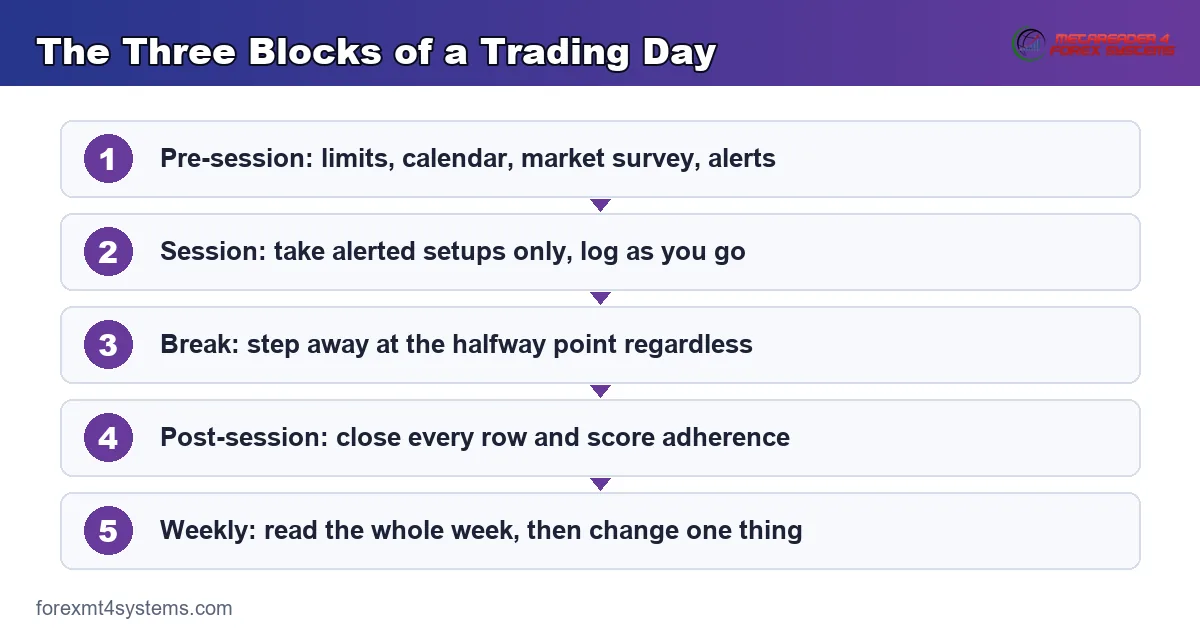
Most traders describe their day as “watch the charts and see what happens”. A daily trading routine replaces that with three blocks, each with a start time, a fixed length and a short list of tasks.
Nothing here promises better results. What a timeline does deliver is a day that looks the same whether yesterday went well or badly.
What a Daily Trading Routine Has to Do
The routine handles the decisions you should never make in real time. Limits, calendar, watchlist and stop time all get settled before the first chart opens.
Everything left inside the session then becomes execution. That split is the whole design, and it matters most on the days you feel least like following it.
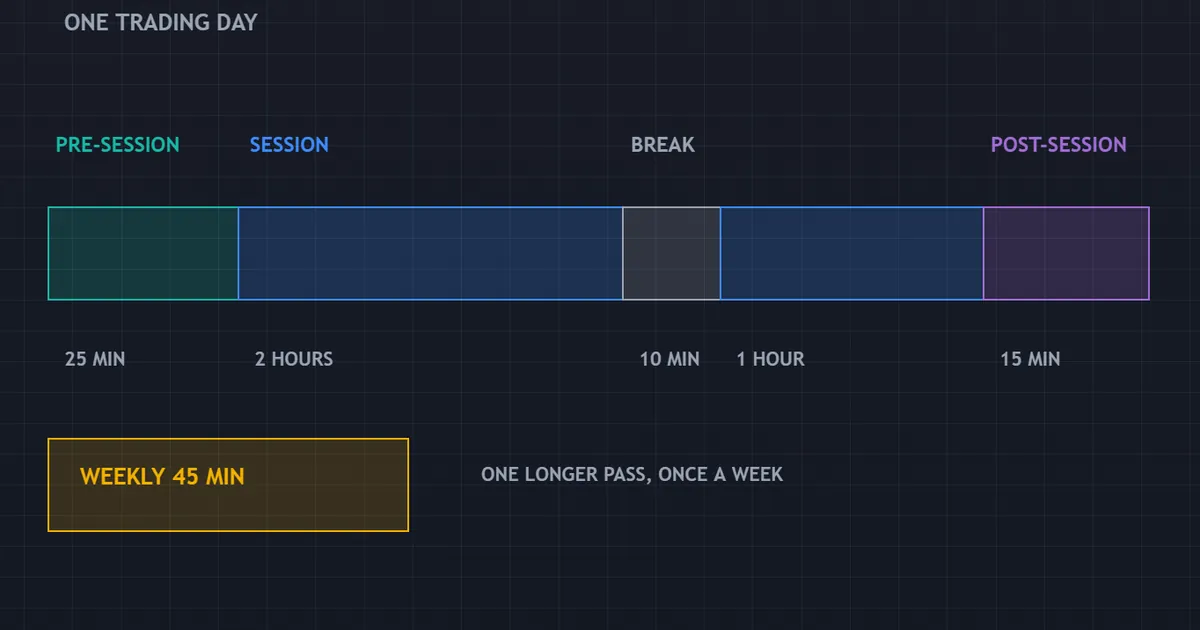
The panel above lays the day out on one bar. Twenty-five minutes before, the session itself, a break in the middle, then fifteen minutes after.
Three Blocks, Not a To-Do List
Task lists sprawl. Blocks have edges, so you can tell whether you finished one.
Preparation, execution and review each demand a different frame of mind. Mixing them produces the familiar trap of analysing a market while a position argues with you.
Keep the blocks physically separate where you can. Some traders prepare standing at a different desk, which sounds trivial and works surprisingly well.
Realistic Durations
Twenty-five minutes covers preparation for most swing and intraday traders. Fifteen minutes covers the review, and a weekly read takes about forty-five.
Longer plans collapse within a fortnight. A routine you can complete on a bad morning beats a thorough one you abandon by month two.
Time each block once before you commit to a length. Guessed durations run short by half, and a block that always overruns quietly teaches you to skip it.
Round the numbers afterwards. Twenty-five minutes reads as a slot in a diary, whereas twenty-three reads as a target nobody hits.
Block One: Pre-Session Preparation
Run this before the market you trade opens, at the same clock time each day. The order below moves from cheapest checks to most demanding.
Minutes One to Five: Account and Limits
Open the account and read three numbers: balance, open positions and yesterday’s closed result. Then state today’s loss floor out loud or in writing.
Check that nothing sits open from yesterday by accident. Traders find forgotten positions far more often than they admit.
Note the floor in currency terms, not only as a percentage. A number you can picture stops a session far more reliably than a fraction you have to compute mid-morning.
Minutes Six to Fifteen: Market Survey
Scan the calendar first, covering the whole span you expect to hold trades for. Mark every high impact release inside that window.
Then read the higher timeframe on each pair you follow. One sentence each is plenty, and writing them down beats holding them in your head.
Our free economic calendar and market hours tools make this block fast enough to run every single day.
Minutes Sixteen to Twenty-Five: Setups and Alerts
List the specific setups you would take today, with the price that triggers each one. Two or three candidates is a normal morning.
Set a platform alert at each trigger price, then close the charts. Alerts exist so the session does not require staring.
Write the stop time for the day as the last line. Deciding when to finish while calm removes the hardest decision of the afternoon.
Block Two: Inside the Session
The session block has one job: execute what preparation produced. Everything else counts as improvisation.
The Only Three Decisions
Take an alerted setup, manage an open position, or do nothing. Those three exhaust the legitimate options.
Anything outside that list means the idea did not come from preparation. Log it as an improvised trade if you take it, so the monthly review can count them.
Run your pre trade checklist before each entry. The routine positions the checklist; the checklist gates the order.
Screen Rules
Watching a position tick by tick changes how you manage it. Traders who stare tend to exit early, and the habit costs more than any single decision.
So set the alert and step away. Return when something fires or when a scheduled review point arrives.
Half-hourly check-ins suit intraday work. Swing traders can often manage with two per day.
Alerts also solve a subtler problem. A trigger price set during calm preparation rarely moves, whereas a price you decide while watching drifts toward wherever the market already sits.
The Break Rule
Take a genuine break at the halfway point, away from the screen. Ten minutes is enough, and it needs to happen whether the morning went well or badly.
Breaks after losses feel like giving up. They are actually the cheapest available protection against the next three decisions.
Download the complete indicator database
Put these concepts on your charts. One email unlocks the full library of 1,380+ indicators with compiled MT4 and MT5 files, plus my TradingView scripts. No paywall, no spam, unsubscribe any time.
Get free access to my indicator database
One email unlocks 1,380+ free MT4, MT5 and TradingView indicators — the complete library. No single-tool download; you get the whole database.
Block Three: Post-Session Review
Fifteen minutes, at a fixed time, with the platform closed. This block turns a day of activity into a record.
Log Before You Leave
Complete every open journal row: outcome, R multiple, and one line on what you did well or badly. Add the setups you passed on.
Do it today, not on Sunday. Memory reshapes a trade within hours, and the reshaped version always sounds more reasonable.
Our free trade journal keeps the fields consistent, though any spreadsheet works.
Score the Day on Adherence
Give the day a mark out of five for following your own process. Outcome plays no part in that score.
Five out of five on a losing day counts as a good day. That scoring feels odd initially, and it fixes more behaviour than any other habit in this article.
Keep the scale coarse. Marks out of five stay quick to assign, whereas a ten-point scale invites you to negotiate with yourself over half a point.
Then read the scores as a run at the end of the month. Three low marks in a row point at something structural rather than at a difficult market.
Close the Loop Weekly
Book forty-five minutes at the end of each week. Read every row, count improvised trades, and note which block kept slipping.
Then change one thing for the following week. Our guide on reviewing your trades covers what to look for in the numbers.
What the Routine Looks Like Over a Month
Individual days tell you very little. Twenty of them stacked together start to show a shape.

The panel above marks an even weekly trade count beneath the equity line. Notice the regularity rather than the direction, since regularity is the thing a routine controls.
What Stays Constant
Trade counts stay in a narrow band. Position sizes stay uniform, and the steps in the curve keep a similar height.
That uniformity makes the month readable. You can ask whether the strategy worked, because execution stopped being a variable.
What the Routine Cannot Control
Direction, obviously. A perfectly kept month can still lose money, and a chaotic one can still make some.
Confusing the two is how traders abandon good process after one bad fortnight. Score the process on adherence and the strategy on a much longer sample.
No-Setup Days
Some days produce nothing. Preparation runs, alerts sit untouched, and the session ends with no position taken.
Doing Nothing Is a Result
Record the day exactly as you would record a trading day. Note the setups you watched and why each one failed to trigger.
Those notes accumulate into your best filter data. A month of near-misses tells you whether your trigger prices sit sensibly or too far away.
Beginners often treat a flat day as wasted. It is the routine working, and our note on overtrading covers what happens when that patience runs out.
Count your flat days over a month. A strategy that triggers every single session is usually one with criteria loose enough to catch anything.
The Substitute Task List
Idle hands find trades. Fill the gap with work that helps rather than work that costs.
- Backfill the journal. Convert older rows to R multiples, or add the setup names you skipped recording.
- Rebuild one watchlist. Check that the pairs you follow still suit your strategy and your session.
- Study one closed trade in depth. Screenshot it, mark the level, and write what you would repeat.
- Update your spread log. Record the typical spread per pair at the hours you actually trade.
- Read one guide properly. Twenty minutes of reading beats two hours of watching a flat chart.
Notice that none of those tasks involve opening a position. That is the point of having the list ready in advance.
Building Your Own Version in One Week
Copying somebody else’s timeline rarely survives contact with your life. Building your own takes five days.
Day One: Time the Blocks You Already Run
Trade as normal, with a stopwatch running. Note how long you genuinely spend preparing, watching and recording.
Most traders find the split runs badly. Two hours of watching, four minutes of preparation, and no review whatsoever is a common result.
Days Two and Three: Write the Minimum Version
Cut preparation down to the checks you would keep with only five minutes available. Usually that leaves limits, the calendar and one alert.
Run that stripped version for two sessions. Short and completed beats thorough and abandoned every time.
Days Four and Five: Add Back What You Missed
Note what went wrong across the stripped days. Then add only the items that would have prevented a real problem.
Anything you did not miss stays out. Routines grow far too easily, and each extra minute lowers the odds that you run the whole thing on a difficult morning.
The Weekly and Monthly Layers
Daily blocks handle execution. Two slower loops handle everything a single day cannot see.
The Weekly Read
Forty-five minutes, in the same slot each week. Count the trades, count the improvised ones, and read the adherence scores as a sequence.
Then find the block that slipped. Almost every bad week traces back to preparation shortening rather than to a market that misbehaved.
The Monthly Number
Once a month, convert results to R multiples and recompute expectancy. That figure moves slowly, which is exactly why checking it weekly wastes your time.
Compare against your own previous month rather than against anybody else. Costs, pairs and sessions all differ between traders, so outside comparisons rarely mean much.
The Quarterly Rule Review
Book one session every three months for the rules themselves. Read the journal first, then change a single item.
Changes made outside that slot almost always loosen something. Booking the date in advance protects you from your own worst week.
Common Mistakes and Their Fixes
Routines rarely collapse all at once. They drift, and the panel below sets a kept day against a drifting one.

Starting the Session Before Preparation Finishes
Opening charts first turns preparation into commentary on whatever price is doing. Finish the block, then look.
Letting the Stop Time Float
A finish time decided by the last result is not a finish time. Write it during preparation and honour it, especially after a loss.
Reviewing Only the Losers
Half a review misleads. Sloppy entries that happened to work teach the most dangerous lessons of all, so read the winners with equal care.
Building a Ninety-Minute Preparation Block
Thorough routines die young. Cut preparation until it fits a bad morning, then protect what remains.
Skipping the Routine on Quiet Days
Quiet days are exactly when the habit gets built. Run the blocks anyway, even when the whole thing takes eight minutes.
The Timeline at a Glance
Print this and stick it beside the screen. Each block names its length and its output.
| Block | Length | Tasks | Output |
|---|---|---|---|
| Pre-session: account | 5 minutes | Balance, open positions, loss floor stated | Today’s limits written down |
| Pre-session: survey | 10 minutes | Calendar across the holding window, higher timeframe notes | One sentence per pair |
| Pre-session: setups | 10 minutes | Candidate setups, trigger prices, alerts, stop time | Two or three alerts, one finish time |
| Session | Variable | Take alerted setups, manage positions, do nothing | Journal rows opened before each order |
| Break | 10 minutes | Away from the screen at the halfway point | A reset that does not depend on results |
| Post-session | 15 minutes | Complete every row, log skips, score adherence | A closed record and a mark out of five |
| Weekly read | 45 minutes | Count improvised trades, find the slipping block | One change for next week |
When the Routine Breaks Down
Breakdowns follow a pattern. Preparation shortens first, the stop time goes next, and the log stops last.

The panel above shows the same account traded without a routine. Trade counts spike after losses and the step sizes vary wildly, which makes the whole record hard to read.
Counts Spike Where the Rules Slipped
Six trades on a Tuesday after four losses on the Monday is not a market signal. It records a trader trying to fix a feeling.
Plot your daily trade count beside your daily result. The spikes line up with the bad days almost every time.
Rebuilding After a Break
Drop back to the shortest possible version: five minutes of preparation, one setup, five minutes of review. Run that for a week.
Then add one block back at a time. Rebuilding the full routine in a single day tends to fail for the same reason it broke.
Cut position size while you rebuild. Smaller trades restore the habit without the pressure that broke it in the first place.
Watch the First Thing to Go
Everyone has a signature failure. For some it is the log, for others the break, and it repeats across years.
Name yours from the journal, then build friction around that one item. Setting a phone alarm for the break sounds childish and works.
What Belongs Outside the Daily Blocks
Plenty of useful work does not fit inside a trading day. Pushing it in there is how a preparation block swells to ninety minutes.
Strategy Work
Testing a new entry, reading research or reworking a rule belongs in a separate slot, ideally at the weekend. None of it should happen while a session runs.
Mixing the two produces the worst version of both. You test carelessly and you trade distractedly.
Platform and Admin Tasks
Chart templates, indicator settings, broker paperwork and withdrawal requests all sit outside the blocks. Handle them on a fixed weekday evening instead.
Small tasks feel harmless during a quiet hour. They still pull attention away from the one alert that eventually fires.
Learning
Courses, videos and guides deserve real attention rather than the gaps between alerts. Book them like any other appointment.
Traders who study during sessions usually end up doing neither properly. Separate slots protect both activities.
Adapting the Routine to Your Style
The three blocks stay. Their contents and lengths change with what you trade.
Intraday and Scalping
Preparation shortens to ten minutes and repeats before each session you trade. Cost checks move to the front, since spread matters far more at high frequency.
Breaks become more frequent and shorter. Screen fatigue arrives quickly, and tired execution shows up in the R record long before you notice it.
Swing and Position Trading
Preparation runs once a day, often in the evening. The calendar scan extends across several days rather than a few hours.
Sessions matter less, though they still shape entry timing. Our guide to forex trading sessions covers which hours suit which approach.
Part-Time Traders
Anchor the routine to your actual availability rather than to a market open. A fixed evening block beats a scattered attempt to catch London.
Then choose a strategy that survives your schedule. Our library of forex trading strategies covers approaches that suit longer holding periods.
Related Guides Worth Reading Next
A routine executes a plan, so the plan comes first. Our trading plan example shows the document these blocks work from.
After that, tighten the gate. The checklist linked above turns each entry into a yes or no, and the review guide turns each week into a small, testable change.
Keep the whole thing boring. Boring routines survive, and survival is what lets any strategy accumulate a sample worth reading.
FAQ
How long should a daily trading routine take?
Around forty minutes outside the session for most traders: twenty-five before and fifteen after. Scalpers often run shorter preparation blocks more frequently, while position traders may prepare once a day and review twice a week. The length matters far less than doing it at the same clock time, since a fixed slot is what turns the sequence into a habit.
What should I do on a day with no setups?
Record the day, note which setups you watched and why each failed to trigger, then work the substitute list. Backfilling the journal, updating a spread log or studying one closed trade all count as productive. What you should avoid is lowering your criteria to manufacture activity, because those trades pollute the very record you are trying to build.
Should the routine change after a losing week?
Not during the week itself. Changes made under pressure reflect the pressure rather than the evidence, and they almost always loosen a rule that felt inconvenient. Bring the observation to your weekly read, change one item, and give it twenty sessions before judging whether it helped.
Do I need the pre-session block if I trade the daily chart?
Yes, though it shrinks. Position traders still need to check limits, scan the calendar across a multi-day window and confirm that open positions match the plan. Ten minutes usually covers it, and skipping it entirely is how forgotten positions and unnoticed releases happen.
How do I keep a routine while working full time?
Anchor it to your day rather than to a market. Twenty minutes before work and fifteen in the evening builds the same structure, provided your strategy suits the hours you can actually watch. Alerts do most of the heavy lifting here, since they replace screen time with a notification.
What if my routine keeps slipping by mid-week?
Shorten it rather than trying harder. A block that survives Monday and dies on Wednesday is usually too long for the energy you have on a normal day. Cut it to the version you would still complete after a poor night’s sleep, hold that for a fortnight, then add one item back. Consistency at a small size beats ambition that collapses.
Does following a routine improve my results?
It makes them measurable, which is a different claim. A consistent process removes execution as a variable, so the record starts to describe your strategy rather than your mood on a given Tuesday. Whether that strategy has an edge remains a separate question, answered only by a large sample over a long period. Results are not guaranteed; past performance is not indicative of future results.
External references
- For background on this concept, see Implementation Intention on Wikipedia.
- For broader market context, see Time Management at Corporate Finance Institute.

About the author
Written by Dominic Walsh, a Forex trader and MT4/MT5 indicator, Expert Advisor and script developer. Every tool on forexmt4systems.com is tested on live charts before release and ships with ready-to-use compiled MT4 (.ex4) and MT5 (.ex5) files. Learn more about the trader and developer behind this site.
How we build, test and correct every tool: Editorial & Testing Policy. Trading carries risk; see the disclaimer.