
Most people try to learn chart reading by watching more videos. That approach fills a notebook and changes nothing, so this guide covers how to learn price action trading through repetition instead.
What follows is a path rather than a lesson. It sets out five stages, a daily practice loop, a journal, and a way to tell whether any of it is working.
How to Learn Price Action Trading Without Wasting a Year
Chart reading is a perceptual skill. It behaves like sight-reading music or judging distance, and skills of that kind respond to reps rather than to explanation.
So the plan below spends very little time on definitions. Our overview of what price action trading is already covers the vocabulary, and this article assumes you have read it.
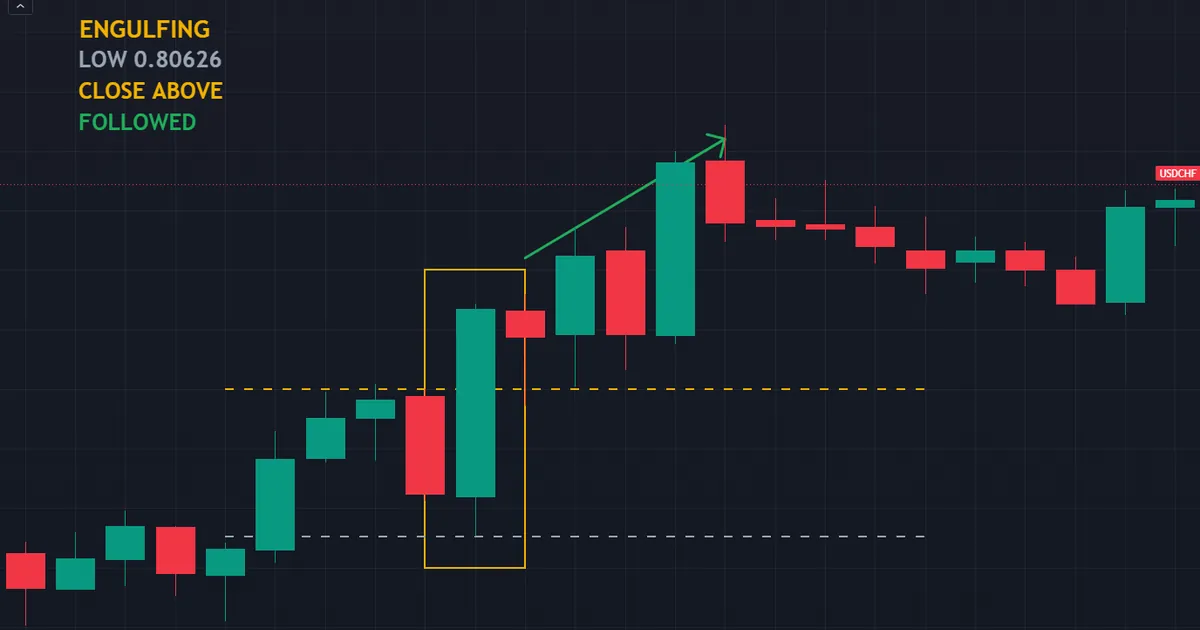
Above sits a bullish engulfing bar on USDCHF hourly bars, formed around midday on 16 July 2026. Price traded down to 0.80626, then closed above the previous bar’s high, and the bars afterwards moved up.
Why Most Self-Study Stalls
Learners collect patterns for months and still freeze at the live chart. The gap is not knowledge, and adding a sixth pattern never closes it.
Reading requires you to judge messy, half-formed structure under time pressure. Textbook examples are already resolved, so studying them trains recognition of a situation you never actually face.
What Fixes It
Practice on bars whose outcome you cannot see. Hide the right-hand side of the chart, commit to a reading, then reveal what happened.
That single change turns passive study into a feedback loop. Everything else in this article supports it.
What You Are Actually Training
Three separate skills hide behind the phrase “reading charts”. Naming them helps, because each one improves in a different way.
Perception
First comes seeing structure quickly. Swing points, the direction of the sequence, whether bars overlap or step cleanly.
Perception improves purely through volume. Nobody talks their way to it, and everybody gets there eventually with enough exposure.
Judgement Under Uncertainty
Second comes committing to a reading while the outcome is still hidden. That is uncomfortable, and it is the part most study routines skip entirely.
Written notes before the reveal train this directly. Watching a resolved chart trains nothing, because there is no uncertainty left to sit with.
Restraint
Third comes doing nothing when the chart says nothing. Most charts, most of the time, say nothing worth acting on.
Restraint is a habit rather than an insight. It builds by counting the setups you correctly skipped, which is why the journal has a field for them.
Why the Three Improve at Different Speeds
Perception moves fastest and shows results within weeks. Judgement takes months, and restraint takes longer still because live money keeps testing it.
Expecting all three at once causes most of the frustration. Track them separately and the flat stretches stop feeling like failure.
The Practice Loop That Does the Work
One repetition takes about three minutes. Five steps, in the same order every time.
- Scroll back and hide the future. Pick a random date, then cover or replay from a point where you cannot see what came next.
- Mark the levels first. Draw only the obvious ones: prior swing extremes, the last range boundary, the weekly open.
- Write a one-line reading. State the market condition, the level that matters and the price that would prove you wrong.
- Reveal the next twenty bars. Compare what happened against what you wrote, without editing the note.
- Log the repetition. Record whether the level mattered, whether your invalidation held, and what you missed.
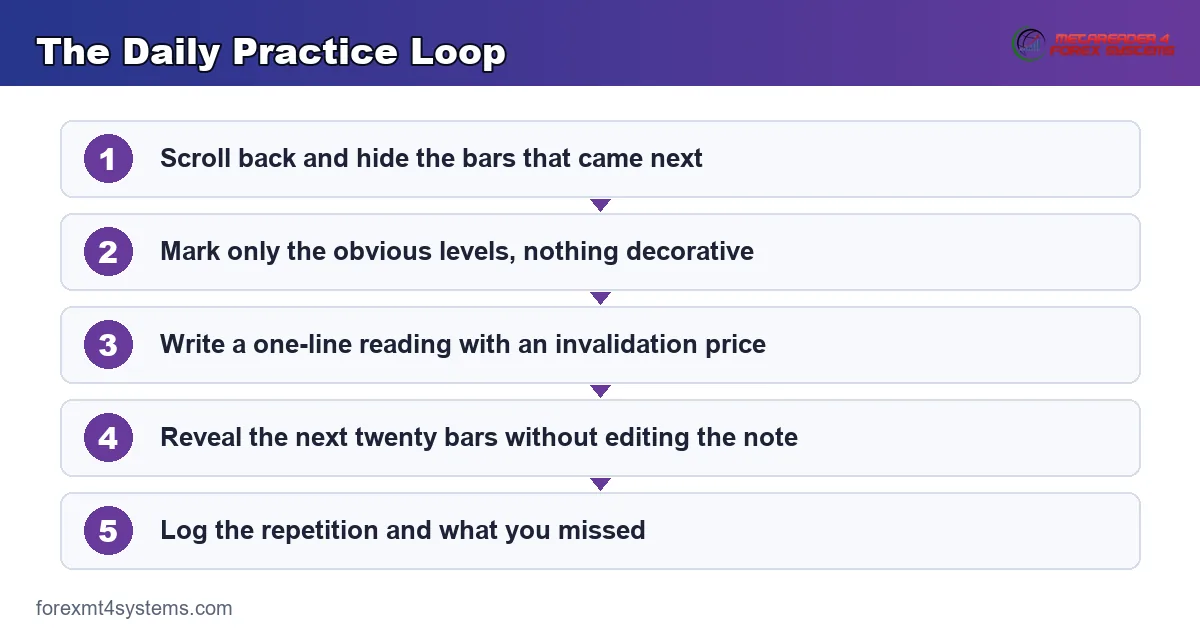
Twenty of these a day beats an hour of video. The loop is dull by design, and the dullness is where the learning sits.
Why Writing It Down Matters
An unwritten reading rewrites itself the moment the bars appear. Memory is generous towards its own predictions, and it does that silently.
A sentence on paper cannot move. So the honest comparison only exists when you commit before the reveal.
The Replay Tool You Already Have
Most platforms include a bar-replay function. Load a pair, drag the replay marker back a few months, and step forward one bar at a time.
No subscription is required for any of this. Historical bars and a notepad cover the whole method.
Choosing Where to Start Each Repetition
Pick the starting date without looking first. Jumping to a spot that already looks interesting quietly selects the dramatic charts, which are the least representative ones.
Random starts give you the boring stretches too. Those matter, since most of live trading happens during them.
Do Not Step Bar by Bar to the Answer
Reveal the whole twenty-bar block at once. Stepping forward one bar at a time lets you adjust your view continuously, which erases the commitment the loop depends on.
One note, one reveal, one score. Anything softer turns the exercise back into passive watching.
The Five Stages, in Order
Rushing stages is the commonest mistake, so treat the sequence as fixed. Each one takes roughly two to three weeks of daily practice.
Stage One: One Market, One Timeframe
Choose a single pair and a single chart, then stay there. A major pair on the four-hour chart works well, because the bars are readable and the data is deep.
Depth beats breadth at the start. Watching six markets badly teaches you six shallow habits at once.
Stage Two: Marking Levels Blind
For two weeks, do nothing except mark levels. No entries, no patterns, no opinions about direction.
Then check each mark a week later. Levels that produced a reaction get a tick, and the rest teach you what you over-marked.
This stage feels unproductive and pays the largest dividend. Location does most of the work later, so building it first orders everything else.
Stage Three: Naming What You See
Now add bars to the picture, and keep the list short. A rejection bar, an engulfing bar and a compression bar cover nearly everything.
Our guides to pin bar meaning and engulfing candle meaning supply the definitions once, and repetition supplies the rest.
Stage Four: The Full Loop with Invalidation
Add the invalidation price to every reading. Before revealing the next bars, write the exact level that would end the idea.
That habit converts observation into a plan. It also makes your notes scoreable, since you can check afterwards whether the level held.
Stage Five: Small Live Size
Only now does money belong in the picture, and it should be an amount you would shrug at. Live execution introduces hesitation that no replay can simulate.
Work the size from the invalidation distance rather than from habit. Our position size calculator handles the arithmetic, and our note on risk per trade covers how much to put at stake.
A Worked Repetition
Here is one loop run properly, using a real bar. The chart below is a compression setup rather than a dramatic one, which makes it a better teacher.
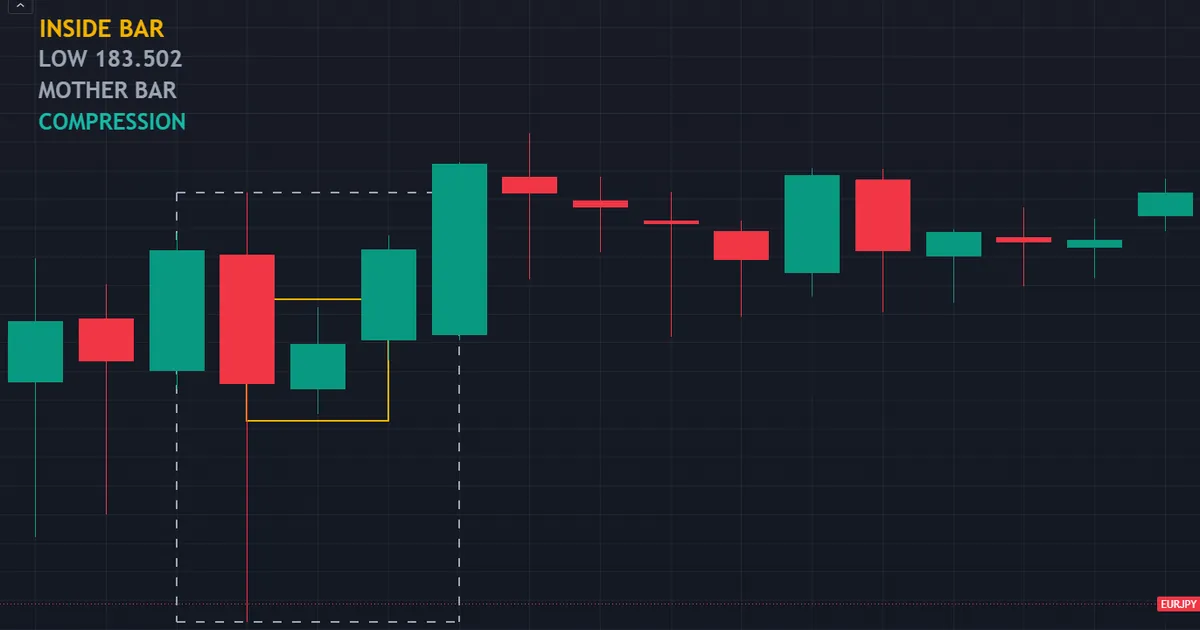
The image shows an inside bar on EURJPY daily bars, formed on 6 May 2026. Its low sat at 183.502, entirely within the previous day’s range, and price went on to follow through.
The Reading, Written Before the Reveal
A student note might read: market in a pullback, prior swing low nearby, compression at that area, invalidation below 183.502.
Notice what is absent. No target, no prediction of size, and no confidence rating dressed up as analysis.
Scoring It Afterwards
Three checks settle the repetition. Did the marked level matter, did the invalidation price hold, and did the reading describe the condition correctly?
Two out of three counts as a good repetition. Chasing three out of three teaches you to write vaguer notes, which defeats the purpose.
What a Weak Repetition Looks Like
Compare that note with a vague one: “looks bullish, might go up”. Nothing in it can be checked afterwards, so the reveal teaches nothing.
Every reading needs at least one falsifiable claim. A price, a level or a named condition all qualify, and adjectives do not.
Handling the Ones You Get Wrong
Wrong readings are the useful ones, so resist the urge to skip past them. Write a single sentence on what the chart showed that you did not weigh properly.
Then look for that same feature in the next twenty repetitions. Targeted attention converts one mistake into a permanent correction.
Why Inside Bars Suit Practice
Compression bars force you to read context rather than drama. There is no long wick to react to, so the level and the trend have to carry the reading.
Our explainer on what an inside bar means covers the structure in more depth.
Download the complete indicator database
Put these concepts on your charts. One email unlocks the full library of 1,380+ indicators with compiled MT4 and MT5 files, plus my TradingView scripts. No paywall, no spam, unsubscribe any time.
Get free access to my indicator database
One email unlocks 1,380+ free MT4, MT5 and TradingView indicators — the complete library. No single-tool download; you get the whole database.
The Journal That Makes It Stick
Practice without records produces a feeling of progress and no evidence of it. Six fields are enough, and adding more usually kills the habit.
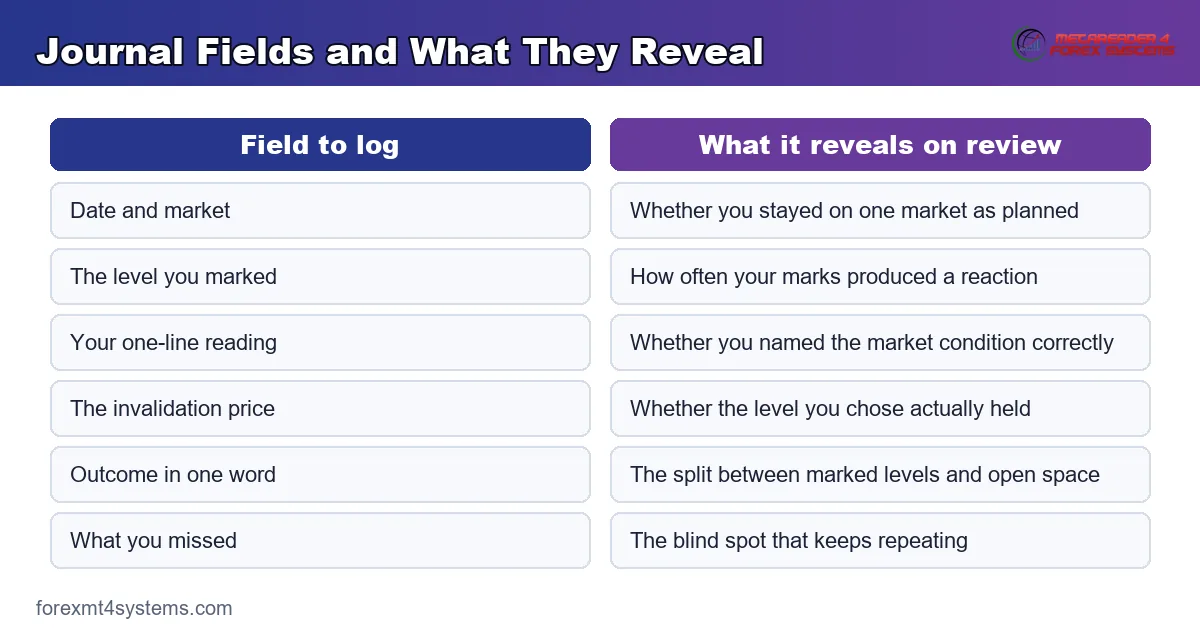
Keep the Fields Few
Date, market, the level you marked, your one-line reading, the invalidation price, and the outcome in one word. That fits on a phone screen.
Our free trade journal holds those columns without any setup work.
Review Weekly, Not Daily
Daily review encourages tinkering. Weekly review shows patterns across twenty or thirty repetitions, which is where the useful signal lives.
Sort by Location Quality
Split your repetitions into two piles: readings at a level you marked in advance, and readings anywhere else. Compare the two columns.
Most learners find the difference larger than anything between bar shapes. That comparison alone reorders how they spend their attention.
Screenshot Sparingly
A folder of a thousand images helps nobody. Save one chart a week, chosen because it taught you something specific, and annotate it in a sentence.
Those fifty-two images become a genuine reference by the end of a year. A dump of everything becomes a folder you never open.
Write the Rule Changes Down
When a review prompts an adjustment, record the date, the old rule and the new one. Otherwise your method drifts and you cannot trace where.
Change one rule per month at most. Altering several at once leaves you unable to attribute any improvement that follows.
Quick Reference: A Week of Study
Twenty-five minutes a day sustains this comfortably. The table shows a schedule that survives a full-time job.
| Day | Task | Time |
|---|---|---|
| Monday to Friday | Twenty replay repetitions, written before the reveal | 25 minutes |
| Saturday | Review the week’s log, sorted by location quality | 30 minutes |
| Sunday | Mark levels on your pair for the week ahead | 20 minutes |
| Month end | Change one rule, and only one | 15 minutes |
Fitting the Reps Into a Real Week
Ambitious schedules collapse within a fortnight. A small routine that survives beats a large one that does not.
Twenty-Five Minutes, Same Time Daily
Attach the session to something you already do, such as the first coffee of the morning. Fixed timing removes the daily negotiation about whether to bother.
Twenty repetitions fit comfortably into that window once the loop becomes familiar. Early on, five or six is a fair day’s work.
Batch the Level Marking
Mark levels once on Sunday rather than daily. That leaves the weekday sessions for repetitions, which is where the learning actually happens.
Protect the Weekly Review
Skipping the Saturday review is the fastest way to waste a week of reps. Thirty minutes of sorting turns raw repetitions into a lesson.
If something has to give, drop two weekday sessions rather than the review. The reps without the review teach far less than the reverse.
Expect Flat Stretches
Progress arrives in steps rather than a smooth line. Several weeks can pass with no visible improvement, then a chunk of it lands at once.
Keep the log during those stretches. It is the only thing that will show you the step when it comes.
Signs the Practice Is Working
Outcomes are noisy, so judge the process instead. Four signals show up long before any account balance moves.
Your Marks Get Fewer
Beginners cover the chart in lines. Improvement shows as fewer marks, each one chosen for a reason you can state out loud.
Your Readings Get Shorter
Early notes ramble across three sentences and hedge in every direction. Later notes name a condition, a level and an invalidation price in one line.
You Skip More Charts
A rising number of repetitions ending in “nothing here” is progress rather than laziness. Recognising an unreadable chart quickly is a real skill.
The Surprises Change Character
At first the market surprises you constantly. Later the surprises narrow to specific situations, such as behaviour around news or the first hour of a session.
Narrow surprises are actionable, because you can study one situation. Broad surprises simply mean the reps have not landed yet.
Where Learners Go Wrong
Six habits stall progress more than anything else. Each has a cheap fix.
Studying Resolved Examples
A textbook chart shows a shape after the outcome exists. Hide the right-hand side, or you are practising recognition of something you never meet live.
Collecting Patterns
Learning a twelfth shape feels productive and adds nothing. Cap the list at three and spend the time on repetitions instead.
Changing Market Every Week
Each market has its own rhythm, session behaviour and typical range. Switching resets the clock, so stay with one pair for the first two months.
Skipping the Written Reading
Reading silently and revealing the bars teaches almost nothing. The note has to exist before the answer does.
Going Live Too Early
Money changes how you see a chart, and it changes it for the worse at first. Stay in replay until your written readings hold up for a few weeks.
Judging Progress by Outcomes
A correct reading can still lose, and a lazy one can win. Score the process instead, because the process is the only part you control.
Practising Only the Exciting Charts
Dramatic reversals are memorable and rare. Feed yourself a diet of them and you will read every quiet chart as though something is about to happen.
Treating the Journal as Admin
Learners often log for a fortnight, then stop because nothing seems to come of it. Value arrives at the review, so a log without a weekly review really is pointless paperwork.
Book the review before you book the reps. That ordering keeps the whole routine honest, and it takes half an hour a week.
The Twelve-Week Path at a Glance
Twelve weeks covers the five stages at a sustainable pace. The panel below lays them out as four three-week blocks.
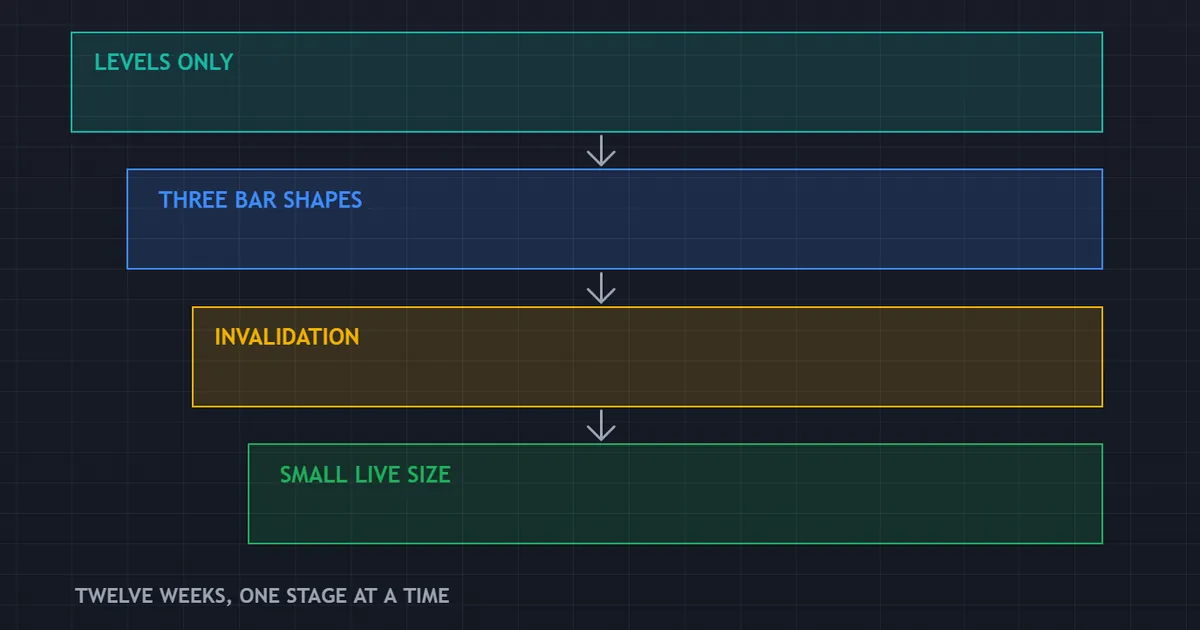
Weeks One to Three
One market, one timeframe, levels only. No bar names and no entries, which frustrates most people and works anyway.
Weeks Four to Six
Add the three bar shapes and the written reading. Twenty repetitions a day, logged, with a weekly review on Saturday.
Weeks Seven to Nine
Add the invalidation price to every note. Start scoring repetitions two ways: was the level right, and did the invalidation hold?
Weeks Ten to Twelve
Introduce live size small enough to feel unimportant. Keep the replay reps running alongside, because live trades arrive far too slowly to teach much.
What to Do If a Stage Stalls
Stalling usually means the previous stage was rushed. Drop back one stage for a week rather than pushing harder at the current one.
Level marking is the usual culprit. Learners who cannot separate a level that mattered from one that did not will struggle with everything built on top.
After Twelve Weeks
Add a second timeframe for context rather than a second market. Our walkthrough of multi-timeframe analysis covers how to run two charts without doubling the work.
Related Guides Worth Reading Next
Two directions extend this path naturally, and both add depth rather than new patterns.
Levels Before Everything
Location carries the load, so study it hardest. Our support and resistance indicators archive collects tools that mark levels mechanically, which is useful for checking your own marks against something consistent.
Keep Your Expectations Calibrated
Learning to read bars is not the same as finding an edge. Our honest assessment of whether price action trading works is worth reading before you spend a year on this.
Our companion piece on whether candlestick patterns work applies the same test to single-bar shapes.
FAQ
How long does it take to learn price action reading?
Count repetitions rather than months. A few hundred written readings, each committed before the reveal, teach more than a year of casual watching. Twelve weeks of daily practice gets most people to competent basic reading, and fluency takes considerably longer.
Do I need a paid course?
No. The definitions are freely available, and the part that actually builds skill is repetition on your own charts, which no course can do for you. Spend money on time rather than on content if you have the choice.
Which pair and timeframe should I start on?
A major currency pair on the four-hour chart suits most beginners. Bars are readable, the history runs deep, and the pace gives you time to think. Avoid exotic pairs and anything below fifteen minutes while you are learning.
Can I learn faster by trading more?
Live trades arrive far too slowly to teach a perceptual skill. A busy week might produce five, while a replay session produces a hundred readings in the same time. Use live trading to test discipline and use replay to build the reading, because the two jobs are separate.
What if I keep marking levels that never matter?
That is the stage working as intended, and the fix is subtraction. Review each mark a week later, keep only the ones that produced a reaction, and note what the useful ones had in common. Most learners find they were marking minor swings inside a range and ignoring the boundaries.
Is demo practice enough on its own?
It builds the reading and not the discipline. Replay and demo work teach you to see structure, while live execution introduces hesitation, second-guessing and the urge to move a stop. Both stages matter, so run them in the order given above.
How many patterns should I actually learn?
Three is plenty to start with. A rejection bar, an engulfing bar and a compression bar cover most of what a chart offers, and each extra shape adds vocabulary rather than skill.
How do I know whether I am improving?
Score the process, not the profit. Track whether your marked levels produced reactions, whether your written invalidation prices held, and whether your readings named the market condition correctly. Those three columns move before any account balance does, and they keep you honest during flat stretches. Results are not guaranteed; past performance is not indicative of future results.
External references
- For background on this concept, see Practice (Learning Method) on Wikipedia.
- For broader market context, see Price Action at Investopedia.

About the author
Written by Dominic Walsh, a Forex trader and MT4/MT5 indicator, Expert Advisor and script developer. Every tool on forexmt4systems.com is tested on live charts before release and ships with ready-to-use compiled MT4 (.ex4) and MT5 (.ex5) files. Learn more about the trader and developer behind this site.
How we build, test and correct every tool: Editorial & Testing Policy. Trading carries risk; see the disclaimer.