
Anyone comparing funded programs runs into static vs trailing drawdown within about five minutes. The two rules use the same headline percentage and hand you wildly different amounts of usable room.
This guide settles static vs trailing drawdown with plain arithmetic, and it stays firm-neutral throughout. You will see how each floor gets calculated, how the same trading week ends differently under each, and which type suits which style of trader.
Static vs Trailing Drawdown at a Glance
Both rules cap the total loss on a funded account. They simply disagree about where to measure that loss from.
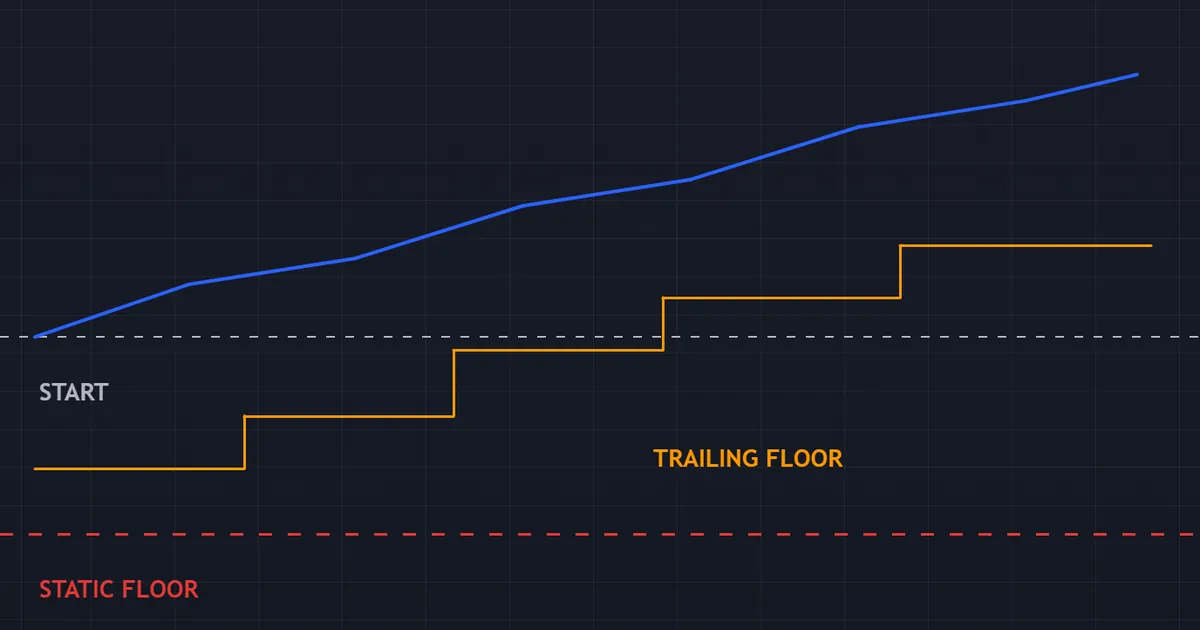
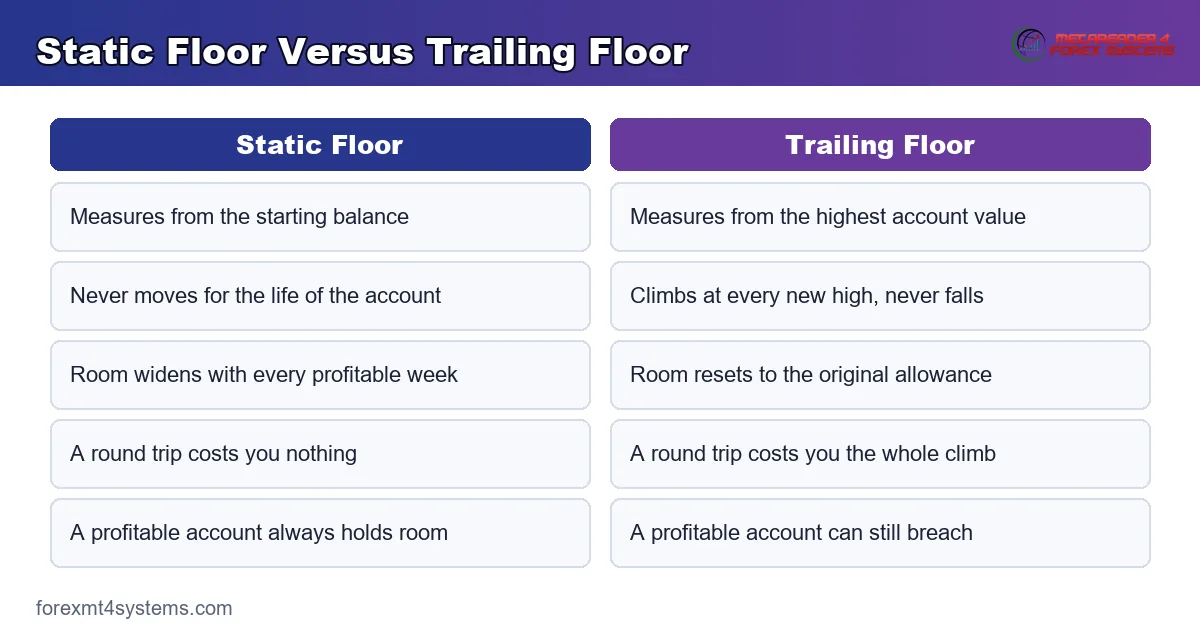
A static floor anchors to the balance you started with. A trailing floor anchors to the highest value your account has ever reached.
| Feature | Static drawdown | Trailing drawdown |
|---|---|---|
| Reference point | Starting balance, fixed | Highest account value so far |
| Floor after profit | Unchanged | Climbs with every new high |
| Floor after a loss | Unchanged | Stays at its highest level |
| Room after a winning run | Grows steadily | Resets to the original allowance |
| Cost of a round trip | None | The whole climb |
| Breach while in profit | Not possible | Entirely possible |
The Short Answer
Static rules give a trader more usable room over time. Because the floor stays put while profit accumulates, every good week genuinely widens the cushion.
Trailing rules keep the cushion at a constant width. So a trader never builds a buffer, and the rule stays equally tight in month six as on day one.
Neither rule is hidden or unfair. Firms publish both openly, and the trader simply needs to know which one governs the account before placing a single order.
How Each Floor Is Calculated
The arithmetic differs by one input. Everything else about the two rules matches.
Run the steps below on any program and you will know which type you face. Each step takes a single line in a notebook.
- Convert the allowance into money. Apply the drawdown percentage to the starting balance.
- Pick the reference point. A static rule uses the starting balance, while a trailing rule uses your peak.
- Subtract the allowance from that reference. The result gives you today’s floor.
- Recalculate only when required. A static floor never changes, while a trailing floor changes at every new high.
- Confirm what counts as a high. Some firms use closed balance, others use live equity.
- Note any freeze level. Many trailing rules stop climbing once the floor reaches breakeven.
Step two carries the whole difference. Because a peak moves and a starting balance does not, one input decides how much room a winning run leaves behind.
Both rules also need one more answer from the rule book. Ask whether the firm watches closed balance or live equity, since an equity rule can breach on a floating loss you never realised.
The Static Calculation
Take the starting balance, subtract the allowance, and write the answer down once. That figure serves you for the life of the account.
A fifty thousand dollar account with a ten percent limit gives a floor of forty-five thousand dollars. Grow the account to sixty thousand dollars and the floor still sits at forty-five thousand.
The Trailing Calculation
Take the highest account value so far, then subtract the same allowance. Repeat that sum whenever a new peak prints.
The same fifty thousand dollar account starts with a floor at forty-five thousand dollars. Reach sixty thousand dollars and the floor climbs to fifty-five thousand, so your room measures five thousand dollars once again.
Notice the direction of travel. The floor tracks you upward and then refuses to follow you back down, which turns your best result into a permanent obligation.
The End-of-Day Middle Ground
Some programs trail the floor only on the daily close. Intraday peaks come and go without touching the rule at all.
This version sits neatly between the other two. So a spike that fades before the bell costs you nothing, which makes the rule far kinder to volatile strategies. Futures programs use this style more often than currency programs do.
Watch for the exact update moment though. A close-of-day trail measured at the server’s midnight can still catch a position you left open across that hour.
Daily Caps Sit on Top of Either Rule
Both rule types usually come with a separate daily loss limit. That cap resets each session and works the same way regardless of which floor governs the account.
So the comparison affects your long-horizon room, not your daily one. Because the daily cap normally binds first, your session risk barely changes between a static and a trailing program.
The difference appears across months instead. A static floor lets a good quarter build a real cushion, while a trailing floor keeps handing you the same short leash.
The Same Trading Week Under Both Rules
Arithmetic convinces nobody until it touches a real week. Run three of them and the gap between the rules becomes obvious.
Each week below starts from the same fifty thousand dollar account with a five thousand dollar allowance. Only the reference point differs.
A Winning Week
You gain four thousand dollars across five sessions. Under the static rule your room widens from five thousand to nine thousand dollars.
Under the trailing rule your room still measures five thousand dollars. So the same week leaves one trader relaxed and the other exactly where they began.
Both traders earned the same money, of course. Only their tolerance for the next bad week differs, and that tolerance decides who keeps trading in three months.
A Choppy Week
Now you gain three thousand dollars by Wednesday, then hand it all back by Friday. The static floor never moved, so your room finishes at the original five thousand dollars.
The trailing floor climbed three thousand dollars on Wednesday and stayed there. So your room finishes at two thousand dollars, and a single bad session could now end the account.
A Losing Week
Suppose instead you simply lose two thousand dollars with no highs at all. Both rules behave identically here, since neither floor had any reason to move.
That symmetry matters. Because the rules only diverge after profit, traders often meet the trailing floor for the first time during a good run rather than a bad one.
A Recovery Week
Now start two thousand dollars lower and claw all of it back. The static floor still sits five thousand dollars below the original balance, so your room returns to five thousand dollars.
The trailing floor behaves identically here, because your recovery never printed a new high. So both rules treat a pure recovery the same way, which surprises traders who expect the ratchet to punish them again.
What Each Rule Costs You Over Six Months
A single week hides the real gap. Stretch the comparison across a couple of quarters and the arithmetic separates sharply.
The Static Path
Imagine a trader who adds two percent a month on a fifty thousand dollar account. After six months the balance approaches fifty-six thousand dollars.
The static floor has not moved from forty-five thousand dollars. So their room has grown from five thousand to roughly eleven thousand dollars, which more than doubles their tolerance for a bad patch.
The Trailing Path
Give the same trader the same results under a trailing floor. Every monthly high lifts the line, so the floor finishes near fifty-one thousand dollars.
Their room still measures five thousand dollars. Six profitable months bought no additional safety at all, and one heavy week could still end the program.
Why the Gap Compounds
Room and survival feed each other. A trader with more room survives longer, and a trader who survives longer collects more payouts.
So the two rules diverge more with every profitable month. Because a static floor converts profit into permanence, its advantage grows exactly when a trader starts doing well.
The Payout Angle
Withdrawals change the picture under both rules. Taking money out lowers your balance while the floor stays where it sat, so your room shrinks by roughly the amount you withdrew.
Trailing programs make that pinch sharper. Because the floor already climbed with the profit you now withdraw, a payout can leave you very close to a line you lifted yourself.
Many programs soften the problem deliberately. A common clause locks the floor at the starting balance, or slightly above it, once a first payout clears, which turns the trailing rule into a static one from that day on.
So read the payout clause beside the drawdown clause. Because one rule can quietly undo the benefit of the other, the pair only makes sense when you read them together.
A Worked Example of One Path and Two Floors
Trace a single equity path against both floors at once. Picture a fifty thousand dollar funded account with a ten percent maximum drawdown.
The allowance equals five thousand dollars under either rule. Both floors therefore open at forty-five thousand dollars.
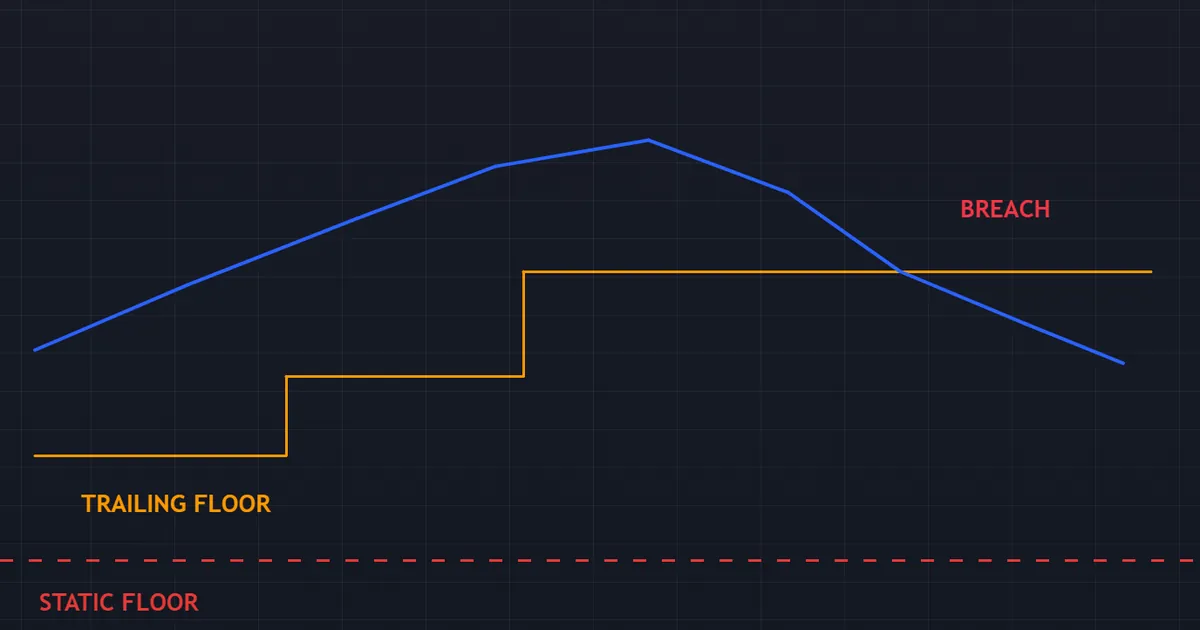
The Path Itself
Month one lifts the account to fifty-four thousand dollars. Month two hands back five thousand five hundred dollars, leaving forty-eight thousand five hundred dollars.
Nothing about that sequence looks reckless. A four thousand dollar gain followed by a partial giveback describes an ordinary quarter for many traders.
The Static Floor Through the Path
The static floor never budged from forty-five thousand dollars. At forty-eight thousand five hundred dollars the account still holds three thousand five hundred dollars of room.
So the trader carries on. The giveback stung, yet the program survived it comfortably and the trader keeps their funded status.
The Trailing Floor Through the Path
The trailing floor rose with the account to forty-nine thousand dollars. At forty-eight thousand five hundred dollars the account sits below that line.
So the program ends. The trader gave back part of a gain and lost the account while still holding a profit against the original balance.
What Would Have Saved the Trailing Account
Three small changes would have kept that program alive. None of them required better analysis.
Banking part of the gain earlier would have shortened the giveback. Cutting size once the floor closed within a thousand dollars would have slowed the decline. Stopping for the month after the first two losses would have ended the sequence outright.
So the trailing rule rewards defensive habits rather than sharper entries. Because the floor tracks your best moment, protecting that moment matters more than adding to it.
Sizing Differently Under Each Rule
Static rules let you size off a slowly growing cushion. Trailing rules force you to size off a cushion that never grows.
Our prop firm position size calculator works a position against either rule type, and our drawdown calculator shows how a losing run eats each kind of allowance.
Download the complete indicator database
Put these concepts on your charts. One email unlocks the full library of 1,380+ indicators with compiled MT4 and MT5 files, plus my TradingView scripts. No paywall, no spam, unsubscribe any time.
Get free access to my indicator database
One email unlocks 1,380+ free MT4, MT5 and TradingView indicators — the complete library. No single-tool download; you get the whole database.
Which Drawdown Type Is Friendlier
One rule clearly gives a trader more room. That does not make the other one useless, though it does explain why traders hunt for the first.
Why Static Rules Feel Easier
A static floor turns profit into permanent safety. Every dollar you keep widens the gap between your equity and the line, which lowers the pressure on every later trade.
The rule also removes a whole class of mistakes. Because the number never changes, you cannot misread a floor that moved while you were not watching.
Where Trailing Rules Still Make Sense
Trailing programs sometimes pair the tighter rule with other advantages. A larger allowance, a lower fee or a faster payout cycle can offset the harder floor.
The rule also suits genuinely smooth strategies. So a trader whose equity climbs in small consistent steps loses little to the ratchet, since each new high barely moves the line.
Matching the Rule to Your Style
Compare your own equity curve honestly before you choose. Small steady gains cope well with a trailing floor, while lumpy results suffer badly under one.
Then look at how long you hold trades. Because an equity-tracked trailing rule reacts to unrealised peaks, longer holds and wider targets fit a static program much better.
Common Mistakes When Comparing Drawdown Types
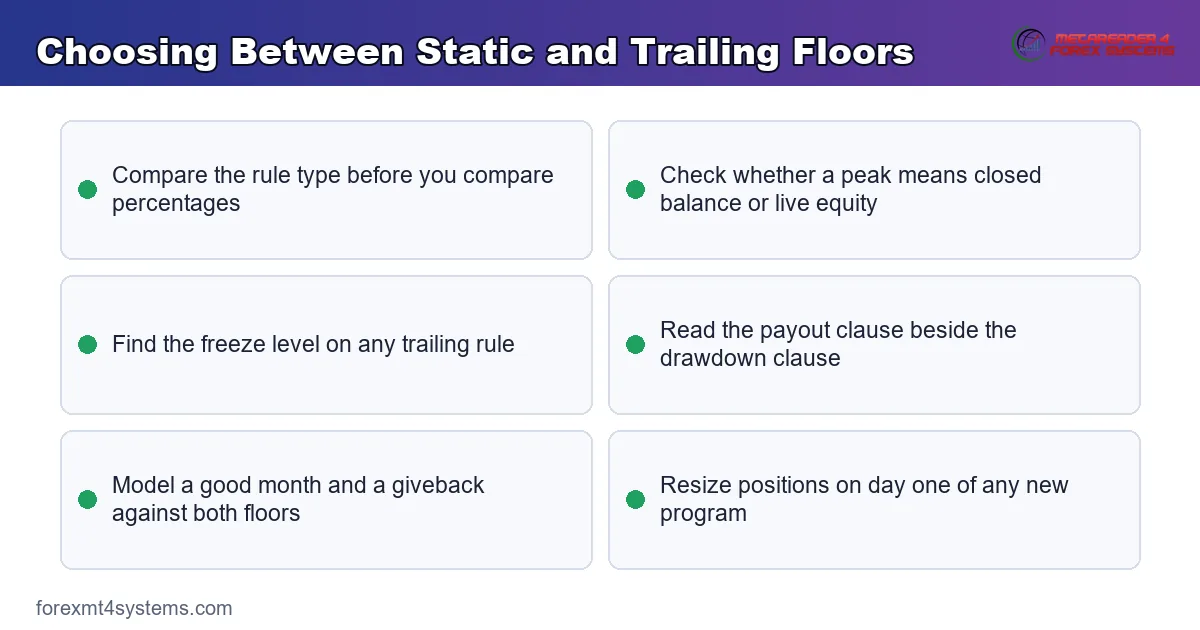
Traders rarely compare these rules carefully, which costs them fees. The graphic below sets out how to choose between static and trailing floors.
Comparing Percentages Instead of Rule Types
An eight percent static allowance often beats a ten percent trailing one. Because the static version compounds your room over time, the smaller headline number can offer far more real safety. So compare mechanics first and percentages second.
Assuming Every Program Trails
Plenty of firms run purely static floors, and plenty of traders never check. Trading a static program as though the floor moves wastes real opportunity. So read the clause rather than guessing from experience elsewhere.
Missing the Freeze Level
Many trailing rules stop climbing at breakeven and behave statically from then on. Traders who overlook that clause misjudge how tight the program stays. So find the freeze level before you compare anything else.
Ignoring the Balance or Equity Question
An equity-tracked trailing rule bites hardest of all, since unrealised peaks count. A balance-tracked version of the same rule feels noticeably softer. So treat that detail as part of the comparison, not a footnote.
Switching Rule Types Without Resizing
Moving from a static program to a trailing one changes your effective account size. Keeping the same lot sizes therefore raises your real risk sharply. So recalculate position size on day one of any new program.
Chasing the Bigger Number
A twelve percent allowance reads better than an eight percent one. Yet a trailing twelve can leave less usable room than a static eight after a good month. So run the arithmetic on your own equity curve instead of trusting the headline.
Static vs Trailing Drawdown Quick Reference
Work down this list whenever you compare two programs. It takes about two minutes per firm.
- Convert each allowance into money using the starting balance.
- Identify the reference point: starting balance or peak value.
- Ask whether a peak means closed balance or live equity.
- Find the freeze level on any trailing rule.
- Check whether the floor trails intraday or on the daily close.
- Model a good month and a giveback against both floors.
- Recalculate your position size for the rule you choose.
- Write today’s floor down before your first trade each day.
Where Traders Get Caught
The gap between these rules shows up at one specific moment. The chart below traces a round trip that a static floor absorbs and a trailing floor cannot.
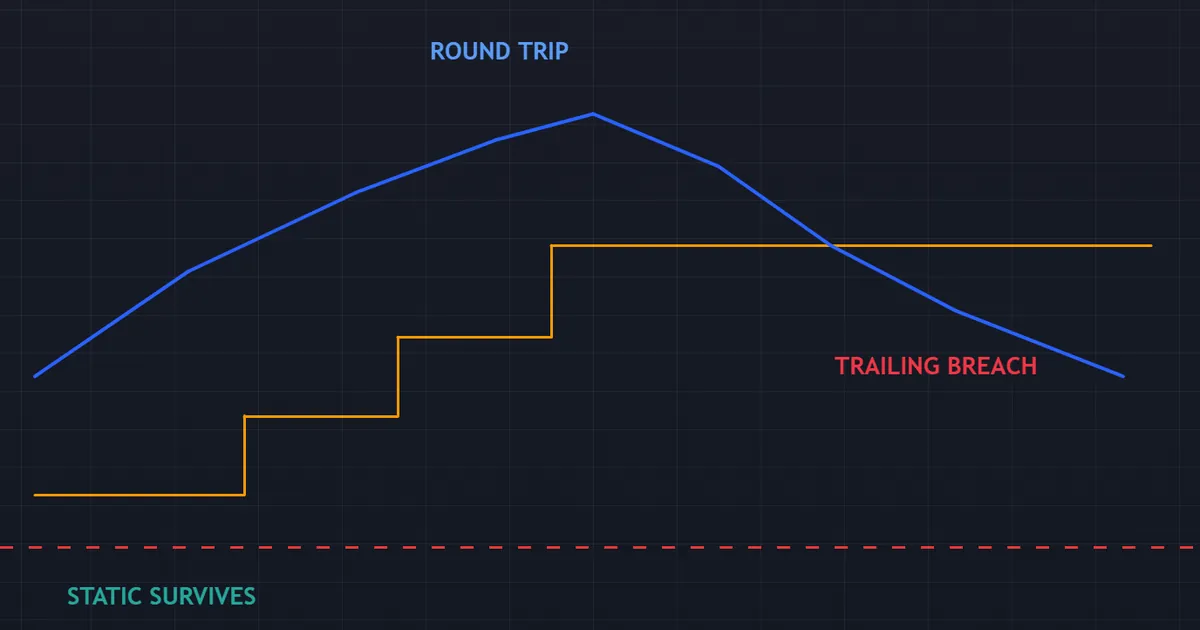
Watch the shape from left to right. The path climbs, the trailing line follows it up, and the drift back down crosses that line long before it approaches the flat static one.
The Profitable Breach
Trailing rules allow an outcome that feels absurd. Your account sits above its starting balance, yet the program ends because the floor climbed higher than you did.
Static rules make that outcome impossible. Because the floor sits permanently below the opening balance, a profitable account always holds room by definition.
The Unrealised Peak
An equity-tracked rule counts a peak you never closed. So a trade that ran deep into profit and then reversed can lift the floor permanently while leaving your balance untouched.
The Scale-Up Trap
Bigger lots print bigger peaks. Under a trailing rule those peaks tighten the floor, so scaling up too early can shorten the leash rather than lengthen it.
The Overnight Gap
A weekend gap can print a loss no stop could prevent. Under a static floor that gap usually eats into a cushion you built earlier, while under a trailing floor it lands straight against a tight line. So overnight exposure carries a different price under each rule.
The Copied Rule Book
Traders who run several programs often assume the rules match. One static account and one trailing account demand different sizing entirely. So keep a separate note of each floor and check both daily.
Reading the Rule Book Quickly
The wording tells you the answer faster than any comparison page can. A handful of phrases separates the two rule types.
Words That Signal Each Type
Static rules mention the initial balance, the starting equity or a fixed threshold. None of those phrases respond to a winning run.
Trailing rules mention the highest equity, the peak balance, the high-water mark or the maximum account value. Any of those phrases means the floor follows your results upward.
What to Confirm With Support
Ask which figure the platform displays on the dashboard, since a visible floor beats your own arithmetic. Then ask whether that figure updates live or overnight.
Ask finally whether a scaling plan changes the rule. Because some programs switch a trailing floor to a static one at a larger account size, the answer can change your whole plan.
Keep the reply in writing where you can. A short support message beats memory when a floor behaves unexpectedly six weeks later.
Related Concepts to Study Next
These two rules sit inside a wider rule set worth learning properly. Three neighbouring guides finish the picture.
Read the mechanics of the tighter rule in our guide to trailing drawdown, then map the full rule set in our overview of prop firm drawdown rules. For the wider model, see our explainer on what a prop firm is. Because both floors measure pure risk, our overview of drawdown in trading explains the curve behind them, and our note on position sizing turns a floor into a lot size.
FAQ
What does static vs trailing drawdown actually mean?
Static drawdown measures your loss floor from the starting balance, so the floor never moves. Trailing drawdown measures it from your highest account value, so the floor climbs with every new peak. Both use the same allowance and give very different room.
Which drawdown type is friendlier to traders?
Static rules give more usable room, since profit widens the gap to the floor permanently. Trailing rules keep that gap at a constant width, so a winning run buys no extra safety. Many traders therefore prefer static programs.
Can a static floor ever move?
No, that fixed behaviour defines it. The floor sits a set distance below the starting balance for the life of the account. Some programs do raise it after a scaling event, which the terms will spell out.
Does a trailing floor keep climbing forever?
Often it does not. Many programs freeze the trail once the floor reaches the starting balance or a small buffer above it. From that point the rule behaves exactly like a static one.
How should I size trades under each rule?
Size against the gap between your equity and the floor in both cases. Under a static rule that gap grows as you profit, while under a trailing rule it stays fixed. So a trailing program keeps your position size flat over time.
Which type should a beginner choose?
A static floor forgives ordinary mistakes more readily, so new funded traders usually find it easier to work with. Read the exact wording either way, and size small until the rules feel familiar. Results are not guaranteed; past performance is not indicative of future results.
External references
- For background on this concept, see Drawdown at Corporate Finance Institute.
- For broader market context, see Underwater Positions at Investopedia.

About the author
Written by Dominic Walsh, a Forex trader and MT4/MT5 indicator, Expert Advisor and script developer. Every tool on forexmt4systems.com is tested on live charts before release and ships with ready-to-use compiled MT4 (.ex4) and MT5 (.ex5) files. Learn more about the trader and developer behind this site.
How we build, test and correct every tool: Editorial & Testing Policy. Trading carries risk; see the disclaimer.