
Traders ask how to get a funded trading account more than almost any other prop question. The honest answer runs through four things: a rule set you can live with, a demo run, careful sizing, and an evaluation you may need more than one attempt to pass.
This guide lays out how to get a funded trading account as a practical sequence, and it stays firm-neutral throughout. No firm names appear, because the path looks much the same wherever you apply.
How to Get a Funded Trading Account, Step by Step
The route runs through a paid evaluation. You pay a fee, trade a simulated account under strict limits, and the firm grants capital once you clear the targets.
So the fee buys a test, not an account. Because the test measures discipline more than flair, preparation beats talent almost every time.
Most applicants skip the preparation and pay again. A trader who rehearses the exact rules on demo first usually needs fewer attempts.
So treat the fee as tuition and the rules as the syllabus. Then the evaluation becomes a formality rather than a gamble.
What You Actually Buy
Your fee covers access to an evaluation platform and a rule set. It buys no capital and no promise of funding.
Some firms refund the fee after your first payout, while others keep it. So read that clause before you pay, since it changes the real cost of a failed attempt.
What the Firm Actually Wants
Firms hunt for traders who protect capital under pressure. They care less about your best month than about your worst day.
So the metrics they watch are risk metrics. Because a steady, dull record signals a trader they can fund for years, quiet consistency wins the test.
How Long the Whole Path Takes
Preparation usually takes longer than the test. Two weeks on demo, then a few weeks of careful trading, covers one clean attempt.
So budget months rather than days. Because many traders need a second or third attempt, a calendar built on optimism tends to invite rushed trades.
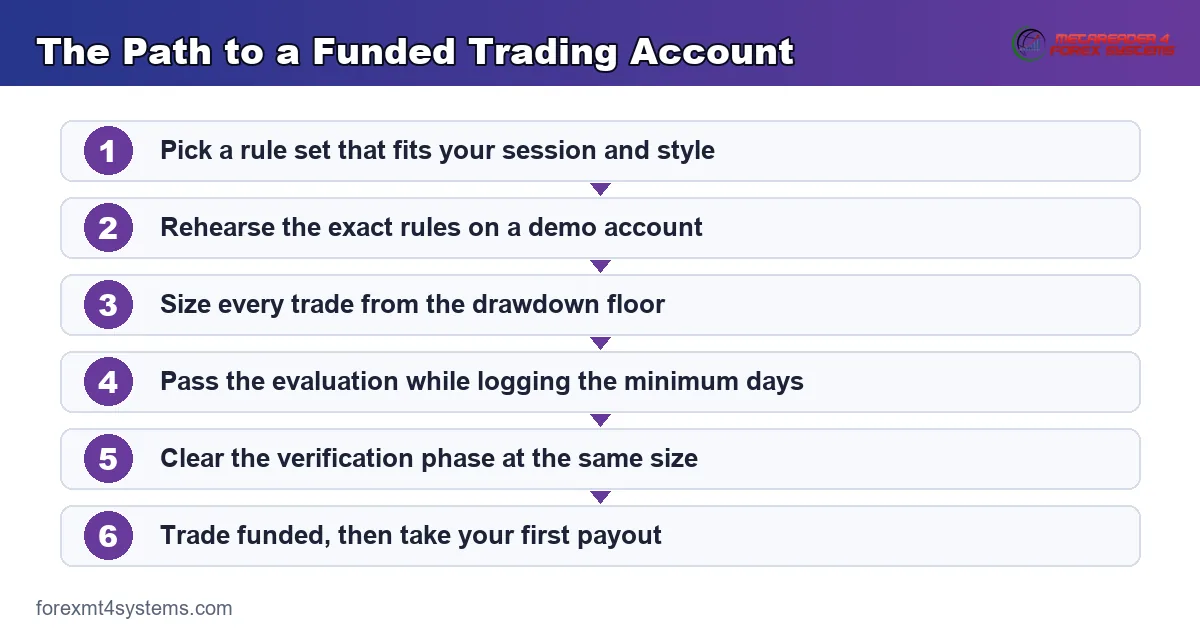
The Path in Seven Steps
Every application follows roughly the same arc. Learn the arc, and you stop guessing at the next move.
- Pick a rule set you can trade. Match the limits to your session, hold time, and style.
- Demo the exact rules first. Run the same targets and caps on a practice account.
- Size to the drawdown. Work your lot size backward from the floor, never from the balance.
- Pass the evaluation. Hit the profit target while clearing the minimum trading days.
- Clear verification. Repeat a smaller version of the same test at many firms.
- Trade the funded account. Protect the floor first and build profit second.
- Take your first payout. Withdraw on the firm’s cycle and prove the loop works.
So the sequence rewards patience at every stage. Because each step tests the same habits, the trader who prepares once passes repeatedly.
Where Most Traders Start Too Fast
The usual error skips straight to step four. A trader buys an evaluation, reads the rules once, and starts trading the same day.
Then a daily loss breach ends the attempt inside a week. So spend a fortnight on steps one to three, and the fee lasts far longer.
Step One: Pick a Rule Set You Can Trade
Rule sets differ enough to decide the outcome before you place a trade. A plan that suits a scalper can strangle a swing trader.
So shop for the rules, not the headline account size. Because the limits shape every decision, a good fit does more for you than extra capital.
Match the Rules to Your Session
Check whether the firm restricts trading around major news releases. An active news trader needs a firm that permits it.
Then check the daily reset time, since it sets when your daily loss clock restarts. A trader in Asia and a trader in New York feel that clock very differently.
Match the Rules to Your Hold Time
Swing traders need permission to hold overnight and across the weekend. Some firms forbid one or both.
Scalpers care instead about spreads, commissions, and any minimum hold time. So list your three non-negotiables, then reject any firm that fails them.
Check the Consistency Rule
Some firms cap how much of your total profit a single day may contribute. One strong session can then delay your pass.
So find the consistency clause before you commit. Because it quietly shapes how you take profit, a tight version suits steady traders and frustrates opportunists.
One-Phase or Two-Phase Programs
Programs split into two broad shapes. One asks for a single evaluation, while the other adds a verification phase.
So the choice trades speed against cost. Because each shape suits a different temperament, pick the one that matches your patience.
The One-Phase Route
A single phase gets you funded faster. Firms usually balance that with a tougher target or a tighter drawdown.
So expect harder limits in exchange for speed. Because a breach here restarts the whole process, the faster route often costs more in fees.
The Two-Phase Route
Two phases stretch the timeline and soften each target. The second phase usually asks for roughly half the first.
So a patient trader finds this route gentler. Because both phases share one rule set, your preparation covers them together.
Step Two: Demo the Exact Rules First
A demo run costs nothing and answers the only question that matters. Can your method reach the target without touching a limit?
So replicate the rules precisely on a practice account. Because a rough approximation teaches you nothing, copy every figure across.
Build the Rule Card
Write the profit target, the max drawdown, the daily loss cap, and the minimum trading days on one card. Add the reset time and any restricted instruments.
Then keep that card beside your screen. So every trade gets checked against the real limits rather than a hazy memory of them.
Run Twenty Sessions
Twenty sessions reveal your true daily loss pattern. Two sessions reveal nothing except luck.
So log each day and mark your worst one. If that worst day would have breached the cap, your size is wrong, and the demo just saved your fee.
Test Your Worst Case
Run your method through the ugliest week you can remember. Count the loss it would have produced under the firm’s caps.
If that week breaches a limit, halve your size and test again. So the demo answers the survival question before real money pays for the answer.
Step Three: Size to the Drawdown
Most failed attempts trace back to sizing. Traders pick a lot size that suits the balance and ignore the floor entirely.
So flip the calculation around. Because the floor ends the account, the floor decides your size.
Work Backward From the Floor
Start with the max drawdown in money. Divide it by the number of consecutive losses you want to survive, and you have your risk per trade.
A free prop firm position size calculator runs that arithmetic against a firm’s limits in one pass. So your lots match the rules rather than your optimism.
Set a Personal Daily Stop
Set your own daily stop well inside the firm’s cap. Two-thirds of the official figure gives you room to breathe.
Then stop trading the moment you touch it. Because the firm’s cap ends the attempt outright, your softer cap protects the fee you already paid.
Cap Your Total Open Risk
Two correlated trades act as one larger position. A pair of long dollar trades can double your intended risk without warning.
So cap the risk you hold open at any moment. Because the daily limit counts every position together, correlation deserves a hard rule of its own.
A Worked Example of the Evaluation Math
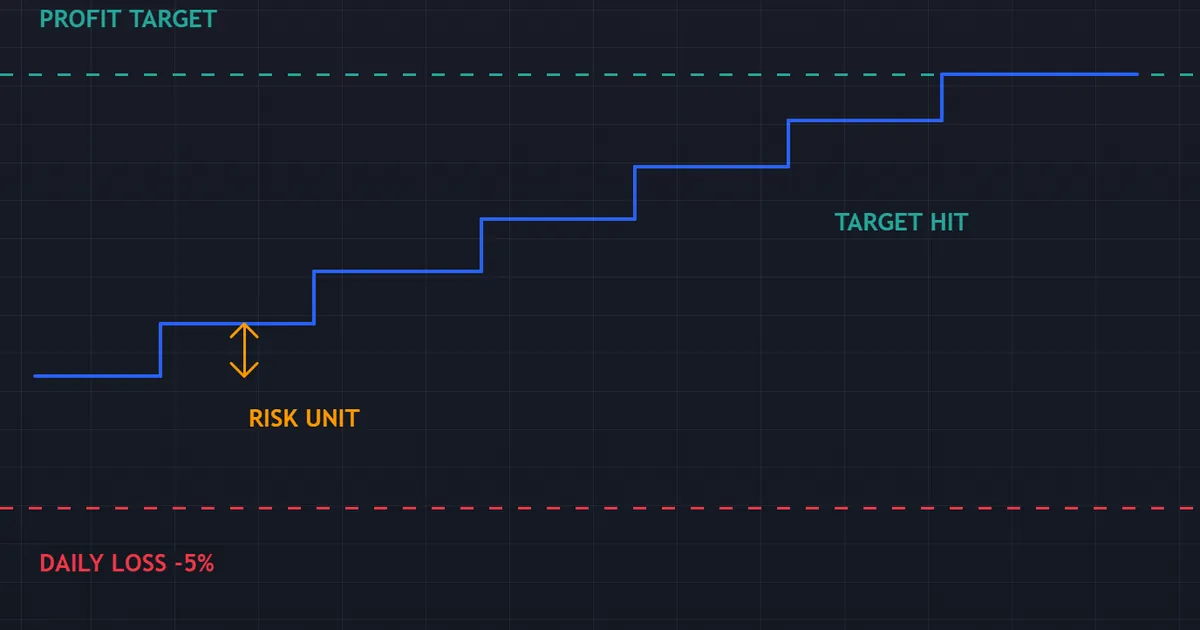
Numbers turn the plan into something you can check. Picture a fifty thousand dollar evaluation with an eight percent profit target.
The target equals four thousand dollars. A ten percent max drawdown puts the floor five thousand dollars below the start, and a five percent daily cap allows two thousand five hundred dollars in one day.
The Target in Risk Units
Risk half a percent per trade, and each unit equals two hundred and fifty dollars. The target therefore equals sixteen risk units of net profit.
At two units per winning trade, eight net winners clear it. So the goal shrinks from a scary percentage to a countable number of good trades.
What a Losing Streak Costs
Now count downward. Ten straight losses at that size cost two thousand five hundred dollars, which uses half your floor.
So the same sizing survives a rough patch and still reaches the target. Because both numbers come from one calculation, sizing correctly solves two problems at once.
Where the Daily Cap Bites
The daily cap allows two thousand five hundred dollars, or ten risk units. Ten losses inside one session would end the attempt outright.
So set your personal stop near six units and walk away there. Then a rough day costs a slice of the floor rather than the whole attempt.
Step Four: Pass the Evaluation
The evaluation rewards routine over ambition. Traders who chase the target quickly meet the daily cap instead.
So aim to finish slowly. Because most firms set no time limit, patience costs you nothing at all.
Trade the Minimum Days First
Many firms ask for a minimum number of trading days. Clear that count early, so the requirement never forces a trade you dislike.
Then let the profit accumulate across those sessions. So the target arrives while the day count quietly takes care of itself.
Bank the Target and Stop
Once you reach the target, stop trading for the phase. Extra trades add risk and nothing else.
Some traders keep pushing and breach a limit after passing. So close the platform, submit the phase, and wait for the firm to confirm.
Step Five: Clear Verification
Many firms add a second phase, often called verification. It usually asks for a smaller profit target under the same risk limits.
So the second phase tests repeatability. Because the rules match phase one, a prepared trader finds it easier rather than harder.
Why a Second Phase Exists
One good month can happen by chance. Two in a row look much more like a method.
So verification filters the lucky from the consistent. Treat it as the same job at a gentler pace, and it rarely troubles you.
How to Trade the Second Phase
Keep the same size and the same setups you used in phase one. Nothing about a smaller target justifies extra risk.
So resist the urge to finish quickly. Because the limits stay identical, the calm approach that passed once will pass again.
Download the complete indicator database
Put these concepts on your charts. One email unlocks the full library of 1,380+ indicators with compiled MT4 and MT5 files, plus my TradingView scripts. No paywall, no spam, unsubscribe any time.
Get free access to my indicator database
One email unlocks 1,380+ free MT4, MT5 and TradingView indicators — the complete library. No single-tool download; you get the whole database.
Step Six: The First Weeks Funded
Funded trading feels different, even with identical rules. Real payouts now hang on your decisions, and that changes how a loss lands.
So plan the first weeks deliberately. Because the account can end on one breach, a slow start protects everything you worked for.
Treat Week One as a Rehearsal
Trade half your normal size for the first week. You learn the platform, the spreads, and the reset behavior at low cost.
Then return to full size once the mechanics feel dull. So a surprise in the plumbing never costs you the account.
Watch the Floor, Not the Balance
Your balance flatters you, while the floor tells the truth. Check the gap between equity and floor before every session.
Many firms trail that floor upward as you profit. So the cushion shrinks exactly when confidence grows, which catches plenty of new funded traders.
Step Seven: Your First Payout
A payout completes the loop and proves the model works for you. Until money reaches your bank, the account remains a promise.
So push for the first withdrawal early. Because the loop only counts once cash arrives, treat that milestone as the real finish line.
Read the Payout Cycle Early
Cycles vary from a fortnight to a month or longer. Some firms set a minimum profit before you may withdraw.
So read those terms before you pay any fee. Because the cycle shapes your cash flow, it deserves as much attention as the profit split.
Withdraw on Schedule
Leaving profit in the account feels productive and adds risk. That balance still sits behind the firm’s rules.
So take the payout when the cycle allows. Then a later breach costs you the account rather than your earnings as well.
Common Mistakes on the Road to Funding
The path is simple, yet the same errors repeat across thousands of attempts. The panel below gathers the ones worth pinning up.
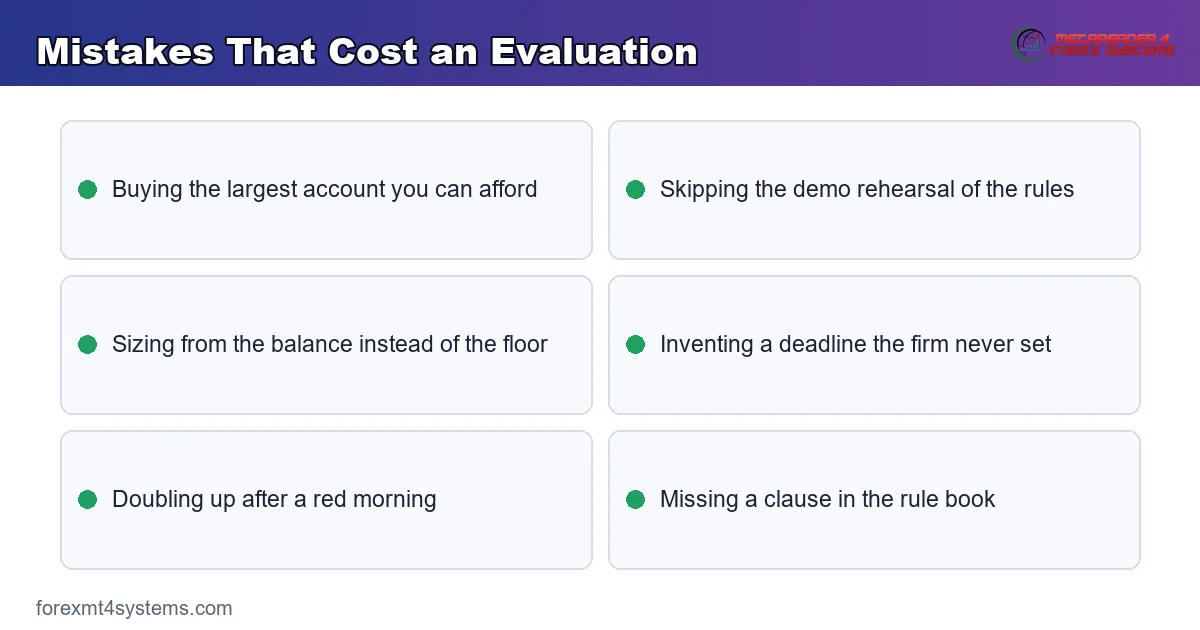
Buying the Biggest Account You Can
A large evaluation raises the fee and the pressure together. The limits scale with it, so nothing gets easier.
So start small and prove the loop first. Because the process matters more than the size, a modest pass beats an expensive failure.
Skipping the Demo Rehearsal
Reading a rule book is not the same as trading it. Traders discover the daily reset time the hard way.
So run the rules on demo for a fortnight. Then the first real session holds no surprises.
Sizing From the Balance
A lot size chosen from the account balance ignores the floor. The floor, not the balance, ends the attempt.
So calculate from the drawdown every time. Our general position size calculator handles the plain risk arithmetic when you want a second view.
Trading to Hit a Deadline
Self-imposed deadlines create reckless trades. Most evaluations impose no time limit at all.
So remove the clock from your plan. Because slow passes count the same as fast ones, the extra week costs nothing.
Revenge Trading a Red Morning
A bad morning tempts traders into doubling up. That habit is precisely what the daily cap exists to stop.
So close the platform at your personal stop. Then tomorrow starts fresh with the attempt still alive.
Ignoring the Fine Print
Restricted instruments, holding rules, and copy-trading clauses vary widely. A breach counts even when you never noticed the rule.
So read the whole rule book once, slowly. Because one overlooked clause can void a passed phase, that hour pays for itself.
Trading Instruments You Do Not Know
Evaluations often unlock indices, metals, and crypto alongside currencies. Traders wander into unfamiliar markets hunting a faster target.
Those markets move at their own pace and punish borrowed assumptions. So trade only what you already understand until the payout loop works.
Funded Account Application Checklist
Work through this list before you pay any evaluation fee.
- Confirm the firm permits your session, hold times, and instruments.
- Copy the profit target, drawdown, daily cap, and day count onto one card.
- Run the exact rules on demo for at least twenty sessions.
- Calculate risk per trade from the drawdown floor, not the balance.
- Set a personal daily stop inside the firm’s cap.
- Check whether the fee returns after your first payout.
- Read the payout cycle and any minimum withdrawal figure.
- Start with the smallest account that proves the loop.
What Ends Most Attempts
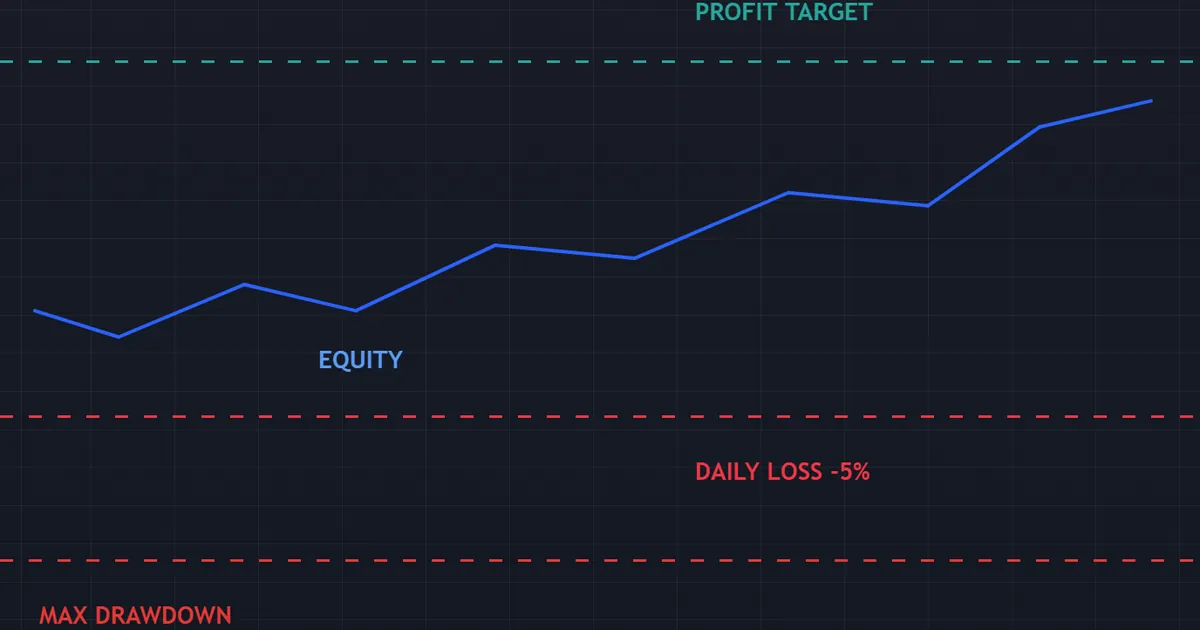
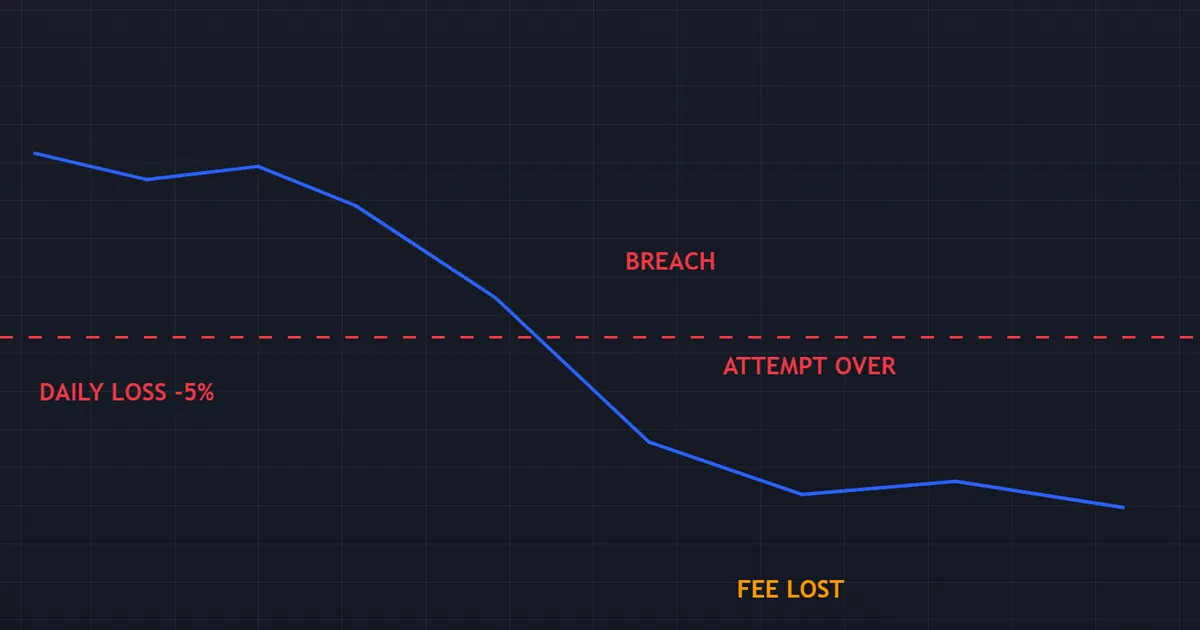
Attempts rarely end from bad analysis. They end from a breached limit, usually early. The chart below shows an equity path cutting through its daily loss line.
The Daily Cap Arrives First
The daily loss limit sits far closer than the max drawdown. So it claims most failed attempts in the first fortnight.
Size for the daily cap first, then check the total floor. Because the nearer limit binds you harder, it deserves the tighter margin.
One Oversized Trade
A single large position can breach both limits at once. Traders reach for it after a slow start.
So cap your maximum lot size in writing. Then no impulse trade can end the attempt on its own.
Costs You Forgot to Count
Spreads, commissions, and swaps all eat into the target. Frequent trading turns a passing month into a flat one.
So build costs into your target arithmetic. Because they compound quietly, they decide plenty of near-miss attempts.
Weekend Gaps and Overnight Holds
A position held over the weekend can reopen far from your stop. That gap counts against the daily limit on Monday.
So check whether your firm even permits weekend holds. Then either close on Friday or size the trade for a gap you cannot control.
Related Concepts to Study Next
Getting funded rests on two skills: reading rules carefully and sizing correctly. A few short guides sharpen both before you pay a fee.
Start with the mechanics of a prop firm challenge, then read our practical notes on how to pass a prop firm challenge. Because the funded stage follows next, review what a funded trading account asks of you and the wider prop firm rules behind it. Then set a hard daily loss limit, and browse more in our prop trading library.
FAQ
How do I get a funded trading account as a beginner?
Pick a firm whose rules suit your session and hold times, then rehearse those exact rules on a demo account. Size your trades from the drawdown floor rather than the balance. Only then pay for the smallest evaluation that proves the loop works for you.
How much does an evaluation cost?
Fees scale with the account size, so a small evaluation costs a fraction of a large one. Many firms refund the fee after your first payout, while others keep it. Because a failed attempt means paying again, the smallest sensible account usually beats the largest one you can afford.
How long does it take to get funded?
Preparation takes longer than the test at most firms. A fortnight of demo work, then a few weeks of careful trading, is a realistic timeline for one clean attempt. Since many traders need more than one attempt, plan for months rather than days.
Do I need a second phase to get funded?
Many firms run a verification phase after the first evaluation, usually with a smaller profit target and the same risk limits. Some skip it and fund you straight away. So check the phase count before you pay, because it changes the total time involved.
What size account should I start with?
Start with the smallest account that lets you trade your normal position size sensibly. A large account raises the fee, the pressure, and the cost of a breach, without making any rule easier. Once you clear a payout, a scaling plan can grow the capital for you.
Can I lose money trying to get funded?
Yes, you can lose the evaluation fee, and repeated attempts add up quickly. You never risk the firm’s capital, yet the fees are real money, and most applicants do not reach a payout. So treat the fee as an expense you can absorb, and prepare properly before you spend it. Results are not guaranteed; past performance is not indicative of future results.
External references
- For background on this concept, see Day Trader Career Profile at Corporate Finance Institute.
- For broader market context, see Brokerage Account at Investopedia.

About the author
Written by Dominic Walsh, a Forex trader and MT4/MT5 indicator, Expert Advisor and script developer. Every tool on forexmt4systems.com is tested on live charts before release and ships with ready-to-use compiled MT4 (.ex4) and MT5 (.ex5) files. Learn more about the trader and developer behind this site.
How we build, test and correct every tool: Editorial & Testing Policy. Trading carries risk; see the disclaimer.