
Emotions in trading do not ruin accounts by themselves. They ruin accounts by changing an order that was already written down.
This guide treats emotions in trading as a mechanical problem rather than a character test. Each feeling gets named, traced to the exact change it makes on the ticket, and paired with a rule that blocks it.
What a Feeling Actually Does to a Decision
A feeling does not reach into the market. It reaches into you, and then you reach into the market.
So the damage always travels through one narrow channel. Somebody changes a size, a stop, a target or a decision to click.
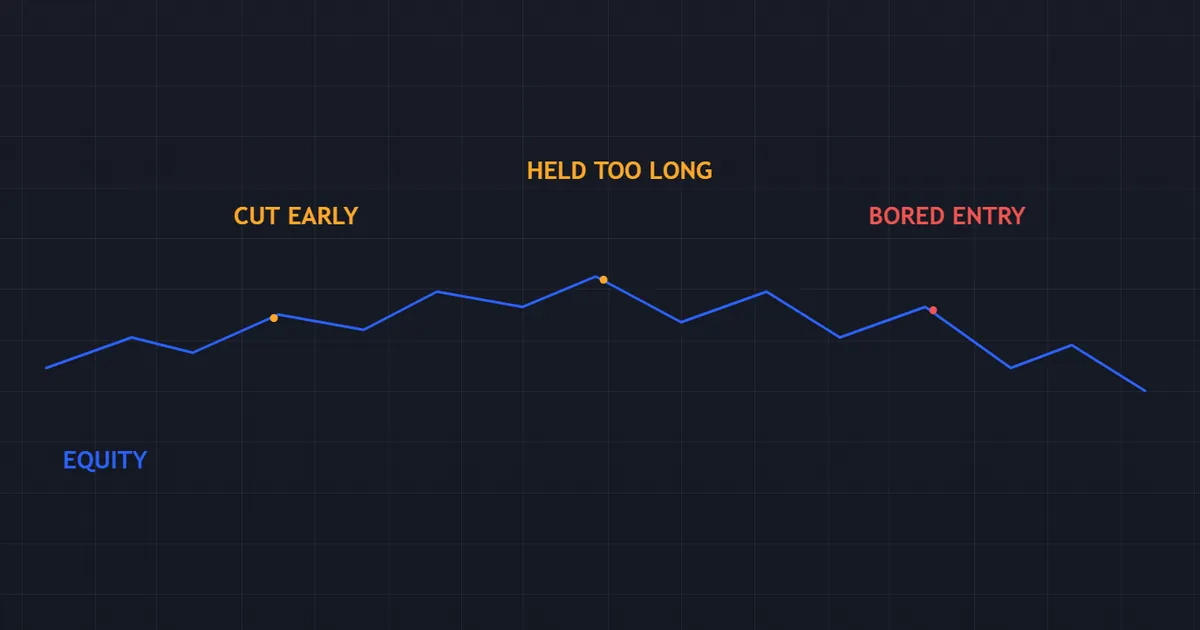
The equity curve above marks three of those changes. Each looks tiny beside the curve, and together they explain most of the slope.
Nothing in that picture required a crisis. Ordinary sessions and ordinary feelings produced the whole result.
Feelings Arrive Before Thoughts
Your body reacts to a moving number faster than your reasoning does. Heart rate rises, attention narrows, and the plan feels distant.
So arguing with yourself mid-trade rarely works. Because the reaction already started, the useful move involves a rule that runs without debate.
Uncertainty Does Most of the Work
Markets never tell you the outcome in advance. Your mind dislikes that gap and fills it with feeling instead of fact.
So a plan that names the exit in advance reduces the gap. Because fewer decisions remain live during the trade, fewer feelings find a lever to pull.
Money Makes the Signal Louder
The same chart produces almost no reaction on a demo account. Add real money, and every wick starts to matter.
Size decides the volume of that signal. So a position too large for your comfort turns a normal session into a stressful one.
Emotion Is Not the Enemy
Traders who feel nothing tend to make careless decisions. A little discomfort keeps attention sharp and risk respected.
So the goal involves regulation rather than removal. You want the feeling present, noticed and unable to touch the order.
Losses Weigh More Than Gains
Research into prospect theory found a clear asymmetry. A loss hurts roughly twice as much as a gain of the same size pleases.
That imbalance explains a great deal of trader behaviour. So cutting a winner early and holding a loser long makes emotional sense, even though it wrecks the arithmetic.
The Body Gives You a Warning
Physical signs arrive before bad decisions do. A tight jaw, a shortened breath and a faster refresh habit all count.
So learn your own three signs and write them on paper. Because the signal comes early, catching it costs nothing at all.
How a Feeling Becomes an Order
The path runs through five steps every time. Break it at any point, and the order stays as written.
- The market moves and your body reacts before you think.
- Attention narrows onto the profit and loss figure.
- A reason appears that justifies changing the plan.
- You adjust a stop, a size or a target.
- The trade now carries a risk nobody agreed to.
Step three does the real damage. So the reason feels convincing precisely because the feeling arrived first.
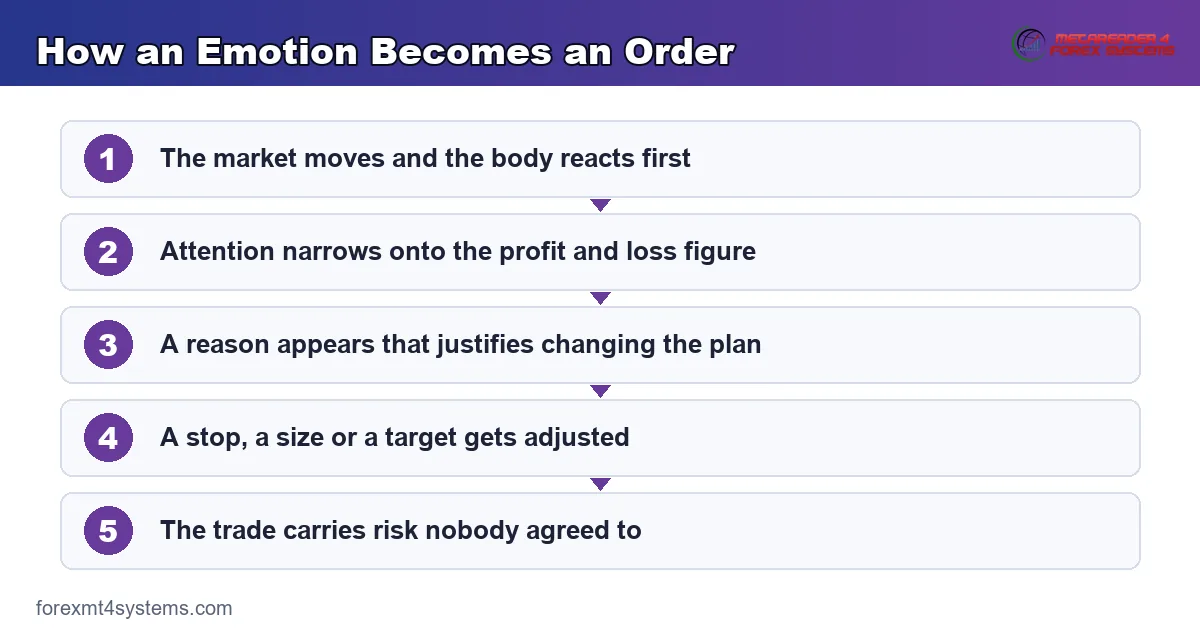
The flow diagram above shows those five steps in one panel. Notice how short the gap between step one and step four looks in practice.
Most traders try to fix step one. Because that step happens automatically, the reliable interventions sit at steps three and four instead.
Emotions in Trading, Feeling by Feeling
Eight feelings cover almost everything that happens at a trading desk. Each one changes the order in a predictable way.
Read them for recognition first. The counter-measures work best when you can name the feeling as it arrives.
Fear
Fear shows up as a refusal to click, or as an exit taken far too early. The trade never gets the room the plan allowed.
It usually signals size rather than cowardice. A position that frightens you generally sits above your real comfort level.
So cut size until the trade feels ordinary, then keep the plan intact. Our position size calculator turns a comfortable risk percentage into lots.
Fear also hides behind analysis. A trader who keeps checking one more chart before entry usually feels afraid rather than unprepared.
Greed
Greed shows up as a target that keeps moving. A trade that reached its level stays open because more looks available.
The result reverses your own arithmetic. A planned reward turns into a round trip, and a winner closes at break even.
So set the target before entry and let it fill. Read our guide to fear and greed in trading for the wider pattern.
Partial exits solve most of the argument. Take half at the written target, then manage the rest against a level you set in advance.
Hope
Hope keeps a losing position open past its stop. The trader waits for a bounce that the chart never promised.
Hope also rewrites the timeframe. A day trade becomes a swing trade, and a swing trade becomes an investment.
So place the stop with the broker at entry. Because the order sits outside your hands, hope loses its only lever.
Watch your language for the tell. Words like surely, must and any minute now signal hope rather than analysis.
Regret
Regret follows a missed move or an early exit. It then pushes you into the next trade at the wrong price.
The fear of missing out grows from the same root. Our note on fomo in trading covers how that chase starts.
So write the missed trade in the log and score it as a correct decision. A setup outside your rules deserves no regret at all.
Missed moves also feel worse than they were. In hindsight the entry looks obvious, though nobody could see it that clearly at the time.
Frustration and Anger
Anger arrives after a stop that filled and then reversed. It carries an urge to get even with something that cannot notice.
Poker players call the resulting state tilt. Our guide to tilt in trading covers the symptoms and the circuit breakers.
So stop trading after two losses in a session. Because you set that rule while calm, it costs nothing emotionally when it fires.
Anger also spreads outside the platform. A bad morning at the screen can sour a whole day, which is a cost worth counting.
Boredom
Boredom produces trades nobody planned. A quiet session feels like wasted time, so a marginal setup starts to look acceptable.
These trades rarely appear in reviews. Traders remember the dramatic losses and forget the small ones that funded them.
So give yourself something to do that is not trading. Chart study, journal work and a walk all beat a low-quality entry.
Alerts help more than willpower here. Set a price alert, close the platform, and let the software watch the level for you.
Relief
Relief feels harmless and behaves badly. After a scare, traders close good positions early simply to end the discomfort.
The trade gets judged by how it felt rather than by what it did. So your average gain quietly shrinks month after month.
So separate the exit rule from your comfort. If a position feels unbearable, cut half and leave the rest on the written plan.
Relief also explains a strange pattern in many logs. The best trades often feel the least pleasant while they run.
Excitement
Excitement usually appears right before a size increase. A strong run or a fast market makes bigger positions feel obvious.
Nothing about the method changed at that moment. Only the mood changed, and moods make poor sizing rules.
So hold your risk figure through good stretches. Any change belongs in a scheduled review with a written reason.
Excitement travels well between traders too. A busy chat room raises everyone’s size at the same moment, which is rarely a coincidence.
Which Feeling Shows Up Where
Each feeling prefers a particular moment. Knowing the moment gives you a warning before the order changes.
| Moment in the session | Feeling most likely | What it does to the order |
|---|---|---|
| Just before entry | Fear | The click never happens |
| Trade slightly in profit | Relief | The winner closes far too early |
| Trade past its target | Greed | The target moves and the gain unwinds |
| Trade slightly in loss | Hope | The stop moves further away |
| Straight after a stop fills | Anger | A larger trade goes in immediately |
| Quiet midday session | Boredom | A setup outside the rules gets taken |
Mark the row you meet most often. That row names the rule worth writing first.
A Worked Example of One Emotional Session
Take a trader with a written plan and half a percent risk per trade. The first trade stops out within the hour.
Nothing unusual happened there. Stops fill regularly, and the plan expects it.
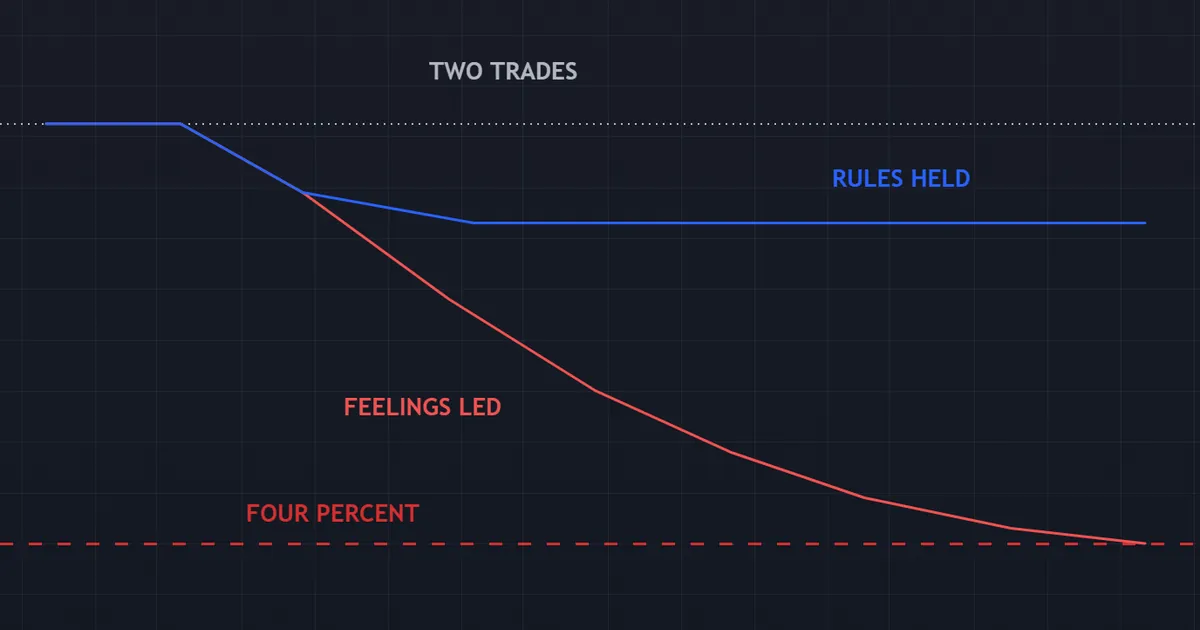
Anger arrives anyway, so the second trade goes in at double size. That one loses too, which now costs two percent in total.
The third trade follows immediately with no setup behind it. By lunchtime the day has cost four percent, and the method never got tested.
What the Rule-Driven Version Looks Like
Same trader, same first loss, same feeling. The difference sits in a rule written the week before.
Two losses close the platform for the day, so the session ends at one percent. Our guide to setting a daily loss limit shows how to size that cap.
The feeling still arrived in full. It simply had nothing left to press.
Compare the two versions over a month rather than a day. Four percent lost in one morning takes weeks to rebuild, while one percent barely registers.
So the rule does not make you a calmer person. It just limits how much a normal bad morning can cost.
Download the complete indicator database
Put these concepts on your charts. One email unlocks the full library of 1,380+ indicators with compiled MT4 and MT5 files, plus my TradingView scripts. No paywall, no spam, unsubscribe any time.
Get free access to my indicator database
One email unlocks 1,380+ free MT4, MT5 and TradingView indicators — the complete library. No single-tool download; you get the whole database.
Mistakes Traders Make With Their Emotions
The fix goes wrong as often as the problem itself. These six errors waste most of the effort.
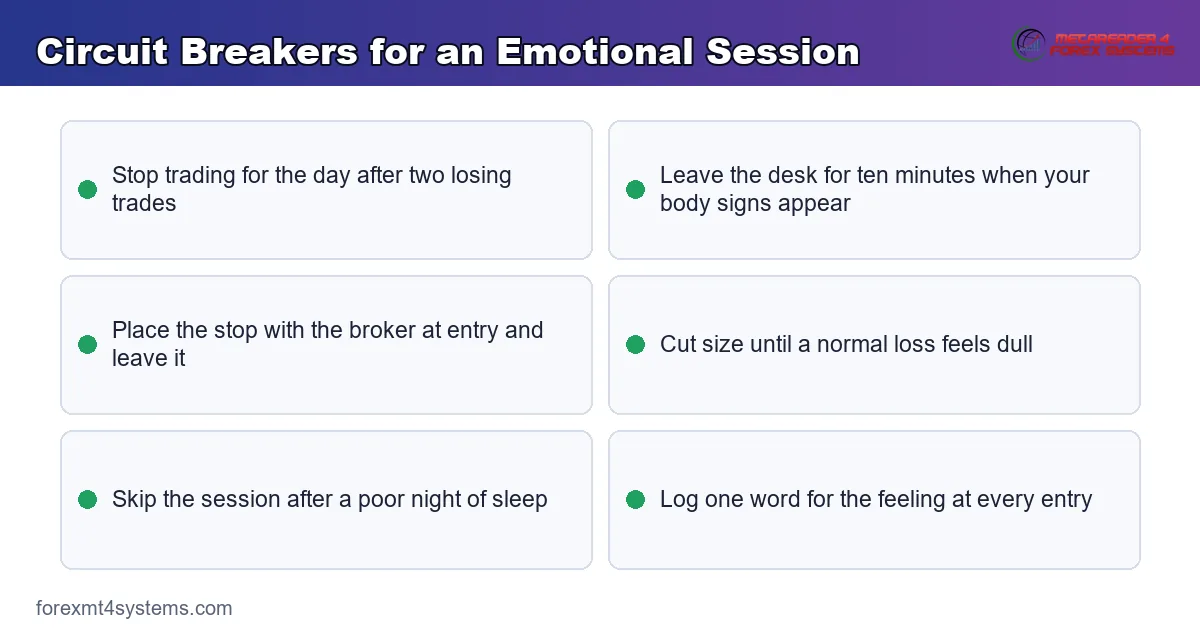
The key points panel above lists circuit breakers that stop a bad session early. Keep it beside the platform where you can reach it.
Trying to Feel Nothing
Traders decide to become calm and treat that as the plan. The decision fails within one session.
So change the rule instead of the feeling. Because the rule works while you calm down, it does the job willpower cannot.
Waiting Until the Feeling Passes
Some traders sit at the screen and wait for the urge to fade. Staring at a chart keeps the urge alive.
So leave the desk instead. Ten minutes away breaks the loop far better than ten minutes of resistance.
Blaming Emotion for a Weak Method
Discipline cannot rescue a method with negative expectancy. Traders spend months on mindset while the numbers stay untouched.
So check the record before you blame your head. A hundred logged trades tells you which problem you actually have.
Trading Through Real Life
Poor sleep, illness and family stress all reach the order ticket. The chart looks the same, and you do not.
So treat those days as no-trade days or half-size days. Our guide on managing trading stress covers the practical side.
Fixing Every Feeling at Once
Eight feelings and eight new rules produce nothing. The list collapses by the second week.
So pick the feeling that costs you most and build one rule for it. One habit held for a month beats eight attempted for three days.
Trading Bigger to Feel Something
Some traders raise size because normal trading feels flat. Excitement then becomes the reason for the position.
So notice when boredom and size move together. Because that combination has nothing to do with the chart, it belongs in the log as a rule breach.
Journalling Only the Numbers
A log of entries and exits misses the whole subject. Nothing in it shows why the stop moved.
So add one short field for how you felt at entry. Because the pattern needs only a word or two, the field stays quick to fill.
Setting Rules Nobody Can Follow
A rule to never feel greedy cannot be checked. A rule to close at the written target can.
So write rules with numbers and times in them. Then the log can say plainly whether the rule held.
A Two-Week Emotion Log
Reading about feelings settles nothing about your own trading. A short log answers the question with your own data.
Run it for two weeks and change nothing else while it runs.
- Write one word for how you felt at the moment of entry.
- Write a second word after the exit if the state changed.
- Mark any trade where the stop moved after entry.
- Mark any trade closed before the written target.
- Mark any trade taken outside your written rules.
- At the end, group the marks by the feeling word beside them.
The groups name your costliest feeling without any theory. Most traders find one word attached to most of the marks.
Then build a single rule for that word alone. Because the log gives a count rather than an opinion, progress becomes measurable.
Session Discipline Checklist
Run this list before and during each session. It takes two minutes and removes most of the damage.
- Set the position size so a normal loss feels boring.
- Place the stop with the broker at entry, then leave it alone.
- Write the target before entry and let the order fill.
- Stop for the day after two losing trades.
- Note one word for how you felt at entry in the log.
- Stand up and leave the desk when your three body signs appear.
- Skip the session entirely after a poor night of sleep.
- Review the feeling column once a week, not after every trade.
None of those items rely on staying calm. That absence is the point, since calm disappears exactly when you need it.
Pitfalls and Edge Cases
A few wrinkles bend the tidy picture, so keep them in view. The equity curve below shows one small loss escalating inside a single session.
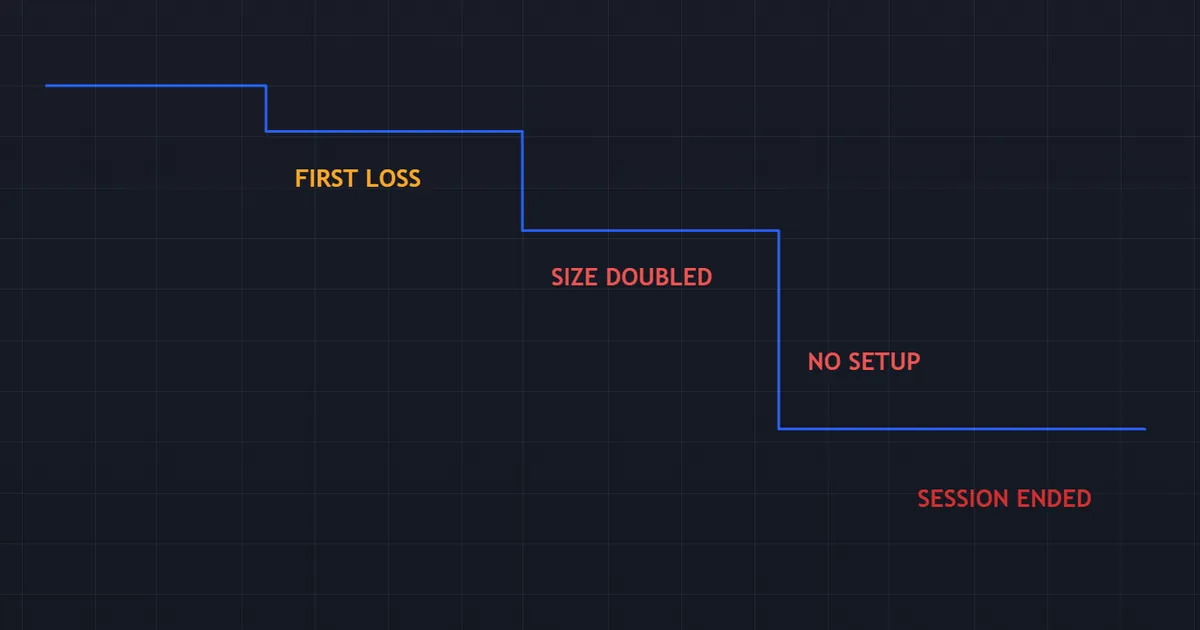
Notice the timescale. All of that damage happened in a few hours, from a first loss that fell well inside the plan.
Numbness Costs Money Too
Trading with no reaction at all sounds ideal and rarely helps. Traders who feel nothing skip checks and take casual risk.
So watch for indifference as carefully as for panic. Because both states loosen the rules, both deserve a break from the screen.
Screens Multiply the Signal
Four charts, a news feed and a chat window keep the reaction running all day. Each refresh renews the pressure without adding information.
So cut the screen count during a session. One chart and one alert usually beats a wall of them.
Automation Moves the Problem
An automated system removes the click and keeps the trader. People still switch systems off during drawdowns and on during good runs.
So write rules for the intervention itself. Decide in advance what would justify stopping a system, and record the reason each time.
Good Feelings Distort Too
Most advice covers fear and anger and ignores the pleasant end. Confidence, relief and excitement change orders just as reliably.
So log the feeling on winning trades as well. Our note on revenge trading shows how quickly a mood can flip after a good stretch.
Rules Written While Upset
A rule invented straight after a painful session carries the session with it. Traders ban a whole strategy over one bad morning.
So write rules at a fixed weekly slot instead. Because that slot arrives with a clear head, the rule survives the next bad morning as well.
When the Pressure Grows Beyond Trading
Some difficulty sits well outside the scope of a checklist. Chasing losses, hiding trades and losing sleep all point to something larger.
If trading affects your sleep, your finances or your relationships, step away and seek qualified professional support. That decision protects far more than an account.
Related Concepts to Study Next
Feelings and risk control interlock, because a comfortable position size removes most of the pressure before it starts. Read our guide to a risk reward ratio so your targets stop inviting greed, then keep a trade journal with a feeling column so the pattern becomes visible.
Sizing deserves the last word here, because a comfortable position turns most of these feelings into background noise. So set the number first, then treat every rule above as a backstop rather than a cure.
FAQ
Can I trade without feeling anything?
No, and the attempt tends to backfire. A small amount of discomfort keeps you attentive and keeps risk respected. The workable goal involves noticing the feeling and keeping it away from the order. Naming it out loud often takes most of its force away.
Which feeling costs traders the most?
Hope usually does the most damage, because it keeps losing positions open past the stop. Greed runs close behind by turning finished winners into round trips. Both attack your average trade from opposite ends. Fixing either one changes your numbers more than a new indicator will.
How do I stop myself moving a stop?
Place the order with the broker at entry and treat it as fixed. Then reduce your size until a normal loss feels dull rather than painful. If you still want to move it, the position is too large. Size fixes far more of this problem than resolve ever will.
Does a demo account help with this?
Only partly, since demo removes the financial consequence that creates the feeling. A small live account teaches more, because the signal becomes real while the loss stays trivial. Use demo for mechanics and small live size for behaviour. Traders who skip that bridge usually meet all eight feelings at once.
What should I write in a feeling column?
One word does the job, such as calm, rushed, bored or angry. Add a second word after the exit if the state changed. Two weeks of entries usually shows which feeling costs you most. Keep the field to one word, since a long form stops getting filled in by Thursday.
How long before this improves my results?
Expect a few months rather than a few sessions. The rules take effect at once, and you need a reasonable sample before the numbers separate a real improvement from ordinary variance. Track the behaviour first, and let the account follow later. Most traders notice the rule breaches stop long before the equity curve reflects the change. Results are not guaranteed; past performance is not indicative of future results.
External references
- For background on this concept, see Emotion on Wikipedia.
- For broader market context, see Cognitive Dissonance at Investopedia.

About the author
Written by Dominic Walsh, a Forex trader and MT4/MT5 indicator, Expert Advisor and script developer. Every tool on forexmt4systems.com is tested on live charts before release and ships with ready-to-use compiled MT4 (.ex4) and MT5 (.ex5) files. Learn more about the trader and developer behind this site.
How we build, test and correct every tool: Editorial & Testing Policy. Trading carries risk; see the disclaimer.