
The prop firm consistency rule stops any single day or trade from carrying too much of your total profit. It rarely closes an account, yet it blocks more payouts than most traders expect.
This guide explains the prop firm consistency rule in plain terms, and it stays firm-neutral throughout. You will see the arithmetic, a worked example, and the habits that keep your profit spread wide enough to pass.
What the Prop Firm Consistency Rule Actually Says
The clause reads simply enough. No single trading day, and sometimes no single trade, may account for more than a set share of the profit you built over the measured period.
Firms commonly set that share somewhere between a fifth and a half of total profit. A cap near 30 percent turns up most often, though the wording varies widely.
So the rule cares about shape, not size. A modest month spread over twelve sessions can clear it, while a larger month built on one spectacular afternoon cannot.
The One-Line Definition
Take your best day’s profit, divide it by your total profit, then turn the answer into a percentage. That single figure decides the outcome.
If the figure sits at or below the firm’s cap, your profit looks consistent. Climb above it, and the firm treats your record as too dependent on one session.
Notice what the rule ignores. It says nothing about your strike rate, your strategy or your drawdown, so a careful trader can still trip it by accident.
What the Rule Does Not Do
The clause does not cap your profit. You may earn as much as the other limits allow, provided the earnings arrive across enough sessions.
It also does not judge individual trades on merit. A perfectly planned position that ran further than expected counts the same as a reckless one, since the arithmetic looks only at proportions.
So think of it as a shape test rather than a quality test. Two traders with identical monthly totals can land on opposite sides of the cap.
How the Consistency Rule Works, Step by Step
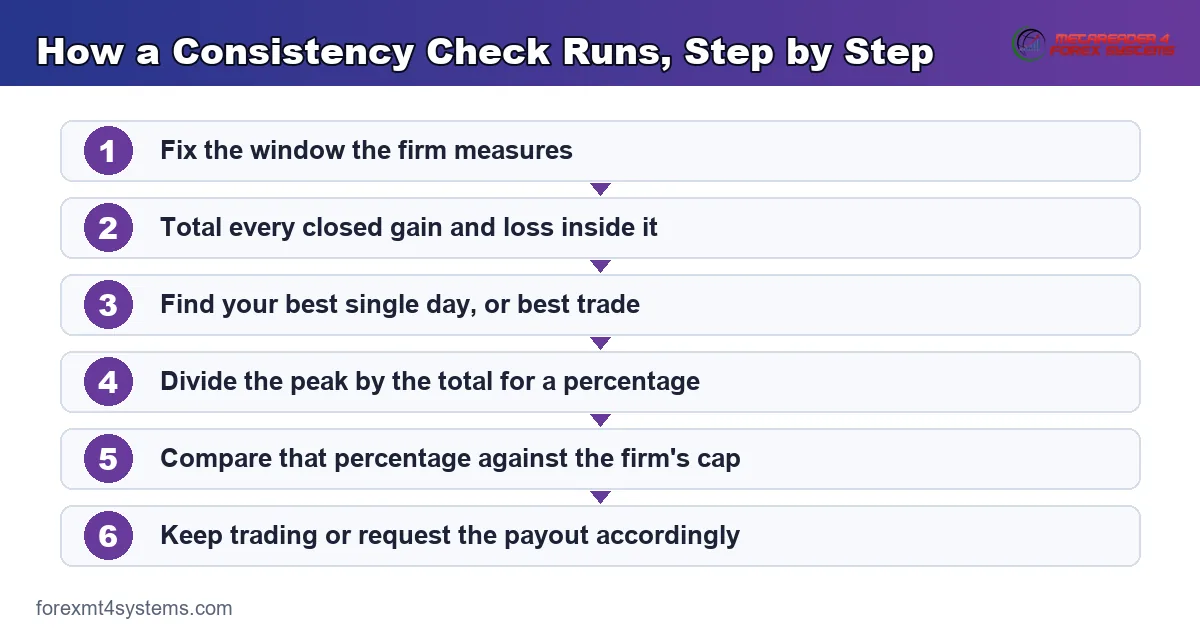
Every firm runs the same basic check, whatever words the rule book uses. Follow the five steps below and you can run that check yourself at any point.
- Fix the window. Identify the period the firm measures, usually an evaluation phase or a payout cycle.
- Total the profit. Add every closed gain and loss inside that window for a single net figure.
- Find the peak. Locate your best single day, or your best single trade where the rule names trades.
- Divide. Split the peak by the total, then read the answer as a percentage.
- Compare. Hold that percentage against the firm’s cap and act before you request anything.
So the check takes a minute once your figures sit in front of you. Our free consistency rule calculator runs those five steps for you and flags a request that would fall short.
Run the check weekly rather than at the end. Because the ratio moves with every closed trade, an early warning leaves you time to fix it.
Which Window the Firm Measures
The window matters as much as the cap. Some firms measure across a whole evaluation phase, while others reset the clock at each payout cycle.
A longer window helps you, since more sessions dilute any single day. A short window concentrates the arithmetic and makes one strong afternoon far more visible.
So find the window before you plan around the rule. Two firms quoting the same cap can behave quite differently once the measured period changes.
Days, Trades, or Both
Read whether the clause names days or trades. A per-day version lets you take several good positions in one session, provided the day’s total stays proportionate.
A per-trade version bites harder. One outsized winner can breach it even when the day around it looks ordinary, so position size carries extra weight.
A handful of firms apply both tests at once. In that case the tighter of the two governs, and your planning should follow the stricter figure.
Check how the firm handles a day with several trades as well. Some count the net figure for the session, while others look at the largest single winner inside it.
Gross or Net, and Which Trades Count
Most clauses work on net profit, so your losses on a day reduce that day’s contribution. A session with a large winner and two small losers therefore scores better than the winner alone suggests.
Read whether pending or partially closed positions enter the sum too. A trade opened on Monday and closed on Thursday usually counts on the closing day, which can concentrate profit unexpectedly.
So map your holding style against the counting method. Swing traders often find their profit lands on fewer calendar days than they realized, purely because of when positions close.
Why Firms Use a Consistency Rule
The clause can feel arbitrary when it delays your money. Look at it from the firm’s side, though, and the logic becomes plain.
A firm wants traders who repeat a process, not traders who happened to catch one enormous move. The rule separates those two groups cheaply.
Screening for Repeatable Skill
One huge day proves very little. It might reflect skill, or it might reflect a single oversized position that happened to land the right way.
Twelve steady days prove rather more. So the firm reads a flat, wide profit distribution as evidence of a process it can back for years.
Because the firm only earns from traders who last, this filter costs it almost nothing. It simply defers a payout until the record looks durable.
Guarding Against One-Shot Risk
A trader who makes everything on one day probably risked a great deal on that day. The next attempt at the same trade could just as easily breach a drawdown floor.
So the rule works as a quiet size limit. It nudges you toward risk levels you could repeat every session without flinching.
Our note on prop firm rules shows how this clause fits beside the drawdown and daily loss limits. The three of them push in the same direction.
Keeping the Payout Review Simple
Firms review a great many payout requests each month. A single ratio gives them one objective number to check, which keeps the process quick and even-handed.
The alternative would mean reading every trade by hand. So the rule serves the firm’s operations as much as its risk desk, which explains why the wording stays so blunt.
That bluntness works in your favor too. Because the test is arithmetic rather than judgement, you can predict the outcome exactly before you ever click the request button.
A Worked Example of the Consistency Rule
Numbers settle the idea fastest. Picture a payout cycle where your total profit reaches 8 percent of the account, and your best single day contributed 3 percent.
Divide 3 by 8, and the best day carries 37.5 percent of the total. Against a 30 percent cap, that request falls short.
Nothing here suggests bad trading. The month simply leans too heavily on one session, so the firm asks you to keep going before it releases the money.
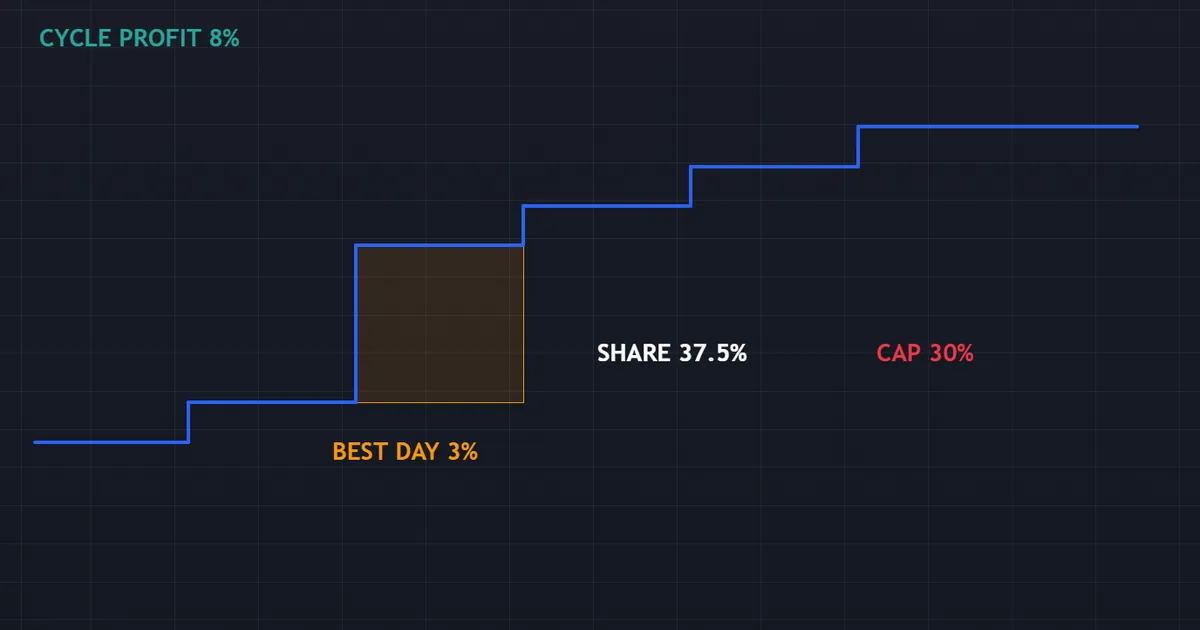
Two levers fix the ratio, and the table sets them side by side. You can grow the total, or you can hold future days smaller.
| Cycle profit | Best day | Best-day share | Against a 30 percent cap |
|---|---|---|---|
| 8 percent | 3 percent | 37.5 percent | Over the cap, payout deferred |
| 10 percent | 3 percent | 30.0 percent | Exactly at the cap |
| 12 percent | 3 percent | 25.0 percent | Comfortably inside |
How to Fix a Failing Ratio
Work the arithmetic backwards. To satisfy a 30 percent cap with a 3 percent best day, your total needs to reach at least 10 percent.
So keep trading at your normal size until the total catches up. Roughly seven more sessions at half a percent each would close the gap.
The second lever runs the other way. Multiply your current total by the cap for the largest day you may still afford, which comes to 2.4 percent on an 8 percent total.
Write both figures on your platform. Because they update as the cycle runs, a quick recalculation each Friday keeps the target in view.
A Second Example: The Per-Trade Version
Some clauses name trades rather than days. Run the same arithmetic on your single best position instead of your best session.
Suppose the cycle again totals 8 percent, and your largest winning trade contributed 2.6 percent. Divide 2.6 by 8, and that one trade carries 32.5 percent of the total.
Against a 30 percent cap the request falls short, though only by a little. So the repair is small as well: another 0.7 percent of profit lifts the total to 8.7 percent and drops the share below the cap.
Per-trade clauses reward tight take-profit discipline. Because a runner that triples your usual reward can breach the test, some traders scale out rather than hold for an outsized single result.
Download the complete indicator database
Put these concepts on your charts. One email unlocks the full library of 1,380+ indicators with compiled MT4 and MT5 files, plus my TradingView scripts. No paywall, no spam, unsubscribe any time.
Get free access to my indicator database
One email unlocks 1,380+ free MT4, MT5 and TradingView indicators — the complete library. No single-tool download; you get the whole database.
How to Spread Profit Across More Days
Prevention beats repair here. A few habits keep the ratio healthy without any conscious effort at the end of the cycle.
All three habits below reduce the size of your peak day rather than shrinking your total. That distinction matters, since the goal remains a good month.
Cap Your Best Day on Purpose
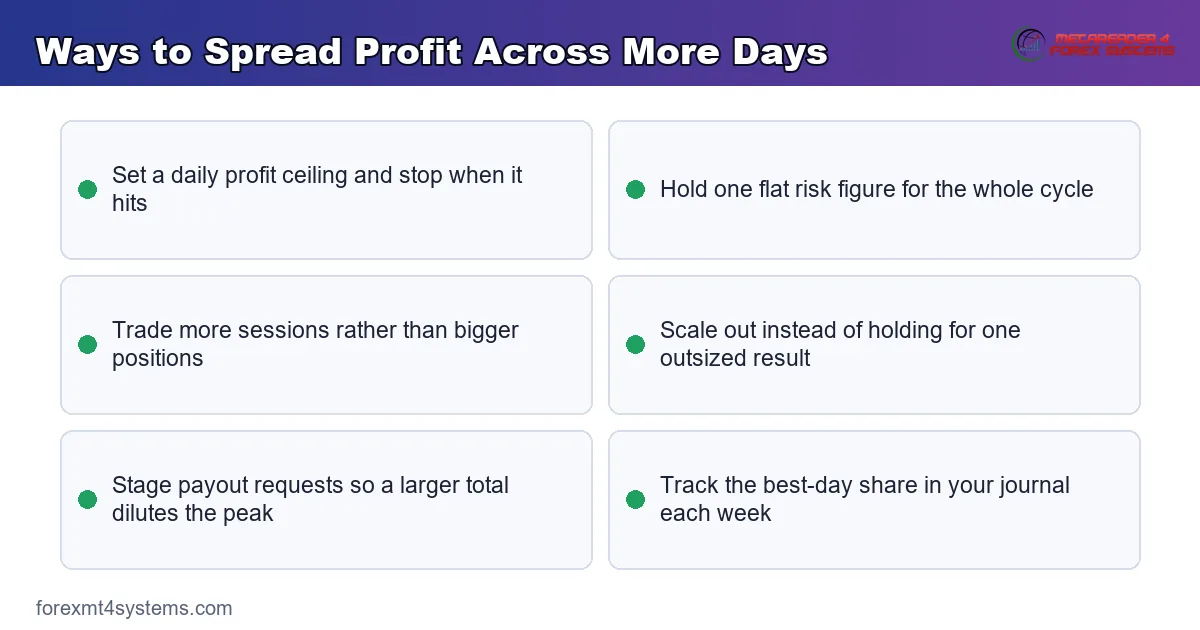
Set a daily profit ceiling and stop when you reach it. Traders resist this idea, yet a hard stop on good days protects the ratio at almost no cost.
Pick the ceiling from your expected cycle total. If you aim for 8 percent across a month, a daily ceiling near 2 percent keeps you clear of a 30 percent cap.
So a strong morning ends early rather than compounding. The profit you leave on the table today returns as a released payout later.
Trade More Sessions, Not Bigger Ones
Twelve half-percent days beat three two-percent days on every measure that matters here. The total lands in the same place, while the peak stays tiny.
Keep position size flat across sessions too. Our guide to position sizing explains why a fixed fractional approach naturally flattens your daily distribution.
A steady size also helps the drawdown rules. Use our free prop firm position size calculator to lock a lot size that suits both the floor and the cap.
Stage Your Payout Requests
A larger total dilutes a big day, so patience alone can rescue a ratio. Waiting one extra cycle often turns a blocked request into a clean one.
Read the payout terms before you plan this, though. Our note on prop firm payouts covers cycles, minimums and the clauses that sit beside them.
Journal the Ratio Each Week
Add two columns to your trading journal: the cycle total and the best day so far. A third column holds the share, which the spreadsheet works out for you.
Glance at that share every Friday. A figure creeping toward the cap tells you to trim size next week, long before the number becomes a problem.
So the journal turns a payout surprise into a routine chore. Traders who track the ratio almost never meet the clause as an obstacle.
Building the Rule Into Your Routine
A rule you check once at the end of a cycle controls nothing. A rule baked into your daily process quietly shapes every decision you make.
So convert the cap into two numbers you can act on today. One governs when you stop, and the other governs how much you risk.
Your Daily Stop-Out Number
Multiply your intended cycle total by the cap. That product gives the largest day you may bank without any risk of breaching the clause.
Set a platform alert at that level. When the alert fires, close the screen for the day rather than debating the point with yourself.
Traders often find this the hardest habit in the whole rule book. Because stopping on a good day feels wrong, the alert has to do the deciding for you.
Your Flat Risk Number
Then fix a single risk figure per trade and hold it all cycle. A flat figure spreads your results naturally, so the ratio tends to look after itself.
Resist the urge to press size after a strong run. The peak day you create today becomes the number your whole cycle must outgrow later.
Common Consistency Rule Mistakes and Fixes
Traders trip this clause in a small number of predictable ways. The keypoints panel below collects the habits that keep profit spread wide.
Reading the Rule Only at Payout Time
The ratio takes weeks to build and minutes to check. So run the sum every week, and treat a drifting figure as a signal to trade smaller rather than harder.
Chasing One Big Trade to Pass Faster
A single outsized winner can pass the profit target and fail the consistency test on the same afternoon. So keep risk flat, even when a setup looks unusually clean.
Assuming It Only Applies to Payouts
Plenty of firms apply the clause to the evaluation as well. Check both stages, because a challenge you thought you had passed can sit unresolved for weeks.
Forgetting That Losses Shrink the Total
Your denominator falls whenever you lose. So a rough week after a great day pushes the ratio up without you trading badly at all, which argues for extra caution after any peak.
Mixing Up Days and Trades
A per-trade clause needs a different plan from a per-day clause. Read which word the rule uses, then size for that version rather than the one you remember elsewhere.
Trading Bigger Right After a Peak
Confidence rises after a strong session, and size tends to follow. That instinct works directly against the ratio, so treat a peak day as a reason to trim rather than press.
Treating the Cap as a Target
Some traders aim to land exactly on the cap, since it looks efficient. A single losing week then shrinks the total and pushes the share over the line. So leave a margin and aim well inside the figure.
Consistency Rule Quick Reference
Keep this list beside your journal. Five answers cover everything the clause can ask of you.
- What percentage cap does the firm set?
- Does the clause measure days, trades, or both?
- Which window applies: a phase, a payout cycle, or the account’s life?
- Does the rule apply during the evaluation, at payout, or at both stages?
- What happens on a breach: a deferred payout, a voided trade, or something harsher?
- What is your current best-day share, as of this week?
- What is the largest day you can still afford under the cap?
Answer all seven before your first payout request. Because the arithmetic never changes, one careful pass covers the whole account.
Pitfalls and What Delays Payouts
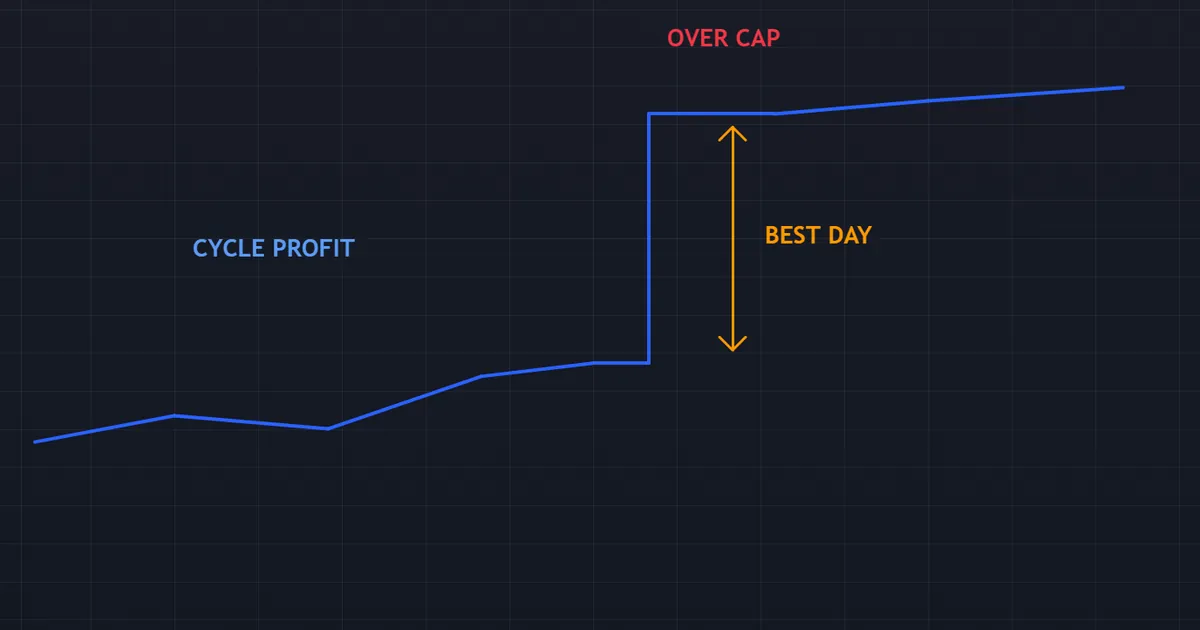
A few wrinkles surprise traders who thought they had the rule covered. The chart below shows an equity path where one dominant day blocks a payout request.
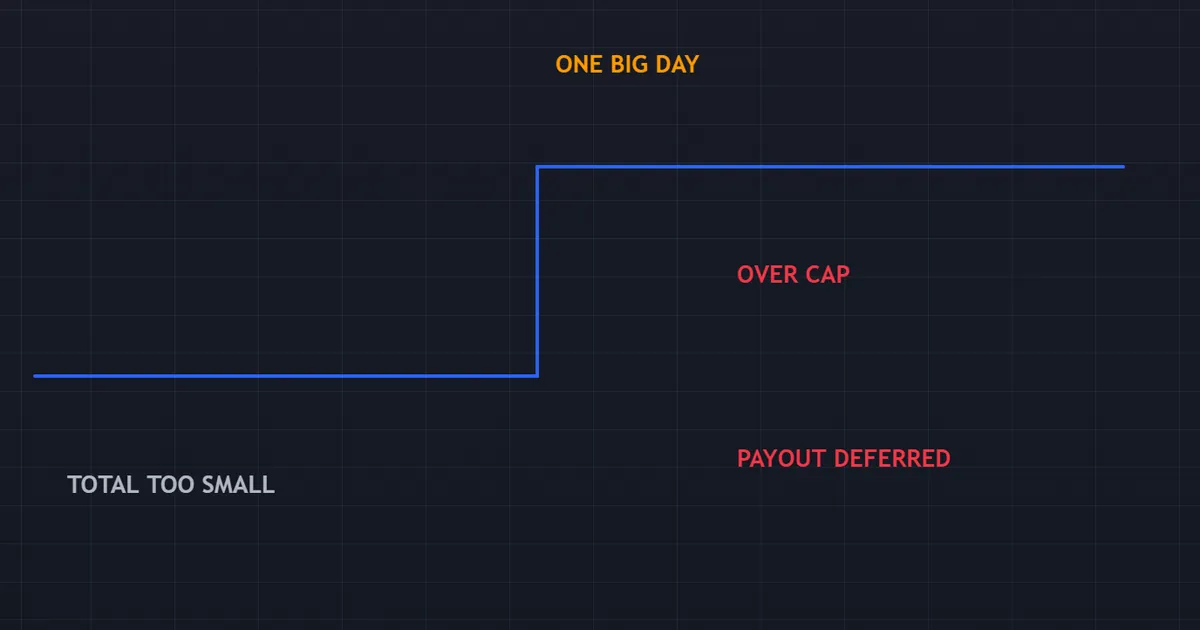
Look at the shape of that path. It rises gently, jumps once, then flattens, and the jump alone accounts for too much of the cycle.
A Losing Streak Can Trip the Rule
Nothing in the clause requires bad behavior. Lose steadily after a strong day, and the shrinking total pushes your peak share upward on its own.
Partial Payouts May Not Reset the Window
Some firms carry the measured history forward after a withdrawal. So a peak day from an earlier cycle can still weigh on the next request, which makes the terms worth checking closely.
Commission and Swap Count Toward the Total
Trading costs reduce your net profit, and the rule usually works on net figures. A high-cost month therefore shows a slightly worse ratio than the raw gains suggest.
The Cap Can Change With the Account
Firms sometimes tighten the clause on larger accounts or on a second funded stage. So recheck the figure whenever you scale, rather than trusting the terms you first read.
A Breach Rarely Ends the Account
Most firms treat this clause as a soft rule. Your account keeps running, yet the pass or the payout waits until the distribution improves, which costs time rather than capital.
Not Every Firm Publishes an Exact Cap
A few rule books describe the requirement in words rather than numbers. Phrases about trading in a reasonable and repeatable manner leave the firm room to judge each case.
So ask support for the working figure in writing. A vague clause becomes manageable once you hold a number, and the written reply protects you during a later review.
Failing that, plan against a strict assumption. Keeping your best day under a quarter of the total satisfies nearly every published cap and most unpublished ones too.
Related Concepts to Study Next
The consistency clause makes most sense beside the rest of the rule book, so a couple of neighboring guides finish the picture. Each one covers a limit that shapes your daily size.
Read our overview of a funded trading account for the wider model, then our guide to pass a prop firm challenge for the pacing that keeps this ratio healthy from day one.
Pair both with a flat sizing habit. A single risk figure held all cycle does more for your ratio than any clever adjustment at the end, and it keeps the drawdown floor at a safe distance as well.
FAQ
What is the prop firm consistency rule?
It caps the share of your total profit that may come from a single trading day, and sometimes from a single trade. Firms commonly set the cap somewhere between a fifth and a half of the total, with a figure near 30 percent appearing most often.
How do I calculate my consistency ratio?
Divide your best single day’s profit by your total profit for the measured window, then read the answer as a percentage. Compare that percentage against the firm’s cap. Run the sum weekly so a drifting figure never surprises you at payout time.
Does a breach close my account?
Usually not. Most firms treat the clause as a soft rule, so the account keeps running while the pass or the payout waits. You then trade on until the distribution of profit improves enough to satisfy the cap.
How do I spread profit across more days?
Set a daily profit ceiling and stop when you reach it, keep position size flat across sessions, and trade more days rather than bigger ones. Twelve small winning days produce the same total as three large ones, with a far healthier ratio.
Does the rule apply during the challenge?
At some firms yes, at others only at payout. Check both stages in the rule book, because an evaluation you believe you have passed can sit unresolved while the distribution of profit fails the test.
Can a consistency rule stop me earning at all?
No, it delays rather than blocks, provided you keep trading within the other limits. Payouts still depend entirely on your results and your discipline. Results are not guaranteed; past performance is not indicative of future results.
External references
- For background on this concept, see High-Water Mark at Corporate Finance Institute.
- For broader market context, see Coefficient of Variation at Investopedia.

About the author
Written by Dominic Walsh, a Forex trader and MT4/MT5 indicator, Expert Advisor and script developer. Every tool on forexmt4systems.com is tested on live charts before release and ships with ready-to-use compiled MT4 (.ex4) and MT5 (.ex5) files. Learn more about the trader and developer behind this site.
How we build, test and correct every tool: Editorial & Testing Policy. Trading carries risk; see the disclaimer.