
The prop firm vs broker comparison confuses new traders because both give you a platform and a live market. Only one of them lends you the money, and only one of them holds your deposit.
This guide sets out prop firm vs broker on four points that actually differ. Whose capital you trade, who holds the cash, who writes the rules, and who supervises the business. It stays firm-neutral, so no company names appear.
Prop Firm vs Broker: The Core Difference
A broker sells you access to a market and holds the money you deposit. You trade your own capital, and you keep every dollar you make.
A prop firm sells you an evaluation. Pass it, and the firm grants an account funded with its capital, under rules it writes.
So the broker relationship centers on access, while the prop relationship centers on capital. That one distinction explains almost every other difference.
Many traders use both at once. A funded account for size, plus a personal broker account for freedom, covers two very different needs.
One Sells Access, One Lends Capital
Think of a broker as a road and a prop firm as a car loan. The road takes you to market, whatever vehicle you drive.
The loan supplies the vehicle with conditions attached. So a broker alone can take you to market, yet only a firm hands you capital you never had.
Why the Confusion Persists
Both routes hand you the same terminal, the same charts, and the same instruments. The screen gives away nothing.
So traders judge the two models by appearance and miss the substance. Because the real differences sit in the paperwork, no chart will ever show them.
How Each Business Works
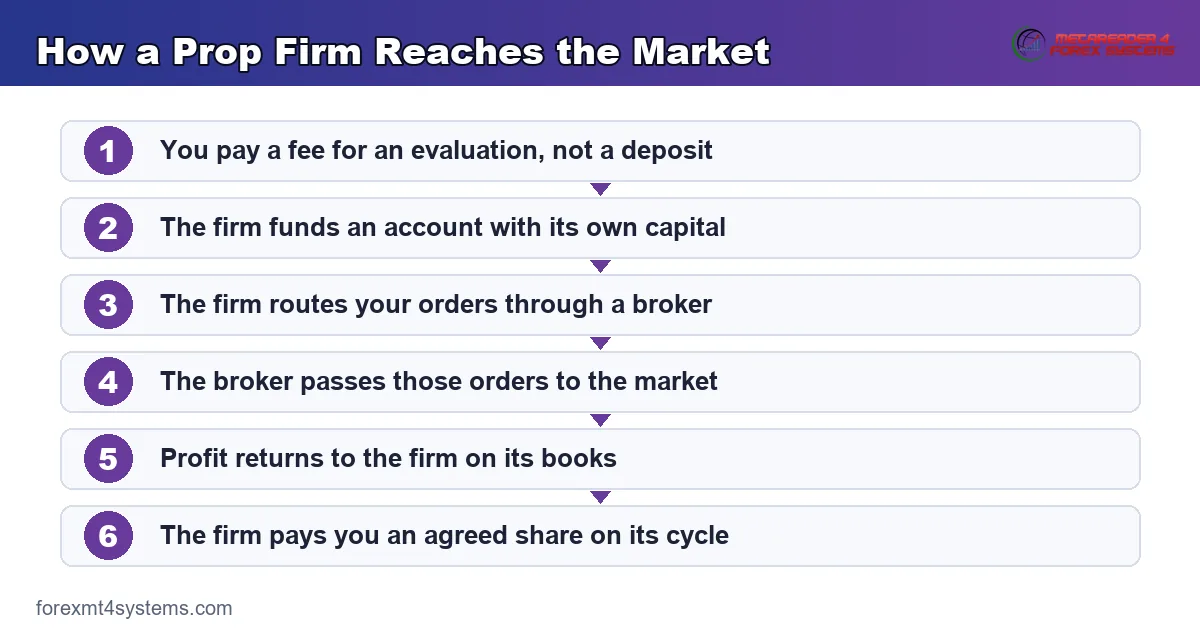
Follow the money through both models, and the fog clears fast. Each step below happens in the order you meet it.
- Broker, step one. You open an account and deposit your own funds.
- Broker, step two. The broker holds that money and routes your orders to the market.
- Broker, step three. You pay spreads, commissions, and swaps on every trade.
- Prop firm, step one. You pay a fee for an evaluation on a simulated account.
- Prop firm, step two. Pass the test, and the firm funds an account with its own capital.
- Prop firm, step three. The firm often routes those orders through a broker of its choosing.
- Prop firm, step four. Profit returns to the firm, which pays you an agreed share.
So a prop firm frequently sits on top of a broker rather than replacing one. Because the firm needs market access too, the two models stack instead of competing.
Why Many Firms Sit on Top of a Broker
A prop firm rarely builds its own market infrastructure. It buys execution from a broker or a liquidity provider, then layers its rules on top.
So your orders may travel through a broker you never chose. Because the firm picks that partner, your spreads and fills depend on its choice rather than yours.
Where Your Order Actually Goes
On a broker account, your order leaves the platform and lands on that broker’s book. On a funded account, it reaches the firm’s system first.
Some firms pass the order onward, while others simulate the fill internally. So ask the question directly, since the answer shapes your slippage and your fills.
The Side-by-Side Table
The table below lines the two models up on the points that decide most questions.
| What differs | Broker | Prop firm |
|---|---|---|
| What it sells | Market access | An evaluation, then funded capital |
| Whose money you trade | Yours | The firm’s |
| Who holds your cash | The broker, in a client account | Nobody, since you deposit nothing |
| What you pay | Spreads, commissions, swaps | A fee, plus the same trading costs |
| Who writes the risk rules | You do | The firm does |
| Profit you keep | All of it | An agreed share |
| Usual oversight | A financial regulator | Contract terms, often no regulator |
| What ends the account | An empty balance | A breached rule |
Row three and row seven drive most of the confusion. Read those two together, and the models separate cleanly.
The Rows That Matter Most
A broker holds your money, so rules exist to protect it. A prop firm holds none of your money, so those rules rarely apply.
That single fact explains the regulation gap further down this page. Because the protections follow the deposit, no deposit means no protection.
Who Holds the Money
Custody sounds dull and matters enormously. It decides what happens if the business fails.
So trace your cash before you send it anywhere. Because the answer differs sharply between the models, the question deserves five minutes.
A Broker Holds Your Deposit
Send money to a broker, and the broker becomes its custodian. Reputable firms keep client funds apart from company funds in segregated accounts.
So a collapse should not consume your balance, at least in a well-supervised jurisdiction. Many regimes add a compensation scheme on top, up to a stated limit.
A Prop Firm Holds Nothing of Yours
A prop firm takes a fee for a service and nothing more. Your savings stay in your own bank the whole time.
So the firm holds no deposit to protect. Because your fee buys access to a test, it earns none of the protections a deposit would receive.
What Sits in the Funded Account
The balance in a funded account belongs to the firm. Some firms run those accounts on simulated capital and pay you from company revenue.
Others route genuine orders to a live market. So ask which model a firm uses, since it changes where your payouts actually come from.
Why Custody Decides the Risk
Custody sets what you stand to lose if a business fails. A broker holding your deposit puts that whole balance in play.
A firm holding only your fee puts far less at stake. So the prop model limits that particular risk, while adding a contract risk in its place.
Who Sets the Rules
Both models impose conditions, yet they cover different ground. Mixing the two up leads to plenty of frustration.
So separate trading conditions from risk conditions. Because the broker owns one set and the firm owns the other, you may face both at once.
A Broker Sets Trading Conditions
A broker decides your spreads, commissions, leverage, and available instruments. It also sets margin requirements and closes positions when margin runs out.
A free margin calculator shows how those requirements bite on a given trade. So you can price a position under a broker’s terms before you place it.
A Prop Firm Sets Risk Conditions
A firm adds a profit target, a maximum drawdown, a daily loss cap, and often a consistency rule. Break one, and the account closes.
So the firm governs your behavior rather than your execution. Because both layers apply on a funded account, you answer to a rule book and a margin engine together.
Sizing Under Two Rule Layers
Sizing on a funded account starts from the firm’s floor, not the margin available. Plenty of margin means nothing when a drawdown limit sits closer.
A free prop firm position size calculator works backward from that floor. So your lots respect the binding limit rather than the loosest one.
When the Two Layers Collide
Occasionally the two rule layers pull against each other. A broker may close a position on margin before you reach the firm’s floor.
More often the reverse happens, and the firm’s limit arrives long before margin ever tightens. So identify which layer sits closest to you, then plan around that one. Because only the nearest limit ends anything, the other layer becomes background noise.
How Each Side Makes Its Money
Revenue explains behavior in both models. Follow the income, and the rules start to make sense.
So look at where each business earns. Because incentives shape rule books, this section tells you more than any marketing page.
Broker Revenue
A broker earns from spreads, commissions, and swaps, and sometimes from taking the other side of client trades. Volume drives the income.
So brokers court active traders and long account lifespans. Because a trader who blows up stops paying spreads, retention serves the broker as well as you.
Prop Firm Revenue
A firm earns from evaluation fees, from the many traders who fail those evaluations, and from its share of genuine profits. Some also earn through the execution arrangement behind the account.
So a firm needs fee volume and a handful of consistently profitable traders. Because failed attempts pay the bills, read every rule as though it exists to test you.
What the Incentives Mean for You
Neither model makes a business your enemy, yet neither makes it your partner either. A broker wants you trading for years, and a firm wants you passing and paying out.
Both outcomes need you to survive. So the incentives align on longevity and diverge on almost everything else. Because your survival serves both businesses, sound risk control remains the one habit that helps you on either route.
A Worked Example of the Same Trade
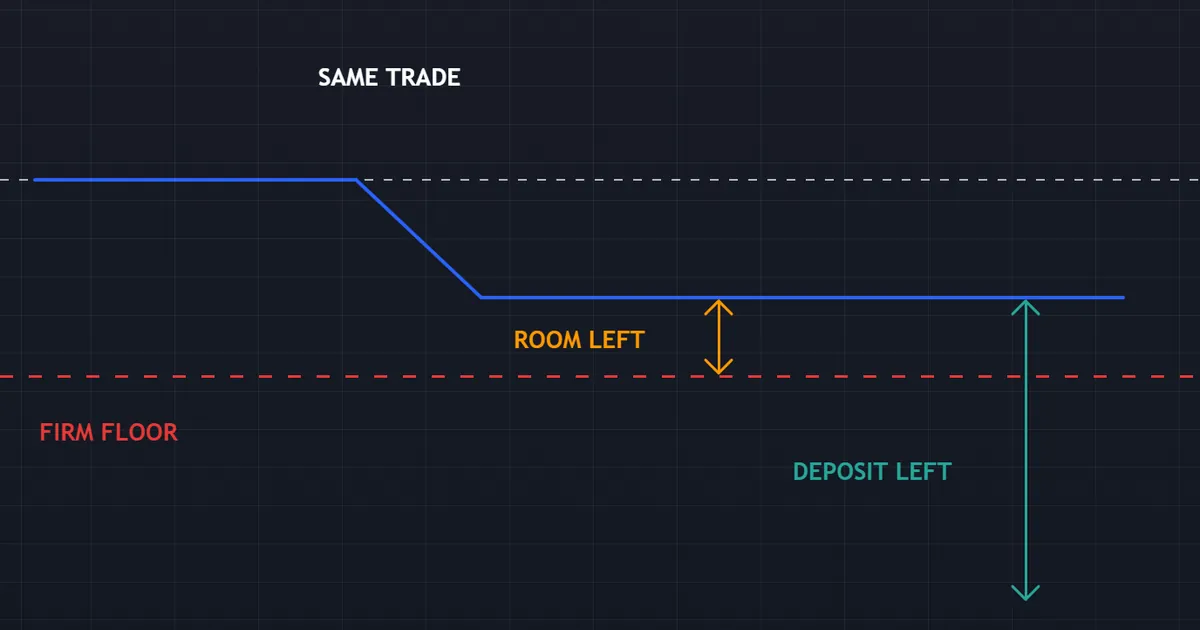
Numbers make the gap concrete, so place one identical trade in both worlds. Risk five hundred dollars on a single position.
At a broker with a ten thousand dollar deposit, that loss costs five percent of your own money. At a firm with a hundred thousand dollar account and a five thousand dollar floor, the same loss consumes a tenth of your total room.
The Same Trade at a Broker
Your balance drops, and nothing else changes. You can take the next trade at the same size or a smaller one.
So recovery sits entirely in your hands. Because no external limit exists, your own discipline provides the only brake.
The Same Trade at a Prop Firm
Your balance drops, and your remaining room drops with it. Nine more losses like that would end the account.
So the firm’s floor turns every loss into a countdown. Because the countdown never resets on most drawdown rules, the same trade carries far more weight.
Why the Countdown Matters
On your own account, ten losses leave you smaller but still trading. On a funded account, the tenth loss can close the door for good.
So the same method needs a smaller size under a firm’s floor. Because the floor never forgives, your sizing has to assume a bad run rather than a good one.
Download the complete indicator database
Put these concepts on your charts. One email unlocks the full library of 1,380+ indicators with compiled MT4 and MT5 files, plus my TradingView scripts. No paywall, no spam, unsubscribe any time.
Get free access to my indicator database
One email unlocks 1,380+ free MT4, MT5 and TradingView indicators — the complete library. No single-tool download; you get the whole database.
Regulation: The Biggest Practical Gap
Regulation separates the models more than any other feature. It also causes the most misunderstanding.
So learn what oversight covers on each side. Because the protections follow client money, the gap makes perfect sense once you see the logic.
What Broker Oversight Covers
Brokers that hold retail deposits usually need a license in each market they serve. Regulators then require capital buffers, client-money segregation, and reporting.
Many regimes cap leverage and add a compensation scheme as well. So a licensed broker operates inside a framework designed to protect the money it holds.
Why Prop Firms Often Sit Outside It
A prop firm takes no client deposits, so most of that framework simply does not reach it. Your payment counts as a purchase of a service.
So the arrangement rests on a commercial contract. Because no regulator supervises the terms, the rule book and the payout clause carry all the weight.
What That Means for You
Read the contract as carefully as a broker’s terms. Check the payout clause, the rule wording, and the entity you actually contract with.
Keep a dated copy of everything. Because disputes turn on the exact text, a saved rule book protects you better than any assumption about oversight.
Why the Two Models Keep Converging
The line between the models blurs a little every year. Both sides now borrow from each other.
So expect the labels to matter less over time. Because the underlying products overlap, judge each offer on its terms rather than its category.
Firms Acquiring Brokers
Several large prop firms have bought or launched regulated brokerages in recent years. The move gives them execution and a licensed home for client-facing business.
So some firms now sit on both sides of the fence. Because that structure changes who holds what, read the entity names on your paperwork.
Brokers Launching Evaluations
Brokers have noticed the demand and now run funded programs of their own. The mechanics mirror the prop model closely.
So the badge on the website tells you little. Because the rules and the custody arrangements decide your risk, read those instead.
How to Tell Them Apart Anyway
Ask one question: does the business want a deposit or a fee? A deposit points to a broker, while a fee points to an evaluation.
Then check who owns the balance you trade. So two short questions sort any offer, whatever the marketing calls it.
Common Confusions and Fixes
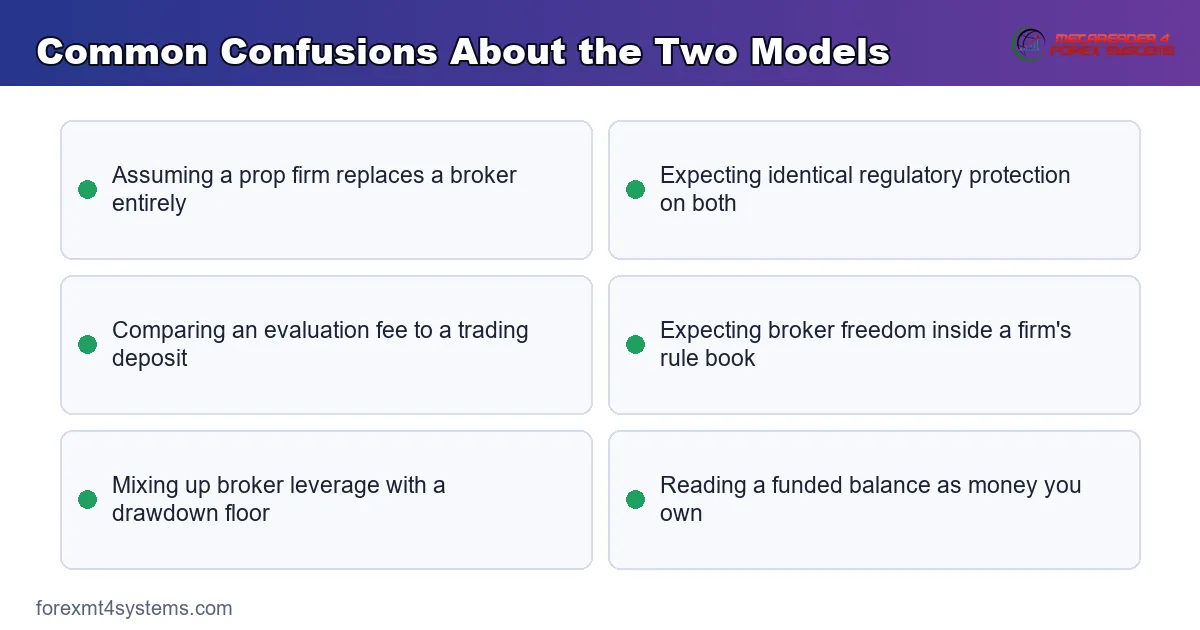
A few misunderstandings repeat constantly. The panel below gathers the ones worth clearing up.
Thinking a Prop Firm Replaces a Broker
Traders sometimes assume a funded account removes the broker entirely. Most firms route orders through one anyway.
So expect broker-style costs on a funded account too. Because spreads and commissions still apply, they still eat into your profit target.
Assuming Regulation Works the Same Way
A licensed broker and a prop firm sit in very different regulatory positions. Traders often assume the same protections cover both.
So check which entity you contract with and where it sits. Because the fee is a purchase rather than a deposit, no compensation scheme stands behind it.
Comparing Fees to Deposits
An evaluation fee looks tiny beside a trading deposit. The two figures answer different questions, though.
A deposit stays yours until you lose it in the market. A fee leaves your pocket immediately, so repeated attempts add up faster than they feel.
Expecting Broker Freedom on a Funded Account
Traders used to their own account bristle at news restrictions and daily caps. Those limits protect the firm’s capital, not yours.
So read the rule book before you pay. Because a method that needs wide freedom may not fit any firm, the check saves both time and money.
Mixing Up Leverage and Drawdown
A broker’s leverage sets how large a position you can open. A firm’s drawdown sets how much you can lose in total.
So high leverage on a funded account means very little. Because the drawdown floor binds first, that figure decides your real position size.
Treating the Funded Balance as Yours
The number on a funded account belongs to the firm. Only your share of realized profit ever reaches your pocket.
So read that balance as a scoreboard rather than savings. Because a breach erases it instantly, treating it as wealth invites reckless decisions.
Quick Reference: Which Is Which
Use this list whenever an offer looks hard to categorize.
- It holds your deposit and routes your orders: that is a broker.
- It charges a fee for a test, then funds you: that is a prop firm.
- It sets your spreads, leverage, and margin: broker territory.
- It sets profit targets and drawdown limits: prop firm territory.
- You keep all the profit: your own broker account.
- You split the profit: a funded arrangement.
- A regulator supervises client money: usually the broker side.
- A contract governs everything: usually the prop side.
Pitfalls Worth Knowing
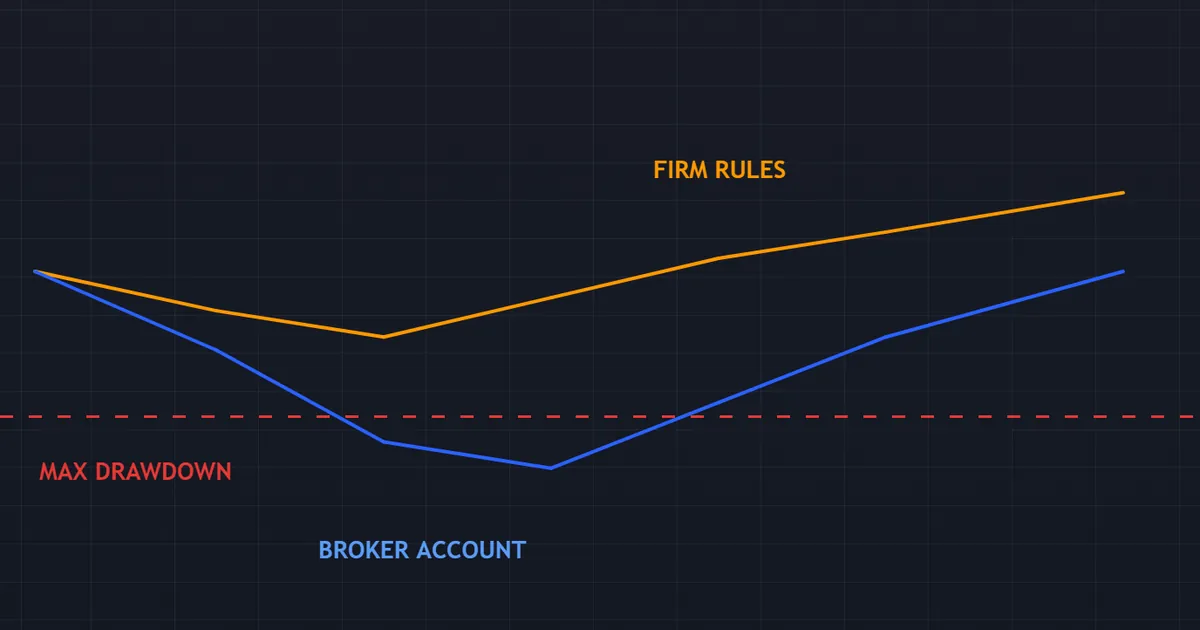
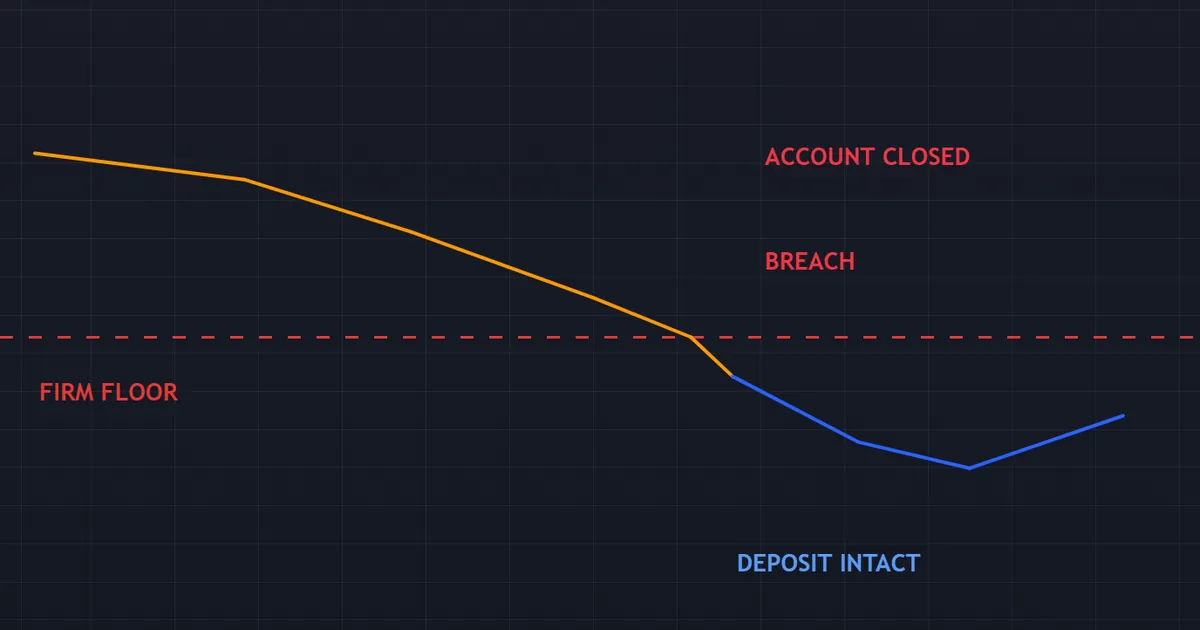
Each model carries risks worth naming plainly. The chart below shows an equity curve ending at a firm floor while a broker balance carries on below it.
Broker Pitfall: Nothing Stops You
A broker closes positions only when margin runs out. That point sits far below any sensible stopping place.
So write your own drawdown rule and honor it. Because the margin engine offers no protection worth the name, your discipline carries the whole load.
Prop Pitfall: The Rule Book Can Change
Firms update terms, and payout clauses sometimes shift. A contract without a regulator behind it leaves you fewer routes to appeal.
So keep dated copies and start small with any new firm. Because a first payout proves the loop works, treat it as the real test of a firm’s promises.
Shared Pitfall: Costs Hide in Both
Spreads, commissions, and swaps apply on either route. On a funded account they also shrink the profit that counts toward a payout.
So build costs into every plan. Because they compound quietly across a month, they decide plenty of near-miss results.
Related Concepts to Study Next
This comparison opens onto a few neighboring questions. Each short read fills in a different piece of the picture.
Start with the basics of what a prop firm is, then follow the revenue side in our guide to how prop firms make money. Because the choice often comes down to capital, weigh prop firm vs personal account next, then read what a funded trading account asks of you. For the habits behind both routes, review risk management in forex, and browse more in our prop trading library.
FAQ
What is the difference between a prop firm and a broker?
A broker sells market access and holds the money you deposit, so you trade your own capital and keep all the profit. A prop firm sells an evaluation, then funds an account with its own capital under strict rules and takes a share of the profit.
Is a prop firm a broker?
Usually not, though the two often work together. Most prop firms buy execution from a broker or liquidity provider and layer their rules on top. A few large firms have acquired brokerages, so one company can now operate in both roles.
Who holds my money at a prop firm?
Nobody holds it, because you never deposit trading capital. You pay a fee for a service, and the funded balance belongs to the firm throughout. So your savings stay in your own bank, while the fee itself carries no deposit protection.
Are prop firms regulated like brokers?
Generally no, and the reason is structural. Most financial rules attach to businesses that hold client money, and a prop firm holds none. So the arrangement rests on a commercial contract, which makes the rule book and the payout clause worth reading closely.
Do I still pay spreads on a funded account?
Yes, in almost every case. Firms route orders through a broker, so spreads, commissions, and swaps still apply. Those costs come out of the profit that counts toward your target and your payout, which makes an active style more expensive than a patient one.
Which should I choose, a broker or a prop firm?
It depends on your capital and your temperament. A broker account suits a trader with savings who wants full control, while a prop firm suits a trader with skill and little capital who can live inside a rule book. Many traders run both, and neither route removes the need for careful sizing. Results are not guaranteed; past performance is not indicative of future results.
External references
- For background on this concept, see Broker on Wikipedia.
- For broader market context, see Broker at Corporate Finance Institute.

About the author
Written by Dominic Walsh, a Forex trader and MT4/MT5 indicator, Expert Advisor and script developer. Every tool on forexmt4systems.com is tested on live charts before release and ships with ready-to-use compiled MT4 (.ex4) and MT5 (.ex5) files. Learn more about the trader and developer behind this site.
How we build, test and correct every tool: Editorial & Testing Policy. Trading carries risk; see the disclaimer.