
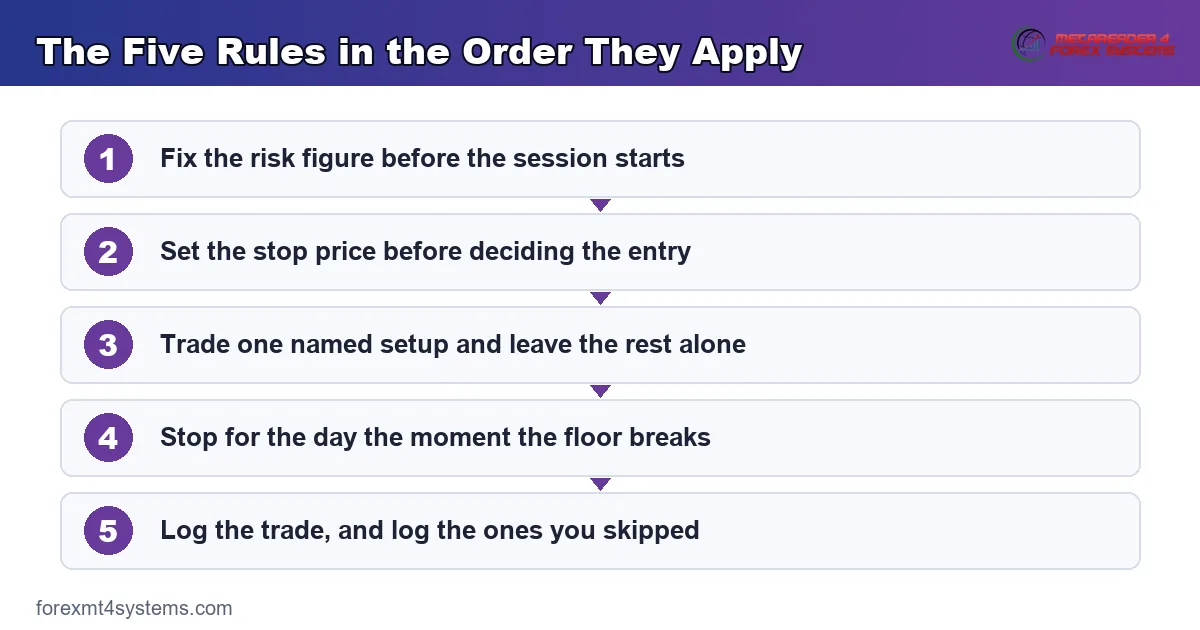
Every list of trading rules for beginners runs to ten items, and most of those items exist to round the number up. Five rules carry almost all of the weight.
The five below share one property. Each names a specific failure it prevents, so you can tell whether it earned its place on your desk.
Which Trading Rules for Beginners Actually Matter
Early losses rarely come from poor analysis. They come from size, from missing stops, from trading after a bad morning, and from having no record of any of it.
So the useful rules address behaviour rather than prediction. None of them tells you what to buy, and that omission is deliberate.
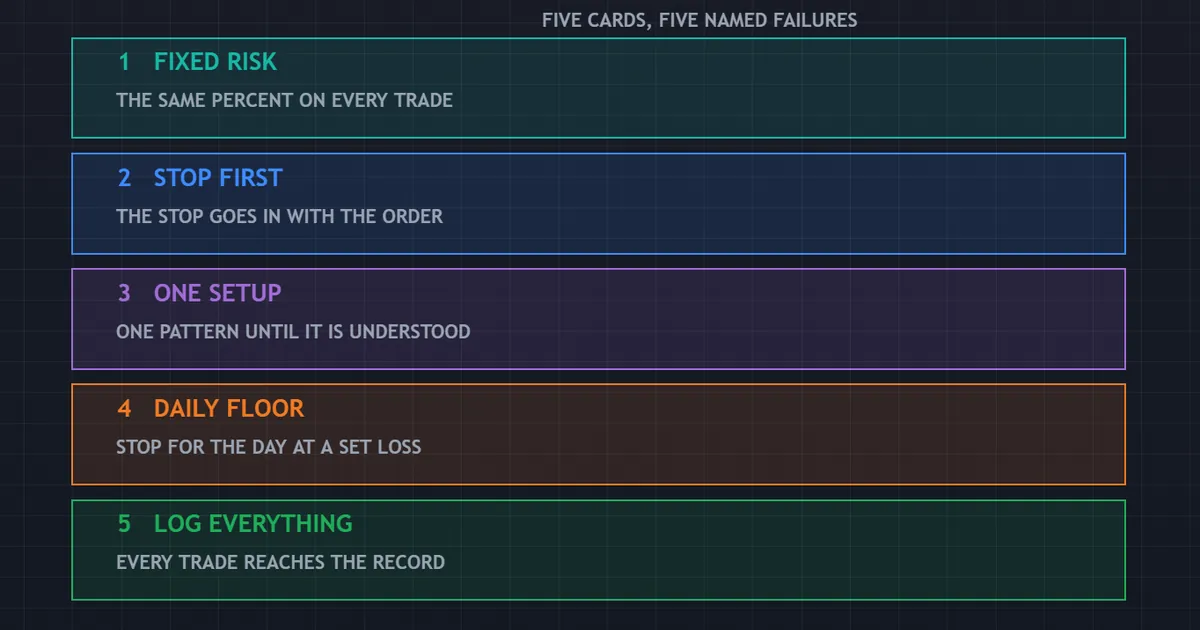
The panel above holds the whole set. Five cards, five failures, and nothing added to reach a rounder total.
Five, Not Ten
Longer lists feel more thorough. In practice they dilute attention, because a rule you cannot recall under pressure protects nothing.
Ten-item lists also tend to mix levels. “Risk one percent” and “trade with the trend” belong in different documents, since one governs money and the other governs strategy.
Keep strategy out of your rules for now. The rules exist to keep you solvent while your strategy takes shape.
Each Rule Names the Failure It Prevents
A rule without a named failure quietly becomes a preference. Preferences bend, and they bend hardest on the days that matter.
Test any rule you add later against that standard. Ask which specific bad outcome it blocks, and drop it when the answer stays vague.
What These Rules Deliberately Leave Out
No entry criteria appear here. Nothing about indicators, timeframes, sessions or pairs makes the list either.
Those choices belong to strategy, and strategy varies enormously between traders. Two people running opposite methods can follow all five of these rules without contradiction.
Splitting the two documents also keeps your review honest. When a quarter goes badly, you can ask whether the strategy underperformed or whether the rules simply went unfollowed.
Rule One: Fix Your Risk Per Trade
Choose one figure and apply it everywhere. Half a percent of the account suits most people starting out, and one percent sits at the upper end.
Then hold that figure through good weeks and bad ones. Stability matters far more than the exact number you pick.
The Failure It Prevents
Size creep. After three losses in a row, doubling up feels like the fastest route back, and after three wins it feels deserved.
Both instincts destroy the arithmetic. One oversized loss can wipe out weeks of small, careful ones, and it usually lands on the trade you felt most certain about.
How to Set the Number
Work backwards from a losing streak you could sit through. Ten consecutive losses at one percent take roughly a tenth off the account, which stings without ending anything.
Our guide on risk per trade walks through the choice in detail, including when to change it.
Rule Two: The Stop Price Exists Before the Entry
Decide where the idea dies first. Only then work out where to get in.
That order sounds pedantic until you watch it fail. Traders who enter first place the stop where the loss feels bearable, and price has no interest in what feels bearable.
The Failure It Prevents
An open-ended loss. Without a defined invalidation price, a trade has no maximum size, so a single position can run until it dwarfs your intended risk.
Mental stops fail the same way. They work perfectly on calm days and evaporate exactly when a real one would matter.
A resting order executes even when your connection drops or your laptop sleeps. That single fact settles most arguments about keeping the level in your head.
Where the Stop Belongs
Behind a structure, not at a round distance you chose for comfort. A prior swing, a session extreme or a multiple of recent range all give the level a reason to exist.
Then size the position from that distance. Wide stops call for smaller lots, and our risk reward calculator shows what the resulting trade looks like before you send it.
Rule Three: One Setup at a Time
Pick a single named entry and trade only that for the first few months. Everything else waits.
Beginners usually run four or five ideas at once, which sounds like diversification. It is closer to noise, since none of the five collects enough occurrences to judge.
The Failure It Prevents
An unreadable record. Twenty trades spread across five setups leave four examples each, and four examples tell you nothing whatsoever.
Concentration fixes that. Forty trades on one setup start to describe something, especially when every one of them cleared the same conditions.
One setup also shortens preparation. Scanning six pairs for a single pattern takes minutes, while scanning the same pairs for five patterns turns into an evening job.
How Long to Wait Before Adding a Second
Give the first setup fifty trades or three months, whichever takes longer. Then read the record before you decide anything.
Adding a second setup earlier feels productive and usually is not. Our note on overtrading covers the itch behind that impulse.
Rule Four: A Daily Loss Limit You Cannot Argue With
Set a floor for the day before the day starts. Two or three times your per trade risk works for most traders.
Hit the floor and the platform closes. No last attempt, no smaller size to feel better, nothing until tomorrow.
The Failure It Prevents
The spiral. Almost every account-ending session follows the same shape: a loss, a larger position to recover it, a bigger loss, then panic sizing.
A floor cuts that sequence at the second step. It works because it removes the decision from a moment when your judgement runs at its worst.
Notice how the spiral needs no unusual market. An ordinary choppy morning produces it just as reliably as a crash, since the driver sits on your side of the screen.
Making the Floor Enforceable
Write the number where you can see it, then close the terminal when it breaks. Some traders hand the password to a partner for the rest of the day.
Our guide to the daily loss limit covers how to pick a floor you will actually respect.
Download the complete indicator database
Put these concepts on your charts. One email unlocks the full library of 1,380+ indicators with compiled MT4 and MT5 files, plus my TradingView scripts. No paywall, no spam, unsubscribe any time.
Get free access to my indicator database
One email unlocks 1,380+ free MT4, MT5 and TradingView indicators — the complete library. No single-tool download; you get the whole database.
Rule Five: Log Every Trade, and the Ones You Skipped
Record entry, stop, target, setup name and the reason, before the order goes out. Add the outcome afterwards.
Then log the setups you passed on. Skipped trades reveal your filters, and nobody remembers them accurately by Friday.
The Failure It Prevents
Hindsight rewriting your history. Memory keeps the trades that confirm what you already believe and quietly drops the rest.
A written record settles arguments you would otherwise have with yourself. It also turns “I keep losing on Mondays” from a feeling into a countable fact.
Keep It Small Enough to Survive
Six fields beat twenty-six. Elaborate journals get abandoned inside a fortnight, while a short one survives for years.
Our free trade journal holds the essential fields, and a plain spreadsheet does the job just as well.
Add columns later, once the habit holds. Traders who start with a twenty-field template usually end up with three months of blank cells and no usable history.
Why the Order of the Rules Matters
The five sit in sequence for a reason. Each one leans on the ones above it, so skipping ahead breaks the chain.
Sizing Depends on the Stop
You cannot hold a fixed risk per trade without a stop distance to divide by. Rules one and two therefore work as a pair, and neither functions alone.
Traders who choose a lot size first have picked their risk by accident. Whatever distance the stop ends up at then decides what that trade really costs.
The Floor Depends on the Risk Figure
A daily floor means little without a fixed per trade risk behind it. Two losses might cost fifty dollars or five hundred, depending entirely on how you sized them.
Fix rule one and the floor becomes countable. Three losses ends the session, and everybody understands what three losses means.
The Log Depends on Everything Above
A journal full of trades with varying size, varying stops and varying setups records activity rather than a process. Sorting such a record teaches almost nothing.
Hold the first four rules and the fifth earns its keep immediately. Every row then differs only in the things you actually wanted to test.
Working the Five Rules Through One Trade
Abstract rules stay abstract until you run them once. Take a five thousand dollar account and one setup on the daily chart.
Before the Order Goes Out
Half a percent of that account gives twenty-five dollars of risk. Rule one supplies the figure, and it does not move because this particular setup looks unusually clean.
Next comes the stop. Say the structure behind the idea sits thirty pips below your intended entry, so the stop goes there and the entry follows from it.
Position size then falls out of the two numbers. Twenty-five dollars over thirty pips of distance produces the lot size, and a calculator settles it in seconds.
While the Position Runs
Rule three keeps you off the other three charts you were watching. One setup means one position, so the rest of the screen becomes reference material rather than temptation.
Rule four sits quietly in the background. Two losses of twenty-five dollars each bring the day to its floor, so any third idea waits until tomorrow.
After the Exit
Rule five closes the loop. The journal row already held entry, stop, target and setup name, so only the result and a one-line note remain.
Total time spent on rules across the whole trade: under three minutes. That small cost buys a record you can still read in March.
What the Five Rules Look Like on an Account
Rules become concrete once you picture the equity line they produce. Consider fifty trades run with all five held.
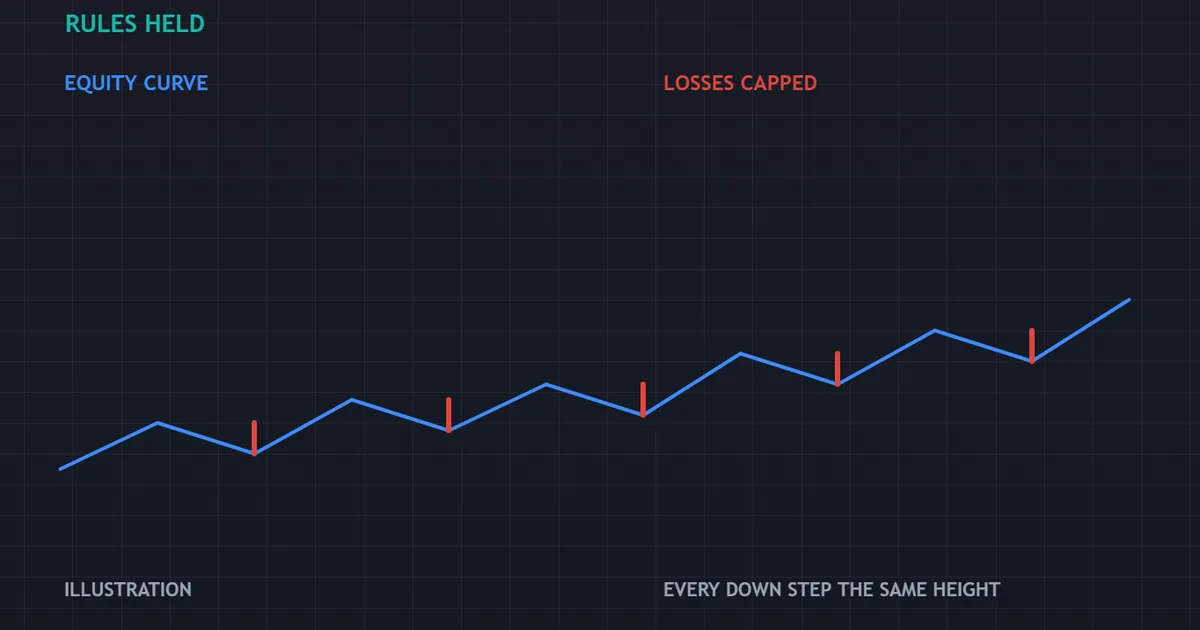
The panel above shows the resulting equity curve. Notice the shape rather than the direction: every loss lands at the same height, so no single trade decides the outcome.
What the Shape Tells You
Uniform losses mean the sizing rule held. Uneven ones mean it did not, whatever the trader remembers.
The curve makes no promise about profit, and neither do the rules. What the rules deliver is a record where the process stays visible.
That visibility is the real payoff. Without it, you cannot tell a poor strategy from poor execution of a decent one.
Common Mistakes and Their Fixes
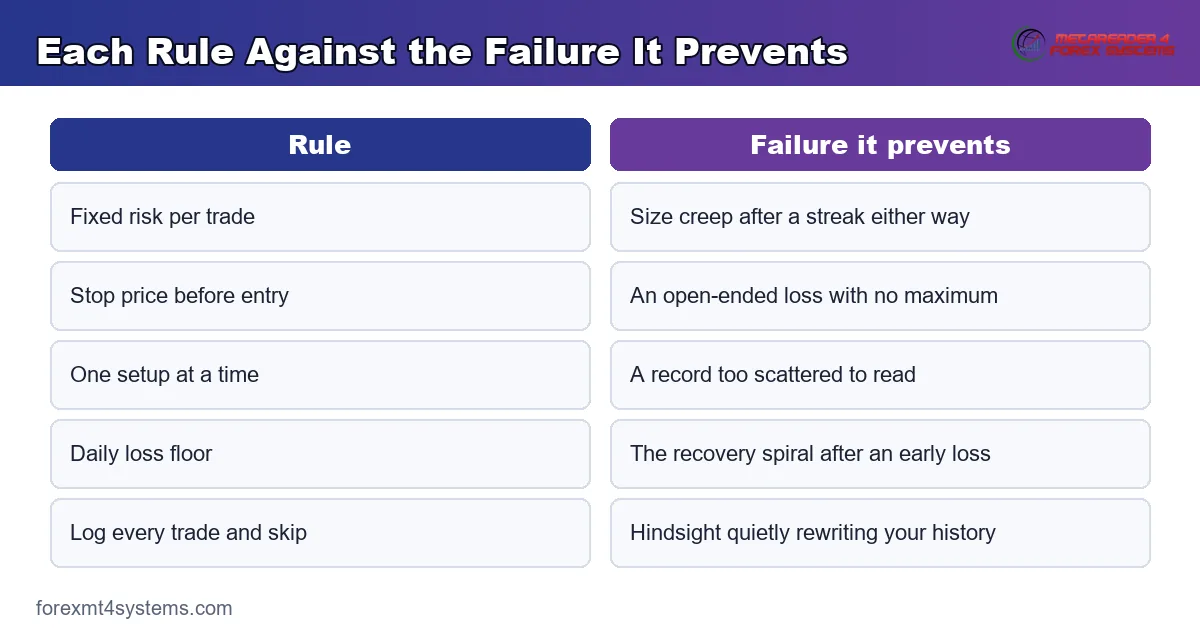
Five habits break the rules while appearing to follow them. The panel below pairs each rule with the failure it exists to block.
Treating the Risk Figure as a Maximum
Traders often risk less on setups they dislike and more on ones they love. That turns a fixed fraction into a confidence bet, and confidence has a poor record as a sizing input.
Moving the Stop Away
Widening a stop mid-trade converts a planned loss into an unplanned one. Move a stop toward the entry if you must, never away from it.
Counting the Floor in Percentage Terms Only
A floor stated only as a percentage drifts as the account grows. Restate it in currency terms each month so the number stays real to you.
Logging Only the Losses
Half a record misleads more than none. Log winners with the same detail, because the sloppy entries that happen to work teach the most dangerous lessons.
Rewriting the Rules After a Bad Week
Rules changed under stress reflect the stress, not the evidence. Book a fixed review date each quarter and hold every change until then.
The Quick Reference Table
Print this and keep it beside the screen. Each row states the rule, the test and the failure it removes.
| Rule | How you check it | Failure it prevents |
|---|---|---|
| Fixed risk per trade | Amount at risk equals the same figure every time | Size creep after a streak in either direction |
| Stop before entry | Exact stop price stated before the ticket opens | An open-ended loss with no maximum |
| One setup at a time | Every trade carries the same setup name | A record too scattered to read |
| Daily loss floor | Closed result for the day sits above the floor | The recovery spiral after an early loss |
| Log everything | A row exists for each trade and each skip | Hindsight quietly rewriting your history |
Notice that none of the five mentions a chart pattern. That gap is intentional, since strategy belongs in a separate document.
What Happens When the Rules Break
Broken rules rarely announce themselves. The damage shows up in the shape of the equity line long before it shows up in your memory.
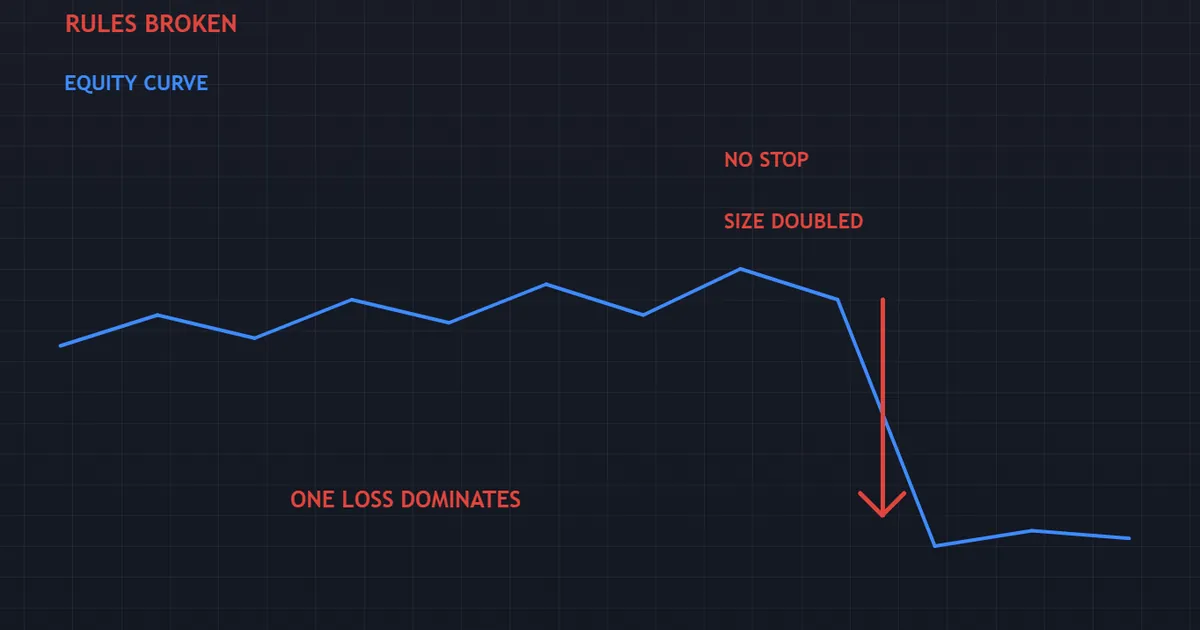
The panel above runs the same account with the rules broken. One unsized, unstopped position dominates the entire line, and the other forty-nine trades barely register.
One Trade Should Never Matter That Much
When a single position outweighs fifty others, the sizing rule failed. Everything downstream of that failure becomes noise.
Reviewing such a month teaches almost nothing about strategy. The only readable lesson concerns the rule that broke.
Rebuilding After a Break
Cut size in half for the next twenty trades. Small positions restore the habit without the pressure that broke it.
Then read the journal entries around the break. Traders usually find a skipped floor or a widened stop sitting one or two trades earlier.
Rules That Sound Important and Are Not
Plenty of popular advice belongs somewhere other than a beginner rule list. Three examples come up constantly.
Never Trade Against the Trend
Reasonable strategy advice, and a poor rule. Trend definitions vary by timeframe, so the instruction cannot pass or fail cleanly.
Cut Losses Short and Let Winners Run
The phrase describes an outcome rather than an action. Replace it with your exit rules, which name actual prices.
Only Trade the London Session
Useful for some strategies and irrelevant for others. Session choice follows from what you trade, so it sits inside the plan rather than above it.
Making the Rules Stick Past Week Three
Almost everyone follows five rules for a fortnight. The interesting question concerns week three, once the novelty wears off.
Attach Each Rule to a Moment
Rules fail when they float free of the day. Tie the risk figure to your session start, the floor to your closing routine, and the log to the moment a position closes.
A rule with a home tends to survive. A rule that merely exists on paper competes with everything else for your attention.
Count Adherence, Not Outcomes
Score each week on how many trades followed all five rules. Five out of five during a losing week beats three out of five during a good one.
That scoring feels strange at first. It works because you control adherence directly, whereas outcomes arrive with a great deal of noise attached.
Expect One Rule to Break First
Most traders carry a weak point, and it stays the same for years. For some the weakness concerns size, for others the daily floor.
Find yours in the journal, then build friction around that single rule. Effort spread evenly across all five achieves far less.
Always Use a Two to One Reward Ratio
A sensible default, and still a strategy choice rather than a rule. Some methods run near one to one with a higher strike rate, while others need four to one before the arithmetic works at all.
Related Guides Worth Reading Next
Rules live inside a plan. Our guide to what a trading plan is shows the document these five belong to.
After that, add the gate. Our pre trade checklist turns each rule into a yes or no answered before the order, and our explainer on the R multiple gives you a single unit for measuring whether any of it works.
Traders who want conditions flagged on the chart can browse our MetaTrader indicators library. Tools of that kind prompt you, and the decisions remain yours.
FAQ
Are five trading rules for beginners really enough?
For the first year, yes. The five cover sizing, invalidation, focus, daily damage and record keeping, which between them account for most early account damage. Extra rules usually belong in your strategy document rather than your rule list. Add a sixth only when your own journal shows a repeating failure that none of the five would have blocked.
What risk figure should a beginner use?
Somewhere between a quarter and one percent of the account per trade. Lower figures let you survive a long losing streak while you learn, and they keep any single mistake from mattering too much. The exact number matters far less than applying it identically to every trade, since consistency is what makes your results readable later.
Can I trade without a stop if I watch the screen?
Watching is not a stop. A live order sits at the broker and executes whether your connection holds, whether you step away, and whether the move happens in three seconds. Screen-watching also tends to convert a small planned loss into a larger negotiated one, because the decision arrives while the position argues with you.
How strict should the daily loss floor be?
Strict enough that arguing with it feels absurd. Two to three times your per trade risk suits most traders, so two or three full losses end the session. Some traders also add a weekly floor at roughly double the daily one. Whatever you choose, write it down before the week starts, never during a losing morning.
Should I log demo trades too?
Log them with the same fields, and read them separately. Demo records tell you a great deal about execution, timing and rule adherence, though almost nothing about how you behave when real money moves. Keep the two sets apart so the demo sample does not flatter your live statistics.
Do these rules apply to prop firm accounts?
They apply, with one addition. Prop programmes impose their own daily and overall loss limits, and those sit outside your control, so your personal floor should land comfortably inside the firm’s. Traders who set the two at the same level leave no margin for a weekend gap or a slipped fill, which turns an ordinary bad day into a breached account.
When should these rules change?
On a schedule, not on a feeling. Set a quarterly review, read the journal, and change one rule at a time so you can tell which change did what. Rules edited during a drawdown almost always loosen rather than tighten, which is exactly backwards. Give any change fifty trades before judging it, and treat every conclusion as provisional. Results are not guaranteed; past performance is not indicative of future results.
External references
- For background on this concept, see Rule of Thumb on Wikipedia.
- For broader market context, see Risk Management at Corporate Finance Institute.

About the author
Written by Dominic Walsh, a Forex trader and MT4/MT5 indicator, Expert Advisor and script developer. Every tool on forexmt4systems.com is tested on live charts before release and ships with ready-to-use compiled MT4 (.ex4) and MT5 (.ex5) files. Learn more about the trader and developer behind this site.
How we build, test and correct every tool: Editorial & Testing Policy. Trading carries risk; see the disclaimer.