
Almost every broker site claims to be regulated. The word appears in the footer, next to a logo, and nobody checks it.
So what is a regulated forex broker in practice? It is a firm that holds a licence from a named authority, follows that authority’s rules on client money and capital, and appears on a public register you can search yourself.
What Is a Regulated Forex Broker, Exactly
A licence is a permission, not a badge. Someone granted it, and someone can take it away.
A Named Authority Grants It
A financial authority reviews the firm before it opens. It checks the owners, the money, the systems and the staff.
The firm then reports to that authority for as long as it trades. Audits and filings follow every year.
Rules Come Attached
The licence carries duties. Client money must sit apart from company money, and capital must cover the risk the firm takes.
Marketing rules apply too. So do rules on how orders get handled and how complaints get answered.
A Public Register Proves It
Every serious authority publishes a searchable list. You type a name or a number, and the entry comes back.
If the firm is not on the register, the claim is empty. That test takes about two minutes.
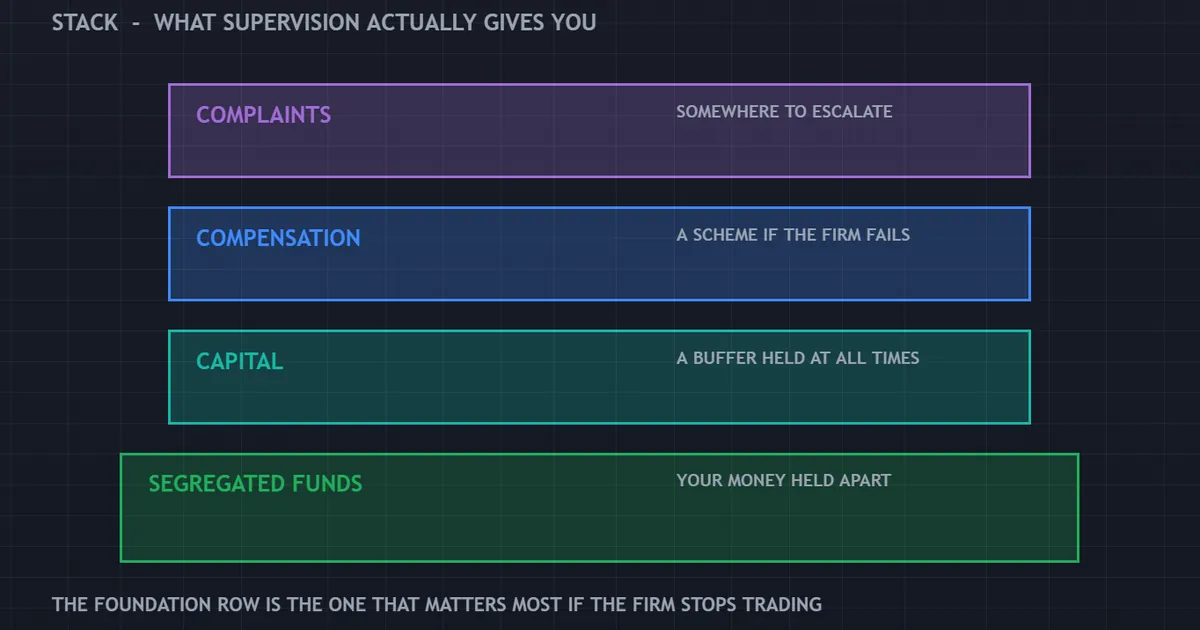
The Four Protections That Matter
People say “regulated” and mean four separate things. Take them one at a time.

Segregated Client Funds
Your deposit sits in a bank account kept apart from the firm’s own money. It cannot fund salaries or marketing.
If the company fails, that pot should still hold client cash. Segregation is the single most valuable rule on this list.
Capital Requirements
A licensed firm must hold a minimum amount of its own money at all times. The figure rises with the risk it carries.
Capital absorbs shocks. A broker with a thin cushion breaks during a violent move, and clients feel it.
A Compensation Scheme
Some countries refund clients up to a cap when a licensed firm collapses. In the United Kingdom that scheme covers up to eighty five thousand pounds per person.
Caps and coverage differ by country. Many places offer nothing at all, so read this line carefully.
Note that a scheme covers firm failure, never trading losses. That distinction catches people out constantly.
A Complaints Route
You can escalate past the broker to an ombudsman or the authority itself. That route costs nothing in most countries.
Without it, a dispute ends at the broker’s support desk. Our guide to forex broker withdrawal problems covers how to use that route.
How to Check a Licence in Five Minutes
The check is simple, and most people skip it. Six steps.
- Scroll to the footer. Find the legal entity name and the licence number printed there.
- Note the country. The entity name usually ends with a clue, and the small print names the authority.
- Open the register directly. Type the authority’s address yourself. Never click the broker’s own link.
- Search the number. Numbers beat names, since names repeat across countries.
- Match the entity. The name on the register must match the name in your client agreement exactly.
- Read the permissions. The entry lists what the firm may do. Payment services and investment dealing are not the same thing.

Why the Number Beats the Logo
Logos get copied. A number ties the claim to one entry on one register.
Clone firms exist and copy real details. So type the register address yourself, then search from there.
What a Clean Entry Looks Like
Status reads active. The address matches the site. The permissions cover dealing in investments as principal or as agent.
Anything marked lapsed, restricted or withdrawn is a stop sign. Close the tab.
Warnings Lists Are Worth a Look
Most authorities publish a separate list of firms they have flagged. The FCA, ASIC and CySEC all run one.
Search the brand name there as well as on the main register. A hit takes seconds to find and saves months of trouble.
Check a second country too if the group operates widely. Warnings do not always cross borders quickly.
The Main Authorities and What They Cover
Six names cover most of the retail market. Each one behaves differently.
United Kingdom
The Financial Conduct Authority, known as the FCA, licenses firms in the United Kingdom. It caps retail leverage, requires negative balance protection and backs the compensation scheme.
Its register is public and easy to search. Rules on marketing are strict, and firms must show a risk warning on the front page.
Complaints can go to the Financial Ombudsman Service once the broker replies. That step costs the client nothing.
European Union
Each country licenses its own firms. CySEC covers Cyprus, and BaFin covers Germany.
ESMA sets the common standard across the bloc. Leverage caps and risk warnings come from that standard, so a Cyprus licence and a German licence share a floor.
United States
The Commodity Futures Trading Commission, or CFTC, oversees retail forex. The National Futures Association, the NFA, handles membership and day to day supervision.
Rules there are the tightest in the world. Leverage is low, hedging on one account is barred, and very few firms bother to apply.
Australia
The Australian Securities and Investments Commission, known as ASIC, licenses local firms. It cut retail leverage sharply and required negative balance protection.
Its register is public. Standards sit close to the European level.
Switzerland and Elsewhere
FINMA supervises Swiss firms, which often hold banking status as well. That bar is high and few retail brokers clear it.
Japan, Canada and Singapore run their own strong regimes. Each caps leverage and each publishes a register.
Our guide to forex regulatory bodies goes through the main ones in detail, and it explains what each body can actually enforce.
Download the complete indicator database
Put these concepts on your charts. One email unlocks the full library of 1,380+ indicators with compiled MT4 and MT5 files, plus my TradingView scripts. No paywall, no spam, unsubscribe any time.
Get free access to my indicator database
One email unlocks 1,380+ free MT4, MT5 and TradingView indicators — the complete library. No single-tool download; you get the whole database.
Strong Licence Versus Offshore Registration
Here is the distinction that costs people money. Registration is not regulation.

What Offshore Usually Means
A company gets incorporated in a small jurisdiction. It pays a fee and receives a certificate.
Often no rules on client money follow. No compensation scheme exists, and no ombudsman will read your file.
Why Firms Use It
Offshore entities can offer leverage that European or Australian rules forbid. They can accept clients that stricter regimes exclude.
That freedom is the product. Our note on leverage in forex explains why the high number rarely helps you.
How the Two Get Mixed Up
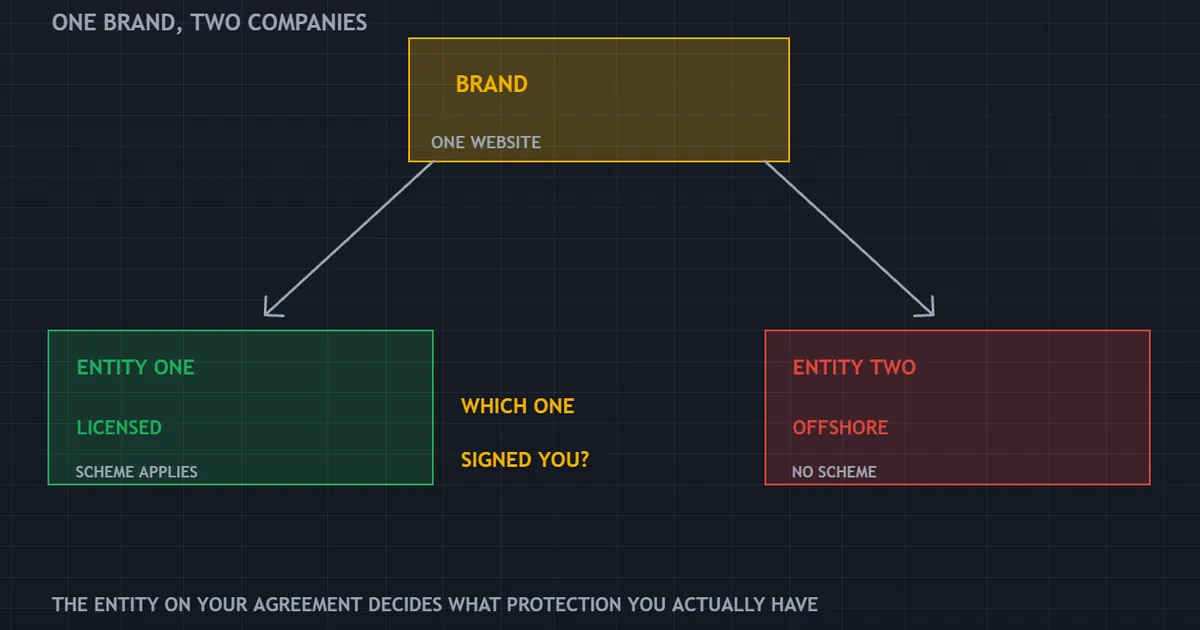
A site shows a strong licence at the top and signs you to an offshore entity at checkout. Both statements are true, and only one applies to your account.
Read the client agreement before you fund anything. The entity named there is the one holding your money.
The Entity Trap
One brand, several companies. This catches careful people, not just careless ones.
Same Website, Different Company
Large groups run parallel entities in several countries. The website looks identical for all of them.
Your country of residence decides which one you get. Sometimes a dropdown decides it instead.
Where to Look
Check three places: the client agreement, the deposit page, and the small print in the footer. All three should name the same company.
A mismatch is not always sinister. It still deserves a direct question before you send money.
Watch the Sign-Up Path
Some sites switch entity halfway through the form. A country dropdown, a tick box, or a redirect can move you.
Read the final page before you confirm. The company named on the last screen is the one you are hiring.
Save a copy of that page as well. Terms change, and a dated screenshot settles arguments later.
Why It Matters So Much
Protections travel with the entity, never with the brand. Segregation, compensation and complaints all sit at company level.
So the logo tells you nothing useful. The company name tells you everything.
What Regulation Does Not Do
Oversold promises help nobody. Three honest limits.
It Does Not Protect Your Trades
No authority refunds a losing position. Rules cover conduct and client money, not outcomes.
Trading losses stay yours under every licence in the world.
People sometimes complain to an authority about a losing month. Those files go nowhere, and they crowd out the cases that matter.
It Does Not Make Execution Perfect
Spreads still widen. Stops still fill in gaps. Thin markets still exist on a Friday evening.
A licence sets standards for handling orders fairly. It cannot create liquidity that is absent.
It Does Not Prevent Failure
Licensed firms have collapsed before, usually after a violent market move. Segregation and compensation limit the damage rather than removing it.
So spread balances across firms, and withdraw profits regularly. Our position size calculator helps keep any single account small enough to lose.
Warning Signs Worth Acting On
Behaviour beats reputation. Watch for patterns rather than single events.
Vague Licensing Language
Phrases like “internationally regulated” or “fully licensed” without a number mean nothing. A real firm prints the authority and the number plainly.
Ask for both. A slow or confused answer is the answer.
Pressure to Deposit More
Calls urging bigger deposits or bonus offers tied to trading volume are red flags. Licensed firms in strict regimes cannot legally do most of it.
Our guide to forex broker red flags lists the full set of behaviours.
Withdrawals That Drift
A first withdrawal that stalls behind new document requests is the strongest signal on this page. Test the process early with a small amount.
Do that before your balance grows. A small test costs almost nothing and tells you a great deal.
If Something Goes Wrong
A complaint has a path. Follow it in order.
Start With the Firm
Write to the broker in one clear message. State the ticket numbers, the dates and what you want.
Keep everything in writing. Phone calls leave no trail worth using later.
Escalate to the Authority
If the reply fails, take the file to the regulator or the ombudsman. Most publish a form and a deadline.
Evidence decides these cases. Screenshots, statements and timestamps do the work.
Know When to Stop
Offshore entities usually have no route above them. Chasing one costs months and rarely returns anything.
That is the whole argument for checking a register first. Prevention here is cheap, and the cure often does not exist.
A Plain Way to Think About It
Drop the jargon and the idea gets easy. Think about a taxi.
The Licensed Cab
A licensed cab carries a plate with a number on it. The city knows the driver. Every year that car passes a test.
If the ride goes wrong, you have somewhere to call. The number on the plate ties the trip to a real person.
The Unlicensed Car
Another car pulls up. It looks the same. The driver may be fine, and you have no way to know.
No plate, no test, no phone number to call. You are trusting a stranger with nothing behind him.
The Same Logic Applies Here
A licence does not make the driver good. It makes him traceable, and it gives you a route when things break.
Brokers work the same way. So check the plate before you get in.
What Changes Under a Strict Regime
Strict rules alter the product you get. Three visible changes.
Leverage Drops
Caps in Europe, the United Kingdom and Australia hold retail leverage on major pairs to a low multiple. Positions get smaller as a result.
People treat that as a loss. In practice it slows the rate at which small accounts disappear.
Bonuses Vanish
Deposit bonuses and trading credits are banned or heavily limited in strict regimes. Offers tied to volume disappear with them.
A large bonus offer therefore tells you which rulebook applies. Read it as a clue, not as a gift.
Risk Warnings Appear
Firms must publish the share of retail accounts that lose money. The figure sits at the top of the page by law.
Those numbers are usually high, and they are honest. A site with no warning at all is operating under different rules.
Testing a New Broker Safely
Verification tells you about the paperwork. A small test tells you about the firm.
Deposit a Small Amount
Send the minimum the account allows. Treat the money as the cost of the test.
Nothing about a large first deposit helps you. It only raises what you stand to lose while learning.
Trade Lightly for Two Weeks
Place small trades in quiet hours. Watch the spread at the daily rollover and note how fills behave.
Keep a short log. Screen price, ticket price, time and conditions cover it.
Withdraw Before You Add More
Request a withdrawal early, even a tiny one. Count the days it takes and note every document they ask for.
A smooth first withdrawal is the best sign you will get. A slow one is the cheapest warning you will ever buy.
Then Scale Slowly
Add funds in steps rather than all at once. Keep enough elsewhere that one firm failing does not end your trading.
Two smaller accounts beat one large one for this reason alone.
Quick Reference
Keep this open while you read a broker’s small print.
| Check | Where to look | What a good answer looks like |
|---|---|---|
| Legal entity | Client agreement | One company, named consistently |
| Licence number | Footer and register | Active entry, matching address |
| Client money | Terms and register entry | Segregated at a named bank |
| Compensation | Terms and scheme site | A capped refund if the firm fails |
| Complaints | Terms | An ombudsman or authority named |
| Leverage offered | Account page | In line with the local cap |
| Negative balance | Terms | Protection stated for retail clients |
Common Mistakes
Four habits cause most of the damage. Each fix takes a minute.
Trusting a Review Site
Many comparison pages earn a fee per signup. Rankings follow the fee more often than the licence.
Use them for names only. Then verify each name on the register yourself.
Clicking the Broker’s Own Link
A link on the broker’s site can point anywhere. Type the authority’s address into the bar yourself.
Clone firms rely on people skipping that step.
Assuming a Big Brand Is Safe
Size is not supervision. A well-known name can still route your account through a weak entity.
Check the company that signs your agreement, every time.
Confusing Prop Firms With Brokers
A funded account provider is usually not a licensed broker at all. Different rules, different protections, different risks.
Our guide asking are prop firms legit covers that gap. If you would rather focus on the chart, our MT5 indicators library is a better use of an hour.
FAQ
How do I check a broker’s licence?
Find the entity name and licence number in the footer or the client agreement. Then open the authority’s register by typing its address yourself, and search the number. Match the entity name, the address and the permissions against what the broker claims. If any of the three fails to match, stop there.
Is an offshore broker always unsafe?
Not always, but you carry the risk alone. Offshore registration usually brings no rules on client money, no compensation scheme and no complaints body above the firm. Some honest companies operate that way, and you have no route to recover funds if one fails.
Does the register tell me if a broker is good?
No, and it does not try to. A register entry proves that a licence exists, that it is active, and that the firm may do certain things. Service quality, pricing and execution are separate questions, and your own records answer those better than any list.
What if my broker is licensed somewhere I have never heard of?
Look up the authority itself before you judge the firm. Read what rules it sets on client money, capital and complaints, then see whether a public register exists. Some smaller countries run serious regimes, and others sell certificates. The rulebook tells you which one you are dealing with.
Which authority is the strictest?
The United States regime, run by the CFTC with the NFA, sets the tightest rules for retail forex. Leverage is low and few firms bother to apply. The FCA, ASIC and the European standard from ESMA sit close behind, and all four are far ahead of any offshore certificate.
Does a licence protect me from losing money?
No. Rules cover conduct, client money and capital, and nothing covers your trading decisions. A licensed firm can still hand you losses every month, because the market does that, not the broker.
What is negative balance protection?
It stops your account going below zero after a violent gap. The rule is mandatory for retail clients under several regimes, including the United Kingdom, the European Union and Australia. Our guide to negative balance protection covers what it does and does not cover.
Why does one broker have several licences?
Because groups run separate companies in separate countries. Each entity holds its own licence and serves its own clients. Only the entity in your client agreement matters to you, whatever the homepage displays.
Is high leverage a sign of a bad broker?
It usually signals a jurisdiction with light rules rather than a dishonest firm. Strict regimes cap retail leverage because large positions on small deposits destroy accounts quickly. Treat a very high figure as a clue about the licence, then check the register.
Can a regulated broker still fail?
Yes. Licensed firms have collapsed after extreme market moves, most memorably when a central bank abandoned a currency peg. Segregation and compensation schemes limit the loss instead of removing it, which is why spreading balances across firms is sensible.
What should I do before funding a new account?
Verify the entity on the register, read the client agreement for the counterparty clause, confirm the compensation scheme and the complaints route, deposit a small amount, and test a withdrawal before adding more. Those five steps take under an hour and remove most of the risk that traders actually meet. Results are not guaranteed; past performance is not indicative of future results.
External references
- For background on this concept, see The Financial Services Register at the FCA.
- For broader market context, see Check a Registration at the CFTC.

About the author
Written by Dominic Walsh, a Forex trader and MT4/MT5 indicator, Expert Advisor and script developer. Every tool on forexmt4systems.com is tested on live charts before release and ships with ready-to-use compiled MT4 (.ex4) and MT5 (.ex5) files. Learn more about the trader and developer behind this site.
How we build, test and correct every tool: Editorial & Testing Policy. Trading carries risk; see the disclaimer.