
Negative balance protection is the rule that stops a losing account from turning into a debt. When a position gaps past your stop and eats the whole deposit, the rule caps the damage at zero.
It sounds like a small clause in a long document. In one bad hour it decides whether you lose your deposit or owe money on top of it.
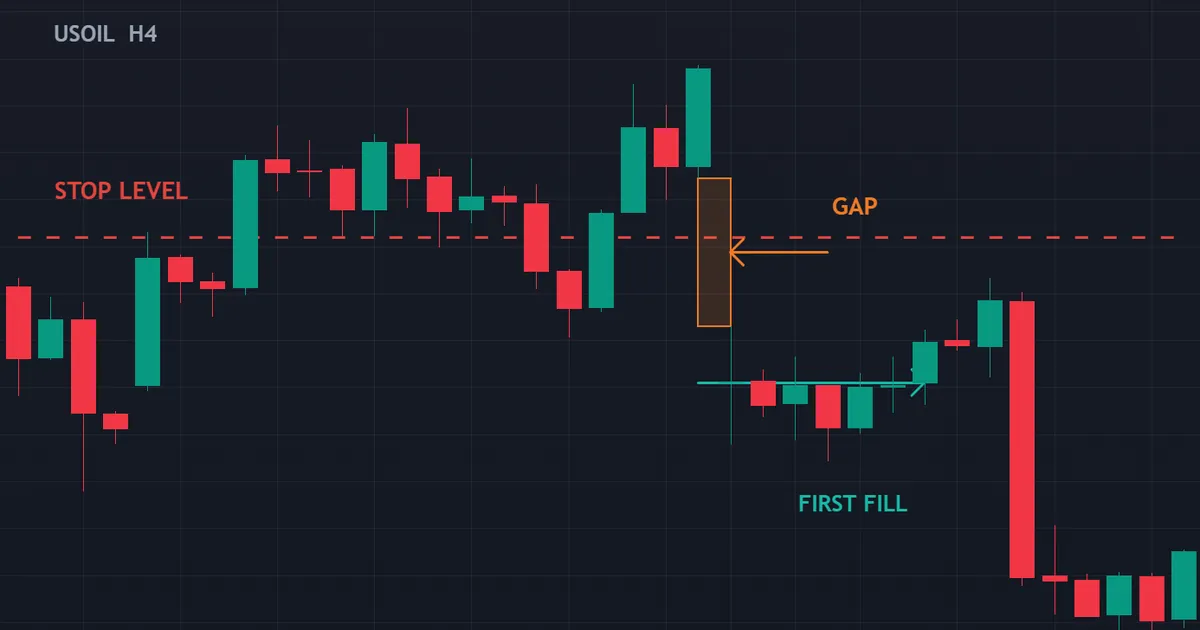
The Gap That Creates a Negative Balance
USOIL opened down straight through 83.2 on 2026-08-02, a gap of 1.31 ATR. A long stop jumped at that level was not filled at the level — the next available price was already past it.
That bar sits at the start of a new trading week. Weekend news lands while the market sleeps, so the first print of the week often arrives well away from Friday’s close.
A Stop Is an Instruction, Not a Promise
A stop order tells the broker to sell once price touches your level. It says nothing about the price you actually get.
When trading resumes below that level, the order fills at the first price available. The distance between the two is pure loss, and nobody chose it.
Why the Loss Can Pass the Deposit
Leverage sets the speed. A position worth many times your balance moves your equity many times faster than the market moves.
So a gap of one percent on a heavily leveraged position can wipe a deposit outright. Push the gap wider and the balance goes below zero, which is where this rule earns its keep.
What Negative Balance Protection Means
Strip away the jargon and the rule is short. If your account ends up below zero after a forced close, the firm writes off the shortfall.
The Rule in One Sentence
You cannot lose more than the money in the trading account. That single line covers the whole idea.
Some rules apply the cap to the account as a whole, rather than to each position. That detail matters when several trades blow up together.
What Gets Written Off
The shortfall is the amount below zero after every position closes. The firm absorbs it and resets your balance to nothing.
You still lose the entire deposit. Nothing here softens that part, so read the rule as a floor rather than a cushion.
It Is Not Insurance
Insurance pays you something back. This rule simply stops the number going lower than zero.
Treat it as a backstop against ruin, not as a reason to size larger. Traders who lean on it usually meet it far sooner than they expected.
How an Account Reaches Zero and Passes It
Four stages sit between a bad position and a negative balance. Each stage has a name in the platform.
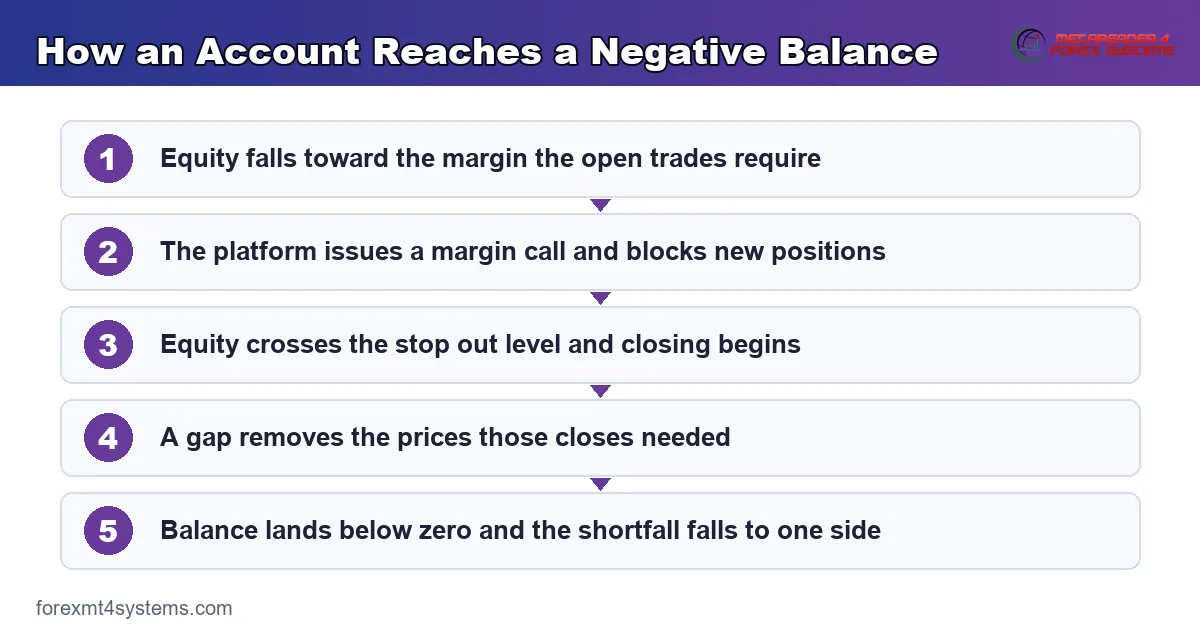
Margin Call
Equity falls toward the margin your open trades require. The platform flags the account and blocks new positions.
Nothing closes yet. Our note on the margin call and stop out sequence walks through what each level does.
Stop Out
Equity keeps falling and crosses the stop out level. The platform then closes positions automatically, usually the worst one first.
In a normal market that process works. Liquidity exists, orders fill near the last price, and the account lands above zero.
The Gap That Beats Stop Out
Now remove the liquidity. Price reopens far below the stop out level, so the automatic close happens at the first price on offer.
Equity jumps past zero in one step. No system reacts fast enough, because there was no trading in between.
The Shortfall Lands Somewhere
Money has to come from a party. Either the client owes it, or the firm swallows it under the rule.
That choice is exactly what negative balance protection settles in advance. Without the rule, brokers have chased clients for the difference.
A Worked Example Without the Jargon
Numbers make the mechanism obvious. Follow one small account through a single weekend.
The Position
Picture an account holding one thousand units of deposit. The trader opens a position worth fifty times that amount.
Every one percent move now shifts equity by half the deposit. Two percent against the trade removes all of it.
The Gap
Trading resumes three percent lower. Equity does not pause at zero on the way past.
The forced close happens at the first traded price. Balance lands near minus five hundred units, which is half the deposit again.
The Two Endings
With the rule, the firm writes off that minus figure. The account shows zero, and the trader owes nothing further.
Without it, the statement shows a debt. Collection then depends on the contract and on local law.
Why Gaps Happen When They Do
Gaps cluster in four situations. Knowing them tells you when this clause moves from theory to practice.
The Weekly Reopen
Markets close for the weekend while the world keeps moving. News that lands on Saturday shows up in the first quote of the week.
Scheduled Events
Rate decisions, elections and central bank statements arrive at known times. Liquidity thins just before them, then price jumps once the number lands.
Policy Shocks
Occasionally a central bank abandons a policy without warning. Those moments produce the widest moves, because almost nobody was positioned for them.
Thin Hours
Late in the session, or during a national holiday, fewer firms quote. A modest order then moves price further than it would at midday in London.
No chart tool changes any of this. Nothing in our indicator library can price a market that is not trading.
With the Rule and Without It
The difference only shows on one day in a decade. On that day it is the whole story.
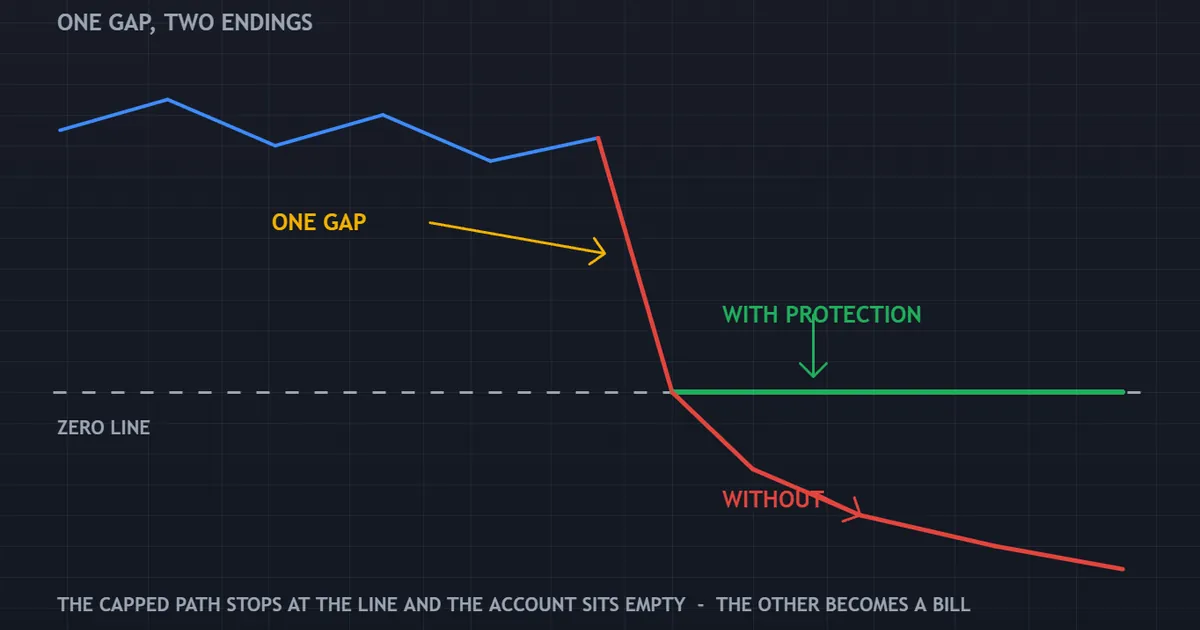
Two Paths From the Same Gap
The panel above tracks one account through a single gap. Both paths fall the same way until equity crosses the zero line.
With the rule, the balance stops at zero and the account sits empty. Without it, the line keeps going, and that distance becomes a bill.
How Large Can the Bill Get?
The shortfall scales with position size, not with the deposit. A small deposit carrying a large position can produce a debt several times the money originally sent.
Historic currency shocks did exactly that to retail accounts. Some clients received demands for many times their deposit, and a few brokers failed in the same event.
The Broker Carries the Same Risk
Understand who else is exposed here. A firm that writes off client debts still owes its own liquidity providers.
So the rule pushes tail risk onto the broker’s capital. That is one reason regulators pair it with leverage caps and capital requirements.
What the Rule Does Not Do
Plenty of traders read far too much into the clause. Four limits deserve stating plainly.
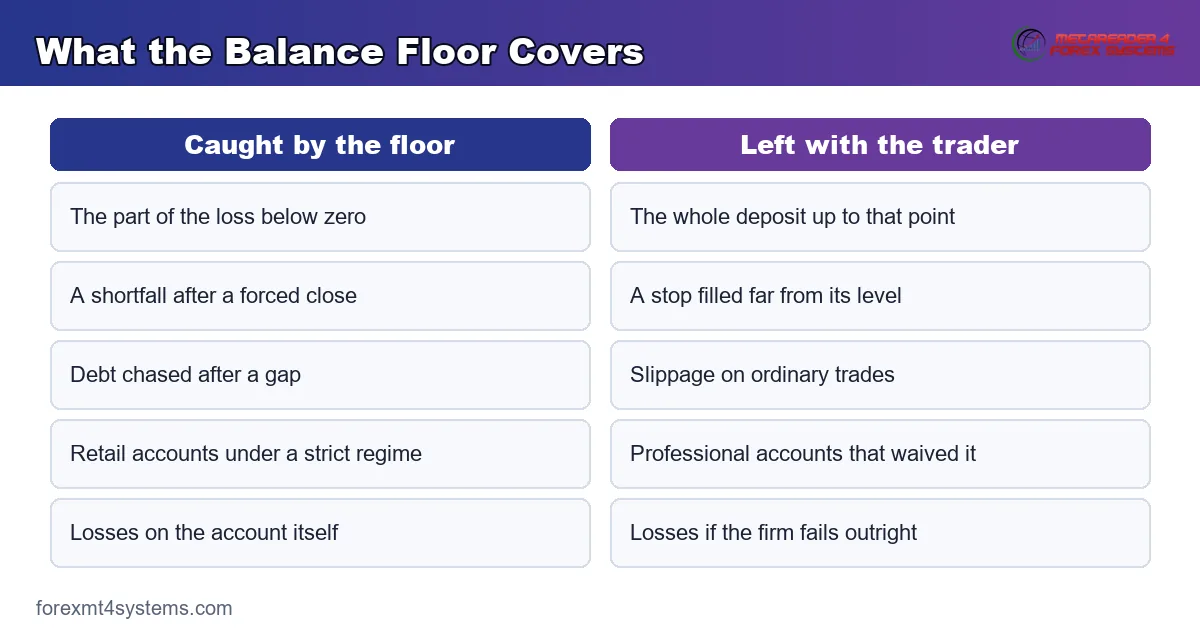
It Does Not Cap Your Loss at the Stop
Your stop can still fill far away. The rule only catches the case where the account itself passes zero.
It Does Not Protect the Deposit
Losing everything is a permitted outcome. The floor sits at zero, and zero is a total loss of the account.
It Does Not Cover a Broker Failure
Client money rules and compensation schemes handle that risk instead, and they differ by country. Our guide to what a regulated broker actually offers separates the two questions.
It Does Not Stop a Forced Close
Automatic closing still runs, at whatever level your firm sets. The floor only catches what remains after that process finishes.
It Does Not Apply Everywhere
Coverage depends on your regulator, your client category and the entity named on your contract. Many groups run several entities, and only some of them sit inside a strict regime.
Retail Client or Professional Client
Client category decides more than most traders realise. The same firm treats two accounts very differently.
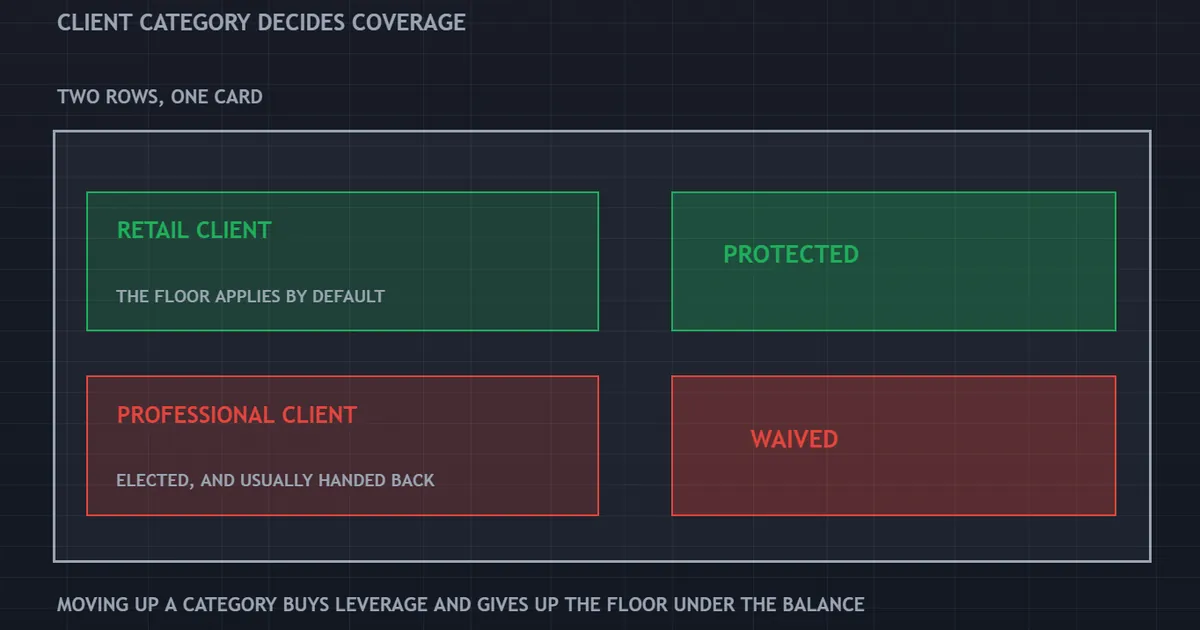
Retail Clients
Retail status brings the full set of rules where it applies: leverage caps, standard risk warnings, a margin close out level and this balance floor. You get those protections by default.
Professional Clients
Elective professional status lifts the leverage cap, which is why traders ask for it. The balance floor usually goes with it, along with several complaint and compensation routes.
Firms may still apply a similar policy voluntarily. Voluntary is the key word, since a policy can change without a rule behind it.
Qualifying Is Not the Same as Benefiting
Meeting the professional criteria says nothing about whether the switch suits you. Higher leverage plus no balance floor is a combination that ends accounts.
Model the downside before you ask. Our risk of ruin calculator shows what a larger position size does to survival odds.
The Event That Created These Rules
Rules rarely appear without a disaster behind them. This one has a date.
A Peg Ends Without Warning
In January 2015 the Swiss National Bank removed its cap on the franc. The currency repriced by double digits within minutes.
Stops filled far away, or filled not at all. Retail accounts across several countries closed with balances well below zero.
The Fallout
Some firms pursued clients for the shortfall. Others waived it, and at least one large broker needed emergency funding to survive the week.
Supervisors then studied the wreckage and wrote rules. The balance floor and the leverage caps both came out of that review.
Why It Could Happen Again
Nothing in the rule prevents another shock. It only decides who carries the part below zero when one arrives.
Where the Rule Comes From
Regulators reacted in stages, and the picture still varies by region. Read your own regulator rather than a summary.
The European Standard
ESMA introduced product intervention measures for retail clients in 2018. Those measures set leverage caps, a margin close out level and a balance floor applied per account.
National regulators then wrote the measures into their own permanent rules. BaFin, CySEC and the other authorities each publish their own version.
The United Kingdom
The FCA made equivalent restrictions permanent for retail clients. Its rules cover leverage, risk warnings, incentives and the same balance floor.
Australia
ASIC issued a product intervention order covering contracts for difference sold to retail clients. It carries leverage limits and a balance floor as well.
Other Regions
Elsewhere the position varies widely, and some frameworks impose nothing of the kind. Offshore registration in particular is not the same thing as supervision.
Read the client agreement rather than the marketing page. The contract states whether a debit can be pursued.
How Firms Manage the Risk They Absorb
A firm that caps client losses at zero keeps the tail on its own books. Three tools handle that exposure.
Lower Leverage Limits
Smaller positions relative to deposits shrink gap risk on every account at once. So caps and the balance floor tend to arrive in the same rulebook.
Tighter Close Out Levels
Automatic closing at a higher equity level leaves more room before zero. It also closes trades earlier than many traders would like.
Hedging and Capital
Firms pass part of the client risk to price makers, then hold capital against the rest. Supervisors set minimum capital for exactly this reason.
None of that removes the tail. It spreads the tail, which is the most any structure can do.
What to Do If a Balance Goes Negative
Panic produces expensive decisions. Work through four steps in order instead.
Stop Trading First
Close whatever remains open and add nothing new. Choices made in that hour tend to be poor ones.
Save the Records
Download the trade history and the account statement the same day. Portals archive data faster than most people expect.
Ask for the Position in Writing
Quote the clause and ask the firm what it intends to do about the shortfall. Keep every reply in one folder.
Escalate Properly
Supervised firms come with a complaints procedure, and an ombudsman or similar body may sit behind it. Offshore entities usually offer neither route.
Reducing the Chance of Ever Needing It
Relying on a backstop is a poor plan. Five habits cut the odds of meeting it.
- Size from the stop, not from the margin. Decide the loss you accept, then work back to a position size that produces it.
- Respect the weekend. Positions held over a market break carry gap risk that no stop can control.
- Watch scheduled events. Rate decisions and central bank statements produce the widest jumps, and they arrive on a published calendar.
- Use less leverage than the cap allows. The cap is a legal limit, never a recommendation for your account.
- Keep total exposure honest. Five correlated trades behave like one large trade when a shock hits.
Check the calendar before you hold anything through an event with our economic calendar. Two minutes of reading prevents most surprises.
How to Check Your Own Account
Three checks settle whether the rule covers you. All three take a few minutes.
Find the Entity
Look at the contract, not the website header. Groups often operate one regulated entity and one offshore entity under a single brand.
The entity decides which rulebook applies. Our page on forex regulatory bodies explains what each authority actually supervises.
Find Your Client Category
The account portal states whether you count as a retail or professional client. If you once signed a form to lift the leverage cap, check that page again.
Status can also change when you move between entities inside one group. A transfer for higher leverage often carries a new category with it.
Read the Clause Itself
Search the terms for the words negative balance. The clause states whether the cap applies per account, and whether the firm can reverse it in unusual conditions.
Some agreements carve out exceptions for abusive trading or for arbitrage on stale prices. Knowing that in advance beats discovering it later.
Five Questions Worth Sending to Support
- Which entity holds my account, and which authority supervises that entity? Brand names mean nothing here, so ask for the registered company and its licence number.
- Am I recorded as a retail client or a professional client? The answer decides which protections apply to your account today.
- Does the balance floor apply per account or per position? That wording changes the outcome when several trades close together.
- Under what conditions can the firm set the clause aside? Carve-outs exist in many agreements, and they belong in your notes.
- Where is client money held, and under which rules? Segregation and compensation schemes answer a different risk from this one.
Ask in writing, through the platform’s own message system. A written answer carries far more weight later than a phone call.
Download the complete indicator database
Put these concepts on your charts. One email unlocks the full library of 1,380+ indicators with compiled MT4 and MT5 files, plus my TradingView scripts. No paywall, no spam, unsubscribe any time.
Get free access to my indicator database
One email unlocks 1,380+ free MT4, MT5 and TradingView indicators — the complete library. No single-tool download; you get the whole database.
Common Misunderstandings
Four ideas circulate about this clause. None of them survives a careful read.
My Stop Loss Makes It Irrelevant
Stops fail exactly when the rule matters. Gaps, halts and thin liquidity all defeat a stop, so the two things solve different problems.
Only Tiny Brokers Chase Debts
Size tells you little here. What matters is the rulebook the entity sits under and the wording of your own agreement.
It Means Higher Leverage Is Safe
The floor sits at total loss of the account. Larger size simply gets you to that floor faster.
Every Licensed Firm Offers It
Supervision covers many things, and this clause is only one of them. A licence issued in one country may carry no balance floor at all.
Demo Accounts Show How It Works
Demo servers rarely reproduce a violent reopen, and they never send a real demand for money. Our comparison of demo and live trading covers what simulation leaves out.
What Traders Should Take From This
The clause is worth checking, and it is worth almost nothing as a strategy. Both statements hold at once.
Check It Once, Properly
Read the entity, the category and the clause today. Then file the answer and move on.
Then Trade As If It Did Not Exist
Position sizes chosen with the floor in mind tend to be too large. Sizes chosen from a stop distance tend to be right.
Learn the sizing method properly with our position sizing guide. The arithmetic takes ten minutes to learn and lasts a career.
FAQ
Does negative balance protection cover every account?
No, and coverage depends on three things: the regulator supervising the entity you contracted with, your client category, and the wording of the agreement itself. Retail clients under strict regimes usually have it, while professional clients typically do not. Check the contract rather than the brand.
Can a broker still ask me for money if my account goes negative?
Where the rule applies to your account, the firm absorbs the shortfall and resets the balance to zero. Where no such rule applies, the agreement decides, and some contracts allow the firm to pursue the debit. That is why the entity on your paperwork matters more than the website you signed up through.
Why did my stop not prevent a negative balance?
A stop is an instruction to trade once a level trades, not a promise of that price. When the market reopens beyond the level, or liquidity vanishes during a shock, the fill happens at the first price available. The distance between your level and that fill is the loss the rule was written for.
Does the rule apply per position or per account?
The main European measures apply the cap to the account as a whole, which matters when several trades close badly at once. Other regimes and individual firms word it differently, so the clause itself is the authority. Read it before assuming either version.
Do the rules cover every instrument on the platform?
Product intervention measures were written around contracts for difference and rolling spot positions, which covers most retail forex, index and commodity products. Instruments offered through a different wrapper, or booked with another entity in the same group, can sit outside them. The product terms state the scope, so read those rather than the account summary.
Should I become a professional client to get more leverage?
That switch usually removes the balance floor along with several complaint and compensation routes, in exchange for a higher leverage cap. The combination raises both the size you can take and the consequence of a gap. Treat it as a serious decision rather than a form to sign.
Is negative balance protection a reason to trade larger?
It is a floor at total loss of the account, so leaning on it simply means reaching that floor sooner. Size from your stop distance and your risk per trade instead, then treat the clause as the last line of defence it was designed to be. Results are not guaranteed; past performance is not indicative of future results.
External references
- For background on this concept, see The CFD Product Intervention Measures at ESMA.
- For broader market context, see The CFD Product Intervention Order at ASIC.
- The compensation route that covers a broker’s failure, as distinct from negative balance protection, is set out in How to claim compensation if a firm fails at the FCA.

About the author
Written by Dominic Walsh, a Forex trader and MT4/MT5 indicator, Expert Advisor and script developer. Every tool on forexmt4systems.com is tested on live charts before release and ships with ready-to-use compiled MT4 (.ex4) and MT5 (.ex5) files. Learn more about the trader and developer behind this site.
How we build, test and correct every tool: Editorial & Testing Policy. Trading carries risk; see the disclaimer.