
Most guides to the types of gaps in forex borrow their list from the stock market and forget to mention the awkward part. Spot currency trades almost around the clock, so the gaps those lists describe barely happen here.
One routine exception exists. The market shuts on Friday evening and reopens on Sunday, and that single reopening produces nearly every gap you will ever see on a currency chart.
Why Types of Gaps in Forex Stay Rare
A gap needs a closed market. Price can only jump when nobody could trade the ground in between.
Equities close every night and every weekend. Currencies close once a week, so the opportunity for a jump arrives once a week too.
That single fact reshapes the whole topic. Gap strategies imported from stock trading fire perhaps fifty times a year on a currency pair instead of daily.
What a Gap Looks Like Elsewhere
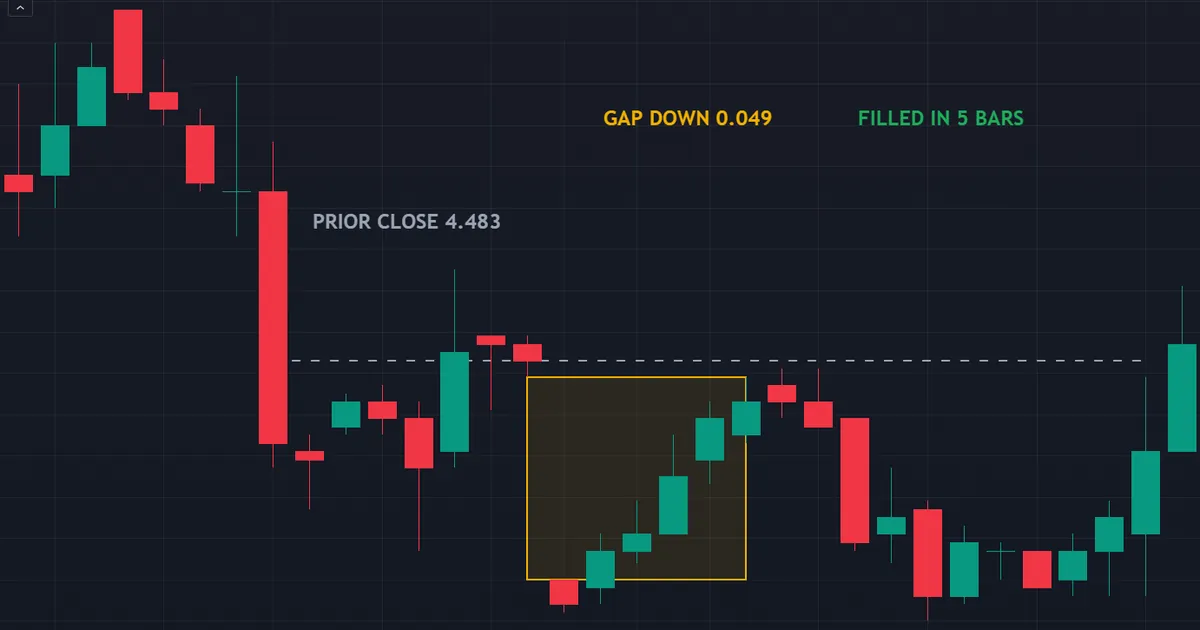
The chart above shows the US 10-year Treasury yield on four-hour bars, which is not a spot currency pair. It reopened below the whole of Friday’s final bar, leaving a 0.049 gap, roughly five basis points.
Measured against its own recent bars, that jump ran about 1.72 times the typical range. Price then closed the gap within five bars.
Instruments like that stop trading and restart. Currencies mostly do not, and the contrast explains why gap analysis feels so much thinner in forex.
The Spot Market Barely Closes
Trading rolls from Sydney into Tokyo, then London, then New York. Each handover happens while the previous session still runs, so quotes never stop.
Our guide to forex trading sessions maps that relay in detail. Check the current state any time with our forex market hours tool.
Continuity removes the mechanism. Without a closed period, price has to travel through every level rather than skipping any.
The Weekend Open Is the Exception
Friday evening brings a genuine halt. Roughly forty-eight hours later the Sunday open reprices everything that happened in between.
Most of those reopenings are quiet. Price picks up within a few pips of the Friday close, and nothing worth naming appears on the chart.
Occasionally the weekend delivers real news. Our guide to the weekend gap in forex covers the mechanics of that open in full.
The Four Types of Gaps and What Each Signals
Classical analysis names four. All four appear in currencies, though only at that weekly reopening.
- Common gap. A small jump inside an existing range, with no story behind it, which usually closes fast.
- Breakaway gap. A jump beyond a level that mattered, starting a move rather than interrupting one.
- Runaway gap. A jump partway through an established trend, showing the move still has momentum behind it.
- Exhaustion gap. A jump near the end of a trend, which stalls quickly and then reverses.
Notice the honest problem buried in those definitions. Three of the four labels depend on what happens next, so you cannot apply them at the moment the gap appears.
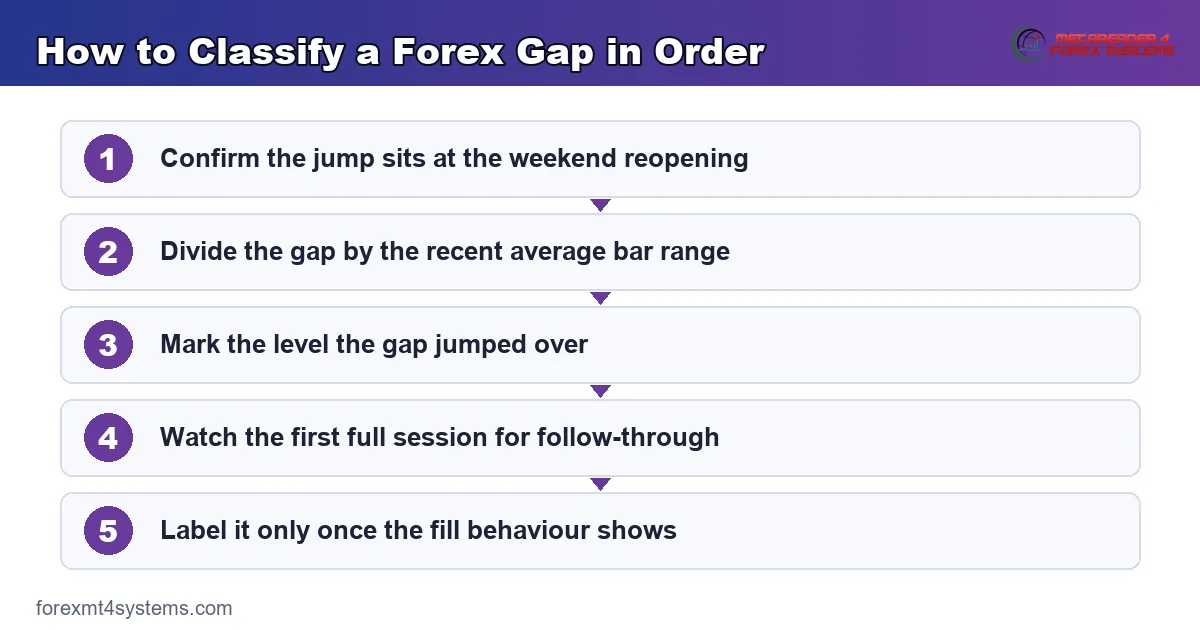
So classify late rather than early. Traders who name a gap on Sunday evening are guessing about Wednesday.
Common Gaps
These make up the bulk of what you see. Price reopens a few pips away from Friday, drifts back, and the chart looks normal within hours.
Size gives the first clue. A jump smaller than an ordinary bar range rarely carries information worth acting on.
Position gives the second. A gap sitting comfortably inside a familiar range says the weekend produced nothing new.
Breakaway Gaps
These start something. Price opens beyond a level that had held for weeks, and it keeps going rather than drifting back.
They almost always follow real news. Something arrived while the market was shut, and Sunday’s open simply repriced it.
The fill behaviour separates them from the rest. A breakaway gap frequently stays open, which flatly contradicts the folk rule that all gaps close.
Runaway Gaps
These appear mid-trend. A market already moving reopens further along in the same direction, and the trend continues afterwards.
Some traders call them measuring gaps. The idea is that the gap lands near the midpoint of the whole move, which offers a rough projection.
Treat that projection loosely. It resembles a measured move target in spirit, and it deserves the same scepticism.
Exhaustion Gaps
These arrive last and disappoint the most. A tired trend reopens with one final jump, then stalls almost immediately.
They look identical to runaway gaps on the day. Only the failure to follow through distinguishes them, and that takes days to establish.
Traders who buy the open get caught here. The gap that looked like acceleration turns out to be the final push.
Island Reversals
Two gaps in opposite directions produce a fifth shape. Price jumps away, trades for a while in isolation, then jumps back over the same empty space.
The isolated bars form the island. Both gaps stay open, and the structure marks a sharp turn in sentiment.
These stay genuinely rare in currencies. Two weekend jumps in opposite directions within a few weeks is an unusual sequence.
How Brokers Differ at the Open
Your gap and mine may not match. Brokers reopen at slightly different moments and quote from different liquidity pools.
A jump of a few pips on one feed can vanish entirely on another. That difference alone invalidates most small gap signals.
So check your own broker’s history before building anything around the open. The chart your strategy trades is the only one that counts.
How Gap Fills Actually Work
Folk wisdom says every gap fills. Reality is more useful than that, and rather less tidy.
Why Most Weekend Gaps Close Quickly
Sunday liquidity is dreadful. Very few participants quote, spreads balloon, and the opening price reflects a thin market rather than a considered one.
Proper volume arrives with Tokyo and then London. Those participants often disagree with the Sunday print, and price returns toward Friday’s close.
Our guide to why spreads widen covers the cost side of that window. Trading into it deliberately is expensive.
What the First Session Tells You
Watch the Asian session rather than the opening print. Drift back toward Friday’s close during those hours argues for a common gap.
London then supplies the verdict. Real volume arrives, and whatever survives that session usually survives the week.
New York adds the confirmation. A gap still open after all three sessions has passed every test the day could offer.
Why Some Never Close At All
News changes the calculation. If something genuinely repriced the currency, London does not disagree with the Sunday open, it agrees and pushes further.
Those gaps stay open for months. Anyone shorting the open on the assumption of a fill takes an unbounded loss on the trend that follows.
Size hints at which case you have. A jump several times the normal bar range signals information rather than thin liquidity.
The Fill Is Not a Trade Plan
Betting on a fill means fading a market with no stop level. Nothing in the structure tells you where the idea stops working.
Pick a level instead, then trade against it. Friday’s close, the prior week’s high, or a range boundary all give you something concrete.
Our levels indicators archive collects the tools that mark those references automatically.
Measuring the Fill Honestly
Decide what a fill means before you count any. Touching the Friday close once is a different event from closing a bar back inside the old range.
Add a deadline too. A gap that closes eleven weeks later has not really behaved like a gap that closed on Monday morning.
Both examples here came with a bar count. Five bars on the yield chart and seventeen on gold, which tells you far more than a simple yes.
What the Weekend Reopening Costs
Gaps get all the attention while the costs around them get none. Those costs decide whether any of this is tradeable.
Spread at the Reopening
Sunday spreads run several times their weekday level on major pairs. Exotic pairs can widen far more than that.
A five pip spread against a fifteen pip gap leaves nothing. So the small gaps that fill most reliably are also the least worth trading.
Wait for the spread to normalise. On most brokers that happens within an hour or two of Tokyo opening properly.
Slippage and Stop Execution
A stop cannot execute inside a jump, because no price traded there. It becomes a market order at the reopening instead.
So a position held over the weekend has a stop level and no stop protection. The two are not the same thing.
Plan for the worst reopening rather than the average one. Sizing for a normal Monday is exactly how weekend surprises hurt.
Swap Charges Around the Break
Most brokers book the weekend rollover on Wednesday. Holding through that day therefore triples the usual swap charge on many accounts.
Check your own broker’s schedule, since the convention varies. Rates change too, so a figure you noted last quarter may no longer apply.
Factor the charge into any multi-day gap trade. Waiting three days for a fill has a cost beyond the tied-up margin.
A Breakaway Gap That Never Filled
Numbers make this concrete. So here is a real one on a daily currency chart.
Reading the Numbers
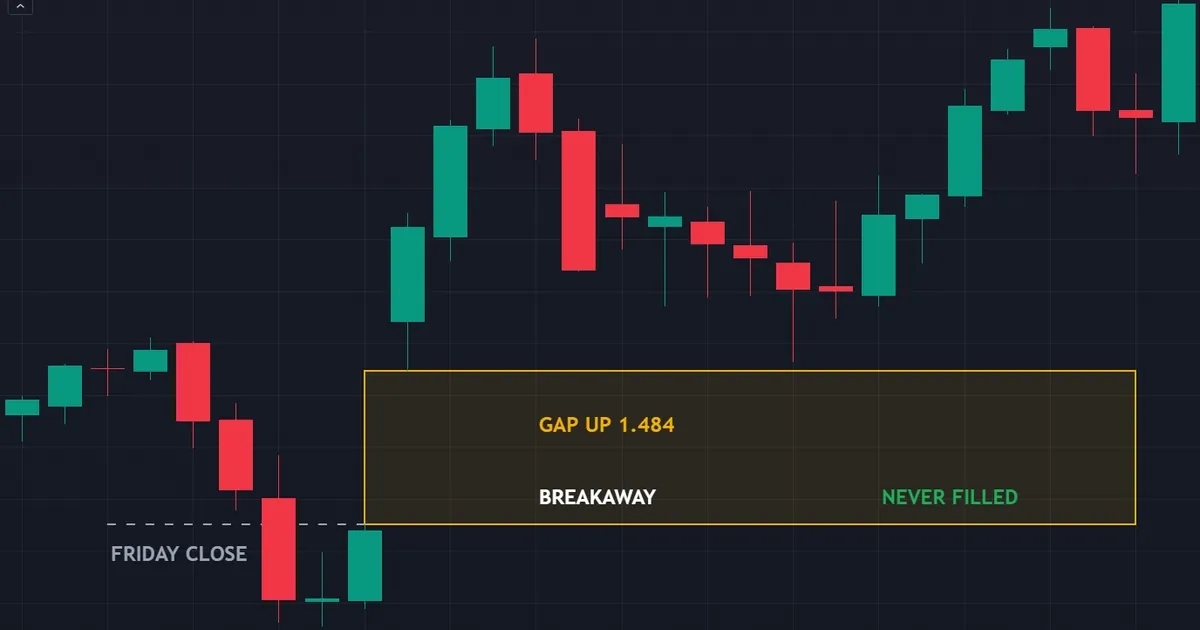
The chart above shows EURJPY daily bars at a weekend open. Price reopened above the whole of Friday’s range, leaving a 1.484 gap, roughly 148 pips.
Against its own recent bars that gap ran about 1.46 times the typical range. So it was large, though not absurdly so.
Price never closed it. The chart moved on, and the empty space from that Sunday still sits there untouched.
What Made It Different
The clue was direction and persistence together. Price opened higher and then closed the day higher still, near 176.122.
A thin-liquidity gap behaves differently. It drifts back through the Asian session rather than extending through London and New York.
So the follow-through told the story. By Monday’s European close the fill argument had already lost.
Trading Around One
Nothing forces you to trade the open at all. Waiting for London removes the worst spreads and most of the ambiguity.
If the gap holds through the first proper session, the breakaway reading strengthens. Trading with it then beats fading it on a folk rule.
Keep size modest either way. Weekend repricing moves fast, and a wide stop demands a small position.
Where the Stop Belongs
Use the gap itself as the boundary. A stop back inside the space price jumped says the breakaway reading has failed.
That gives a wide stop on a jump this size. Roughly 148 pips of room means the position has to shrink accordingly.
Never anchor the stop to the Sunday print. It came from the thinnest hour of the week and it means very little.
Download the complete indicator database
Put these concepts on your charts. One email unlocks the full library of 1,380+ indicators with compiled MT4 and MT5 files, plus my TradingView scripts. No paywall, no spam, unsubscribe any time.
Get free access to my indicator database
One email unlocks 1,380+ free MT4, MT5 and TradingView indicators — the complete library. No single-tool download; you get the whole database.
Common Gap Trading Mistakes and the Fixes
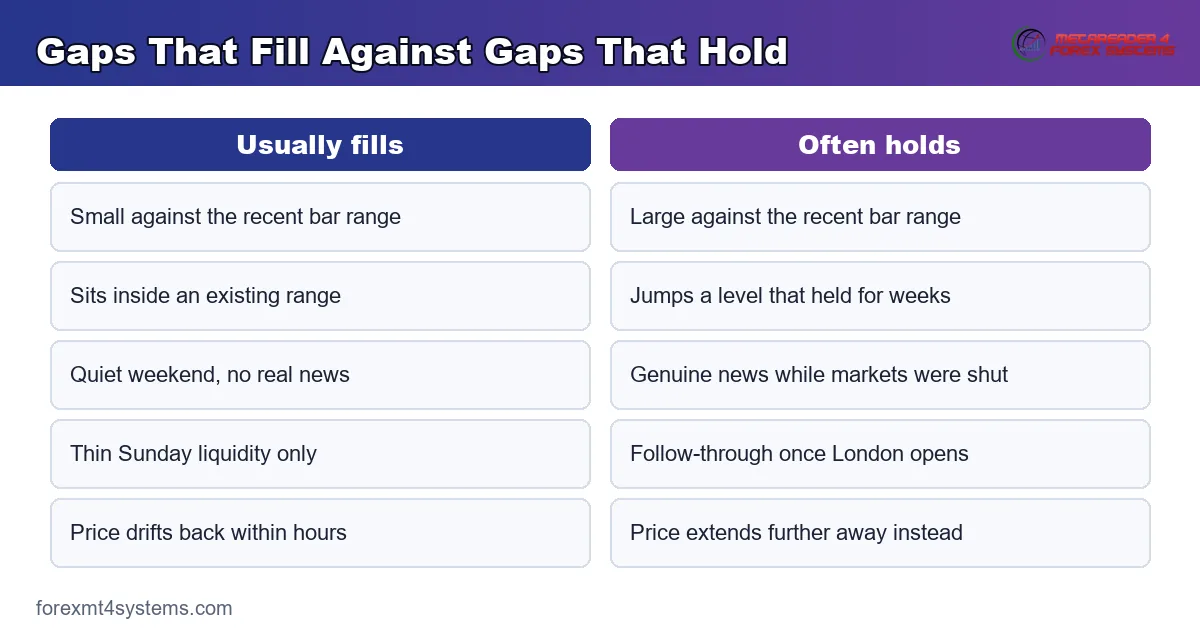
Most losses around gaps trace back to a handful of habits. The comparison below separates the two outcomes that matter.
Assuming Every Gap Fills
Breakaway gaps regularly stay open for months. Treat the fill as one possible outcome, then trade a level rather than a slogan.
Check the size first. A jump several times the normal bar range rarely closes the way a small one does.
Trading the Sunday Open
Spreads at that hour can run several times normal. Waiting for Tokyo or London costs you nothing and saves a meaningful slice of every trade.
Slippage compounds the problem. Thin books fill market orders badly, so the price you see is rarely the price you get.
Labelling the Gap Too Early
Runaway and exhaustion gaps look identical on the day. Wait for follow-through before choosing a name, because the label carries no information until then.
Write the candidate labels down instead. Then record which one the market picked, and your own sample grows.
Importing Stock Market Statistics
Gap studies from equities assume a daily close, which currencies do not have. Any figure quoted for gap fill frequency almost certainly came from a different market entirely.
Measure your own pairs instead. Fifty weekend opens a year gives you a usable sample within twelve months.
Ignoring the Level Underneath
A gap through a level that held for months means more than a gap through empty space. Mark the level first, then judge the gap against it.
Our support and resistance indicators archive covers the tools that keep those levels on the chart consistently.
Holding Through the Reopening
A position carried over the weekend faces the gap with no stop protection. Your stop cannot execute inside a jump, so it fills wherever the market reopens.
Size weekend positions for that reality. Cut them, hedge them, or accept that the stop is a guideline rather than a limit.
Gap Types Quick Reference
Keep this table beside the chart on Sunday evenings. Each row states a condition rather than an outcome.
| Type | Where it appears | Typical fill behaviour |
|---|---|---|
| Common | Inside an existing range, no news | Closes within hours, often before London |
| Breakaway | Beyond a level that held for weeks | Frequently stays open indefinitely |
| Runaway | Partway through an established trend | Usually holds while the trend continues |
| Exhaustion | Late in a tired trend | Stalls, then closes as price reverses |
| Size clue | Gap against recent bar range | Larger jumps close less readily |
| Timing clue | Behaviour through the first full session | Extension argues against a fill |
| Cost clue | Spread at the reopening | Widest of the week, by a distance |
Notice what the table refuses to include. No column offers a fill percentage, because the honest figures depend on the pair, the period and the definition of a gap applied.
Your own record fixes that. Fifty weekend opens per pair per year builds a sample nobody else can hand you.
When a Gap Traps You
The exhaustion gap does the most damage, and it does it to the most confident traders. It arrives looking exactly like acceleration.
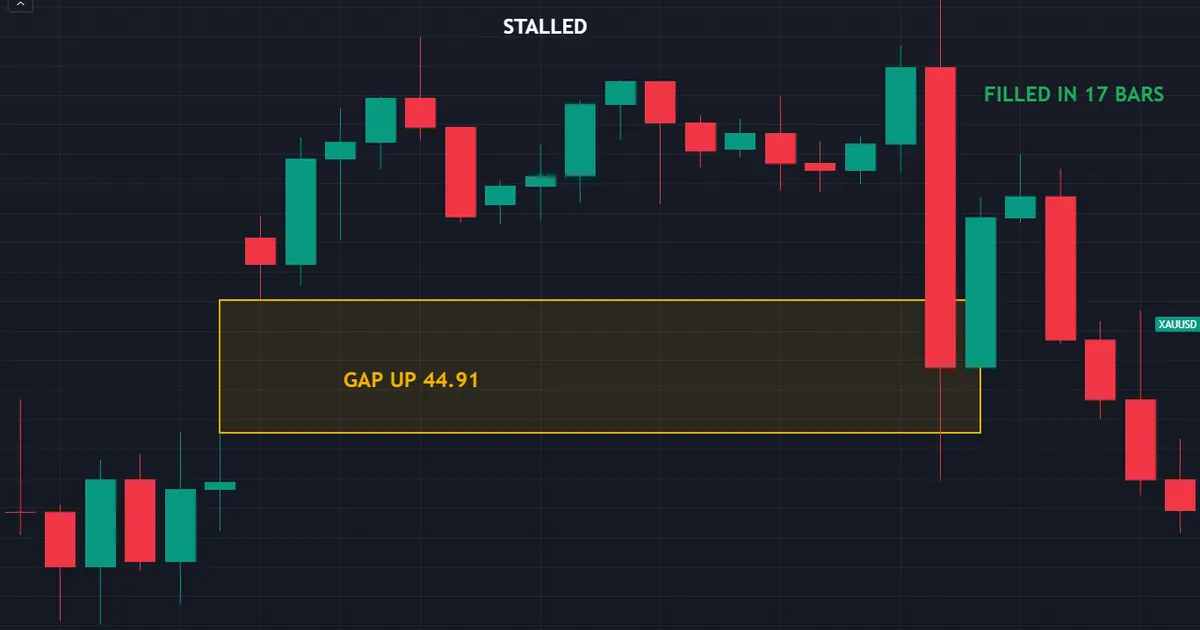
The Numbers on This One
The chart above shows XAUUSD four-hour bars at a weekend open. Price reopened clear of the previous bar, leaving a 44.91 gap, about 0.81 times the recent bar range.
That ratio is the tell. A jump smaller than a normal bar carries far less information than the headline number suggests.
The move stalled rather than accelerating. Price crept higher for three more days, then one session erased the whole advance. Seventeen four-hour bars after the open, the gap had closed completely.
Why the Ratio Beats the Raw Size
Forty-five points sounds dramatic on gold. Set against an instrument that routinely covers more than that in a single bar, it stops sounding dramatic at all.
Always divide by the recent range. The resulting ratio compares gaps across instruments in a way raw pips never can.
Apply the same test to the earlier examples. EURJPY gapped 1.46 ranges and held, while gold gapped 0.81 ranges and closed.
What the Trap Costs
Buyers who chased that open sat on a modest gain for three days. One session then erased it, and their stops sat under a level price walked straight through.
The fix is patience rather than cleverness. Let the first full session decide, then trade whatever it decided.
Seventeen bars is roughly three trading days. Anyone holding a long through that stretch watched a comfortable gain vanish inside a single session.
Reading the Bar Itself
The reopening bar closed at 4292.545, well below its 4309.19 high. So more than half of its own range went back to sellers inside four hours.
That kind of close is a warning on its own. A bar that opens near its high and then closes in the lower half has already said something about the session.
Compare it with the EURJPY case. There the daily bar closed near its high, and the gap held for months afterwards.
When the Structure Stops Mattering
Sometimes the market ignores every level on the chart. Our guide to chart pattern failure covers how to respond when that happens.
Cut and log it rather than arguing. A gap week is a poor time to defend an opinion.
Related Ideas to Study Next
Reversal shapes often bracket the gaps that matter. Our guide to the double top pattern covers one that regularly forms around an exhaustion move.
Session timing decides most of the outcome. Knowing which hours carry real volume tells you when the Sunday price is likely to face a proper test.
Costs deserve equal attention. A gap trade taken at the reopening pays the widest spread of the week, which changes the arithmetic on every projection.
Volatility measurement ties the whole topic together. Once you express every gap as a multiple of the recent range, comparing a yen jump with a gold jump stops being guesswork.
Trend context comes next. A gap that pushes further in the direction price was already travelling reads very differently from one that jumps the other way.
One habit outranks all the labelling. Recording each weekend open on your pairs, with the gap size, the ratio and the fill outcome, builds evidence that applies to you rather than to somebody else’s market.
FAQ
What are the types of gaps in forex?
The same four that classical analysis names elsewhere: common, breakaway, runaway and exhaustion. In spot currencies they appear almost exclusively at the Sunday reopening, because the market does not close at any other time.
Why are gaps so rare on currency charts?
A gap needs a period when nobody can trade. Spot forex runs continuously from Sunday evening to Friday evening, so the only routine halt is the weekend itself.
Do all forex gaps get filled?
No, and the exception matters more than the rule. Small gaps from thin Sunday liquidity usually close quickly, while gaps caused by real news over the weekend often stay open indefinitely.
How do I tell a breakaway gap from an exhaustion gap?
Only follow-through separates them. A breakaway gap extends through the first full trading session, while an exhaustion gap stalls almost immediately and then works back the other way.
Do gaps appear on other instruments I trade?
Yes, and far more often than in spot currencies. Indices, single stocks, bonds and yields all stop trading overnight, so each new session can open away from the previous close.
Should I trade the Sunday open?
Spreads at that hour run several times normal and fills are unreliable. Most traders wait for Tokyo or London, which costs little in missed movement and saves a great deal in execution.
How should I measure gap size?
Divide the jump by the instrument’s recent average bar range rather than reading the raw pips. That ratio compares a gold gap with a yen gap sensibly, and it flags which jumps carry real information. Log each one you see, note whether it closed, and size every gap trade so a weekend surprise stays survivable. Results are not guaranteed; past performance is not indicative of future results.
External references
- For background on this concept, see Breakaway Gap at Investopedia.
- For broader market context, see Trading Halt on Wikipedia.

About the author
Written by Dominic Walsh, a Forex trader and MT4/MT5 indicator, Expert Advisor and script developer. Every tool on forexmt4systems.com is tested on live charts before release and ships with ready-to-use compiled MT4 (.ex4) and MT5 (.ex5) files. Learn more about the trader and developer behind this site.
How we build, test and correct every tool: Editorial & Testing Policy. Trading carries risk; see the disclaimer.