
Learning the core forex trading terms is the fastest way to feel at home on a trading platform. Master a short glossary, and the jargon that once looked baffling turns into plain, useful language.
This guide collects the forex trading terms every beginner should know, each with a one-line definition and a link to a deeper article. You will learn the words for price, size, cost, and risk, so nothing on your screen stays a mystery.
Why Forex Trading Terms Matter
A trader who knows the vocabulary reads the market with clear eyes. Every field on the platform, from volume to margin, uses a specific word with a specific meaning. So learning the terms first removes a layer of confusion from every trade.
The terms also connect to one another. Pip value flows from lot size, and margin flows from leverage, so the words form a web. Because the ideas link up, learning them together is far easier than meeting each one cold in a live trade.
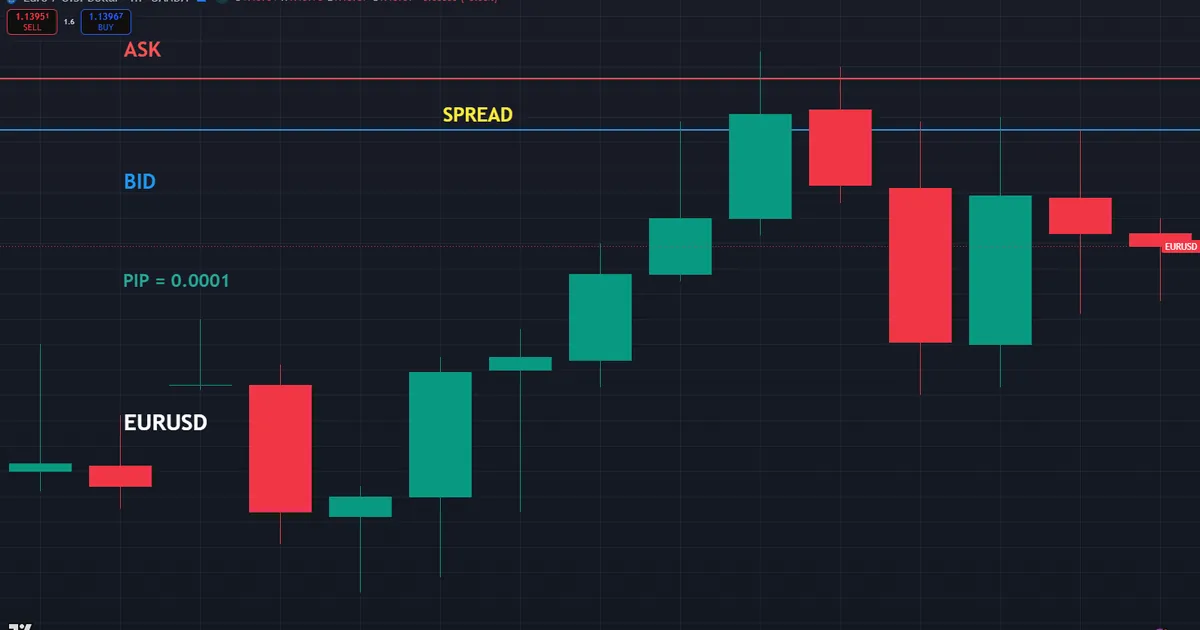
This glossary groups the terms by theme rather than by alphabet. You will move from price words to size words, then to cost words and risk words. So each group builds on the last, and the whole picture comes together in order.
How to Use This Glossary
Treat the list below as a reference you return to often. Read it once to get the shape, then look back whenever a term trips you up. Each entry stays short on purpose, so the meaning lands fast.
- Price terms describe the quote itself, such as bid, ask, and pip.
- Size terms describe how much you trade, such as lot and units.
- Cost terms describe what a trade charges you, such as spread and swap.
- Risk terms describe how you control loss, such as stop-loss and margin.
Notice how the four groups mirror a real trade. You read a price, choose a size, pay a cost, and manage the risk. Because that order matches how a trade unfolds, the terms slot neatly into the flow of your day.
Price and Quote Terms
Price terms describe the numbers you see quoted for every pair. They are the first words a beginner meets, since nothing happens before you read a price. Get these clear, and the rest of the glossary follows more easily.
A currency pair pins two currencies together, like EURUSD. The first is the base currency, and the second is the quote currency, so the price shows how much quote buys one unit of base. Master that, and every quote reads cleanly.
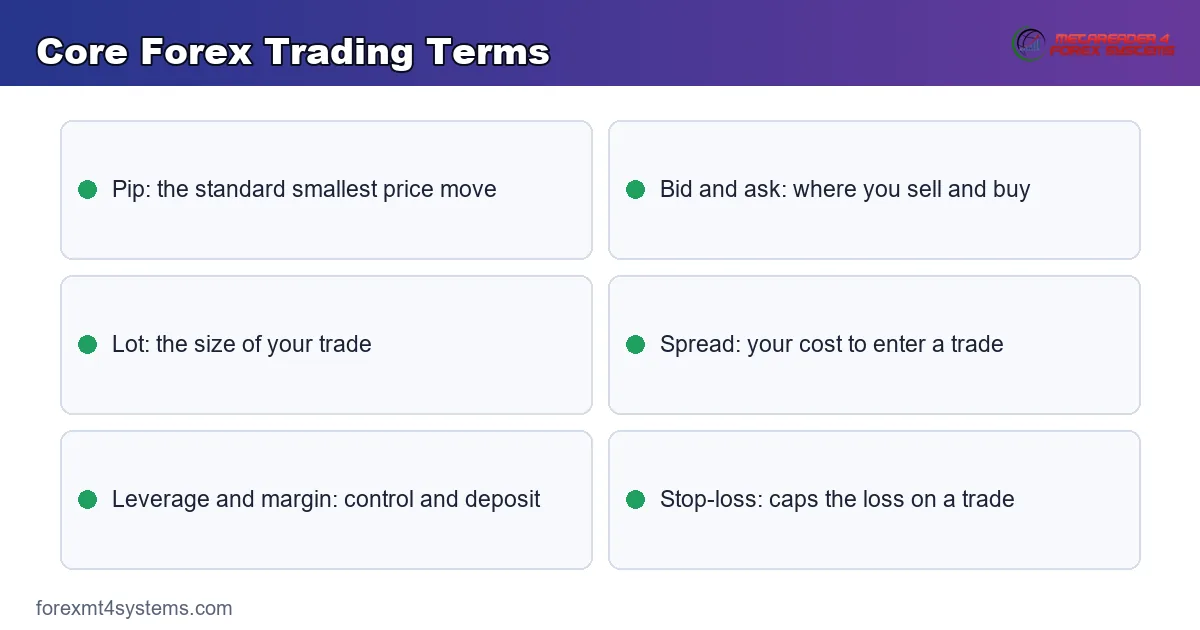
Here are the core price terms, each in a single line.
- Pip. The standard smallest price move on most pairs, equal to 0.0001. See our guide on the pip in forex for the full detail.
- Bid. The price at which you can sell the base currency right now.
- Ask. The price at which you can buy the base currency, always a touch above the bid. Our guide on the bid and ask price unpacks the pair.
- Base currency. The first currency in the pair, the one you buy or sell.
- Quote currency. The second currency, in which the price is measured.
Reading a Live Quote
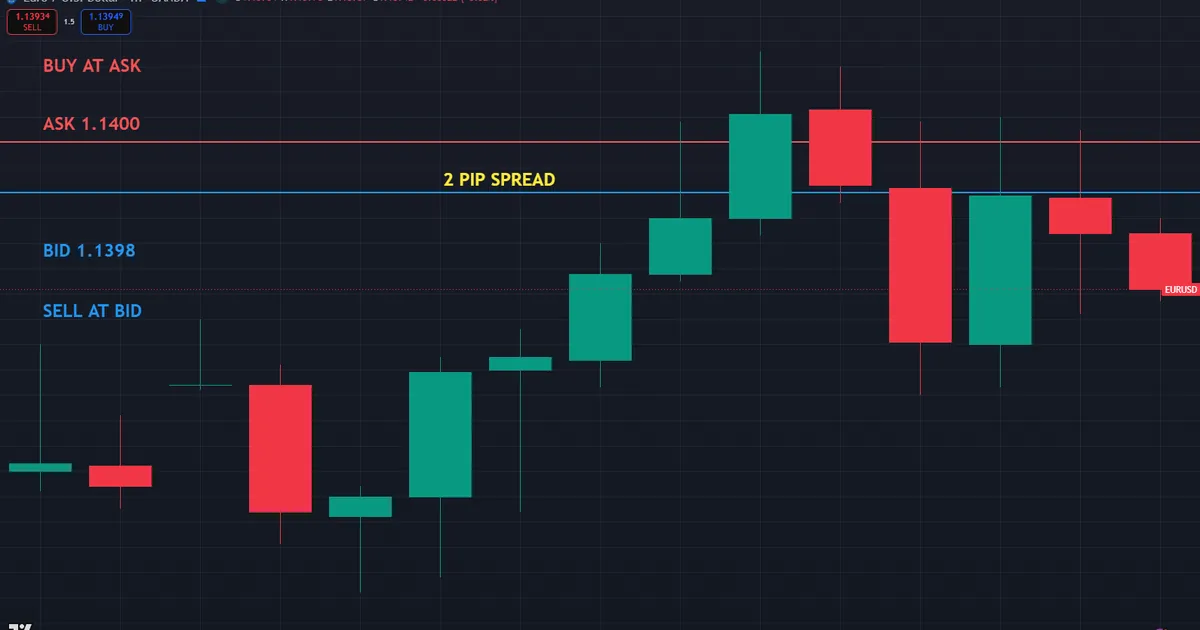
Put the price terms together on one quote. Suppose EURUSD shows a bid of 1.1398 and an ask of 1.1400 near current levels. The euro is the base, the dollar is the quote, and the gap of two pips is the cost to cross the market.
So a single quote already uses four terms at once. You read the bid to sell, the ask to buy, and the pips between them as the spread. Because those words repeat on every pair, learning them once pays off forever.
Size and Cost Terms
Size terms tell you how much currency a trade controls. They decide how much each pip is worth, so they drive the real outcome of a trade. A beginner who masters size terms controls risk far more precisely.
Cost terms tell you what a trade charges you to hold. Every position carries a cost, from the spread at entry to the swap held overnight. Because the costs repeat, knowing them keeps a small account from bleeding quietly.
Here are the key size and cost terms, each in a line.
- Lot. A unit of trade size, where a standard lot is 100,000 units. See our guide on lot size in forex.
- Micro lot. A small size of 1,000 units, shown as 0.01 on the platform.
- Pip value. The money one pip is worth, set by the lot size and the pair.
- Spread. The gap between the bid and the ask, your cost to enter. Read more on the spread in forex.
- Swap. The interest paid or earned for holding a trade overnight. See our guide on the swap in forex.
How Size Sets the Pip Value
Size and pip value travel together as a pair. On a dollar-quoted pair, a standard lot is worth about ten dollars a pip, and a micro lot about ten cents. So the size you type sets how much each pip earns or costs.
This link is why size terms matter so much. Change the lot, and every profit and loss figure changes with it. Our position size calculator turns your risk into the right size in one step.
Risk and Account Terms
Risk terms are the words that keep an account alive. They describe how you cap a loss and how the broker measures your exposure. A beginner who learns these terms early avoids the traps that end most new accounts.
Account terms describe the state of your balance as trades run. They show how much you can still trade and how close you sit to a forced close. Because these figures shift in real time, reading them well is a core skill.
- Leverage. The ratio that lets a small deposit control a larger position. See our guide on leverage in forex.
- Margin. The deposit the broker locks to open a trade. Read our guide on the margin in forex.
- Stop-loss. An order that closes a trade automatically at a set loss level.
- Take-profit. An order that closes a trade automatically at a set profit level.
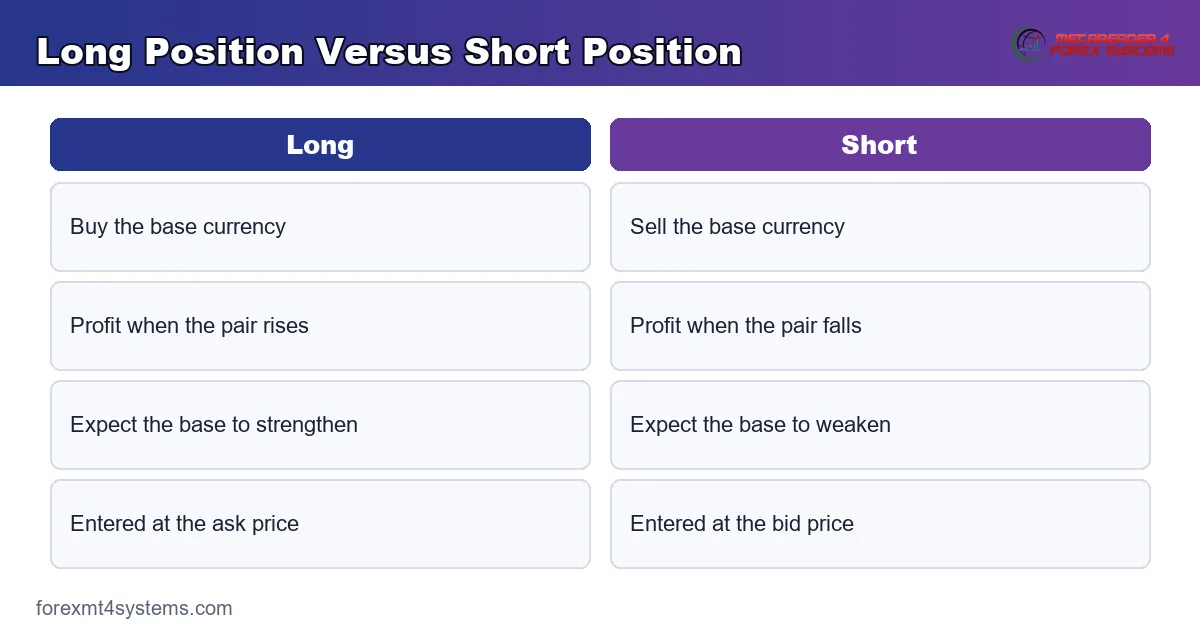
- Long and short. Long means buying the base currency, and short means selling it.
Long, Short, and Direction
Direction terms confuse many beginners, yet they are simple. Going long means buying the base currency in hope of a rise. Going short means selling it in hope of a fall, since forex always trades in pairs.
So a falling market is not a dead one for a trader. You can go short and profit as the base currency drops. Because both directions are open, the same pair offers a chance whether it climbs or slides.
Download the complete indicator database
Put these concepts on your charts. One email unlocks the full library of 1,380+ indicators with compiled MT4 and MT5 files, plus my TradingView scripts. No paywall, no spam, unsubscribe any time.
Get free access to my indicator database
One email unlocks 1,380+ free MT4, MT5 and TradingView indicators — the complete library. No single-tool download; you get the whole database.
Common Term Mix-Ups
A few terms trip up nearly every beginner, and the fixes sit under the graphic below. Most mix-ups come from words that sound similar but mean different things.
Confusing Margin With Risk
Margin is the deposit locked to open a trade, not the money you can lose. Risk is set by the stop and the size, which decide the actual loss. So a trade can use little margin yet still carry a large risk if the size is wrong.
Mixing Up Pips and Points
A pip is the standard fourth-decimal move, while a point often means the fifth-decimal move on many platforms. Reading one as the other misjudges the distance of a stop. So check which unit your platform shows before you set a level.
Treating Leverage as Free Money
Leverage lets a small deposit control a large position, which can feel like a gift. Yet it magnifies losses just as fast as gains. So treat leverage as a tool that raises risk, and let your position size stay tied to the stop.
Reversing Bid and Ask
You sell at the bid and buy at the ask, never the other way around. Reversing the two leads to confusion about your entry price and cost. So remember the ask sits higher, and the spread is the gap you pay to cross.
Confusing Balance With Equity
Balance is your account before open trades are counted, while equity includes their floating profit or loss. Reading balance alone hides how a losing trade is eroding the account. So watch the equity figure to see your true, live position.
Forex Terms Quick Reference
Keep this short list beside your platform. Glance at it whenever a term on the screen gives you pause.
- Pip is the standard smallest price move, equal to 0.0001.
- Bid is where you sell, and ask is where you buy.
- Lot sets the size, and pip value follows from it.
- Spread is your entry cost, and swap is the overnight charge.
- Leverage controls a large position from a small deposit.
- Margin is locked to open a trade, while risk is set by the stop.
- Equity includes open trades, while balance does not.
Term Pitfalls and Edge Cases
A few terms behave differently in special cases, so watch for them. The chart below marks a common trap, reading balance instead of equity while a trade runs against you.
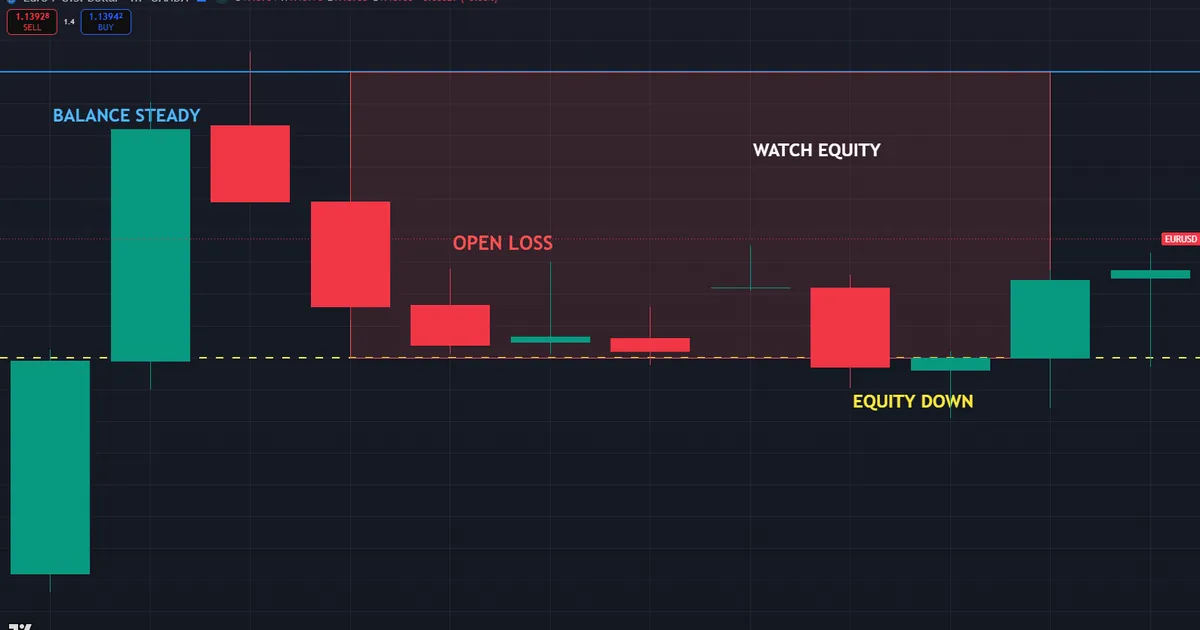
Picture a trader with a balance that looks healthy on the screen. A losing trade is open, so the equity has already dropped well below the balance. Because the trader watches the wrong number, the danger stays hidden until a margin call arrives.
The lesson is to read the live terms, not the static one. Equity shows the true state of the account while trades run, while balance lags behind. So a habit of checking equity catches trouble that balance alone would miss.
Points on Different Platforms
The word point can mean different things across platforms. On a five-decimal broker, a point is often the fifth digit, a tenth of a pip. So confirm the definition on your own platform before you read any distance in points.
Swap on Held Positions
Swap can be positive or negative, depending on the pair and direction. A trade held over many nights can gather a meaningful cost or credit. So check the swap before you plan to hold a position for a long stretch.
Pip Value on Non-Dollar Pairs
The ten dollar pip rule only holds when the dollar is the quote currency. On a yen pair or a cross, the pip value shifts with the exchange rate. So confirm the real figure with a tool rather than assuming the same value everywhere.
Margin Requirements That Change
Margin rules can tighten around major news or the weekend. A broker may raise the required margin, so a position that fit before no longer does. So watch for margin changes ahead of big events, since they can force an early exit.
Order and Execution Terms
Order terms describe how you tell the broker to trade. Each type of order does a specific job, from entering now to waiting for a level. A beginner who knows these words places trades with far more precision.
Execution terms describe what happens when an order fills. They cover the price you actually get and any gap from the price you asked for. Because fills are not always perfect, these words explain the small surprises that trades sometimes bring.
- Market order. An order to buy or sell right now at the current price.
- Limit order. An order to buy or sell only at a chosen price or better.
- Stop order. An order that triggers once the price reaches a set level.
- Slippage. The gap between the price you expected and the price you got.
- Fill. The completion of your order, whole or in part.
When Each Order Fits
A market order suits a trader who wants in or out at once. It fills fast, though the price may shift slightly in a quick market. So it trades certainty of entry for a small chance of slippage.
A limit order suits a trader who values price over speed. It waits patiently for your level and never fills worse than you asked. Because it can be missed entirely, though, a limit order trades speed for control.
Why Slippage Happens
Slippage appears when the price moves between your click and the fill. In a calm market it is tiny or absent, while in a fast one it can widen. So major news, with its sudden moves, is where slippage grows most likely.
A stop order is especially prone to it. Once the level triggers, the order fills at the next available price, which may sit past your level. Because a gap can jump the level entirely, a stop protects you without promising an exact price.
Analysis and Chart Terms
Analysis terms describe how traders study a chart. They cover the tools for reading price and the words for what the chart shows. A beginner meets these terms the moment they open a price chart for the first time.
Chart terms describe the picture itself. They name the shapes and levels traders watch for clues about the next move. Because charts are the daily workspace of a trader, these words appear constantly.
- Timeframe. The period each candle covers, such as one hour or one day.
- Candle. A bar showing the open, high, low, and close for its period.
- Support. A level where price has tended to stop falling.
- Resistance. A level where price has tended to stop rising.
- Trend. The general direction of price over time, up, down, or sideways.
Reading a Candle
A single candle packs four prices into one shape. The body shows the open and the close, while the thin wicks mark the high and the low. So one glance at a candle tells you where price traveled during its period.
Colors add a quick read on direction. A rising candle usually shows one color, and a falling one another, so a chart’s mood is clear at a distance. Because the pattern repeats across every timeframe, learning one candle teaches you all of them.
Support, Resistance, and Trend
Support and resistance mark levels where price has paused before. Traders watch them because price often reacts there again. So these levels give a beginner a simple framework for planning entries and stops.
Trend describes the broader flow of price over time. An uptrend makes higher highs, while a downtrend makes lower lows, and a range drifts sideways. Because trading with the trend is often kinder to beginners, naming it early is worthwhile.
Volatility and Liquidity
Two more chart words round out the set. Volatility measures how far and fast a price moves, so a volatile pair swings widely. Liquidity measures how easily you can trade without moving the price, so a liquid pair fills smoothly.
These two traits shape every trade you plan. A volatile, thinly traded pair carries wider swings and wider spreads, which raises the risk. So a beginner leans toward liquid majors, where the moves are steadier and the costs stay low.
Together the analysis terms give you a working vocabulary for the chart. You can name the timeframe, read a candle, mark support, and judge the trend. Because those words cover the daily work of trading, they turn a blank chart into a readable map.
Build the vocabulary in layers, not all at once. Learn the price and size words first, then add the risk words, and finish with the chart words. Because each layer supports the next, a steady, ordered study beats trying to memorize everything in a single sitting. So keep this page bookmarked, revisit a group each day, and let the words settle in through repetition rather than cramming. A term you use often is a term you rarely forget.
Related Concepts to Study Next
This glossary opens onto a few ideas worth your next reading hour. A clear path for placing a first trade puts the terms to work in a real setting. The deeper guides linked above turn each one-line definition into full understanding.
Read our guide on how to trade forex for beginners to see the terms in action across a real trade. Then return to any single-term guide above whenever a word needs more depth. Together they turn this glossary from a list into working knowledge.
FAQ
What are the most important forex trading terms for a beginner?
The core forex trading terms are pip, lot, spread, leverage, margin, and stop-loss. Together they cover price, size, cost, and risk, which are the four parts of every trade. Learn these first, and most of the platform stops looking like jargon.
What is the difference between a pip and a lot?
A pip is the standard smallest price move, equal to 0.0001 on most pairs. A lot is the size of your trade, such as 100,000 units for a standard lot. The lot decides how much money each pip is worth.
What does going long or short mean?
Going long means buying the base currency because you expect it to rise. Going short means selling it because you expect it to fall. Because forex trades in pairs, both directions are always open to you.
What is the difference between margin and leverage?
Leverage is the ratio that lets a small deposit control a larger position. Margin is the actual deposit the broker locks to open that trade. Leverage sets the ratio, and the margin is the money it holds in place.
What is the difference between balance and equity?
Balance is your account total before open trades are counted. Equity includes the floating profit or loss on any open position. So equity shows your true live value, while balance lags until the trades close.
How long does it take to learn forex trading terms?
The core terms take only a few study sessions to learn well. Using them in real trades then cements the meanings over a few weeks. Keep this glossary handy, review it often, and the vocabulary will soon feel natural. Results are not guaranteed; past performance is not indicative of future results.
External references
- For background on this concept, see Forexpedia Glossary at BabyPips.
- For broader market context, see Glossary of stock market terms on Wikipedia.

About the author
Written by Dominic Walsh, a Forex trader and MT4/MT5 indicator, Expert Advisor and script developer. Every tool on forexmt4systems.com is tested on live charts before release and ships with ready-to-use compiled MT4 (.ex4) and MT5 (.ex5) files. Learn more about the trader and developer behind this site.
How we build, test and correct every tool: Editorial & Testing Policy. Trading carries risk; see the disclaimer.