
Discipline decides more trading outcomes than any indicator setting. Yet most advice on the subject stops at slogans.
This guide answers how to be a disciplined trader with mechanics rather than motivation. You get written rules, a pre-trade checklist, a daily loss limit, a post-loss cooling-off period, journal fields and a fixed review cadence.
Nothing here depends on willpower. Each part removes a decision from the moment when your judgement works worst.
What Discipline Actually Means at the Screen
Discipline is not calm. A calm trader can still break every rule, and an anxious one can follow all of them.
So the working definition stays narrow. Your behaviour during the session matches the behaviour you specified before it.
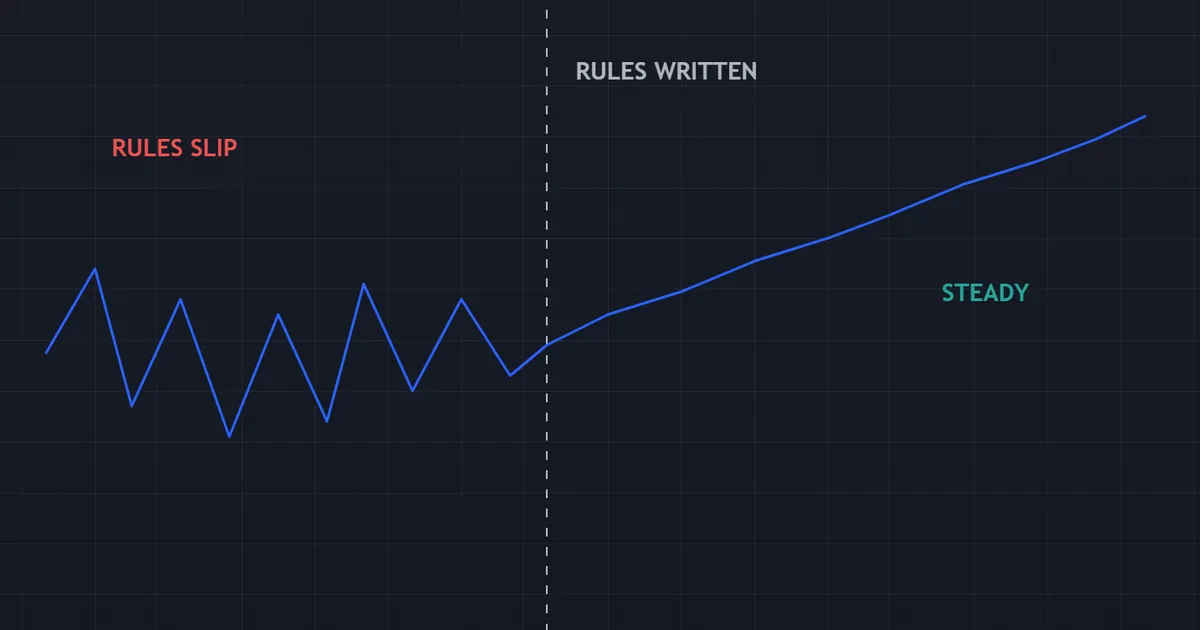
That version can be measured. Count the trades that matched your written rules, then divide by the trades you took.
Discipline Is a System, Not a Feeling
Feelings arrive whether you want them or not. Because you cannot switch them off, the useful move is to make them irrelevant to the decision.
A system does that by fixing the decision earlier. You choose the entry criteria on Sunday, so Tuesday afternoon has nothing left to negotiate.
Think of it as pre-commitment. The version of you with no position open writes the rules, and the version with money at risk simply follows them.
Why Motivation Fails as a Control
Motivation rises and falls with results. After three winners it feels enormous, and after three losers it vanishes.
So a process that leans on motivation collapses exactly when you need it most. Rules do not care about the last three trades.
Late in a session, decision fatigue makes this worse. Fewer live decisions therefore protect the quality of whatever decisions remain.
The Rule-Following Score
Give yourself one number each week. Divide the trades that followed every rule by the total trades you placed.
Eighty percent is a realistic starting point for a discretionary trader. Below sixty, the plan is decoration rather than a control.
Track that percentage beside your results, but read it separately. A profitable week at fifty percent compliance is luck wearing a disguise, and luck reverses.
How to Be a Disciplined Trader, Step by Step
The whole method fits into six steps. Work through them in order, because each one leans on the one above it.
- Write the rules. Put your setup, entry, exit and sizing rules in a single document you can read in two minutes.
- Number every rule. A numbered rule can be cited in a journal entry; a vague principle cannot.
- Build a pre-trade checklist. Turn the entry rules into boxes you tick before every order.
- Set a daily loss limit. Decide the figure that ends your session, then automate the reminder.
- Define a cooling-off period. Fix how long you stand down after a loss or a rule break.
- Review on a schedule. Book a weekly and a monthly slot, and treat both as unmissable.
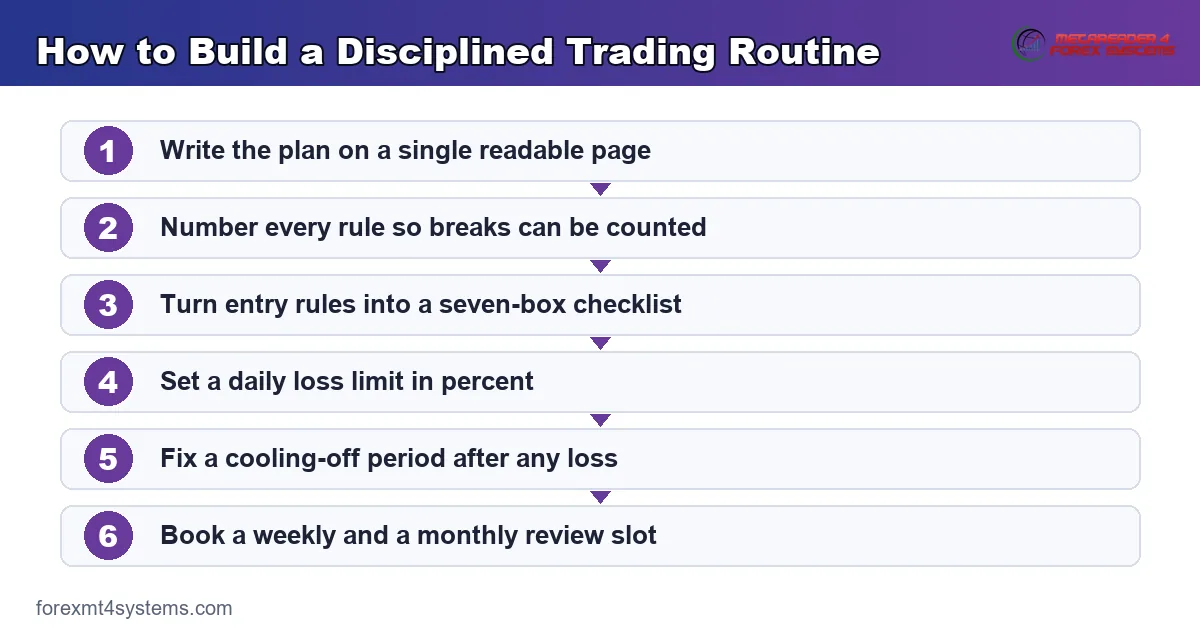
Notice what the six steps share. Each one moves a choice out of the live session and into a quiet moment.
Write the Rules Before the Session
Rules held in your head are not rules. They drift, and they drift in whatever direction the last trade pushed them.
So put the document on one page. If it runs longer, you will not read it, and an unread rule set controls nothing.
Keep the file open beside the platform. A rule you can see beats a rule you have to remember.
Give Every Rule a Number
Numbers make rules auditable. When you break rule four, your journal records “broke rule four” rather than “got impatient”.
That precision changes the review. You can count how often each rule fails, then fix the two that fail most.
Vague self-criticism produces nothing. Countable breaks produce a repair list.
Keep the numbering stable across months. If rule four means something new every few weeks, your history stops comparing.
Keep the Plan Under Version Control
Date every version of the document. Then a change you made in March can be judged against the results that followed it.
Log the reason beside each edit, in one line. Traders who skip this end up unable to explain why a rule exists, and unexplained rules get dropped first.
Limit yourself to one edit per review. Slow change is what makes the record readable later.
The Written Trading Plan
Your plan carries four sections and no more. Anything longer turns into an essay you skim rather than a control you follow.
Write it in plain language. A rule that needs interpretation will get interpreted generously at the worst possible moment.
Setup and Entry Conditions
State the market, the session and the timeframe you trade. Then state the exact conditions that create a valid setup.
Use conditions you can verify at a glance. “Price closes above the twenty-period average” works, while “momentum looks strong” does not.
Cap the number of conditions at four or five. Beyond that, no chart ever satisfies all of them, and you end up trading none of your setups.
Exit Rules Written in Advance
Both exits belong in the plan. Write the stop distance and the target rule before you open anything.
Then decide, in advance, what may move a stop. For most traders the honest answer is that only a trailing rule may move it, and never in the direction of more risk.
Our guide to how to use a stop loss covers placement in detail. The discipline point is narrower: the stop goes in with the order, not after it.
Sizing Rules
Fix one risk figure per trade and hold it. A flat figure removes the sizing decision entirely, which is the point.
Work the lot size out before the session using a position size calculator. Then you never size by feel while a candle is forming.
Our note on risk per trade explains how to choose that figure. Once chosen, treat it as fixed for at least a month.
Rules for the Days You Do Not Trade
Most plans cover entries and ignore abstention. So traders default to acting, because the document never told them when to sit still.
Name the conditions that cancel a session outright. Illness, poor sleep, a major scheduled release inside your window, or an argument before you sat down all qualify.
Write those conditions as a short list. Then a no-trade day becomes a rule you followed rather than an opportunity you missed.
Your Pre-Trade Checklist
A checklist converts your plan into an action you perform. Pilots and surgeons use them for the same reason traders should: memory fails under pressure.
Keep it short enough to run in twenty seconds. A long checklist gets skipped, and a skipped checklist is worse than none.
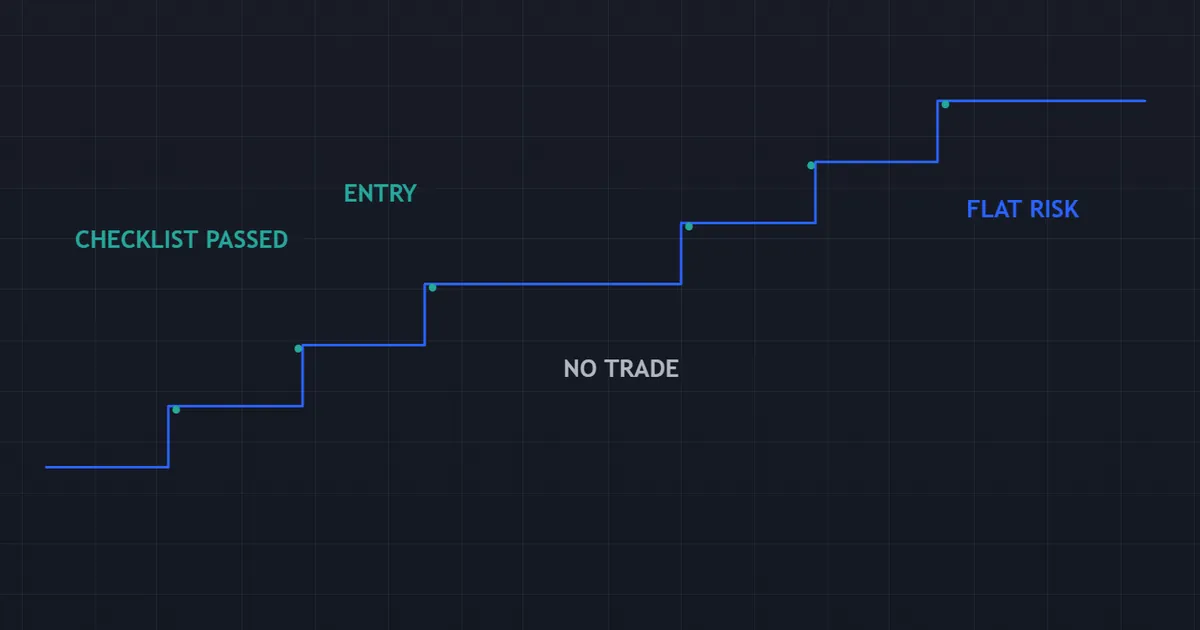
The Seven Boxes
Seven boxes cover almost every discretionary strategy. Adapt the wording, but keep the count low.
- Is this one of my named setups, by its written definition?
- Am I inside my traded session and timeframe?
- Is my risk on this trade the same figure as always?
- Do I know the stop price before I click?
- Do I know the target or the exit rule?
- Is my daily loss limit still intact?
- Am I inside a cooling-off period right now?
Any unticked box means no trade. That rule needs no exceptions, and adding one destroys the whole device.
How to Use It Without Slowing Down
Run the checklist while the candle forms, not after it closes. So the answer arrives before the opportunity does.
Print it and keep it beside the keyboard. Screen space competes with charts, whereas paper sits in view permanently.
After a month, most boxes become automatic. Keep running it anyway, because the boxes you stop checking are exactly the ones that slip.
Why Checklists Outperform Willpower
A checklist shifts the work from memory to recognition. Reading a box and answering yes or no takes almost no mental effort.
Willpower, in contrast, drains through the session. By the fourth hour you have less of it, and the fourth hour is where damage usually happens.
There is a second benefit. A written box gives you something to point at when you want to skip it, which makes the skip a conscious act rather than a drift.
Download the complete indicator database
Put these concepts on your charts. One email unlocks the full library of 1,380+ indicators with compiled MT4 and MT5 files, plus my TradingView scripts. No paywall, no spam, unsubscribe any time.
Get free access to my indicator database
One email unlocks 1,380+ free MT4, MT5 and TradingView indicators — the complete library. No single-tool download; you get the whole database.
Daily Loss Limit and the Cooling-Off Period
Two numbers do most of the protective work. One ends the session, and the other delays your next order.
Both work only when you set them in advance. A limit invented halfway through a bad day is not a limit at all.
Setting the Daily Number
Express the limit as a percentage of the account, not as a cash figure. Percentages scale as the balance moves, so the rule survives growth and drawdown alike.
Many traders anchor it to their per-trade risk. Three consecutive full losses is a common stopping point, which lands near three percent for a one percent risk.
Our guide to the daily loss limit works through the arithmetic. The discipline half is easier: when the number hits, the platform closes.
The Post-Loss Cooling-Off Period
Losses raise the odds of the next mistake. Traders re-enter faster, size larger and skip the checklist, which is how one loss becomes four.
So write a fixed pause. Fifteen minutes after any full stop-out, and the rest of the session after two in a row, suits most intraday styles.
The pause is not punishment. It simply separates the emotional signal from the next decision, so the two stop contaminating each other.
What to Do During the Cool-Off
Leave the chart. Watching a market you cannot trade builds pressure rather than releasing it.
Write the journal entry for the trade you just lost instead. That turns dead time into the raw material for your weekly review.
Then return only when the clock says so. Our note on revenge trading shows how quickly the alternative escalates.
Add a Weekly Floor as Well
A daily limit alone leaves a gap. Five controlled losing days in a row still add up to a serious month.
So set a weekly floor at roughly twice the daily figure. Hitting it means the week ends early, whatever the calendar shows.
Use the pause productively. Reduce size by half for the following week, then return to full size only after five clean sessions.
Journal Fields That Enforce Discipline
A journal full of prose teaches nothing. Fields you can count and sort teach a great deal.
So design the journal as a table first. Free text belongs in one column at the end, not everywhere.
The Fields to Record
Twelve fields cover a discretionary process. Record them for every trade, winners included.
- Date, time and instrument
- Setup name, taken from your written list
- Checklist complete: yes or no
- Planned risk, in percent
- Actual risk, in percent
- Entry, stop and target prices as planned
- Actual exit and the reason for it
- Result in R multiples
- Rules broken, by number
- Emotional state before entry, on a one-to-five scale
- Was this trade inside a cooling-off period
- One sentence of comment, maximum
Our free trade journal holds these fields already. A spreadsheet works equally well, provided you never skip a row.
The Rule-Break Column
One column carries more weight than the rest. The rule-break field turns discipline into a number you can track weekly.
Count the breaks, not the losses. A losing trade that followed every rule is a cost of doing business, while a winning trade that broke three rules is a warning.
Because the count is objective, it resists the stories traders tell themselves. Ten breaks in a week is ten breaks, whatever the balance says.
Grade the Session, Not the Result
End each session with a single letter grade for process. An A means every trade cleared the checklist and every exit followed the plan.
Ignore the balance when you grade. A red day run perfectly earns an A, while a green day full of improvisation earns a C.
Over a month the grades form a pattern. Traders usually find their worst grades cluster in one hour or one setup, which points straight at the repair.
Common Discipline Mistakes and How to Fix Them
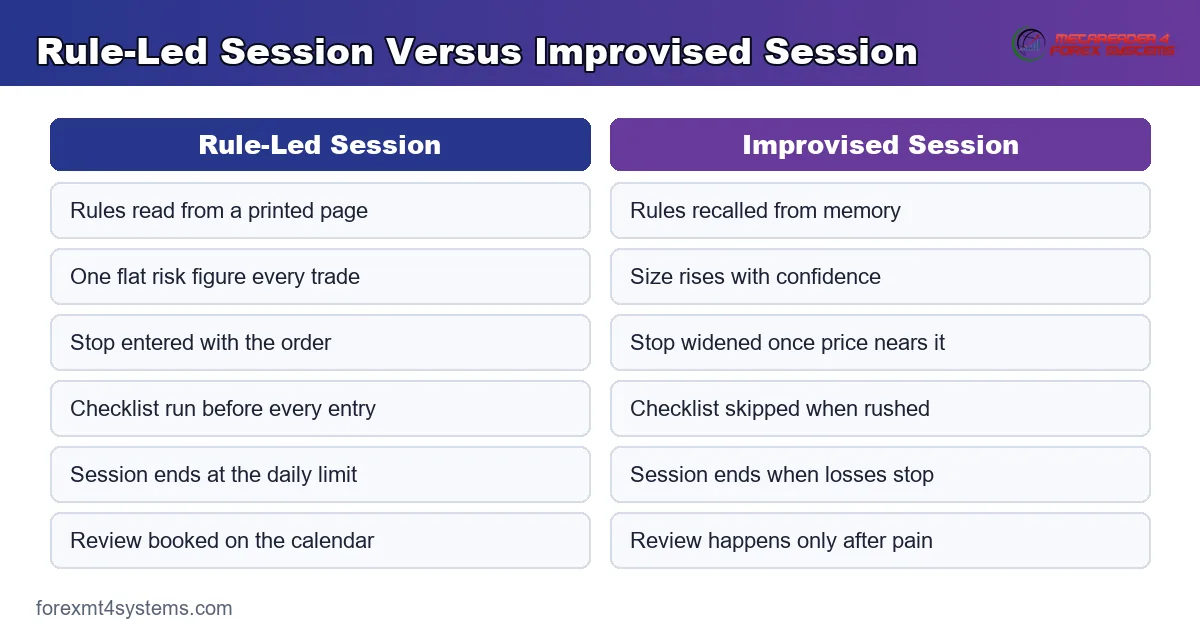
Six patterns account for most broken rules. The comparison panel below sets a rule-led session beside an improvised one.
Rules That Live Only in Your Head
Unwritten rules bend silently. So write them down, print the page, and keep it where you can see it during every session.
Sizing by Confidence
Traders press size on setups that feel obvious. Those feelings correlate poorly with outcomes, so hold one flat risk figure and let the edge do the work.
Moving the Stop
Widening a stop converts a planned loss into an unplanned one. Write a rule that permits movement in one direction only, then treat the original stop as final.
Trading Outside Your Session
Boredom pulls people into markets and hours they never studied. Name the session in your plan, and close the platform outside it.
Skipping the Checklist When Rushed
Urgency is precisely when the checklist earns its keep. If a setup moves too fast to check, it was never your setup.
Reviewing Only After Losses
Reviews that follow pain arrive too late and read too harshly. Book the review on a calendar instead, and hold it whatever the week produced.
Discipline Quick Reference
Keep this table beside your platform. Each row names a control and the moment it applies.
| Control | When it applies | What it prevents |
|---|---|---|
| Written plan on one page | Read before every session | Rules drifting with recent results |
| Pre-trade checklist, seven boxes | Before every order | Setups you never actually defined |
| Flat risk per trade | Every position, no exceptions | Sizing by confidence |
| Daily loss limit | Reached during the session | One bad day becoming a bad month |
| Cooling-off period | After a loss or a rule break | Immediate re-entry and escalation |
| Weekly review | Same slot every week | Repeating the same break unnoticed |
Six controls cover the whole method. Add a seventh only when a real problem demands one.
Discipline Across Different Trading Styles
The controls stay the same, though their weighting shifts. A scalper and a swing trader break rules in different places.
Intraday and Scalping
Speed is the enemy here. Because setups appear and vanish inside minutes, the checklist has to be short enough to run in real time.
Trade count becomes the key discipline metric. Set a hard cap on trades per session, and treat the cap as seriously as the loss limit.
Session boundaries matter more too. Scalpers who drift past their studied hours usually give back the morning during the afternoon.
Swing and Position Trading
Patience is the harder skill at this pace. Days pass without a setup, and the temptation is to lower the bar rather than wait.
So the discipline shifts toward abstention. Count the valid setups you skipped alongside the ones you took, and check that the skips had reasons.
Holding through noise also needs a written rule. Decide in advance whether news inside a trade changes anything, because deciding mid-position rarely ends well.
Review Cadence and What Goes Wrong
Discipline decays without inspection. So the review is not admin, it is the maintenance that keeps everything else honest.
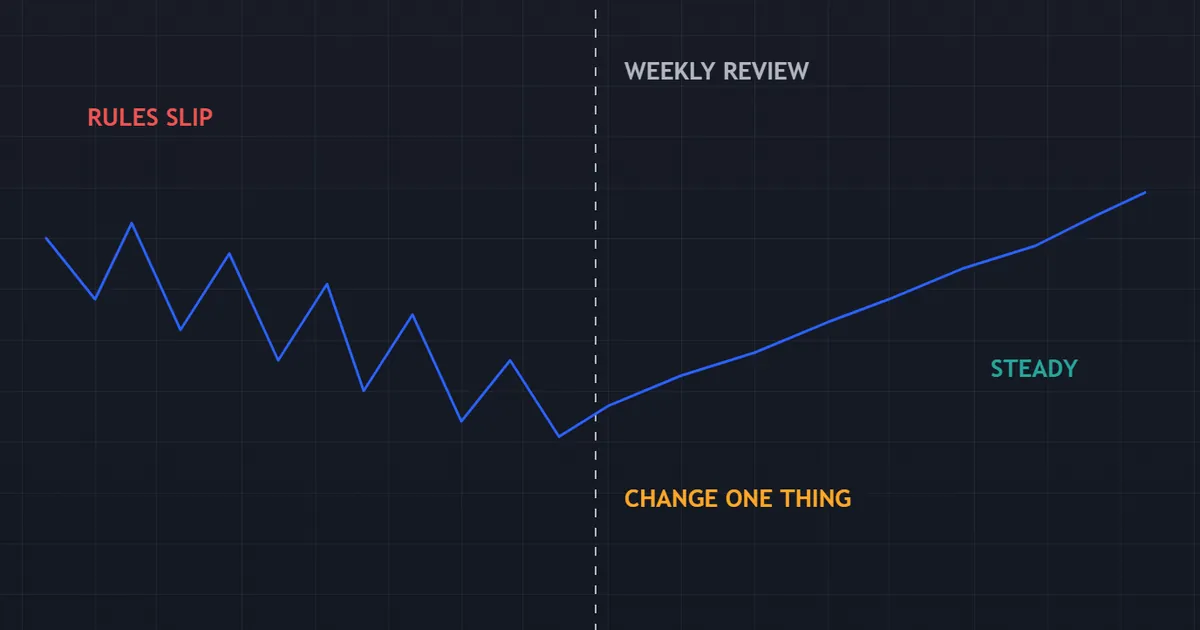
The equity panel below shows the pattern most traders recognise. Rules slip, the curve chops, then the curve steadies once the rules return.
The Weekly Review
Give it thirty minutes and three questions. How many rules did I break, which rule broke most, and what single change fixes that one rule next week?
Change one thing at a time. Two simultaneous changes make the following week impossible to interpret.
Then write the change into the plan document. A change you did not write is a change you will forget by Wednesday.
The Monthly Review
Once a month, look at the shape rather than the detail. Compare rule-following trades against rule-breaking trades and read the two results separately.
This split answers the important question. If your rule-following trades lose while your breaks win, the rules need work rather than your behaviour.
Most traders find the opposite. Their breaks cost far more than they earn, which settles the argument for another month.
Where Discipline Systems Break Down
Perfectionism kills more plans than laziness. A trader who demands a flawless week quits the whole system after one slip, so build in a tolerance instead.
Overlong rule sets fail too. Nobody reads two pages before a session, and unread rules cannot control anything.
Watch for silent scope creep as well. New instruments and new timeframes arrive one at a time, and each one quietly escapes the plan you wrote.
Copying somebody else’s rules causes trouble too. A plan written for a different schedule and a different temperament will not survive contact with your Tuesday.
Another common failure is the rewrite after a bad week. Changing the plan while the wound is fresh usually encodes the emotion rather than the lesson, so wait for the scheduled review.
Finally, treat serious stress seriously. If trading affects your sleep, your finances or your relationships, stepping away and seeking qualified professional support is the right move.
Related Concepts to Study Next
Discipline sits between two neighbouring topics. One supplies the rules, and the other explains why traders abandon them.
Start with our list of trading discipline rules for wording you can copy into your own plan. Then read our guide to overtrading, because most discipline failures show up first as trade count.
Pair both with a flat sizing habit. A single risk figure held all month does more for consistency than any clever adjustment.
FAQ
How long does it take to become a disciplined trader?
Most traders see a measurable drop in rule breaks within four to six weeks of journaling them. The habit itself takes longer, and it never becomes permanent. Treat discipline as maintenance rather than a milestone you pass once.
What is the single most effective discipline rule?
A daily loss limit, applied without exception. It caps the damage from every other failure, including revenge trading, oversizing and trading outside your session. One number, decided in advance, prevents most account-ending sequences.
Should I stop trading after breaking a rule?
Stand down for a fixed period rather than the whole day. Fifteen minutes separates the emotion from the next decision. Two breaks in a session is a reasonable trigger to close the platform entirely and review that evening.
Does a smaller position size improve discipline?
Usually yes. Traders follow rules far more reliably when the outcome of one trade barely matters. If you break rules constantly, halve your risk figure for a month and count the breaks again.
How do I stay disciplined during a losing streak?
Shrink the decision surface. Reduce size, trade fewer setups, and hold the review cadence. Our guide to handling a losing streak covers the sequencing in detail.
Can discipline alone make a strategy profitable?
No. Discipline lets an edge express itself, but it cannot create one where none exists. A strategy with negative expectancy simply loses more consistently when you follow it precisely. Results are not guaranteed; past performance is not indicative of future results.
External references
- For background on this concept, see Habit on Wikipedia.
- For broader market context, see How Trading Psychology Affects Investment Success at Investopedia.

About the author
Written by Dominic Walsh, a Forex trader and MT4/MT5 indicator, Expert Advisor and script developer. Every tool on forexmt4systems.com is tested on live charts before release and ships with ready-to-use compiled MT4 (.ex4) and MT5 (.ex5) files. Learn more about the trader and developer behind this site.
How we build, test and correct every tool: Editorial & Testing Policy. Trading carries risk; see the disclaimer.