
Plenty of traders build a beautiful practice record and then lose money in week one of a real account. Nothing about the strategy changed.
The gap sits in demo vs live trading psychology, and it comes down to one variable: consequence. A practice account removes the financial outcome, so the reactions that shape real trading never fire at all.
This guide explains what changes, why practice results travel badly, and how to bridge the two accounts deliberately. The bridge is a live account traded at a size small enough that the feeling is real and the loss is trivial.
What Changes the Moment Money Is Real
A practice account reproduces the chart, the platform and the order ticket. It cannot reproduce the part that matters.
Consequence is the missing variable. Without it, every behavioural pressure that governs live trading sits switched off.
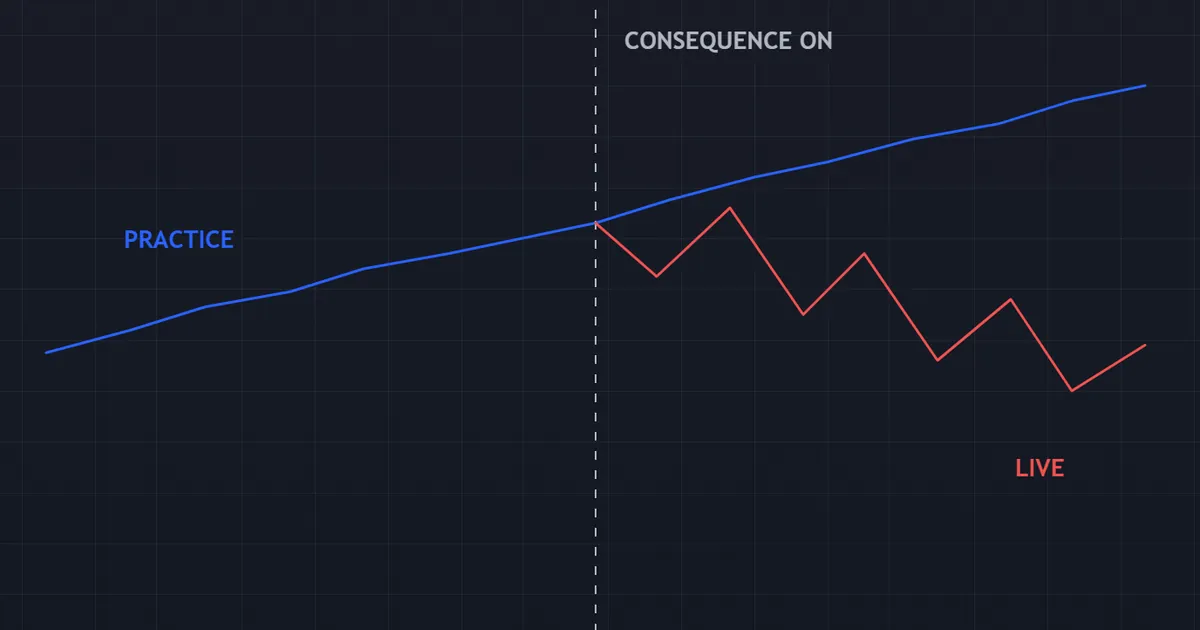
So the practice record measures your analysis. It does not measure your execution under pressure, which is the harder half.
Loss Aversion Needs Something to Lose
Behavioural research describes loss aversion as feeling a loss roughly twice as strongly as an equivalent gain. Kahneman and Tversky documented the asymmetry in their work on prospect theory.
A practice loss triggers none of that. The number changes on screen, and nothing in your life changes with it.
So the stop you honoured fifty times in practice becomes negotiable on the first real trade. Nothing about your discipline declined, because the pressure had never been applied.
Fear of Missing Out Behaves Differently
Missing a practice move costs nothing. You shrug and wait for the next one.
Missing a live move costs an opportunity you can price. Because the number feels concrete, traders chase entries they would have skipped in practice.
Our guide to fear of missing out in trading covers the pattern in detail. Practice accounts simply cannot reproduce it.
Drawdown Stops Being an Abstraction
A twelve percent practice drawdown reads as a statistic. The same drawdown on real money reads as rent, or as a holiday you no longer take.
That difference changes behaviour in both directions. Some traders freeze and stop taking valid setups, while others double size to get it back.
Neither reaction appears in the practice record. So a smooth practice equity curve tells you nothing about how you handle the fourth losing week.
Your Analysis Stays Intact
One thing does survive the move. Your ability to read a chart works exactly the same on both accounts.
That is worth saying plainly, because traders often conclude their strategy was flawed. Usually the strategy was fine and the execution changed underneath it.
So the diagnosis matters. Rebuilding a working strategy wastes months, whereas fixing execution takes a few dozen small live trades.
Demo vs Live Trading Psychology, Side by Side
The comparison panel below sets the two accounts against each other. Read the right column as the version of you that actually shows up.
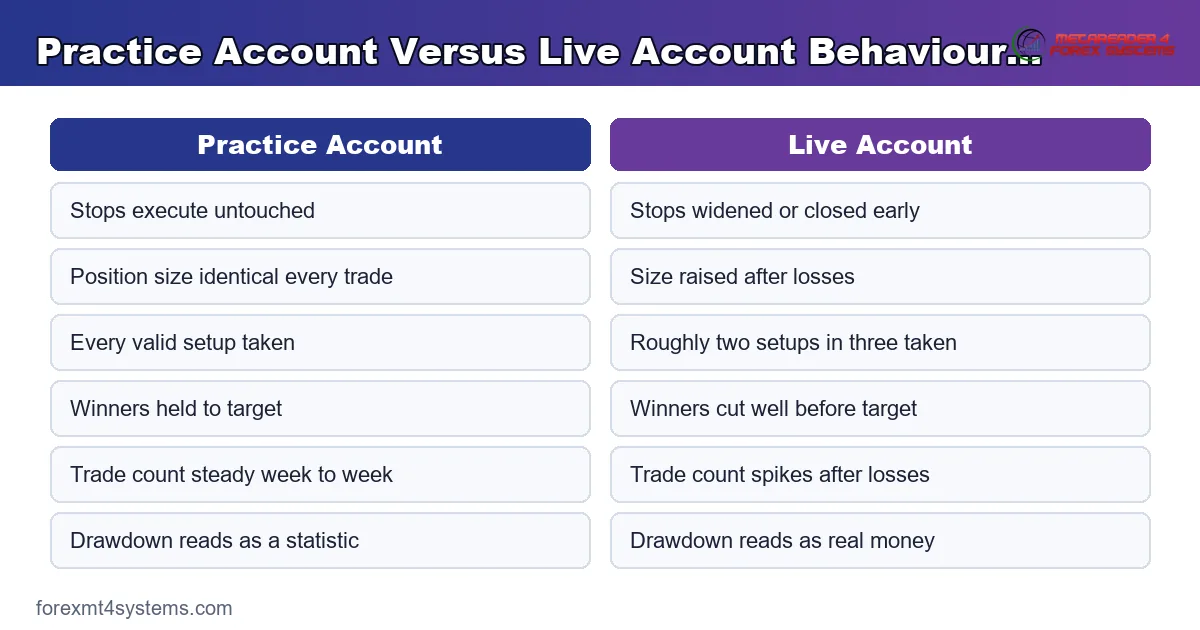
Six differences carry most of the weight. Each one changes the decision rather than the analysis.
The Six Differences That Matter
Start with stop handling. Practice traders let stops execute, while live traders widen them, close early, or watch them for an hour.
Position sizing shifts next. Practice accounts often carry an inflated balance, so the sizes bear no relation to what you will really trade.
Then look at trade selection, hold time, re-entry speed and session length. Every one of them moves once the outcome has weight.
Hold time deserves particular attention. Live traders close winners early because a floating profit feels fragile, and that single habit removes most of the reward from a trend strategy.
Session length drifts too. A practice trader stops at the planned hour, whereas a live trader stays on for one more attempt after a red session.
Why the Gap Surprises People
Traders assume the practice period built a habit. It built a habit under laboratory conditions, which is a different thing.
Skills that depend on emotional load do not transfer from load-free practice. So the first live month feels like starting again, because in the relevant sense it is.
Expecting this changes the plan. You schedule a transition rather than a graduation.
The Same Chart, Two Different Decisions
Put the same screenshot in front of both versions of yourself. On a practice account you click and move on.
Live, you hesitate, check a second timeframe, and wait for the candle to close. Half the time the setup has gone by then.
Nothing in that sequence is irrational. Because the outcome now carries weight, your brain demands more certainty before committing, and certainty arrives late.
Why Practice Results Fail to Transfer
Two separate problems corrupt the comparison. One is mechanical, and the other is behavioural.
Both push the same way. Practice results look better than the same strategy will look live.
Execution: Fills, Spreads and Slippage
Practice servers fill orders generously. Limit orders fill at the touch, market orders fill at the quote, and slippage rarely appears.
Live fills behave worse, especially around news and at session opens. A strategy that scalps a few pips can lose its whole edge to this alone.
Costs deserve a check too. Our note on forex trading costs covers spread, commission and swap, none of which practice accounts model accurately.
Behaviour: The Larger Problem
Mechanical differences cost a fraction of a percent. Behavioural differences cost far more.
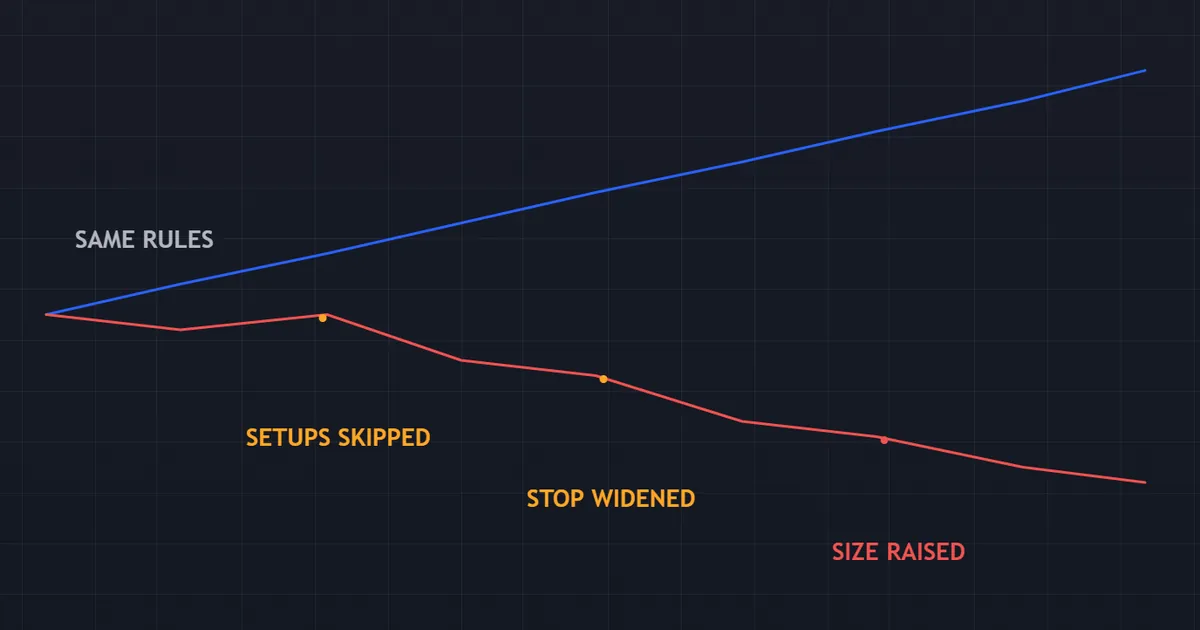
Count the ways a live trader deviates. Skipped setups, early exits, widened stops, doubled size and extra trades all appear in month one.
None of those show up in the practice log. So the practice equity curve describes a trader who does not exist yet.
Sample and Selection Problems
Practice runs are short and self-selected. Traders who blow a practice account usually open another one and forget the first.
Restarts destroy the record. Because only the surviving run gets remembered, the reported result is the best of several attempts.
Length matters as well. Thirty practice trades over two calm weeks tells you very little about a strategy across a full quarter.
Small Costs Compound Quietly
Take a strategy that averages six pips of profit per trade. Add one pip of slippage and half a pip of extra spread on a live server.
That removes a quarter of the edge before behaviour enters the picture. Over two hundred trades the difference reshapes the whole equity curve.
So model the costs deliberately. Subtract your broker’s real spread and a pip of slippage from every practice result before you believe the number.
A Worked Example of the Transfer Gap
Picture a trader with sixty practice trades and a tidy result. The same strategy then runs live for sixty trades.
The table sets the two runs beside each other. Note that the strategy definition never changed.
| Measure | Practice run | First live run |
|---|---|---|
| Setups taken of those available | Almost all of them | Roughly two in three |
| Stops honoured as placed | Every time | Widened or closed early on several |
| Average hold time on winners | Full target | Cut short well before target |
| Risk per trade | Identical on every trade | Raised after losses, cut after wins |
| Trades per week | Steady | Spikes after losing sessions |
Reading the Two Columns
Every difference above is behavioural. Not one of them reflects a flaw in the analysis or the entry rules.
So the honest conclusion is uncomfortable. The practice record validated a strategy that the live trader was not yet running.
Fixing this needs exposure to consequence, not more practice. That is exactly what the bridge below provides.
What the Table Does Not Show
Two things sit outside the columns. First, the live trader thought about trading far more between sessions.
Second, the losing weeks felt longer. A flat month on a practice account passes unnoticed, while the same month live invites a strategy rewrite.
Both effects push toward change for its own sake. So a written rule about minimum sample size protects the strategy from its owner.
Download the complete indicator database
Put these concepts on your charts. One email unlocks the full library of 1,380+ indicators with compiled MT4 and MT5 files, plus my TradingView scripts. No paywall, no spam, unsubscribe any time.
Get free access to my indicator database
One email unlocks 1,380+ free MT4, MT5 and TradingView indicators — the complete library. No single-tool download; you get the whole database.
The Bridge: Going Live at a Trivial Size
The transition has one rule. Trade real money at a size where the emotional signal is genuine and the financial outcome is not.
That combination is the whole point. You want the pressure switched on while the cost of learning stays small.
Choosing the Starting Size
Pick an amount per trade you would spend on lunch without noticing. For most people that sits somewhere between one and five dollars of risk.
Micro lots make this practical on most retail platforms. Our pip value calculator converts that cash figure into a lot size for your pair.
Then size every trade identically. Our guide to calculating lot size covers the arithmetic if your platform makes it awkward.
Work in Twenty-Trade Blocks
Judge yourself over blocks rather than individual trades. Twenty trades is enough to reveal a behavioural pattern and short enough to stay interesting.
Grade each block on compliance only. Count setups skipped, stops moved, sizes changed and checklist boxes ignored.
Ignore profit entirely at this stage. At this size the result carries no information, whereas the behaviour carries all of it.
Write the block score down before you start the next one. A number on paper resists the story you would otherwise tell about the week.
When to Step the Size Up
Raise size only after two consecutive clean blocks. Clean means at least ninety percent compliance with your written rules.
Then double the risk figure, not more. Each step reintroduces pressure, and a large jump undoes the habit you just built.
Step back down after any block that fails. Our note on small account risk management covers sizing at these levels.
Why a Trivial Size Still Teaches
Traders object that tiny positions feel like practice again. They do not, and the reason is simple.
Real money engages the same reactions regardless of the amount. Watching a live position move against you triggers the urge to interfere even when the sum is small.
So the signal arrives intact while the cost stays near zero. That combination is exactly what you cannot buy on a practice server.
An Eight-Week Transition Plan
The bridge works better as a schedule than as an intention. Eight weeks covers most traders comfortably.
Adjust the pace to your trade frequency. A scalper compresses this into three weeks, while a swing trader may need three months.
Weeks One and Two: Mechanics
Fund the account and set the size at your lunch-money figure. Trade every valid setup, and do not judge the results at all.
The only goal is order handling. Place stops with entries, take partial closes, and get comfortable seeing a live number move.
Log everything from the first trade. A gap in week one becomes a gap you never fill.
Weeks Three to Six: Compliance
Now the blocks begin. Grade twenty trades at a time, counting rule breaks rather than profit.
Expect the first block to look poor. Most traders skip setups and cut winners early, which is the pressure showing up exactly as predicted.
Repeat blocks at the same size until two in a row come back clean. Rushing this step is the single most common way the transition fails.
Weeks Seven and Eight: First Step Up
Double the risk figure and run another block. Watch whether compliance holds at the new level.
If it slips, step back down immediately and repeat. There is no penalty for spending an extra month at a small size.
Then set the ceiling in advance. Decide now what your normal risk figure will be, and how many clean blocks stand between you and it.
Write the whole ladder on one page. Seeing the steps laid out removes the temptation to skip two of them after a good week.
Common Demo-to-Live Errors and How to Fix Them
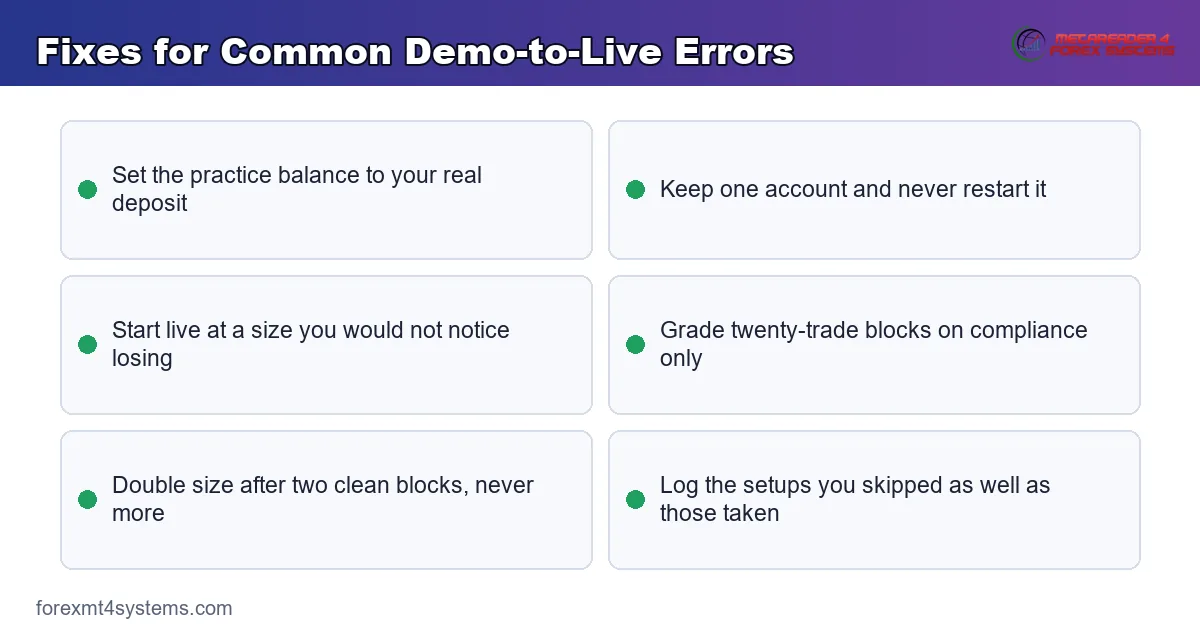
Six errors account for most failed transitions. The panel below collects the fixes in one place.
Practising on an Inflated Balance
A hundred thousand practice account teaches sizing you will never use. Set the practice balance to the amount you will actually fund, on day one.
Treating the Practice Result as Proof
A good practice record proves the rules are followable when nothing is at stake. Treat it as a mechanical rehearsal, then validate the behaviour live at a trivial size.
Jumping Straight to Full Size
Going from practice to full risk applies maximum pressure at the moment of least preparation. Step through blocks instead, doubling size only after clean compliance.
Restarting the Practice Account
Each restart deletes the evidence you most needed. Keep one account, log every trade, and treat a blown practice run as data rather than embarrassment.
Running Both Accounts at Once
Traders often keep a practice account open for the trades they are afraid to take live. That habit hides the fear rather than fixing it, so close the practice account during the transition.
Ignoring the Skipped Trades
Setups you did not take are the clearest sign of pressure. Log them beside the trades you took, and count them in every block.
Rewriting the Strategy in Live Week One
A poor first live month usually reflects behaviour rather than rules. Hold the strategy still for at least thirty live trades, then judge it.
Funding More Than You Can Lose
A deposit that matters financially keeps the pressure far too high to learn under. Fund an amount whose complete loss would change nothing about your month.
Demo to Live Quick Reference
Work through this list before you fund an account. Seven answers cover the whole transition.
- Does my practice balance match the amount I will actually deposit?
- Have I logged at least sixty practice trades with no restarts?
- What cash figure per trade would I genuinely not notice losing?
- What lot size does that figure produce on my usual pair?
- What counts as a clean twenty-trade block for me?
- What compliance level must I hit before doubling size?
- What sends me back down a step?
Write the answers before the first live order. Because the rules are set in advance, the first losing block cannot rewrite them.
What a Practice Account Is Genuinely Good For
None of this makes practice accounts useless. It makes them useful for a narrower list of jobs.
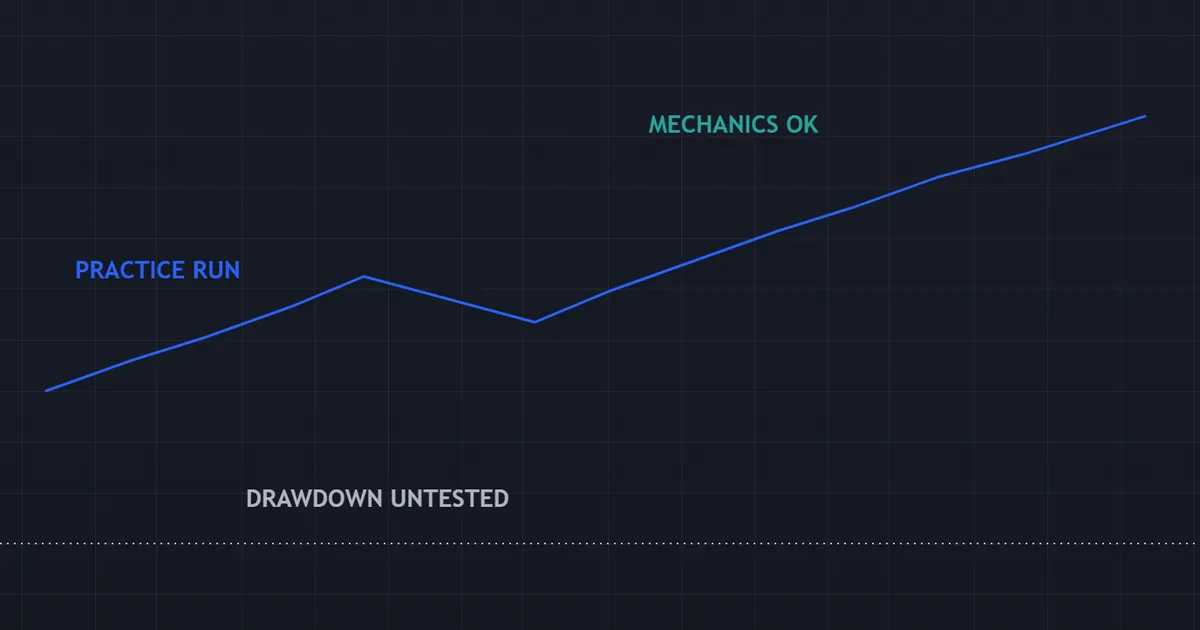
The equity panel below shows a practice run that never tested a real drawdown. It is a useful record of mechanics and nothing more.
Platform Mechanics
Learn the order ticket where mistakes cost nothing. Practise market orders, limit orders, stops, partial closes and trailing stops until the clicks become automatic.
Break things on purpose. Place a stop on the wrong side, close half a position, and modify an order mid-trade so the platform holds no surprises.
Strategy Sanity Checks
Practice accounts filter out obviously broken ideas quickly. If a strategy loses steadily with generous fills and no pressure, it will not improve live.
They also help you time a session. Watching your chosen hours for two weeks shows whether the setups appear when you are actually free to trade.
Testing a Routine Rather Than a Result
Use practice to rehearse the routine around the trade. Pre-market preparation, checklist reading, journal entry and session review all deserve practice runs.
Time each part honestly. Traders often discover their routine takes ninety minutes on a weekday evening they do not have.
Fix that clash before real money arrives. A routine that does not fit your week will be abandoned in week two, whatever your intentions.
What It Cannot Test
It cannot test whether you honour a stop when the loss is real. It cannot test how you behave in week four of a drawdown.
Our guide to the fear of taking a trade covers the freeze that often arrives with the first live account. Practice records never predict it.
It also cannot test your recovery habits. Nobody learns how they respond to a real losing month by simulating one.
So use practice accounts for mechanics, and use small live positions for behaviour. The two tools answer different questions.
Practice After You Are Already Live
Experienced traders still keep a practice account, though for a narrow purpose. New strategies get their first hundred trades there before any money follows.
Keep the two strictly separate. Testing a fresh idea alongside your live routine blurs both records, and the blur usually favours the new idea.
Then move the tested idea across using the same bridge. Small size, twenty-trade blocks, compliance grading, and a step up only after two clean runs.
Related Concepts to Study Next
This topic sits beside two others. One explains the underlying reactions, and the other covers the sizing arithmetic.
Read our overview of trading psychology for the behavioural background. Then check our note on lot size in forex, and set the starting size with our position size calculator.
FAQ
Why do I trade well on demo and badly live?
Because a practice account removes financial consequence, so loss aversion, the fear of missing out and the pain of a drawdown never fire. Your analysis transfers, but your execution under pressure has not been tested. The fix is a live account at a size small enough that the feeling is real and the loss is trivial.
How long should I trade on a practice account?
Long enough to learn the platform and to see sixty trades of your strategy, which usually takes four to eight weeks. Beyond that, extra practice adds very little, because the remaining problems only appear with real money at stake.
What size should I use on my first live account?
Risk an amount per trade you would spend without noticing, often a few dollars. Micro lots make this workable on most retail platforms. Keep that size until you complete two clean twenty-trade blocks, then double it.
Should I set my practice balance to match my real deposit?
Yes, and it is one of the highest-value changes you can make. Practising with a hundred thousand balance teaches sizing you will never use, so the habits transfer badly the moment you fund a smaller account.
Do practice accounts show realistic spreads and slippage?
Rarely. Practice servers fill orders generously, especially around news and session opens. Strategies that target only a few pips per trade lose the largest share of their edge to this difference.
Can I go straight to a live account and skip practice entirely?
You can, provided you start at a trivial size and treat the first blocks as training. Learning the order ticket with real money attached costs more than learning it in practice. Results are not guaranteed; past performance is not indicative of future results.
External references
- For background on this concept, see Demo Account at Investopedia.
- For broader market context, see Transfer of Learning on Wikipedia.

About the author
Written by Dominic Walsh, a Forex trader and MT4/MT5 indicator, Expert Advisor and script developer. Every tool on forexmt4systems.com is tested on live charts before release and ships with ready-to-use compiled MT4 (.ex4) and MT5 (.ex5) files. Learn more about the trader and developer behind this site.
How we build, test and correct every tool: Editorial & Testing Policy. Trading carries risk; see the disclaimer.