
Almost every trader who asks how to stick to your trading plan already owns a decent plan. The document is rarely the problem.
Adherence is a design problem rather than a character problem. This guide treats it that way: pre-commitment, fewer live decisions, deliberate friction, and a review loop that catches drift early.
How to Stick to Your Trading Plan: The Short Version
Decide everything you can before the session starts. Then remove as many in-session choices as your platform allows.
Whatever choices remain, make the wrong one slower than the right one. Finally, review often enough that drift shows up as data rather than as a bad month.
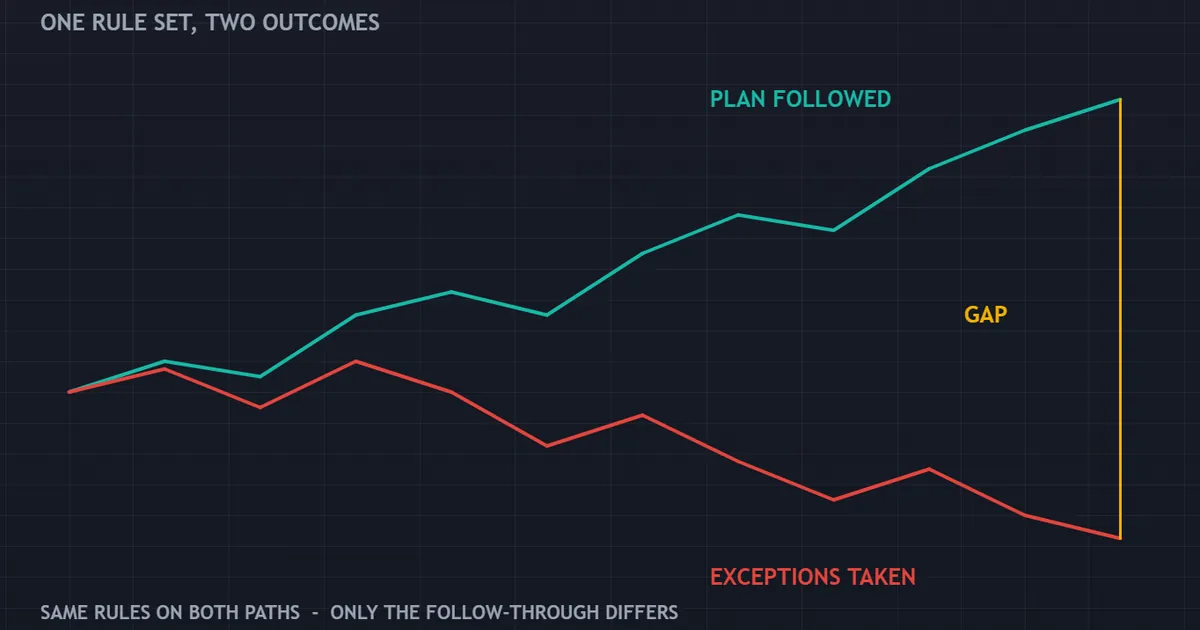
The panel above compares two equity paths built from identical rules. One account traded the rules as written, the other took a handful of reasonable-looking exceptions.
Why Willpower Is the Wrong Tool
Willpower works well when you need it once. Trading asks for it repeatedly, under time pressure, while money moves.
Nobody performs consistently under those conditions. Systems that reduce the number of decisions beat resolve, because they work when you feel tired.
So stop treating a broken rule as a moral failure. Treat it as evidence that a decision sat somewhere it should never have been.
What a Plan Does and Does Not Do
A plan does not create an edge. It makes an existing edge executable, and it makes the absence of one visible.
That second function matters more than traders expect. Rules followed consistently produce records you can actually judge.
Rules followed sometimes produce noise. You end up unable to tell whether the method failed or whether you simply stopped running it. Our guide to what a trading plan is covers the document itself in detail.
Pre-Commitment: Deciding Before It Costs Anything
Pre-commitment means making a choice while it stays cheap. Five steps turn that idea into a routine.
- Prepare outside market hours. Mark levels and shortlist setups when no position exists.
- Write the trade in advance. Entry, stop, target and size, all recorded before the session.
- Name what cancels it. State the conditions that take the setup off your list.
- Place resting orders where possible. An order sitting at your level needs no decision later.
- Close the platform between checks. Watching creates opportunities to interfere.
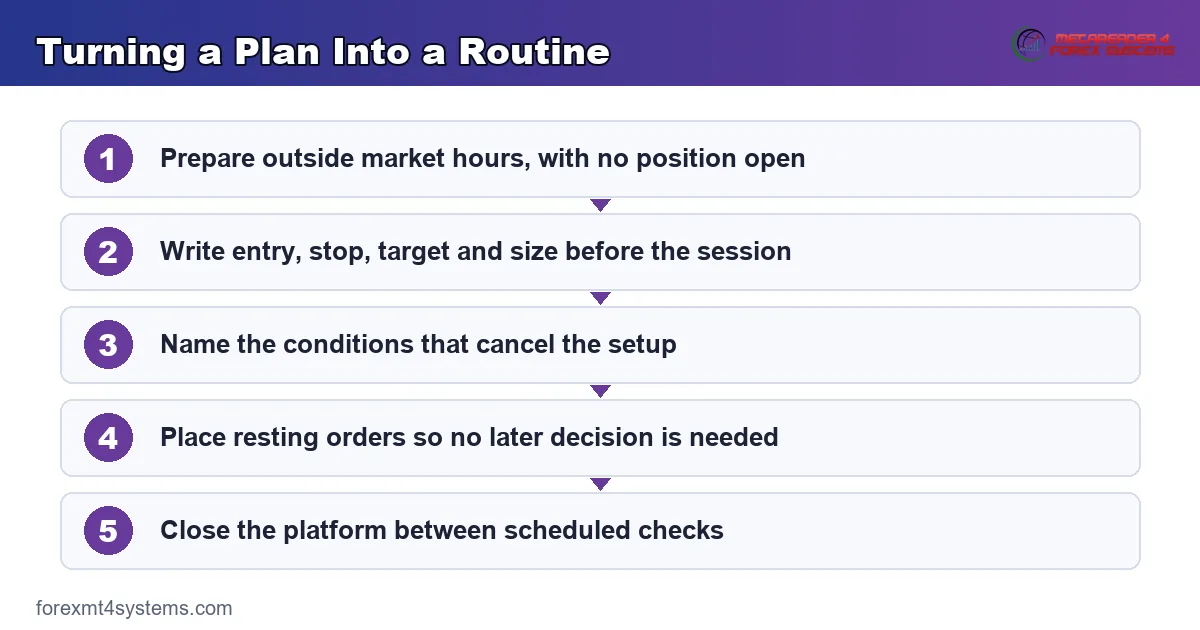
Step two carries most of the benefit. A trade written down in advance gives your later self something to obey rather than something to invent.
Write the Trade Before the Session
Vague intentions collapse under pressure. Precise ones survive, because there is nothing left to work out.
Compare two versions of the same idea. Buying a pullback if it looks good invites argument, while buying a limit at a stated price with a stated stop does not.
Our pre-trade checklist gives you the fields worth filling in. Working through it takes minutes and removes most in-session debate.
Name the Conditions That Cancel It
Traders write entry rules carefully and skip cancellation rules entirely. That gap is where most improvisation starts.
Decide what invalidates the idea before entry. A close beyond a level, a release landing mid-setup, or simply the session ending all work as cancellation conditions.
Then honour them without review. A cancelled setup that later worked is not evidence against the rule.
Keep It to One Page
Long plans do not survive live sessions. Anything you will not read at seven in the morning may as well not exist.
Compress the rules onto a single page. Entry conditions, cancellation conditions, risk per trade, daily limit and session hours cover most of what you need.
Detail belongs in a separate document you read monthly. The one-pager exists to be obeyed, not to be comprehensive.
Why Plans Break: Four Common Triggers
Deviations cluster around predictable moments. Knowing yours lets you defend the right ones.
Straight After a Loss
The urge to recover something immediately is the most expensive impulse in trading. It arrives fastest when the loss felt unfair.
Build a cooling-off rule for exactly this window. Ten minutes away from the screen removes most of it.
Straight After a Big Win
Confidence following a good trade feels like skill and behaves like risk. Size creeps upward, and standards for the next setup quietly relax.
Treat the trade after a win with extra suspicion. Many traders cap size for the rest of the day once a target lands.
During Quiet Markets
Boredom produces trades that no rule describes. Nothing looks interesting, so the standard falls until something does.
Plan for empty sessions in advance. Deciding what you will do when nothing qualifies stops you inventing something.
When Life Is Loud
Poor sleep, deadlines and family stress all drain the resources adherence needs. The market takes no account of any of it.
Trade smaller or not at all on those days. Recognising the condition is most of the fix.
Cutting the Number of Live Decisions
Count the decisions your process demands while a position runs. Then remove as many as you can.
Every Open Decision Is a Chance to Drift
Each live choice offers a moment to depart from the plan. Ten such moments per trade produce ten opportunities, and you only need to take one.
Reducing them is more effective than resolving to choose well. Fewer choices means fewer chances for the wrong one.
Bracket Orders Remove Three at Once
Attaching a stop and a target at entry settles three questions permanently. Where to exit if wrong, where to exit if right, and whether to keep watching.
Those three account for a large share of rule-breaking. Handing them to the broker at entry removes the argument entirely.
Do the same with size. Working the lots from the stop distance before the order goes in leaves nothing to adjust in the moment.
A Fixed Watchlist Removes More
An unlimited universe of markets always offers a setup somewhere. That is precisely the problem, because you will find one whether or not it deserves the trade.
Fix the list weekly and leave it alone. Five or six instruments produce enough opportunity and far less temptation.
Our note on the daily trading routine covers how that list fits into a repeatable day.
Building Friction Against Rule-Breaking
Friction means making the wrong action harder than the right one. Small obstacles work remarkably well.
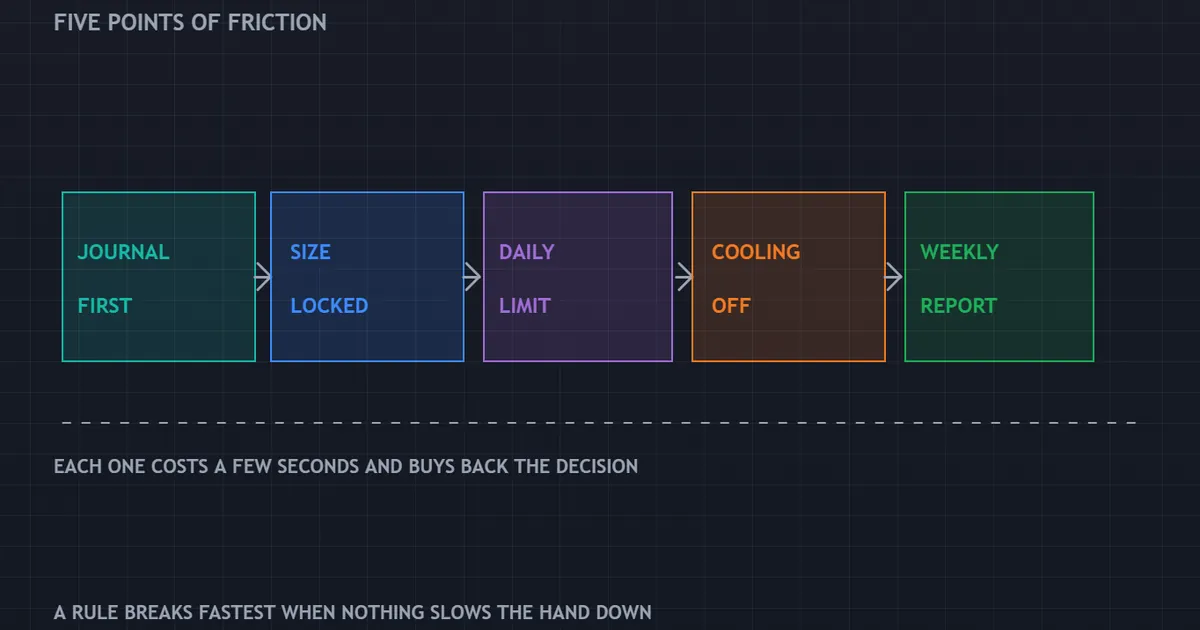
Make the Wrong Move Slower
Speed is the enemy of a plan. A trade you can place in two seconds gets placed for reasons you would reject given twenty.
Insert a delay you cannot skip. Writing the setup into your journal before the order goes in adds perhaps ninety seconds, and it filters an enormous share of impulsive entries.
Our free trade journal makes that step quick enough to keep doing. Friction only works when it survives contact with a busy session.
Hard Limits Beat Soft Intentions
An intention to stop after three losses fails in the moment it matters. A limit enforced by something outside you does not.
Set a daily loss limit and hand enforcement to the platform where possible. Our guide to the daily loss limit explains how to choose the number.
Then log out when it triggers. Closing the terminal converts a decision into a non-event, which is exactly what you want after a losing run.
Involve Someone Else
Rules with a witness get followed more often. A weekly message to one other trader, listing every deviation, works better than most software.
You do not need advice from them. Reporting alone supplies the accountability, and knowing you will report changes behaviour in advance.
Download the complete indicator database
Put these concepts on your charts. One email unlocks the full library of 1,380+ indicators with compiled MT4 and MT5 files, plus my TradingView scripts. No paywall, no spam, unsubscribe any time.
Get free access to my indicator database
One email unlocks 1,380+ free MT4, MT5 and TradingView indicators — the complete library. No single-tool download; you get the whole database.
Common Mistakes and the Fixes
Six habits undo good plans repeatedly. The panel below sets out what protects against them.

Writing a Plan Too Long to Follow
Twenty pages of nuance cannot survive a live session. Compress the plan onto one page you genuinely read every morning.
Leaving Size to Judgement
Size decided in the moment tracks confidence rather than risk. Fix the risk per trade in advance and derive the lots from the stop.
Rewriting Rules After a Losing Week
Losses feel like feedback and usually are not. Change rules on a schedule and on evidence, never on the emotion following a drawdown.
Treating a Profitable Break as Vindication
A rule broken profitably is still a rule broken. Grade the decision by whether it followed the plan, and grade it before you look at the result.
Chasing Losses Back
Nothing dismantles a plan faster. Our guide to revenge trading covers the pattern and how to interrupt it.
Reviewing Only the Losers
Winners taken outside the rules deserve equal attention. Otherwise your review quietly teaches you that breaking rules works.
Quick Reference Checklist
Five habits carry most of the adherence load. Keep this table where you plan.
| Habit | What it looks like | What it removes |
|---|---|---|
| Prepare outside the session | Levels marked and setups shortlisted before the open | Analysis performed while a position runs |
| Write the trade first | Entry, stop, target and size recorded in advance | Improvised entries and moving stops |
| Attach the bracket at entry | Both exits handed to the broker immediately | Three live decisions per trade |
| Enforce a hard daily limit | A number the platform applies, not a hope | Chasing losses after a bad run |
| Review on a schedule | Weekly adherence grade, monthly rule review | Drift that hides until it is expensive |
None of these require more discipline than you already have. Each simply moves a decision to a moment when deciding costs nothing.
How Drift Actually Looks
Plans rarely collapse in one dramatic session. They erode, and the erosion looks reasonable at every individual step.
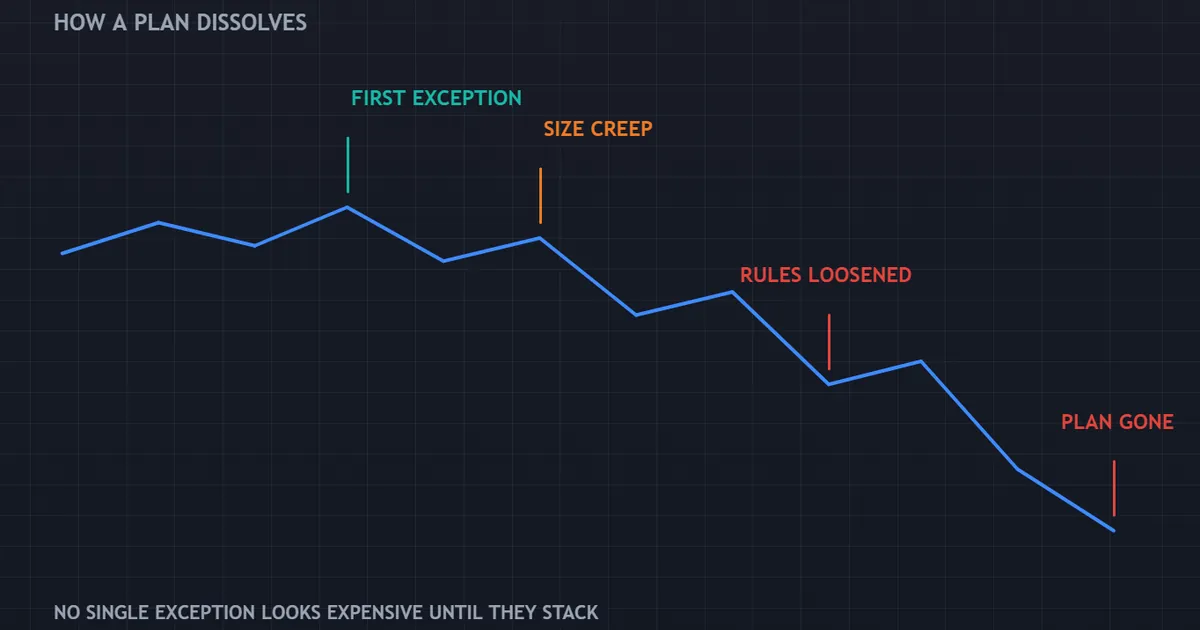
It Starts With One Reasonable Exception
The first deviation always has a good argument behind it. Conditions looked unusual, the setup looked exceptional, the news made it obvious.
What matters is the precedent rather than that trade. Once an exception exists, the next one needs a weaker justification.
Three exceptions later, the plan describes something you no longer do. Nobody decided to abandon it, and everybody who abandons one gets there this way.
The Records Show It Before You Feel It
Drift appears in your data long before it appears in your equity. Position sizes spread out, hold times wander, and setups appear that no rule describes.
Those signals cost nothing to monitor. A weekly count of trades taken outside the rules catches the pattern within a fortnight.
Catching It Early
Grade every trade for adherence, separately from profit. Two columns, one marked in or out of plan, and the number tells you plenty.
Set a threshold in advance. More than one out-of-plan trade in ten means you pause and diagnose rather than continue.
Deciding the threshold early matters as much as the number itself. A limit chosen while drifting will always sit just beyond wherever you currently are.
Designing the Environment Around You
Your surroundings decide more behaviour than intention does. A few changes remove whole categories of temptation.
What Sits on the Screen
An open order ticket invites a trade. Charts without one in view make impulsive entries slightly harder, which turns out to be enough.
Hide the running profit figure as well. Watching money move encourages management decisions that no rule ever asked for.
Notifications and Chatter
Group chats supply opinions at exactly the moments you should follow your own plan. Mute them during your session.
Price alerts are the useful exception. An alert brings you to a level you chose in advance rather than to somebody else’s idea.
Session Boundaries
Open and close the platform at set times. An unbounded session drifts, because no natural moment to stop ever arrives.
Write the finish time beside the start time. Both belong in the plan for the same reason.
Fitting the Plan to Your Actual Life
Most abandoned plans were never followable. They assumed time and attention the trader did not have.
Count the Hours You Really Have
A plan built around watching the London open fails if you work mornings. That is a design fault rather than a discipline fault.
Match the timeframe to your availability. Daily bars suit people who can check twice a day, and nothing about that is inferior.
Fewer Rules, Better Followed
A simple plan executed consistently beats a sophisticated one applied erratically. Complexity carries an adherence cost that nobody prices in.
Cut any rule you have broken repeatedly. Either it does not suit you or it does not suit your schedule, and both point the same way.
Build In the Days You Will Miss
Nobody trades every planned session. Deciding in advance what happens after a missed day stops one gap becoming a fortnight.
The Review Loop
Adherence needs a feedback cycle, otherwise it decays quietly. Three cadences cover it without eating your week.
Weekly, Monthly, Quarterly
Weekly, count deviations and note what preceded each one. The trigger matters more than the trade.
Monthly, look at whether the rules still match the market you trade. Ranges expand and contract, and a stop distance that suited spring may not suit autumn.
Quarterly, ask the bigger question. Whether the plan still fits your available time, your account size and your temperament.
Grade the Process, Not the Outcome
A good decision can lose and a bad one can win. Grading outcomes therefore teaches you the wrong lesson roughly half the time.
Score the process instead. Did you follow the entry rule, place the bracket, respect the size and honour the limit?
Our guide on how to review your trades sets out a workable format. Doing it badly still beats skipping it.
Change One Rule at a Time
When a review suggests an adjustment, alter a single rule. Changing three at once leaves you unable to attribute the result.
Give the change enough trades to mean something. Twenty is a start, and fifty says considerably more.
Measuring Adherence With a Number
Anything you want to improve needs a measurement. Adherence scores easily once you decide what counts.
The Adherence Rate
Divide in-plan trades by total trades for the week. Ninety percent means one deviation in ten, which makes a workable target for most people.
Track it beside your results, never inside them. The two numbers answer different questions, and blending them hides both.
What the Number Tells You
A high rate with poor results points at the rules. A low rate tells you nothing about the rules at all, because you never really tested them.
That distinction saves months. Traders who scrap a method after a bad run frequently scrap one they had not actually run.
Where to Keep It
One extra column in your journal covers the whole job. Mark each trade in or out of plan as you close it, while the reasoning stays fresh.
Add a one-line reason for every deviation. Those reasons repeat, and the repeated ones show you which defence to build next.
Related Guides Worth Reading Next
Two neighbouring topics reinforce the habit side of this. Both change behaviour rather than merely describing it.
Start with the rules themselves. Our collection of trading discipline rules covers the behavioural side that sits underneath any written plan.
Then look at your tools. Our wider MetaTrader indicators library helps only once the process around it holds steady, which is the whole argument of this article.
After that, pick one change and run it for a month. Adding a journal entry before every order, or a single hard daily limit, moves adherence further than any amount of reading.
Give the change time to show up. Adherence habits feel awkward for a fortnight and automatic by the second month, so judge them on the far side of that gap.
FAQ
How do I stick to my trading plan when I keep breaking it?
Stop trying harder and start removing decisions. Write the trade before the session, attach the stop and target at entry, fix the size from the stop distance, and set a hard daily limit. Each of those converts a live judgement into a settled one, which is far more reliable than resolve.
Is breaking a rule always a problem if the trade wins?
Yes, and that case does more damage than a loss. A profitable deviation teaches you that the rules are optional, which makes the next deviation easier. Grade the decision against the plan before you look at the outcome.
How often should I change my trading plan?
On a schedule rather than after individual results. A monthly look at whether the rules still fit current conditions works well, with a deeper quarterly review. Avoid rewriting anything in the days immediately following a drawdown.
What is the single most effective adherence habit?
Writing the full trade down before the session, including entry, stop, target and size. It costs a few minutes and removes almost every improvised decision later. Traders who do nothing else usually see the largest single improvement from this one step.
Does a trading plan improve my results by itself?
Not directly. A plan makes an existing edge repeatable and exposes the absence of one quickly. If the method has no edge, consistent execution simply reveals that faster, which is still useful information.
How do I know whether I am drifting?
Count trades taken outside your rules each week. Watch for spreading position sizes, wandering hold times and setups that no rule describes. Those appear well before the equity curve reacts, so a simple weekly tally catches drift early.
Can automation help me follow my plan?
It removes execution decisions, which is the part most people struggle with. A robot places the bracket, respects the size and never chases a loss. It also automates whatever flaws the rules already contain, so it magnifies a weak plan just as faithfully as a sound one.
Should I trade at all after breaking my rules badly?
Stop for the day, then review before you resume. A pause costs you very little, and continuing while frustrated tends to compound the original error. Write down what preceded the break, since the trigger usually repeats and the specific trade rarely does. Results are not guaranteed; past performance is not indicative of future results.
External references
- For background on this concept, see Precommitment on Wikipedia.
- For broader market context, see Bias at Investopedia.

About the author
Written by Dominic Walsh, a Forex trader and MT4/MT5 indicator, Expert Advisor and script developer. Every tool on forexmt4systems.com is tested on live charts before release and ships with ready-to-use compiled MT4 (.ex4) and MT5 (.ex5) files. Learn more about the trader and developer behind this site.
How we build, test and correct every tool: Editorial & Testing Policy. Trading carries risk; see the disclaimer.