
Three products get sold as one thing, and they behave differently. Copy trading vs PAMM is the comparison most new followers need first, with social trading sitting behind both.
The structure decides who owns the money, who can close a position, and when the fees land. Learn that now, or learn it in the middle of a drawdown.
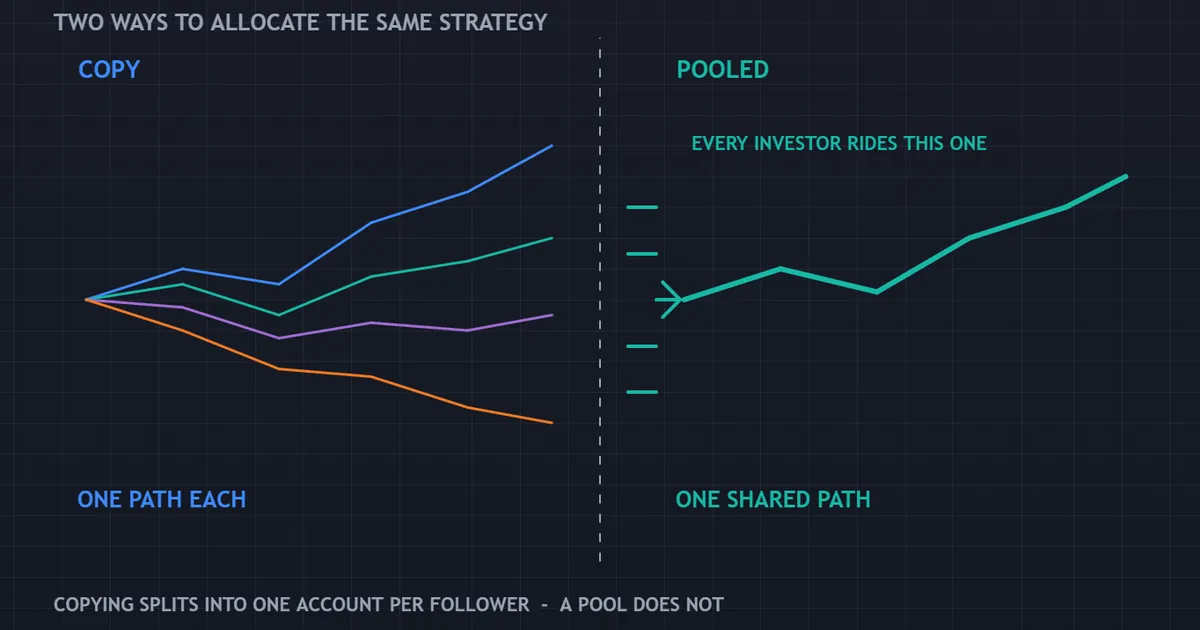
Copy Trading vs PAMM: The Core Difference
Start with the account, because everything else follows from it. In copy trading you keep your own account and your own orders. A pooled programme puts your money into one trading account that a manager runs.
The panel above draws that split. One model gives every follower a separate path, so results drift apart over time. The other hands everybody the same single path.
What Copy Trading Does
A copier links your account to a source account. When the source opens a trade, your terminal opens a matching trade in your own name.
Your broker still holds your funds. You can close any position yourself, and you can unlink whenever you like. That control matters more than it sounds.
Our guide to how copy trading works covers the plumbing in more depth.
What a PAMM Account Does
PAMM stands for percentage allocation management module. Investors deposit into one master account, and the manager trades that single balance.
Each investor holds a share of the pool rather than a set of trades. Profit and loss then split by share at the end of each period.
Nobody else can close a single trade inside a pooled account. The manager decides, so your only lever becomes whether you stay.
Where Social Trading Sits
Social trading describes the feed, not the plumbing. You watch what other traders do, read their reasoning, then act or ignore it.
Some platforms bolt copying onto that feed. Still, the two features solve different problems, so keep them apart in your head.
Who Owns the Money in Each Model
Ownership sounds like paperwork until you want your money back. Then it becomes the only question that matters.
Your Account, Your Orders
Copy trading leaves the account in your name. You keep the login, the statements and the withdrawal rights.
Unlinking takes one click. Closing everything takes a few more, and no third party has to agree first.
One Account, Many Shares
A pooled account works the other way round. Your deposit buys a percentage, so the broker tracks that percentage rather than your individual trades.
Exit usually waits for a rollover point. Many programmes settle weekly or monthly, so an urgent request can sit for days.
Why the Difference Bites Under Stress
Markets move fastest at exactly the moment you want out. A copy follower can flatten in seconds, while a pool investor files a request and waits.
Ask about that timing before you fund anything. The answer belongs in the contract, not in a chat message.
How an Order Reaches a Follower Account
The route from a source fill to your fill runs through several stages. Each stage costs a little time, and time costs price.
- The source trader clicks. Their platform sends an order to their own broker.
- Their broker fills it. That fill becomes the reference price everyone quotes afterwards.
- The copier reads the event. A bridge, a server or an interface poll notices the new position.
- Your size gets worked out. A rule converts their lot into yours by ratio, by equity or by a fixed figure.
- Your broker fills you. Your spread applies, your liquidity applies, and price has already moved a little.
- The exit repeats the chain. Every delay you met on entry meets you again on the way out.
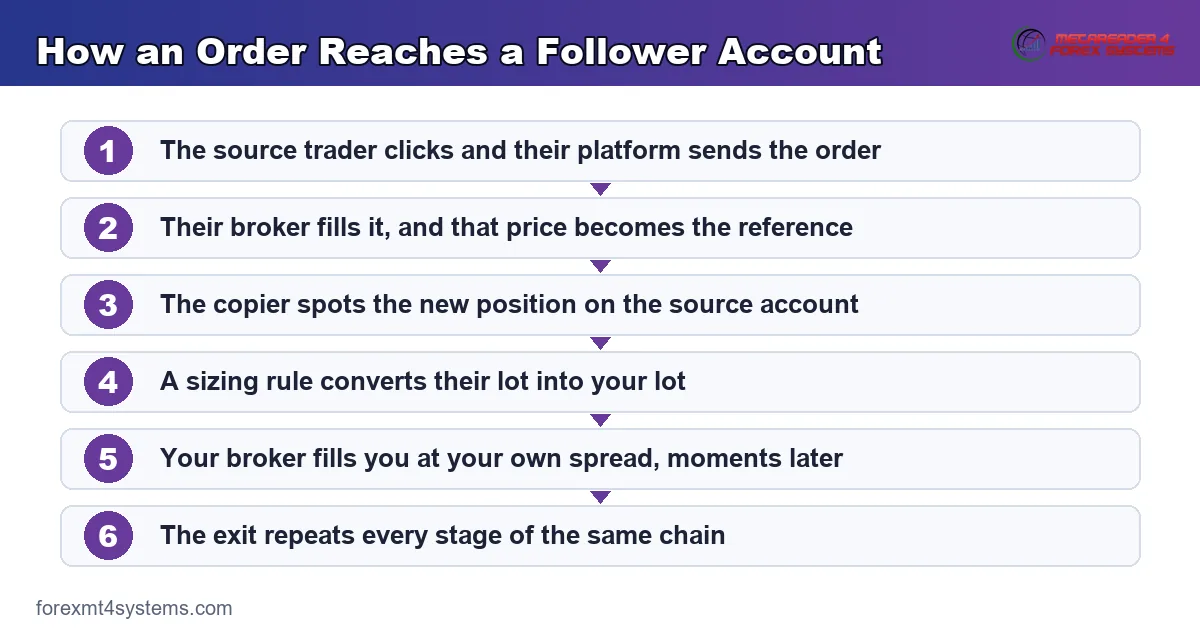
Notice where the cost hides. Nothing in that chain looks expensive, yet six small gaps add up across hundreds of trades.
Our note on what a trade copier does walks the same route stage by stage.
Delay Is the Cost Nobody Prints
Every copied trade arrives late. The lag can measure milliseconds or minutes, and the market never pauses while it happens.
Where the Lag Comes From
Three places create most of it. The copier has to spot the trade, then work out your size, then reach your broker.
Platform bridges poll on a timer. A slow poll turns a quick entry into a worse one, especially on a break of a level.
Why It Hurts Most on the Trades You Want
Fast markets move price between the two fills. Those fast markets tend to arrive exactly when a breakout or a news trade fires.
So the trades with the biggest potential also carry the widest fill gap. A source curve built on quick entries rarely survives the transfer intact.
What Reduces It
A server close to your broker helps. So does a copier that reacts to events rather than polling, plus a source that avoids the first seconds after a release.
None of that removes the gap. Measure it instead: compare ten source fills against your own, then write down the average difference.
Fees and When They Land
Fee structures differ more than the marketing suggests. Timing differs too, and timing changes what you keep.
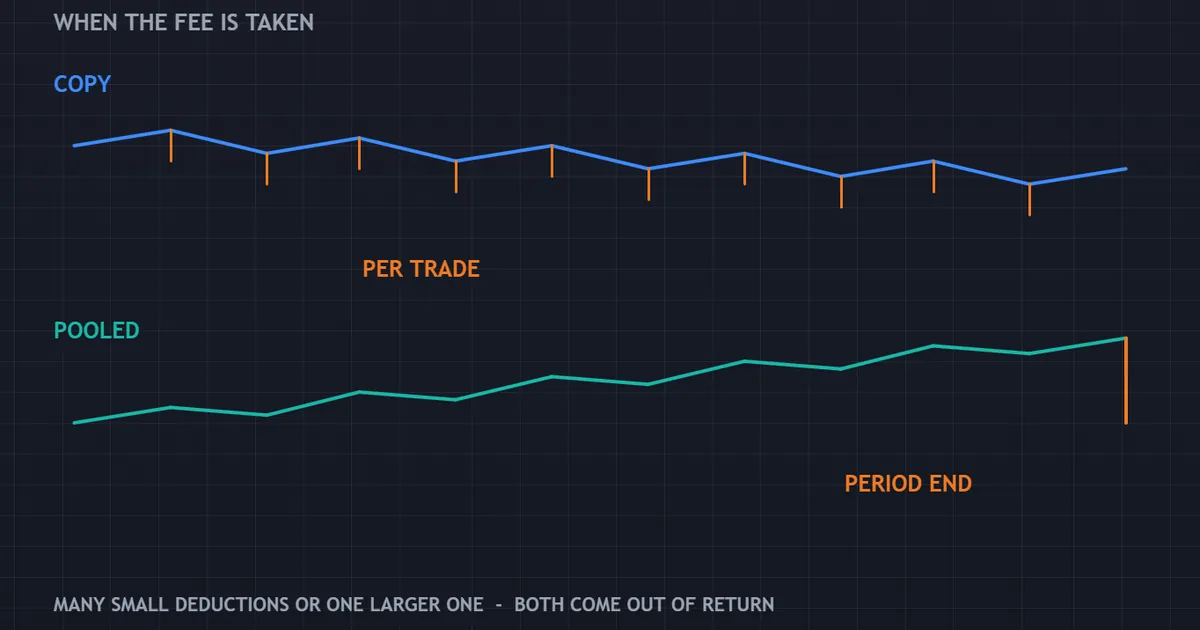
The panel above sets the two shapes side by side. One model bleeds cost on every trade, while the other takes a single bite at the end of a period.
Per-Trade Drag When You Copy
You pay your own spread on entry and again on exit. The source paid theirs as well, so one idea carries two sets of costs across two accounts.
Some copiers add a commission per lot on top. A busy source then becomes expensive to follow, even when it trades sensibly.
Performance Fees and the High-Water Mark
Pooled programmes usually charge on profit. A high-water mark means the manager charges again only once the account passes its previous peak.
Read that clause closely. Without it, you can pay twice for recovering the same ground.
The Cost Neither Model Prints
Slippage never appears on an invoice. Swap on held positions stays quiet too, and both push your result away from the published one.
Our breakdown of forex trading costs lists the full set in one place.
Control and the Off Switch
Control differs sharply between the two, and most disputes start here.

The panel above says it in one image. Every follower switch flips freely on the copy side, while the pooled side stays locked until the manager acts.
What You Can Change as a Copier
You set the multiplier, the maximum lot and often a stop for the whole link. Some copiers let you skip certain symbols entirely.
You can also override a single trade by hand. That freedom cuts both ways, since a nervous override breaks the very process you paid to follow.
What You Cannot Change in a Pool
A pooled investor sets none of that. Leverage, symbols, sizing and hold time all belong to the manager.
Your influence stops at the size of your allocation. So read the mandate, because it describes everything you have agreed to accept.
Download the complete indicator database
Put these concepts on your charts. One email unlocks the full library of 1,380+ indicators with compiled MT4 and MT5 files, plus my TradingView scripts. No paywall, no spam, unsubscribe any time.
Get free access to my indicator database
One email unlocks 1,380+ free MT4, MT5 and TradingView indicators — the complete library. No single-tool download; you get the whole database.
Risk Travels Across, Judgement Does Not
Here sits the point that costs new followers the most money. Orders copy across cleanly, and reasoning does not copy at all.
You Inherit the Drawdown
Whatever losing stretch the source runs through, you run through as well. You simply meet it later, and often at a worse average price.
The percentage can land harder on your side. A smaller balance following the same lot size takes a deeper hit for the identical trade.
Model that before you commit with our drawdown calculator. Seeing the depth in your own balance changes how it feels.
You Do Not Inherit the Reasoning
A source trader might scale out because a data release approaches. You see only the closing order, stripped of the thinking behind it.
So following somebody transfers their orders and nothing else. Their patience, their context and their read of the day all stay where they were.
Past Results Predict Nothing
A published history describes what already happened under conditions that have gone. It carries no forecasting power, however long the record runs.
Treat a strong record as a reason to look closer, never as evidence about next quarter. Our page on drawdown in trading explains why depth matters more than headline totals.
Sizing Decides What You Actually Risk
Two accounts can follow identical trades and finish nowhere near each other. Sizing explains most of that gap.
Fixed Lot Copying
The simplest rule copies the source lot exactly. It also ignores the difference in balance, so a smaller account carries far more risk on every trade.
Multiplier Copying
A multiplier scales their lot by a factor you choose. Half, quarter or double all work, and the arithmetic stays easy to check.
Trouble arrives when the source changes their own sizing. Your multiplier then amplifies a decision you never saw coming.
Equity Percent Copying
The steadiest rule keeps risk proportional to your balance. When your equity falls, your lots fall with it, which slows the damage during a bad run.
Work the numbers through with our position size calculator before you link anything. A rule that looks mild on a chart can look severe once you convert it into lots.
What a Published Track Record Leaves Out
Marketing pages rarely lie outright. They just omit the context that would let you judge the numbers.
The Denominator
A total means little without the account size and the risk per trade behind it. Those two figures often shrink an impressive number into an ordinary one.
The Worst Stretch
Ask for the deepest losing run and how long it lasted. A curve that recovered quickly on paper still emptied plenty of follower accounts on the way down.
The Start Date
Shift a start date by three months and many records change character. A history that begins after a bad quarter tells you about the calendar, not the trader.
The Fills
Published entries come from the source account. Your entries come from yours, seconds later, through your own spread.
Words the Marketing Uses Loosely
Three terms get stretched until they stop meaning much. Knowing the plain definition saves an argument later.
Managed Account
This label can describe a pooled structure, or a separate account traded under a power of attorney. Ask which one applies, because the exit terms differ completely.
Strategy Provider
A provider badge describes a listing on a platform, not a qualification. Anybody with a live account can usually appear there.
Verified
Verified normally means a platform read the account statement. It says nothing about the balance, the risk taken, or the months before the record started.
Regulation Covers the Broker, Not the Result
Both models depend on the firm holding your money. Regulation shapes that part, and nothing beyond it.
What Supervision Actually Buys
Rules from bodies such as the FCA, CySEC, ASIC or BaFin cover client money segregation, capital levels and a complaints route. Some regimes add a compensation scheme for firm failure.
None of that touches trading outcomes. A supervised firm can hold your funds correctly while the strategy inside loses money.
Where Pooled Structures Add Paperwork
A pooled programme needs a mandate, a fee schedule and a settlement calendar. Read all three, since they define your exit far better than any marketing page.
Offshore registration also differs from supervision. A licence number alone tells you very little about who checks the books.
Copy Account Against Pooled Account
The two structures diverge on five practical points. Read them as a decision list rather than a scorecard.
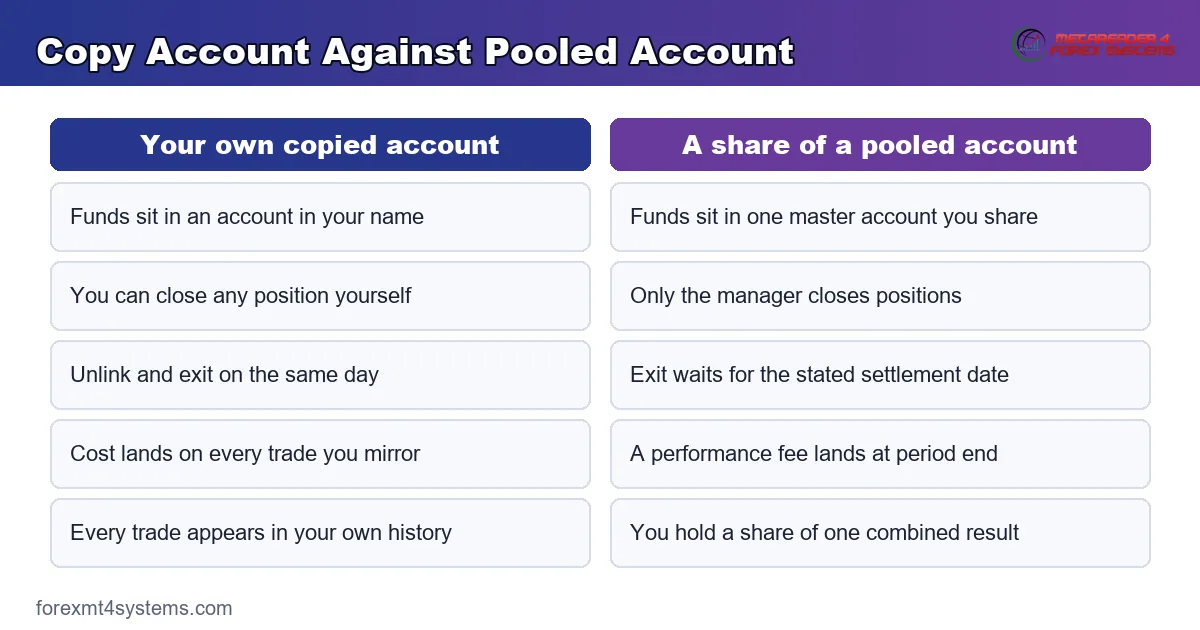
Neither column wins outright. One trades control for effort, and the other trades effort for control.
Pick Copy When You Want the Switch
Choose the copy route when you want to see every trade and keep the ability to stop. That suits somebody who plans to learn from the log.
Pick Pooled When You Want Distance
Choose a pooled structure when you genuinely want no involvement. Just accept that the distance runs both ways, and includes the exit.
How to Test a Source Before You Scale
Treat the first months as an experiment. The aim here is measurement, not profit.
Start at the Smallest Size
Link at the minimum your broker allows. The value of the exercise lies in the fill data, and small size collects the same data as large size.
Log the Gap on Every Trade
Record the source price, your price and the time difference. After thirty trades you hold a real cost figure rather than a hopeful one.
Decide Your Stop Rule in Advance
Write down the drawdown that ends the link, then respect it. Deciding halfway down produces the worst version of both choices.
Our deeper look at whether copy trading is worth it covers the trade-offs once that test data arrives.
Which Model Suits Which Trader
Fit depends on temperament as much as on numbers. Three questions settle it quickly.
How Fast Do You Want Out?
Answer in hours or in weeks. An honest answer of hours rules out most pooled programmes immediately.
Will You Interfere?
Most people say no, then close a losing position at the worst moment. If that sounds familiar, the extra control of copying may work against you.
How Much Do You Want to Learn?
Copying puts every trade in your own history, so you can study the pattern. A pooled share teaches you almost nothing about execution.
Traders who want to learn the mechanics often start elsewhere. Browsing the indicator library and testing rules yourself builds more than any follow button.
Common Mistakes Followers Make
Five errors turn a reasonable allocation into an expensive lesson. Each one has a plain fix.
Chasing the Top of the Leaderboard
Leaderboards reward recent risk. A trader at the top often arrived there by sizing aggressively, and that same sizing produces the drawdown you meet next.
Copying Several Sources That Trade Alike
Three sources buying the same pair in the same hour form one position, not three. Check the overlap before you call it diversification.
Switching After Every Bad Month
Jumping between sources locks in each losing stretch and skips each recovery. Set a review date instead, then hold to it.
Reading Percentages Without Context
A monthly percentage means nothing until you know the risk behind it. Two traders can post the same figure while one risked a tenth of what the other did.
Forgetting the Account Behind the Link
Margin still applies to your own balance. A trade that sits comfortably in the source account can push a smaller follower account towards a stop out.
Where Signals Fit Beside Both
A signal service sits between the two models. Somebody sends instructions, then you or a bridge place the order.
The judgement moves away from you, while the execution stays yours. So a signal follower carries the copy trading problems without the automation that at least makes them consistent.
Each of the three models parks the decision somewhere different. None of them removes the decision, and none of them removes your responsibility for the account.
Checks Before You Allocate Anything
Work through this list before money moves. It takes an evening and saves considerably more.
| Question | What good looks like | Warning sign |
|---|---|---|
| Who holds the funds? | A regulated broker, in your name or in a named pool | Transfers to a private wallet or a personal account |
| How fast can you exit? | Same day for copying, a stated settlement date for a pool | Exit terms that nobody will put in writing |
| What does the fee attach to? | Profit above a high-water mark, or a stated cost per lot | A fee on gross gains with no mark and no cap |
| How deep was the worst run? | A stated figure with dates you can check | A curve with the losing months cropped out |
| How long is the live record? | Many months from the first live order | A screenshot of one strong quarter |
| What happens if you stop? | Open positions handled by a written rule | Nobody can say who closes what |
Size the allocation last, not first. A share you can lose without changing your life keeps the decision rational.
FAQ
Is a PAMM account safer than copy trading?
Neither structure is inherently safer, because both leave the trading decisions with somebody else. The difference lies in control and access. Copying keeps your funds in your own account with a same-day exit, while a pooled account concentrates the decisions and slows your exit to a settlement date.
Why does my copied result differ from the published one?
Four gaps explain almost all of it. Your fill arrives after the source fill, your spread differs from theirs, your lot size follows a conversion rule, and your swap and commission apply to your own account. Each gap looks tiny, and together they move the curve.
Can I close a single trade in a PAMM account?
No. A pooled account holds one set of positions for every investor at once, so closing part of it would change everybody’s exposure. Your only decision remains whether to keep your allocation or withdraw it at the next settlement point. That single limitation explains most complaints about pooled programmes, and it appears in the mandate rather than in the sales material.
Does social trading mean the same thing as copy trading?
Not quite. Social trading describes a feed of ideas, discussion and shared statements, and acting on any of it stays your choice. Copy trading automates the orders themselves. Many platforms offer both, which is why the two words often get used as if they meant one thing.
How much of my account should follow one source?
Treat any single source as one position rather than a portfolio. Concentration risk applies here exactly as it applies to a trade, so a share you could lose without changing your plans keeps the decision clear. Spreading across several sources reduces the damage from one blow-up, though correlated strategies can still fall together.
Do fees really change the outcome that much?
They can, and the effect compounds quietly. Per-trade costs scale with activity, so a source that trades many times a day hands you a much larger bill than its published curve suggests. Performance fees without a high-water mark charge you twice for the same recovered ground. Results are not guaranteed; past performance is not indicative of future results.
External references
- For background on this concept, see Separately Managed Accounts on Wikipedia.
- For broader market context, see Managed Futures in the BabyPips Forexpedia.
- The licence conditions covering client money, financial resources and a complaints route are listed in AFS licensee obligations at ASIC.

About the author
Written by Dominic Walsh, a Forex trader and MT4/MT5 indicator, Expert Advisor and script developer. Every tool on forexmt4systems.com is tested on live charts before release and ships with ready-to-use compiled MT4 (.ex4) and MT5 (.ex5) files. Learn more about the trader and developer behind this site.
How we build, test and correct every tool: Editorial & Testing Policy. Trading carries risk; see the disclaimer.