
Two traders can run the identical strategy and face completely different consequences. That gap sits at the heart of the funded account vs live account question, and it changes far more than the size of the balance.
This guide compares both routes without naming a single firm or broker. You will see who carries the loss, which rules apply, what each option costs, and where the honest trade-offs sit.
Funded Account vs Live Account: The Core Difference
One question separates the two. Whose money sits behind the position?
On a live account the answer is yours. On a funded account the answer belongs to the firm, and the firm writes rules to protect it.

Everything else follows from that single fact. So read every difference below as a consequence of who carries the downside.
What a Live Account Means
A live account holds your own deposit at a broker. You choose the size, the instruments and the risk, within the broker’s margin terms.
Profits belong entirely to you. Losses do too, which is exactly why the freedom cuts both ways.
What a Funded Account Means
A funded account arrives after an evaluation, usually for a fee. The firm sets a balance, a rule set and a share of the profit.
Your downside stops at the fee you paid. The firm absorbs trading losses, and it closes the account when a limit breaks.
Who Carries the Loss
Loss ownership drives every other difference. A broker lets you lose your whole deposit, because it is yours to lose.
A prop firm cannot allow that. So it caps your daily loss, floors your drawdown and reserves the right to end the seat.
Why the Distinction Matters
Traders often compare the two on balance size alone. That comparison misses the point entirely.
A large funded balance with a tight floor gives less real room than a modest live account. So compare loss limits, never headline balances.
The Fee Is Not a Deposit
An evaluation fee buys an attempt, nothing else. A deposit remains yours until the market takes it.
Treat the fee as a sunk cost the moment you pay. Because it never returns as capital, the comparison only works when you price several attempts.
Six Practical Differences
Six areas cover nearly every meaningful comparison. Read them together, since they interact.
Write your own numbers beside each line. Because terms vary widely, only your specific broker and program settle the question.
- Capital ownership. Your deposit against the firm’s balance, with your exposure limited to the fee.
- Rule set. Broker margin terms against a daily cap, a drawdown floor and extra clauses.
- Execution environment. Live order routing against an environment that may simulate live prices.
- Cost structure. Spreads and swaps against spreads plus an evaluation fee and a profit split.
- Access to money. Withdraw any time against a payout cycle with minimum days and approval.
- Regulatory position. Broker oversight against a commercial contract with a prop program.
Notice that none of those lines mention strategy. So your method matters less to the comparison than your temperament and your capital.

Score each line honestly against your situation. Because the right answer changes with your savings and your schedule, no universal winner exists.
Capital and Exposure
A live account risks money you already own. A funded account risks a fee, plus the time you spend on the evaluation.
Neither route removes cost. So count repeated evaluation fees before you call the funded path cheaper.
Rules and Limits
Brokers rarely stop you from trading badly. Margin calls arrive only when equity runs low.
Prop rules bite far earlier. A daily cap can end your session while the account still looks perfectly healthy.
Execution and Environment
Many prop programs state plainly that funded accounts mirror live prices in a simulated environment. Others route some orders to a live venue.
Read the disclosure rather than assuming. Because slippage and fill quality differ between models, the detail affects short-term styles most.
Costs You Actually Pay
Live trading costs spread, commission and overnight swap. Funded trading adds an evaluation fee and hands a slice of profit to the firm.
Model both totals over a year. So the cheaper route reveals itself with arithmetic rather than intuition.
Getting Paid
A live account pays whenever you withdraw. A funded account pays on a cycle, after a day count and an approval step.
Plan around that delay. Because cash arrives later on the funded route, treat early cycles as proof rather than income.
Regulation and Protection
Brokers operate under financial rules that vary by jurisdiction, sometimes with client-money protection. Prop programs usually sit on a commercial contract instead.
Check the legal position of each provider. So you know exactly what protection exists before anything goes wrong.
Rules That Only Exist on a Funded Seat
Four clauses have no equivalent at a broker. Each one can end an account that shows a healthy balance.
Learn them before you compare anything else. Because these rules cause most funded closures, they deserve more attention than the split.
The Daily Loss Cap
A daily cap limits how much your account may fall in one session. Cross it and the seat ends, even with money still in the account.
Set a personal stop at roughly half that figure. So slippage or a news spike cannot push you over the line.
The Maximum Drawdown Floor
A floor marks the lowest point your equity may reach. Static floors sit at a fixed level, while trailing floors climb behind your gains.
Recalculate a trailing floor after every strong day. Because the cushion shrinks as confidence rises, that arithmetic protects you from your own optimism.
The Consistency Clause
Many programs cap how much of a cycle’s profit one session may supply. A single outsized day can therefore stall a withdrawal.
Track your best day against the running total. So a strong session never blocks the payout it earned.
Minimum Activity Requirements
Programs often demand a set number of active days per cycle. Some also close accounts after a long quiet spell.
Diary those windows at the start. So a holiday or an illness never ends a seat by accident.
How Each Account Feels to Trade
Rules on paper and rules under pressure feel different. So consider the daily experience, not only the terms.
Temperament decides more outcomes than strategy. A structure that suits you produces fewer forced decisions.
Freedom on a Live Account
Nobody closes your account for a bad week. You can hold through a drawdown, add to a plan or stand aside for a month.
That freedom cuts both ways. Because nothing stops an oversized position, live traders lose accounts through choices a prop rule would have blocked.
Structure on a Funded Account
Hard limits force discipline you might otherwise skip. A daily cap ends revenge trading before it compounds.
Structure also removes flexibility. So a strategy needing wide stops or long holds can struggle inside the same rules.
Where the Psychology Diverges
Live traders fear losing savings. Funded traders fear losing a seat they already paid for.
Both fears distort sizing. Because the funded fear arrives with a countdown attached, it tends to produce hesitation and rushed entries in the same week.
Screen Time and Scheduling
A live account tolerates a quiet month with no consequence. Many funded programs expect a minimum number of active days per cycle.
Count your realistic trading mornings first. So the route you pick fits the life you already have.
Recovering From a Bad Run
Live traders can shrink their size and grind back over months. Nothing forces a deadline on that recovery.
Funded traders rarely get the same luxury. Because a floor sits underneath the account, a long recovery has to start before the floor arrives.
Money Mechanics Compared
The plumbing differs more than most comparisons admit. Three areas deserve a close look.
Check each one against your own paperwork. Because small mechanical details compound, they decide net outcomes over a year.
Leverage and Margin
Live leverage depends on your broker and your jurisdiction, and caps differ sharply around the world. Funded leverage sits wherever the program sets it.
Higher leverage never means higher edge. So size from your stop distance and your risk budget, whichever account you trade.
Spreads, Commissions and Swaps
Both routes charge transaction costs. Funded accounts sometimes show wider spreads or different commission tiers than a retail broker.
Log your real costs for a month. Because costs eat small edges quietly, measurement beats assumption every time.
Withdrawals and Cash Flow
Live withdrawals usually clear within days and carry no approval beyond compliance checks. Funded payouts wait for a cycle, a day count and sometimes a consistency check.
Build your budget around the slower path. So a delayed payout never forces a reckless trade.
Position Granularity on Small Balances
Tiny live accounts struggle with lot sizing. The smallest available lot can breach your risk budget on a wide stop.
Funded balances remove that friction. Because the balance sits larger, your percentage risk translates into a workable position size.
A Worked Example on the Same Strategy
Numbers settle this comparison faster than opinion. Picture one method traded twice, once on each route.
The live account holds five thousand units of your own money. The funded account carries fifty thousand units with a five percent daily cap and a ten percent floor.
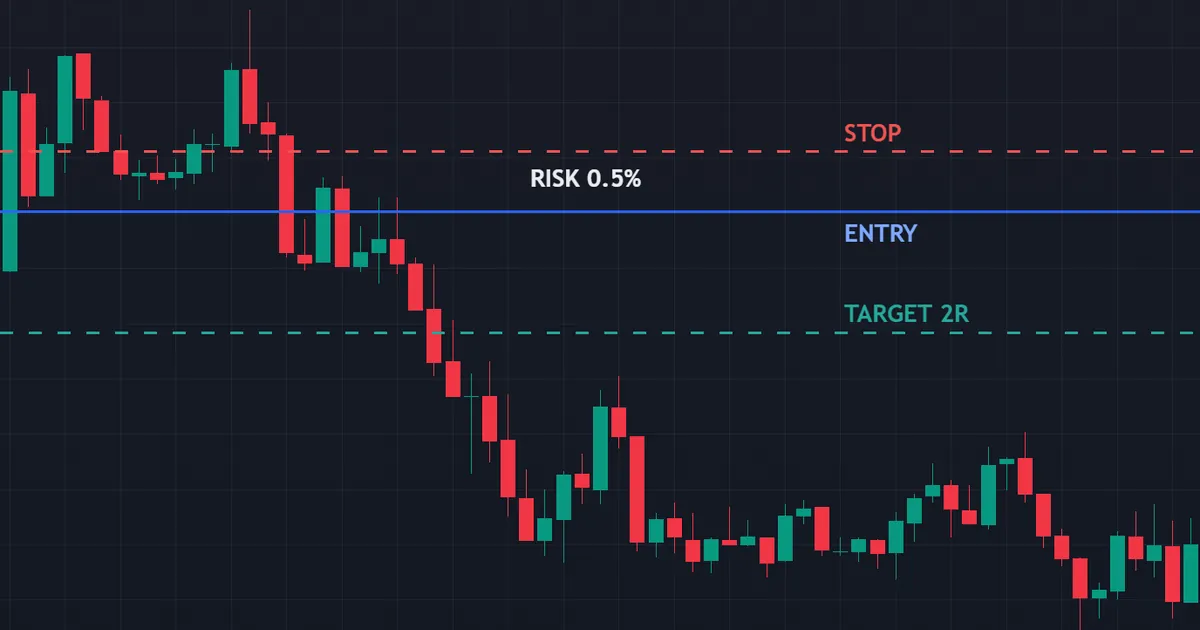
Risk half a percent of each balance per trade. That costs twenty five units live and two hundred and fifty units funded.
The Live Account Path
Ten net winners at twice risk return five hundred units. Your account grows by ten percent, and every unit belongs to you.
A bad month costs you real savings though. Because nothing caps the damage, discipline has to come entirely from inside.
The Funded Account Path
The same ten net winners return five thousand units. An eighty percent split leaves four thousand units for you, minus the fee you already paid.
A bad month costs the fee and the seat instead. So the downside stays bounded while the upside arrives with conditions attached.
What the Comparison Shows
The funded route multiplies the same edge across a larger balance. It also adds rules that can end the run early.
The live route keeps every unit and every risk. So the choice reduces to leverage on your edge against control over your account.
Changing One Variable
Raise the risk to two percent and both paths change character. The live account swings four times harder, and the funded account meets its floor within a normal losing streak.
Run the arithmetic before you commit. Because sizing dominates every other variable, a calculator answers most of this debate.
A Month That Goes Wrong
Picture eight losses and two winners in a slow month. The live account falls by roughly one hundred and fifty units, an ordinary dent.
Meanwhile the funded account falls by one thousand five hundred units. That sits comfortably inside a ten percent floor, so the seat survives.
Now double the risk on both. The funded account lands near its floor while the live account merely looks bruised, which shows how the rules reshape identical trading.
Download the complete indicator database
Put these concepts on your charts. One email unlocks the full library of 1,380+ indicators with compiled MT4 and MT5 files, plus my TradingView scripts. No paywall, no spam, unsubscribe any time.
Get free access to my indicator database
One email unlocks 1,380+ free MT4, MT5 and TradingView indicators — the complete library. No single-tool download; you get the whole database.
Common Mistakes When Comparing the Two
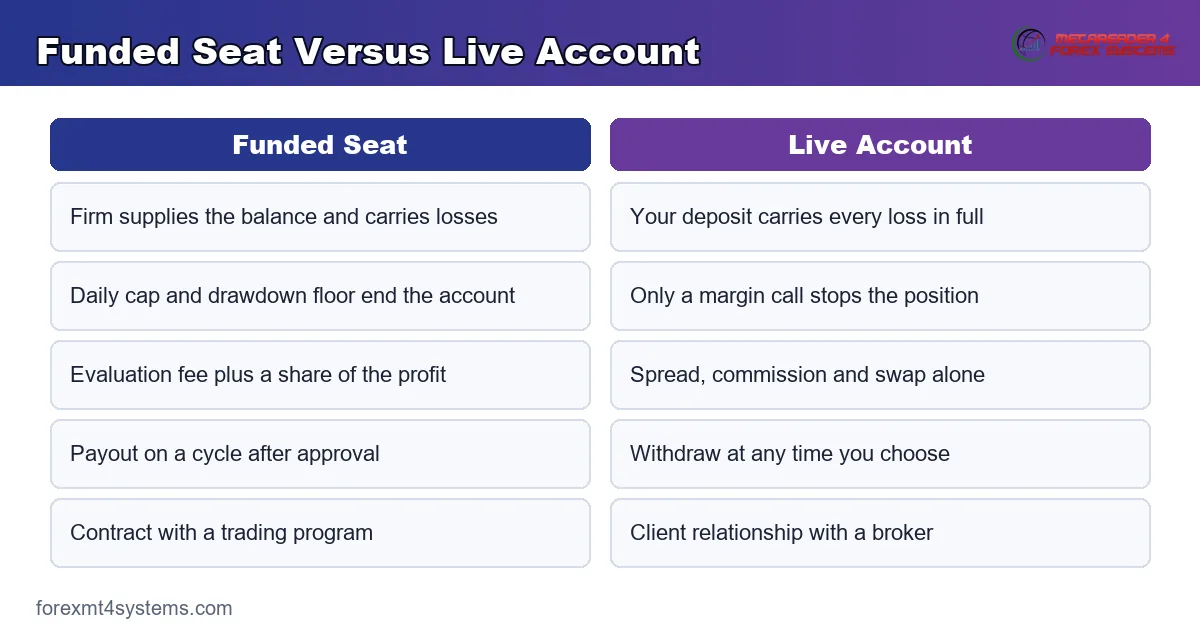
Six errors distort this comparison repeatedly. The compare graphic below sets the two routes against each other on the points that matter.
Comparing Balances Instead of Limits
A large funded balance looks impressive beside a small live deposit. Yet a tight floor can allow fewer losses in cash terms. So compare survivable losing streaks, not headline numbers.
Ignoring Repeated Evaluation Fees
One fee looks cheap against a serious deposit. Several failed attempts change that arithmetic quickly. So budget for more than one try before calling the funded route cheaper.
Assuming Funded Means Live Orders
Many programs run funded accounts in a simulated environment. Traders who assume otherwise misread fills and slippage. So read the disclosure in the agreement rather than guessing.
Forgetting the Profit Split
A funded account hands a slice of every gain to the firm. Over a year that share adds up meaningfully. So include the split when you model returns.
Treating a Seat as Job Security
Funded accounts close on a single rule breach. Traders who plan household budgets around one seat take poor trades in slow months. So keep other income until several cycles complete.
Skipping the Legal Position
Broker protection and prop contracts differ substantially. Many traders never check either. So read the terms and understand exactly what you hold.
Which Account Suits You: Quick Reference
Run this list before you deposit or buy anything. It takes a few minutes and prevents the common regrets.
- Write down the capital you can genuinely afford to lose.
- Price a realistic number of evaluation attempts against that figure.
- Convert every prop limit into cash on the offered balance.
- Divide each loss limit by your risk per trade.
- Check whether your stop distances fit inside the daily cap.
- Confirm the execution model stated in the agreement.
- Compare total costs including spread, commission and split.
- Map the payout calendar against your cash flow needs.
- Count the minimum active days each cycle demands.
- Read the regulatory position of the broker or program.
- Test the same strategy on a demo under both rule sets.
- Start with the smallest size either route offers.
- Check that the smallest lot fits your risk budget on a live balance.
- Note whether the drawdown floor sits static or trails your equity.
- Ask how the consistency figure gets measured across a cycle.
- Keep records for tax from the very first trade.
Pitfalls and Edge Cases
A few details escape most comparisons entirely. The chart below shows one strategy that survives a live drawdown yet breaches a funded floor.

Strategies That Need Wide Stops
Swing methods often use stops that sit far from entry. A tight daily cap then blocks a normal position size. So test your stop distances against the rules before you buy an evaluation.
Drawdowns That Recover Later
A live account can sit underwater for weeks and recover fully. A funded floor ends the account at the low point instead. So a method with deep drawdowns fits the live route far better.
News and Holding Restrictions
Prop programs frequently restrict news entries, weekend holds or automated systems. Brokers rarely impose the same limits. So check whether your edge depends on something the rules forbid.
Correlated Positions Across Accounts
Running several funded accounts with matching trades breaks most rule books. Firms watch for identical timestamps and sizes. So run one account properly rather than copying across three.
Tax Treatment Differs
Trading profits and prop payouts sometimes fall into different categories, and treatment varies by country. Payouts commonly arrive gross with nothing withheld. So keep records from day one and consult a qualified local tax professional.
Account Closure Without Warning
A rule breach can end a funded seat instantly, including the balance you built. Live accounts simply continue at whatever equity remains. So keep screenshots and a written journal in case of a dispute.
Platform Outages Mid-Trade
Feeds stall on both routes occasionally. On a funded account an unfilled stop can breach a limit through no fault of yours. So contact support quickly and never rely on a mental stop.
Using Both Routes Together
The comparison rarely needs a single winner. Plenty of traders run a small live account alongside an evaluation.
That combination teaches different lessons. So treat the pairing as a curriculum rather than a hedge.
The Live Account as a Laboratory
A small live balance builds the habit of real consequences. Even modest sums produce the emotions a demo cannot.
Keep the size genuinely small. Because the goal is learning rather than income, a tiny account teaches the same lesson cheaply.
The Funded Route as Leverage
An evaluation offers scale without a large deposit. That appeals once your process already survives a live account.
Earn the seat before you buy one. So the fee funds an opportunity rather than an experiment.
Keeping the Records Separate
Mixing both accounts in one journal blurs your data. Separate logs show which environment suits your method.
Review them monthly side by side. Because the numbers rarely match your impressions, written records settle the argument.
Related Concepts to Study Next
This comparison rests on ordinary account mechanics, so a few nearby topics repay the reading. Start with the funded model, then the arithmetic.
Read our explainer on a funded trading account for the model in detail, then compare it with our guide to prop firm vs personal account. Because the business model shapes the rules, read how prop firms make money and our notes on prop firm vs broker. For the mechanics, study leverage in forex and equity in forex, then review risk management in forex and size every position with our position size calculator.
FAQ
Which is better, a funded account vs live account?
Neither wins outright, since the answer depends on your capital and your style. A live account offers control and keeps every unit of profit. A funded account offers scale for a fee, with rules that can end the seat at any point.
Is money on a funded account real?
Many firms run funded accounts in a simulated environment that mirrors live prices, while others route orders to a live venue. The agreement states which model applies. Either way, the payout obligation and the rule set stay contractual.
Can I lose more than my fee on a funded account?
No, your financial exposure normally stops at the evaluation fee and any reset you buy. Trading losses fall on the firm, which is exactly why the rules stay strict. You can still lose the seat and the balance you built.
Do I need a live account before an evaluation?
Not strictly, though a small live account teaches lessons a demo cannot. Real consequences change how you size and how you exit. Many traders run a modest live balance alongside an evaluation for that reason.
Which route costs less overall?
It depends on how many attempts you buy and how much you would otherwise deposit. Funded trading adds a fee and a profit split, while live trading ties up your own capital. Model both across a full year rather than a single month.
Does a funded account improve my trading?
Structure helps some traders and frustrates others. Hard limits stop revenge trading early, which suits anyone who struggles to close the platform. Methods that need wide stops or long holds usually perform better on a live account.
Can a funded seat replace a salary?
Treat it as an opportunity rather than an income, because a single rule breach ends the account. Most participants never reach a payout at all. Results are not guaranteed; past performance is not indicative of future results.
External references
- For background on this concept, see Moral Hazard at Investopedia.
- For broader market context, see Slippage at BabyPips Forexpedia.

About the author
Written by Dominic Walsh, a Forex trader and MT4/MT5 indicator, Expert Advisor and script developer. Every tool on forexmt4systems.com is tested on live charts before release and ships with ready-to-use compiled MT4 (.ex4) and MT5 (.ex5) files. Learn more about the trader and developer behind this site.
How we build, test and correct every tool: Editorial & Testing Policy. Trading carries risk; see the disclaimer.