
The confusion over position size vs leverage sinks more beginner accounts than any bad indicator. Traders blame leverage for a blown account when the real culprit was an oversized position. So separating the two ideas is one of the most useful things a new trader can learn.
This guide pulls position size vs leverage apart and shows how each one works. You will see that position size controls your real risk, while leverage only sets the margin a trade ties up. Once the two stop blurring together, sizing a trade safely gets much simpler.
Position Size vs Leverage: Two Different Jobs
Position size and leverage answer two different questions. Position size asks how much of your own money you actually put at risk. Leverage asks how little of your own cash the broker lets you post to hold that same position. So they touch the same trade from opposite sides.
Position size is the real exposure. It is the number of units, or the lot size, you buy or sell. So position size, together with your stop distance, decides how much money a losing trade costs you.
Leverage is a facility the broker offers. It lets you control a large position with a small deposit, called margin. So leverage changes how much cash a trade parks, not how much the trade can lose.
Hold that distinction in mind. Your risk flows from position size and stop distance, full stop. Leverage merely decides whether the trade fits in your account, which is a separate matter entirely.
Here is a quick test of the idea. If you doubled your leverage but kept the same lot and stop, your risk would not move an inch. Only the margin parked would shrink. So the risk lives entirely in the position, and the ratio just changes the parking fee.
Why Traders Confuse the Two
The mix-up has a simple root. High leverage lets a small account open a huge position, so people equate leverage with danger. Yet the danger lives in the oversized position, not in the leverage that permitted it.
Think of leverage as a bigger credit limit. A high limit does not force you to spend more. It only lets you, if you choose to. So a disciplined trader can hold high leverage and still risk very little per trade.
Marketing muddies things further. Brokers advertise leverage in bold numbers, so it feels like the main lever a trader pulls. So beginners tune the flashy number and ignore the quiet one that actually governs their risk.
An Everyday Analogy
Picture buying a house with a mortgage. The loan lets you control a large asset with a small down payment, much like leverage. Yet the size of the house, not the loan ratio, decides how much you can lose if prices fall.
A modest home with a big mortgage carries little risk. A mansion far beyond your means carries a lot, whatever the loan terms. So the asset you choose, like the position you size, drives the real exposure.
Leverage in trading works the same way. It sets how little you must post, never how much you should hold. So a wise trader picks a sensible position first and lets the facility quietly support it.
How Each One Works
The mechanics separate cleanly once you follow them in order. Walk through both, since position size comes first in a sound plan.
- Pick your risk. Decide the money you will lose if the stop hits, often one percent of the account.
- Read the stop distance. Measure the pips from entry to the stop, drawn from structure.
- Solve for position size. The risk and stop distance give the exact lot size, and nothing else does.
- Check the margin. Leverage then tells you how much cash that position ties up.
- Confirm it fits. If the margin sits comfortably inside the account, the trade is workable.
Notice the order. You size the trade for risk first, then check margin second. So leverage enters only at the end, as a fit test, never as the thing that sets your risk.
Position Size, Your Real Exposure
Position size is the number that moves your balance. A larger lot earns or loses more per pip, so it carries more risk. So sizing is the true throttle on how hard any trade hits your account.
The stop distance works hand in hand with size. A wider stop demands a smaller lot to keep the same risk. So the two together, not the lot alone, fix the money on the line.
This is why a single lot size can never be right for every trade. A tight stop allows a larger lot for the same risk, while a wide stop calls for a smaller one. So your position size should shift trade by trade as the stop distance changes.
Our position size calculator does this math for you. Enter your risk percent, stop distance, and pair, and it returns the exact lot size. So the guesswork that wrecks new accounts simply disappears.
Leverage, Just a Facility
Leverage is a ratio the broker sets, such as thirty to one. It means you can hold a position worth thirty times the margin you post. So a small deposit can support a much larger notional trade than the cash alone would ever allow.
Crucially, leverage does not choose your position size. You do. So two traders on the same thirty-to-one account can risk wildly different amounts, purely by sizing their trades differently.
This is the point most guides bury. Leverage caps the maximum position an account can hold, yet it never tells you the position to take. So think of it as a ceiling, not a target, and stay far below the ceiling by choice.
Margin is the cash the broker holds while the trade runs. Higher leverage means less margin per position, which frees up cash. Our margin calculator shows how much a given position ties up at your leverage.
A Side-by-Side Comparison
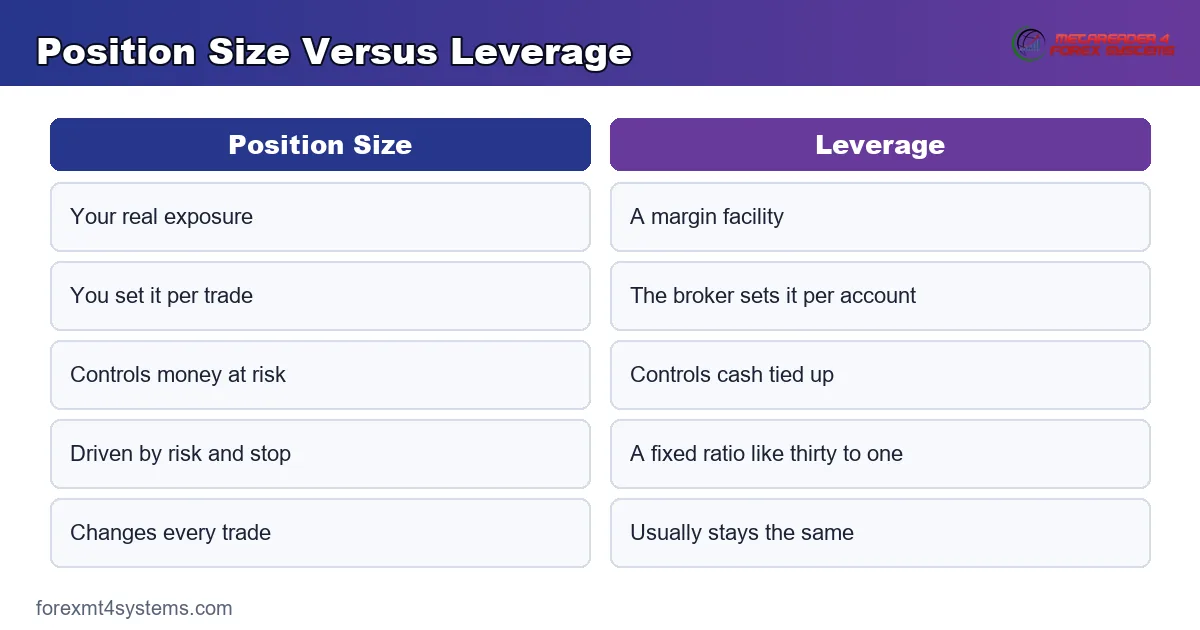
The table below lines the two ideas up on the features that matter. Read it once, and the split holds firm.
| Feature | Position Size | Leverage |
|---|---|---|
| What it is | Your real exposure | A margin facility |
| Who sets it | You, per trade | The broker, per account |
| Controls | Money at risk | Cash tied up as margin |
| Driven by | Risk percent and stop | A fixed ratio like thirty to one |
| Changes each trade | Yes | Usually no |
| Main danger | Oversizing the lot | Tempting you to oversize |
Putting Numbers to Both
Numbers settle the argument, so walk a trade end to end. You hold an account near ten thousand units and risk one percent, or one hundred units, per trade.
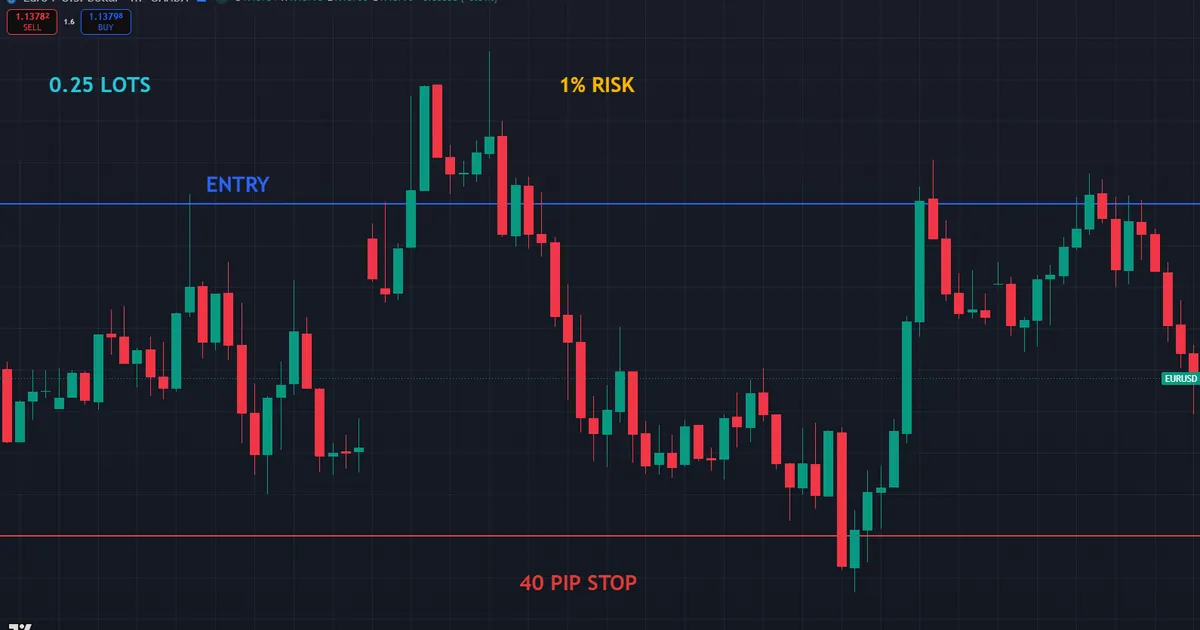
You spot a long on EURUSD near 1.14. Structure puts the stop forty pips below entry. So the risk and the stop distance now fix the position size, before leverage enters at all.
Sizing the Trade
A forty pip stop with a one hundred unit risk points to about a quarter of a standard lot. That lot moves roughly two and a half units per pip. So forty pips against you costs the planned one hundred units, exactly as designed.
The calculator returns that quarter lot in a click. You do not nudge it higher for a bigger thrill. The number holds your risk where you set it, no matter what leverage the account offers.
The Leverage You Actually Use
Now bring leverage in. A quarter lot of EURUSD near 1.14 carries a notional value close to twenty-eight thousand units. Against a ten thousand unit account, that works out to under three times your equity.
Yet the account may offer thirty to one. So you hold a facility for far more leverage than you touch. The real leverage you use flows from your position size, and here it sits low because you sized for risk.
At thirty to one, that position ties up under one thousand units of margin. So the trade fits the account with plenty to spare. Leverage did its only job, letting the position fit, and left your risk untouched.
Compare that with a trader who reads the same thirty-to-one and feels invited to go big. That trader might post ten times the lot, tying up most of the account as margin. So the identical facility becomes safe or reckless depending only on the size chosen.
Download the complete indicator database
Put these concepts on your charts. One email unlocks the full library of 1,380+ indicators with compiled MT4 and MT5 files, plus my TradingView scripts. No paywall, no spam, unsubscribe any time.
Get free access to my indicator database
One email unlocks 1,380+ free MT4, MT5 and TradingView indicators — the complete library. No single-tool download; you get the whole database.
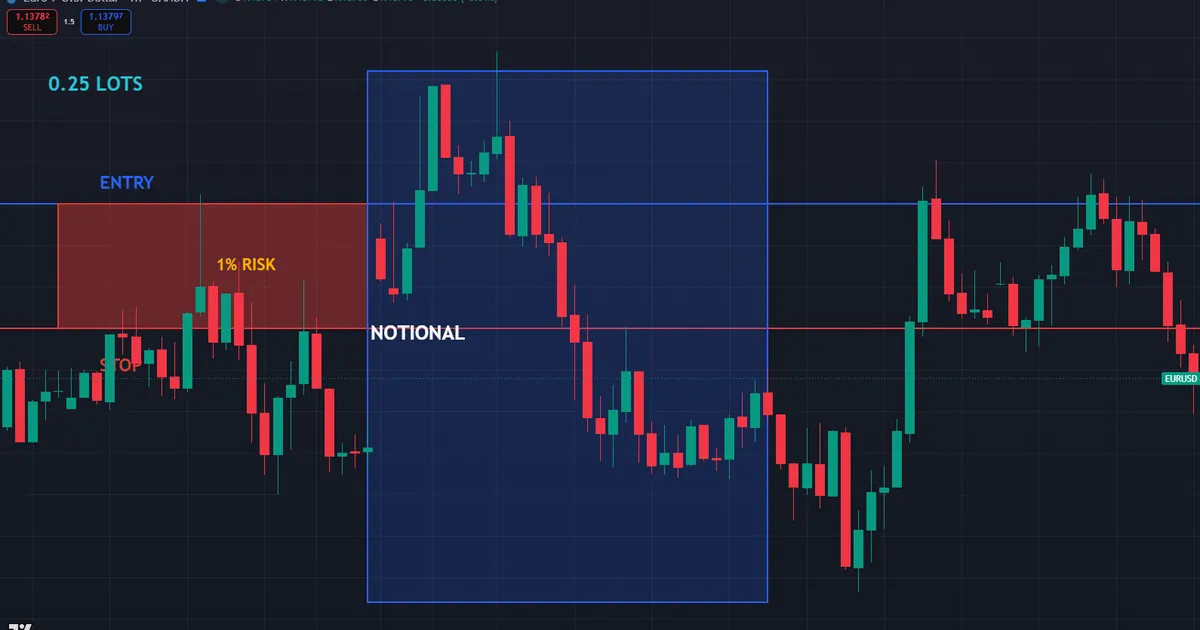
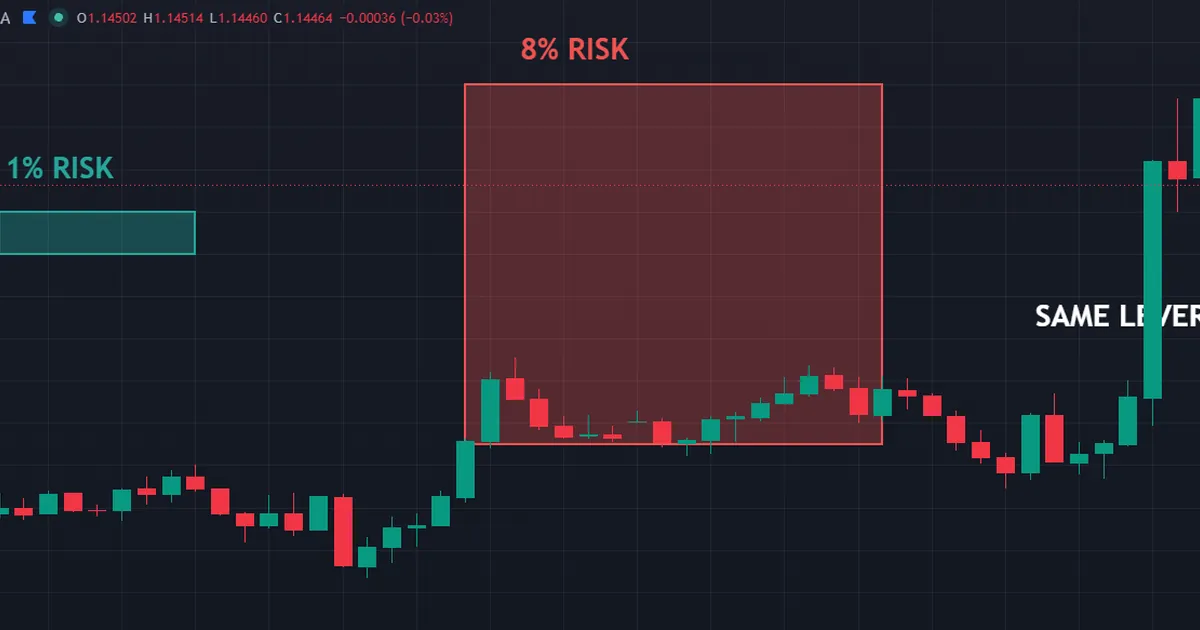
Change nothing but the position size, and the picture flips. Buy two full lots on the same account, and a forty pip stop now risks eight percent in a single trade. The leverage ratio never changed, yet the risk exploded because the lot did.
One Account, Two Traders
Put two traders on identical thirty-to-one accounts to drive the point home. The first sizes each trade to one percent and sleeps well. The second maxes the margin on every setup and rides a roller coaster.
Both hold the exact same leverage. Yet their outcomes could not differ more, purely because of position size. So the ratio printed on the account tells you almost nothing about how either trader actually risks money.
This is the whole lesson in one image. Leverage is the shared road, and position size is the speed each driver chooses. So blaming the road for a crash misses the driver who floored the pedal.
Why the Confusion Turns Costly
The blur between the two ideas is not harmless. It leads traders to blame the wrong thing and fix the wrong thing. So the mistake repeats until the distinction finally lands.
A trader who fears leverage may switch to a low ratio and feel safe. Yet nothing stops that trader from posting a huge position within the lower limit. So the account still blows up, and the real cause hides in plain sight.
High Leverage Is Not High Risk by Itself
High leverage only raises risk when you let it inflate your position. Held with disciplined sizing, a high ratio simply frees up margin. So the ratio is neutral, and your sizing decides whether that freedom helps or harms.
The reverse holds too. Low leverage does not ensure safety. A trader can still oversize within a modest limit and take a brutal loss. So chasing a low ratio soothes the nerves without fixing the actual risk.
The Habit That Keeps You Safe
The fix is a firm order of operations. Size every trade for a small, fixed risk first. Then treat leverage as a background fit test, not a dial you turn for excitement.
Traders who follow that order rarely fret about leverage at all. Their risk stays capped by sizing, so the ratio becomes a quiet convenience. So the whole knot untangles the moment position size leads and leverage follows.
Where Leverage Still Matters
Separating the two ideas does not make leverage irrelevant. It still shapes your account in real ways, just not the way beginners fear. So a full picture gives leverage its proper, smaller role.
It Sets How Many Trades Fit
Leverage decides how much margin each position parks. A higher ratio frees up cash, so you can hold more trades at once. So leverage matters for how many positions your account can carry, not for the risk of any one.
That freedom cuts both ways, though. More open trades can mean more correlated risk if you are careless. So the margin leverage frees should support diversified trades, not a stack of the same bet in disguise.
It Affects Your Margin Buffer
Free margin is the cushion that keeps trades open through a drawdown. Low leverage ties up more cash, which thins that cushion faster. So a very low ratio can, oddly, leave less room to weather an open loss.
The balance is sensible sizing plus enough free margin to breathe. So you neither max the leverage nor starve the account of its buffer. A middle path keeps trades alive without inviting a reckless lot.
Common Mistakes and Fixes
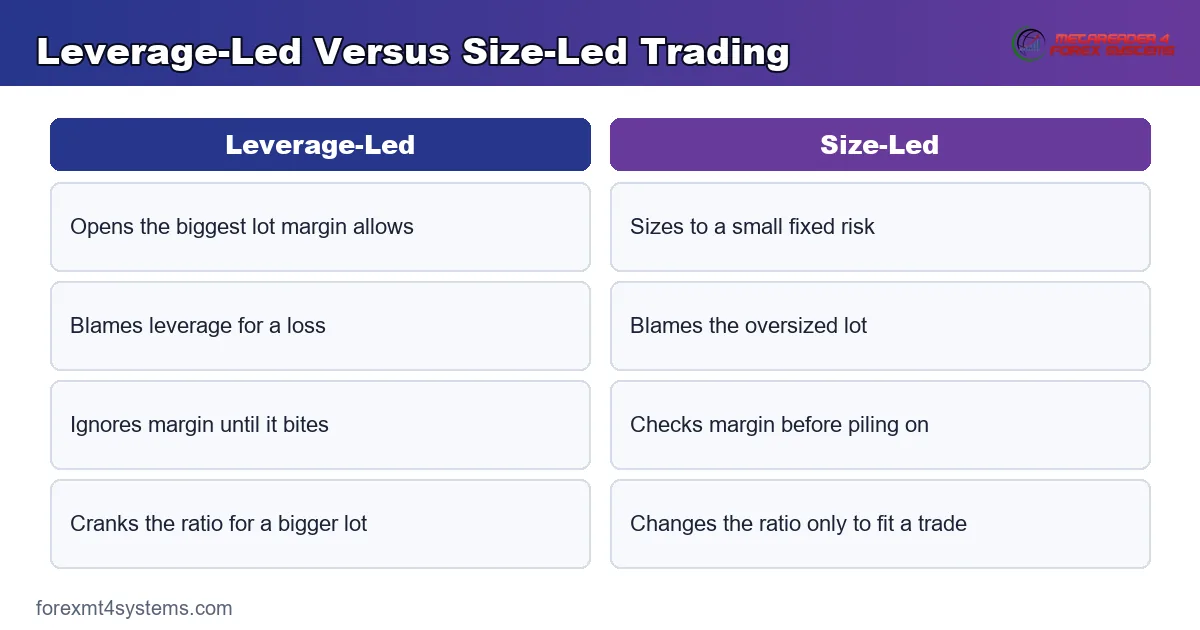
The idea is simple, yet the same errors surface on new accounts. Most come from letting leverage lead the decision. The compare graphic below sets a leverage-led trader against a size-led one.
Sizing to the Margin, Not the Risk
Some traders open the biggest position their margin allows. That turns the account into a coin flip. So size to a small risk instead, and let spare margin sit idle rather than fueling a giant bet.
Fearing Leverage Instead of Oversizing
Blaming leverage for a loss aims at the wrong target. The oversized lot did the damage. So focus on position size, and treat the leverage ratio as a side detail rather than the main threat.
Ignoring Margin Until It Bites
A trader who never checks margin can stack positions until a margin call hits. So run the margin math before piling on trades, and keep a healthy buffer of free margin at all times.
Cranking Leverage for a Bigger Position
Raising the leverage ratio only to hold a larger lot inverts the whole plan. So set your position from risk, and change the ratio only if a trade would not otherwise fit the account.
Copying Someone Else’s Lot Size
A tip to buy a full lot means nothing without the account behind it. That lot may risk one percent for one trader and twenty for another. So never copy a raw lot size, and always translate advice back to your own risk percent.
Forgetting That Size Sets the Loss
Watching the leverage number while ignoring the lot hides your true exposure. So always tie the decision back to money at risk, which the position size and stop distance alone control.
Quick Reference Checklist
Keep this short list beside the platform. Run through it before every trade.
- Decide the money you will risk, often one percent.
- Read the stop distance from structure.
- Solve for position size from risk and stop.
- Check the margin the position ties up.
- Confirm the trade fits with room to spare.
- Never lift the lot just because leverage allows it.
Pitfalls and Edge Cases
A few wrinkles bend the clean split, so keep them in view. The chart below sets a small one percent risk box against a much larger eight percent one. Both trades run at the same leverage. So the position size alone explains the gap.
Margin Calls Force Exits
Stack too many positions, and free margin thins toward zero. The broker then closes trades for you at the worst moment. So watch free margin, and leave a wide cushion rather than sizing to the last unit.
Notional Grows With Price
The notional a lot controls shifts as the pair moves and as the pair itself differs. A lot of gold ties up far more than a lot of a minor pair. So check the true notional per trade, since it drives the margin.
Leverage Limits Vary by Region
Regulators cap leverage differently across the world. A ratio you used abroad may not exist at a new broker. So confirm the limit before you assume a position will fit, and size for risk regardless.
Different Instruments Carry Different Weight
Indices, metals, and exotic pairs often come with tighter leverage than majors. So the same lot can demand very different margin from one market to the next. Check the instrument’s terms before you size, since a rule tuned for a major pair may not travel to gold or an index.
Sizing Still Rules Under Any Ratio
Whatever leverage a broker grants, position size and stop distance still set the loss. So the lesson holds across every account and every region. Lead with sizing, and leverage never surprises you.
Related Concepts to Study Next
The two ideas link to a wider set of risk skills, and a few deserve your next reading hour. Sizing rewards a closer look, since it governs your real exposure. Your risk per trade then sets the target the sizing must hit.
Start with our guide to position sizing for the full method. Then read about leverage risk and how to set risk per trade to anchor the plan. For the basics of the facility itself, see leverage in forex, then size any trade fast with the position size calculator linked above and place it within a plan on our forex trading strategies hub.
FAQ
What is the difference between position size and leverage?
Position size is your real exposure, the lot you buy or sell, which sets the money at risk. Leverage is a broker facility that decides how little margin the position ties up. So sizing controls risk, while leverage controls only the cash parked.
Does high leverage mean high risk?
Not by itself, since leverage only sets the margin, not the position size. Held with disciplined sizing, a high ratio simply frees up cash. The risk climbs only when a trader uses that room to open an oversized lot.
What actually determines how much I can lose on a trade?
Your position size and stop distance set the loss, and nothing else does. A larger lot or a wider stop both raise the money at risk. Leverage never enters that calculation, though it decides whether the trade fits your account.
Should I choose a low leverage account to stay safe?
Low leverage can help, yet it does not ensure safety on its own. A trader can still oversize within a modest limit and take a heavy loss. Disciplined position sizing protects the account far more than a low ratio.
How do I size a trade correctly?
Decide the money you will risk, read the stop distance from structure, then solve for the lot. A calculator turns those inputs into an exact position size. Only after sizing do you check that the margin fits your account.
Can controlling position size promise a profit?
No method promises a profit, since markets stay uncertain on any single trade. Disciplined sizing caps your losses so an edge has room to work over many trades. Lead with position size, treat leverage as a fit test, and stay patient. Results are not guaranteed; past performance is not indicative of future results.
External references
- For background on this concept, see Financial Leverage at Corporate Finance Institute.
- For broader market context, see Degree of Combined Leverage at Investopedia.

About the author
Written by Dominic Walsh, a Forex trader and MT4/MT5 indicator, Expert Advisor and script developer. Every tool on forexmt4systems.com is tested on live charts before release and ships with ready-to-use compiled MT4 (.ex4) and MT5 (.ex5) files. Learn more about the trader and developer behind this site.
How we build, test and correct every tool: Editorial & Testing Policy. Trading carries risk; see the disclaimer.