
You ask for five lots and three arrive. Nothing broke, and understanding what is a partial fill explains why that outcome is completely ordinary.
This guide covers the mechanism, the conditions that produce it, and the quiet damage it does to position sizing. One real resting order anchors the first section.
What Is a Partial Fill in Plain Terms
A partial fill happens when an order executes for less than its full size. The available liquidity at your price ran out before your whole order did.
Price on your screen is only the top of a queue. Behind that quote sits a finite amount of size, and a big enough order simply exhausts it.
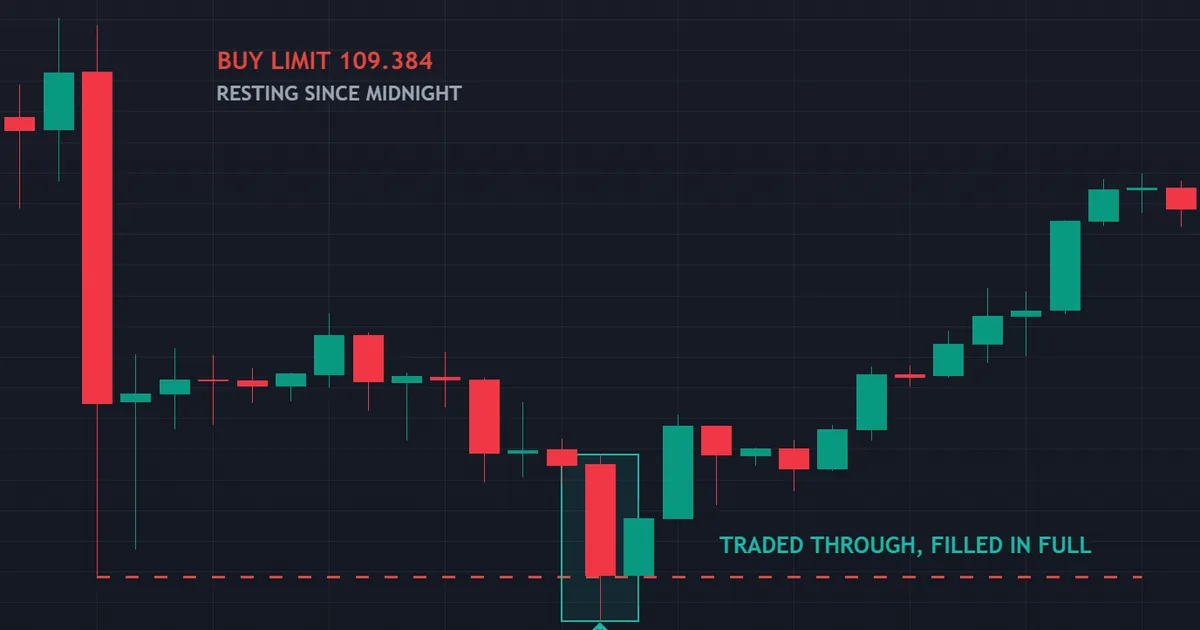
The chart above shows a buy limit on AUDJPY hourly bars. The order rested at 109.384 from midnight on 3 August 2026, and price traded down to 109.239 during the 13:00 bar.
Why This One Filled Completely
Notice how far price travelled past the level. The bar reached 109.239, roughly fourteen pips below the order, then closed at 109.39.
An order that price trades decisively through usually fills in full. Plenty of trading happened at and below the level, so there was ample size to meet it.
Partial fills live at the other extreme. They cluster where price merely touches your level and turns away immediately.
The Order Book Behind the Price
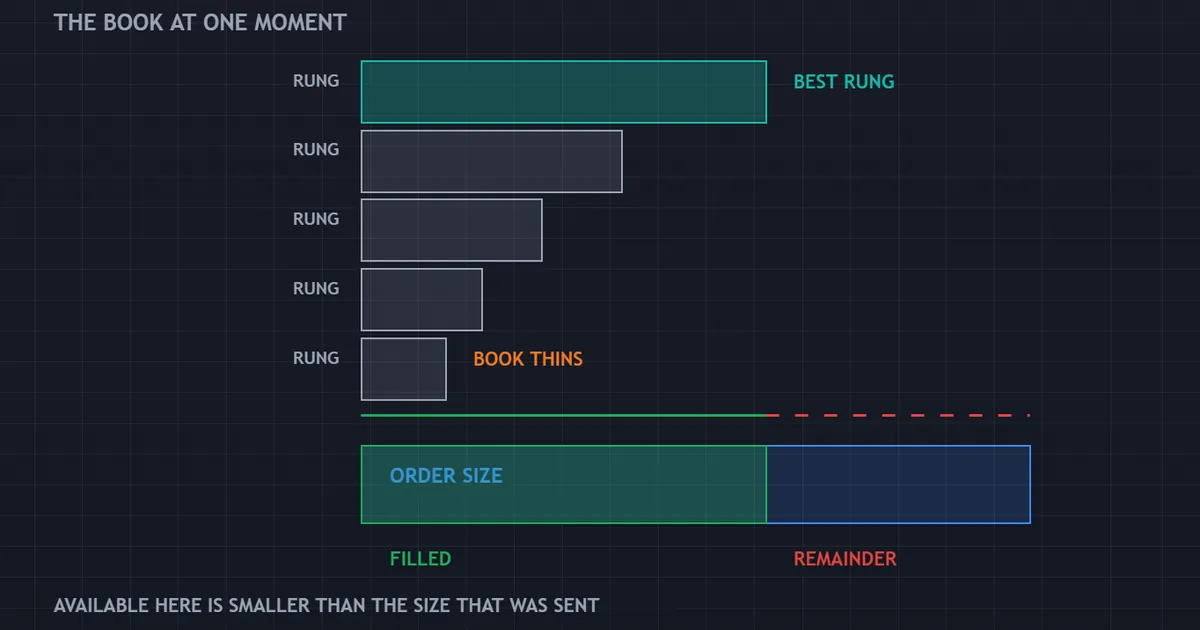
Every quoted price represents the best bid and the best offer. Below and above sit further prices with their own available size.
An order larger than the top rung eats through it. What happens next depends entirely on the order type you sent.
A market order walks down the ladder and fills at worse prices. A limit order refuses to walk, so it takes what sits at your price and stops there.
How a Partial Fill Happens, Step by Step
Five steps describe almost every case. The sequence rarely varies, whatever the platform calls it.
- You send an order for a given size. The size is your request, never a promise from anyone.
- The venue checks available liquidity. It looks at what rests at your price or better.
- The matching engine fills what it can. Your order takes the size that exists right then.
- Liquidity at that price runs out. Nothing remains to trade against without moving to a worse price.
- The remainder follows your instruction. It rests, it cancels, or it fills worse, depending on the order type.
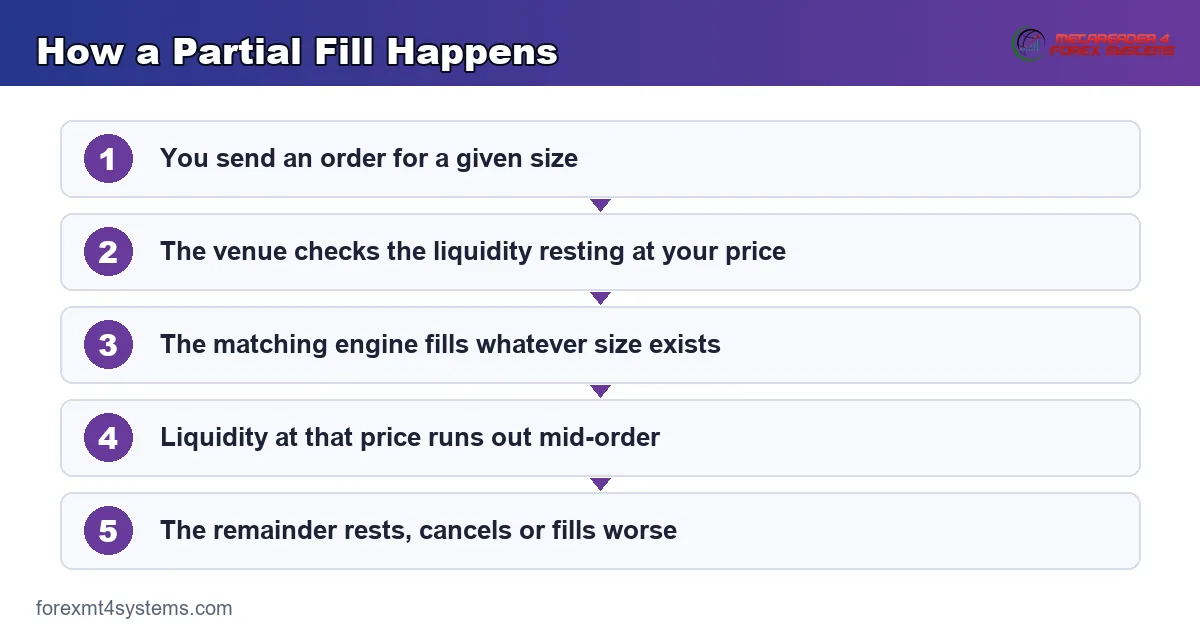
Step five causes most of the confusion. Traders assume one behaviour and their platform applies another.
Reading the Fill in Your Platform
Open the trade history rather than the order log. Each execution appears as its own line, with its own price and volume.
Two lines against one order tell the story at a glance. Add the volumes, then compare that total against what you requested.
The position tab shows the blended entry price. That blended figure, not the price you had in mind, feeds every later calculation.
Where the Remainder Goes
A resting limit order keeps its unfilled portion working. The remainder waits at your price until it fills or you cancel it.
A market order behaves differently. It keeps consuming price levels until the whole size trades, which produces one average price rather than a partial position.
So the phrase means different things by order type. With limits you get less size at your price, and with market orders you get full size at a worse average.
Time in Force Decides
MetaTrader 5 exposes a filling policy for each symbol. Three settings cover the common cases, and your broker chooses which ones exist.
Fill or kill executes the whole order or none of it. Immediate or cancel fills whatever exists and cancels the rest instantly.
The return policy fills what it can and leaves the remainder working as an order. Check which policy applies before you assume anything about a leftover.
The Liquidity Ladder
Depth is the quantity available at each price, and it varies enormously. Traders who think only in prices miss half the picture.
Depth Is Not the Same as Price
Two pairs can quote an identical spread and offer completely different size behind it. The tighter quote sometimes hides the thinner book.
Spread tells you the cost of crossing. Depth tells you how much you can cross before the cost changes.
Our forex spread comparison covers the first half of that equation across brokers.
Thin Books Move Faster
A shallow ladder means each trade shifts the price further. Partial fills and slippage rise together, because both come from the same shortage.
That connection matters when you read your fills. Our guide to slippage in trading covers the price side of the same problem.
Why Retail Traders Rarely See It
A single standard lot is small against a major currency pair in London hours. The book absorbs it without noticing.
Scale changes everything, though. The same lot size on an exotic pair at three in the morning meets a very different ladder.
So the question is never whether your account is large. It is whether your order is large compared with what sits at that price right now.
Partial Fills Versus Related Terms
Three execution words get used interchangeably. They describe different events, and mixing them up hides what really happened.
Partial Fill Versus Slippage
A partial fill changes your size. Slippage changes your price.
Both come from the same shortage. A limit order meets that shortage as a partial fill, while a market order meets it as a worse average price.
Partial Fill Versus a Requote
A requote offers a new price and waits for your answer. Nothing executes until you accept.
A partial fill has already executed. Some of your order traded, so you hold a live position rather than a pending question.
Partial Fill Versus a Rejection
A rejection leaves you with nothing at all. The order never traded, so your exposure stays exactly where it was.
Partial fills sit awkwardly between the two. You hold a position, though not the one you asked for, which is why they cause more errors than plain rejections.
How Execution Models Differ
Your broker’s model shapes what you experience. Two arrangements dominate retail forex.
Dealing Desk Pricing
A dealing desk quotes its own prices and takes the other side. Partial fills stay unusual there, because the desk decides whether to accept the order at all.
What you meet instead is a rejection or a requote. That swaps one inconvenience for another rather than removing it.
Straight-Through and ECN Routing
Here your order meets external liquidity providers. Depth becomes real, and so does the chance of exhausting it.
Partial fills belong to this model. They are the visible cost of trading against a genuine book rather than a single counterparty.
Which One Suits You
Neither model wins outright. Small, steady size rarely notices the difference, while larger size usually prefers real depth even with the occasional partial.
When Partial Fills Actually Matter
Three conditions produce nearly all of them. Any one of the three raises the odds, and two together make it likely.
Size Relative to the Book
What counts as large depends on the market rather than your account. Ten lots is routine on a major and substantial on a thin cross.
Judge size against typical depth, never against your balance. Our guide to lot size in forex covers the units behind that comparison.
Exotic and Minor Pairs
Fewer participants quote these markets. Books thin out quickly, so an order of moderate size reaches the bottom of a price level fast.
Spreads on such pairs also widen at the first sign of stress. Our note on why spreads widen explains what drives that.
Off-Hours and the Rollover Window
Liquidity providers step back around the daily rollover and into the weekend. Books thin, spreads widen, and partial fills become far more common.
The same applies immediately after a major release. Everyone widens simultaneously, so depth vanishes exactly when volume spikes.
Avoid resting large orders through those windows. Nothing prevents a fill there, and very little about it will please you.
Download the complete indicator database
Put these concepts on your charts. One email unlocks the full library of 1,380+ indicators with compiled MT4 and MT5 files, plus my TradingView scripts. No paywall, no spam, unsubscribe any time.
Get free access to my indicator database
One email unlocks 1,380+ free MT4, MT5 and TradingView indicators — the complete library. No single-tool download; you get the whole database.
Common Mistakes and the Fixes
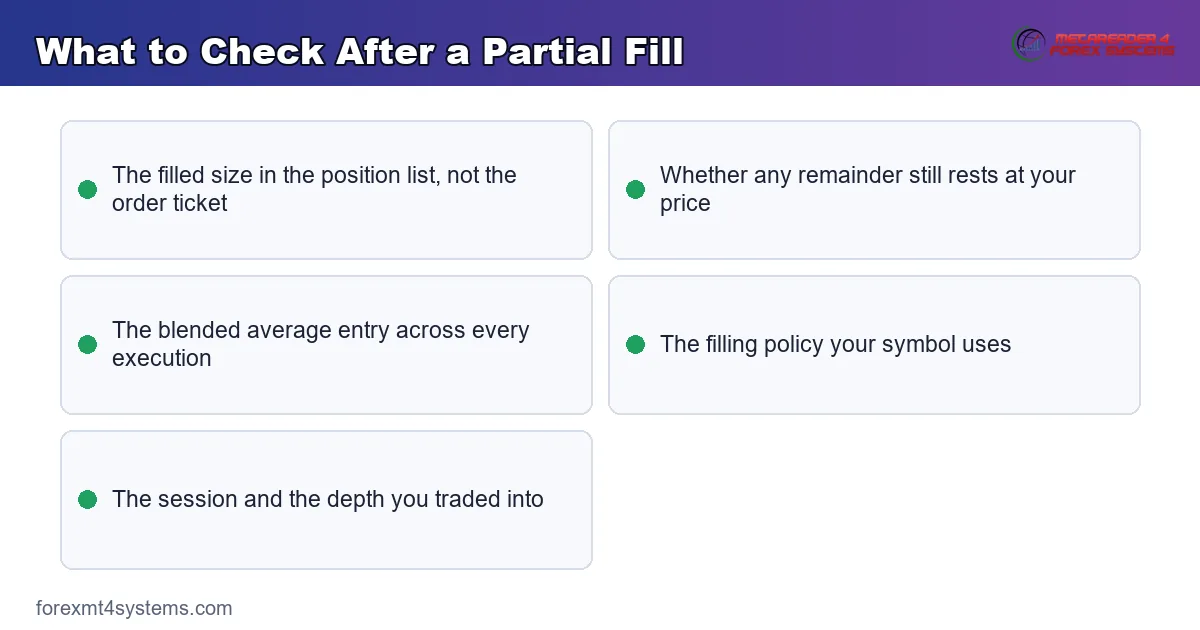
Six habits turn an ordinary partial fill into a real problem. The panel below collects what to check.
Assuming the Position Matches the Order
Traders often size a stop from the requested lots rather than the filled ones. Read the position, never the ticket, before you calculate anything.
Leaving the Remainder Working Unnoticed
An unfilled portion sitting at your price can trigger hours later. Cancel it deliberately or accept it deliberately, but never forget it.
Adding Size to Compensate
Topping up a partial fill at a worse price changes the trade you planned. The average entry moves, and the original stop no longer represents the same risk.
Blaming the Broker Automatically
A partial fill is usually arithmetic, not misconduct. Persistent partials on small size in liquid hours deserve a question, and the occasional one does not.
Trading Large Size at the Wrong Hour
Depth follows the sessions. Move meaningful size during overlapping sessions rather than in the quiet stretch before the rollover.
Ignoring the Filling Policy
Fill or kill and immediate or cancel produce completely different outcomes. Check which one your symbol uses before it surprises you mid-trade.
Who Meets Partial Fills Most Often
The experience varies enormously by trading style. Three groups meet them regularly.
Traders Working Larger Size
Size relative to depth drives everything. A trader moving fifty lots reaches the bottom of a price level often, whatever the pair.
Such traders usually split orders as standard practice. Breaking one order into five reduces the chance any single piece exhausts a rung.
Automated Systems
A robot sends orders without judging the hour. It will happily request size at the rollover, when depth sits at its thinnest.
Careful execution code reads the filled volume after every send. Code that assumes the requested volume arrived drifts out of step with reality.
Traders on Exotic Crosses
Thin markets produce partials at sizes that would never trouble a major. The pair matters far more than the account.
Anyone trading these often should watch depth rather than spread alone. A tight quote on a thin book flatters the market considerably.
Partial Fills When You Close a Trade
Most articles treat this purely as an entry problem. Exits deserve more attention, because the consequences run further.
A Half-Closed Position Is Still Open
Closing three of five lots leaves two lots live. Traders who glance at the confirmation and walk away carry exposure they believe they closed.
Check the position list instead. Confirmations describe what traded, never what remains.
Stops Are Orders Too
A stop becomes a market order when touched, so it usually completes. In a genuinely disordered market it can still fill in pieces at several prices.
Your blended exit then differs from the level you set. That gap belongs in the same family as slippage, and it grows in the same conditions.
Scaling Out Deliberately
Planned partial exits are a different thing entirely. There you choose the size, and the platform simply does as asked.
Keep the two ideas apart in your journal. One reflects your decision, the other reflects the market’s capacity.
Quick Reference Checklist
Five checks cover nearly every partial fill you will meet. Run them in order.
| Check | What to look at | Why it matters |
|---|---|---|
| Filled size | The position, not the order ticket | Risk arithmetic depends on the real size |
| Remainder status | Whether anything still rests at your price | A forgotten order can fill much later |
| Average entry | The blended price after every fill | Stop distance and R both shift with it |
| Filling policy | The symbol setting in your platform | It decides what happens to leftovers |
| Session and depth | The hour and the pair you traded | Thin books cause most partial fills |
Those five take under a minute. Skipping them is how a small execution quirk becomes a sizing error.
The Position-Sizing Consequence
This is where a partial fill does real damage. The execution itself is harmless, and the arithmetic afterwards is not.
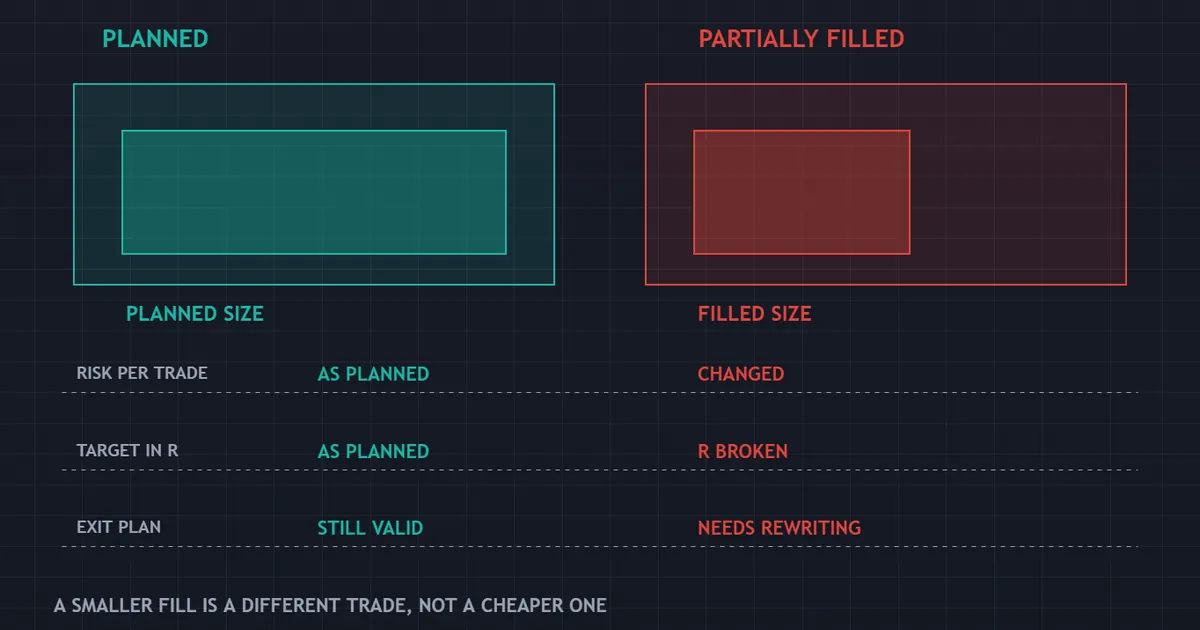
Your Risk Is No Longer What You Planned
Position size, stop distance and risk form a triangle. Change one and the others must change with it.
A fill at sixty percent of your intended size cuts your risk to sixty percent. That sounds harmless, and it quietly breaks the consistency your plan depends on.
Our guide to position sizing covers the triangle in full, and the position size calculator recalculates it in seconds.
R Breaks Quietly
R only means something when every trade risks the same amount. Trades taken at inconsistent size produce results you cannot compare.
A run of partial fills therefore corrupts your records. The strategy looks worse or better than it is, purely because the sizes wandered.
The Fix Takes Two Minutes
Check the filled size before you place the stop. If the fill came in small, either accept the smaller risk or resize deliberately.
Then log what actually happened. A note beside the trade keeps your review honest when the numbers look odd months later.
Habit beats memory here. Check the filled volume every time and the question stops arising at all.
Partial Fills on a Funded Account
Funded accounts add a rule layer on top of execution. A partial fill can interact with those rules awkwardly.
Consistency Rules and Uneven Size
Many firms review whether your trade sizes stay consistent. A run of partial fills produces uneven sizes through no fault of your own.
Keep the evidence either way. A screenshot of the fills protects you if a review ever questions the pattern.
Risk Limits Count Filled Size
Daily loss limits measure actual exposure, never intended exposure. A smaller fill therefore uses less of your allowance.
The reverse holds too. A remainder filling later can push exposure past a limit you believed you had respected.
Read the Rulebook Once
Firms differ on how they treat leftover orders. Five minutes with the rules beats discovering the answer during a payout review.
A Worked Example in Lots
Numbers make the sizing problem obvious. Follow one order through and the consequence stops feeling abstract.
The Plan
Suppose your rules risk one percent per trade. The stop sits forty pips away, and the arithmetic gives you five lots.
You place a buy limit for five lots, then walk away. So far everything matches the plan exactly.
The Fill
Price touches your level and turns immediately. Three lots trade, while the remaining two stay resting at the price.
Live risk now sits at three fifths of one percent. The stop still waits forty pips away, and the loss it represents shrank without any decision from you.
The Awkward Part
Those two lots may fill later at the same price. Risk then jumps back to the full one percent, possibly hours after you stopped watching.
Decide now which outcome you want. Cancelling the remainder locks in the smaller trade, while leaving it working accepts a position that can change size on its own.
Related Guides Worth Reading Next
Two order types explain most fill behaviour between them. Read both and partial fills stop feeling mysterious.
Our page on the limit order covers resting orders that fill at your price or better. Its counterpart on the market order explains why a market order takes full size at whatever price it finds.
Traders building automated execution should read both twice. Our wider MetaTrader indicators library covers the analysis side once the execution side makes sense.
After that, watch your own fills for a month. Nothing teaches depth faster than noticing which pairs and which hours give you exactly what you asked for.
FAQ
What is a partial fill in trading?
An order that executes for less than the size you requested. The liquidity available at your price ran out before your whole order traded. The remainder then rests, cancels or fills at a worse price, depending on the order type and the filling policy in force.
Do partial fills mean my broker did something wrong?
Usually not. A partial fill reflects the size available at a price, which no broker controls in a liquid market. Repeated partials on small orders during active sessions do deserve a question, since that pattern suggests something other than depth.
Which order types can be partially filled?
Limit and stop-limit orders most often, because they refuse to trade at worse prices. A plain market order normally fills in full at a blended price instead, since it walks down the ladder until the size completes.
How do I stop partial fills happening?
Use a fill-or-kill policy if your broker offers it, which executes everything or nothing. Trading during overlapping sessions and sticking to liquid pairs helps far more. Splitting a large order into smaller pieces also reduces the chance any single piece exhausts a price level.
What happens to the unfilled part of my order?
That depends on the instruction attached to it. A resting limit keeps the remainder working at your price until it fills or you cancel. An immediate-or-cancel instruction removes it straight away, and fill-or-kill would have rejected the whole order rather than filling part.
Does a partial fill affect my stop loss?
It affects what that stop means in money terms. The level itself stays wherever you placed it, while the smaller position makes the loss smaller too. Recalculate before assuming the trade still carries your intended risk.
Can a partial fill happen on a stop loss?
Rarely, though it can. A stop becomes a market order when price touches it, and market orders normally complete by taking successively worse prices. In a badly disordered market those fills arrive in pieces at several prices, which shows up as a blended exit rather than a clean one.
Are partial fills common in retail forex?
Not at typical retail size on major pairs during active hours. They become far more likely on exotic crosses, around the daily rollover, into the weekend and immediately after major releases. Size relative to available depth decides it, rather than the size of your account. Results are not guaranteed; past performance is not indicative of future results.
External references
- For background on this concept, see Fill at Investopedia.
- For broader market context, see Order Book at Corporate Finance Institute.

About the author
Written by Dominic Walsh, a Forex trader and MT4/MT5 indicator, Expert Advisor and script developer. Every tool on forexmt4systems.com is tested on live charts before release and ships with ready-to-use compiled MT4 (.ex4) and MT5 (.ex5) files. Learn more about the trader and developer behind this site.
How we build, test and correct every tool: Editorial & Testing Policy. Trading carries risk; see the disclaimer.