
The anchored VWAP vs VWAP question comes down to one thing: where the calculation starts. Both plot the volume-weighted average price — the average price of every trade, weighted by volume — as a single line on your chart. Standard VWAP resets at the start of each session, so it always measures today. Anchored VWAP starts from a point you choose — a swing high, an earnings candle, a news spike — and keeps running from there. So VWAP tells you the fair price today, while anchored VWAP tells you the fair price since one specific event. This guide shows both on real charts, side by side, and tells you exactly when each line earns its place on your screen.

What standard VWAP is

Standard VWAP tracks the average price paid so far in the current session, weighted by how much volume traded at each level. Big-volume prices pull the line toward them; thin prices barely move it. That makes VWAP a running “fair value” for the day. Institutions lean on it hard. A fund buying a large position wants to fill at or below VWAP, because a fill under the line beats the day’s average. So the level works as a benchmark and a magnet at the same time.
The catch is the reset. At the session open the line starts fresh, blind to everything before it. On the chart above you can watch VWAP restart each morning and drift with the day’s flow. That daily rebirth is exactly what day traders want, and exactly what longer-term traders find limiting.
What anchored VWAP is, and why the anchor point matters
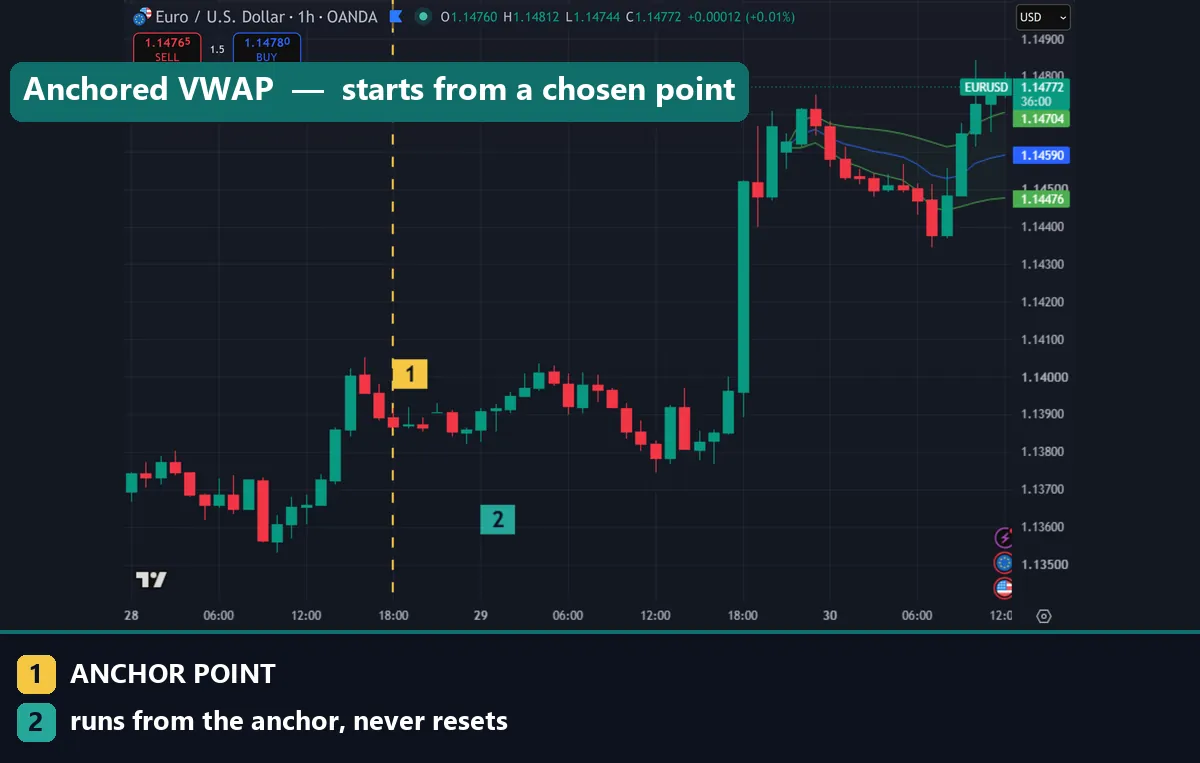
Anchored VWAP uses the same maths, but you decide where the count begins. You drop the anchor on one bar, and the indicator averages every trade from that bar to now. Nothing before the anchor counts. So the line shows the average price of everyone who has traded since that moment.
The anchor point is the whole game. Anchor to a major swing low and the line shows the average entry of every buyer since the bottom — a level those buyers tend to defend. Anchor to an earnings candle, a central-bank announcement, or a big news spike, and you track fair value since the market repriced. Pick the anchor badly and the line means nothing. Pick it well and you get a level tied to a real event, not an arbitrary clock reset.
Good anchors share one trait: they mark a moment the market clearly cared about. An obvious swing high or low, the open of a strong trend, a gap, or a high-volume reversal bar all qualify.
Anchored VWAP vs VWAP: the key differences

Put the two side by side and the contrast is obvious. The chart above runs standard VWAP and an anchored VWAP on the same pair. Standard VWAP chops into fresh segments at every session boundary. Anchored VWAP runs as one smooth line from the event you chose, ignoring the clock entirely.
| Feature | Standard VWAP | Anchored VWAP |
|---|---|---|
| Start point | Session open, automatic | A bar you choose |
| Reset behaviour | Resets every session | Never resets until you re-anchor |
| Best use | Intraday day trading | Swing trades, key-level analysis |
| Timeframe | M1 to H1 | H1 to weekly |
| What it measures | Fair price today | Fair price since an event |
| How to add it | One click, no settings | Add, then place the anchor |
Read the table as a division of labour, not a contest. VWAP owns the intraday clock. Anchored VWAP owns the story between two events.
How each line behaves as support and resistance
Both lines act as dynamic support and resistance, but on different clocks. When price trades above standard VWAP, the line tends to hold as support on pullbacks; below it, the line caps rallies as resistance. Day traders buy dips into a rising VWAP and sell rips into a falling one. Because the level resets, yesterday’s VWAP is gone, so it only matters for today’s tape.
Anchored VWAP holds the same way, yet the level carries the weight of the whole move since the anchor. A rising anchored VWAP from a swing low often catches pullbacks for weeks. Price reclaiming an anchored VWAP after trading below it signals that the average buyer since the event is back in profit — a shift worth noting. Since the line never resets, these levels stay relevant far longer than a session VWAP.
VWAP vs anchored VWAP: when to use which

Match the tool to your horizon. Use standard VWAP when you trade intraday. Scalpers and day traders live on the session line: it frames fair value, flags mean-reversion entries, and gives a clean benchmark for the day. If your trade opens and closes inside one session, standard VWAP is the right line.
Reach for anchored VWAP when the story spans days or weeks. Swing traders anchor to the last major high or low and trade around that line. Position traders anchor to an earnings report or a policy decision and hold as long as price respects it. Anytime a single event — not the calendar — defines the move, anchored VWAP fits better.
Plenty of traders run both. The session VWAP handles today’s entry timing, while an anchored VWAP from the swing low marks the bigger level you are trading toward.
How to add both on TradingView, MT4 and MT5
On TradingView, standard VWAP is built in. Open the indicator search, type VWAP, and add it — no setup needed. For the anchored version, search “Anchored VWAP,” add it, then click the bar you want as the anchor. You can drag that anchor to a new bar anytime. Add several anchored VWAPs at once to track more than one event.
MetaTrader works differently. Neither MT4 nor MT5 ships a native VWAP, so you add both through custom indicators. Load the file into the indicators folder, restart the platform, and drag it onto the chart; the anchored version exposes an anchor date or bar-shift input. Our guide on how to install MT4 and MT5 indicators walks through the folder steps with screenshots. Browse ready-made options in our VWAP indicators library.
Download the complete indicator database
Put these concepts on your charts. One email unlocks the full library of 1,380+ indicators with compiled MT4 and MT5 files, plus my TradingView scripts. No paywall, no spam, unsubscribe any time.
Get free access to my indicator database
One email unlocks 1,380+ free MT4, MT5 and TradingView indicators — the complete library. No single-tool download; you get the whole database.
Common anchored VWAP and VWAP mistakes
A few errors undo most VWAP setups. First, anchoring to a random bar. An anchor only means something when it marks a real event — a swing extreme, a gap, a news candle — so choosing a bar at random gives you a line with no logic behind it. Second, using session VWAP on a swing chart. On a daily chart the session line resets constantly and tells you little, which is where anchored VWAP belongs instead. Third, treating either line as a hard signal. Both are context, not triggers, so pair the line with structure or momentum before you act. Fourth, letting the anchor go stale. Re-anchor when a fresh swing forms, or the line quietly measures the wrong move.
Where to go next
Keep comparing tools before you commit to one. Browse our other head-to-head breakdowns in the indicator comparisons hub, see where VWAP ranks among the best forex indicators, and explore every version in our VWAP library above. For the underlying maths, Investopedia explains how VWAP is calculated, and Wikipedia covers the volume-weighted average price formula in full.
FAQ
What is the difference between VWAP and anchored VWAP?
The difference between VWAP and anchored VWAP is the starting point. Standard VWAP resets at each session open and measures today’s fair price. Anchored VWAP starts from a bar you choose and keeps running from that event, so it measures fair price since that moment.
Is anchored VWAP better than VWAP?
Neither is better; they suit different horizons. Standard VWAP wins for intraday day trading, while anchored VWAP wins for swing trades and key-level analysis. Many traders run both on the same chart.
Where should I place the anchor on anchored VWAP?
Anchor to a moment the market clearly reacted to — a major swing high or low, a gap, an earnings candle, or a strong session open. A meaningful anchor gives a meaningful line; a random bar gives noise.
Does VWAP work on MT4 and MT5?
Yes, but not out of the box. Neither platform ships a native VWAP, so you add both the standard and anchored versions through custom indicators dropped into the indicators folder.
Does anchored VWAP repaint?
No. Once a bar closes, its contribution to the anchored VWAP is fixed. Only the current, unclosed candle updates in real time, which is normal for any volume-weighted line.
Is anchored VWAP guaranteed to predict reversals?
No. Anchored VWAP shows an average price, not a forecast. Trading involves risk, results are not guaranteed, and past performance is not indicative of future results. Test any approach on a demo account before trading it live.

About the author
Written by Dominic Walsh, a Forex trader and MT4/MT5 indicator, Expert Advisor and script developer. Every tool on forexmt4systems.com is tested on live charts before release and ships with ready-to-use compiled MT4 (.ex4) and MT5 (.ex5) files. Learn more about the trader and developer behind this site.
How we build, test and correct every tool: Editorial & Testing Policy. Trading carries risk; see the disclaimer.