
The Quasi Volume Bars Indicator reads volume activity on MT4 and MT5 to show where real participation is entering the market. Also, it helps you separate genuine moves backed by volume from thin, low-conviction drifts.
For more like this, browse the more volume indicators for forex or jump to the full free MT4 and MT5 indicators.
What the Quasi Volume Bars Indicator does on the chart
Under the hood the indicator uses standard math you know. It plots one clear layer. It does not call external libraries. Also, it does not slow down the chart.
The Quasi Volume Bars Indicator reads price, volume, and recent bar structure. Also, still, it plots the result on the chart. You can read it at a glance. Thus, the indicator runs natively on MT4 and MT5. You drag it onto any chart in one step.
Key features and settings
- Reads transaction volume reported by the broker feed
- Plots volume context as bars or a heat strip
- Configurable smoothing for cleaner display
- Useful as a confirmation overlay, not a sole signal
- Full alert system: popup, push notification to mobile MetaTrader, email, and sound — all four channels can be toggled independently from the inputs panel. Alerts fire once per closed bar so you never get spammed mid-tick.
- Built for MT4 and MT5; works on every timeframe the platform supports.
- Lightweight code that does not slow down the chart.
| Setting | Description | Recommended default |
|---|---|---|
| Period | Lookback length for any smoothing applied to volume data | 20 |
| Display style | Bars or heat strip | Bars |
| Alerts | Toggle alerts on volume spikes | Off |
| Color theme | Switch between dark and light chart palettes | Dark |
| Show on chart | Toggle the on-chart visual without removing the indicator | On |
How to read signals from the Quasi Volume Bars Indicator
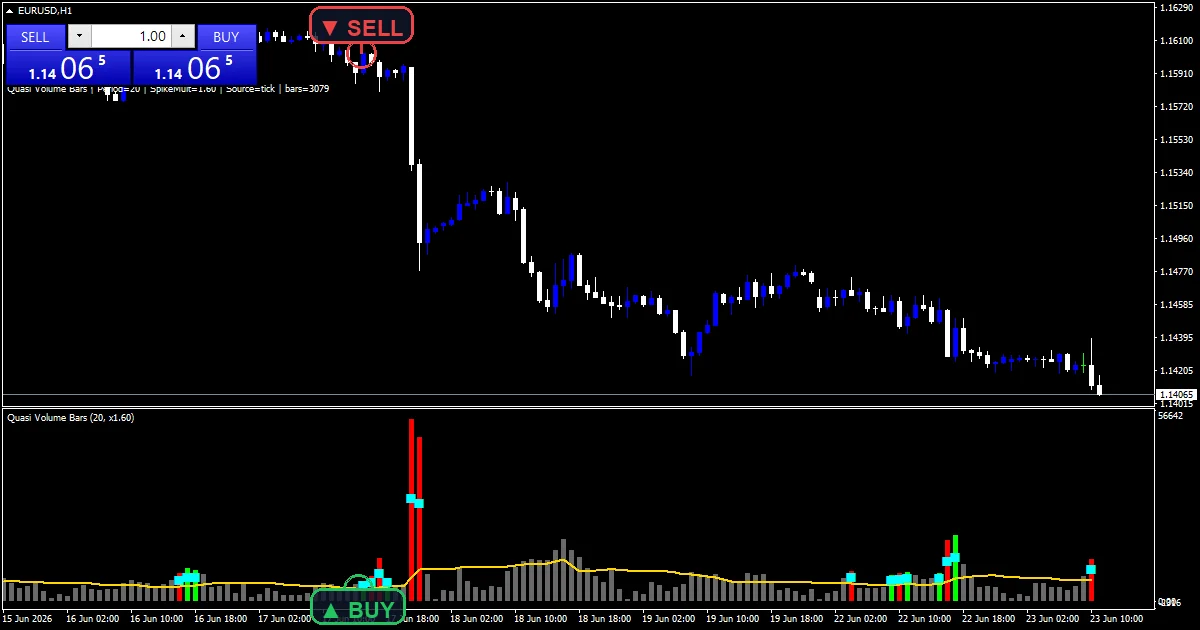
The Quasi Volume Bars Indicator highlights shifts in transactional activity that confirm or contradict the price move. Also, still, hence, a typical workflow looks like this.
Entry idea (long). Wait for a momentum bar with above-average volume to break a recent minor high. Next, wait for the bar to close. Intra-bar values can shift.
Entry idea (short). Wait for a momentum bar with above-average volume to break a recent minor low. The same close rule applies.
Exit idea. A stop placed beyond the most recent swing point and a target at the next reaction level keeps risk readable from the start. Some traders trail with structure. Others trail with the indicator itself.
These are concepts, not rules. Then, backtest on your instrument and timeframe before live capital.
Tuning the Quasi Volume Bars Indicator inputs
Start with the defaults, then tune for your market. AveragePeriod (default 20) sets the averaging length — raise it for smoother, slower signals or lower it for faster, more sensitive ones; SpikeMultiplier (default 1.6) scales sensitivity — higher values widen the distance and produce fewer signals; UseTickVolume (default true) toggles this behaviour on or off. Thus, yet, every alert channel — pop-up, sound, email and mobile push — toggles independently in the same inputs panel, and alerts fire once per closed bar.
Recommended timeframes and instruments
Quasi Volume Bars Indicator relies on volume, which is most meaningful on higher timeframes.
- H1 and above where bar volume carries weight.
- H4 to Daily for confirming larger moves.
Sub-H1 tick volume is noisier, so pair it with price structure on EURUSD, GBPUSD and indices.
How to install on MT4 and MT5

Installation is the same for every indicator on this site. Indeed, still, hence, truly, unzip the download, copy the compiled .ex4 into your MT4 MQL4/Indicators folder (or the .ex5 into MT5 MQL5/Indicators), refresh the Navigator, then drag it onto the chart. For the full step-by-step with alert setup and troubleshooting, see our guide to installing MT4 and MT5 indicators.
Best practices and tips
- Use volume to confirm a move, not to trigger one on its own.
- Watch for divergence between price and volume at extremes.
- Wait for the bar to close before acting on a signal.
- Backtest your configuration on at least 200 closed bars before trading live.
- Keep position sizing small while you learn how the tool behaves on your instrument.
- Review your results weekly and prune settings that underperform.
Get the Quasi Volume Bars for MT4 and MT5
One email unlocks the full library. This Quasi Volume Bars Indicator plus the other 1,382 free MT4, MT5 and TradingView indicators we publish and maintain. Next, plainly, no paywall, no upsell, same opt-in for all of them – you give an email once and you can grab every tool we ship.
Download this indicator free
Enter your email and the file is yours. You also get the full MT4 and MT5 library.
Enter your email and the file lands in your inbox right after. The download is free.
Built by forexmt4systems.com
This Quasi Volume Bars Indicator is one of 1,383 free MT4, MT5 and TradingView indicators we publish and maintain. Also, every tool ships with ready-to-use compiled MT4 (.ex4) and MT5 (.ex5) files, a 4-channel alert system (popup + mobile push + email + sound), and we load each tool on EURUSD H1 before release to confirm it draws cleanly without repainting. The same one-step email opt-in below unlocks the entire library – not just this one indicator.
FAQ
Basics
What does the Quasi Volume Bars measure?
It plots a clear signal layer that the Quasi Volume Bars computes from recent price and volume on the chart.
Is the Quasi Volume Bars Indicator non-repaint?
By default the indicator only confirms a signal on the bar close, so that bar close locks the printed signal. Then, some users prefer the early intra-bar mode for faster signals — both options are in the inputs.
Timeframes and instruments
Which timeframe should I use?
There is no single best timeframe. Thus, yet, still, m15 to H1 is a common starting point for intraday traders, and H4 to D1 works for swing traders. Backtest the configuration on the timeframe you actually trade.
Does it work on instruments other than forex?
It works on any instrument MT4 and MT5 supports — forex majors, gold (XAUUSD), indices like US30 and NAS100, and major cryptos. Thus, fast-moving instruments may need a smaller period setting.
Alerts and signals
Can I add alerts?
Yes. Still, hence, truly, hence, you can toggle pop-up, sound, push, and email alerts directly in the inputs. On MT4 and MT5 the alert plays on the bar close that triggers the signal. Next, the Quasi Volume Bars Indicator ships with full alert functionality built in: popup alerts on the chart, push notifications to mobile MetaTrader, email alerts, and a sound alert with a configurable .wav file. You toggle each channel independently from the inputs panel (EnableAlerts, EnablePopup, EnablePushNotify, EnableEmail, EnableSound). Then, alerts trigger once per closed bar.
For external background reading, see the background on volume analysis.
Risk disclosure
Are results guaranteed?
No. Trading involves risk. Results are not guaranteed. Past performance is not indicative of future results. Use the Quasi Volume Bars Indicator as one input. Always backtest before trading live.
Category: this is part of our Volume collection. Browse more Volume for MetaTrader, or explore every MT4 indicator and MT5 indicator on the site.
External references
- Learn more about the underlying method in Negative volume index on Wikipedia.
- For wider market background, see Negative Volume Index Nvi at StockCharts ChartSchool.

About the author
Written by Dominic Walsh, a Forex trader and MT4/MT5 indicator, Expert Advisor and script developer. Every tool on forexmt4systems.com is tested on live charts before release and ships with ready-to-use compiled MT4 (.ex4) and MT5 (.ex5) files. Learn more about the trader and developer behind this site.