
MACD Crossover Strategy is a momentum-timing strategy: it does not try to catch a trend early, it waits for the MACD line to actually cross its signal line from the stretched side of zero, which is a later, more confirmed entry than trading the histogram alone. This page covers the exact entry and exit rules, a real Strategy Tester run of those rules on GBPUSD H4, how the stop and time-stop scale across other pairs and timeframes, and where the rules break down.
For more like this, browse the forex strategy hub.
Strategy overview
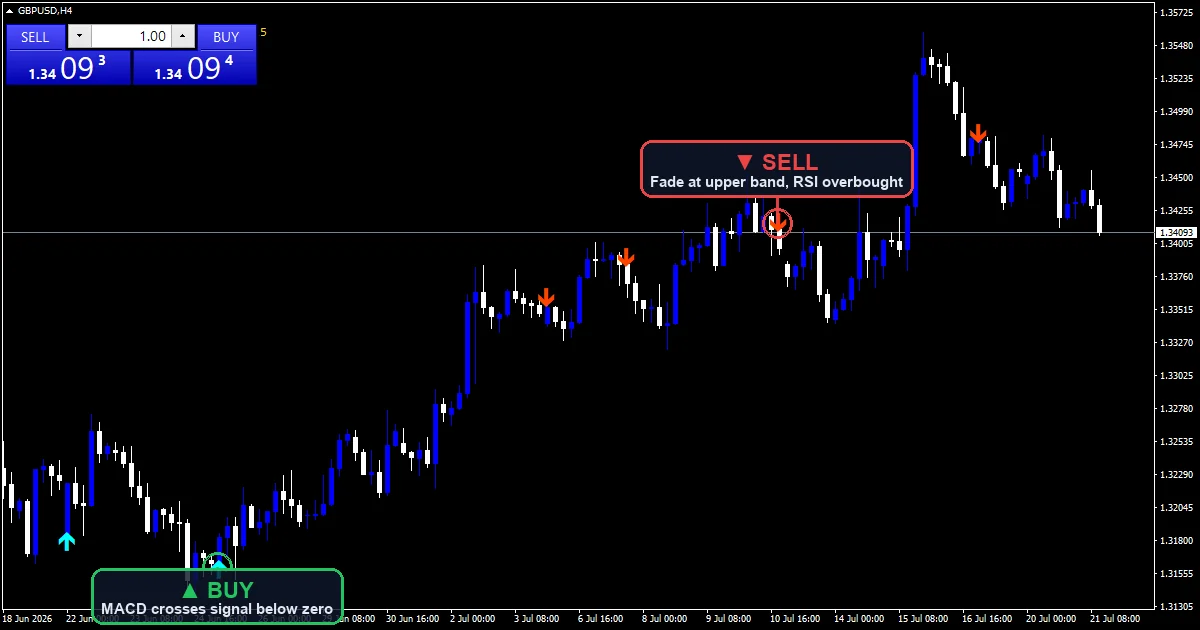
MACD Crossover Strategy trades GBPUSD on the H4 chart. GBPUSD runs wider ranges than EURUSD. Give the stop extra room.
Requiring the cross to happen below zero for longs (above zero for shorts) is the filter that separates this rule set from a plain MACD-cross system. A cross close to zero can be noise; a cross that happens after MACD has spent time on the stretched side of the line carries more information about where momentum is actually turning.
Tools used
- MACD (12, 26, 9)
- EMA200 trend filter on the trading timeframe (optional)
- Recent swing points for stops and targets
- MT4 and MT5 for chart, alerts, and order placement.
Entry rules
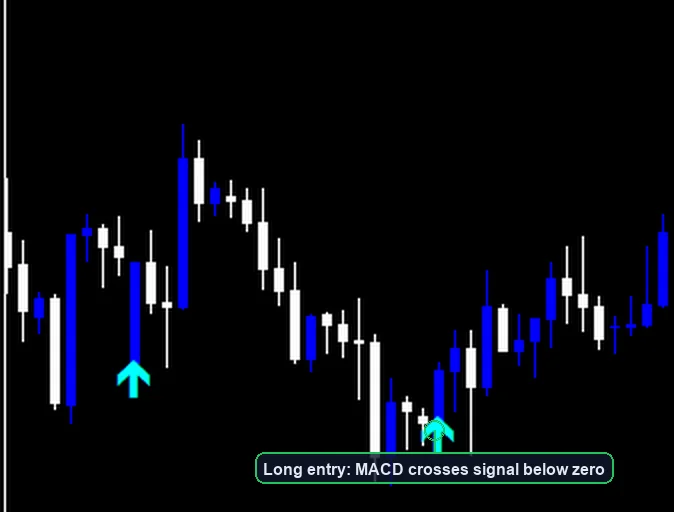
Long entry:
- Wait for the MACD line to cross above the signal line while both sit below the zero line. A cross from stretched levels carries more snap.
- Let the cross bar close. A cross that prints and then un-prints before the close does not count.
- Optional: require price above the EMA200 on the trading chart. The trend filter input turns this on.
- Enter at the open of the next bar. The indicator prints a aqua arrow under the cross bar.
Short entry: The MACD line crosses below the signal line while both sit above zero. The indicator prints a orange-red arrow above the bar.
Exit rules
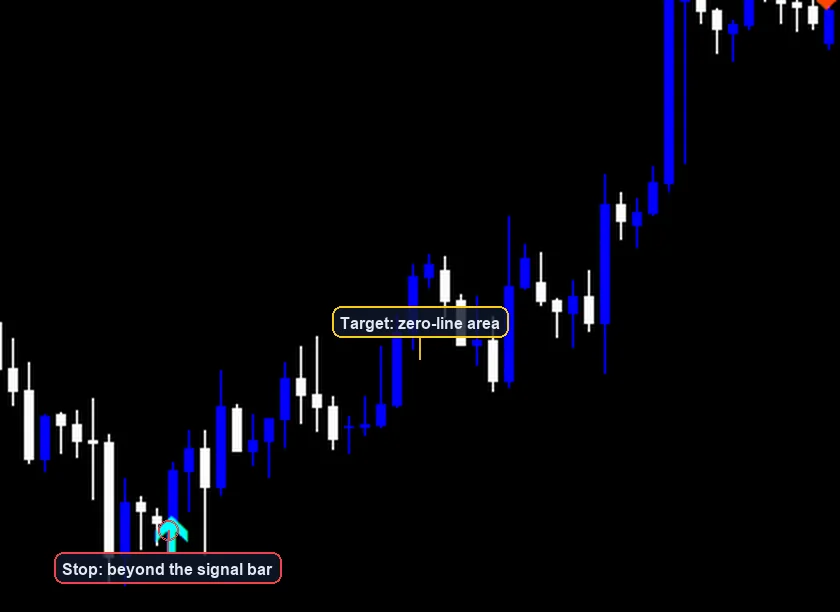
- First target. The zero-line tag or the last swing high, whichever is closer. Momentum crosses tend to carry into that pocket.
- Stop loss. Place the stop below the last swing low before the cross. On GBPUSD H4 that usually lands 40–80 pips out.
- Time stop. If MACD flattens and the trade has gone nowhere after 12 closed bars, exit at market.
Filters that improve the setup
- Turn on the EMA200 trend filter for live trading. Crosses against the baseline fail more often.
- The indicator waits at least 3 bars between same-side signals.
- Each H4 bar spans a full session, so session timing matters less. Focus on the daily bias instead.
- Skip red-folder news for the pair’s currencies. A news candle can print and reverse a cross within minutes.
Worked example
- The MACD line curls up through the signal line below zero. The bar closes and the cross holds.
- The indicator prints a aqua arrow. You enter at the open of the next bar.
- The stop sits below the swing low that preceded the cross — on GBPUSD H4, typically 40–80 pips from entry.
- The first target is the zero-line area. Trail the rest if the histogram keeps expanding.
These numbers are illustrative. They are not a forecast and they are not a promise.
Indicator settings
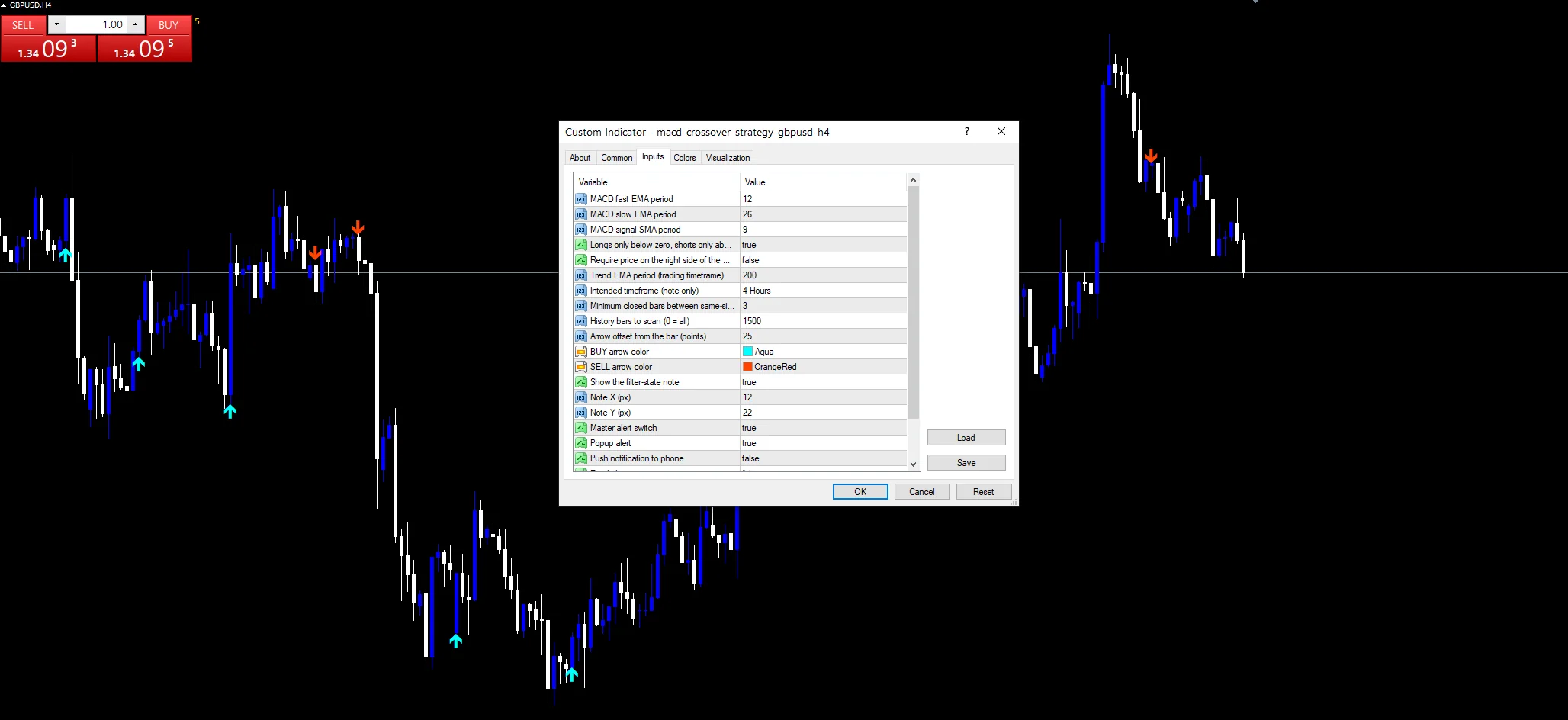
The download ships with these defaults. Every input is adjustable from the indicator’s settings panel.
| Input | Default | Purpose |
|---|---|---|
| FastEma / SlowEma / SignalPeriod | 12 / 26 / 9 | Standard MACD engine |
| UseTrendFilter | false | Require price on the right side of the EMA200 |
| TrendEmaPeriod | 200 | Trend baseline on the trading timeframe |
| RequireZeroSide | true | Longs only from below zero, shorts only from above |
| MinBarsBetween | 3 | Cooldown bars between same-side signals |
How the rules adapt across pairs and timeframes
The entry and exit logic above does not change from market to market – only the stop distance and the time-stop window scale with each instrument’s own volatility. These are the real per-market figures the rule set uses, not a single copied number:
| Pair | Timeframe | Typical stop | Time-stop window |
|---|---|---|---|
| GBPUSD | H4 | 40–80 pips | about two trading days |
| EURUSD | M15 | 8–18 pips | about two and a half hours |
| XAUUSD | M15 | $1.50–$3.50 | about two and a half hours |
| USDCAD | H1 | 15–35 pips | about half a trading day |
Backtest results
We coded the exact entry, exit, filter and time-stop rules above into a rules-testing Expert Advisor (macd_crossover_backtest_ea.mq4 – not the download package above, which only draws signals) and ran it through the MT4 Strategy Tester on GBPUSD H4, open-price model, fixed 0.01 lots, a $10,000 starting balance, magic-number isolated from any other order. The broker’s own history for this symbol and timeframe covered 2025.11.05 00:00 to 2026.08.18 23:59.
Over that window the rules produced 51 trades, 49% of them profitable, for a small net gain of $+1.70 (gross profit $+122.35, gross loss $-120.65, profit factor 1.01). Maximum drawdown over the run was 0.27% of the test balance.
51 trades is a small sample – not enough to draw a firm conclusion about the rules’ long-run edge, only enough to show the exact logic above actually executes as described against real historical price data rather than a hand-picked chart example. Test the rules yourself over a longer window and on your own broker’s feed before risking capital. Results are not guaranteed; past performance is not indicative of future results.
Where this strategy fails
- MACD crosses lag price by construction – the entry always comes after the move that caused the cross has already started, so the best part of a fast reversal is gone before this strategy can act on it.
- In a choppy range, MACD can cross back and forth near zero even with the RequireZeroSide filter on, producing a string of small, low-conviction signals.
- The zero-line target sits close to entry on a cross that happens near zero itself, which caps the reward on exactly the setups where the zero-side filter was supposed to add quality.
How this page was verified
The signal indicator behind the download is our own build, compiled for MT4 and MT5 and checked on live charts before release; it draws signals once per closed bar and does not repaint. The Backtest results section above verifies the underlying rule logic separately, against real historical price data, not against the indicator’s chart output.
Download the MACD Crossover Strategy template
Download the complete MACD Crossover Strategy package for MT4 and MT5 below. The zip contains the compiled signal indicator for both platforms, a ready chart template for each, a STRATEGY-RULES.txt file with the exact rule list, and a README with install steps.
Download this strategy free
Enter your email and the file is yours. You also get the full MT4 and MT5 library.
You will receive the package by email after a one-step confirmation. If you are new to MetaTrader, follow the step-by-step MT4 and MT5 indicator install guide to load the indicator and the chart template.
FAQ
Why is this a macd crossover strategy, not just a generic setup?
A momentum-timing strategy: it does not try to catch a trend early, it waits for the MACD line to actually cross its signal line from the stretched side of zero, which is a later, more confirmed entry than trading the histogram alone.
How many trades did the real backtest produce?
On GBPUSD H4, the rules-testing EA logged 51 trades over 2025.11.05 to 2026.08.18 – see the Backtest results section above for the full numbers.
Why does the cross have to happen below zero for a long entry?
A MACD line already above zero going into a cross means the fast average was already above the slow one – the momentum shift already happened earlier. Requiring the cross from below zero targets the point where momentum is only just turning, not where it has already run.
Does this strategy work the same on every pair?
The MACD engine (12/26/9) does not change, but the stop distance does – it is set from the pair’s own typical range at that timeframe, shown in the settings table below, not a fixed pip count copied across pairs.
Can I run this on a different pair or timeframe than shown here?
Yes – the settings-by-pair/timeframe table above shows how the stop distance and time-stop window change across a few real combinations. The core rules (the indicator settings table) stay the same; only the distances scale with the instrument’s own volatility.
Are results guaranteed?
No. Trading involves risk. Results are not guaranteed. Past performance is not indicative of future results. This macd crossover strategy is a rule-based framework, not a signal service; test it and adapt it to your own risk tolerance before using live capital.
Related on forexmt4systems.com: MACD Crossover Strategy for GBPUSD on H1 · MACD Crossover Strategy for GBPUSD on M15 · MACD 2 Color Histogram Indicator MT4 + MT5.
Authoritative references
- Learn more about the MACD.
- General background on technical indicators.

About the author
Written by Dominic Walsh, a Forex trader and MT4/MT5 indicator, Expert Advisor and script developer. Every tool on forexmt4systems.com is tested on live charts before release and ships with ready-to-use compiled MT4 (.ex4) and MT5 (.ex5) files. Learn more about the trader and developer behind this site.
How we build, test and correct every tool: Editorial & Testing Policy. Trading carries risk; see the disclaimer.