
Cumulative Volume Delta Pivot is a cumulative volume delta indicator TradingView traders can run directly on the price chart. It signs each bar’s volume by where the close sits inside the bar range, then adds the result to a running total. Pivots on that CVD line get matched against pivots in price. A match means order flow confirms the swing. A 21-period EMA of CVD then sets the flow bias.
It is free and open source. You can add it to any chart from the Cumulative Volume Delta Pivot script page on TradingView, and the full Pine source is published there for you to read.
What Cumulative Volume Delta Pivot plots on the price chart
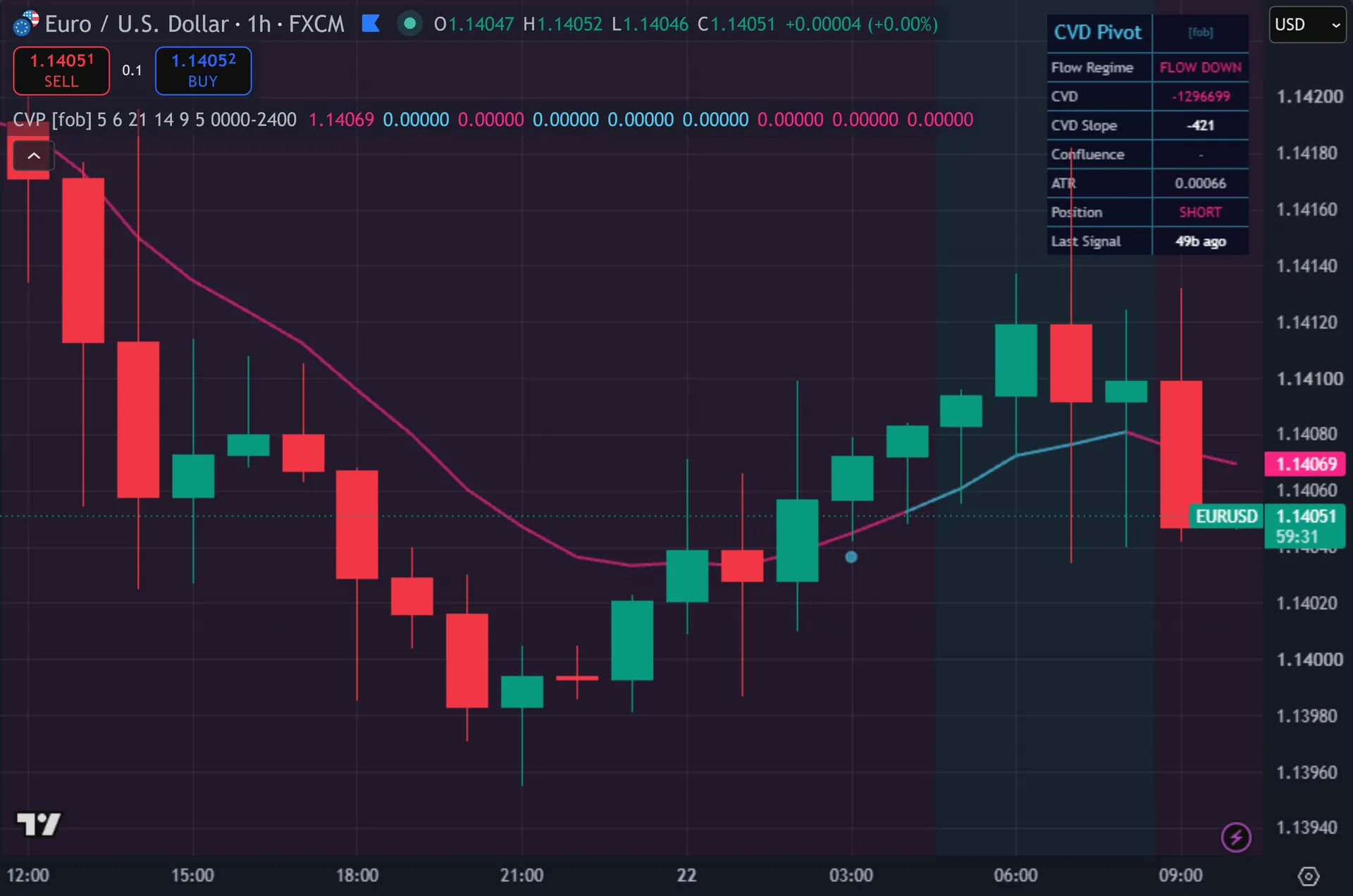
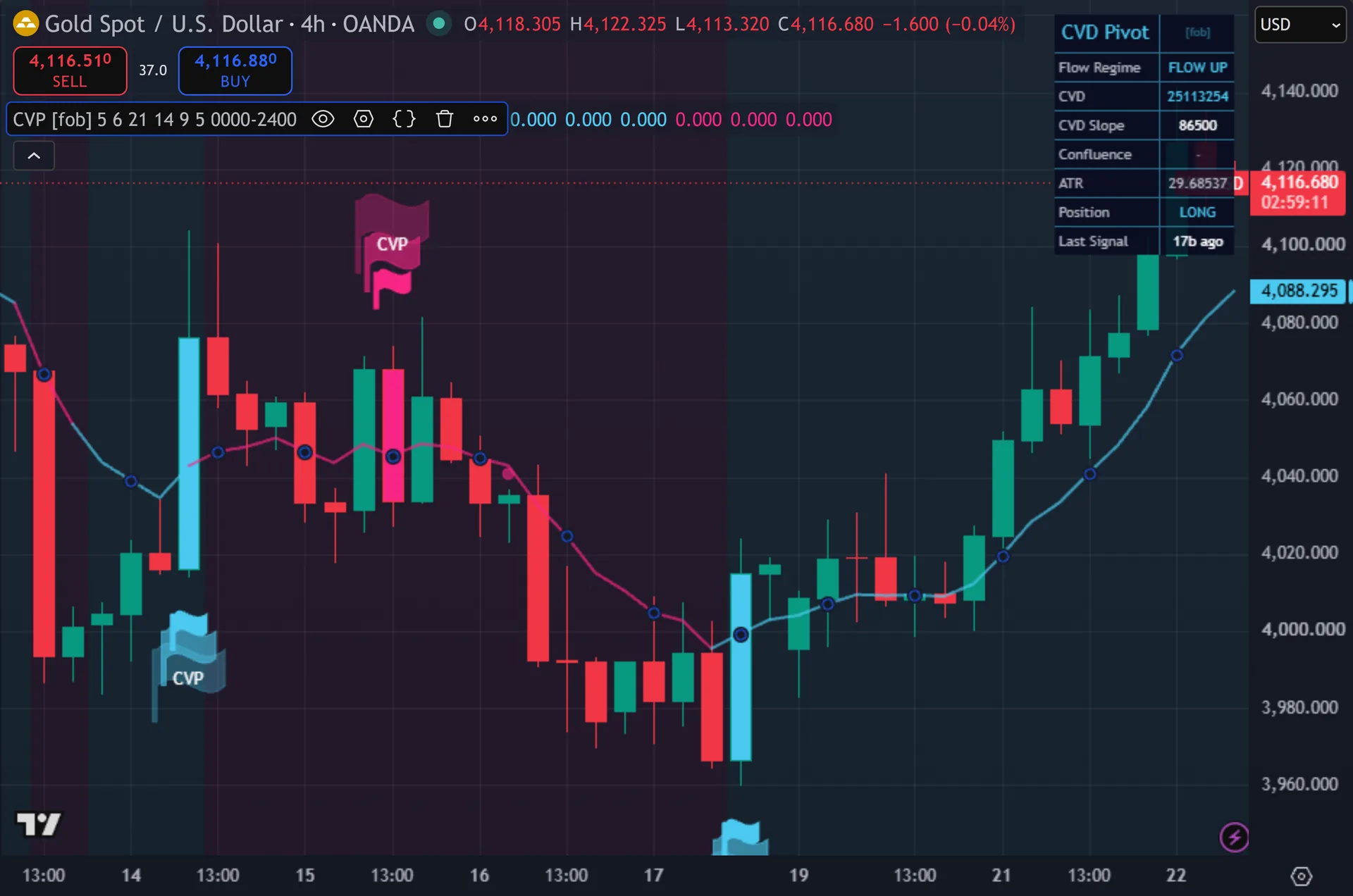
Everything draws on the price chart rather than a sub-window. The main line is a 9-period reclaim EMA, cyan when flow points up and pink when it points down. A faint background wash repeats that regime. Small circles mark bars where a CVD pivot lines up with a price pivot. Flags mark entries, drawn three times at different sizes for a glow effect. Signal bars change colour. An eight-row table reports flow regime, raw CVD, CVD slope, confluence state, ATR, position and bars since the last signal.
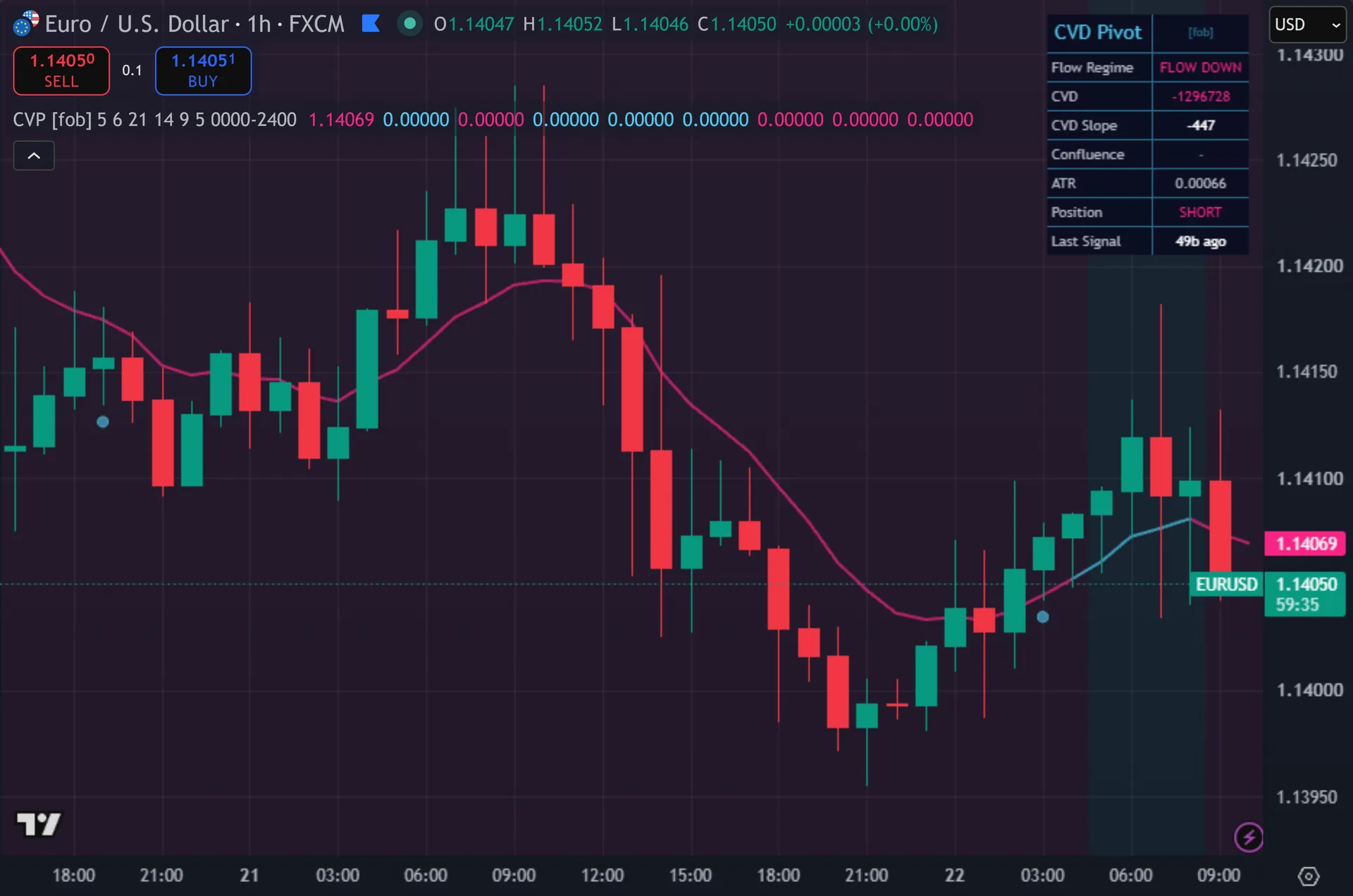
How Cumulative Volume Delta Pivot is built
Building the delta line
Each bar gets a sign between -1 and +1. The formula takes two times close minus low, divides by the bar range, then subtracts one. A close at the high scores +1. A close at the low scores -1. A mid-range close scores zero. Switch off Sign by Close Position and the script falls back to the plain tick rule of plus or minus one.
The script multiplies that sign by bar volume and adds it to a running total. That total is CVD. A 21-period EMA smooths it. Slope equals raw CVD minus that EMA. The sign of the slope sets the regime, so above zero reads as flow up and below zero as flow down.
Pivot confluence runs in parallel. The script calls ta.pivothigh and ta.pivotlow on both price and the CVD line with a 5-bar window on each side. A bullish confluence needs a CVD pivot low within 6 bars of a price pivot low. The bearish case mirrors it exactly.
Timing the entry
Regime alone never fires a trade. The script waits for a close cross of the 9-period reclaim EMA in the direction of the flow bias. A long needs flow up plus a crossover. A short needs flow down plus a crossunder.
Confluence-Only Mode stays off by default, so entries do not need fresh pivot agreement. Switch it on and the gate tightens. A long then also requires a bullish price and CVD pivot match on the signal bar.
Two more filters apply. Position state stops a second long before a short appears. A five-bar cooldown blocks clusters of signals. Every entry requires barstate.isconfirmed, so the flags do not repaint. An optional session window limits signals to hours you choose.
How to read the signals
Read the background wash first. Cyan means CVD sits above its own 21-period EMA, so buying pressure is building. Pink means the opposite. Trade with the wash rather than against it.
Circles give context, not entries. A circle says price and order flow turned at the same swing. That is agreement, not divergence, and it supports the new leg continuing.
The flags are the real triggers. Check the Last Signal row to see how many bars have passed since the previous one. When the CVD number keeps climbing while price stalls, buyers are absorbing supply, and the next reclaim cross often follows soon after.
Every Cumulative Volume Delta Pivot setting explained
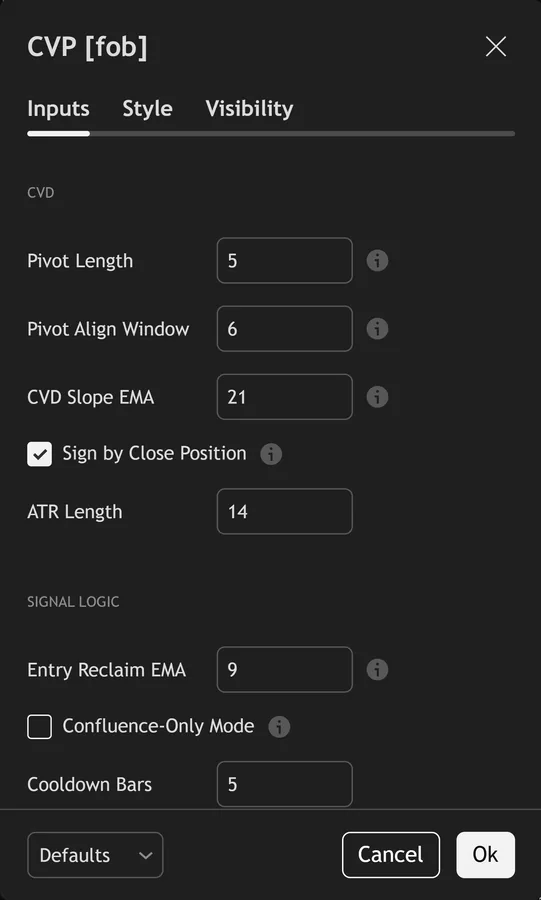
The script exposes 16 inputs, grouped in the settings panel exactly as shown below. Defaults are the published values.
CVD
| Setting | What it does | Default | Range |
|---|---|---|---|
| Pivot Length | Bars each side to confirm price and CVD pivots. | 5 | 2 to 30 |
| Pivot Align Window | A CVD pivot within this many bars of a price pivot = confluence. | 6 | 1 to 20 |
| CVD Slope EMA | CVD minus this EMA defines the order-flow bias. | 21 | 3 to 100 |
| Sign by Close Position | On = sign volume by close-in-range; Off = pure tick rule. | on | on / off |
| ATR Length | Sets the atr length used in the calculation. | 14 | 5 to 50 |
Signal Logic
| Setting | What it does | Default | Range |
|---|---|---|---|
| Entry Reclaim EMA | After CVD slope sets a bias, a close-cross of this EMA in that direction times the entry. | 9 | 2 to 50 |
| Confluence-Only Mode | On = only fire on bars with fresh price/CVD pivot confluence. | off | on / off |
| Cooldown Bars | Sets the cooldown bars used in the calculation. | 5 | 1 to 40 |
Filters
| Setting | What it does | Default | Range |
|---|---|---|---|
| Restrict to Session | Toggles restrict to session on the chart. | off | on / off |
| Session Window | Controls session window. | 0000-2400 |
Visual
| Setting | What it does | Default | Range |
|---|---|---|---|
| Show Dashboard | Toggles show dashboard on the chart. | on | on / off |
| Show 3-Layer Glow | Toggles show 3-layer glow on the chart. | on | on / off |
| Show Reclaim EMA | Toggles show reclaim ema on the chart. | on | on / off |
| Buy Color | Colour used for buy color. | #4cc9f0 | |
| Sell Color | Colour used for sell color. | #f72585 | |
| Dashboard BG | Colour used for dashboard bg. | color.new(#070b1f, 14) |
Alerts built into Cumulative Volume Delta Pivot
The script ships 15 alert conditions. Open the alert dialog on the chart, pick the indicator as the condition source, then choose the event you want. Alerts fire on the close of the bar, so they follow the same confirmed-bar rule the on-chart signals use.
- CVP Buy
- CVP Sell
- CVP Any Signal
- CVP Bull Confluence
- CVP Bear Confluence
- CVP CVD Pivot Low
- CVP CVD Pivot High
- CVP EMA Up
- CVP EMA Down
- CVP Slope Zero
- CVP Regime Flip
- CVP Any Confluence
Other markets and timeframes
The maths uses no fixed price or volume constants. The sign formula normalises by bar range, and ATR(14) reports in the symbol’s own units. Data quality is the real constraint here. On spot forex, brokers publish tick volume, which counts price updates rather than traded contracts. CVD built on tick volume tracks activity, so read it as a proxy and not as true executed size. Futures, crypto and stock feeds carry real exchange volume and give a far more faithful delta.
Limitations worth knowing
The delta is an estimate. TradingView supplies bar volume, not a bid and ask split. The close-position formula infers who held control, and it can read a wide bar with long wicks on both sides incorrectly.
CVD is a running sum with no reset. Its absolute value drifts with the loaded chart history and means little on its own. Only the slope against the 21-period EMA carries information, which is why the regime uses that difference.
Pivots confirm 5 bars late. Confluence circles therefore appear after the swing rather than at it. Confluence-Only Mode makes signals much rarer and can skip long stretches of chart. Past performance does not predict future results.
Get Cumulative Volume Delta Pivot on TradingView
Open Cumulative Volume Delta Pivot on TradingView
If you also trade MetaTrader, the MT4 and MT5 indicator library is available below.
Get the complete indicator library
One email unlocks the full MT4 and MT5 indicator library. This TradingView script stays free on TradingView – the button above adds it to your chart.
Using it alongside MetaTrader
Adding a script on TradingView takes one click, so there is no install step here. If you want the same idea on MetaTrader, the MT4 and MT5 indicator installation guide walks through copying files into the data folder and attaching them to a chart. You can also browse the full MetaTrader indicator library, the MT4 indicators section, or the other free TradingView scripts published on this profile. For related chart tools see the MT5 indicators section and the forex trading strategies guides.
External references
- Money flow index on Wikipedia
- On-Balance Volume at Investopedia
- CandleVolume at StockCharts ChartSchool
Frequently asked questions
Does Cumulative Volume Delta Pivot repaint?
No. Every entry carries a barstate.isconfirmed gate, so flags print on closed bars only. The confluence circles rely on ta.pivothigh and ta.pivotlow, which need 5 bars of confirmation, so they appear with that expected delay.
Does it work on forex pairs?
It runs, with one honest caveat. Spot forex brokers report tick volume rather than exchange volume, so the delta measures update activity instead of contracts traded. The pivot and EMA logic still functions. For a truer delta, use futures such as 6E, or a crypto or stock symbol.
What is confluence, and how does it differ from divergence?
Divergence looks for price and CVD disagreeing. This script looks for agreement. A CVD pivot low landing within 6 bars of a price pivot low says order flow turned with price, which supports continuation of that swing.
Should I enable Confluence-Only Mode?
Use it when you want fewer, stricter signals. With the mode on, an entry needs the EMA reclaim cross, the correct flow regime and a fresh pivot match on the same bar. Expect long quiet periods as a result.
How much should I rely on this indicator?
Treat it as one input, not a decision. It is a chart analysis tool, not trading advice. Test it on your own markets and timeframes before relying on it. Results are not guaranteed; past performance is not indicative of future results.

About the author
Written by Dominic Walsh, a Forex trader and MT4/MT5 indicator, Expert Advisor and script developer. Every tool on forexmt4systems.com is tested on live charts before release and ships with ready-to-use compiled MT4 (.ex4) and MT5 (.ex5) files. Learn more about the trader and developer behind this site.
How we build, test and correct every tool: Editorial & Testing Policy. Trading carries risk; see the disclaimer.