
The forex most traded pairs are a short list. Seven pairs carry the bulk of a market turning over roughly 7.5 trillion dollars a day, and the reason matters more than the ranking: the busiest pairs give you the tightest spreads, the deepest liquidity and the most predictable behaviour. This guide covers which pairs dominate, why volume concentrates there, and how to pick the ones that suit your method.

The forex most traded pairs, ranked by turnover
The Bank for International Settlements surveys the market every three years, and the shape of the result barely changes between surveys. A handful of dollar pairs take most of the volume.
| Pair | Nickname | Approx share of turnover | Character |
|---|---|---|---|
| EURUSD | Fiber | ~22% | Tightest spread, orderly, trend-friendly |
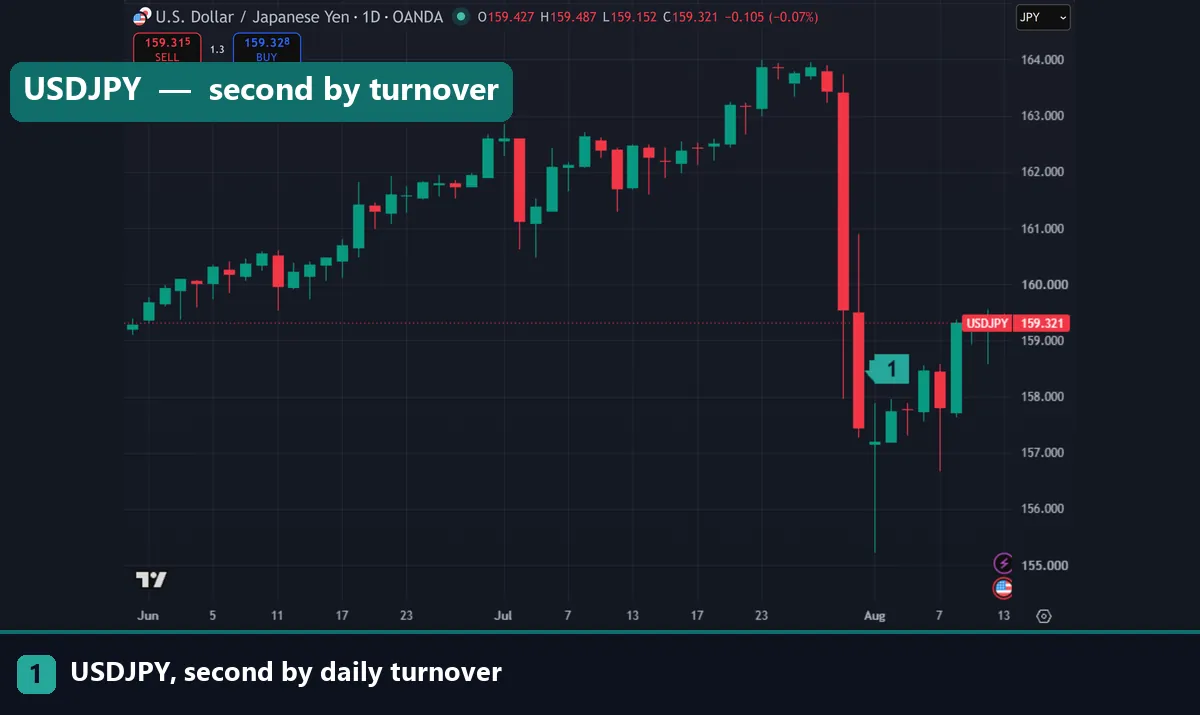
| USDJPY | Gopher | ~14% | Rate-sensitive, respects levels well |
| GBPUSD | Cable | ~10% | Wider daily range, faster moves |
| USDCNY | — | ~7% | Managed, rarely retail traded |
| AUDUSD | Aussie | ~6% | Tracks commodities and risk appetite |
| USDCAD | Loonie | ~5% | Correlated with oil |
| USDCHF | Swissy | ~4% | Safe-haven flows, often mirrors EURUSD |
One fact explains the whole table: the US dollar sits on one side of roughly 88% of all trades. That is not because the dollar is the destination, but because it is the bridge. Converting Swedish krona to Thai baht usually routes through the dollar in two legs, since that route is deeper and cheaper than a direct market.
Why EURUSD leads by so far
EURUSD joins the two largest economic blocs, and both currencies are freely floating and fully convertible. Add near-continuous participation from banks, corporates, funds and retail across every session, and the result is the deepest order book in any market anywhere.
That depth is what you actually buy when you trade it. Spreads sit tighter than anything else, slippage is smaller, and a large order moves price less. Our bid ask spread calculation guide shows what that saving is worth per trade.
Volume is not volatility
Traders confuse these two constantly, and that leads them to the wrong pair. Volume is how much trades. Volatility is how far price moves. They are related but not the same thing.
EURUSD has the highest volume and a comparatively modest daily range. GBPUSD trades less but moves further, which is why it suits traders who want more distance per setup and can handle wider stops. Our forex pair volatility guide covers the average daily ranges.
The practical rule: high volume buys you low cost and clean execution. It does not promise movement. If your method needs a 60 pip run to work, the quietest major may be the wrong home for it regardless of how well it trades.
Beyond the majors

Crosses exclude the dollar. EURGBP, EURJPY and GBPJPY are the busiest. They cost more to trade, since the broker is effectively pricing two dollar legs, and they can move sharply because the underlying liquidity is thinner. GBPJPY is the standing example of a pair that moves a long way and punishes a stop placed as if it were EURUSD.
Exotics pair a major with a smaller-economy currency: USDTRY, USDZAR, USDMXN. Spreads run many times wider, gaps are common, and political news moves them hard. They are not a beginner’s instrument whatever the volatility looks like.
Metals sit outside the classification. XAUUSD trades like a major by volume, yet it quotes in dollars and cents rather than pips. Its contract size catches out anyone applying forex sizing habits.
Download the complete indicator database
Put these concepts on your charts. One email unlocks the full library of 1,380+ indicators with compiled MT4 and MT5 files, plus my TradingView scripts. No paywall, no spam, unsubscribe any time.
Get free access to my indicator database
One email unlocks 1,380+ free MT4, MT5 and TradingView indicators — the complete library. No single-tool download; you get the whole database.
Correlation between the busiest pairs

Because the dollar is on one side of most majors, the majors are not independent. EURUSD and USDCHF move close to inversely most of the time. EURUSD and GBPUSD often move together, since both are the dollar against a European currency.
That matters for risk. Long EURUSD and long GBPUSD at 1% each is not two 1% positions; it is closer to a single 2% bet on the dollar weakening. Traders discover this during a dollar move when several trades lose at once.
Two habits handle it. Count correlated positions as one when sizing, and check what the dollar is doing before adding a second trade in the same direction. AUDUSD adds a further layer, since it responds to commodity demand and general risk appetite on top of the dollar leg.
Which pairs suit which trader

Beginners belong on EURUSD. Tight spreads forgive mistakes, the pair behaves orderly around levels, and every guide and screenshot you read will use it, so there is nothing to translate.
Scalpers need cost above all, which again means EURUSD and USDJPY during the London and New York overlap. On a 6 pip target the spread decides the outcome, not the setup.
Day traders can add GBPUSD for range, accepting wider stops in exchange for more distance.
Swing traders have the most freedom, since holding for days makes the spread almost irrelevant. Crosses and even some exotics become viable when cost is spread across a large move.
Whatever the choice, size from the stop rather than the pair. Our position sizing calculator handles the conversion, and how to use ATR as a stop loss adapts the distance to each pair’s own volatility.
Common mistakes
Four repeat. Chasing exotics for their volatility tops the list, and the spread usually eats the extra movement. Treating volume as a promise of movement comes second. Third, traders hold several correlated majors and believe they are diversified when they hold one dollar position in disguise. Fourth, they apply EURUSD stop distances to GBPJPY or gold, which are different animals entirely.
Where to go next
Pair selection sits alongside the rest of your plan. Start with forex trading for beginners if the terms are new, then read forex pair volatility for how far each one travels and when the forex market opens for the hours each is liveliest. Complete rule sets live in our forex currency trading strategies. For further reading, the BIS triennial survey at the Bank for International Settlements publishes the turnover figures, and the currency pair article on Wikipedia covers the naming conventions.
FAQ
What are the most traded forex pairs?
EURUSD leads with roughly 22% of turnover, followed by USDJPY near 14% and GBPUSD near 10%. AUDUSD, USDCAD and USDCHF complete the majors, and the dollar sits on one side of about 88% of all trades.
Why is EURUSD the most traded pair?
It joins the two largest economic blocs, both currencies float freely, and participation runs across every session. That depth produces the tightest spreads and the smallest slippage available anywhere in the market.
Are the most traded pairs the most volatile?
No. Volume and volatility are different. EURUSD trades most but moves a moderate distance, while GBPUSD trades less and ranges further, which is why it suits methods needing more room per trade.
What is the difference between a major and a cross?
A major has the US dollar on one side. A cross does not, so EURGBP and GBPJPY are crosses. Crosses generally cost more to trade because the broker is pricing two dollar legs behind the quote.
Which pair should a beginner trade?
EURUSD. The spread is the tightest available, the pair behaves in an orderly way around levels, and nearly all educational material uses it, so nothing needs translating as you learn.
Does trading a major pair make trading safer?
It lowers cost and improves execution, nothing more. Risk comes from position size and stop distance. Trading involves risk, results are not guaranteed, and past performance is not indicative of future results.

About the author
Written by Dominic Walsh, a Forex trader and MT4/MT5 indicator, Expert Advisor and script developer. Every tool on forexmt4systems.com is tested on live charts before release and ships with ready-to-use compiled MT4 (.ex4) and MT5 (.ex5) files. Learn more about the trader and developer behind this site.
How we build, test and correct every tool: Editorial & Testing Policy. Trading carries risk; see the disclaimer.