
A forex time zone converter answers one practical question: what time do the sessions open where you actually live? The market runs 24 hours across four centres. Every schedule online uses a different zone, and two centres shift by an hour twice a year on different dates. This guide gives you the conversion table, the daylight-saving trap that catches everyone, and the two hours that matter more than the rest.
Why a forex time zone converter is needed at all
There is no single exchange with an opening bell. Trading passes between financial centres as each business day begins, so the market opens Sunday evening in Sydney and closes Friday evening in New York.
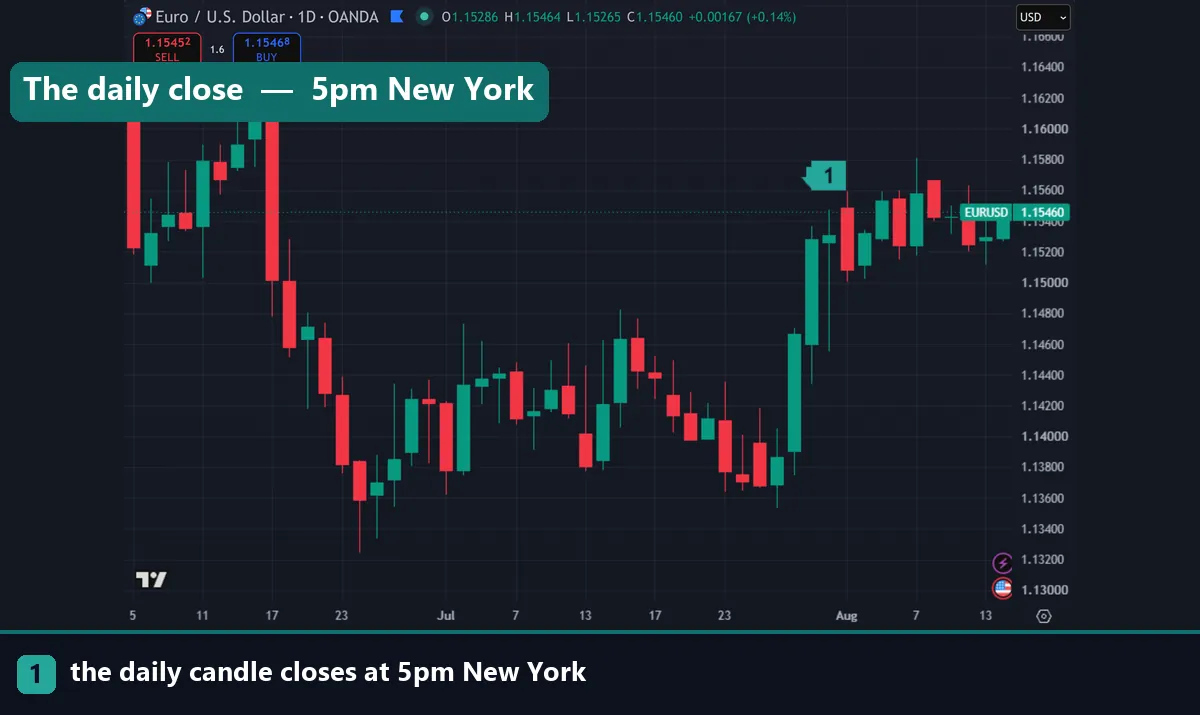
The problem is that every source quotes different clocks. Broker platforms often run on their own server time, usually somewhere in Europe. Economic calendars default to the zone of whoever built them. Session charts you find online tend to use GMT, while most trading commentary uses New York time because that is where the daily candle closes.
So a schedule that says “London opens at 08:00” is useless until you know which 08:00 it means, and whether that source adjusts for summer time.
The four sessions in one table
| Session | Opens (UTC, winter) | Closes (UTC, winter) | Character |
|---|---|---|---|
| Sydney | 21:00 | 06:00 | Thin; AUD and NZD lead |
| Tokyo | 00:00 | 09:00 | Yen pairs active, ranges usually tight |
| London | 08:00 | 17:00 | Highest volume of the day |
| New York | 13:00 | 22:00 | US data lands, dollar pairs move |
Read those as approximate rather than exact. Liquidity builds and fades either side of the stated hour, and the boundaries are conventions rather than switches.
To convert to your own clock, take the UTC figure and add your offset. Central European Time is UTC+1 in winter, so London opens at 09:00 for a trader in Berlin. Eastern Time is UTC−5 in winter, so the same open is 03:00 in New York.
The overlap that matters
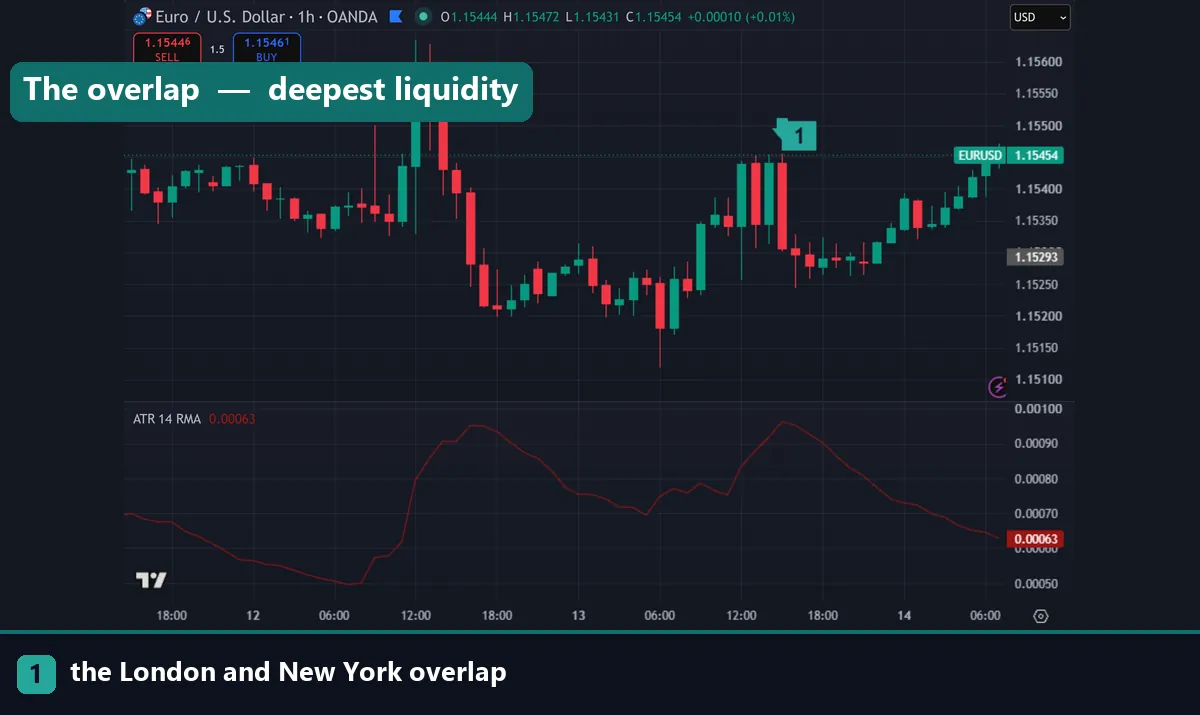
One window carries a disproportionate share of the day’s movement: the hours when London and New York are both open, roughly 13:00 to 17:00 UTC in winter.
Two of the largest centres trade at once. Order books are deepest, spreads are tightest, and the biggest releases land inside it. If you can only trade a few hours a day, these are the ones worth choosing.
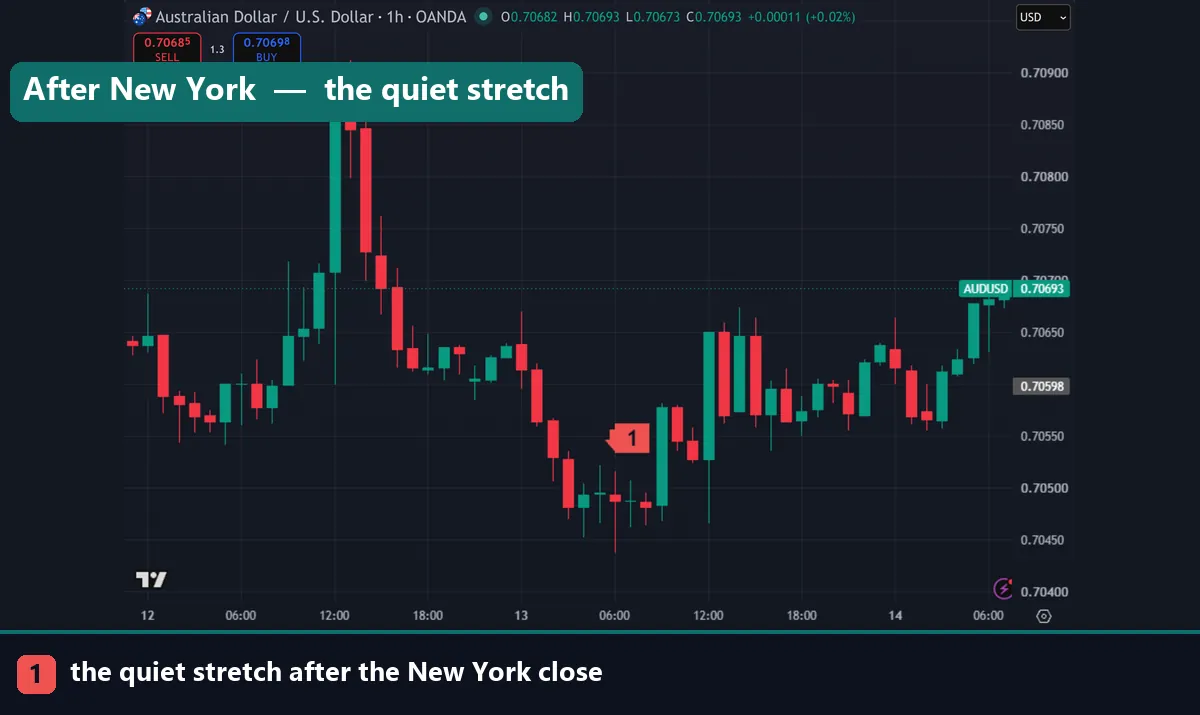
The mirror image is the stretch after the New York close and before Tokyo gets going. Spreads widen, ranges compress, and moves that look like breakouts often reverse when real volume returns. Our guide to bid ask spread calculation covers what that costs you.
The daylight saving trap
This is where most schedules go wrong, and it catches experienced traders every year.
The centres do not change clocks together. The United States switches on the second Sunday in March and the first Sunday in November. The United Kingdom and Europe switch on the last Sunday in March and the last Sunday in October. Japan does not observe daylight saving at all, and Australia moves in the opposite direction because it is in the southern hemisphere.
The consequence is a few weeks each spring and autumn when the usual gap between London and New York is an hour different from normal. In late March the London-New York overlap shifts, and in late October it shifts back. During those windows a session clock built on fixed offsets is simply wrong.
Two habits handle it. Work in UTC, which never changes, and convert once. And re-check your session markers on the calendar dates above rather than assuming they still line up.
Setting your platform clock straight
MetaTrader shows server time, not your time, and you cannot change it. Most brokers run servers on GMT+2 or GMT+3, which means the daily candle closes at 00:00 server time rather than at the New York close.
That matters more than it sounds. A broker’s server clock builds a different daily candle than the New York close does. So pivot levels, daily highs and lows, and any daily-bar strategy will not match a chart drawn elsewhere. Two traders can look at the same pair and see different daily candles.
Work out your broker’s offset once, write it down, and apply it whenever you read a schedule. If precision matters to your method, choose a broker whose server closes the daily candle at 17:00 New York, which is the convention most analysis assumes.
Download the complete indicator database
Put these concepts on your charts. One email unlocks the full library of 1,380+ indicators with compiled MT4 and MT5 files, plus my TradingView scripts. No paywall, no spam, unsubscribe any time.
Get free access to my indicator database
One email unlocks 1,380+ free MT4, MT5 and TradingView indicators — the complete library. No single-tool download; you get the whole database.
When each pair actually moves
Session times matter because pairs behave differently depending on which centres are awake.
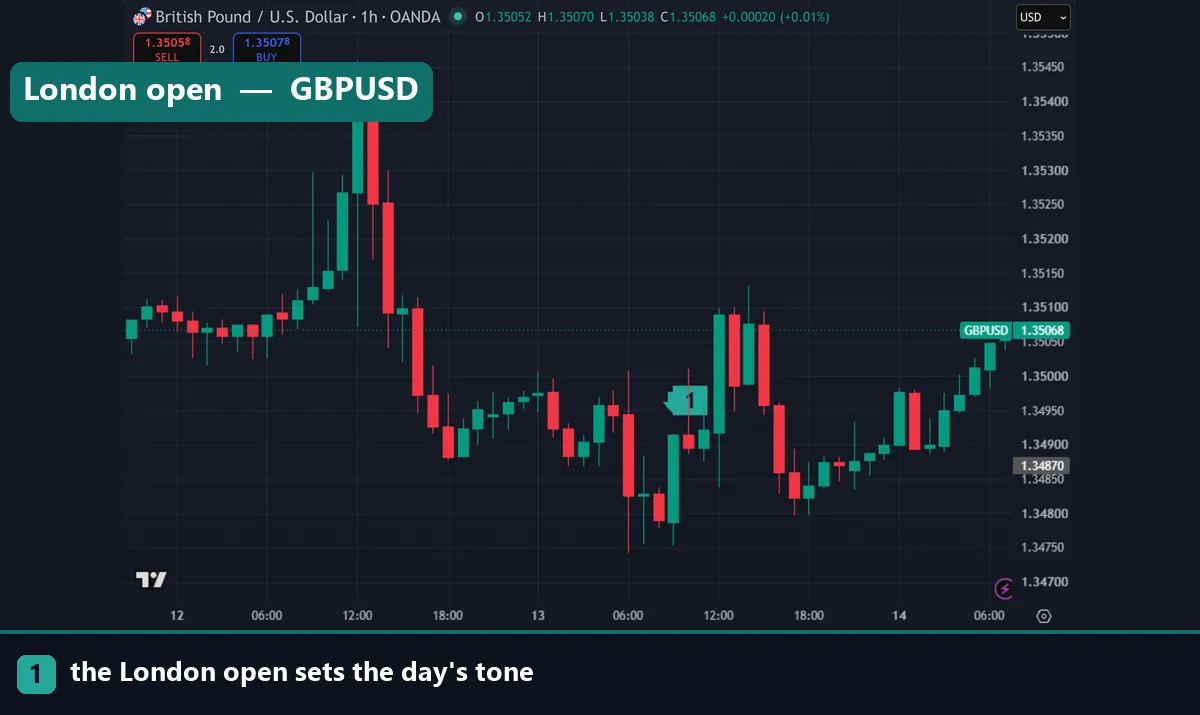
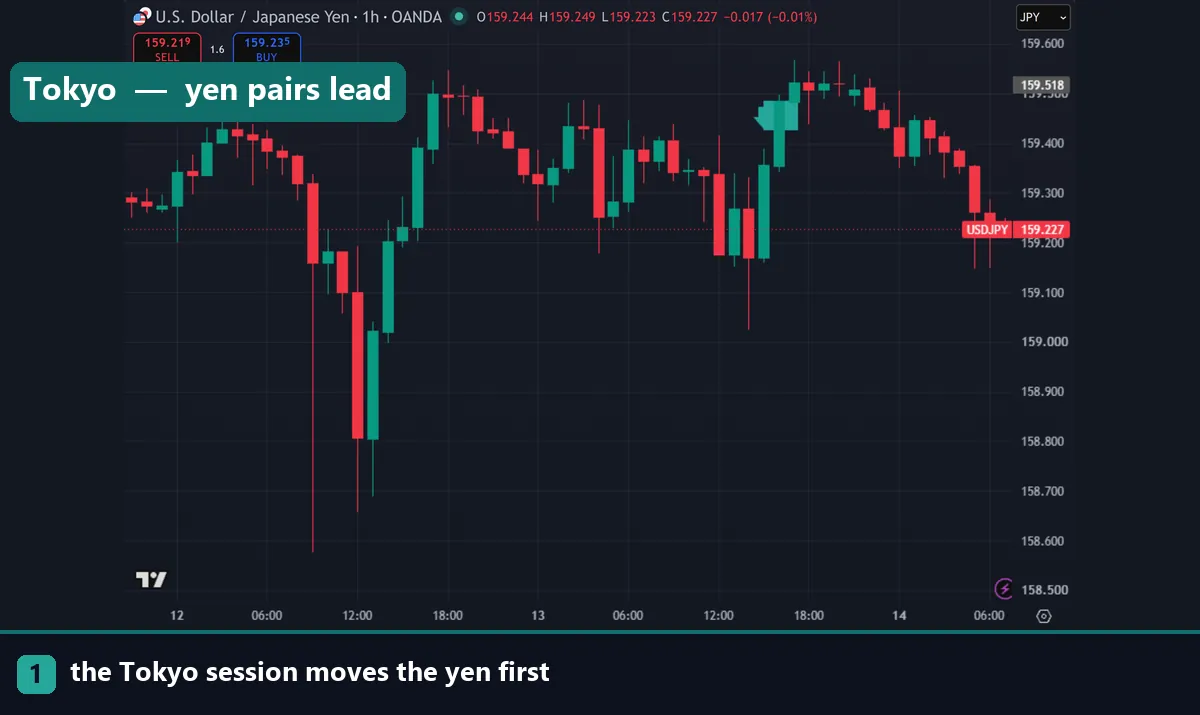
Yen pairs are most active during Tokyo, when Japanese institutions are trading. EUR and GBP pairs come alive at the London open and stay busy through the overlap. Dollar pairs react to US data in the New York morning. AUD and NZD move during Sydney and Tokyo, and often drift once Europe takes over.
The practical use is matching your available hours to a pair that moves in them. Trading EURUSD during the Asian session usually means sitting through a tight range and paying a wider spread for the privilege. Our notes on volatile forex pairs and the most traded pairs cover which instruments suit which window.
Building your own converter
You do not need a tool. Three steps cover it permanently.
First, find your own UTC offset and whether your region observes daylight saving. Second, write the four session opens in UTC on a note and add your offset to each. Third, mark the two overlap hours, since those are the ones you will plan around.
Then check it twice a year on the switch dates. Session-clock indicators need the same check. Most use fixed offsets and drift out by an hour until you correct them.
Common mistakes
Four repeat. Assuming broker server time is your time tops the list, and it puts every daily level in the wrong place. Ignoring the daylight-saving mismatch comes second, which breaks session markers for several weeks a year. Third, traders use a schedule without checking which zone it was written in. Fourth, they trade a pair outside its active session and blame their strategy for the flat result.
Where to go next
Session timing sits alongside the rest of your planning. Read when the forex market opens for the weekly cycle, and ICT times for the intraday windows some traders build around. To match instrument to session, see forex pair volatility, and the forex news factory calendar for release timing. For further reading, the Coordinated Universal Time article on Wikipedia explains the reference standard, and Investopedia covers forex trading hours at Investopedia.
FAQ
What does a forex time zone converter do?
It translates session opening hours into your local clock. Sessions are quoted in UTC, GMT or New York time. Add your own offset to see when London or Tokyo opens where you are.
Which session times matter most?
The London and New York overlap, roughly 13:00 to 17:00 UTC in winter. Two major centres trade at once, so liquidity is deepest, spreads are tightest, and most large scheduled releases land in that window.
Why does my broker show a different time?
MetaTrader displays server time, commonly GMT+2 or GMT+3, and it cannot be changed. That shifts where the daily candle closes, so your daily bars may not match charts drawn on the New York close.
How does daylight saving affect session times?
The centres switch on different dates. The US changes in March and November, the UK and Europe in late March and late October, and Japan not at all. For a few weeks each year the usual gaps are an hour out.
What time does the trading week start and end?
It opens Sunday evening with Sydney, around 21:00 UTC in winter, and closes Friday at the New York close, around 22:00 UTC. Liquidity is thin at both ends, so spreads are wider.
Should I only trade during the overlap?
It suits most short-term methods because costs are lowest there, though swing traders holding for days care far less. Trading involves risk, results are not guaranteed, and past performance is not indicative of future results.

About the author
Written by Dominic Walsh, a Forex trader and MT4/MT5 indicator, Expert Advisor and script developer. Every tool on forexmt4systems.com is tested on live charts before release and ships with ready-to-use compiled MT4 (.ex4) and MT5 (.ex5) files. Learn more about the trader and developer behind this site.
How we build, test and correct every tool: Editorial & Testing Policy. Trading carries risk; see the disclaimer.