
Both styles finish the day flat. The real split in scalping vs day trading comes down to trade frequency and hold time, and that one difference decides how much of every move your costs take.
This guide keeps the comparison concrete. It runs the arithmetic in pips, shows one EURUSD window at two speeds, and makes no claim about which style pays better.
Scalping vs Day Trading in One Look
Scalping means many small trades held for seconds or minutes. Day trading means a few larger trades held for an hour or several.
Both close before the session ends, so neither pays swap or carries a weekend gap. Frequency and hold time do all the separating.
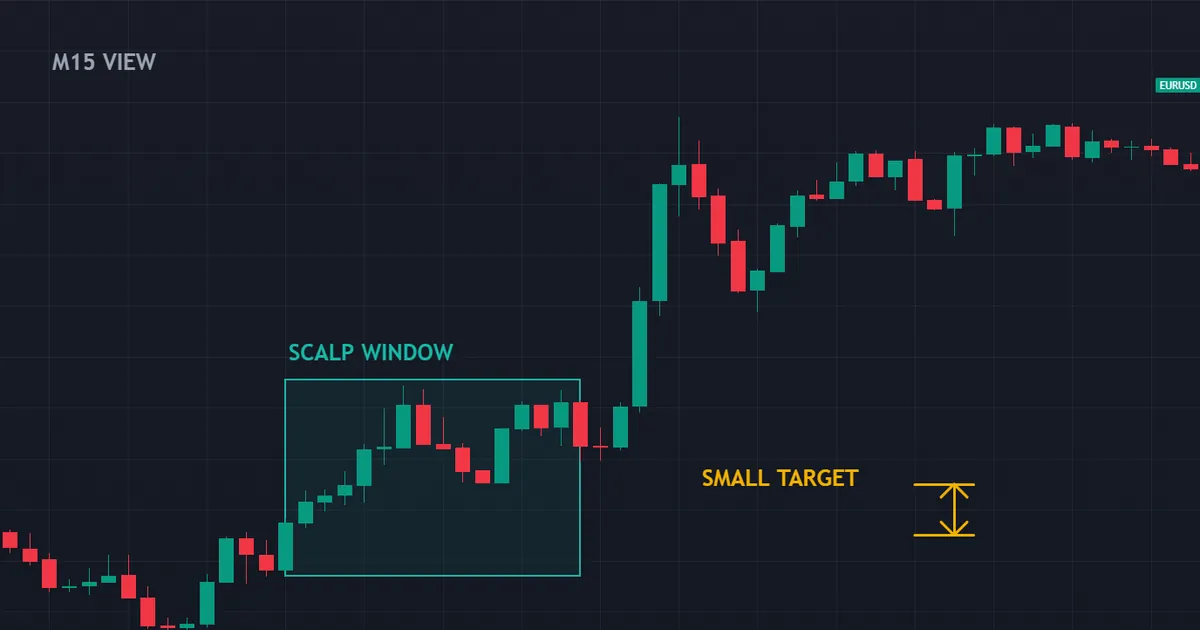
Above sits EURUSD on fifteen-minute bars. Each candle covers a quarter of an hour, and a trader working at this speed may aim at a move only a handful of pips wide.
Hold Time Sets the Rest
Pick a hold time and everything else follows. A two-minute hold forces a small target, a tight stop and a high trade count.
An eight-hour hold allows a wide target and a wide stop. So one decision quietly fixes your cost burden, your screen time and your daily trade count together.
Neither Style Wins
Frequency changes the shape of the job, not the quality of the idea. A sound entry rule stays sound whether you apply it twice a day or thirty times.
What changes is the friction sitting between the idea and the result. That friction forms the whole subject of this article.
How Each Style Is Built
Strip both down and the same five decisions appear. Only the numbers you drop into them differ.
- Hold time. Seconds to minutes for a scalp, an hour to a full session for a day trade.
- Target size. A few pips against tens of pips, which sets everything downstream.
- Trade count. Ten to forty attempts a day against one to five.
- Cost per trade. Spread, commission and slippage, and it barely shifts between the two.
- Screen time. Constant attention against scheduled checks at bar closes.
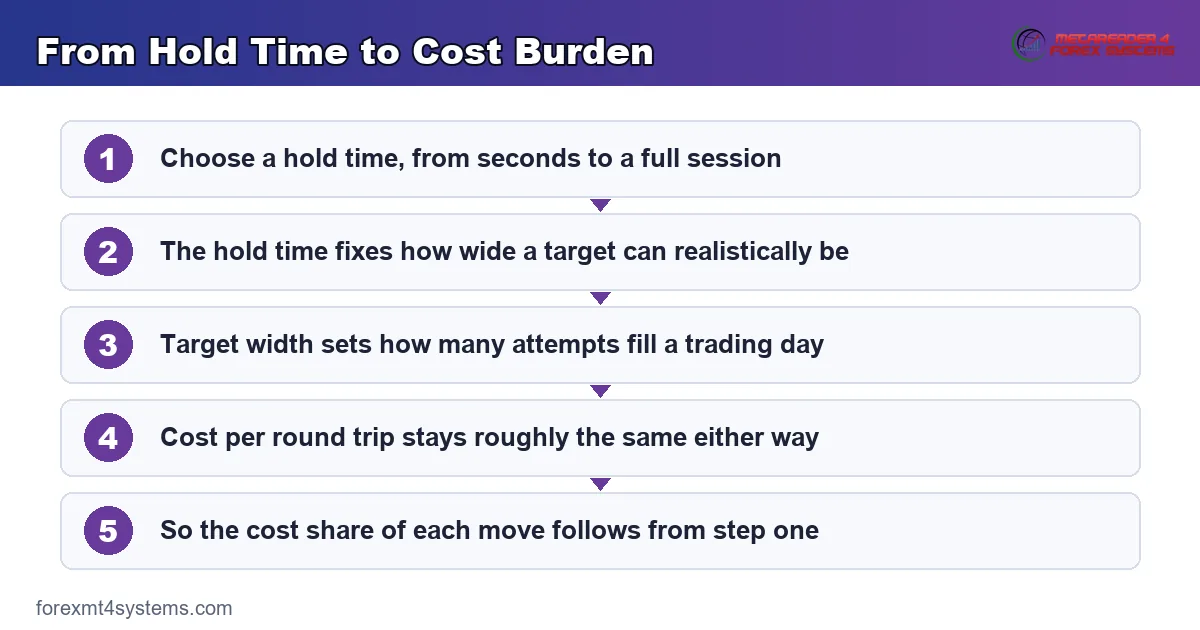
Notice the fourth item. Cost per trade stays roughly fixed while target size swings by a factor of ten, and that mismatch drives everything below.
What the Two Styles Share
Differences get all the attention. Yet the overlap explains why traders move between the two so easily.
No Overnight Exposure
Neither style holds through the close, which removes swap charges and weekend gap risk in one stroke. You start each day from a known position, namely none.
That shared trait puts both in the same family. It also separates them from swing and position trading, where a trade lives through news you never see arrive.
The Same Analysis Underneath
Support, resistance, trend and session timing apply at every speed. A level that matters on the hourly chart still matters on the five-minute chart, only with more noise around it.
So switching styles rarely means learning new analysis. It means rebuilding the arithmetic around a different target size, which traders forget far more often.
The Cost Arithmetic, Made Explicit
Here sits the part most comparisons skip. Your cost per round trip barely cares how long you hold.
Fixed Cost, Moving Target
Say a round trip on EURUSD costs you 1.2 pips once spread and commission land. That figure stays put whether you hold for ninety seconds or nine hours.
Now aim at a five-pip target. The cost takes 24 percent of the gross move before anything else happens.
Aim at forty-five pips instead. The same 1.2 pips takes under three percent, so more than nine tenths of the move reaches your account.
Same Edge, Different Outcome
Picture a rule that captures, on average, one tenth of its target as gross edge. On the forty-five pip target that leaves 4.5 pips gross and roughly 3.3 pips net.
Run the identical tenth on a five-pip target and you hold 0.5 pips gross against 1.2 pips of cost. The same rule now bleeds purely on friction.
Nothing about the entry changed. Only the size of the move behind it changed, and the arithmetic did the rest.
Slippage Belongs in the Sum
Spread and commission appear on the ticket. Slippage does not, yet it lands on every order that fills at a worse price than the screen showed.
Half a pip of slip sounds trivial. Against a five-pip target it removes a tenth of the move, while against a forty-five pip target it costs barely one percent.
Add that half pip to the earlier sum. The scalper’s cost climbs to 1.7 pips, or 34 percent of a five-pip target, and the day trader now pays under four percent.
Trade Count Multiplies It
Costs also stack with frequency. Thirty scalps a day at 1.2 pips each burns 36 pips of cost before you judge a single trade.
Three day trades at the same 1.2 pips burn 3.6 pips. Over a twenty-day month that gap runs to roughly 650 pips of pure friction.
Our breakdown of forex trading costs walks through each component. Then compare pricing across venues with the forex spread comparison tool before you settle on a style.
One Market Shown at Two Speeds
The chart below shows the same EURUSD window as the first one, redrawn on hourly bars. Nothing about the market changed; only the resolution did.
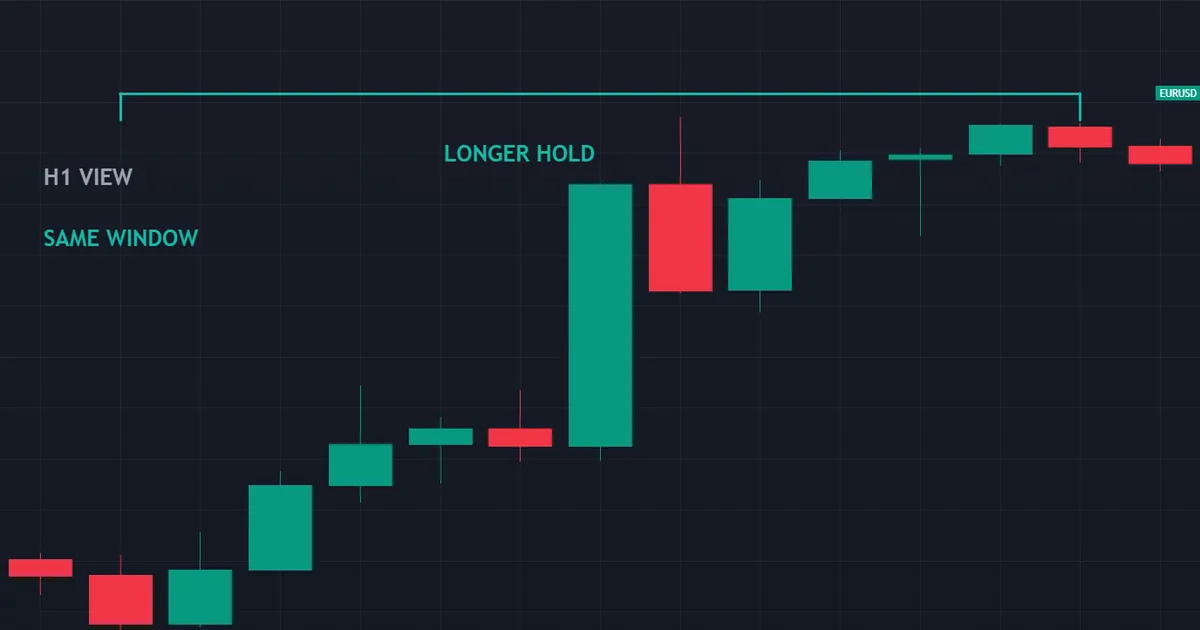
Four fifteen-minute candles collapse into one hourly candle. Swings that looked tradeable at the faster speed shrink into a single wick here.
What the Faster Chart Offers
More bars mean more decision points. A fifteen-minute chart hands you four times as many closes, four times as many pullbacks and four times as many chances to act.
That abundance feels like opportunity. In practice it also multiplies the number of times you pay to find out you were wrong.
What the Hourly Chart Offers
Fewer bars mean fewer decisions and longer moves between them. The hourly view of this same window shows one direction where the faster chart showed several.
Neither picture lies. Both describe identical trading, so the difference lives entirely in what each resolution chooses to show you.
Why the Shared Window Matters
Comparisons usually cheat by picking a choppy chart for one style and a trending chart for the other. Using one window removes that trick.
The market gave both traders the same raw material. Their results diverge because of hold time, trade count and cost, never because they faced different conditions.
Instruments and Hours
Style dictates where you trade as much as when. A market that suits one speed can prove hopeless at the other.
Spread Decides the Shortlist
Small targets need tight, stable pricing, which narrows a scalper to the most liquid majors. Exotic pairs with wide quotes remove the target before the trade even opens.
Day traders tolerate a wider spread, since the same cost sits against a much larger move. That freedom opens crosses and metals a scalper should probably leave alone.
Liquidity Decides the Clock
Pricing tightens when several sessions overlap and loosens when they do not. The overlap between London and New York carries the deepest flow of the day for most major pairs.
Scalping outside those hours means paying more for less movement. Day trading survives quieter stretches, because a larger target absorbs the extra cost.
Volatility Cuts Both Ways
A busy market gives a scalper the movement needed to reach a small target quickly. It also widens quotes and worsens fills exactly when everybody wants to trade.
Judge conditions before the session rather than during it. A quick look at the day’s likely range tells you whether either style has room to work.
Stops, Size and the Same Account
Risk works identically at both speeds, though the numbers look nothing alike. One fraction of the account still stands behind every trade.
Stop Distance Drives Lot Size
Fix the money at risk first, then let the stop distance decide the lots. A four-pip stop supports a far larger position than a forty-pip stop for the same exposure.
Scalpers therefore trade bigger size by design, not by bravado. That larger size explains why a single slipped fill hurts more at the fast end.
Frequency Changes the Daily Range
Risking a fixed fraction per trade produces very different daily swings. Thirty attempts at that fraction can move an account further in one day than three attempts move it in a week.
So a scalper needs a daily stop as well as a per-trade limit. Without one, a bad morning compounds into an afternoon nobody planned.
The Recovery Trap
Both styles tempt traders to raise size after a loss. The scalper feels that pull faster, because the next chance arrives within minutes rather than hours.
Write the size rule down and leave it fixed for the session. Our note on risk per trade explains why a fixed fraction limits the damage when discipline slips.
Screen Time and Decision Load
Cost arrives in hours as well as pips. This part rarely appears in a comparison table, yet it decides who lasts.
Attention as an Input
Scalping demands unbroken focus for the whole window you trade. Step away for four minutes and a position may travel through both your target and your stop.
Day trading tolerates a checked phone and a coffee break. You still watch, though the tempo lets you think between decisions rather than during them.
Decisions per Hour
Count the decisions rather than the trades. A scalper may reject forty setups for every one taken, and each rejection still costs attention.
Day trading spreads a similar number of judgements across a much longer window. That spacing explains why many traders drift towards it over time.
Fatigue Shows Up as Extra Trades
Tired traders do not stop trading. Instead they loosen the filter, take marginal setups and add trades that no rule ever approved.
Because the scalper already trades often, that drift hides easily inside a busy day. Nobody notices five extra attempts among thirty.
Download the complete indicator database
Put these concepts on your charts. One email unlocks the full library of 1,380+ indicators with compiled MT4 and MT5 files, plus my TradingView scripts. No paywall, no spam, unsubscribe any time.
Get free access to my indicator database
One email unlocks 1,380+ free MT4, MT5 and TradingView indicators — the complete library. No single-tool download; you get the whole database.
Common Mistakes and Their Fixes
Six habits cause most of the trouble on either side. Each one has a plain fix.
Scalping to Repair a Loss
A day trade goes wrong, so the trader drops to a one-minute chart to earn it back. Now the cost ratio has flipped against them at the worst possible moment.
The fix: write your working timeframe into the plan and treat a change of timeframe as a change of strategy, never as a repair.
Ignoring the Cost Ratio
Traders compare targets to stops and forget to compare targets to spread. A five-pip objective against a two-pip spread starts 40 percent behind.
The fix: divide your typical target by your typical round-trip cost. Under ten to one deserves real scepticism, whichever style you picked.
Using a Day-Trade Stop on a Scalp
A thirty-pip stop behind a five-pip target turns one bad trade into six good ones undone. Frequency then makes the arithmetic brutal.
The fix: take the stop from the structure you actually traded, then work the lot size from that distance rather than from habit.
Judging a Style in a Week
Twenty scalps arrive in a day, so a week feels like evidence. It is not, because a short run of either style tells you almost nothing.
The fix: commit to a fixed number of trades before you review, and record every one as it happens rather than afterwards.
Trading the Wrong Hours
Spreads widen when liquidity thins, which punishes small targets hardest. A scalper working a quiet stretch pays a premium for every attempt.
The fix: pick your hours from the liquidity, then let the style fit the hours instead of forcing hours to fit the style.
Copying a Rule Across Timeframes
A rule that looked solid on hourly bars rarely survives on one-minute bars unchanged. The signal may repeat, yet the cost ratio behind it collapses.
The fix: retest the rule at the speed you plan to trade it, with realistic spread and slippage included, before you trust a single result.
Quick Reference
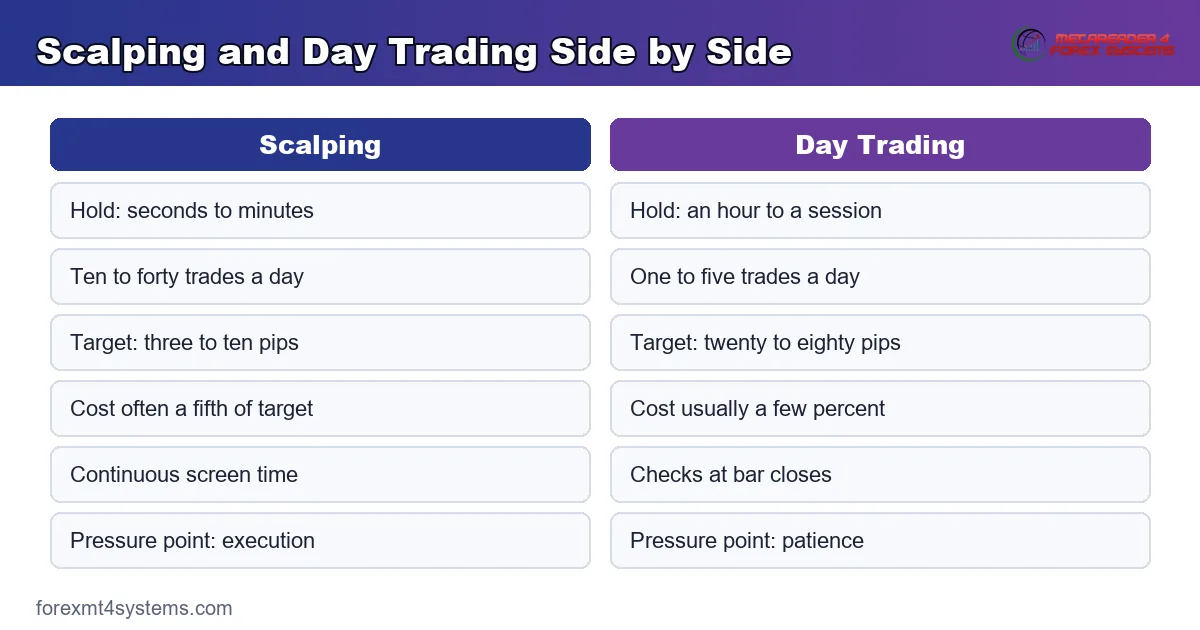
Keep this table beside you while you decide. It collects the practical differences in one place.
| Dimension | Scalping | Day trading |
|---|---|---|
| Typical hold | Seconds to a few minutes | One hour to a full session |
| Trades per day | Ten to forty | One to five |
| Typical target | Three to ten pips | Twenty to eighty pips |
| Cost share of target | Often a fifth or more | Usually a few percent |
| Screen time | Continuous while trading | Checks at bar closes |
| Main pressure point | Execution quality and spread | Patience during the hold |
Cost per Unit of Edge
One number settles the comparison better than any other. Divide what a style costs you by the size of the move it aims at.
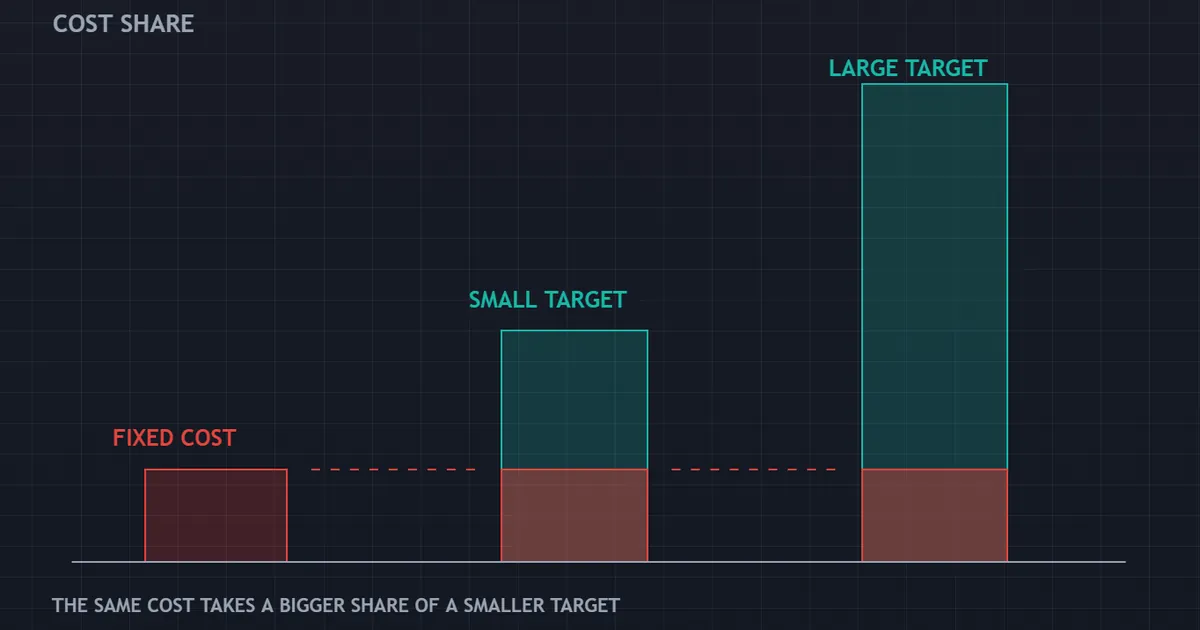
The panel above shows that ratio as a concept rather than a market. A fixed cost block that swallows part of a small target shows the friction problem before any trade happens.
Why the Ratio Beats a Pip Count
Raw cost per trade looks small on any platform. Set against a five-pip objective, though, the same figure turns into a fifth of the move.
So the useful question never asks whether a spread looks tight. It asks what share of your target that spread consumes.
Running the Numbers Once
Take two traders with identical analysis and a 1.2 pip round trip. One aims at five pips thirty times a day, the other at forty-five pips three times a day.
The first trader reaches for 150 pips of gross movement across the day and pays 36 pips for the attempt. The second reaches for 135 pips and pays 3.6.
Both chase a similar amount of market movement. One hands over roughly a quarter of it before any analysis even begins.
Where Execution Enters
Slippage widens the gap further, and it lands hardest where targets run small. A half-pip of slip barely dents a sixty-pip trade, yet it removes a tenth of a five-pip one.
Because of that, one platform can serve a day trader well and frustrate a scalper. Our guide on the spread in forex covers how quoted pricing shifts through the day.
What the Ratio Does Not Say
A friendly ratio does not create an edge. It only tells you that friction will not swallow one if you happen to have it.
Plenty of low-cost strategies still lose. The ratio simply removes an obstacle that no amount of chart reading can overcome.
How Each Style Feels Over a Month
Numbers describe the arithmetic. They say little about which routine you can sustain past week three.
Feedback Speed
Scalping returns results within minutes, which teaches quickly and stings quickly too. Thirty outcomes a day build a sample fast, and they build fatigue just as fast.
Day trading feeds back slowly. A week may hold ten results, so patterns take longer to appear and single losses linger in memory.
The Boredom Problem
Slow styles fail through boredom more than through analysis. Traders waiting for a setup that never arrives often invent one by lunchtime.
Fast styles fail through saturation instead. After two hours of constant decisions, the filter that rejected marginal setups at nine quietly stops working.
Matching the Failure Mode
Pick the failure mode you handle better. Someone who fidgets during quiet hours may do better with a busy style, provided the cost arithmetic still works.
Someone who rushes under pressure should slow down instead. Neither answer suits everybody, and honesty about your own pattern beats any published comparison.
Choosing Between Them
Start with your calendar rather than your chart. The hours you can genuinely watch decide more than any preference about candles.
Match the Style to the Clock
Two uninterrupted hours suit scalping inside a liquid session. A scattered day with meetings suits fewer, larger trades checked at the hourly close.
Our walkthrough of how to choose a trading style turns that into a short questionnaire. Read it before you commit months to either path.
Test Before You Commit
Run each style for a fixed block of trades and log every one. Then compare the two records on cost, on missed entries and on how you felt at the end of each day.
New scalpers should read our setup guide on how to start scalping first. Anyone drawn to the wider view can begin with intraday trading, which covers the session structure both styles sit inside.
Tools Help Either Way
Trend context matters at both speeds, since a target aimed with the larger move usually travels further. Browse our trend indicators archive for tools that mark that direction on any timeframe.
Whatever you pick, keep the measurement honest. A style you cannot execute cleanly on a busy Tuesday is not a style, it is a hobby.
FAQ
Is scalping harder than day trading?
Harder in a specific way, yes. Scalping compresses every decision into seconds and hands costs a much larger share of each move, so execution quality and platform latency matter far more. Day trading asks for patience instead, which many traders find just as difficult once a position sits open for hours.
How many trades a day does each style involve?
Scalpers commonly take between ten and forty attempts inside a session, and some take considerably more. Day traders usually work with one to five positions. Those counts vary by market and by rule set, so treat them as ranges rather than targets to hit.
Does scalping need a larger account?
Not larger in itself, though it does need enough size that a few pips of movement still matters after costs. That pressure pushes some traders towards bigger positions, which raises risk quickly. Work your position size from stop distance instead, and let the account grow or shrink from there.
Can I trade both styles at once?
You can, but keep them in separate records. Mixing a fast rule and a slow rule in one journal hides which one produced the result. It also tempts you to switch mid-trade when a position moves against you, which turns two clear plans into one muddle.
Why does the spread matter so much more for scalping?
Because the cost stays roughly fixed while the target shrinks. A 1.2 pip round trip against a forty-five pip objective costs under three percent of the move, while the same 1.2 pips against a five-pip objective costs almost a quarter of it. Multiply that by thirty trades a day and the gap becomes the dominant term in the whole month.
Which style suits someone with a full-time job?
Usually the slower one, since day trading tolerates gaps in attention that scalping does not. Even so, the honest answer depends on which hours you can watch without interruption and on how your platform fills orders during those hours. Log a fixed block of trades in each style before deciding, then judge the record rather than the feeling. Results are not guaranteed; past performance is not indicative of future results.
External references
- For background on this concept, see Scalping as a Day Trading Technique at Corporate Finance Institute.
- For broader market context, see Day Trader at BabyPips Forexpedia.

About the author
Written by Dominic Walsh, a Forex trader and MT4/MT5 indicator, Expert Advisor and script developer. Every tool on forexmt4systems.com is tested on live charts before release and ships with ready-to-use compiled MT4 (.ex4) and MT5 (.ex5) files. Learn more about the trader and developer behind this site.
How we build, test and correct every tool: Editorial & Testing Policy. Trading carries risk; see the disclaimer.