
Scalping punishes sloppy preparation faster than any other style. Learning how to start scalping is mostly about setup work done before the first trade, not about finding a clever entry signal.
This guide covers the four decisions that matter: which pair, which hours, which execution, and where the day stops. Get those right and the chart work becomes the easy part.
How to Start Scalping Without Losing to Costs
Scalping means taking many small trades and holding each for seconds or minutes. Targets run from a few pips to about ten, and everything closes before the session ends.
That small target is the whole problem. Your cost per round trip stays the same as any other trader’s, yet the move you aim at is a fraction of theirs.
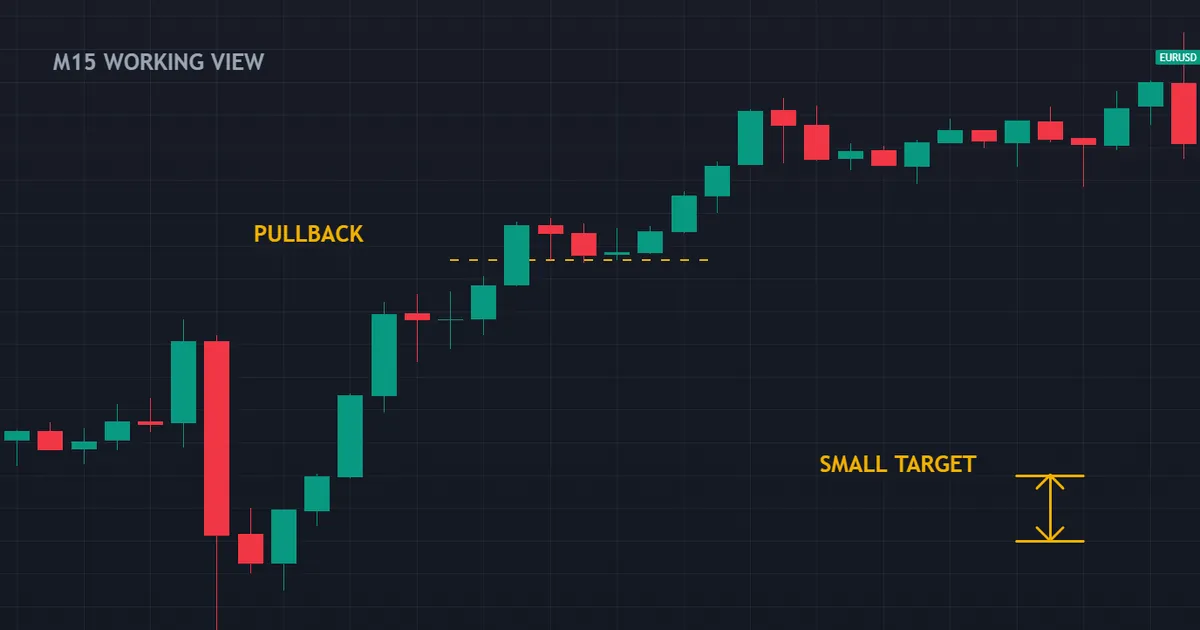
Above sits EURUSD on fifteen-minute bars, the resolution most new scalpers work from. Each candle covers a quarter of an hour, which gives enough structure to read without the noise of a one-minute chart.
Be Blunt About the Difficulty
No style suffers more from poor execution and high cost. A wide spread, a slow platform or a slipped fill removes a bigger share of a five-pip target than of a fifty-pip one.
Say that plainly before you begin. Traders who skip the cost arithmetic usually blame their entries for a problem the pricing created.
What Scalping Is Not
Scalping is not a faster route to results. It simply moves the same decisions into a shorter window and multiplies how often you pay to make them.
Nor does it suit a distracted afternoon. Our comparison of scalping vs day trading works through the arithmetic side by side if you remain undecided.
What You Need Before Day One
Preparation here is unusually practical. Four things matter, and none of them involve a signal.
A Connection You Can Trust
Fast trading rewards a stable link and punishes a flaky one. A dropped connection mid-scalp leaves a position open with nobody watching it.
Wired beats wireless wherever possible. Keep a phone app installed as a fallback, purely so you can close a trade when the desktop fails.
An Account Priced for the Job
Check the total cost per round trip rather than the headline spread. Commission, financing and any markup all belong in the same number.
Read the account terms too. Some accounts restrict very short holds, and discovering that after a strong morning wastes everybody’s time.
A Written Rule Before Any Chart
Decide your entry trigger, your stop rule and your exit rule in advance. Writing them down turns a vague intention into something you can test.
Keep the rule short enough to read in ten seconds. Anything longer will not survive a fast market, because you simply will not consult it.
The Setup, Step by Step
Work through these six steps in order. Skipping any of them puts the later ones on shaky ground.
- Pick pairs by spread. Shortlist the tightest, deepest majors and drop everything else.
- Pick hours by liquidity. Trade the session overlap, and leave the quiet stretches alone.
- Check execution quality. Measure fills, requotes and latency before you raise size.
- Fix the risk per trade. One small fraction of the account, worked from stop distance.
- Set a hard daily stop. A loss figure and a trade count that end the day automatically.
- Log every attempt. Entry, exit, spread paid and slippage, recorded as it happens.

Notice that only one step involves a chart. Five of the six concern cost, timing and discipline, which is where this style really lives.
Step One: Choose Pairs by Spread
Instrument selection does more for a scalper than any indicator. A tight, stable quote turns an unworkable target into a workable one.
Start With the Deepest Majors
The most heavily traded pairs carry the narrowest quotes for most of the day. EURUSD leads, with USDJPY and GBPUSD close behind on typical pricing.
Crosses and exotics quote wider and move less predictably in a five-minute window. Leave them to styles with targets big enough to absorb the extra cost.
Judge the Ratio, Not the Number
A tight-looking spread means nothing on its own. Divide your intended target by your typical round-trip cost and look at the answer.
Six pips against a 1.2 pip cost gives a ratio of five to one, which leaves very little room. Ten to one reads far healthier, and higher again reads better still.
Start With a Single Pair
Two pairs double the screens, the levels and the decisions for no obvious gain. One instrument builds familiarity far faster.
You learn how it behaves at each hour, where it stalls and how the quote widens. That knowledge does more for a small target than a wider watchlist ever will.
Watch How the Quote Behaves
Average spread hides the moments that hurt. Watch the same pair through a data release and through the late hours before you commit to it.
Our guide on why spreads widen explains the mechanics. Watch your own platform through those moments rather than trusting an advertised average.
Step Two: Choose Hours by Liquidity
Time of day changes both your cost and your movement. Scalping the wrong hours means paying more to chase less.
The Overlap Carries the Flow
Pricing tightens when two large sessions run together. The London and New York overlap concentrates the most participation of the day for major pairs.
Movement usually arrives with that participation. Both halves of the equation improve at once, which rarely happens elsewhere in the day.
Quiet Hours Cut Both Ways
Late sessions bring wider quotes and thinner books. A target that took eight minutes to reach at midday may take an hour, and it costs more to attempt.
Ranges can still be traded then, though the arithmetic tightens considerably. Read our overview of forex trading sessions before you pick a window.
Fix a Window and Keep It
Choose two hours you can watch without interruption, then trade only those. A fixed window builds a comparable record, since every trade faces similar conditions.
Our forex market hours tool shows the overlaps in your own time zone. Print the window and treat it as a rule rather than a suggestion.
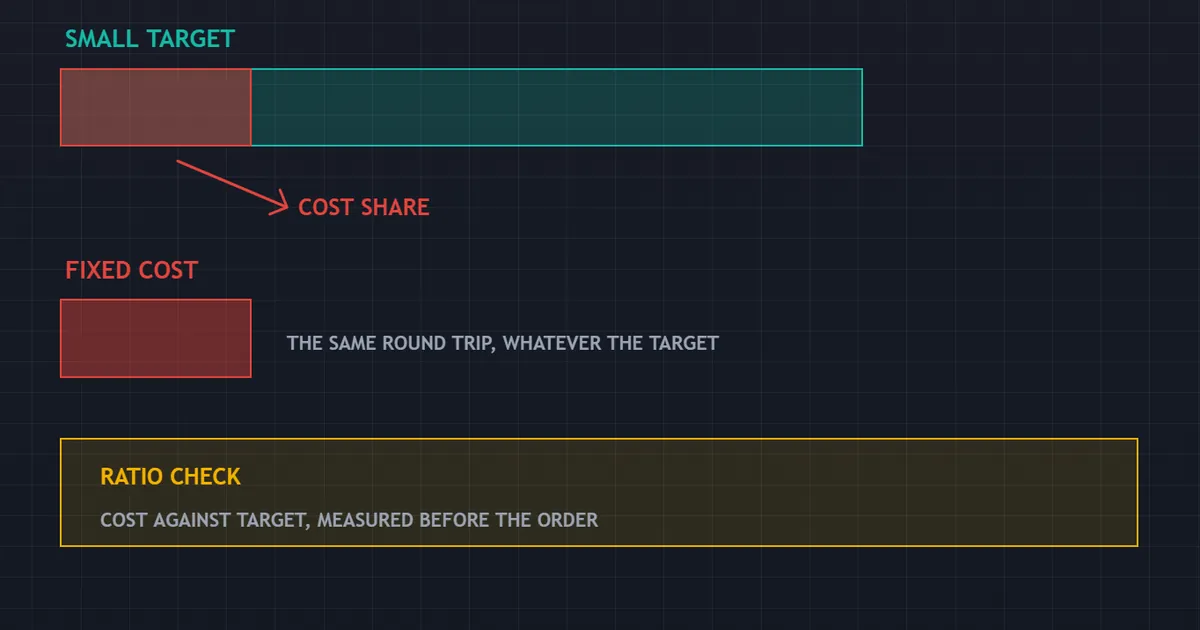
The panel above lays the cost picture out as a concept. A fixed spread bar beside a small target bar shows the share you surrender before the trade even starts.
Step Three: Check Execution Quality
Execution decides more scalping outcomes than analysis does. Test it deliberately instead of assuming it works.
What to Measure
Record three things for the first fifty trades: the price you asked for, the price you received, and how long the platform took to answer. Small differences repeat thousands of times.
Slippage of half a pip on a five-pip target removes a tenth of the move. That figure belongs in your cost sum, alongside spread and commission.
Latency Matters Here
A slow connection turns a good signal into a worse fill. Distance from the venue, a congested network and a busy computer all add delay you never see on the chart.
Test during the busy hours rather than the calm ones. Execution behaves differently exactly when everybody wants to trade at the same moment.
Requotes and Rejections
Some accounts answer a fast market with a requote instead of a fill. Others fill you anyway at a worse price, which at least keeps the trade alive.
Neither approach counts as misconduct. Both change what a small target can realistically achieve, so measure which one you face before scaling up.
Order Types Under Pressure
A market order takes whatever price the venue offers, so it fills readily while the price stays uncertain. That trade-off suits an exit far better than an entry.
A limit order fills at your price or better, and it may never fill at all. Scalpers lean on limits to control cost, then accept the missed trades that follow.
A stop order turns into a market order once touched, which means slippage applies to it. Knowing which of the three you just sent matters most when the market moves quickly.
Reading a Fast Chart
Analysis changes less than beginners expect. What changes is how little time you have to apply it.
Mark Levels Before the Session
Draw the previous day’s high and low, the round numbers nearby and the overnight range before you trade. Ten minutes of preparation removes most in-session guesswork.
Then trade only near those marks. A scalp taken in the middle of a range has nothing behind it except hope and a small target.
Direction From the Slower Chart
Check the hourly picture before working the faster one. Trading with the larger move gives a small target more room to arrive quickly.
That check takes seconds and filters plenty. Many losing scalps come from fighting a move that looked obvious one timeframe up.
Keep the Screen Simple
Three indicators arguing with each other slow you down at exactly the wrong moment. One trend reference and one measure of movement usually suffice.
Every extra tool adds a decision. At this speed the count of decisions matters more than the quality of any single one.
Step Four: Fix Risk, Then Size
Small stops let scalpers trade larger positions for the same exposure. That fact cuts both ways.
Work Backwards From the Stop
Decide the fraction of the account you accept losing, then let the stop distance produce the lot size. A four-pip stop supports a much larger position than a forty-pip stop.
Our position size calculator does that sum in seconds. Run it before every session rather than trusting yesterday’s numbers.
Bigger Size Amplifies Slippage
Larger positions turn a half-pip of slip into a meaningful loss. The same slip on a small day-trading position barely registers.
So the scalper’s size advantage carries a matching penalty. Keep the fraction small and let frequency, not size, do the work.
Never Widen a Stop Mid-Trade
A four-pip stop stretched to twelve pips destroys the arithmetic behind the entry. The trade you now hold bears no relation to the one you planned.
Set the level, then leave it alone. A fixed fraction survives a bad run far better than a flexible one, because the arithmetic behind each trade stays predictable.
Step Five: Set a Hard Daily Stop
Frequency turns a bad hour into a bad month faster than any other style. A daily limit is the brake.
Two Numbers, Written Down
Pick a loss figure that ends the session and a trade count that ends it too. Reaching either one closes the platform for the day, with no exceptions.
The trade count matters as much as the loss. Overtrading rarely announces itself, and a counter catches it before the balance does.
Why Scalpers Need It Most
Thirty attempts a day means thirty chances to break a rule. A day trader who loses twice has an afternoon to cool down, while a scalper has ninety seconds.
Our guide to the daily loss limit shows how to size that number sensibly. Set it once, then automate the check if your platform allows it.
Stopping Early Counts as a Result
Closing after three clean trades makes for a good session. Plenty of scalpers hand back a solid morning during an afternoon nobody planned.
Write a stopping rule for good days as well as bad ones. Both directions of drift cost money, and only one of them feels like a warning at the time.
Volatility Changes the Plan
A quiet range and a fast trend demand different targets. Check the day’s likely movement before you trade, and skip the session when conditions do not fit your rule.
Tools that measure movement help here. Our volatility indicators archive collects the ones that mark expanding and contracting ranges on any timeframe.
Download the complete indicator database
Put these concepts on your charts. One email unlocks the full library of 1,380+ indicators with compiled MT4 and MT5 files, plus my TradingView scripts. No paywall, no spam, unsubscribe any time.
Get free access to my indicator database
One email unlocks 1,380+ free MT4, MT5 and TradingView indicators — the complete library. No single-tool download; you get the whole database.
Your First Two Weeks
Ramping in slowly costs nothing and teaches plenty. Treat the opening fortnight as measurement rather than trading.
Week One: Smallest Size
Trade the minimum size your platform allows and take every signal your rule produces. The point is data on fills, spreads and your own attention span.
Record the numbers daily. By Friday you will know your true cost per round trip, which almost never matches the advertised figure.
Week Two: Test the Limits
Keep the size low and add the daily stop rules. See whether you actually close the platform when the counter hits its limit.
Most traders discover the rule breaks before the account does. Better to learn that at minimum size than after raising it.
Then Change One Thing
After a fortnight, adjust a single variable and run another block of trades. Size, session or pair, never two together.
Slow iteration feels frustrating and works anyway. Changing three inputs at once leaves you with a different result and no idea which change caused it.
Common Mistakes and Their Fixes
Six habits sink most new scalpers. Each one has a direct fix.
Trading Before Measuring Costs
Traders often start scalping on an account they picked for other reasons. The pricing then decides the outcome long before any entry rule does.
The fix: log spread and slippage for fifty trades at small size, then judge whether your target survives the total.
Dropping to the One-Minute Chart
Faster charts feel more responsive, and they hand you four times as many marginal setups. Costs stay fixed while targets shrink further.
The fix: start at fifteen minutes, prove the rule there, and move down only if the cost ratio still reads sensibly.
Chasing a Missed Entry
A scalp missed by two pips tempts an immediate chase. Entering late shrinks the target while leaving the stop where it was.
The fix: treat a missed entry as a completed trade with no outcome, then wait for the next signal without adjusting anything.
Trading Through a Release
Spreads widen sharply around scheduled data and fills degrade with them. A five-pip target has no room in those conditions.
The fix: mark the releases that affect your pairs and stand aside for the minutes around each one.
Skipping the Log
Fast trading produces too many results to remember accurately. Memory keeps the dramatic ones and quietly drops the rest.
The fix: record every attempt as it happens, including the ones you cancelled, using our free trade journal.
Raising Size Too Early
A calm first week tempts an immediate increase. Larger positions then turn the same half-pip of slippage into a much bigger loss.
The fix: hold size flat for a full block of logged trades, then raise it in small steps once the record justifies the change.
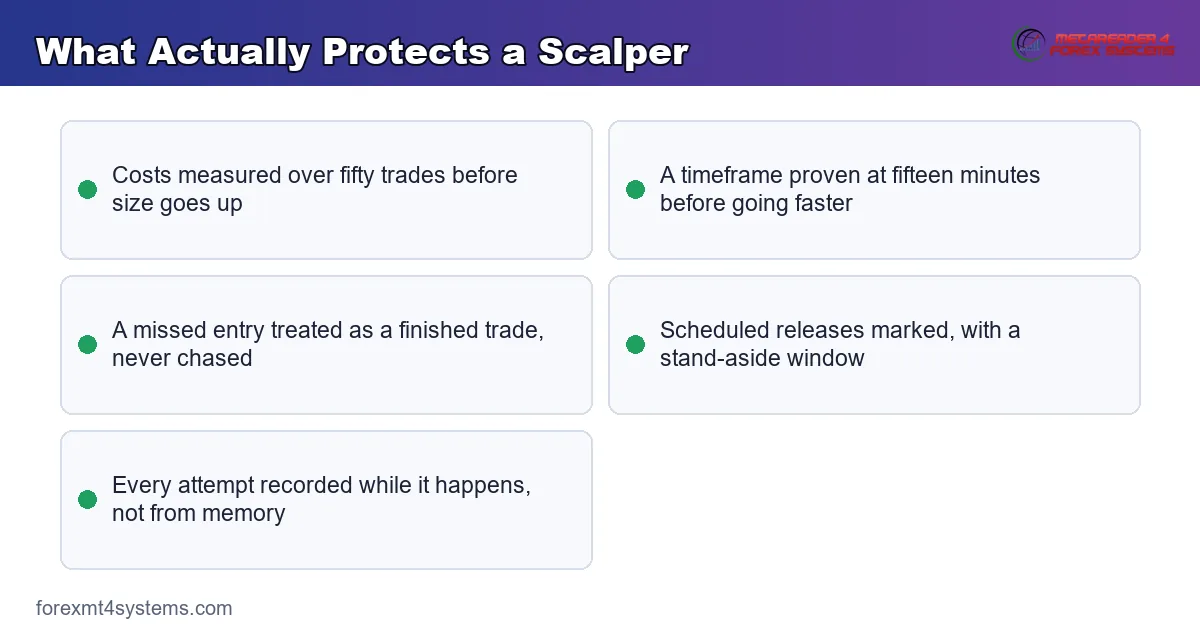
Quick Reference Checklist
Run this list before the session opens. It takes two minutes and prevents most avoidable damage.
- Pair shortlist confirmed — only the tightest majors, checked against today’s quote.
- Window set — the overlap hours you can watch without interruption.
- Cost ratio checked — target divided by round-trip cost, ideally ten to one or better.
- Risk fraction fixed — one number, applied through the position size calculator.
- Daily limits written — a loss figure and a trade count that both end the day.
- Releases marked — scheduled data noted, with a stand-aside window around each.
- Platform tested — a small trade placed early to confirm fills behave normally.
- Journal open — ready to record before the first entry, not after the last.
Picking Your Session
Session choice decides your cost and your movement together. Treat it as a setup decision rather than a scheduling one.
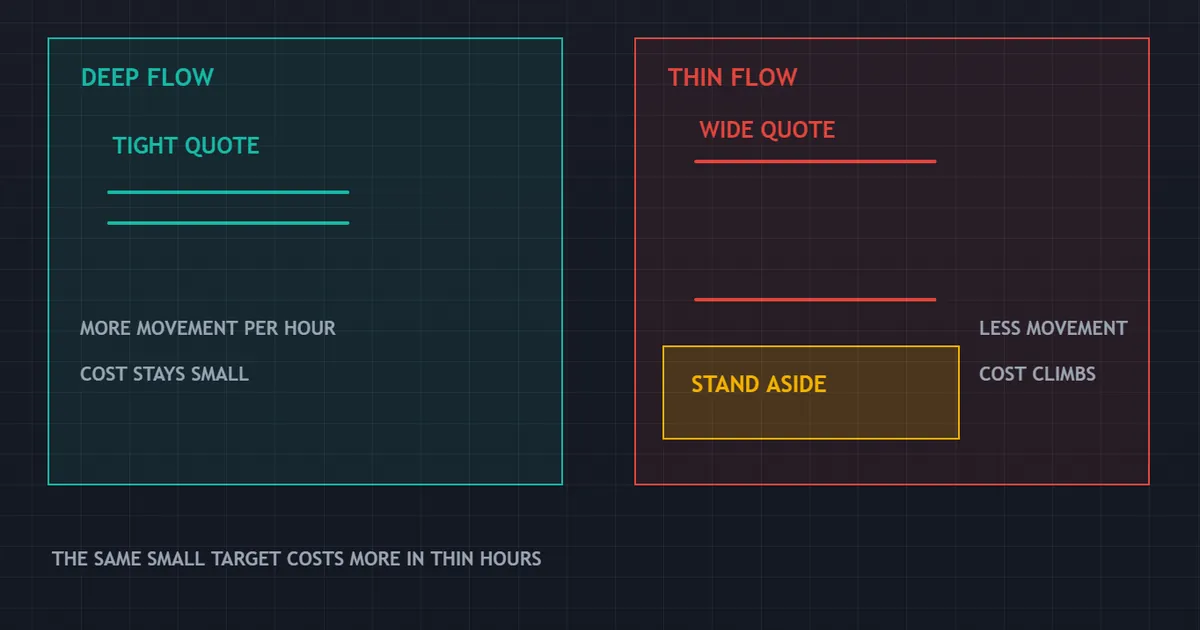
The panel above frames that choice as a concept. Deep flow on one side and thin flow on the other, with the cost of a small target attached to each.
Match the Window to Your Life
Scalping needs unbroken attention, so the window has to fit around genuine free hours. Two focused hours beat six distracted ones every time.
Traders in the wrong time zone often force the issue. Shifting to a slower style usually works better than scalping a session you cannot watch properly.
Build a Comparable Record
Trading one fixed window makes your log meaningful. Every trade then faces similar liquidity, so differences in the results point at your rule rather than the clock.
Change one variable at a time afterwards. Adding a second window and a new pair together tells you nothing about which change mattered.
Know When to Stand Aside
Some days offer neither movement nor tight pricing. Recognising those early saves more than any entry filter, because a skipped session costs nothing at all.
Check whether your broker or firm restricts this style before scaling up too. Our guide on whether scalping is allowed covers the rule categories you may run into.
FAQ
What timeframe should a beginner scalp on?
Start on fifteen-minute bars rather than one-minute bars. The structure reads more clearly, the targets stay large enough to survive costs, and the pace leaves time to think. Move faster only once your log shows the cost ratio still works.
How many pips should a scalp target?
Enough that your round-trip cost stays a small share of it. A three-pip target against a 1.2 pip cost gives away 40 percent before you start, while an eight or ten pip target reads far healthier. The exact figure depends on your pricing, so run the division yourself.
Do I need a special platform to scalp?
You need one that fills quickly and quotes tightly during your window. Test it with small trades and record what you asked for against what you received. That measurement tells you more than any feature list, since two accounts on the same platform can behave very differently once the market speeds up.
Is scalping suitable for a small account?
Small accounts face the same cost per trade as large ones, so the friction weighs proportionally heavier. Keep the risk fraction small, avoid raising size to compensate, and accept that progress at this scale takes time. Many traders reach for leverage at this point, which shrinks the number of losing trades the account survives rather than solving the cost problem.
Should I scalp during news releases?
Generally no. Quotes widen, fills degrade and the movement arrives faster than a small target can handle. Mark the schedule for your pairs and stand aside for a few minutes either side of each release.
How long before I know whether scalping suits me?
Judge the process before the outcome. Fifty logged trades in one fixed window will tell you whether you can hold attention, follow the daily limit and take the fills your platform offers. Only after that does the record start to say anything about the rule itself, and even then a short run reflects conditions as much as skill. Results are not guaranteed; past performance is not indicative of future results.
External references
- For background on this concept, see Scalping in Trading on Wikipedia.
- For broader market context, see Scalping at BabyPips Forexpedia.

About the author
Written by Dominic Walsh, a Forex trader and MT4/MT5 indicator, Expert Advisor and script developer. Every tool on forexmt4systems.com is tested on live charts before release and ships with ready-to-use compiled MT4 (.ex4) and MT5 (.ex5) files. Learn more about the trader and developer behind this site.
How we build, test and correct every tool: Editorial & Testing Policy. Trading carries risk; see the disclaimer.