
Short answer first. Is scalping allowed at most retail brokers? Generally yes, and nothing about the style breaks any rule by itself.
The complications sit in the fine print. Minimum hold times, execution models and prop firm conditions all restrict how fast you can trade, and each one bites in a different way.
Is Scalping Allowed, or Merely Tolerated
Most retail accounts place no explicit ban on short holds. You open a position, you close it two minutes later, and nothing happens.
The limits tend to show up in other words. A clause on abusive trading, a note on hold time, or a rule about arbitrage can each cap the style without ever naming it.
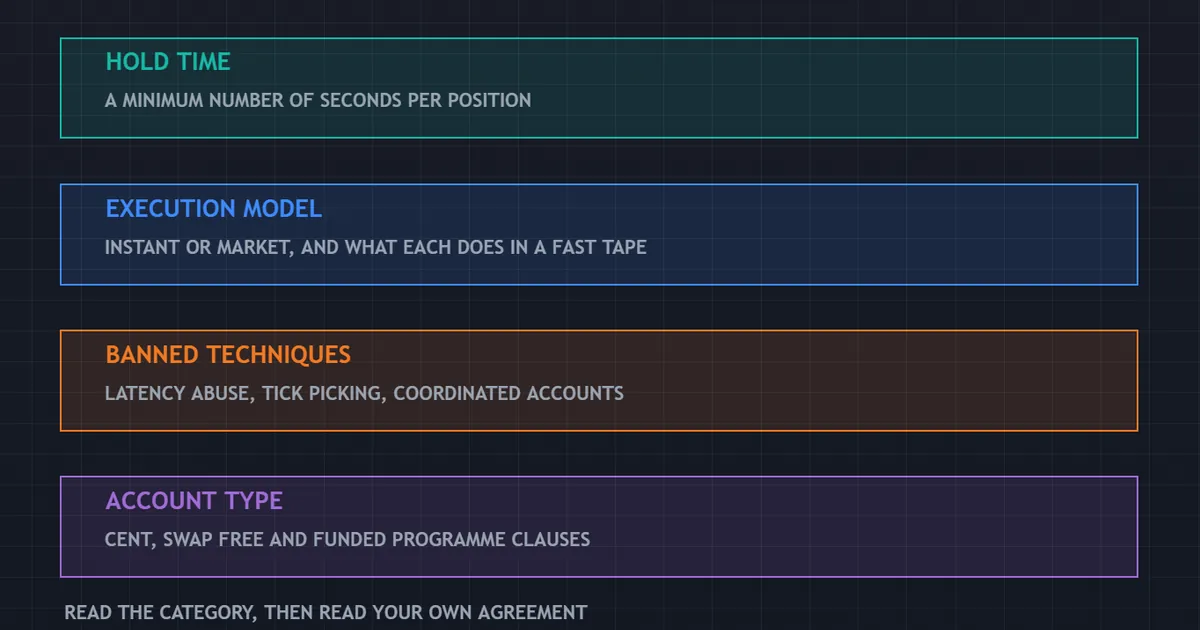
The panel above groups those clauses into categories. Reading them as categories rather than as individual paragraphs makes any set of terms much quicker to assess.
Why Restrictions Exist
A venue that quotes a price carries the other side of your trade until it offsets that exposure. Very fast trading around a stale quote leaves it holding a loss it never chose.
Rules against that behaviour target the trick, not the speed. Plain scalping on live prices looks nothing like what those clauses describe.
Reading the Terms Properly
Look for four things: a minimum hold time, an execution model, a list of banned strategies, and any account-type limits. Those four cover almost every restriction you will meet.
Ask support directly if a clause reads ambiguously. A written answer before you fund an account beats an argument about a withdrawal afterwards.
What the Rules Are Really Aimed At
Most clauses target one thing. They aim at traders who profit from a price that is out of date.
Stale Prices, Not Speed
A quote takes time to travel. If one feed lags by half a second, a trader on a faster feed already knows where the market went.
Buying at the old price is a sure thing, not a trade. Rules exist to stop that, and speed alone is not the issue.
Why Firms Care
The other side of your trade sits with somebody. That firm has to hedge it, and it cannot hedge a price that no longer exists.
So the loss is not a trading loss. It is a hole in the plumbing, and firms close holes with a clause.
Where That Leaves You
Trading fast on live prices is not the same act. You still take risk, and you can still be wrong.
Read the clause with that in mind. Most of them describe a trick you were never doing.
The Rule Categories You Will Meet
Five categories cover the landscape. Work through them in order for any account you consider.
- Minimum hold time. A stated number of seconds or minutes before a position may close.
- Execution model. Instant execution with requotes, or market execution with slippage.
- Banned techniques. Latency arbitrage, quote sniping and similar exploits of stale pricing.
- Account-type limits. Restrictions applied to bonus accounts, demo contests or specific instrument groups.
- Prop firm rules. Programme conditions layered on top of everything a broker already sets.

Notice that only the third one describes real abuse. The other four just mark the edges of a normal business deal.
Minimum Hold Times
This rule blocks scalping most directly. A stated hold-time floor takes the fastest trades off the table.
How the Rule Works
Terms may say that trades closed within a set number of seconds fall outside normal handling. Some accounts apply it to every trade, others only to trades around a release.
The number varies widely. Anything from a few seconds to several minutes turns up across the trade, and the figure rarely sits on a sales page.
What It Means for You
A one-minute rule ends tick scalping while leaving a fifteen-minute approach untouched. So the restriction matters enormously to one trader and not at all to another.
Match the rule to your actual hold time before assuming a problem. Our setup guide on how to start scalping covers choosing that hold time deliberately.
Where to Find It
Check the client agreement, the order execution policy and any product-specific annex. The clause hides in a different document at almost every firm.
Search the documents for words such as duration, seconds, holding and abusive. Two minutes of searching answers the question that support may take a day to confirm.
Execution Models and Why They Matter
The execution model shapes what a fast style can achieve. It also determines what happens when your order meets a moving market.

The panel above sets the two models side by side. One answers a fast market with a requote, the other answers with a fill at a different price.
Instant Execution
Under instant execution the venue tries to fill at the exact price you clicked. When the market has moved, it may return a requote and ask you to accept a new price.
Requotes cost time. For a five-pip target, a two-second pause and a fresh confirmation can remove the reason for the trade.
Market Execution
Under market execution the order fills at the best available price with no requote. You get a fill, and the price may differ from the one on screen.
That difference is slippage. It cuts both ways in principle, though it lands hardest during fast conditions when everybody wants the same side.
Neither Model Is Unfair
Both are normal business choices. Each just moves the doubt to a different place, either into the timing or into the price.
Scalpers generally prefer market execution, since a fill at a slightly worse price beats no fill at all. Test which one you face before raising size.
Signs an Account Does Not Suit You
Rules are one thing. Day-to-day behaviour tells you more, and it tells you sooner.
Fills That Drift
Watch the price you ask for against the price you get. A small drift is normal, and a one-sided drift is worth noting.
Keep the log for fifty trades. One bad fill proves nothing, while a pattern across fifty proves plenty.
Requotes at the Wrong Time
Requotes cluster when the market moves. That is the exact moment your entry mattered most.
Count them by hour. If they land in the hours you trade, the account and the style do not fit.
Spreads That Jump
A quote that widens for a few seconds each hour eats small targets. An advertised average hides those moments.
Watch the live quote for a week before you scale up. What you see beats what the page claims.
Prop Firm Restrictions
Funded-account firms add their own layer. Their rules tend to be tighter and far more direct than anything a retail broker prints.
Bans on Tick Scalping
Many firms rule out trades held for only a few seconds. The reason given is usually risk modelling, not any charge of abuse.
Some go further and set a floor across your whole account history. One very fast trade can then break a rule you never read.
Latency Arbitrage and Quote Sniping
Every firm bans the use of a delayed price feed. Trading against a quote that has not yet caught up is the clearest case, and it shows up in almost every rulebook.
Ordinary scalping does not resemble this. The distinction lies in whether you trade on live pricing or on the gap between two feeds.
Hold Time and Consistency Rules
Firms often pair a hold-time rule with a consistency rule. The second one caps how much of your result may come from one day or one trade.
Very fast styles can trip that rule without breaking any hold-time rule. Our guide to prop firm rules works through the common conditions in detail.
News and Automation Clauses
Trading around set data times draws its own rules, since spreads widen and fills worsen in those minutes. Robots bring another set of rules again.
Read our note on prop firm EA rules before running anything automated. The rules there differ sharply from what retail accounts allow.
By Hand or by Robot
The rules split sharply here. A tool that places orders faces a longer list than a person clicking a mouse.
What Changes With a Robot
Speed goes up and so does trade count. Both raise the load a firm has to hedge, which is why the extra rules exist.
Some accounts bar robots outright. Others allow them but block certain types, so the answer depends on the account.
Chart Tools Are a Different Thing
A tool that only draws on a chart places no orders. That kind of tool raises none of the same questions.
Keep the two apart when you ask. Support staff often hear the word robot and stop listening.
Test Before You Trust
Run any tool on a demo account first and watch what it sends. Order type, size and timing all matter to the rules.
Then read the policy again with that behaviour in mind. The clause makes far more sense once you know what your tool does.
How to Check Before You Trade
Five minutes of checking prevents most disputes. Do it before funding rather than after a good week.
Read Three Documents
Open the client agreement, the execution policy and the product annex. Between them they carry every restriction that applies to your account.
Save a copy with the date. Terms change, and a dated file settles later questions about which version applied to your trading.
Ask One Specific Question
Vague questions get vague answers. Ask whether positions closed within a stated number of seconds face any restriction, and ask for the answer in writing.
A firm that answers clearly has told you something useful. A firm that avoids the question has also told you something useful.
Test With Small Size
Place fifty small trades at your intended speed and watch what happens. Requotes, rejections and unusual delays all show up quickly at that sample size.
Record the results as you go. Our guide on the spread in forex explains what normal pricing behaviour looks like for comparison.
Download the complete indicator database
Put these concepts on your charts. One email unlocks the full library of 1,380+ indicators with compiled MT4 and MT5 files, plus my TradingView scripts. No paywall, no spam, unsubscribe any time.
Get free access to my indicator database
One email unlocks 1,380+ free MT4, MT5 and TradingView indicators — the complete library. No single-tool download; you get the whole database.
Common Mistakes and Their Fixes
Six habits cause most of the trouble here. Each one has a plain fix.
Assuming Silence Means Permission
Terms rarely name scalping, which traders read as a green light. The limit tends to sit under hold time or abusive trading instead.
The fix: search the documents for the mechanics rather than the label, and confirm anything ambiguous in writing.
Confusing Broker Rules With Programme Rules
A funded account sits on top of a broker relationship, and both rulebooks apply. Traders often check one and assume it covers the other.
The fix: read both sets, then work to whichever is stricter on every single point.
Treating Slippage as Misconduct
A worse fill during a fast move usually reflects the market rather than any wrongdoing. Complaints built on that assumption go nowhere.
The fix: log your requested price against your fill price over many trades, then judge the pattern instead of a single event.
Scalping Through Scheduled Data
Spreads widen and fills degrade around releases, and many programmes restrict trading in those windows anyway. Both problems arrive together.
The fix: mark the calendar before the session and stand aside for the minutes surrounding anything that touches your instruments.
Running a Robot Without Checking
Robot rules differ from hand-trading rules at nearly every firm. A tool that is fine on one account breaks the rules on another.
The fix: check the robot policy on its own, and never assume one account’s answer covers another.
Blaming Rules for a Cost Problem
Traders sometimes attribute a poor month to restrictions when the real issue is the cost share of a small target. Those are different problems.
The fix: compare venues on total round-trip cost with our forex spread comparison tool before blaming any clause.

Quick Reference
Keep this table beside the terms while you read them. It maps each category to the question it answers.
| Rule category | What to look for | Who it affects most |
|---|---|---|
| Minimum hold time | A stated number of seconds or minutes | Very fast scalpers only |
| Execution model | Instant with requotes, or market with slippage | Anyone with a small target |
| Banned techniques | Latency arbitrage and stale-quote trading | Automated and feed-based systems |
| Account-type limits | Bonus, contest or instrument-specific clauses | Promotional account holders |
| Programme rules | Consistency, duration and news conditions | Funded-account traders |
| Automation clauses | Any tool that places orders for you | Anyone running software |
Execution Risk in Practice
Rules are only half the story. The other half concerns what happens to an order when the market moves without you.

The chart above shows XAUUSD hourly bars at the weekly open on 26 July 2026. Price gapped up by 27.565, roughly 1.95 times an average hourly range, and jumped straight over the 4062.125 level where a short position’s protective stop sat.
What Actually Happened to the Stop
A stop order becomes a market order the moment price touches its level. Here price never touched 4062.125 at all, because the gap carried the market from below it to above it in one move.
So the order filled at the first available price beyond the gap. The trader received an exit, though not at the number written on the ticket.
Nothing there went wrong. That is exactly how a stop order works when no trading happens between two prices.
Why the Weekly Open Is the Worst Moment
Two days of news accumulate while the market sits closed. The first quote of the week reflects all of it at once, which is how a gap of nearly two average ranges appears.
Our guide to the weekend gap in forex covers how that works. Day styles dodge it by finishing flat on Friday.
What This Means for Fast Traders
A scalper working a five-pip target has no defence against a move of this size. The only reliable protection is the absence of a position.
Size matters too. Because tight stops support larger positions, a gapped exit at the fast end of the scale costs more than the same gap would at a slower one.
If Your Style Is Restricted
A restriction is information rather than a verdict. Three responses usually work better than arguing.
Adjust the Hold Time
Moving from a thirty-second hold to a five-minute hold clears most duration rules. It also improves your cost ratio, since a longer hold usually means a larger target.
Our comparison of scalping vs day trading runs that arithmetic in pips. The adjustment often helps for reasons unconnected with any rule.
Change the Account, Not the Rule
Different account types carry different conditions at the same firm. A standard account may allow what a promotional one forbids.
Ask what else they offer before you move. A new venue resets everything you learned about fills, and that costs real time.
Ask for the Rule in Numbers
Vague terms cause most of the arguments. A rule with a number in it can be checked, and a rule without one cannot.
Push for the number. Ten seconds, sixty seconds or five minutes each point at a very different style.
Diarise the Check
Terms change over time. A rule that suited you last year may read differently now, and few firms send a clear note when they edit one.
Set a reminder every few months. Save the file each time, with the date in the name.
Know Why Traders Fail Programmes
Duration rules account for very few breaches. Most failures come from risk limits and drawdown rules instead, which our note on why traders fail prop challenges covers in detail.
Fix the larger problem first. Traders who solve their sizing rarely spend much time worrying about a hold-time clause.
Keep the Tools Simple
Trading by hand avoids the robot rules. Anyone who does want tooling can browse our MT4 indicators archive for tools that mark levels without placing orders.
A tool that only draws on a chart raises none of the questions a robot raises. That split matters in almost every rulebook.
FAQ
Do brokers actually close accounts for scalping?
Rarely, and usually only where terms describe something specific such as trading against stale quotes. Ordinary fast trading on live prices sits within normal use at most firms. Even so, read the hold-time and abusive-trading clauses yourself rather than leaning on forum opinion. A dated copy of the terms you agreed to settles almost every later dispute.
What is latency arbitrage?
Trading against a price feed that has not yet updated, so you already know where the market has moved. Every rulebook bans it, and the ban is not aimed at manual scalping. The distinction is whether your edge comes from analysis or from a delay in someone else’s quote.
Are prop firms stricter than brokers about scalping?
Generally yes, because their risk models lean on steady trade behaviour. Expect hold-time rules, consistency rules and news rules on top of what the broker already sets. Both rulebooks apply at once, so work to the stricter of the two.
Does a stop loss protect me during a gap?
Only partially. A stop order becomes a market order once price reaches its level, so a gap that jumps straight past that level produces a fill at the next available price instead. The example above moved almost two average hourly ranges in a single step. Sizing for that possibility matters more than any clause in the terms.
Is scalping allowed on all instruments?
Not always. Some accounts set different terms for metals, indices or crypto than for the major pairs. Those extra pages are easy to miss, so check the one that covers whatever you plan to trade.
Should I ask support before opening an account?
Yes, and ask a specific question in writing. Describe your intended hold time in seconds and your intended trade frequency, then ask whether either falls outside normal use. Keep the reply, because staff change and terms get revised. A clear answer costs you nothing and removes the single most common source of dispute. Results are not guaranteed; past performance is not indicative of future results.
External references
- For background on this concept, see Proprietary Trading at Corporate Finance Institute.
- For broader market context, see Broker at BabyPips Forexpedia.

About the author
Written by Dominic Walsh, a Forex trader and MT4/MT5 indicator, Expert Advisor and script developer. Every tool on forexmt4systems.com is tested on live charts before release and ships with ready-to-use compiled MT4 (.ex4) and MT5 (.ex5) files. Learn more about the trader and developer behind this site.
How we build, test and correct every tool: Editorial & Testing Policy. Trading carries risk; see the disclaimer.