
Gold pivot levels are calculated the same way as any other instrument, but trading them on XAUUSD is not the same as trading them on EURUSD. Gold moves in dollars rather than pips, its daily range dwarfs the majors, and its session boundaries are set by a market that trades metal rather than currency. This guide covers the calculation, the adjustments gold demands, and how the levels behave in practice.
Calculating gold pivot levels
The arithmetic is identical to any other market. Take yesterday’s high, low and close, and average them.
PP = (High + Low + Close) ÷ 3
From there, R1 = (2 × PP) − Low and S1 = (2 × PP) − High, with R2 and S2 adding or subtracting the full range from the pivot.
The difference is scale. Say gold printed a high of 2,412, a low of 2,378 and closed at 2,395. The pivot is 2,395. R1 is 2,412 and S1 is 2,378 — landing on yesterday’s extremes, exactly as the formula does on any instrument when the close sits mid-range.
Note the units. That 34-dollar range is roughly 3,400 points on a five-decimal broker, and how your platform quotes gold decides what those numbers mean. Our pivot calculation guide covers the general formula and its variants.
Why gold needs different handling
Three things separate gold from a currency pair when you use these levels.
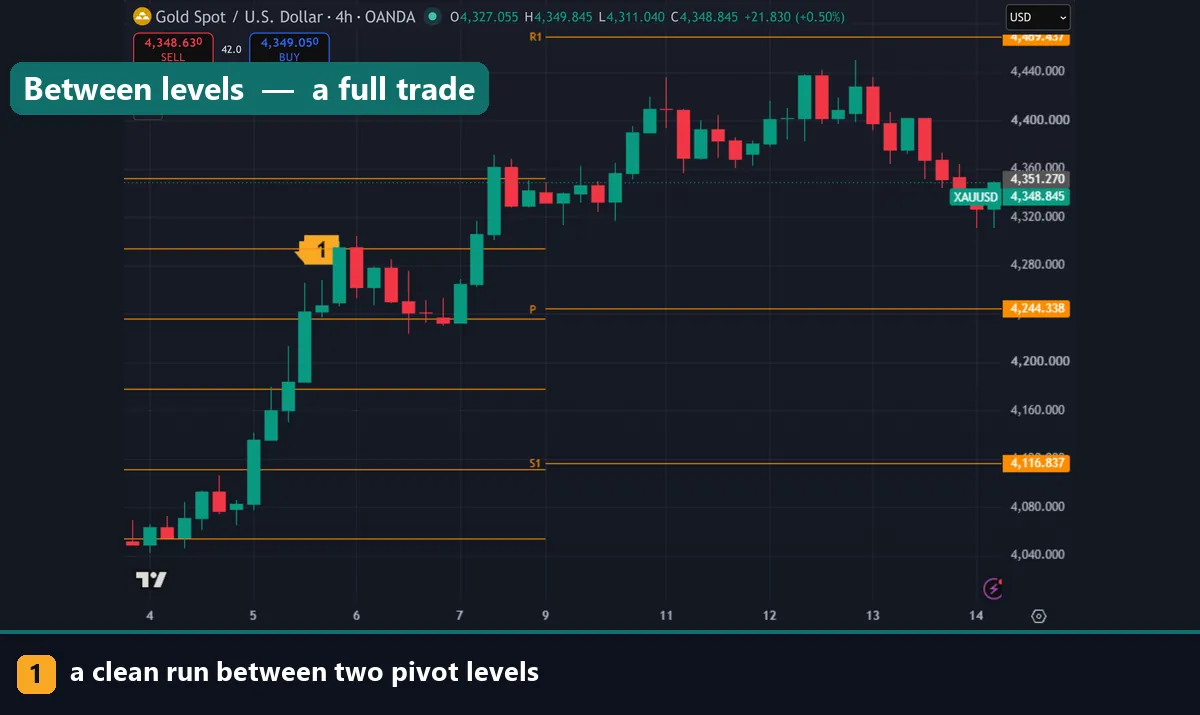
The range is far larger. Gold routinely travels twenty to forty dollars a day. Levels sit much further apart than on EURUSD, so a move from S1 to the pivot is a substantial trade rather than a scalp.
The contract is bigger. A standard gold lot is 100 ounces, so a one-dollar move is worth 100 dollars. Traders who carry forex sizing habits onto gold routinely open positions ten times larger than intended. Check the contract specification before the first trade.
Session definition matters more. Gold trades nearly around the clock but its liquidity is concentrated around the London fix and the New York session. A daily pivot built on a broker whose day closes at 00:00 GMT+2 differs from one built on the New York close, and on an instrument this volatile that difference is material.
How the levels behave
Gold respects pivots reasonably well, and the reason is the same as anywhere else: enough participants calculate the same public numbers to make them matter.
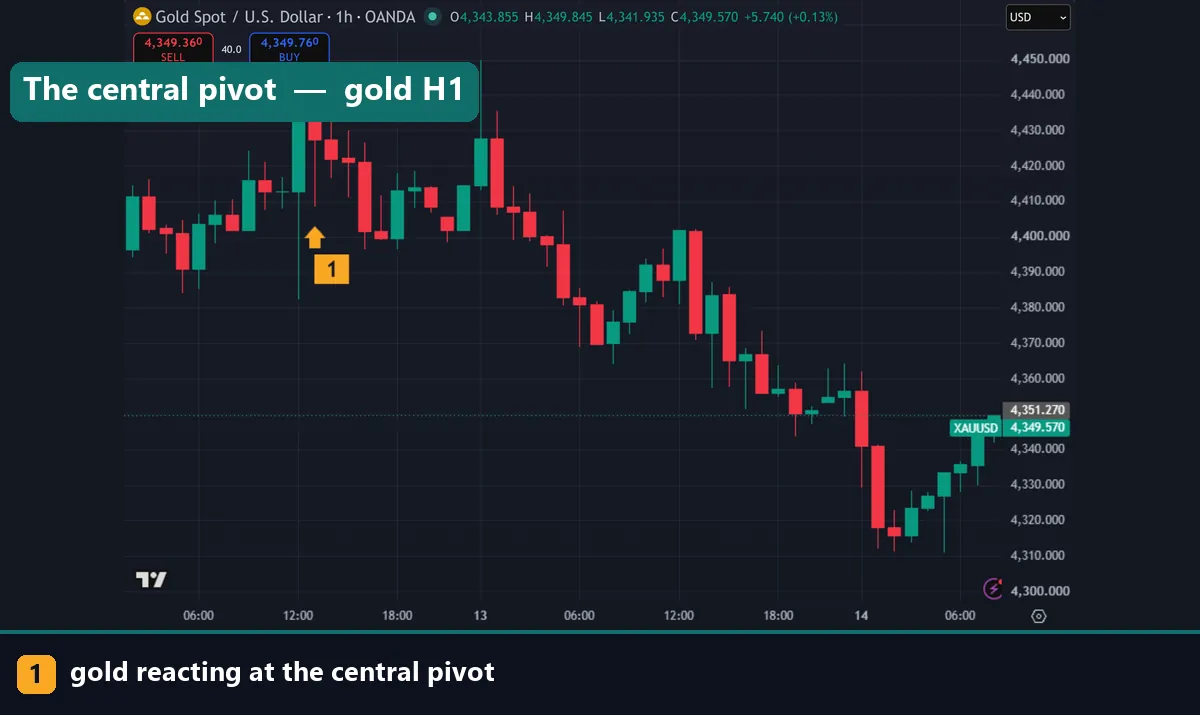
Two behaviours dominate. The central pivot as bias works well on gold, perhaps better than on the majors, because gold trends persistently. Price above PP through the London session often stays above it.
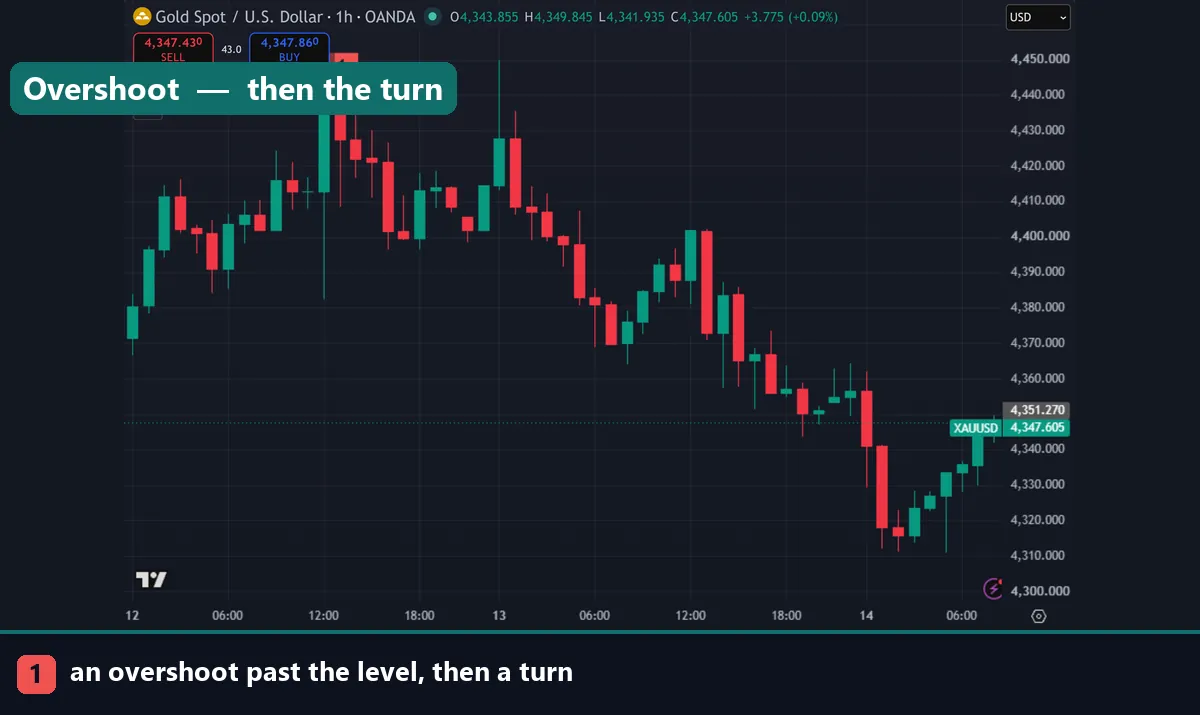
R1 and S1 as reaction zones also hold up, though gold overshoots more than a currency pair does. A ten-dollar overshoot past a level before turning is ordinary, which on EURUSD would be an unusual event.
That overshoot behaviour has a direct consequence: a stop placed just beyond a gold pivot will be hit by normal noise. Use the Average True Range instead, as covered in our ATR stop loss guide.
Which timeframe to build them on
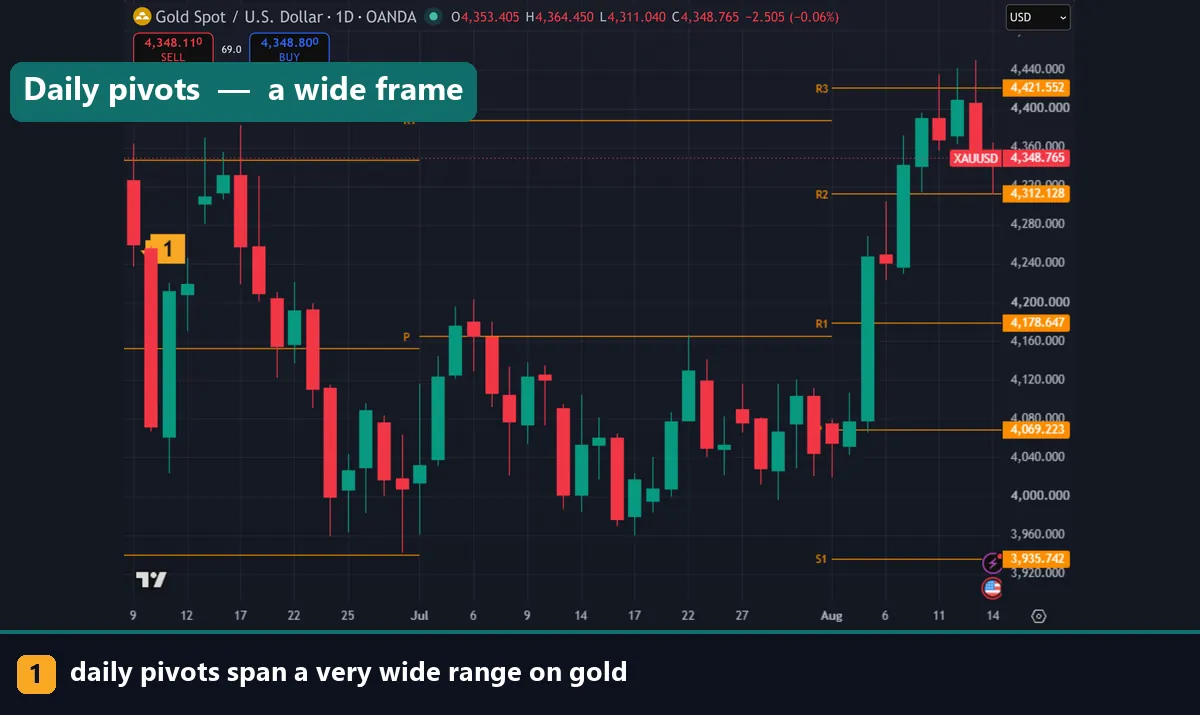
Daily pivots suit intraday gold trading and are the standard choice. Weekly pivots frame swing positions, and given how far gold travels in a week those levels sit a long way apart.
Because the daily range is large, gold traders often find R2, S2 and even R3 reached more frequently than on currency pairs. On EURUSD a day reaching R3 is unusual. On gold during a trending week it is routine, which changes how much weight to give an outer level.
Intraday pivots, built on a session rather than a full day, appeal to some gold traders for the same reason: the daily levels can be too far apart to be useful within a single session.
Download the complete indicator database
Put these concepts on your charts. One email unlocks the full library of 1,380+ indicators with compiled MT4 and MT5 files, plus my TradingView scripts. No paywall, no spam, unsubscribe any time.
Get free access to my indicator database
One email unlocks 1,380+ free MT4, MT5 and TradingView indicators — the complete library. No single-tool download; you get the whole database.
What moves gold through the levels
Pivots are backward-looking arithmetic. They know nothing about what is scheduled, and gold is unusually sensitive to a specific set of releases.
US inflation data and Federal Reserve decisions matter most, because gold responds to real interest rates. Higher real rates raise the cost of holding a non-yielding asset, so gold typically weakens; falling real rates do the reverse.
Risk events drive it independently. Geopolitical shocks push capital towards gold regardless of what rates are doing, which is why it sometimes moves against its usual rate relationship.
Dollar strength matters because gold is priced in dollars. A rising dollar makes gold more expensive in other currencies, which tends to weigh on demand.
Any of these will drive price through pivot levels that would have held on a quiet day. Check the calendar before planning around them, as covered in our forex news factory guide.
A workable routine
Four steps. Confirm how your broker quotes gold and what a one-dollar move is worth for your lot size. Build daily pivots and check which daily close your platform uses. Size from ATR rather than from the distance to the next level. And check the calendar for US inflation, Fed events and any risk headlines before treating a level as reliable.
Treat every level as a zone several dollars wide rather than a line. On an instrument that moves thirty dollars a day, precision to the cent is false comfort.
Common mistakes
Four repeat. Applying forex lot sizing to gold tops the list, and a 100-ounce contract makes that error expensive fast. Placing stops just beyond a level comes second, since gold overshoots routinely. Third, traders use pivots without checking which daily close their platform builds them from. Fourth, they plan around levels through a Fed announcement, when the calendar overrides the arithmetic entirely.
Where to go next
Levels are one framework among several. Read pivot calculation for the formula and variants, and use the pivot level calculator to skip the arithmetic. For sizing on a large-contract instrument, see forex trading lot sizes, and volatile forex pairs for how gold compares on range. For further reading, Investopedia explains pivot points at Investopedia, and BabyPips covers gold at BabyPips, including what drives the metal.
FAQ
How do I calculate gold pivot points?
Average yesterday’s high, low and close for the central pivot. R1 is twice the pivot minus the low, S1 is twice the pivot minus the high, and R2 and S2 add or subtract the full range.
Do pivot levels work on gold?
Reasonably well, and the central pivot works particularly well as a bias line because gold trends persistently. Expect larger overshoots past each level than a currency pair produces.
Why is sizing different on gold?
A standard lot is 100 ounces, so a one-dollar move is worth 100 dollars. Applying EURUSD habits produces a position roughly ten times larger than intended.
Which daily close should the calculation use?
Whichever your platform uses, but check it. A broker closing the day at 00:00 GMT+2 produces different levels than the New York close, and on gold the gap between them is material.
Are R2 and R3 useful on gold?
More so than on currency pairs, because gold’s daily range is wide enough to reach them regularly. That also means an outer level carries less significance than the same level on EURUSD.
What overrides gold pivot levels?
US inflation data, Federal Reserve decisions and risk headlines, since gold responds to real rates and safe-haven flows. Trading involves risk, results are not guaranteed, and past performance is not indicative of future results.

About the author
Written by Dominic Walsh, a Forex trader and MT4/MT5 indicator, Expert Advisor and script developer. Every tool on forexmt4systems.com is tested on live charts before release and ships with ready-to-use compiled MT4 (.ex4) and MT5 (.ex5) files. Learn more about the trader and developer behind this site.
How we build, test and correct every tool: Editorial & Testing Policy. Trading carries risk; see the disclaimer.